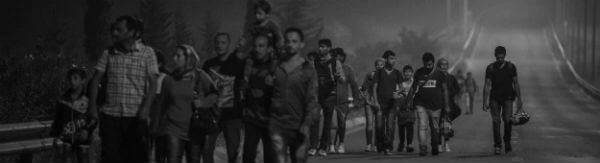
Vice News reports: “How many countries from here until Germany?” asked Mahfuz Jalili, 16, collecting information to relay to the group of 17 friends and family members who left suburbs of Kabul a month ago only to become temporarily stranded on the Greek-Macedonian border.
“Five?! How much will that cost?!” Mahfuz looks worried. Out of just over $3,000 that his father gave him to make the mammoth voyage from Afghanistan, he has only $50 left, and after more than a day waiting at a gas station on a highway leading to Macedonia, he is getting anxious that Europe may be about to close.
“I don’t really even want to go to Germany, there are too many refugees there,” he told VICE News. “I thought about trying to get to Ireland so I can study engineering. Afghanistan is abnormal, I had to leave.”
As Muhfaz spoke, yet more buses from the Greek capital of Athens swept into the car park and the air become thick with smoke as refugees begun to light bonfires with plastic and kindling foraged from nearby woods. [Continue reading…]
Category Archives: Analysis
Freed U.S. student: Now is not the time to go to Iran
Reuters reports: An American student detained in Iran who was freed this month under a prisoner swap said on Thursday he was accused of trying to overthrow the Iranian government and held for nearly a month in solitary confinement.
Matthew Trevithick, who had traveled to Iran to study Farsi, told CNN that interrogators at Iran’s Evin Prison also accused him of having access to millions of dollars and knowledge of secret weapons caches.
In his first television interview since his Jan. 16 release, he described his 41-day ordeal, including how he was captured and his treatment and conditions at the prison. [Continue reading…]
Iran forcing Afghan refugees to fight in Syria
Human Rights Watch: Iran’s Revolutionary Guards Corps (IRGC) has recruited thousands of undocumented Afghans living there to fight in Syria since at least November 2013, Human Rights Watch said today, and a few have reported that Iranian authorities coerced them. Iran has urged the Afghans to defend Shia sacred sites and offered financial incentives and legal residence in Iran to encourage them to join pro-Syrian government militias.
Human Rights Watch in late 2015 interviewed more than two dozen Afghans who had lived in Iran about recruitment by Iranian officials of Afghans to fight in Syria. Some said they or their relatives had been coerced to fight in Syria and either had later fled and reached Greece, or had been deported to Afghanistan for refusing. One 17-year-old said he had been forced to fight without being given the opportunity to refuse. Others said they had volunteered to fight in Syria in Iranian-organized militias, either out of religious conviction or to regularize their residence status in Iran.
“Iran has not just offered Afghan refugees and migrants incentives to fight in Syria, but several said they were threatened with deportation back to Afghanistan unless they did,” said Peter Bouckaert, emergencies director at Human Rights Watch. “Faced with this bleak choice, some of these Afghan men and boys fled Iran for Europe.” [Continue reading…]
Iraqis freed from ISIS’s rule now threatened by ethnic and sectarian ‘cleansing’
Aida al-Khatib reports: Thanks to the security crisis caused by the extremist group known as the Islamic State, the demographics of the province of Diyala are changing. The extremist group has been driven out of certain parts of the province and some of these are now controlled by Iraq’s sometimes-controversial Shiite Muslim volunteer militias while others are run by the Iraqi Kurdish military.
“Demographic changes have become a reality here,” says Raad al-Dahlaki, a Sunni Muslim MP and head of the Iraqi Parliament’s Committee on Immigration and Displacement. “There are many areas where security is extremely lax and there are violations of the law that should not be tolerated. For example certain areas have been shelled deliberately and it’s causing the mass displacement of [mostly Sunni] families.”
Al-Dahlaki believes the perpetrators of these acts are “militant gangs that pretend to be part of the volunteer militias but who are actually carrying out agendas set by foreigners”. And by this he means neighbouring Iran – many of the Shiite militias are funded or otherwise supported by the Iranian military.
“These gangs want to sow discord and change the demography of the province,” al-Dakhali argues.
Al-Dakhali believes the federal government should be doing more to stop the targeting of civilians by military groups, including the Shiite Muslim volunteers and Iraqi Kurdish troops. [Continue reading…]
Keen to be healthier in old age? Tend your inner garden
By Claire Steves, King’s College London and Tim Spector, King’s College London
The world’s oldest man, Yasutaro Koide recently died at the age of 112. Commentators as usual, focused on his reported “secret to longevity”: not smoking, drinking or overdoing it. No surprises there. But speculation on the basis of one individual is not necessarily the most helpful way of addressing this human quest for the Philosopher’s Stone.
The “very old” do spark our interest – but is our search for a secret to longevity actually misguided? Wouldn’t you rather live healthier than live longer in poor health? Surely, what we really want to know is how do we live well in old age.
Clearly as scientists we try to illuminate these questions using populations of people not just odd individuals. Many previous attempts have approached this question by looking for differences between young and old people, but this approach is often biased by the many social and cultural developments that happen between generations, including diet changes. Time itself should not be the focus – at least, in part, because time is one thing we are unlikely to be able to stop.

Kyodo/Reuters
The real question behind our interest in people who survive into old age is how some manage to stay robust and fit while others become debilitated and dependent. To this end, recent scientific interest has turned to investigating the predictors of frailty within populations of roughly the same age. Frailty is a measure of how physically and mentally healthy an individual is. Studies show frailer older adults have an increased levels of low grade inflammation – so-called “inflammaging”.
Sweden prepares to turn thousands of asylum seekers into outcasts

The Local reports: Sweden plans to charter aircraft to send back as many as 80,000 rejected asylum seekers in what the country’s interior minister is calling “a very big challenge”.
Interior minister Anders Ygeman told Sweden’s Dagens Industri newspaper that he believed that at least 60,000, and possibly as many as 80,000 of the 163,000 who sought asylum in Sweden last year would have their applications rejected, meaning they will be returned either to their home countries or to the European country responsible under EU rules.
“The first step will be to go with voluntary return, and to create the best conditions for that,” Ygeman said. “But if that doesn’t work, we will need to have returns backed up by force.”
“I think we will have to see more chartered planes, particularly in the EU-region.”
He said that the Swedish government hoped to strike deals with other EU countries — in particular Germany — over coordinating flights to return asylum seekers.
It is also seeking return agreements with countries such as Afghanistan and Morocco.
But Victor Harju, Ygeman’s press secretary, on Thursday told The Local that the headlines were “a bit exaggerated”.
“Due to the fact that we received so many people in Sweden last year, we have to face the reality that more people will also not fulfil the needs within the asylum programme and will not get a permit to stay,” he said.
However, immigration lawyer Terfa Nisébini criticised Ygeman’s plan, saying that by giving an estimate that roughly half of applications would be rejected, telling Expressen newspaper that it risked influencing the way the Swedish Migration Agency assesses cases.
Swedish opposition parties also questioned whether the government would be able to successfully carry out Ygeman’s plan. [Continue reading…]
If Ygeman’s press secretary thinks the headlines are a bit exaggerated (BBC News is similar to most others: “EU migrant crisis: Sweden may reject 80,000 asylum claims”) there is nevertheless no reason to doubt that the minister’s statement was designed to generate exactly this kind of reporting. In other words, Sweden wants prospective asylum seekers to assume they will be unwelcome and thus set their sights elsewhere.
As individual European countries each engage in their own poorly conceived forms of crisis management, what is increasingly evident is that this crisis is itself the product of a policy vacuum.
As George Soros said recently:
we don’t have a European asylum policy. The European authorities need to accept responsibility for this. It has transformed this past year’s growing influx of refugees from a manageable problem into an acute political crisis. Each member state has selfishly focused on its own interests, often acting against the interests of others. This has precipitated panic among asylum seekers, the general public, and the authorities responsible for law and order. Asylum seekers have been the main victims.
Al Jazeera reports:
A “race to the bottom” on asylum policy among European Union countries is exposing more than 360,000 child migrants to greater risk of harm as the bloc struggles to cope with a surge of refugees, rights watchdogs said on Monday.
European children’s agencies issued the warning in a report released in Amsterdam, where the EU’s interior ministers were meeting to discuss how to deal with the influx of people fleeing war in Africa and the Middle East.
One of the main concerns is that EU countries, from Sweden to Britain, have implemented measures limiting family reunification rights — which risks separating children from their parents after they survive perilous journeys.
“It seems as if European countries are in a contest to win the title of ‘least willing to accept asylum seekers,'” said the report from the European Network of Ombudspersons for Children, which represents 41 independent children’s rights institutions in 34 European countries.

The multi-billion-euro price-tag of shutting down the EU’s open borders
La Stampa reports (translation by Worldcrunch): Thirty years ago, the European Union’s passport-free Schengen zone came into being. At the time, the International Monetary Fund estimated that the abolition of border controls on the continent would add 1 to 3% to the area’s GDP growth. In the most conservative estimate the pact has brought an additional 28 billion euros in economic growth; the sum could realistically be as high as 50 billion.
This is the scale of the kinds of economic benefits that would be lost if more countries were to re-impose border control, thus ending the three decades of free movement in Europe. And even a partial collapse of the zone could harbor significant costs for all.
In this tense and tumultuous time for the European Union as a whole, Schengen is in real danger of disappearing. Buckling under the pressure of the wave of migrants fleeing war and seeking better lives, six nations have “temporarily” reintroduced border controls with other EU members. While allowed for under exceptional circumstances by the agreement, this is the first time in two decades that such a closure has occurred. In the absence of Europe-wide solutions decided at minister-level meetings, more countries could follow suit to protect their security. [Continue reading…]
Seizing valuables from asylum seekers – Denmark has lost the plot, and its heart
By Katharine Jones, Coventry University
Denmark is to seize cash and valuables from asylum seekers arriving in the country, after its government won a parliamentary vote on the issue by a huge majority. The message is as clear as it is visceral: refugees are not welcome in Denmark.
All new arrivals, mostly Syrians, Eritreans and Afghanis fleeing war and persecution in their homelands, will have to submit to the indignity and invasiveness of a body search when they arrive in Denmark, as well as having their luggage searched. Refugees will only be allowed to keep up to 10,000 kroner (£1,000) in cash and assets. Anything above that amount will be taken by enforcement officers. Items deemed to be of value will be sold by the authorities.
Horrified reactions to the decision have reverberated around the world. For many it has evoked memories of the Jewish Holocaust.
Why Hillary Clinton’s friend, Robert Reich, is backing Bernie Sanders
Robert Reich writes: Not a day passes that I don’t get a call from the media asking me to compare Bernie Sanders’s and Hillary Clinton’s tax plans, or bank plans, or health-care plans.
I don’t mind. I’ve been teaching public policy for much of the last thirty-five years. I’m a policy wonk.
But detailed policy proposals are as relevant to the election of 2016 as is that gaseous planet beyond Pluto. They don’t have a chance of making it, as things are now.
The other day Bill Clinton attacked Bernie Sanders’s proposal for a single-payer health plan as unfeasible and a “recipe for gridlock.”
Yet these days, nothing of any significance is feasible and every bold idea is a recipe for gridlock.
This election is about changing the parameters of what’s feasible and ending the choke hold of big money on our political system.
I’ve known Hillary Clinton since she was 19 years old, and have nothing but respect for her. In my view, she’s the most qualified candidate for president of the political system we now have.
But Bernie Sanders is the most qualified candidate to create the political system we should have, because he’s leading a political movement for change. [Continue reading…]
How a former Lebanese politician was caught on tape plotting terrorism on behalf of Bashar al-Assad — and still got away with it
The Daily Beast reports: Rarely does a criminal case fall into a judge’s lap as open-and-shut as Michel Samaha’s.
Yanked out of his bed by Lebanese police in a dawn raid on August 9, 2012, within one day the four-time cabinet minister had confessed to conspiring with Syrian officials, up to and including President Bashar al-Assad himself, to blow up Sunni Muslim Lebanese politicians, religious figures, and bystanders at Ramadan fast-breaking gatherings. Thanks to a series of videos leaked to the media, a flabbergasted nation could watch with their own eyes as Samaha, a veteran politician and household name, produced bags of explosives, timers, and detonators from his car, and spoke casually of plans to murder an MP, members of the MP’s family, and senior clerics (“let them be buried”), with express indifference to additional civilian casualties (“whoever departs along the way, departs!”). There seemed no conceivable way out of a severe punishment, and at his formal indictment in February 2013, the judge sought the death penalty.
And yet, on the 14th of this month, Samaha walked out of Lebanon’s Rayhanieh prison and returned to his family home in Beirut an almost-free man, released on $100,000 bail. Despite the gravity of the charges brought against him in 2013 — plotting to carry out “terrorist acts” using explosive devices; planning assassinations of political and religious figures; instigating sectarian conflict; and forming an armed group—he was sentenced to just four and a half years’ imprisonment in May 2015, in a decision legal observers said reeked of Syrian influence over the judiciary. [Continue reading…]
‘Politics of fear’ threatens human rights around the globe
Human Rights Watch: The politics of fear led governments around the globe to roll back human rights during 2015.
In the 659-page World Report 2016, its 26th edition, Human Rights Watch reviews human rights practices in more than 90 countries. In his introductory essay, Executive Director Kenneth Roth writes that the spread of terrorist attacks beyond the Middle East and the huge flows of refugees spawned by repression and conflict led many governments to curtail rights in misguided efforts to protect their security. At the same time, authoritarian governments throughout the world, fearful of peaceful dissent that is often magnified by social media, embarked on the most intense crackdown on independent groups in recent times.
“Fear of terrorist attacks and mass refugee flows are driving many Western governments to roll back human rights protections,” Roth said. “These backward steps threaten the rights of all without any demonstrated effectiveness in protecting ordinary people.”
Significant refugee flows to Europe, spurred largely by the Syrian conflict, coupled with broadening attacks on civilians in the name of the extremist group Islamic State (also known as ISIS), have led to growing fear-mongering and Islamophobia, Human Rights Watch said. But as European governments close borders, they are reviving old patterns of shirking responsibility for refugees by passing the problem to countries on Europe’s periphery that are less equipped to house or protect refugees. The emphasis on the potential threat posed by refugees is also distracting European governments from addressing their homegrown terrorist threats and the steps needed to avoid social marginalization of disaffected populations.
Policymakers in the United States have used the terrorism threat to try to reverse recent modest restrictions on intelligence agencies’ ability to engage in mass surveillance, while the United Kingdom and France have sought to expand monitoring powers. That would significantly undermine privacy rights without any demonstrated increase in the ability to curb terrorism. Indeed, in a number of recent attacks in Europe, the perpetrators were known to law enforcement authorities, but the police were too overwhelmed to follow up, suggesting that what’s needed is not more mass data but more capacity to pursue targeted leads, Human Rights Watch said.
“The tarring of entire immigrant or minority communities, wrong in itself, is also dangerous,” Roth said. “Vilifying whole communities for the actions of a few generates precisely the kind of division and animosity that terrorist recruiters love to exploit.” [Continue reading...]
For Sanders — unlike Clinton — there is no such thing as a noble cold war
Peter Beinart writes: In the final days before she and Bernie Sanders face the voters of Iowa, Hillary Clinton is leveling the same attack she leveled against Barack Obama. She’s saying that on foreign policy, she’s the only adult in the race.
In their January 17 debate, Sanders declared that, “What we’ve got to do is move as aggressively as we can to normalize relations with Iran. … Can I tell you that we should open an embassy in Tehran tomorrow? No, I don’t think we should. But I think the goal has got to be, as we’ve done with Cuba, to move in warm relations with a very powerful and important country in this world.”
When the debate ended, Team Hillary pounced. Ignoring the second half of Sanders’s statement, the campaign released a video of foreign-policy advisor Jake Sullivan asking, “Normal relations with Iran right now? President Obama doesn’t support that idea. Secretary Clinton doesn’t support that idea, and it’s not at all clear why it is that Senator Sanders is suggesting it. … It’s pretty clear that he just hasn’t thought it through.” Hillary herself added that Sanders’s comments reflect a “fundamental misunderstanding of what it takes to do the patient diplomacy that I have experience in.”
The language echoes Clinton’s attack on Obama after he pledged in a July 2007 debate to meet leaders of Iran, Syria, Venezuela, Cuba, and North Korea without preconditions — a pledge she called “irresponsible and frankly naive.” That attack, like this one, was contrived: Obama wasn’t planning to rush out to meet Iran’s supreme leader any more than Sanders would rush to build an embassy in Tehran. [Continue reading…]
King Salman’s first year in power in Saudi Arabia has been a dark year for human rights
Amnesty International: Despite limited improvements in the field of women’s rights, the Saudi Arabian authorities have pursued a persistent and ruthless crackdown on all forms of dissent by, among other measures, detaining critics after grossly unfair trials before the Specialized Criminal Court, often on spurious terrorism charges, increased their use of the death penalty and maintained practices that discriminate against the country’s Shi’a Muslim minority. The Kingdom’s military has also repeatedly violated the laws of war in its military campaign in Yemen.
Dozens of human rights defenders, peaceful activists and dissidents remained behind bars after being imprisoned in previous years. Among them were blogger Raif Badawi and his lawyer Waleed Abu al-Khair, the first human rights defender to be sentenced after an unfair trial under Saudi Arabia’s counter-terror law, in force since February 2014. Dozens more were jailed under the law in 2015, including human rights defenders Dr Abdulkareem al-Khoder and Dr Abdulrahman al-Hamid, both founding members of the now disbanded independent Saudi Civil and Political Rights Association (ACPRA), also after unfair trials. Most of the organization’s other founding members remained in prison.
Prominent writer Dr Zuhair Kutbi was sentenced in December 2015 to four years in prison by the Specialized Criminal Court, followed by a five-year ban on overseas travel, a fine of 100,000 Saudi Arabian riyals (about US$26,600) and a 15-year ban on writing and giving interviews to the media. The court also ordered him to erase his social media accounts. It suspended two years of his four-year sentence because of his poor health, but indicated they would be re-imposed if he “offended” again. [Continue reading…]
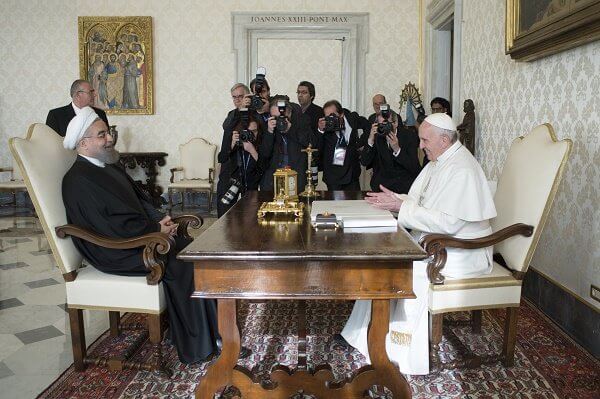
The bond between the Vatican and Iran is a partnership destined to endure

Following a meeting on Tuesday at the Vatican between Pope Francis and Iranian President Hassan Rouhani, and noting that the Vatican has had diplomatic ties with Iran since 1954 (30 years longer than U.S.-Vatican relations), John L. Allen Jr. writes: the close ties between Rome and Tehran reflect the often under-appreciated fact that both the Vatican and post-revolutionary Iran are basically theocracies, representing spiritual traditions — Catholicism and Shia Islam — that have a surprising amount in common.
Iranian writer Vali Nasr, author of the 2006 book “The Shia Revival,” argues that the divide between Sunni and Shia bears comparison to that between Protestants and Catholics, with Shia being the branch closer to Catholicism.
Among those points of contact are:
- A strong emphasis on clerical authority
- An approach to the Quran accenting both scripture and tradition
- A deep mystical streak
- Devotion to a holy family (in the case of Shiites, the blood relatives of Mohammad) and to saints (the Twelve Imams)
- A theology of sacrifice and atonement through the death of Hussain, grandson of Mohammad and the first imam of Shia Islam
- Belief in free will (as opposed to the Sunni doctrine of pre-destination)
- Holy days, pilgrimages, and healing shrines
- Intercessory prayer
- Strongly emotional forms of popular devotion, especially the festival of Ashoura commemorating Hussain’s death
One recent sign of the spiritual vicinity is that Iranian scholars recently translated the Confessions of Augustine and the Catechism of the Catholic Church into Farsi, the result of a 12-year effort.
In terms of sheer realpolitik, both parties also have strong motives for keeping their relationship green.
From Iran’s point of view, it aspires to being not merely a regional but a global player, and to do so it requires not merely “hard” power, to invoke the famous distinction of Harvard political scientist Joseph Nye, but also “soft,” meaning moral legitimacy. The perception of being in dialogue with the Vatican is crucially important, counteracting Bush administration rhetoric about Iran being part of an “axis of evil.”
Tehran also sees the Vatican as a firebreak with sometimes hostile Western nations. In 2007, when it seemed as if concerns over Iran’s nuclear program might lead to armed conflict with the United States, Iranian diplomats quietly sought out the Vatican as a potential mediator. [Continue reading…]
Failures in handling unaccompanied migrant minors have led to trafficking
The Washington Post reports: On the phone, the boy was frantic. After traveling hundreds of miles from a village in Guatemala, he had made it across the U.S. border and into a government-funded shelter for unaccompanied minors.
But then something went terribly wrong.
Instead of sending him to his uncle, Carlos Enrique Pascual, a landscape worker in Florida, authorities said the shelter released the teenager to traffickers who took him to central Ohio, held him captive in a roach-infested trailer and threatened to kill him if he tried to leave.
“Please, how can I get out of this?” Pascual’s nephew begged him during a stolen moment with a telephone. “I’m hungry, and my heart is bursting with fear.”
Pascual called police and, in December 2014, authorities found his nephew, then 17, and seven other boys living in cramped, dirty trailers about an hour outside of Columbus. Authorities said they were working at Trillium Farms, one of the country’s largest egg producers, debeaking hens and cleaning cages nearly 12 hours a day, six days a week, for as little as $2 a day.
The boys were part of a surge of children flowing across the U.S.-Mexico border over the past four years, overwhelming federal officials responsible for their safekeeping, child advocates say. Since 2011, more than 125,000 unaccompanied minors from Central America have been stopped at the border, many placed in shelters funded by the federal Office of Refugee Resettlement. [Continue reading…]
Pursuing critics, China reaches across borders. And nobody is stopping it.
The Washington Post reports: China’s campaign against dissent is going global.
Amid extraordinary moves to rein in criticism at home, Chinese security personnel are reaching confidently across borders, targeting Chinese and foreign citizens who dare to challenge the Communist Party line, in what one Western diplomat has called the “worst crackdown since Tiananmen Square.”
A string of incidents, including abductions from Thailand and Hong Kong, forced repatriations and the televised “confessions” of two Swedish citizens, has crossed a new red line, according to diplomats in Beijing. Yet many foreign governments seem unwilling or unable to intervene, their public response limited to mild protests.
The European Union is divided and appears uncertain about what to do. Hong Kong is in an uproar, with free speech under attack, activists looking over their shoulders and many people saying they feel betrayed by a lack of support from Britain. [Continue reading…]
Europe wades into debate over Poland’s constitutional crisis
By Simona Guerra, University of Leicester and Fernando Casal Bértoa, University of Nottingham
Poland’s prime minister Beata Szydło recently found herself summoned to the European Parliament in Strasbourg to defend her government over accusations that its commitment to democratic values is on the slide.
This was an unprecedented meeting. The parliament had called a debate under the auspices of a law introduced in March 2014, giving it the right to question a national government if it thinks a systemic threat to democracy is about to take place in a European country.
In Poland’s case, concerns were raised over government plans to limit the power of the national constitutional court, and change the way the media is governed and civil servants hired.
The aim of a meeting is to have a constructive conversation about concerns but if that fails, Brussels can move to suspend a country from taking part in EU decision making (although this is an unlikely scenario).
Among the post-communist states that joined the EU in 2004, Poland has generally been seen as a success story. While Hungary and Romania, and candidate countries such as Macedonia and Bosnia and Herzegovina seem to be dragging their feet over democratic reform, Poland has blazed the trail.
But in October 2015, the new social national conservative government, led by Szydło (Law and Justice party, PiS) won an outright majority in parliamentary elections and quickly set about making significant changes.
The inequality problem
Ed Miliband writes: ‘What do I see in our future today you ask? I see pitchforks, as in angry mobs with pitchforks, because while … plutocrats are living beyond the dreams of avarice, the other 99 per cent of our fellow citizens are falling farther and farther behind.’ Who said this? Jeremy Corbyn? Thomas Piketty? In fact it was Nick Hanauer, an American entrepreneur and multibillionaire, who in a TED talk in 2014 confessed to living a life that the rest of us ‘can’t even imagine’. Hanauer doesn’t believe he’s particularly talented or unusually hardworking; he doesn’t believe he has a great technical mind. His success, he says, is a ‘consequence of spectacular luck, of birth, of circumstance and of timing’. Just as his own extraordinary wealth can’t be explained by his unique talents, neither, he says, can rising inequality in the United States be justified on the grounds that it is a side effect of a broader economic success from which everyone benefits. As Henry Ford recognised, if you don’t pay ordinary workers decent wages, the economy will lack the demand to sustain economic growth.
Hanauer is in the vanguard of the ‘Fight for 15’, the campaign for a $15 minimum wage. Like Bill Gates and Warren Buffett, who have also issued loud warnings about inequality, he is heir to a long tradition of social concern among the wealthy in the US. They have reason to be worried. The last time inequality reached comparable levels was shortly before the Wall Street Crash. As Anthony Atkinson shows in Inequality: What Can Be Done?, inequality in the US fell for decades after the crash, before beginning to rise again in the 1970s. Since then the gap between the wealthy and the rest has grown steadily wider. The top 1 per cent now has nearly 20 per cent of total US personal income. In the 1980s, inequality in the UK went up even more sharply than in the US. Since then, overall UK inequality has been relatively stable but the income share of the top 1 per cent has increased significantly and now accounts for about 12 per cent of UK personal income. The important factors are rising inequality in wages, a decline in the share of the national income that wages represent as more money goes to corporate profits and dividends, and a reversal of redistribution from the rich to the poor.
The rise in inequality should not, Atkinson insists, be brushed aside as an inevitable effect of irresistible forces such as globalisation or developments in technology. It is driven by political choices. [Continue reading…]