Category Archives: Analysis

By 2030, renewables will be the world’s primary power source

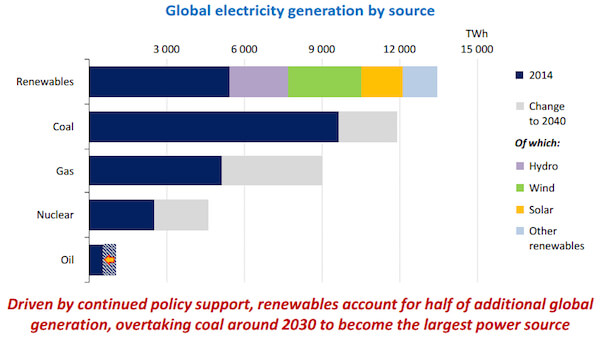
Climate Progress reports: In November, the International Energy Agency quietly dropped this bombshell projection: “Driven by continued policy support, renewables account for half of additional global generation, overtaking coal around 2030 to become the largest power source.”

In this post, I’ll dive deeper into this rapidly-approaching role reversal for coal and renewables. In Part Two, I’ll explain why the so-called “intermittency” problem for some renewables is basically solved and thus not a barrier to this reversal.

In releasing its World Energy Outlook 2015 last fall, the IEA published this chart of projected electricity generation in 2040: [Continue reading…]

renewables2030

Facebooktwittermail

‘Half the confusion in the world comes from not knowing how little we need’

lichen7

Pico Iyer writes: The idea of going nowhere is as universal as the law of gravity; that’s why wise souls from every tradition have spoken of it. “All the unhappiness of men,” the seventeenth-century French mathematician and philosopher Blaise Pascal famously noted, “arises from one simple fact: that they cannot sit quietly in their chamber.” After Admiral Richard E. Byrd spent nearly five months alone in a shack in the Antarctic, in temperatures that sank to 70 degrees below zero, he emerged convinced that “Half the confusion in the world comes from not knowing how little we need.” Or, as they sometimes say around Kyoto, “Don’t just do something. Sit there.”

Yet the days of Pascal and even Admiral Byrd seem positively tranquil by today’s standards. The amount of data humanity will collect while you’re reading The Art of Stillness is five times greater than the amount that exists in the entire Library of Congress. Anyone reading it will take in as much information today as Shakespeare took in over a lifetime. Researchers in the new field of interruption science have found that it takes an average of twenty-five minutes to recover from a phone call. Yet such interruptions come every eleven minutes — which means we’re never caught up with our lives.

And the more facts come streaming in on us, the less time we have to process any one of them. The one thing technology doesn’t provide us with is a sense of how to make the best use of technology. Put another way, the ability to gather information, which used to be so crucial, is now far less important than the ability to sift through it. [Continue reading…]

Facebooktwittermail

How plants rely on friendly fungal bodyguards

By Alan Gange, Royal Holloway

Two plants of the same species grow side by side. One is attacked by insects, one not. On an individual plant, some leaves get eaten, some not. This doesn’t happen at random, but is caused by the fungi that live within the leaves and roots of the plant.

Imagine you are holding a shoot of the dahlia plant, pictured below. How many species do you have in your hand? The answer is most certainly not one, but probably somewhere between 20 and 30. This is because every plant has fungi and bacteria that live on its surface (called epiphytes) and within its tissues (called endophytes).

If the stem is still attached to its roots then the number of species would easily double. The roots contain lots of endophytes and a separate group of fungi, called mycorrhizas. These fungi grow into plant roots and form a symbiotic relationship in which the fungus donates nutrients (principally phosphate and nitrate) to the plant, in return for a supply of carbon.

Dahlia is full of fungi.
Alan Gange, Author provided

There has been a recent surge of interest in these fungi, as their presence can affect the growth of insects that attack plants. Research at Royal Holloway has shown that mycorrhizal fungi reduce the growth of many insects, by increasing the plant’s chemical defences. Our most recent work shows that endophyte fungi, the ones that live within plant tissue, can also cause plants to produce novel chemicals.

Continue reading

Facebooktwittermail

Wall Street declares war on Bernie Sanders

Bill Black writes: Wall Street billionaires are freaking out about the chance that Bernie Sanders could be elected President. Stephen Schwarzman, one of the wealthiest and most odious people in the world, told the Wall Street Journal that one of the three principal causes of the recent global financial trauma was “the market’s” fear that Sanders may be elected President. Schwarzman is infamous for ranting that President Obama’s proposals to end the “carried interest” tax scam that allows private equity billionaires like Schwarzman to pay lower income tax rates than their secretaries was “like when Hitler invaded Poland.”

Schwarzman and Pete Peterson co-founded the private equity firm Blackstone. Peterson leads the effort to destroy the safety net in America. His greatest dream is to privatize Social Security so that Wall Street could increase its revenues by tens of billions of dollars. Blackstone is a major owner of Sea World, and it was in this sphere that Schwarzman went beyond his delusional rants about Hitler and became vile. When an Orca killed its trainer, Schwarzman lied and blamed the death on the trainer, claiming that Sea World “had one safety lapse — interestingly, with a situation where the person involved violated all the safety rules that we had.”

Schwarzman’s claim that the global financial markets are tanking because of Bernie’s increasing support is delusional, but it is revealing that he used the most recent market nightmare as an excuse to attack Bernie. The Wall Street plutocrats, with good reason, fear Bernie – not Hillary. Indeed, it is remarkable how vigorous and open Wall Street has been in signaling through the financial media that it has no problem with Hillary’s Wall Street plan. CNN, CNBC, and the Fiscal Times, under titles such as: “Here’s Why Wall Street Has Little to Fear from Hillary Clinton,” pushed this meme. [Continue reading…]

Facebooktwittermail

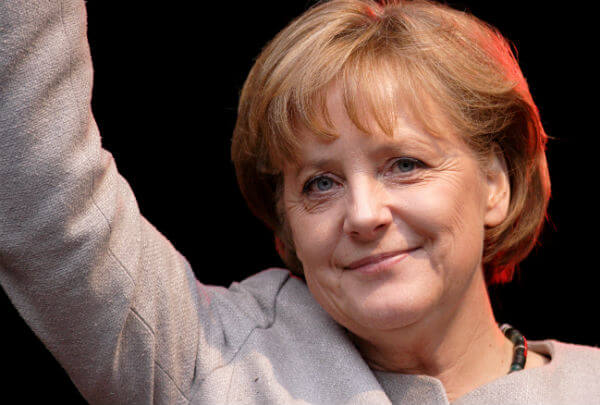
In the face of mounting opposition, Angela Merkel holds to her principles on accepting refugees

Angela_Merkel

Der Spiegel reports: On a Sunday evening in early January, Angela Merkel went to a piano concert by Antonio Acunto in the Konzerthaus on Berlin’s beautiful Gendarmenmarkt. The program included works from Chopin, Rachmaninoff and Schumann, but the chancellor didn’t just come for the music. It was also for a good cause and to show support. The concert was a benefit for the refugees. Her refugees.

Shortly before the concert began, Merkel saw an old acquaintance: Reverend Rainer Eppelmann. In 1990, Eppelmann was head of the Democratic Awakening, a party formed in East Germany soon after the fall of the Berlin Wall, and Merkel was its spokesperson. The party was ultimately folded into the Christian Democratic Union, of which Merkel is now the head.

At the concert, Eppelmann told Merkel how courageous and wonderful he thought her refugee policies were. Given the situation in which Merkel is now in, Eppelmann said, he finds himself thinking often about his favorite quote from the former Czech president and writer Vaclav Havel. “Hope is not the conviction that something will turn out well, but the certainty that something makes sense, regardless of how it turns out.”

The concert began and Merkel listened to a melancholic Chopin ballad in G-minor. When the intermission arrived, she jumped up from her chair and walked directly over to Eppelmann. She asked: “How did that quote about hope go again?”

It is completely unclear how the experiment will end that the German chancellor has forced upon the European Continent, upon her fellow citizens and, not least, upon her party. Her decision late last summer to open the German border to refugees transformed Merkel into a historic figure. It was the most consequential decision of her entire decade in office. [Continue reading…]

Facebooktwittermail

A visit to the world of segregation where Jews are on top

Philip Weiss writes: On my first night in an Israeli settlement, David served chicken soup left over from Sabbath and told me an unsettling story about the birth of Israel. His great uncle had escaped Europe to come to a Jewish kibbutz called Ein Harod. On the next hill was a Palestinian village. When hostilities broke out between Jews and Palestinians in 1948, the Jews went up to the village and announced that the next day they were bringing bulldozers to level the place, the people should leave. The next day they went back and were surprised to find that the Palestinians had all fled– fearing a massacre like the one that took place in Deir Yassin. The Jews then leveled the village and used the stones to build a stadium in their kibbutz. David said his uncle had told this story “with a twinkle in his eye.”

David was not the only settler to tell me stories of the Nakba. And the meaning was clear: A previous generation of Zionists had done terrible things to Palestinians in order to build the state of Israel. Now David and the other settlers were taking that same project– Zionism, the renewal of the Jewish people in their land—to the next part of the land of Israel. And they were doing so without destroying Palestinian villages, as their socialist predecessors had done.

The settlers told me that the great political development of the last year or two is that the Tel Aviv elite now concede that the settlers are never leaving. The elites give lip service to a Palestinian state because the world wants to hear that. But few in Jewish Israeli society even want that to happen; it would tear the country apart. [Continue reading…]

Facebooktwittermail

Syria’s next election: A practical path forward

Bassam Barabandi and Sasha Ghosh-Siminoff write: Negotiations between the Syrian opposition and governing regime start in just a few days. The challenges are numerous and many analysts are quick to proclaim the process already dead. Despite the momentum of the Vienna process, a myriad of factors continues to make Syria a complicated case: a messy situation on the battlefield, an unwillingness to compromise, political dynamics among the opposition, hostility between Iran and Saudi Arabia, Russia’s backing of Assad — take your pick.

While somewhat less than enthused by the framework set out by the UN Security Council resolution, which leaves Assad in power, Syrian opposition groups are meeting in Riyadh to prepare for negotiations. Apart from selecting members of their negotiation committee, the opposition groups are discussing their negotiation goals, including principles for political reform — reform which cannot include Assad as head of any transitional government. This is a tall order, which was once supported by the international community but apparently abandoned in the face of reality on the ground.

The focus on Assad’s role (or lack thereof) in a transitional government is understandable. Nevertheless, it might be pragmatic to review the timeline of transition as presently framed and propose a slightly different approach. With or without Assad, in the case of successful negotiations and an even somewhat effective ceasefire, a genuine deal will include constitutional reform and elections. [Continue reading…]

Facebooktwittermail

Why Iran backs Syria

Barak Barfi writes: The execution of a Shiite cleric in Saudi Arabia and the burning of Riyadh’s embassy in Iran has one again flamed Sunni-Shiite tensions and set the tiny Arab oil sheikhdoms on edge. Leaders from Lebanon to Yemen are fretting about Iranian machinations in Arab countries. But it is Tehran’s involvement in Syria that worries them the most. Tehran has bolstered its client state by dispatching senior military figures, pressing its Lebanese client Hezbollah to send fighters, providing much-needed petroleum products and extending Syria a hefty line of credit.

Without Iran’s help, the regime would likely have collapsed. Some believe Tehran has backed Syria to the hilt because of their common religious roots. Both ruling cliques claim affinity with the heterodox Shia, who are a minority in an Islamic world populated by orthodox Sunnis.

But Iran’s Syrian strategy derives less from spurious religious ties than it does from geopolitical factors. Surrounded by hostile pro-Western nations, Iran needs all the allies it can find to ensure that its regional interests are protected. [Continue reading…]

Facebooktwittermail

The UN repeats mistakes of the past in Madaya

starving-child-madaya

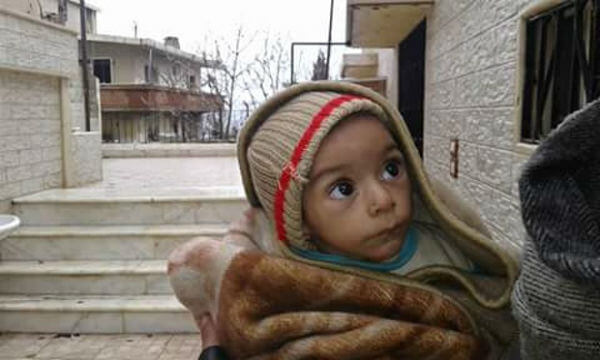
Muhammad Idrees Ahmad writes: Two weeks before an aid convoy delivered food and medicine to the 42,000 people of Madaya, a representative for the town’s council made an urgent appeal to the UN office responsible for the region. The town had been strangled since July 2015 by Bashar Al Assad’s army and the Lebanese Hizbollah. The condition was precarious: inhabitants were subsisting on grass, cats, dogs, insects, salt and water. At least 28 had died of starvation since the beginning of December. The council representative received an automated reply: the staff were away until January 5.

On New Year’s Eve, when the UN chief Ban Ki-moon wished his Twitter followers a peaceful 2016, he made no mention of the unfolding tragedy.

The inertia was broken when a determined social media campaign forced Madaya on the world’s attention and, eventually, the UN relented. On January 7, the regime agreed to allow a one-off supply of aid. The UN was quick to praise the regime for this concession, but it took another four days before it delivered aid to the town. The delay resulted from the “complexity” of synchronising deliveries to the 12,000 inhabitants of Al Fu’a and Kefraya, two pro-regime villages in Idlib encircled by rebels. On entering the town, aid workers were shocked by the “horrifying” conditions. “There are people in Madaya, but no life,” said Sajjad Malik, the UNHCR chief in Syria. “They are fighting for survival. No food, no electricity, no heating, no medicines. People did not even have the energy to complain.”

The representative for the UN’s Office of Coordination of Humanitarian Affairs in Syria, Yacoub El Hillo, too was moved: “We saw a people that are desperate; a people that are cold; a people that are hungry; a people that have almost lost hope”.

But in a curious statement, Mr El Hillo added that before entering Madaya, “it was at times difficult to determine whether what we were seeing was actually fabricated or exaggerated”.

It is unclear why Mr El Hillo should’ve faced such difficulty. The conditions in Madaya had been known to the UN for months. This scepticism may be unfounded but it is consistent with the state-centric bias of the UN’s humanitarian practices. UN agencies are required to respect state sovereignty regardless of legitimacy. And in Syria, they have been reluctant to act without the consent of the regime. This has turned the UN into an unwitting agent of the status quo, allowing the regime to politicise aid. [Continue reading…]

Facebooktwittermail

Rebels in north-western Syria buckle under Russian bombardment

Aron Lund writes: Syria news right now is all about the peace process that is set to start on Friday in Geneva, Switzerland, despite its limited chances of success. But even as they talk, the parties continue to fight and the Russian-Iranian military intervention continues to wear down Syrian rebels. On September 30, the Russian Air Force dropped its first bombs in Syria. The government of Iran joined in by raising an expeditionary corps of Iranian, Iraqi, and Afghan Shia Islamists for the front south of Aleppo.

In a recent article for Vice News, the American freelance writer and Syria expert Sam Heller notes a flurry of desperate-sounding calls for outside support from rebels in northwestern Syria. Though most frontlines have held with little or limited change, four months of relentless Russian bombardment and offensives by the Syrian Arab Army and its Shia allies seem to have left the insurgents exhausted.

In early December, I tried to evaluate the extent of government progress in a post on Syria in Crisis. As far as I could tell, it was clear then that Assad stabilized his positions, but overall progress seemed underwhelming and the picture was mixed. We would have to wait and see.

Since then, however, the wind has continued to blow Assad’s way. General Joseph F. Dunford Jr., the chairman of the U.S. Joint Chiefs of Staff, recently noted that “the regime is in a better place now” compared to before the intervention. Indeed, after four months, the effects of the concerted Russian-Iranian-Syrian campaign have begun to surface. [Continue reading…]

Facebooktwittermail

Violence of young men diminishes when they have jobs and families

The Economist reports: In August 2014 Boko Haram fighters surged through Madagali, an area in north-east Nigeria. They butchered, burned and stole. They closed schools, because Western education is sinful, and carried off young girls, because holy warriors need wives.

Taru Daniel escaped with his father and ten siblings. His sister was not so lucky: the jihadis kidnapped her and took her to their forest hideout. “Maybe they forced her to marry,” Mr Daniel speculates. Or maybe they killed her; he does not know.

He is 23 and wears a roughed-up white T-shirt and woollen hat, despite the blistering heat in Yola, the town to which he fled. He has struggled to find a job, a big handicap in a culture where a man is not considered an adult unless he can support a family. “If you don’t have money you cannot marry,” he explains. Asked why other young men join Boko Haram, he says: “Food no dey. [There is no food.] Clothes no dey. We have nothing. That is why they join. For some small, small money. For a wife.”

Some terrorists are born rich. Some have good jobs. Most are probably sincere in their desire to build a caliphate or a socialist paradise. But material factors clearly play a role in fostering violence. North-east Nigeria, where Boko Haram operates, is largely Islamic, but it is also poor, despite Nigeria’s oil wealth, and corruptly governed. It has lots of young men, many of them living hand to mouth. It is also polygamous: 40% of married women share a husband. Rich old men have multiple spouses; poor young men are left single, sex-starved and without a stable family life. Small wonder some are tempted to join Boko Haram.

Globally, the people who fight in wars or commit violent crimes are nearly all young men. Henrik Urdal of the Harvard Kennedy School looked at civil wars and insurgencies around the world between 1950 and 2000, controlling for such things as how rich, democratic or recently violent countries were, and found that a “youth bulge” made them more strife-prone. When 15-24-year-olds made up more than 35% of the adult population — as is common in developing countries — the risk of conflict was 150% higher than with a rich-country age profile.

If young men are jobless or broke, they make cheap recruits for rebel armies. And if their rulers are crooked or cruel, they will have cause to rebel. Youth unemployment in Arab states is twice the global norm. The autocrats who were toppled in the Arab Spring were all well past pension age, had been in charge for decades and presided over kleptocracies. [Continue reading…]

Facebooktwittermail

Saudi bombing campaign — supported by Britain — leaves Yemen’s healthcare system in tatters

yemen-bombing

The Independent reports: When the men and women who worked at Shiara hospital heard the explosion, there was little surprise. Just half an hour’s drive from the border with Saudi Arabia, in Yemen’s mountainous northern region, they were used to the sound of shelling.

What they did not expect 10 months into the Saudi-led campaign of airstrikes was that it would be their own hospital that had been hit. The bombing on 10 January left six people dead, including three staff members. Many more were injured.

“The wounded were hit by shrapnel from the missile, and also by shards of metal from the fence [around the hospital]. The injuries were brutal,” said Teresa Sancristoval, the head of the emergency desk at Médecins Sans Frontières (MSF), which operates in the hospital.

The attack was among 130 on health facilities hit in Yemen since the Saudi-led coalition began its bombing campaign in March last year. It was the fourth on a facility supported by MSF – which says it gives detailed co-ordinates for its hospitals to both sides of the conflict. [Continue reading…]

Facebooktwittermail

Donald Trump and the ‘rivers of blood’

Sarfraz Manzoor writes: Until recently, Donald J. Trump was best known in Britain for “The Apprentice” television series, the Miss Universe contest and a controversial golf course development in Scotland. And most Britons would probably have viewed his decision to enter the presidential race with no more than mild envy: Why can’t British elections be as much fun as American ones?

Thanks, however, to his incendiary comments about immigrants and Muslims, Mr. Trump has moved from being a buffoonish figure on the margins of British consciousness to the center of political debate. After Mr. Trump said that he, if president, would stop Muslims entering the United States, more than half a million people signed a parliamentary petition, thus requiring a debate in Parliament on whether to bar him entry to Britain. (The debate, which was held this past week in a committee, generated plenty of indignation but had no issue because the power to refuse Mr. Trump admittance is held not by Parliament but by the home secretary.)

Mr. Trump also drew condemnation from leading British politicians, newspapers, the Metropolitan Police and the mayor of London. Even the leader of the UK Independence Party, which campaigns on a strong anti-immigration platform, said Mr. Trump had “gone too far.”

When Mr. Trump speaks of barring Muslims from entering the United States, I hear an echo of a British politician from another age, one who is largely forgotten here but whose views on race and immigration were as polarizing in their time as Mr. Trump’s are now. Enoch Powell was a politician whose career spanned most of the postwar period, first as a Conservative and later as an Ulster Unionist. He had grave reservations about mass immigration and frequently spoke in apocalyptic language about its consequences. [Continue reading…]

Facebooktwittermail

How to determine which Democratic presidential candidate is beholden to wealthy Jewish donors

Politico reports: If Bernie Sanders defeats Hillary Clinton to win the Democratic nomination, he’ll be the first Jewish presidential nominee of a major political party.

But when it comes to his views on Israel, some Jewish Democrats are scratching their heads in confusion.

“His voting record on Israel recently is fine, absolutely fine,” said Steve Rabinowitz, a media consultant and former Clinton White House aide who supports Clinton. “I haven’t heard him once talk about it on the campaign trail. It’s as though he doesn’t utter the word Israel. It just strikes me as odd.”

But over his career Sanders has cast some votes and made critical statements about Israel that unnerve some in the pro-Israel community. That’s all the more puzzling, some say, given his own heritage as the son of a Jewish immigrant father from Poland whose family was wiped out by the Nazis — and someone who spent time working on an Israeli kibbutz.

As Clinton has struggled in recent days to prevent Sanders from notching twin victories in Iowa and New Hampshire, she has zeroed in on what she calls his naive statements about Iran — a country that Israel happens to consider its greatest enemy.

How many Democratic primary voters might have qualms with Sanders is unclear, however. President Barack Obama himself has grown increasingly critical of Israeli policy toward Iran and the Palestinians. Many liberal voters agree: A recent poll by the Chicago Council on Global Affairs found that only 4 in 10 Democrats consider Israel to be playing a positive role in the Middle East.

“The faction of the Democratic base that supports a strongly pro-Israel point of view is shrinking,” said Matthew Duss, president of the left-leaning Foundation for Middle East Peace.

But the Democratic Party still features a strong network of wealthy Jewish donors, such as the Hollywood mogul Haim Saban and American Jewish Congress president Jack Rosen, who hold candidates to high standards when it comes to Israel. It also boasts better political organization than liberals who pressure Israel to take a more conciliatory line with the Palestinians and Iran. [Continue reading…]

Some Jewish Democrats are scratching their heads in confusion? If so, that’s probably because Sanders hasn’t offered himself to the highest bidder.

At the same time, there’s no evidence that Sanders has a progressive view of Israeli-Palestinian politics. As Joseph Dana writes:

The problematic and least radical aspect of the senator’s foreign policy is his unwavering support for Israel. When it comes to the Israel-Palestine conflict, Mr Sanders’s economic radicalism falls by the wayside.

He has endorsed continuing military aid to Israel along with economic aid to the Palestinians, which has proven to be an effective tool for both Israel and the United States to exercise undue influence over Palestinian decision-making, as evidenced by the withholding of aid after the PLO pursued statehood recognition at the United Nations. Additionally, the senator has seldom condemned the Israeli occupation of Palestinian land and said nothing of Israel’s aggression in Gaza over the last decade.

Some have argued that Mr Sanders’s support for Israel is because he is Jewish. Yet, he has barely spoken about a faith-based connection to Israel. He has only cited his religion as an inspiration for progressive activism, especially regarding the struggle for civil rights equality.

Instead of taking a progressive stance, Mr Sanders relies on the security-based narrative that Israel has spun over the international community for decades. Where is the passion and critical thinking that has captured the imagination of millions of Americans and has demonstrated that fresh conversations are possible?

For a politician running a campaign against the “rigged” political and economic system that continues to disenfranchise millions, he is surprisingly content with the prevailing Washington orthodoxy on Israel (and also gun control, but that is a separate issue altogether).

The perplexing part is that Mr Sanders’s orthodoxy comes at a time when American diplomats in Israel are signalling a readiness to chart a new course on the conflict, one that doesn’t accept Israeli PR at face value.

For American single-issue voters whose sole concern is the resolution of the Middle East conflict, the 2016 presidential election won’t be different from any other: there won’t be a single candidate who ranks this as their primary issue (or even top foreign policy issue).

Is this a failure to acknowledge the defining issue of our times? On the contrary, it’s a reminder to be wary of polemicists who pound their podiums when talking about “the defining issue of our times.”

Indeed, if it turns out that throughout this election season, the subject of Israel rarely comes up, on balance that’ll probably be a good thing.

After all, when the subject does get raised, more often than not it is simply for the purpose of finding out who has the least amount of shame in presenting him or herself as a loyal Zionist.

Let’s be thankful if we are subject to as few as possible of these obsequious and obscene exercises.

Facebooktwittermail

Trump’s appeal as the antithesis of Obama

David Axelrod writes: The Republican base is infuriated by Mr. Obama’s activist view of government and progressive initiatives, from health care reform to immigration, gay rights to climate change.

Beyond specific issues, however, many Republicans view dimly the very qualities that played so well for Mr. Obama in 2008. Deliberation is seen as hesitancy; patience as weakness. His call for tolerance and passionate embrace of America’s growing diversity inflame many in the Republican base, who view with suspicion and anger the rapidly changing demographics of America. The president’s emphasis on diplomacy is viewed as appeasement.

So who among the Republicans is more the antithesis of Mr. Obama than the trash-talking, authoritarian, give-no-quarter Mr. Trump?

His bombast allows no room for nuance or complexity. He proudly extols his intolerance as an assault against “political correctness,” and he vows to bring the world to heel, from Mexico to China to Syria and Iraq.

Mr. Trump has found an audience with Americans disgruntled by the rapid, disorderly change they associate with national decline and their own uncertain prospects. Policies be damned, who better to set things right than the defiant strong man who promises by sheer force of will to make America great again?

Yes, we can? Hell, no!

Just leave it to me, Mr. Trump says. Yes, I can!

The robust condemnations Mr. Trump has received from media and political elites have only intensified the enthusiasm of his supporters, many of whom feel disdained and forgotten by the very same people who regularly mock and chide their man for his boorishness. To his base, he’s a truth-teller, thumbing his nose at conventional politicians, whether they are liberal or conservative. Rebukes from fact checkers and purveyors of civil discourse? They’re just so much establishment claptrap.

Relentlessly edgy, confrontational and contemptuous of the niceties of governance and policy making, Mr. Trump is the perfect counterpoint to a president whose preternatural cool and deliberate nature drive his critics mad. [Continue reading…]

Facebooktwittermail

Republican elites surrender to Trump

Dana Milbank writes: Late Thursday night, National Review, the storied conservative magazine founded by William F. Buckley, published an issue denouncing Donald Trump.

“Trump is a philosophically unmoored political opportunist who would trash the broad conservative ideological consensus within the GOP in favor of a free-floating populism with strong-man overtones,” the editors wrote. “Donald Trump is a menace to American conservatism who would take the work of generations and trample it underfoot in behalf of a populism as heedless and crude as the Donald himself.”

The Republican National Committee reacted swiftly — immediately revoking the permission it had given National Review to host a Republican presidential debate next month. “Tonight, a top official with the RNC called me to say that National Review was being disinvited,” the magazine’s publisher wrote online. “The reason: Our ‘Against Trump’ editorial.”

That soft flapping sound you hear is the Grand Old Party waving the flag of surrender to Trump. Party elites — what’s left of the now-derided “establishment” — are acquiescing to the once inconceivable: that a xenophobic and bigoted showman is now the face of the Republican Party and of American conservatism.

In recent days, influential Republicans including Bob Dole, Iowa Gov. Terry Branstad, RNC Chairman Reince Priebus, Rupert Murdoch and, as my Post colleagues reported, Rudy Giuliani and Rep. Peter King (N.Y.) have made noises about being able to stomach Trump. Republican donors are trying to insinuate themselves in the billionaire’s orbit. Trump himself said Thursday: “I have received so many phone calls from people that you would call ‘establishment,’ from people — generally speaking, conservatives, Republicans — that want to come onto our team.”

The Wall Street Journal editorial page had long criticized Trump’s candidacy, publishing an editorial in July arguing that the conservative media who applaud Trump “are hurting the cause.” The editors opined: “If Donald Trump becomes the voice of conservatives, conservatism will implode along with him.”

A week ago, the Journal reversed course. “Mr. Trump is a better politician than we ever imagined, and he is becoming a better candidate,” the editorialists wrote, speculating that “he might possibly be able to appeal to a larger set of voters than he has so far.” [Continue reading…]

Facebooktwittermail

What does the return of mercenary armies mean for the world?

Sean McFate writes: It is a familiar story. A superpower goes to war and faces a stronger-than-expected insurgency in distant lands, yet has insufficient forces to counter it because of political and military constraints. The superpower decides to hire contractors, some of whom are armed, to support its war effort. The armed contractors prove to be both a blessing and a curse, providing vital security services to the campaign, yet at times killing innocent civilians, causing strategic setbacks, and damaging the superpower’s legitimacy. Without these contractors, the superpower could not wage the war. With them, it is more difficult to win.

The armed contractors in question are not in Iraq or Afghanistan but in northern Italy, and the year is not 2007 but 1377. The superpower is not the United States but the papacy under Pope Gregory XI, fighting the antipapal league led by the duchy of Milan. The tragic killing of civilians by armed contractors did not occur in Baghdad but in Cesena, 630 years earlier. The military companies employed were not DynCorp International, Triple Canopy or Blackwater, but the Company of the Star, the Company of the Hat and the White Company. Known as free companies, these for-profit warriors were organised as corporations, with a well-articulated hierarchy of subcommanders and administrative machinery that oversaw the fair distribution of loot according to employees’ contracts. CEO-like captains led these medieval military corporations.

The parallels between medieval and contemporary private military companies (PMCs) are strong. Today, the US and many others hire contractors to fulfil security-related contracts in the world’s most dangerous places. In the late Middle Ages, such men were called condottieri – literally, ‘contractors’ – who agreed to perform security services described in written contracts, or condotte. Both modern and medieval contractors were organised as companies, their services available to the highest or most powerful bidder for profit. Both filled their ranks with professional men of arms drawn from different countries and loyal primarily to the paycheck. Both have functioned as private armies, usually offering land-based combat skills rather than naval (or aerial) capabilities and deploying force in a military manner rather than as law enforcement or police.

Mercenaries are back. Once brandished as villainous outlaws, they are emerging from the shadows to once again become a mainstream instrument of world politics. The United Arab Emirates (UAE) has hired hundreds of Latin-American mercenaries to fight the Iranian-backed Houthis in Yemen. After years of struggling against Boko Haram, Nigeria finally employed mercenaries to do the job, and they did. Russia’s President Vladimir Putin has sent mercs to ‘liberate’ eastern Ukraine, a conflict that still simmers. Mercs are reportedly working in parts of Iraq. [Continue reading…]

Facebooktwittermail

What Donald Rumsfeld knew we didn’t know about the lack of evidence for WMD in Iraq

John Walcott writes: On September 9, 2002, as the George W. Bush administration was launching its campaign to invade Iraq, a classified report landed on the desk of the chairman of the Joint Chiefs of Staff. It came from Defense Secretary Donald Rumsfeld, and it carried an ominous note.

“Please take a look at this material as to what we don’t know about WMD,” Rumsfeld wrote to Air Force General Richard Myers. “It is big.”

The report was an inventory of what U.S. intelligence knew — or more importantly didn’t know — about Iraqi weapons of mass destruction. Its assessment was blunt: “We’ve struggled to estimate the unknowns. … We range from 0% to about 75% knowledge on various aspects of their program.”

Myers already knew about the report. The Joint Staff’s director for intelligence had prepared it, but Rumsfeld’s urgent tone said a great deal about how seriously the head of the Defense Department viewed the report’s potential to undermine the Bush administration’s case for war. But he never shared the eight-page report with key members of the administration such as then-Secretary of State Colin Powell or top officials at the CIA, according to multiple sources at the State Department, White House and CIA who agreed to speak on condition of anonymity. Instead, the report disappeared, and with it a potentially powerful counter-narrative to the administration’s argument that Saddam Hussein’s nuclear, chemical and biological weapons posed a grave threat to the U.S. and its allies, which was beginning to gain traction in major news outlets, led by the New York Times.

While the threat posed by a nuclear-armed Iraq was at the heart of the administration’s case for war, the JCS report conceded: “Our knowledge of the Iraqi (nuclear) weapons program is based largely — perhaps 90% — on analysis of imprecise intelligence.”

The rationale for the invasion has long since been discredited, but the JCS report, now declassified, which a former Bush administration official forwarded in December, nevertheless has implications for both sides in the 2016 presidential race, in particular the GOP candidates who are relying for foreign policy advice on some of the architects of the war, and the Democratic front-runner, who once again is coming under fire from her primary opponent for supporting the invasion. [Continue reading…]

Facebooktwittermail