Sharif Nashashibi writes: There are several grounds on which to oppose the Saudi execution of Shia cleric Nimr al-Nimr. One can do so due to a principled opposition to capital punishment in general. One can criticise the country’s judicial system – Human Rights Watch said this week that it “has documented longstanding due process violations in Saudi Arabia’s criminal justice system that make it difficult for a defendant to get a fair trial even in capital cases.”
One can criticise Nimr’s trial in particular, which Amnesty International called “grossly unfair”. One can argue that he should not have been arrested in the first place – HRW cited “vague charges that do not resemble recognisable crimes”.
One can oppose his execution because of the repercussions it will have regionally and beyond. One can even do so out of concern for Saudi Arabia itself, not just in terms of domestic unrest among its Shia population, but also its foreign interests.
However, in any situation, condemnation is meaningless when based on hypocrisy. As such, Iran – which has arguably been most vocal about Nimr’s execution – does not have a leg to stand on. “It is perhaps surprising that a regime which imprisons journalists, censors cartoonists and holds activists without charge for years on end should be in any position to moralise against another,” wrote Evan Bartlett, news editor at The Independent newspaper.
It is galling – almost comical – for the world’s second-biggest executioner after China to criticise the third-biggest on the subject of executions. It carries the same moral authority as the US lecturing others about gun control, or Japan discouraging other countries from whale-hunting. [Continue reading…]
Category Archives: Analysis
Murder in Istanbul: The latest in a series of audacious killings of enemies of the Russian state
The Guardian reports: Abdulvakhid Edelgireyev survived for years hiding in the Chechen mountains, launching attacks on Russian security forces and evading capture. He survived the battlefields of Syria, and those of east Ukraine. But in November his life came to an abrupt end in a flurry of bullets: he was shot dead in broad daylight in Istanbul as he embarked on a shopping trip with his three-year-old niece.
Edelgireyev and his niece walked out of their apartment block in Kayasehir, a far-flung suburb of nondescript new towers, shortly before 2pm on 1 November. The 32-year-old Chechen sat the girl in the passenger seat of his car, and was about to start the engine when a white car rammed into them from behind, closing him in. Pushing his niece on to the floor under the seat, Edelgireyev scrambled out and started running. One of the assassins gave chase, firing at him, and he crumpled to the ground. When paramedics arrived a few minutes later he was already dead, in a pool of blood. He had been shot five times.
The dead man’s biography, as set out by family and associates, paints a picture of a key figure in the Caucasus Emirate, the umbrella group of Chechen and other fighters in Russia’s North Caucasus that has resorted to terrorist methods, including suicide attacks on Moscow’s metro and Domodedovo airport. Edelgireyev’s experiences during his year in Syria also revealed how the Chechen resistance fight has slowly grown links to Islamic State , and the infighting and turmoil among the foreign fighters in Syria. [Continue reading…]
Why life is not a thing but a restless manner of being
Tim Requarth writes: Mike Russell found his moment of inspiration on a warm spring evening in Glasgow in 1983, when his 11-year-old son broke a new toy. The toy in question was a chemical garden, a small plastic tank in which stalactite-like tendrils grew out of seed crystals placed in a mineral solution. Although the tendrils appeared solid from the outside, when shattered they revealed their true nature: each one was actually a network of hollow tubes, like bundles of tiny cocktail straws.
At the time, Russell, a geologist, was struggling to understand an unusual rock he had recently found. It, too, was solid on the outside but inside was full of hollow tubes, their thin walls riddled with microscopic compartments. It dawned on him then that this rock – like the formations in his son’s toy – must have formed in some unusual kind of liquid solution. Russell posited a whole new geological phenomenon to explain it: undersea hydrothermal hotspots where mineral-rich water spewed from Earth’s interior and then precipitated in the cool surrounding water, creating chemical gardens of towering, hollow rocks growing up from the ocean floor.
That was a huge intuitive leap, but it soon led Russell to an even more outlandish thought. ‘I had the epiphany that life emerged from those rocks,’ he said. ‘Many years later, people would tell me the idea was amazing, but it wasn’t to me. I was just thinking in a different realm, in the light of what I knew as a geologist. I didn’t set out to study the origin of life, but it just seemed so obvious.’
What seemed obvious to Russell was that his hypothetical chemical gardens could solve one of the deepest riddles of life’s origin: the energy problem. Then as now, many leading theories of life’s origins had their roots in Charles Darwin’s speculation of a ‘warm little pond’, in which inanimate matter, energised by heat, sunlight or lightning, formed complex molecules that eventually began reproducing themselves. For decades, most origin-of-life research has focused on how such self-replicating chemistry could have arisen. They largely brushed aside the other key question, how the first living things obtained the energy to grow, reproduce and evolve to greater complexity.
But in Russell’s mind, the origin of life and the source of the energy it needed were a single issue, the two parts inextricably intertwined. As a geologist (now working at NASA’s Jet Propulsion Laboratory in California), he came at the problem with a very different perspective from his biology-trained colleagues. Undersea chemical gardens, Russell realised, would have provided an abundant flux of matter and energy in the same place – a setting conducive for self-replicating reactions, and also a free lunch for fledgling creatures. It has long troubled researchers that the emergence of life seems to rely on highly improbable chemical events that lead toward greater complexity. By considering energy first, Russell believed he could address that. In his view, the emergence of biological complexity was not improbable but inevitable. [Continue reading…]
Time’s (almost) reversible arrow
Frank Wilczek writes: Few facts of experience are as obvious and pervasive as the distinction between past and future. We remember one, but anticipate the other. If you run a movie backwards, it doesn’t look realistic. We say there is an arrow of time, which points from past to future.
One might expect that a fact as basic as the existence of time’s arrow would be embedded in the fundamental laws of physics. But the opposite is true. If you could take a movie of subatomic events, you’d find that the backward-in-time version looks perfectly reasonable. Or, put more precisely: The fundamental laws of physics — up to some tiny, esoteric exceptions, as we’ll soon discuss — will look to be obeyed, whether we follow the flow of time forward or backward. In the fundamental laws, time’s arrow is reversible.
Logically speaking, the transformation that reverses the direction of time might have changed the fundamental laws. Common sense would suggest that it should. But it does not. Physicists use convenient shorthand — also called jargon — to describe that fact. They call the transformation that reverses the arrow of time “time reversal,” or simply T. And they refer to the (approximate) fact that T does not change the fundamental laws as “T invariance,” or “T symmetry.” [Continue reading…]
How Rolling Stone handled Sean Penn’s exclusive interview with El Chapo
The New York Times reports: Several months ago, Jann Wenner, a founder of Rolling Stone magazine, received a call from the actor Sean Penn.
Mr. Penn, Mr. Wenner said in an interview on Sunday, wanted to discuss something important. But he did not want to speak openly over the phone, so the two began to speak elliptically about a potential project.
That vague conversation was the beginning of what eventually became an article, written by Mr. Penn, that rocked both Mexico and the United States when it was published Saturday night. It was an exclusive interview with Joaquín Guzmán Loera, the notorious drug kingpin known as El Chapo, that was conducted while Mr. Guzmán was on the run from the authorities after an audacious escape from a Mexican prison last year.
The 10,000-word article includes accusations of cooperation between the military and Mr. Guzmán’s Sinaloa cartel, as well as Mr. Guzmán’s acknowledgment of his status as a drug dealer and his thoughts about the ethical implications of his business. Mr. Guzmán, whose escape from prison — his second — made him one of the most wanted fugitives in the world, was caught on Friday, before the article was published.
But after its publication, questions have been raised about the ethics for the magazine in dealing with Mr. Guzmán, a criminal being sought on charges of drug trafficking and murder, and in allowing him to approve what would ultimately be published about him. The Republican presidential candidate Marco Rubio, speaking Sunday on “This Week,” on ABC News, acknowledged Mr. Penn’s “constitutional right” to meet with Mr. Guzmán, but called the interview “grotesque.”
Steve Coll, the dean of the Columbia University Graduate School of Journalism, said he was concerned by the editorial approval offered to Mr. Guzmán. But ultimately, he said, “scoring an exclusive interview with a wanted criminal is legitimate journalism no matter who the reporter is.” [Continue reading…]
How to lose the propaganda war with ISIS

The New York Times reports: The Obama administration on Friday announced an overhaul of its efforts to respond to online propaganda from the Islamic State after months of acknowledgments that it had largely failed in its attempts to counter extremist recruitment and exhortations to violence on social media.
The administration has emphasized that it needs the assistance of some of the nation’s biggest technology companies, and a group of top White House and national security officials flew to California on Friday to plead their case with executives.
“Given the way the technology works these days, there surely are ways that we can disrupt paths to radicalization, to identify recruitment patterns and to provide metrics that allow us to measure the success of our counter-radicalization efforts,” Josh Earnest, the White House press secretary, said before the meeting began in California.
A task force will be created in the Department of Homeland Security and the Justice Department to coordinate the government’s new effort. The State Department announced the creation of a center to respond to disinformation from extremist groups by highlighting their misdeeds and creating positive images of the West. [Continue reading…]
If one was to picture America as a complex filtration system with Washington DC at its core, the way this operates guarantees that by the time someone passes through the system’s many layers and reaches a position as an influential decision-maker, their psyche has been stripped of every last trace of imagination.
Picture the many meetings that must have taken place over recent months in which policymakers repeatedly said: in order to stop ISIS we need to improve the image of the West.
This proposition should have been met with howls of scorn and yet instead, multiple teams of straight-faced bureaucrats from multiple agencies nodded their heads in agreement.
At the same time, I greatly doubt anyone believes this kind of PR exercise will have any value whatsoever and yet the consensus of support derives from one fact: no one has come up with a better idea.
Better to do something worthless than to do nothing at all — so the thinking goes.
The term radicalization has been pathologized, thereby divorcing it from its psychological meaning. It’s viewed as a disease, with the implication that if the right steps are taken, the contagion can be controlled.
But to be radicalized is to rebel and anyone who has taken up such a position of defiance has, in the case of ISIS, already reached a conclusion about the West. Indeed, they have most likely reflected more deeply on the West than the majority of their generational counterparts who, being less likely to engage in cultural critiques of any kind, don’t have a particularly coherent view of the West — good or bad.
The problem here is not one if inadequate availability of positive images of the West.
Although it’s often said that this is an ideological struggle, ideology is I suspect of less significance than a core value: the willingness to die in the name of ones cause.
This isn’t a value that governments anywhere want to challenge because every state wants to be able to recruit citizens who are willing to die in defense of their country.
Most states don’t overtly recruit would-be martyrs and yet all states promote the idea that anyone who dies for their country has died in the name of a noble cause.
At the same time, this has become an increasingly ambiguous value as professionalized military forces promote their ability to minimize their own loses. They want their soldiers to remain willing to die and yet decreasingly fearful that they might face such a risk.
The religious zealot who is willing to die for what he believes in, will inevitably have a sense of superiority over the non-religious soldier who has submitted to the commands of the state rather than the command of God.
If Washington thinks it can steer ISIS recruits in a different direction, it’s because it sees this as a contest between the might of the United States and the wrong-headed ambitions of a cadre of hapless youth. But the contest inside the minds of these young people is between divine authority and human design. They inevitably side with God.

The Islamization of radicalism

Olivier Roy writes: France is at war! Perhaps. But against whom or what?
Last November, when the Islamic State staged the shootings that killed 130 in Paris, it did not send Syrians. A year ago, when al Qaeda in the Arabian Peninsula purportedly ordered the deadly attack on the office of Charlie Hebdo, it did not send gunmen from Yemen. Rather, both groups drew from a reservoir of radicalized French youth who, no matter what happens in the Middle East, are already disaffected and are seeking a cause, a label, a grand narrative to which they can add the bloody signature of their personal revolt.
The rallying cry of these youth is opportunistic: Today it is the Islamic State; yesterday, they were with al Qaeda; before that, in 1995, they were subcontractors for the Algerian Armed Islamic Group, or they practiced the nomadism of personal jihad, from Bosnia to Afghanistan, by way of Chechnya. Tomorrow they will fight under another banner, so long as combat death, age, or disillusion do not empty their ranks.
There is no third, fourth, or nth generation of jihadis. Since 1996, we have been confronted with a very stable phenomenon: the radicalization of two categories of French youth — second-generation Muslims and native converts. The essential problem for France, therefore, is not the caliphate in the Syrian desert, which will disappear sooner or later, like an old mirage that has become a nightmare. The problem is the revolt of these youth. And the real challenge is to understand what these youth represent: whether they are the vanguard of an approaching war or, on the contrary, are just a rumbling of history.
* * *
Two readings of the situation dominate at the moment and are shaping the debates on television and in the opinion pages of newspapers: These are, basically, the cultural explanation and the Third World explanation.
The first puts forth that recurring and nagging “war of civilizations” theory: The revolt of young Muslims demonstrates the extent to which Islam cannot be integrated into the West, at least not so long as theological reform has not struck the call of jihad from the Quran. The second interpretation evokes post-colonial suffering, the identification of these youth with the Palestinian cause, their rejection of Western intervention in the Middle East, and their exclusion from a French society that is racist and Islamophobic. In short, the old song: So long as we haven’t resolved the Israel-Palestine conflict, there will be a revolt.
But the two explanations run up against the same problem: If the causes of radicalization are structural, then why do they affect only a tiny fraction of those in France who call themselves Muslims? Only a few thousand, among several million.
But these young radicals have been identified! All the terrorists who have actually taken action were, notoriously, in the “S File” — that is, on the government’s watch list. I don’t wish to get into a discussion here of prevention — I simply note that the information about them is there, and it is accessible. So let us look at who they are and try to draw some conclusions.
Nearly all the French jihadis belong to two very precise categories: They are either “second-generation” French — that is, born or raised from a very young age in France — or they are “native” French converts (whose numbers have increased with time, but who already constituted 25 percent of radicals at the end of the 1990s). This means that, among the radicals, there are practically no “first-generation” jihadis (including recent arrivals), but especially no “third-generation” jihadis.
The third-generation category in France is growing: The Moroccan immigrants of the 1970s are now grandparents. But one does not find their grandchildren among the terrorists. And why do converts, who never suffered from racism, wish to brutally avenge the humiliation experienced by Muslims? Especially since many of these converts — like Maxime Hauchard, the Normandy-born man who appeared in the Islamic State’s beheading videos — come from rural France and have little reason to identify with a Muslim community that for them exists only in theory. In short, this is not a “revolt of Islam” or one of Muslims, but a specific problem concerning two categories of youth, the majority of whom are of immigrant origin. This is not, then, the radicalization of Islam, but the Islamization of radicalism.
What is the common ground between the second generation and the converts? It is, first of all, a question of a generational revolt: Both have ruptured with their parents or, more precisely, with what their parents represent in terms of culture and religion. [Continue reading…]
Sexism is not an imported product

Silke Stöckle and Marion Wegscheider, whose original article in German appeared in marx21, write: The NYE festivities in Cologne, Hamburg and other cities witnessed a high number of sexual attacks on women, and in at least one case, a rape. It is disturbing that this could happen, and outrageous that the authorities in the first instance failed to take victims’ reports seriously.
Sexual violence against women in Germany is in general a large and indeed a long-existing problem: women are commonly and frequently sexually harassed at large festivals, at the Oktoberfest in Munich or during the Carnival in Cologne and other cities. According to a new study commissioned by the Federal Ministry of Family Affairs, one in seven women in Germany experiences sexual violence. One in four women – irrespective of education level or socio-economic status – is exposed to domestic violence. The perpetrators are almost always men, among whom no significant distinction according to religion, background, educational level or social status exists.
In other words, every day there are more than enough reasons for a society-wide outcry over sexism and sexualised violence in Germany. Both phenomena are closely connected to the dominant image of women. Accordingly, sexual assaults on women are all too often not taken seriously, and are at first marginalised – as in Cologne, where victims have had the pleasure of being schooled by local politicians about “rules of behaviour for mass gatherings”, as though the victims, in the face of their determined assaulters, had the possibility to negotiate their way out of harm.
Women are continually portrayed as sexual objects in films, advertising and mass media. But more than this, women’s oppression is structurally anchored in our society, evidenced by differences in pay, employment opportunities or dominant role models. There is no equality here, despite frequent public proclamations to the contrary.
Rather than connecting the events in Cologne and Hamburg to the everyday sexist violence faced by women in Germany, politicians and the media establishment have, from the moment the events occurred, focused above all on the background of the alleged perpetrators, and on questions of public security. Where sexual molestation is acknowledged as a structural manifestation at all, it is only ever in relation to the “culture” in the supposed countries of origin of the perpetrators. In this way, the debate about the attacks has been instrumentalised from the get-go and, in line with a classic racist line of argument, Muslims or refugees have been stereotyped en masse. [Continue reading…]
Deutsche Welle reports: A few kilometers away [from the main station in Cologne], in the “Multi Kulti” center in the neighborhood of Mülheim, several women have gathered in an attempt to work out what measures should be taken to make the streets of Cologne safe again.
“No one is talking about the fact that this is happening to women every day,” Tanja, an activist and one of the initiators of the event told DW.
“People are insisting on making this a political story, trying to shift the focus on pro- or anti-refugees. But in fact, no one is listening to what we have to say – the women who have been suffering from this violence in the streets on a daily basis long before refugees even came here,” she says.
The violence on New Year’s Eve was not different from that during any other big-scale celebration in the city, according to Tanja. “Because refugees are now a burning topic, the media all of a sudden report about these events, but what nobody wants to admit is that these things happen all the time. I’m sorry to break this to you, but German-born men also harass and rape.” [Continue reading…]
Germany’s welcome for refugees has to survive the Cologne attacks
Doris Akrap writes: Too often in the past few days I have heard the Willkommenskultur-Germans saying they feel “exploited”, “abused”, “cheated”. We know this behaviour. It’s like angry parents whose children have got into trouble: “I did everything for you and what do you do?” As every parent, every German, has to learn: just like every child, every refugee is an individual. Not every refugee will study hard and become a doctor. No, some refugees will get drunk on New Year’s Eve and make a whole lot of mess.
I don’t want to trivialise sexual attacks. And I don’t want to deny the possibility that some people from the Middle East may have greater problems with women and alcohol than others. Nobody ever said that the refugees, even when they were wrapped in insulation blankets after arriving over the Mediterranean, were all angels. You’re sure to find bigots, antisemites and criminal gangs among them, just as you’ll find racists, rapists and arsonists among the German population (there were more than 200 arson attacks on refugee accommodation in Germany last year).
But my fear is that Willkommenskultur could end up as nothing more than a slogan. The people who always wanted it to fail, who believe in a Germans-only state, are abusing the fears and insecurities we all have over the background of the new arrivals. And more than that, they are abusing the dozens of women who were victims of assault on New Year’s Eve. [Continue reading…]
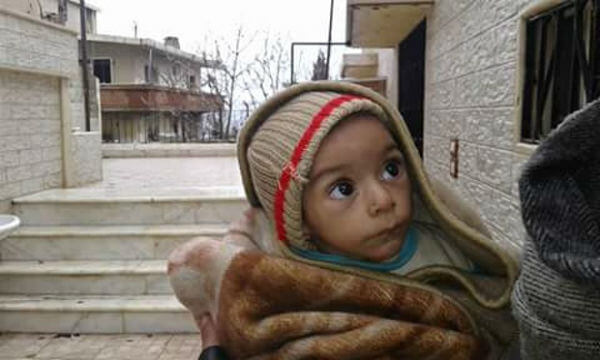
Amnesty: Famine in Syrian city of Madaya ‘the tip of an iceberg’

CNN reports: Evidence of an unfolding famine in the Syrian city of Madaya continues to mount, with the international rights group Amnesty International publishing accounts of people trying to survive on boiled water and leaves.
Except that now that it’s winter, the leaves are gone.
Even more chilling is the idea that Madaya may not be the exception in Syria today, after nearly five years of civil war: It might be representative of an ongoing catastrophe of larger proportions.
“These harrowing accounts of hunger represent the tip of an iceberg,” said Philip Luther, the Middle East and North Africa director for Amnesty International. “Syrians are suffering and dying across the country because starvation is being used as a weapon of war by both the Syrian government and armed groups.”
Luther accused both sides of “toying with the lives of hundreds of thousands of people,” and noted that starving civilians as a tactic in warfare is a war crime. [Continue reading…]
Iran won’t surrender militias that conduct Assad’s war
Hassan Hassan writes: Not long before the Riyadh-Tehran diplomatic row that followed the execution of Saudi Shia cleric Nimr Al Nimr, a showdown between the two countries unfolded in New York. While it is difficult to draw a direct correlation between the two events, the incident can help us understand the depth of the continuing crisis.
On December 18, heated debate ensued between representatives of the two countries at a meeting in New York over the listing of armed groups operating in Syria for possible determination as terrorist organisations. The list, which Jordan was asked to develop, would name extremist groups that must be defeated as part of the UN-sponsored political process for Syria.
A month earlier in Vienna, Saudi Arabia had insisted on including in the list foreign Shia militias fighting on the side of president Bashar Al Assad. Riyadh argued that all foreign fighters must leave Syria, regardless of which side they supported. In New York, Iran, joined by Russia, strongly objected to the demand and the standoff caused a deeper rift between the two countries.
For now, the designation of terror groups in Syria has been referred to a committee comprising several European and regional countries. They first determined indicators and criteria of what constitutes a terrorist organisation, then named armed groups currently fighting in Syria. There is a preliminary list of more than 160 Sunni and Shia organisations.
Iran categorically rejects including any Shia groups in the list. For Tehran, the fate of the Assad regime it supports is critically tied to the presence of those Shia militias. It is a fact that adds to the many issues that compound the conflict in Syria – issues that the international community would seemingly rather sweep under the carpet instead of deal with head on. [Continue reading…]
Ten ways on how not to think about the Iran/Saudi conflict
Omid Safi writes: In order to understand this conflict, do not start with Sunni/Shi‘a seventh century succession disputes to Prophet. This is a modern dispute, not one whose answers you are going to find in pre-modern books of religious history and theology. Think about how absurd it would be if we were discussing a political conflict between the U.S. and Russia, and instead of having political scientists we brought on people to talk about the historical genesis of the Greek Orthodox Church.
Probably the most succinct elaboration of this point came from Marc Lynch:
“The idea of an unending, primordial conflict between Sunnis and Shiites explains little about the ebbs and flows of regional politics. This is not a resurgence of a 1,400-year-old conflict.”
The attempt to explain the Iranian/Saudi conflict, or for that matter every Middle Eastern conflict, in purely religious terms is part of an ongoing Orientalist imagination that depicts these societies as ancient, unchanging, un-modern societies where religion is the sole determining factor (allegedly unlike an imagined “us,” who have managed to become modern and secular.) Watch this four-part series by the late, great Edward Said on how Orientalism operates (skip the introduction):
There is no disputing that religion is a factor in understanding the Middle East. In some conflicts, it might even be a primary factor. But it is never, ever the only factor. Most often it is the other factors (history, economics, ideology, demographics) that are much more important.
Religion, religious traditions, and human societies never stay static and unchanging. There is no such thing as an eternal, unchanging human tradition. [Continue reading…]
Iraq faces take-over by Iran-backed militias if ISIS is defeated, coalition commanders fear
The Telegraph reports: Coalition commanders in Iraq fear that Iran-backed Shia militias may stage an armed takeover of the country if Isil is defeated, a new report has warned.
Senior figures in the US-led mission believe there is a high likelihood of a “war after the war” because of the Iraqi government’s reliance on Shia militias in its fight against Isil.
The move has hugely boosted the strength of such militias, to the point where they are now in a position to challenge the elected government for control of the country.
The warnings are revealed in research compiled by one Britain’s foremost experts on Iraq, Professor Toby Dodge, who served as an adviser to General David Petraeus, America’s former top commander in Baghdad.
Prof Dodge’s findings are based on meetings with high-level coalition commanders and Iraqi politicians conducted during a recent study trip to Iraq for the Middle East Centre at the London School of Economics.
They told him that recent defeats against Isil in Ramadi and Sinjar had shifted “the balance of power” to the Shia militias, who lead around 70 per cent of all military operations.
“Against a background of positive military news, there was near unanimity amongst the senior Iraqi political figures and the military commanders of the American-led, multilateral coalition that that the military defeat of (Isil) in Iraq would trigger another military conflict, which would in effect, mark the country’s return to civil war,” said the report. [Continue reading…]
French proposal to strip citizenship over terrorism sets off alarms
The New York Times reports: The French police have carried out thousands of heavy-handed searches since the Nov. 13 Paris attacks, and a raft of new laws is poised to permanently concentrate even more power in the hands of the Interior Ministry.
Yet among civil libertarians, no government proposal has raised as much alarm as a recent one to strip citizenship from French-born dual nationals convicted of terrorism.
The idea, promoted by Prime Minister Manuel Valls, a Socialist with a conservative twitch, has struck at the core of France’s ideals of the rights of citizens, while underscoring the quandary the government faces as it confronts a widening threat from terrorists born and raised in France.
While the proposal to strip them of citizenship — known here as “déchéance,” or “forfeiture” — is backed by the right and much of the public, it has provoked furious debate and outraged the left, including many of Mr. Valls’s colleagues in the Socialist Party.
Mr. Valls has described the measure as “highly symbolic.” But critics fear that it would deepen fissures in French society by creating two classes of citizens.
Socialists are usually extremely reluctant to distinguish between French citizens, said Patrick Weil, the country’s leading historian on immigration. “The principle of equality is one of the pillars of French identity,” he said. “That he wants to distinguish between French citizens is creating a tsunami. It’s a terrible break with the fundamental principles of the French republic.”
At the same time, opponents of the plan point out that such a change in the law would hardly deter would-be terrorists. No one has been able to envision a situation in which a binational French suicide bomber might not press the button for fear of losing citizenship. [Continue reading…]
‘I went to join ISIS in Syria, taking my four-year-old. It was a journey into hell’
The Observer reports: Sophie Kasiki stared at the photograph of a young English-speaking boy in a camouflage uniform and black bandana covered in Arabic calling for unbelievers to be killed in the latest Islamic State propaganda.
Her eyes welled and she swallowed hard. “That could have been my son,” she said, her firm voice wavering. “That’s hard for me to say and makes me want to cry. I would have killed us both rather than let him become a killer, rather than let him fall into the claws of those monsters.”
The “monsters” she is referring to are Islamic State, and Kasiki weighs her words; she knows her four-year-old son was only ever at risk of falling into the jihadis’ lair because she had taken him there.
Kasiki is one of the few western women who have been to the capital of the Isis-declared caliphate at Raqqa in Syria and returned to recount the tale. It was, she said in her first interview with a British newspaper, like a journey into a hell from which there seemed no return. [Continue reading…]
Egypt’s president turns to religion to bolster his authority
The New York Times reports: When President Abdel Fattah el-Sisi opened a much-heralded extension to the Suez Canal in August, the official Friday Prayer sermon that week hailed it as a “gift from God.”
When Egyptian voters elected a new Parliament in December, a preacher on state TV urged its members to “obey those in authority, specifically the highest authority,” and referred indirectly to Mr. Sisi as “God’s shadow on earth.”
And when a Russian airplane leaving the Sharm el Sheik resort crashed in the Sinai Desert in October, killing 224 people and crippling Egyptian tourism, the Ministry of Religious Endowments encouraged clerics to vacation at the deserted resort — notable because many observant Muslims here view it as a sinful fleshpot.
Fears of Islamist rule helped propel Mr. Sisi, then a military general, to power in 2013 following giant protests that led to the ouster of the Muslim Brotherhood government. But as Mr. Sisi wrestles with militant attacks and a struggling economy, he has increasingly turned to religion to bolster his authority and justify a crackdown on his rivals. [Continue reading…]
Scientists move one step closer to turning water into hydrogen fuel, affordably
Christian Science Monitor reports: Scientists have cleared one hurdle on the path to deriving hydrogen fuel from water affordably, a breakthrough that could drastically change the way we power vehicles.
Hydrogen has the potential to fuel incredibly environmentally clean cars. But making that fuel hasn’t been so efficient or economical. Pure hydrogen gas does not occur naturally on Earth, so scientists must devise ways to separate hydrogen from naturally occurring compounds, like H2 O.
Until now, cars that run on water have been out of reach. Electrolysis, the process of breaking H2 O into hydrogen and oxygen gases by passing an electric current through water, and other possible methods have been prohibitively expensive or difficult.
But a team of scientists have come up with a different mechanism to produce hydrogen fuel from water. These researchers have created a biomaterial that catalyzes the splitting of the water elements, which they describe in a paper published in the journal Nature Chemistry. [Continue reading…]
Why we can’t stay silent on Germany’s mass sex assaults
Maajid Nawaz writes: Recent mass migration patterns across Europe have meant that misogyny has finally come head to head with anti-racism, multiculturalism is facing off against feminism, and progressive values are wrestling with cultural tolerance.
Yes, it is racist to suspect that all brown men who look like me are rapists. It is bigoted to presume that all Muslim men who share my faith advocate religiously justified rape. It is xenophobic to assume that all male refugees are sexual predators awaiting their chance to rape. But let me be absolutely clear: What will feed this racism, bigotry, and xenophobia even more is deliberately failing to report the facts as they stand. Doing so only encourages the populist right’s rallying cry against “the establishment.”
If liberals do not address such issues swiftly, with complete candor and courage, the far-right and anti-Muslim populist groups will get there first. They have been doing so for a while now.
The far-right street protest group Hogesa, or Hooligans Against Salafism, continues to cause consternation on the streets of Cologne, while the populist-right Pegida has already responded to the New Year’s Eve attacks by announcing a protest in Cologne on Jan. 9.
No, my fellow liberals, these issues cannot be brushed under the carpet or simply willed away. They are not going anywhere, anytime soon. So how can we address this sensibly, without bursting a blood vessel in our Right eye, or missing the blind spot in our Left? [Continue reading…]