Category Archives: Analysis

America’s national eating disorder

Julia Belluz spoke to journalist and food advocate Michael Pollan: Julia Belluz: Other countries seem to be doing a much better job of advising people on how to eat, like Brazil. It gives people simple advice — cook at home more often, eat more fruits and vegetables, and eat less meat.

Michael Pollan: That’s an interesting case. The Brazilians have tried to revolutionize the whole concept of dietary guidelines and get away from talking about nutrients completely. They talk not only about foods and science but food culture.

They have recommendations about how you eat, not just what you eat, so for example they encourage Brazilians to eat with other people. What does this have to do with health? It turns out it has everything to do with health. We know that snacking and eating alone are destructive to health.

Julia Belluz: What would it take to see guidelines like Brazil’s in the US?

Michael Pollan: It would take viewing food through a different lens. The mindset that produced those Brazilian guidelines is influenced as much by culture as it is about science — a very foreign idea to us. But food is not just about science. The assumption built into the process here is that it’s strictly a scientific process, a matter of fuel. Eating is essentially a negotiation between the eater and a bunch of chemicals out there. That’s a mistake.

We also have a very powerful food industry that cares deeply about what the government tells the public about food. They don’t want anyone else to be talking to the public about food in a way that might contradict their own messages. So they’re in there lobbying. When the government is deciding about the guidelines for school lunches, industry is in the room, making sure the potato doesn’t get tossed and gets the same respect accorded to vegetables. [Continue reading…]

Facebooktwittermail

America is a constipated nation

Ed Wong writes: In the decades after World War II, a one-eyed Irish missionary-surgeon named Denis Burkitt moved to Uganda, where he noted that the villagers there ate far more fiber than Westerners did. This didn’t just bulk up their stools, Burkitt reasoned; it also explained their low rates of heart disease, colon cancer, and other chronic illnesses. “America is a constipated nation,” he once said. “If you pass small stools, you have big hospitals.”

“Burkitt really nailed it,” says Justin Sonnenburg, a microbiologist at Stanford University. Sure, some of the man’s claims were far-fetched, but he was right about the value of fiber and the consequences of avoiding it. And Sonnenburg thinks he knows why: Fiber doesn’t just feed us—it also feeds the trillions of microbes in our guts.

Fiber is a broad term that includes many kinds of plant carbohydrates that we cannot digest. Our microbes can, though, and they break fiber into chemicals that nourish our cells and reduce inflammation. But no single microbe can tackle every kind of fiber. They specialize, just as every antelope in the African savannah munches on its own favored type of grass or shoot. This means that a fiber-rich diet can nourish a wide variety of gut microbes and, conversely, that a low-fiber diet can only sustain a narrower community. [Continue reading…]

Facebooktwittermail

The Arab Spring and the continuing failure of governance across the region

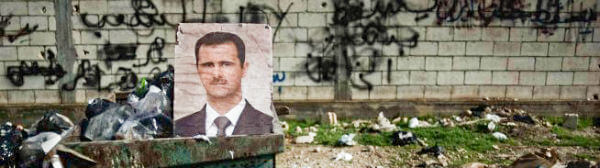
assad-dumped

The Economist reports: It has become fashionable in some circles to ape Russia and Iran in blaming this failure [of the Arab Spring] on supposedly “naive” Western policymakers. Had Western powers not abandoned old allies such as Egypt’s Hosni Mubarak; had they not intervened in support of Libyan rebels; had they not presumed that the Syrian dictator Bashar al-Assad was just another domino waiting to topple; had they not turned a blind eye to the danger of Islamist fanatics: then all would be well.

This is tosh [nonsense]. To frame the uprisings of 2011 as a sequence of isolated events, each of which had a unique and optimal policy response, is to deny the historical reality of what happened. Such hindsight belies the actual experience of seeing an entire region — and the world’s most politically torpid region, at that — whirl into sudden, synchronised motion. It also denies agency to the actors themselves: to the crowds whose cries of “Enough!” reached critical mass; to the paranoid rulers whose responses exacerbated the protests.

This is not to say that the events of 2011 had no precursors. Algeria’s Islamist uprising in 1991, two intifadas in Palestine, the “Independence revolution” that ousted Lebanon’s government in 2005, even the short-lived “Green revolution” in non-Arab but nearby Iran, all signalled the region’s desire for change. But the world’s democracies were, by and large, correct in judging that what they were seeing in 2011 was something broader, more potent and more difficult to steer than a set of national crises that happened to coincide. Nor were they naive to think that an empowered “Arab street” would seek to move its countries closer to global norms of good governance. That was the demand the demonstrators made in protest after protest, from the Gulf to the Atlantic.

The West’s naivety, which was shared — and paid for — by those hopeful demonstrators, lay in underestimating two things. One was the fragility of many Arab states, too weak in their institutions to withstand such ructions in the way that, say, South Africa did when apartheid fell. The other was the vicious determination with which established regimes would seek to retain or recapture control. Who could believe that a soft-spoken leader such as Mr Assad would prefer to destroy his country rather than leave his palace? Those were the truths that brought hope to the ground.

Just as the spring itself was more than just a set of national events, so the current period of counter-revolution is an international matter. Conservatives across the region have received powerful backing from the Gulf. One early and stark example of this was Bahrain, where the ruling family called on fellow Sunni monarchs to help it crush a pro-democracy movement championed by its Shia majority. Last year’s intervention in Yemen by a Saudi-sponsored coalition can be seen in the same light. The Saudis are seeking not only to thwart Houthi rebels, whose Iranian backing they revile. They are trying to force a return to the status quo.

The most internationalised conflict is the bitter civil war in Syria, where powers from the region and beyond contend through proxies. The war has long since metastasised into a monumental free-for-all involving dozens of belligerents. But it remains at its core a fight between aggrieved citizens and a narrowly based — and in Syria’s case largely sectarian — elite intent on keeping its hold on power.

In Egypt, a nation-state of longer standing and greater stability, the ancien régime’s fight has — again with help from the Gulf — been won, for now. Egypt has long been seen as the region’s bellwether, and for good reason. Over the past five years it has provided the Arab spring’s most revealing story of failure; today it highlights the degree to which the tensions persist that brought about the uprisings. [Continue reading…]

Facebooktwittermail

The limits of American realism

Roger Cohen writes: Is realism really, really what America wants as the cornerstone of its foreign policy?

Stephen M. Walt, a professor of international affairs at Harvard University, has an eloquent ode to realism in Foreign Policy magazine. He argues that, with realism as the bedrock of its approach to the world over the past quarter century, the United States would have fared far better. Realists, he reminds us, “have a generally pessimistic view of international affairs and are wary of efforts to remake the world according to some ideological blueprint.”

Pessimism is a useful source of prudence in both international and personal affairs. Walt’s piece makes several reasonable points. But he omits the major European conflict of the period under consideration — the wars of Yugoslavia’s destruction, in which some 140,000 people were killed and millions displaced.

Realists had a field day with that carnage, beginning with former Secretary of State James Baker’s early assessment that, “We don’t have a dog in that fight.” This view was echoed by various self-serving assessments from the Clinton White House that justified inaction through the portrayal of the Balkans as the locus of millennial feuds neither comprehensible nor resolvable.

True, discerning a vital American national interest in places with names like Omarska was not obvious, even if the wars upset the European peace America had committed to maintaining since 1945. The realpolitik case for intervention was flimsy. Sarajevo was not going to break America, less even than Raqqa today.

The moral case was, however, overwhelming, beginning with the Serbian use in 1992 of concentration camps to kill Bosnian Muslim men deemed threatening, and expel Muslim women and children. These methods culminated at Srebrenica in 1995 with the Serbian slaughter of about 8,000 male inhabitants. In the three-year interim, while realists rationalized restraint, Serbian shelling of Sarajevo blew up European women and children on a whim. Only when President Clinton changed his mind and NATO began concerted bombing was a path opened to ending the war.

I covered that conflict and its resolution. For my baby-boomer generation, spared Europe’s repetitive bloodshed by American military and strategic resolve, it was a pivotal experience. After that, no hymn to realism pure and simple could ever be persuasive. Walt calls me “a liberal internationalist;” I’ll take that as an honorable badge. [Continue reading…]

Facebooktwittermail

Why we should learn to love all insects – not just the ones that work for us

By Paul Manning, University of Oxford

Insects, which include more than a million described species, represent roughly two-thirds of the biodiversity on Earth. But they have a big PR problem – many think of insects as little more than crop-eating, disease-carrying jumper-munchers. But in reality, species fitting this bill are but a tiny part of an enormous picture.

A dominant narrative has emerged in an effort to clear the good name of our six-legged friends. Insects are the unsung heroes, the little things that run the world. This fact is undeniable. Insects are critical to the existence of the world as we know it, whether through pollinating plants, controlling populations of agricultural pests, or helping with the decomposition of animal waste.

These numerous benefits provided by our environment are known as ecosystem services. A widely cited paper from 2006 estimates that these insect services are worth an annual US$57 billion to the US economy alone. These valuations are an important step in starting conversations about the importance of insect conservation.

However economic arguments can only take us so far.

Continue reading

Facebooktwittermail

Revolt in governing party shakes Tunisian politics

The New York Times reports: Tunisia’s main Islamist party, Ennahda, re-emerged as the dominant faction in Parliament on Monday as mass resignations from President Béji Caïd Essebsi’s secular party continued, largely to protest his son’s position as party chief.

The upheaval in the governing party, Nidaa Tounes, just over a year after it defeated Ennahda in parliamentary elections and swept Mr. Essebsi to power in a presidential vote, had been brewing for months. The splintering is not expected to bring down the coalition government that Nidaa Tounes leads — indeed, a cabinet reshuffle was confirmed Monday evening despite the resignations — but the shift in power is likely to complicate politics going forward. The lawmakers kept their seats in Parliament but are unaffiliated with a political party for now.

Tunisia has been praised for its democratic progress in the five years since a popular uprising overthrew the dictator Zine el-Abidine Ben Ali, inciting the Arab Spring. But it has had five governments in five years, and many political parties have struggled to find a firm footing. [Continue reading…]

Facebooktwittermail

Without education, Syria’s children will be a lost generation

Gordon Brown writes: mid the Syrian chaos of carnage, starvation and evacuation, there is a tiny glimmer of hope. The Lebanese government has declared that it has taken 207,000 Syrian refugee children off the streets and given them places in their country’s public schools.

And today I am setting out a plan to extend the opportunity of education to 1 million refugee boys and girls across Lebanon, Jordan and Turkey during the course of 2016 – with the ambition that by next year every refugee child will be offered a place at school.

Through a combination of generous European Union funding by development commissioner Johannes Hahn and contributions from both public and private sectors in the region itself, $250m has been raised – the first instalment of the $750m we need to deliver this bold initiative. And in the run-up to the UN pledging conference in London on 4 February we are asking donors from public and private sectors to do more.

What has unlocked the chance of hundreds of thousands of extra school places is the introduction of a “double-shift school system”. Local Lebanese children are educated in the morning in their neighbourhood schools but the same classrooms are now being thrown open to refugee children in the afternoon and early evenings.

Because the double-shift system uses existing schools and so avoids the huge capital costs of building, the average cost is just $10 per school place per week. Already 200 Lebanese schools are offering double-shift education and there are now robust plans to offer 400,000 places by doubling the number of schools.

And as a direct result of Lebanon’s success, Turkey and Jordan are now ready to make double-shift schools the centrepiece of this year’s educational efforts for refugees. Working with Unicef, Turkey has set out its goals to double its school places for refugees to more than 450,000 this year. In Jordan, where just over 100,000 refugees are already in school, the aim is to double places. [Continue reading…]

Facebooktwittermail

Russia is arming Hezbollah, say two of the group’s field commanders

The Daily Beast reports: Lebanese Hezbollah field commanders with troops fighting in Syria tell The Daily Beast they are receiving heavy weapons directly from Russia with no strings attached. The commanders say there is a relationship of complete coordination between the Assad regime in Damascus, Iran, Hezbollah, and Russia. At the same time they say the direct interdependence between Russia and Hezbollah is increasing.

The United States and the European Union have both listed Hezbollah as a terrorist organization with global reach and accuse it of serving Tehran’s interests. But there is more to it than that. Organized, trained, funded, and armed by Iran with Syrian help after the Israeli invasion of Lebanon in 1982, it initially gained fame for suicide bombings hitting Israeli, French, and American targets there, including the U.S. Marine barracks in Beirut where 241 American servicemen were killed in 1983.

Over the years Hezbollah grew to be a parallel army in Lebanon, stronger than the national military, and for years it was regarded in much of the Arab world as the avant-garde of the fight against Israeli occupation of Lebanese territory. It also developed into the most powerful political party in the fractured Lebanese parliamentary system. But its reputation as a nationalist force has been tarnished since it began fighting in Syria to defend the Assad regime, and as The Daily Beast reported in December, some of its soldiers have refused to go back.

The Daily Beast met the commanders on separate occasions at the end of December and the beginning of this year in Dahiya, a majority Shia working-class southern suburb of Beirut. They declined to use their real names because they are not authorized to speak to the media, but both say Hezbollah is directly receiving long-range tactical missiles, laser guided rockets, and anti-tank weapons from Russia. [Continue reading…]

Facebooktwittermail

ISIS has been driven out of Ramadi, but does Iraq have a future?

Emma Sky talked to Jaber al-Jaberi, a former member of the Iraqi parliament for Anbar province, about how ISIS gained control of his native city, Ramadi. She writes: I peppered Jaber with questions: How had everything gone so badly wrong in Ramadi? How had Daesh been able to take over? Who were these people?

Looming large is the question of how to break the corrosive cycle of revenge and retribution.
Jaber described a subculture in Ramadi of uneducated men in their twenties and thirties. Some were thieves and petty criminals. Others had developed fundamentalist thinking. And when al-Qaeda in Iraq came into existence after the fall of the former regime, it was within that organization that they found a sense of power and identity.

However, when the Sahwa, the Anbar Awakening, turned against al-Qaeda, and aligned with US forces during the Surge in 2007, many of these same young men were drawn away from the insurgency and swapped sides, turning themselves into local police. And that was why the violence in Anbar had dramatically declined from 2007 onwards and stability had returned to the province.

The agreement that my former boss, Gen. Raymond Odierno, the then-commander of U.S. forces in Iraq had negotiated with former Prime Minister Nuri al-Maliki was that 20 percent of the Sahwa would be integrated into the security forces and 80 percent into civilian jobs. But the deal was never implemented.

Rather, as U.S. forces withdrew, Maliki reneged on his promises to the Sahwa and arrested its leaders. He accused Sunni politicians of terrorism, driving them out of the political process. In response, Sunnis set up protest camps. But Maliki refused to meet their demands and sent in security forces to violently crush the demonstrations.

With the citizens of Ramadi so at odds with the central government once again, it had been easy for Daesh to rise up out of the ashes of al-Qaeda in Iraq and proclaim itself as the defender of the Sunnis. Daesh had taken over Anbar university and converted it into a prison.

Jaber explained that the tribes in Anbar had lost trust in the government and refused to fight Daesh. They remembered only too clearly how the Sahwa had been betrayed. “We could not convince them that the experience would be different from before.”

Finally, 9,000 tribesmen were persuaded to join the tribal al-Hashd, the popular mobilization force, and received training from U.S. troops in bases at Taqqadum and al-Asad. And it was these tribesman who had supported the counter-terrorism forces in their efforts to liberate Ramadi from Daesh at the end of 2015.

Governor al-Rawi has been nominated as the head of the Crisis Committee, which includes representatives of ministries, and is tasked with cleaning up the city, removing explosives, and restoring basic services to make Ramadi inhabitable once more so that its displaced citizens will return.

But difficult times remain ahead. There are huge challenges to rebuilding Ramadi, particularly with scarce resources available from the government due to the steep drop in oil prices to under $35 a barrel.

And looming large is the question of how to break the corrosive cycle of revenge and retribution that has led to so many deaths and displacement.

Jaber was recently appointed to the new Higher Committee for National Reconciliation established under the auspices of Iraq’s prime minister, the president, and the speaker of parliament, and with the mandate to promote “historic national reconciliation.”

Reconciliation has been talked about continually in Iraq over the last decade—but little has been done to address the structural challenges facing the country, to agree on a workable system of government and to reinvent an inclusive national identity to which Iraqi’s diverse peoples can relate.

Many observers believe that Iraq is finished: the Kurds are moving increasingly towards independence; Shia militias dominate the Iraqi government; Iranian influence is pervasive; and Sunni leadership is weak and fragmented. [Continue reading…]

Facebooktwittermail

Israel faces new brand of terrorism, this time from young settlers

The New York Times reports: To hear his father tell it, Mordechai Meyer, 18, a high school dropout, has spent the past few years camping out with his teenage friends in the rolling hills around Jewish outposts like this one in the northern West Bank. They want “to live simply, to build their own things and to commune with God,” said the father, Gedalia Meyer.

But Israel’s domestic security agency, Shin Bet, says the younger Mr. Meyer belongs to a Jewish terrorist network, some of whose members have been charged with grave crimes, including the July arson attack that killed a Palestinian toddler and his parents in the West Bank village of Duma. The two suspects in that case also spent time in these hills.

The existence of the network, known as the Revolt for the title of its manifesto, became known about six months ago, after the arrest of several suspected members. This latest manifestation of Jewish terrorism is the creation of young extremists rebelling against what they view as the inertia of the Israeli establishment, and it has fermented in lawless outposts like Baladim, a tiny encampment outside Maale Shlomo, and Geulat Zion to the north. [Continue reading…]

Facebooktwittermail

Michael Klare: The look of a badly oiled planet

When it comes to news about Saudi Arabia, the execution of an oppositional Shiite cleric, Nimr al-Nimr, has topped the headlines recently — and small wonder.  Aging King Salman bin Abdulaziz al-Saud and his 30-year-old son, Deputy Crown Prince Mohammed bin Salman, the new defense minister who has already involved his country in a classic quagmire war in Yemen, clearly intended that death as a regional provocation.  The new Saudi leadership even refused to return the cleric’s body to his family for burial, but interred it with the many al-Qaeda terror suspects killed at the same time, some beheaded.  After death, in other words, al-Nimr was left in uncomfortable company.  Think of it as the ultimate beyond-the-grave insult.  The provocative message embedded in the announcement of his execution was so obvious that, in Shia Iran, crowds supporting that country’s religious hardliners (with their own hideous execution policies) promptly torched the Saudi embassy in Tehran.  In the following days, as the Saudis broke diplomatic relations with Iran, ended a failing truce in Yemen (promptly bombing a home for the blind and also hitting the Iranian embassy in Sana’a), and rallied Sunni neighboring states to similarly break ties or at least downgrade relations, the whole, roiling region hit the news as war fears rose.

On September 10, 2001, had someone predicted that the oil heartlands of the planet would, within a decade and a half, become a roiling mix of failed states, fierce sectarian religious and ethnic struggles, spreading terror groups, and the first terror “caliphate” in history, if you had suggested that Saudi Arabia, one of the more stable countries on the planet, might someday begin to come unglued, that Libya would essentially collapse, Syria be no more, and Iraq be transformed into a riven tripartite land, you would surely have been laughed out of any room of pundits and experts.  So the recent intensification of such a state of affairs, involving two countries in those heartlands with gigantic energy reserves, is big news indeed — but not perhaps the biggest news in the region.

My own pick might be a story that passed largely unnoticed in our American world.  Sitting atop some of the planet’s great oil reserves and getting 73% of their revenues from oil sales (income that dropped by 23% last year), the Saudi royals just hiked the domestic price of gas at the pump by 40%.  Though it still remains dirt cheap by global standards, that act — which is like charging for salt water in the middle of the ocean — is an indication that something startling is going on.  And note that, in the years to come, that kingdom’s rulers are planning to cut back on similar subsidies for “electricity, water, diesel, and kerosene.”  In other words, the world’s largest oil producer and a country of striking wealth (and foreign reserves) no longer feels comfortable giving away gas to its own population, even though this is part of a bargain it struck long ago for peace in the kingdom.

And the reason for this has little to do with Iran or Syria or Yemen or Iraq or the Islamic State.  The problem is far more basic, as TomDispatch’s resident energy expert Michael Klare points out today.  It’s the price of oil, which in the last 18 months has dropped through the floor.  In a sense, the oil business — with its constellation of giant energy firms, until recently among the most profitable companies in history, and its energy-producing states, until recently riding high — may prove to be the natural-resource equivalent of a failed state, and, as Klare makes clear, the changing economics of oil will transform the political face of the planet.  So keep your eye on Saudi Arabia.  Things there could get ugly indeed. Tom Engelhardt

The oil pricequake
Political turmoil in a time of low energy prices
By Michael T. Klare

As 2015 drew to a close, many in the global energy industry were praying that the price of oil would bounce back from the abyss, restoring the petroleum-centric world of the past half-century.  All evidence, however, points to a continuing depression in oil prices in 2016 — one that may, in fact, stretch into the 2020s and beyond.  Given the centrality of oil (and oil revenues) in the global power equation, this is bound to translate into a profound shakeup in the political order, with petroleum-producing states from Saudi Arabia to Russia losing both prominence and geopolitical clout.

To put things in perspective, it was not so long ago — in June 2014, to be exact — that Brent crude, the global benchmark for oil, was selling at $115 per barrel.  Energy analysts then generally assumed that the price of oil would remain well over $100 deep into the future, and might gradually rise to even more stratospheric levels.  Such predictions inspired the giant energy companies to invest hundreds of billions of dollars in what were then termed “unconventional” reserves: Arctic oil, Canadian tar sands, deep offshore reserves, and dense shale formations. It seemed obvious then that whatever the problems with, and the cost of extracting, such energy reserves, sooner or later handsome profits would be made. It mattered little that the cost of exploiting such reserves might reach $50 or more a barrel.

Continue reading

Facebooktwittermail

This is the age of dissent – and there’s much more to come

By David J. Bailey, University of Birmingham

The year 2011 is widely viewed as the peak of protest and dissent in the wake of the 2008 financial crisis and the austerity agenda that followed it. It was the year of the Arab Spring, Occupy, UK Uncut, indignados, urban riots and anti-austerity and tuition fee protests – and in which Time magazine famously named “The Protester” as its person of the year.

Yet in the UK, protests continue to occur at a rate rarely seen prior to the global economic crisis in 2008. Indeed, 2015 seems to have confirmed the suggestion, made at the beginning of the year, that 2011 was “really only just the beginning”.

In fact, we appear to be facing a longer-term age of contestation, perhaps prompted by the experience of low growth, and the hardening of attitudes by mainstream politicians despite growing popular demands.

Continue reading

Facebooktwittermail

Our voices and actions bring hope for the year ahead

lichen10

David Suzuki writes: Like any year, 2015 had its share of good and bad, tragedy and beauty, hope and despair. It’s difficult not to get discouraged by events like the Syrian war and refugee crisis, violent outbreaks in Beirut, Paris, Burundi, the U.S. and so many other places, and the ongoing climate catastrophe.

But responses to these tragedies and disasters offer hope. It became clear during 2015 that when those who believe in protecting people and the planet, treating each other with fairness, respect and kindness and seeking solutions stand up, speak out and act for what is right and just, we will be heard.

As Syria descended deeper into chaos during 2015, people in many wealthy nations called for blocking refugees. But many more opened their hearts, homes and wallets and showed compassion. Governments responded by opening doors to people who have lost everything, including family and friends, to flee death and destruction.

Shootings and the inevitable absurd arguments against gun control continued south of the border, but many people, including the president, rallied for an end to the insanity. And while the U.S. presidential race remains mired in bigotry, ignorance and a dumbfounding rejection of climate science, many U.S. citizens, including political candidates, are speaking out for a positive approach more aligned with America’s professed values. And in 2015, voters here and elsewhere rejected fear-based election campaigns that promoted continued reliance on climate-altering coal, oil and gas.

The fossil fuel industry and its supporters continued to sow doubt and confusion about the overwhelming evidence for human-caused climate change and to rail against solutions, but many more people marched, signed petitions, sent letters, talked to friends and family, demanded action from political, religious and business leaders, and got on with innovating and implementing solutions.

The public appetite for a constructive approach to global warming led Canada to shift course in 2015, taking global warming seriously enough to make positive contributions at the Paris climate conference in December. The resulting agreement won’t lower emissions enough to prevent catastrophic warming, but it’s a significant leap from previous attempts, and it includes commitments to improve targets.

If we want to heal this world we have so badly damaged, we must do all we can. Although many necessary and profound changes must come from governments, industry and other institutions, we can all do our part. For the climate, we can conserve energy, eat less meat, drive less, improve energy efficiency in our homes and businesses and continue to stand up and speak out. [Continue reading…]

Facebooktwittermail

Syrians in Madaya who once dreamed of freedom now dream of food

madaya

The New York Times reports: In the hills near the Lebanese border, an hour’s drive from downtown Damascus, much of a Syrian town is starving, according to residents and international humanitarian workers.

The town, Madaya, is controlled by rebels and encircled by pro-government forces with barbed wire, land mines and snipers. People there make soups of grass, spices and olive leaves. They eat donkeys and cats. They arrive, collapsing, at a clinic that offers little but rehydration salts. Neighbors fail to recognize neighbors in the streets because their faces are so sunken.

Syria, once classified as a middle-income country, now reports periodic malnutrition deaths. At least 28 people, including six babies, have died from hunger-related causes at a clinic in Madaya aided by Doctors Without Borders, medics there say. And the 42,000 people that the United Nations counts as trapped in Madaya are about a tenth of those stranded in besieged or hard-to-reach areas as conditions grow steadily worse.

Their plight represents a stark failure of international powers that has worsened even as they intensify military and diplomatic activities, all in the name of resolving the conflict.

This is happening as the United Nations plans a new round of peace talks for Jan. 25. It is happening amid escalating military interventions by Russia and the United States. And in some ways, according to diplomats and humanitarian workers, it is happening not just despite those efforts, but also because of them, as the warring parties flout international law while being courted for negotiations.

Yet in Madaya and neighboring Zabadani, once popular mountain resorts, thoughts of political change have receded in the face of hunger. Hamoudi, 27, a business-school graduate who took up arms after the government’s crackdown on protests in 2011, said many people would surrender in order to eat, even though they expected arrests and retribution to follow.

“In the revolution I was dreaming of democracy, freedom,” Hamoudi said slowly in an interview via Skype, exhaustion evident in his voice. “Today all my dreams are food. I want to eat. I don’t want to die from starvation.” [Continue reading…]

Facebooktwittermail

Nearly 400,000 Syrians starving in besieged areas

Al Jazeera reports: As aid agencies prepare to deliver food to Madaya, on the outskirts of Damascus and two other besieged towns in Idlib province, an estimated 400,000 people are living under siege in 15 areas across Syria, according to the UN.

A deal struck in recent days permits the delivery of food to Madaya, currently surrounded by forces loyal to Syrian President Bashar al-Assad, and the villages of Foua and Kefraya in Idlib, both of which are hemmed in by rebel fighters.

Due to a siege imposed by the Syrian government and the Lebanese Hezbollah group, an estimated 42,000 people in Madaya have little to no access to food, resulting in the deaths of at least 23 people by starvation so far, according to the charity Doctors Without Borders (MSF). [Continue reading…]

Facebooktwittermail

Syrians wonder why Russia is bombing their marketplaces

Michael Weiss reports: “When I’m sitting here and we hear a plane, which is a lot now, I know from the sound. If the plane is above us—you can tell if it’s above you, because that’s when it’s the loudest—and if it’s a Russian plane, then it doesn’t attack where we are. It attacks two or three kilometers away.”

Rami Jarrah is telling me how he distinguishes which government is now bombing civilians in Syria’s Aleppo City. It’s a question that used to answer itself—but no more, given the presence of Syrian, Russian, and coalition aircraft in the skies. Syrian jets, he says, once flew so low that you could actually see the pilots in the cockpits; Russian fixed-wing aircraft fly at much higher altitudes such that they look like crosses or plus-signs in the clouds. They fire from far away, the better to evade the bullets of the Dushka (the name means “sweetie” in Russian), a Soviet-era antiaircraft machine gun, which is typically all anti-Assad rebels have to deter helicopters and attack jets, sometimes successfully.

Jarrah lives in the war-ravaged provincial capital of Syria’s industrial province, documenting the gruesomeness of multisided civil war for his open source newsgathering service ANA Press. Born in Cyprus and educated in London, he first became famous in 2011 as an English-speaking eyewitness on Western TV channels to what was then still a peaceful protest movement against a Ba’athist dictatorship. He used to call himself Alexander Page, a pseudonym he doesn’t need anymore because what good is a pseudonym against one of Putin’s jets? [Continue reading…]

Facebooktwittermail

Turkey wages lengthy battle for Kurdish stronghold

The Wall Street Journal reports: To most Turks living outside Diyarbakir’s ancient citadel walls, the military operation inside the city [the de facto Kurdish capital in southeastern Turkey] is something they see only in television images of flag-draped solders’ coffins and civilians fleeing urban battle zones.

But the outcome of the broader military operation is likely to have a major impact on the rekindled aspirations of millions of ethnic Kurds in Turkey, whose ancestors’ hopes of building a Kurdish nation were thwarted by world powers after World War I.

Kurdish leaders say they want to make sure they don’t let this new opportunity slip away. “The fate of the Middle East is being rewritten,” said Selahattin Demirtas, the top Kurdish lawmaker whom Mr. Erdogan wants to see stripped of parliamentary immunity. “As Kurds, we don’t want the mistakes made 100 years ago to be made again.”

Mr. Demirtas leads a political group drawing inspiration from the successes of American-backed Kurdish militants in neighboring Syria, where they are governing an autonomous region carved out of parts of the country they’ve seized from Islamic State rivals.

“The Kurds are a growing power in the Middle East,” Mr. Demirtas said in an interview last week with The Wall Street Journal.

Emboldened by the gains in Syria and prodded by Mr. Erdogan’s efforts to marginalize his pro-Kurdish Peoples’ Democratic Party, Mr. Demirtas is stepping up his calls for self-rule, a politically charged stance in Turkey that skeptics see as a precursor to Kurdish demands for outright independence.

That is becoming an increasing concern for Mr. Erdogan, who has championed the expanding military and political crackdown on Kurdish activists and insurgents across the country.

One of the most important battlegrounds is in Diyarbakir, where more than 2,000 Turkish security forces have spent weeks battling small numbers of Kurdish militants who have laid deadly booby traps throughout a neighborhood that is home to some of the oldest mosques in Islamic history.

Since Dec. 2, large parts of Diyarbakir’s Sur District have been under 24-hour curfew. Many of the 24,000 people living in the now-closed military zone have fled, said Huseyin Aksoy, the Ankara-appointed governor of Diyarbakir. About 4,000 residents are believed to be trapped in their homes while Turkish forces try to uproot what the governor estimates to be no more than 100 Kurdish militants.

Since mid-December, when Turkey sent 10,000 members of its security forces into a “decisive” military operation targeting thousands of Kurdish militants who have declared self-rule in parts of cities and towns across southeastern Turkey, more than 440 Kurdish fighters have been killed, according to the military. [Continue reading…]

Facebooktwittermail

If Iraqi dam fails, 500,000 people could be killed

The New York Times reports: More than 16 months after Iraqi and Kurdish forces reclaimed Mosul Dam from Islamic State fighters, the structure faces a new threat: the danger that it may collapse because of insufficient maintenance, overwhelming major communities downstream with floodwaters.

In the worst-case scenario, according to State Department officials, an estimated 500,000 people could be killed while more than a million could be rendered homeless if the dam, Iraq’s largest, were to collapse in the spring, when the Tigris is swollen by rain and melting snow. The casualty toll and damage would be much less if Iraqi citizens received adequate warning, if the dam collapsed only partially or if it were breached in the summer or fall, when the water level is lower.

Mosul Dam, which was completed in 1984 by a German and Italian consortium and is 30 miles upstream from the city of Mosul, has long been a maintenance nightmare. Before fighters from the Islamic State, also known as ISIL or ISIS, swept across northern Iraq in 2014, approximately 600 Iraqis worked at the dam.

Because the water was eating away at the gypsum base under the dam, Iraqi teams drilled holes in that foundation and filled them with a cement grout mixture. That work was carried out three times a day, six days a week.

The Islamic State controlled the dam for a little more than a week in August 2014, but its fighters did not damage the structure. After it was retaken later that month, however, many of the Iraqi workers never returned and the Iraqi government did not resume regular maintenance. The Iraqis also lost their usual source of grouting material, which was produced by a factory in Mosul, now under the control of the Islamic State. [Continue reading…]

Facebooktwittermail