Category Archives: Analysis

Palestinians ‘have become unreasonably reasonable’

Sam Bahour writes: “Give me liberty, or give me death!” Patrick Henry declared in a speech he made to the Virginia Convention in 1775, at St John’s Church in Richmond, Virginia. Fast forward 240 years, and if Israel and the US were able to pin those words to a Palestinian and decry incitement, they would do so in a heartbeat.

Like “terrorism,” “incitement” is a word that works great in conflict zones because it means everything and nothing at the same time. However, its misuse as a justification to perpetrate blatant human rights violations and maintain an illegal state of affairs that contributes to conflict being fanned, not diffused.

Both Israel and the US are guilty of misusing the claim of incitement in an attempt to justify their punishment of Palestinians.

For Israel to point to Palestinian incitement, which does exist, as the source of the present violence across Israel and Palestine is pathetic, at best. After dispossessing Palestinians numerous times and leaving more than half the population locked out of their homeland and scattered across the region to live a life of misery as refugees; after installing a system of institutionalized and structural discrimination inside Israel against the Palestinian Muslim and Christian citizens of Israel who remained in the country after Israel’s establishment; after placing (and pressing) a boot of military occupation on the necks of Palestinians in the West Bank, East Jerusalem and Gaza Strip for the past 48 years; after expanding an illegal settlement enterprise from 100,000 settlers to 580,000 settlers, all the while pretending to be engaged in bilateral negotiations to resolve the conflict; and while Israeli prime ministers and ministers continually claim that no Palestinian state will ever be allowed to emerge, while also claiming Palestinians are everything from snakes to subhuman, Israel has no right whatsoever to even hint at incitement as being a factor in this outbreak of violence.

For the US, be it Congress or the Administration, to ignore history and the facts on the ground and point to Palestinian incitement in a knee-jerk reaction to the current violence is criminal. [Continue reading…]


Facebooktwittermail

UK counter-terrorism measures threaten press freedom

Committee to Protect Journalists reports: For journalists investigating jihadist networks, the UK is proving to be no safe haven. British police used special powers under the Terrorism Act 2000 in August to seize the laptop of Secunder Kermani, a reporter for BBC Two’s flagship news show “Newsnight,” according to reports. “They required the BBC to hand over communication between the BBC journalist and a man in Syria who publicly identified himself as an [Islamic State] member,” BBC spokeswoman said today.

Kermani is known in the UK for his coverage of militant groups and, as British daily The Independent noted, “He has built a reputation for making contact with Western-born [Islamic State] fighters and interviewing them online about their motivations.” The reporter has received some criticism for his coverage however, including by the UK’s former security minister Dame Pauline Neville-Jones, who said last year that publicity gives terrorists “a status and importance they should not be accorded.”

The move by police has sent a chill through the British media. Ian Katz, editor of “Newsnight,” told news outlets, “We are concerned that the use of the Terrorism Act to obtain communication between journalists and sources will make it very difficult for reporters to cover this issue of critical public interest.” [Continue reading…]

Facebooktwittermail

Will quantum mechanics swallow relativity?

Corey S Powell writes: It is the biggest of problems, it is the smallest of problems.

At present physicists have two separate rulebooks explaining how nature works. There is general relativity, which beautifully accounts for gravity and all of the things it dominates: orbiting planets, colliding galaxies, the dynamics of the expanding universe as a whole. That’s big. Then there is quantum mechanics, which handles the other three forces — electromagnetism and the two nuclear forces. Quantum theory is extremely adept at describing what happens when a uranium atom decays, or when individual particles of light hit a solar cell. That’s small.

Now for the problem: Relativity and quantum mechanics are fundamentally different theories that have different formulations. It is not just a matter of scientific terminology; it is a clash of genuinely incompatible descriptions of reality.

The conflict between the two halves of physics has been brewing for more than a century — sparked by a pair of 1905 papers by Einstein, one outlining relativity and the other introducing the quantum — but recently it has entered an intriguing, unpredictable new phase. Two notable physicists have staked out extreme positions in their camps, conducting experiments that could finally settle which approach is paramount. [Continue reading…]

Facebooktwittermail

A great tract of Earth is on fire

George Monbiot writes: I’ve often wondered how the media would respond when eco-apocalypse struck. I pictured the news programmes producing brief, sensational reports, while failing to explain why it was happening or how it might be stopped. Then they would ask their financial correspondents how the disaster affected share prices, before turning to the sport. As you can probably tell, I don’t have an ocean of faith in the industry for which I work. What I did not expect was that they would ignore it.

A great tract of Earth is on fire. It looks as you might imagine hell to be. The air has turned ochre: visibility in some cities has been reduced to 30 metres. Children are being prepared for evacuation in warships; already some have choked to death. Species are going up in smoke at an untold rate. It is almost certainly the greatest environmental disaster of the 21st century – so far.

And the media? It’s talking about the dress the Duchess of Cambridge wore to the James Bond premiere, Donald Trump’s idiocy du jour and who got eliminated from the Halloween episode of Dancing with the Stars. The great debate of the week, dominating the news across much of the world? Sausages: are they really so bad for your health?

What I’m discussing is a barbecue on a different scale. Fire is raging across the 5,000km length of Indonesia. It is surely, on any objective assessment, more important than anything else taking place today. And it shouldn’t require a columnist, writing in the middle of a newspaper, to say so. It should be on everyone’s front page. It is hard to convey the scale of this inferno, but here’s a comparison that might help: it is currently producing more carbon dioxide than the US economy. And in three weeks the fires have released more CO2 than the annual emissions of Germany. [Continue reading…]

Facebooktwittermail

A surgeon’s struggle to save the victims in a war the West failed to stop

Dr David Nott writes: In 2014, as in 2013, I worked in Aleppo in two hospitals in an opposition neighbourhood. Many of the medics had fled to Turkey and many hospitals had been bombed. The use of barrel bombs dropped by the Assad regime on civilian areas meant the largest proportion of patients admitted to the hospital were women and children. The nature of their injuries was such that often all we could do was try to make their final moments less painful. As a surgeon, I felt close to despair.

I came back to the UK and once again spoke about what was happening in Syria. I called it for what it was – a genocide perpetrated by Assad – but still was met with government apathy. There were efforts made by the US and UK to train some rebel groups and provide assistance to refugees; there was talk of humanitarian corridors and no-fly zones – but ultimately, without a protective military presence, such initiatives would never succeed.

It was vacillation on the part of the US and UK that emboldened not only the Assad regime but Putin too. The first Russian air strikes, against targets in the West of Syria, were an audacious attempt to shore up Assad’s Alawite heartland. They struck far from the Isil zones of control.

That Assad is an effective ally in the battle against Isil is a fiction repeated by many commentators. When the revolution commenced in 2011, Assad emptied Syria’s jails of radical Salafists, who went on to become Isil’s leaders and commanders. It suits Assad to have a villain against which he can defend his regime, and in Isil he has one that he has fed and watered to great effect.

The only way to win this war is to put boots on the ground, and that should have been done two years ago when there was an opportunity to help the Free Syrian Army and actively remove Assad from power and stem the rise of Islamic extremism. Instead there was a lack of insight and leadership from the West.

An oft-repeated line was that all the anti-government protagonists are equally extreme, equally impossible Western allies. I can say that from my experience that they are not. Towards the end of my time there in 2014, I went to visit a Catholic Church in Aleppo. There, having tea with the priest, were a group of Free Syrian Army fighters, their rifles slung across their chests as they chatted amicably. The Church had been protected by the Free Syrian fighters and the priest respected for the kindness he showed to many sick and dying people. In March this year, I was shocked to hear that this kindly priest had been killed. Not by supposed Islamist rebels intent on destroying all those of other religions; but by a barrel bomb dropped by one of Assad’s helicopters.

The West has so far abrogated its moral responsibility to the Syrian people and has paid a price not only in the hundreds of thousands of desperate refugees flocking to Europe’s shores but also in Putin’s audacious power play, so that we find ourselves in a situation where Russia, Iran and Hizbollah are leading this brutal dance. [Continue reading…]

Facebooktwittermail

If Assad stays on, then Syria will never be saved

H A Hellyer writes: The regime in Damascus has powerful backers in Russia and Iran who are willing to intervene. Opponents of that regime have no such comparable sponsors. The help they receive is limited.

Now the search is on for a compromise solution to the crisis in Syria. But the motives have little to do with the civilian body count, which is now in excess of 200,000 since the start of the crisis. The impetus also has little to do with the destruction of much of Syria’s civilisational heritage either. Rather, the critical factors are the flow of refugees to Europe and the threat of ISIL spreading. Bearing these factors in mind, it’s entirely possible Mr Al Assad will get something of a free pass.

But the compromise solution is not the extension of Mr Al Assad’s rule in Damascus. A full solution in Syria would be the radical reform of the regime structure in the country – a full reform of the apparatus, so that not only would Mr Al Assad leave, but the Baathist edifice would change. That wouldn’t necessitate the destruction of the edifice in the same way as in Iraq, but it would mean more than the departure of Mr Al Assad. A compromise, therefore, that includes Mr Al Assad, is not a compromise in the slightest.

But judging from the moves that are currently being entertained in Europe and the US, it may be that any solution that sees the reduction of refugee flows, and increased activity against ISIL, will be deemed as acceptable. [Continue reading…]

Facebooktwittermail

U.S. signals Bashar al-Assad can take part in political transition in Syria

The Wall Street Journal reports: On Thursday, Thomas Shannon, President Barack Obama’s nominee to be undersecretary of state, said Mr. Kerry is seeking to ascertain whether Russia and Iran are prepared “to convince Mr. Assad that during a political transition process, he will have to go.”

During his confirmation hearing, Mr. Shannon said Mr. Kerry “thought it was time to bring everybody together and effectively call their bluff.”

The U.S. diplomacy is placing the Arab states and Turkey in a bind, as many of them have provided significant arms and funding to the largely Sunni rebel forces seeking to overthrow Mr. Assad.

Saudi Arabia, in particular, has publicly criticized Russia’s military intervention in Syria, arguing it could strengthen Mr. Assad and Shiite-dominated Iran, his closest Middle East ally.

Still, Saudi Arabia is finding it difficult to oppose the new round of diplomacy because of Russian President Vladimir Putin’s heavy military investment in Syria. Saudi officials have been holding their own direct talks with the Kremlin and have also pressed for a clear time line for when Mr. Assad would be forced to stand down, senior Arab officials said.

Mr. Obama’s position in the early days of Syria’s civil war was that Mr. Assad had to step down immediately as part of any resolution to the conflict, but that position shifted as the regime held together and the spread of Islamic State has become a higher priority.

The administration’s primary aim now is to get warring parties to abide by a cease-fire, so the U.S. can more effectively zero in on Islamic State and give new momentum to the stalled fight.

As a result, the administration’s view is Mr. Assad’s future can be dealt with later.

Current and former U.S. officials say the White House’s acceptance of Russian and Iranian demands on keeping Mr. Assad in power at least temporarily will make it hard — if not impossible — for the administration to get the different rebel factions fighting the regime to sign on to a cease-fire. [Continue reading…]

Facebooktwittermail

Selective anti-imperialism: Why some bombings provoke more outrage than others

Sam Charles Hamad writes: Earlier this month in the Afghan city of Kunduz, the U.S. committed an apparent war crime. At some point in the early hours of Oct. 3, a U.S. gunship fired on a hospital run by Medicins Sans Frontieres, destroying the facility, killing 22 people and injuring over 30. There is no doubt of the criminality of this act — even if, as the U.S. and Afghani governments have suggested, the attack occurred due to Taliban militants having some presence within the hospital compound (a claim vigorously denied by eyewitnesses and victims), it was still a crime.

In the hours following the attack, many people of all political persuasions from around the world rightfully condemned it, but perhaps most vocal were those on the political left. Public outrage over war crimes is of course not just to be welcomed passively, but it can be actively useful in terms of demanding accountability from those who committed the crimes, while giving a voice to its victims. All too often, when it comes to activity against these acts of criminality, it is organizations, political parties, and individuals who identify with the left that lead the charge on these matters — the consequences of this can be impressive.

And the left are no longer marginal. The so-called “alternative media” is catching up with the mainstream media in terms of its reach, while political forces that identify as left-wing are now once again in the mainstream of politics, whether it’s forces like SYRIZA in Greece or Jeremy Corbyn’s new role as the leader of Her Majesty’s Opposition in the U.K. What these people do and say now matters on a global scale. Millions of politically-aware people from around the world hang on every word that prominent leftists write and say, whether it’s a figure such as Glenn Greenwald, whose news site The Intercept has become the go-to place for so-called “anti-imperialists,” or a leading politician such as Corbyn.

For a self-identified leftist like me, you might think I’d be over the moon at the way things were steadily — or exponentially, if you consider the rise of the left in this era relative to its fate in the past two decades — developing for the global left, but you’d be wrong. For there’s a bitter catch to all this. [Continue reading…]

Facebooktwittermail

The violent status quo that Benjamin Netanyahu sustains

Roger Cohen writes: Iran has long been a useful distraction from Israel’s core problem, Palestine. Iran is far away from Jerusalem and Iranians seldom think about Israel. Ramallah is very close to Jerusalem and Palestinians think about Israel all the time. Sometimes they rise in fury against their overlord and wield knives.

Oppressed people will do such things. The oppression does not make random Palestinian stabbings of Israelis defensible. They are vicious crimes against innocent people. But it makes them understandable. Violence is the other face of the so-called status quo that Prime Minister Benjamin Netanyahu believes to be in Israel’s interest. Violence is inextricable from the Israeli occupation of the West Bank that is almost a half-century old. Stateless non-citizens, living behind a high-tech wall among colonial settler garrisons, will not all acquiesce to their fate.

Palestinian violence and provocations can no more be an excuse for Israel’s status-quo policy than Iranian outbursts. Serious negotiation, serious diplomacy, can change dangerous situations — slowly and painfully.

No sentient human being can contemplate the Israeli-Palestinian conflict today and not feel disgust at its cynicism. It defies words. Every word has been exhausted on its blood-soaked sterility. President Mahmoud Abbas and Netanyahu have played games while their people die — and while President Obama and Rouhani negotiated a transformative deal that is an admonishment to them both.

The liberal Israeli newspaper Haaretz quoted Netanyahu recently saying that “we will forever live by the sword” and that he does not want a binational state but “we need to control all of the territory for the foreseeable future.” All the territory is binational. Therefore to control it in the way Netanyahu envisages, democracy must be sacrificed. The Jewish and democratic state of Israel withers. [Continue reading…]

Facebooktwittermail

Taking stock of ISIS oil

Matthew M. Reed writes: The early estimate for ISIS oil revenues was $2-3 million a day. Media coverage ran with that number and so did U.S. officials for a time. However, the price/volume assumptions built into it were never clear. “It’s not an estimate that the U.S. intelligence community or the Pentagon is endorsing or has come up with,” a Pentagon spokesman said in September 2014.

The first official U.S. government estimate for ISIS oil revenue came in October last year. Then-Treasury Undersecretary David Cohen estimated that ISIS probably earned $1 million a day in June—before the anti-ISIS coalition intervened. That estimate held up until February 2015 when Cohen said ISIS revenues had fallen to just $2 million a week (or ~$300,000 a day). At that point, U.S. officials became convinced oil was not the top money maker for ISIS; instead the group relied more on taxation, tolls, ransom and theft. Official estimates came with big caveats but the U.S. government apparently believed it had cut down ISIS oil revenues by two-thirds.

That estimate lasted until July, when Treasury’s Assistant Secretary for Terrorist Financing Daniel Glaser concluded that oil ranked third among ISIS revenue streams, but it was still significant. “Earlier this year ISIL made about $40 million in one month, off of the sale of oil. So if you want to extrapolate that out, you get to about $500 million in the course of a year,” he said. $500 million a year works out to almost $1.4 million a day, which is almost a five-fold increase from the lowball claim made in February. (FT estimates revenue at $1.5 million a day as well.) [Continue reading…]

See also Part Two of this report.

Facebooktwittermail

ISIS on recruitment spree in Russia

The Associated Press reports: The Russian province of Dagestan, a flashpoint for Islamic violence in the North Caucasus, is feeding hundreds of fighters to the Islamic State in Syria — and now some are coming back home with experience gained from the battlefield.

The departures mean that the region itself has become markedly less violent recently with fewer bombings and shootings. And the returning fighters have either landed in jail or been kept under close police surveillance. But there are long-term concerns that the presence of radical Muslims trained in IS warfare could lead to greater instability and violence.

“We can’t allow them to use the experience they have just gained in Syria back home,” Russian President Vladimir Putin said recently.

Eduard Urazayev, a former minister in Dagestan’s provincial government, and now a political analyst, said that poverty and unemployment in the region made the IS recruiters’ job easier. “If the high level of corruption and unfavorable socio-economic situation remain,” Urazayev said, “it may further fuel protest sentiments and increase sympathy for the IS.” [Continue reading…]

Facebooktwittermail

Saudi Arabia: Eight of King Salman’s 11 surviving brothers want to oust him

The Independent reports: Eight of the 12 surviving sons of Saudi Arabia’s founding monarch are supporting a move to oust King Salman, 79, the country’s ailing ruler, and replace him with his 73-year-old brother, according to a dissident prince.

The prince also claims that a clear majority of the country’s powerful Islamic clerics, known as the Ulama, would back a palace coup to oust the current King and install Prince Ahmed bin Abdulaziz, a former Interior Minister, in his place. “The Ulama and religious people prefer Prince Ahmed – not all of them, but 75 per cent,” said the prince, himself a grandson of King Ibn Saud, who founded the ruling dynasty in 1932.

Support from the clerics would be vital for any change of monarch, since in the Saudi system only they have the power to confer religious and therefore political legitimacy on the leadership.

The revelation suggests there is increasing pressure within the normally secretive Saudi royal family to bring to a head the internal power struggle that has erupted since King Salman inherited the throne at the beginning of this year. The prince, who cannot be named for security reasons, is the author of two recently published letters calling for the royal family to replace the current Saudi leadership.

In 1964 King Saud was finally deposed after a long power struggle, when the majority of senior royal family members and the Kingdom’s religious establishment spoke with one voice and withdrew their support. The prince says something similar is going to happen again soon. [Continue reading…]

Facebooktwittermail

How did complex creatures evolve from simple single-celled organisms?

Emily Singer writes: In September 2014, Christa Schleper embarked on an unusual hunting expedition in Slovenia. Instead of seeking the standard quarry of deer or wild boar, Schleper was in search of Lokiarchaeota, or Loki, a newly discovered group of organisms first identified near deep-sea vents off the coast of Norway. The simple, single-celled creatures have captured scientists’ interest because they are unlike any other organism known to science. They belong to an ancient group of creatures known as archaea, but they seem to share some features with more complex life-forms, including us.

Though little is known about Loki, scientists hope that it will help to resolve one of biology’s biggest mysteries: how life transformed from simple single-celled organisms to the menagerie of complex life known as eukaryotes — a category that includes everything from yeast to azaleas to elephants. “Next to the origins of life, there’s probably no bigger mystery in the history of life,” said John Archibald, an evolutionary biologist at Dalhousie University in Nova Scotia.

The jump from single cells to complex creatures is so puzzling because it represents an enormous evolutionary gulf. “How do you make a eukaryote, that’s a big question,” said Schleper, a microbiologist at the University of Vienna in Austria. “It’s a huge transition.”

Though single-celled organisms blanket the Earth and are capable of impressive biochemistry — some can eat nuclear waste, for example — their structure and shape remain simple. Cells from animals, plants and fungi, which make up the eukaryotes, are much more sophisticated. They possess a suite of features lacking in their simpler brethren: a nucleus that houses DNA; an energy-producing device known as the mitochondrion; and molecular architecture, known as the cytoskeleton, that controls cell shape and movement.

Most biologists agree that at some point around two billion years ago, one featureless cell swallowed another, and the two began to work together as one. But the details of this process — whether this symbiosis jump-started an evolutionary process, or whether it happened midway along the path to eukaryotes — continue to drive huge disputes in the field. [Continue reading…]

Facebooktwittermail

The theory of parallel universes is not just maths – it is science that can be tested

By Eugene Lim, King’s College London

The existence of parallel universes may seem like something cooked up by science fiction writers, with little relevance to modern theoretical physics. But the idea that we live in a “multiverse” made up of an infinite number of parallel universes has long been considered a scientific possibility – although it is still a matter of vigorous debate among physicists. The race is now on to find a way to test the theory, including searching the sky for signs of collisions with other universes.

It is important to keep in mind that the multiverse view is not actually a theory, it is rather a consequence of our current understanding of theoretical physics. This distinction is crucial. We have not waved our hands and said: “Let there be a multiverse”. Instead the idea that the universe is perhaps one of infinitely many is derived from current theories like quantum mechanics and string theory.

Continue reading

Facebooktwittermail

How four federal lawyers paved the way for Obama to order the execution of Osama bin Laden

The New York Times reports: While the lawyers believed that Mr. Obama was bound to obey domestic law, they also believed he could decide to violate international law when authorizing a “covert” action, officials said.

If the SEALs got Bin Laden, the Obama administration would lift the secrecy and trumpet the accomplishment. But if it turned out that the founder and head of Al Qaeda was not there, some officials thought the SEALs might be able to slip back out, allowing the United States to pretend the raid never happened.

Mr. Preston wrote a memo addressing when the administration had to alert congressional leaders under a statute governing covert actions. Given the circumstances, the lawyers decided that the administration would be legally justified in delaying notification until after the raid. But then they learned that the C.I.A. director, Leon E. Panetta, had already briefed several top lawmakers about Abbottabad without White House permission.

The lawyers also grappled with whether it was lawful for the SEAL team to go in intending to kill Bin Laden as its default option. They agreed that it would be legal, in a memo written by Ms. DeRosa, and Mr. Obama later explicitly ordered a kill mission, officials said. [Continue reading…]

Facebooktwittermail

Reports of the demise of the Free Syrian Army have been greatly exaggerated

Alex Rowell writes: The loose coalition of non-jihadist Syrian rebels often dubbed the Free Syrian Army (FSA) has not had an easy time of the past two years.

Between annihilating defeats at the hands of Al-Qaeda-linked rivals across key provinces in 2014 and longstanding fears of expanding Islamist influence and ideology even within comparatively moderate brigades, a perception has taken root among many observers — particularly in the West — that the FSA is neither a viable nor an especially desirable alternative to the Bashar al-Assad regime. In an August 2014 interview, US President Barack Obama dismissed the fighters as “former doctors, farmers, pharmacists and so forth,” whose chances of victory had “always been a fantasy.” An October 2014 poll found only 35% of Americans favored arming Syrian rebels to fight ISIS, with strong fears cited that the weapons would later be used against the US.

Yet, as the killing last week of a member of Jabhat al-Nusra, Al-Qaeda’s official Syrian subsidiary, by a non-jihadist brigade in Daraa underscored, the notion that the remaining FSA factions today are all happily subservient comrades of the Bin Ladenists is clearly simplistic. Indeed, the FSA’s Southern Front coalition, which controls important territory along Syria’s southern border, including crossings with Jordan (whence it receives military and financial aid from both Gulf and Western nations), officially repudiated Nusra in April 2015, saying “neither [Nusra] [n]or anything else with this ideology represents us […] We can’t go from the rule of Assad to [Al-Qaeda leader Ayman al-]Zawahiri and Nusra.”

Equally, a string of recent FSA accomplishments on the battlefield — most notably the well-publicized destruction of dozens of regime tanks by rebels wielding CIA-supplied anti-tank missiles, leading to territorial gains in Hama and Aleppo — suggests the doctors, farmers, and pharmacists are not as martially feckless as President Obama would have New York Times readers think.

In short, reports of the FSA’s death have been greatly exaggerated. Or, as Brookings Doha Center Visiting Fellow Charles Lister, who has recently completed a book on the Syrian insurgency, put it in a column last week, “Although it is often overlooked, Syria does have a powerful and socially entrenched moderate opposition on the ground.” [Continue reading…]

Facebooktwittermail

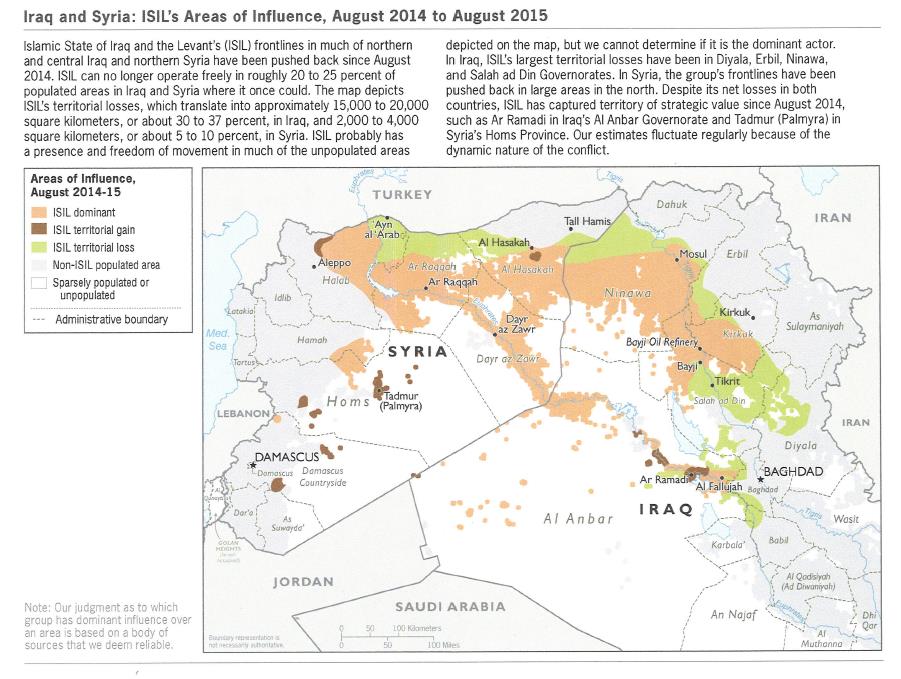
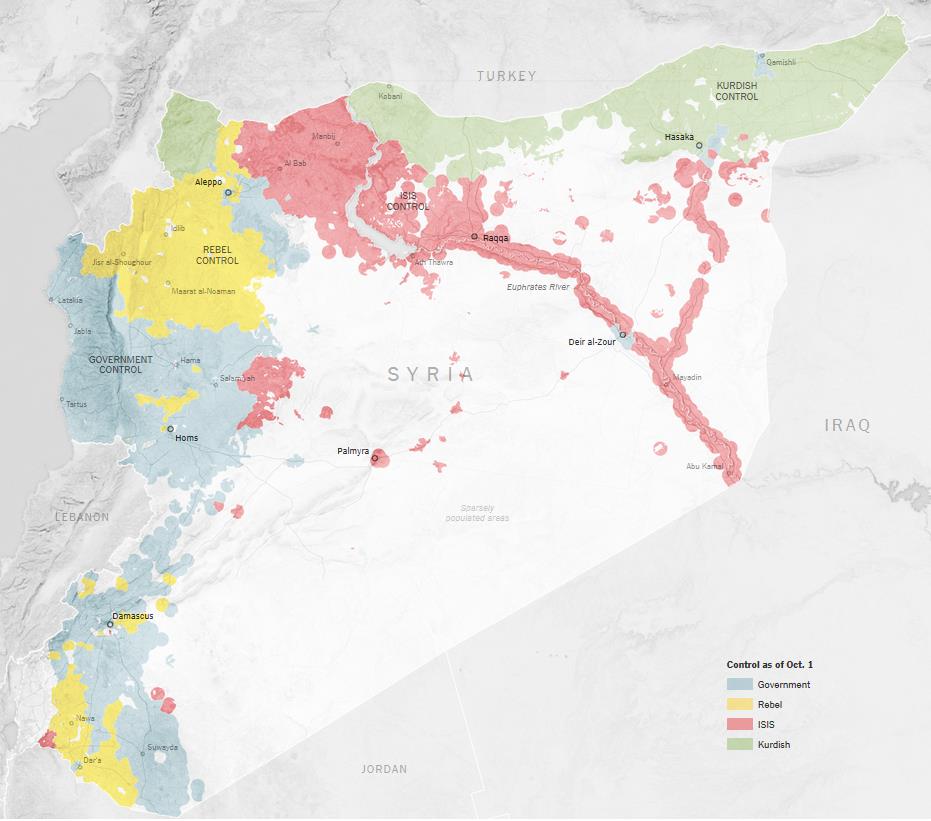
Map: ISIS areas of influence in Syria and Iraq

The following maps come from a recent Congressional Research Service report, “Armed Conflict in Syria: Overview and U.S. Response.”

Iraq and Syria: ISIS’s Areas of Influence, August 2014 to August 2015
img128
Source: Map and text produced by U.S. Department of Defense, September 2015.

Syria Conflict Map: Estimated Areas of Control as of October 1, 2015
Syria-areas-of-control
Source: Tim Wallace, New York Times. Area of control data source is Carter Center, October 1, 2015.
Notes: All areas approximate. Yellow area of “Rebel Control” includes areas under Jabhat al Nusra (Al Qaeda affiliate) control, and includes
areas controlled by a wide variety of anti-Asad forces. White color denotes sparsely populated or unpopulated areas.

Facebooktwittermail

After a U.S. shift, Iran has a seat at talks on war in Syria

The New York Times reports: Just a few weeks ago, Ayatollah Ali Khamenei said any new talks with the United States were forbidden. He described the United States as a persistent enemy of the Islamic revolution, and said that despite the nuclear agreement, it needed to be kept at a distance.

But participating in the multination Syria talks does not contradict Mr. Khamenei’s dictums, some Iranian analysts say.

“Our leader has banned the bilateral relations between Iran and America or any negotiation aimed at resuming relations,” said Hamidreza Taraghi, a political analyst in Tehran considered close to the ayatollah. “Case-by-case negotiations or finding solutions for regional problems on a multilateral basis is all right.”

So, while publicly siding with the hard-liners, the Supreme Leader may well be giving more negotiating room to President Hassan Rouhani, who has advocated more open engagements with the rest of the world. There has already been an unspoken cooperation between Iran and the United States in Iraq, where both are fighting the Islamic State.

“We should thank President Rouhani for his efforts in reaching out to the international community, and the nuclear deal,” said Farshad Ghorbanpour, a political analyst close to the government in Tehran. “Now we are seeing the rewards: We are playing an increasing active role in the international arena.”

That role is something that Iran has desperately sought: Diplomatic weight and respect that bolsters its claim that it, not Saudi Arabia, is the most influential power in the region. “It’s very important because it shows that, following the nuclear agreement, Iran is now ready to cooperate on crisis management in the Middle East,” Seyed Hossein Mousavian, a former Iranian diplomat and nuclear negotiator who now teaches at Princeton, said in a telephone interview. “I’m not surprised, because the leader had said that if the deal were done fairly, with face-saving for all parties, Iran would agree to next steps on other issues. This is a big step forward.”

Cliff Kupchan, an Iran specialist and chairman of the Eurasia Group, a Washington political consultancy, said that given Russia’s recent intervention in Syria to support Mr. Assad, it was clear he would remain in charge for a while, which meant Iran would be attending the Vienna talks from a position of strength.

Still, Mr. Kupchan said in an email, “as U.S.-Iran contacts spread to a broader array of issues, it will be harder and harder for Iranian conservatives to quarantine cooperation.” [Continue reading…]

Facebooktwittermail