The New York Times reports: As Major League Baseball’s top players took the field at the All-Star Game in Minneapolis in July, a covert radar system scanned the sky above the 40,000-seat stadium for what security experts said was an emerging threat to public safety: drones.
Using finely tuned detection programs brought in by the Department of Homeland Security, “Operation Foul Ball,” as it was known, identified several small, commercial drones flying in the area. Some were similar to the quadcopter that crashed on the White House lawn Monday.
But the drone detection system, which was considered one of the most advanced in the country and cost several hundred thousand dollars to operate for just that night, had no way of actually stopping drones from flying into the stadium. There was even confusion about whether one of the drones belonged to ESPN.
Confronted with the system’s cost and limitations, baseball officials decided not to use it for the postseason. But those officials had no warning before a drone hovered over at least one playoff game.
Photo
A drone flew above the scoreboard during a game at Wrigley Field in September in Chicago. Confronted with the cost and limitations of drone detection, Major League Baseball officials concluded that using a detection system again made little sense. Credit Jeffrey Phelps/Getty ImagesThe National Football League will not say what type of system, if any, it will have in place at the Super Bowl in Glendale, Ariz., on Sunday, though the Federal Aviation Administration issued a warning this week that anyone flying drones over an N.F.L. game could be “intercepted, detained and interviewed.”
While drones have not been used in a terrorist attack on American soil, thwarting them is increasingly becoming a challenge for law enforcement and security officials who are charged with protecting large-scale events like the Super Bowl and high-profile public buildings like the White House. The officials have warned that the low-flying devices could be modified to carry explosives, chemicals, biological agents, guns or cameras. [Continue reading…]
Category Archives: Analysis
The ISIS model for expansion
Aaron Y. Zelin writes: The Islamic State announced several months ago that it was “annexing” territory in Algeria (Wilayat al-Jazair), Libya (Wilayat al-Barqah, Wilayat al-Tarabulus and Wilayat al-Fizan), Sinai (Wilayat Sinai), Saudi Arabia (Wilayat al-Haramayn) and Yemen (Wilayat al-Yaman). It is likely that the Islamic State plans to pursue a similar approach in Afghanistan and Pakistan following its announcement of accepting pledges of allegiance from former members of the Afghan and Pakistan Taliban to also try and “annex” territory there under the framework of a new wilayah called “Wilayat Khorasan.” On its face, this bold declaration of an expanding number of wilayat (provinces) resembles the announcements by al-Qaeda of creating numerous franchises in the mid-2000s. The Islamic State’s “wilayat” strategy differs in significant ways from al-Qaeda’s “franchise” strategy, however.
The academic literature has shed great light on the al-Qaeda franchising strategy. In a recent article Daniel Byman highlights a number of key factors within the al-Qaeda network regarding motivations for affiliation and franchising. Typically, affiliates joined up with al-Qaeda as a result of failure. Affiliation helped with financial support; offered a potential haven that could be exploited, along with access to new training, recruiting, publicity and military expertise; gave branding and publicity; and opened up personal networks from past foreign fighter mobilizations. It in turn helps al-Qaeda with mission fulfillment, remaining relevant, providing access to new logistics networks, and building a new group of hardened fighters.
But, Byman argues, those franchises often became as much a burden as an asset as local interests and views diverged with those of the parent organization. Leah Farrall argues that al-Qaeda increasingly came to view franchising “warily” in part due to its inability to always control its new partners such as Abu Musab al-Zarqawi and al-Qaeda in Iraq as well as because of backlash from unsuccessful cooptation of organizations such as the Libyan Islamic Fighting Group or Egyptian Islamic Jihad. This is one of the reasons why, prior to Osama bin Laden’s death, the Somali jihadi group Harakat al-Shabab al-Mujahideen was not given franchise status. Bin Laden had apprehensions about the group’s utility due to past clan infighting and lack of unity. Following the death of bin Laden though, his replacement, Ayman al-Zawahiri, brought Shabab into the fold, but the results have been quite disastrous; Shabab has declined and also was in an internal feud between its foreign and local members. Will the Islamic State’s wilayat pose a similar burden?
There is one key difference between al-Qaeda’s and the Islamic State’s model for expansion. Al-Qaeda wanted to use its new franchises in service of its main priority: attacking Western countries to force them to stop supporting “apostate” Arab regimes, which without the support of Western countries would then be ripe for the taking. This has only truly worked out with its Yemeni branch, al-Qaeda in the Arabian Peninsula (AQAP). On the other hand, while the Islamic State does not have an issue with its supporters or grassroots activists attacking Western countries, its main priority is building out its caliphate, which is evident in its famous slogan baqiya wa tatamaddad (remaining and expanding). As a result, it has had a relatively clear agenda and model: fighting locally, instituting limited governance and conducting outreach. [Continue reading…]
Does defeat in Kobane mark the beginning of the end for ISIS?
A Kurdish marksman stands atop a building as he looks at the destroyed Syrian town of #Kobane. Photo @Kilicbil #AFP pic.twitter.com/iynKSSX1MM
— AFP Photo Department (@AFPphoto) January 30, 2015
Al Jazeera reports: Losing Kobane after more than four months of intense fighting is a significant propaganda blow to ISIL. The group invested extensive military resources to capture the isolated town on the border with Turkey.
“Daesh [ISIL] took most of the places it wanted in Syria and Iraq but could not capture Kobane,” said Anwar Muslim, the prime minister of the self-ruled administration of Kobane, referring to the organisation by its Arabic name.
“This victory marks the beginning of the end for Daesh.”
Kurdish forces have so far taken control of at least three villages in the southern surroundings of Kobane. It will be a highly challenging task for them to expel ISIL from the dozens of villages that dot the plains around the agricultural town. [Continue reading…]
Robin Wright writes: Stuart Jones, the U.S. Ambassador to Iraq, told Al Arabiya last week that more than six thousand militants, including many top commanders, have died in Iraq and Syria since launching their blitz last summer. Some are apparently no longer so keen on martyrdom. The senior Administration official also said that the human toll may be demoralizing to ISIS. “We track quite closely the over-all attrition of its ranks, its vehicles, and the dissension it has caused within the organization,” he said. “We understand that a lot of its fighters now are simply refusing to go to Kobani, and the fighters refusing to go to Kobani are being assassinated by ISIL.”
The campaign has been expensive for the West. The U.S.-led coalition ran more than six hundred airstrikes on Kobani — eighty per cent of all its bombings in Syria — which cost hundreds of millions of dollars. Kobani has certainly paid a price. Fighting and bombings have destroyed half the city, which now has no economy, let alone electricity. There is little left for the forty thousand residents who fled; many may remain refugees for some time.
Kobani’s fate could have little impact on how the rest of Syria fares. It may be true, as the senior Administration official told me, that in areas of northern Iraq where ISIS’s command and control is broken down, “its ability to direct fighters to certain areas of the front — where, whenever fighters go there, they never return — is not nearly what it was four months ago.” But the Islamic State nevertheless appears capable of recruiting more men. Twenty thousand foreigners have now gone to fight in Syria and Iraq. It is “the largest mobilization of foreign fighters in Muslim countries since 1945,” the International Centre for the Study of Radicalisation and Political Violence, at King’s College London, reported on Monday.
The total number of foreign fighters now exceeds that of foreigners mobilized during the ten-year war against the Soviet occupation in Afghanistan, which was the genesis of extremist movements like Al Qaeda. Unlike the situation in the eighties, though, nearly a fifth of today’s fighters — some four thousand — are residents or nationals of Western European countries, the I.C.S.R. reported. The largest numbers come from France, Britain, and Germany. Others come from Ukraine, China, and New Zealand. [Continue reading…]
The surprising alliance that explains Yemen’s political collapse
Peter Salisbury writes: Twelve months ago, Yemeni interim president Abed Rabbo Mansour Hadi stood in front of foreign diplomats and political grandees at Sanaa’s Republican Palace. He declared his country’s political transition to democracy an “unprecedented success.”
In 2011, Yemen’s Arab Spring had threatened to push the country into a debilitating conflict. But remarkably, a deal brokered by the United Nations and the Gulf Cooperation Council prevented a bloody civil war. Longtime president Ali Abdullah Saleh stepped down; Hadi was tasked with overseeing peace talks and the creation of a new constitution.
Initially, these talks went surprisingly well. After decades of instability, a stable, peaceful democracy seemed possible if not probable. Yemen became the last glimmer of hope for Arab countries that had suffered through 2011′s roiling unrest. As Danya Greenfield of the Atlantic Council wrote, achieving consensus of any kind after such an acrimonious period was a “remarkable achievement.”
Today, no one is hopeful. The much-vaunted “Yemen model” for political transition, once mooted as a possible solution for Iraq, Libya and Syria, has been broken beyond repair. [Continue reading…]
Who is in charge in Yemen?
Adam Baron writes: The latest political developments in Yemen — which culminated in the sudden resignation of Prime Minister Khaled Bahah, his Cabinet and President Abd Rabbu Mansour Hadi on Jan. 22 — have left even the most politically consummate Yemenis struggling to put the pieces together.
The country’s widening fault lines are now on full display. Political officials are no longer identified solely by their position but also by their geographical origin, religious background and political history. While many continue to cling to Yemeni nationalism, any remaining sense of unifying links among the country’s various stakeholders appears to be dissipating. If there was any doubt, the succession of local governorates announcing that they will no longer take orders from Sanaa confirmed it.
The roots of the current crisis date back more than a decade before last week’s events. In June 2004 then-President Ali Abdullah Saleh dispatched government forces to arrest Hussein al-Houthi, a charismatic cleric and former member of parliament. Saleh felt increasingly threatened by Houthi’s soaring popularity, due in large part to his sharp critiques of the Yemeni government’s alliance with the United States, the marginalization of the his native province of Saada and the capital’s rampant corruption. He was killed along with more than a dozen followers in the rugged mountains of Marran, according to a statement the government released on Sept. 10, 2004. But his Ansar Allah movement — better known as the Houthis — soldiered on under the leadership of his younger brother, Abdul Malek al-Houthi, as Saleh’s regime waged a series of brutal wars that devastated much of northern Yemen over the past decade. The military campaign further intensified the feelings of marginalization and resentment that laid the seeds for the Houthi rebellion. [Continue reading…]
Torture if you must, but do not under any circumstances call the New York Times
Dan Froomkin writes: Monday’s guilty verdict in the trial of former CIA officer Jeffrey Sterling on espionage charges — for talking to a newspaper reporter — is the latest milepost on the dark and dismal path Barack Obama has traveled since his inaugural promises to usher in a “new era of openness.”
Far from rejecting the authoritarian bent of his presidential predecessor, Obama has simply adjusted it, adding his own personal touches, most notably an enthusiasm for criminally prosecuting the kinds of leaks that are essential to a free press.
The Sterling case – especially in light of Obama’s complicity in the cover-up of torture during the Bush administration – sends a clear message to people in government service: You won’t get in trouble as long as you do what you’re told (even torture people). But if you talk to a reporter and tell him something we want kept secret, we will spare no effort to destroy you.
There’s really no sign any more of the former community organizer who joyously declared on his first full day in office that “there’s been too much secrecy in this city… Starting today, every agency and department should know that this administration stands on the side not of those who seek to withhold information but those who seek to make it known.”
Instead, as author Scott Horton explained to me a few weeks ago, Obama’s thinking on these issues was swayed by John Brennan, the former senior adviser he eventually named CIA director. And for Brennan and his ilk, secrecy is a core value — partly for legitimate national security reasons and partly as an impregnable shield against embarrassment and accountability. [Continue reading…]
Guantánamo Diary
Christian Lorentzen reviews Guantánamo Diary by Mohamedou Ould Slahi: In the autumn of 2001 Mohamedou Ould Slahi was working in Nouakchott, the capital of Mauritania, setting up computer networks. He was born in the hinterlands, son of a nomadic camel trader, and had picked up the trade in Germany; he went to the University of Duisberg on a scholarship in 1988, at the age of 17. He’d long been a fan of the German national football team. He was also devout and had memorised the Koran as a teenager. In 1991 he went to Afghanistan to train with the mujahedin and pledged an oath to al-Qaida. He made another trip the next year, but saw little action fighting Muhammad Najibullah’s communist government before it fell. When the fighting disintegrated into factional struggles, he went back to Germany. He tried once to join the war in Bosnia, but couldn’t get through Slovenia. He worked in Duisberg until 1999, when his visa expired and pressure was coming down from the immigration office. He applied for permanent residency in Canada and went to Montreal, where he led prayers at a mosque attended by an Algerian called Ahmed Ressam. On 14 December 1999, Ressam was arrested at the US border with explosives and timing devices in his rented car. This was the Millennium Plot to blow up Los Angeles International Airport, and though Ressam was a stranger to him it was the start of Slahi’s troubles.
In Montreal he believed he was being watched, possibly through a small hole drilled through his bedroom wall from his neighbour’s flat. (He called the police about it and they told him to fill the hole with caulk.) He was questioned by Canadian intelligence, but let go. Still, he was spooked, and in January 2000 he set off to return to Mauritania, via Dakar; on landing he was picked up by Senegalese special forces. He was rendered to Nouakchott, held for weeks, threatened with torture, and interrogated by Mauritanian intelligence and the FBI. Here was the start of the American authorities’ four-year fixation on two words, ‘tea’ and ‘sugar’, picked up on a tapped phone conversation and presumed to be code. They released him to return to his family. On his way out, the director of Mauritanian intelligence told him: ‘Those guys have no evidence whatsoever.’ [Continue reading…]
Ancient skull sheds light on human dispersal out of Africa
Ivan Semeniuk reports: Francesco Berna still remembers his first visit to Manot Cave, accidentally discovered in 2008 on a ridge in northern Israel. A narrow passage steeply descends into darkness. It then opens onto a 60-metre-long cavern with side chambers, all dramatically ornamented with stalactites and stalagmites.“It’s a spectacular cave,” said Dr. Berna, a geoarcheologist at Simon Fraser University in Burnaby, B.C. “It’s basically untouched.”
Now Manot Cave has yielded a tantalizing sign of humanity’s initial emergence out of Africa and a possible forerunner of the first modern humans in Europe, an international team of researchers that includes Dr. Berna said on Wednesday.
The find also establishes the Levant region (including Israel, Lebanon and part of Syria) as a plausible setting where our species interbred with its Neanderthal cousins.
The team’s key piece of evidence is a partial human skull found during the initial reconnaissance of the cave.
Based on its features and dimensions, the skull is unquestionably that of an anatomically modern human, the first such find in the region. The individual would probably have looked like the first Homo sapiens that appeared in Africa about 200,000 years ago and been physically indistinguishable from humans today.
“He or she would look very modern. With a tie on, you would not be able to tell the difference,” said Israel Hershkovitz, a biological anthropologist at Tel Aviv University and lead author of a paper published this week in the journal Nature that documents the Manot Cave find.
The age of the fossil is the crucial detail. The team’s analysis shows it is about 55,000 years old. That is more recent than the fragmentary remains of some not-so-modern-looking humans that drifted into the region at an earlier stage. But it coincides exactly with a period when a wetter climate may have opened the door to the first modern human migration out of Africa.
Fossils of modern humans that are only slightly less old than the Manot Cave skull have been found in the Czech Republic and Romania, making the new find a potential forerunner of the first Europeans. [Continue reading…]
Much of the reporting on these findings makes reference to “the first Europeans” and even though anthropologists might be clear about what they mean when they use to term Europe, they might consider avoiding using it, given the common meaning that is usually attached to the word.
Indeed, the lead researcher cited above, Israel Hershkovitz, illustrates the problem as he reinforces cultural stereotypes by implying that the human has fully evolved once he adorns the symbol of European, masculine power: a necktie. The irony is compounded by the fact that he and his team were trumpeting the significance of their discovery of a woman’s skull.
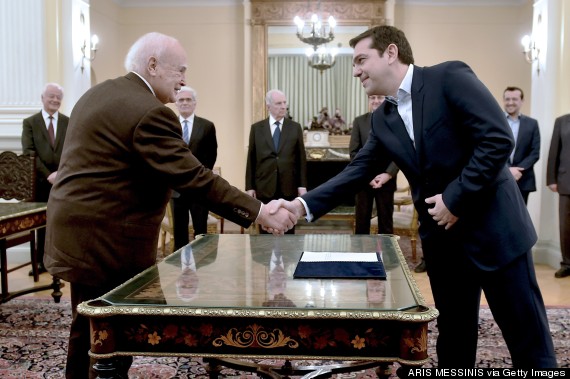
(No doubt many Europeans and others with European affectations have been disturbed this week to see Greece’s new prime minister, in the birthplace of democracy, assuming power without a necktie.)
The Oxford archeologist, Barry Cunliffe, has referred to the region of land that recently got dubbed “Europe” as “the westerly excrescence of the continent of Asia.”
Europeans might object to the suggestion that they inhabit an excrescence — especially since the terms suggests an abnormality — but in terms of continental topography, it points to Europe’s unique feature: its eastern boundaries have always been elastic and somewhat arbitrary.
More importantly, when it comes to human evolution, to frame this in terms of the advance into Europe revives so many echoes of nineteenth century racism.
It cannot be overstated that the first Europeans were not European.
Europe is an idea that has only been around for a few hundred years during which time it has been under constant revision.
Migration is also a misleading term since it evokes images of migrants: people who travel vast distances to inhabit new lands.
Human dispersal most likely involved rather short hops, one generation at a time, interspersed with occasional actual migrations driven by events like floods or famine.
Global democracy is in retreat
The Guardian reports: Global democracy is at greater risk than at any time in the past 25 years, according to a landmark report by the independent watchdog Freedom House.
In the annual report, Discarding Democracy: Return to the Iron Fist, the Washington-based group said 61 countries were going backwards as far as democracy was concerned, compared with only 33 moving forwards. Moreover, some of the transgressors, including Russia, Egypt, Thailand, Nigeria and Turkey, are global or regional powers setting a bad example to others, it said.
Its findings come despite the fact that 2014 was a record year for democracy, with more people casting votes in national ballots than ever before. But holding elections does not always translate into healthy democracy. As the authoritarian Hungarian leader, Viktor Orban, put it: “A democracy does not necessarily have to be liberal.”
“Acceptance of democracy as the world’s dominant form of government – and of an international system built on democratic ideals – is under greater threat than at any other point in the last 25 years,” said Arch Puddington, vice-president for research at Freedom House. [Continue reading…]
Why the Irish political elite is terrified of Syriza
Fintan O’Toole writes: Irish 10-year bond interest rates were trading at under 1.1 per cent at the beginning of this week, while Greek 10-year bond interest rates are close to 9 per cent. There’s a strong financial incentive for Ireland to place as much distance between itself and Greece as it possibly can, all the more so because it is hoping to replace some of its expensive IMF loans with cheaper money raised on those international markets.
But beyond this, there is a deeper terror — the fear that Syriza might actually succeed. The strategy adopted by both the governments that have been in office since 2008 has been one of strict obedience to the demands of its lenders. Everything has been sacrificed — up to and including national sovereignty during the so-called bailout by the Troika — in order to place Ireland as the Eurozone’s exemplary pupil.
There has been a mutual interest at work here. Angela Merkel and the Eurozone leadership need a success story in order to prove that the dual policy of socialising private debt and imposing austerity is both legitimate and effective. The Irish government needs to be able to show its own electorate and international lenders that it is indeed a great success, that the imposition of so much private debt on citizens has made both moral and economic sense.
Hence, Ireland does what it is told and gets in return the gold star for diligence, effort and perseverance. Just last week, the IMF’s Christine Lagarde told The Irish Times that Ireland has “set standards” for other indebted nations to follow — Greece was hardly far from her mind.
If Syriza succeeds in getting major concessions on debt, this whole strategy will be exposed as folly. The Irish political and technocratic elite is deeply invested in an essentially religious narrative: Ireland sinned, Ireland confessed, Ireland did penance, Ireland has been forgiven, Ireland will be rewarded. But if Greece stops doing penance and is nonetheless rewarded, this begins to look like what it almost certainly is — a rather childish view of how power works in the world. [Continue reading…]
Facebook censorship more tangible than its support for free speech
Caitlin Dewey writes: Only two weeks after Facebook CEO Mark Zuckerberg released a strongly worded #JeSuisCharlie statement on the importance of free speech, Facebook has agreed to censor images of the prophet Muhammad in Turkey — including the very type of image that precipitated the Charlie Hebdo attack.
It’s an illustration, perhaps, of how extremely complicated and nuanced issues of online speech really are. It’s also conclusive proof of what many tech critics said of Zuckerberg’s free-speech declaration at the time: Sweeping promises are all well and good, but Facebook’s record doesn’t entirely back it up.
Just this December, Facebook agreed to censor the page of Russia’s leading Putin critic, Alexei Navalny, at the request of Russian Internet regulators. (It is a sign, the Post’s Michael Birnbaum wrote from Moscow, of “new limits on Facebook’s ability to serve as a platform for political opposition movements.”) Critics have previously accused the site of taking down pages tied to dissidents in Syria and China; the International Campaign for Tibet is currently circulating a petition against alleged Facebook censorship, which has been signed more than 20,000 times. [Continue reading…]
Saudi Arabia classified security documents leaked on Twitter
Al-Akhbar reports: The Mufti of Saudi Arabia was right on the mark when he recently said that Twitter was a source of “evil” and a “scourge” for his kingdom. Secret Saudi documents from the interior and defense ministries were leaked on Twitter on Tuesday.
The documents reveal much about the Saudi government’s efforts to spy on its citizens and monitor their accounts, as well as details on arrest warrants and detention of individuals who called for political reform, and the “royal hysteria” over otherwise unremarkable articles published online.
Saudi Arabia being a police state won’t come as news to most people. What is new, however, is that the public can now examine the kingdom’s administrative mechanisms for spying and surveillance — thanks to classified documents leaked on social media sites.
A twitter account called “Monaseron” posted the documents on Tuesday. The account claimed that the set of documents came from the Saudi ministries of interior and defense. [Continue reading…]
ACLU asks judge to block attempt to repossess copies of CIA torture report
The Guardian reports: The American Civil Liberties Union is turning to federal court to stop the chairman of the Senate intelligence committee from repossessing the secret copies of a landmark inquiry into CIA torture.
In an emergency motion filed late on Tuesday, the ACLU asked Judge James Boasberg of the District of Columbia federal district to prevent Senator Richard Burr’s “extraordinary post-hoc request” for all copies of the full, classified 6,900-page report currently held by the Obama administration.
It is part of a persistent effort from human rights groups to keep up pressure for disclosure over one of the most infamous episodes in CIA history, despite moves by both the committee and the CIA to move on.
“The full torture report is critical for meaningful public scrutiny of the CIA’s horrific acts, as well as its lies and evasions to Congress, the courts, and the American public,” said the ACLU attorney Hina Shamsi.
The battle highlights the partisan differences over CIA torture and the investigation of it. The report was produced when the committee was led by the California Democrat Dianne Feinstein. Once Burr, a North Carolina Republican, took over the committee, he moved almost immediately to keep the full report permanently under wraps. [Continue reading..]
French prisons, long hotbeds of radical Islam, get new scrutiny after Paris attacks
The Washington Post reports: The man was sent to France’s largest prison for armed robbery. He emerged a toughened radical who would go on to take part in the bloodiest terrorist attacks on French soil in decades.
France’s prisons have a reputation as factories for radical Islamists, taking in ordinary criminals and turning them out as far more dangerous people. Here at the Fleury-Merogis prison — where Amedy Coulibaly did time alongside another of the attackers in the deadly assaults this month in and around Paris — authorities are struggling to quell a problem that they say was long threatening to explode.
Former inmates, imams and guards all describe a chaotic scene inside these concrete walls, 15 miles from the elegant boulevards surrounding the Eiffel Tower. Militancy lurks in the shadows, and the best-behaved men are sometimes the most dangerous. French Prime Minister Manuel Valls promised last week to flood his nation’s prisons with 60 more Muslim chaplains, doubling their budget to try to combat radicalization. Authorities this week raided 80 prison cells of suspected radicals, saying they found cellphones, USB drives and other contraband. Hundreds of inmates in French prisons are a potential threat, authorities say.
But critics say that these efforts are minuscule compared with the scope of the problem, with prisons so poorly controlled that a leaked French government report once described Osama bin Laden posters hanging on inmates’ walls. The challenge may be compounded by the dozens of people sent to jail after the recent attacks, some for more than a year, under fast-track proceedings in which they were charged with verbal support for terrorism.
“Prison destroys men,” said Mohamed Boina M’Koubou, an imam who works in the Fleury-Merogis prison. “There are people who are easy targets to spot and make into killers.” [Continue reading…]
MI5 says rendition of Libyan opposition leaders strengthened al Qaeda
The Guardian reports: A secret UK-Libyan rendition programme in which two Libyan opposition leaders were kidnapped and flown to Tripoli along with their families had the effect of strengthening al-Qaida, according to an assessment by the UK security service, MI5.
Prior to their kidnap, Abdel Hakim Belhaj and Sami al-Saadi had ensured that their organisation, the Libyan Islamic Fighting Group (LIFG), focused on the overthrow of Colonel Gaddafi, the classified assessment says. Once handed over to the Gaddafi regime, their places at the head of the LIFG were taken by others who wanted to bring the group closer to al-Qaida.
The two men were seized in Thailand and Hong Kong in March 2004 with the assistance of the UK’s intelligence service MI6, and were “rendered” to Tripoli along with Belhaj’s pregnant wife and Saadi’s wife and four children, the youngest a girl aged six.
In an assessment made 11 months later, MI5 concluded that the capture of the pair had cast the group “into a state of disarray”, adding: “While these senior-ranking members have always jealously guarded the independence of the LIFG, providing it with a clear command structure and set goals, the group is now coming under pressure from outside influences.
“In particular, reporting indicates that members including Abu Laith al-Libi and Abdallah al-Ghaffar may be pushing the group towards a more pan-Islamic agenda inspired by AQ [al-Qaida].” [Continue reading…]
Fear and loathing: Argentina’s infamous spy agency
BBC News reports: The death in Argentina of special prosecutor Alberto Nisman, who was found with a bullet in his head hours before presenting evidence before Congress against President Cristina Fernandez de Kirchner, has led to plans to overhaul Argentina’s infamous intelligence service.
Days after Mr Nisman’s body was found on 18 January, Ms Fernandez said his death was part of an intelligence “operation” to harm her government.
On Monday, Ms Fernandez announced the creation of a new body to replace the Intelligence Secretariat (SI), more widely known by its previous initials, Side.
She said the leadership of the new Federal Intelligence Agency would be chosen by the government but would be subject to senate approval.
“We must work to reform the Argentine intelligence system because the one we have has not served the interests of the nation,” she announced in a national address.
The SI is one of Argentina’s most feared and hated state agencies. [Continue reading…]
The New York Times reports: Argentina’s government on Wednesday cast greater suspicion on an aide to Alberto Nisman, the prosecutor whose mysterious death this month has shaken the country, by describing the aide as an intelligence operative — adding to its assertions that rogue spies were involved in the events around Mr. Nisman’s death.
“This kid’s situation is starting to look worrisome,” Aníbal Fernández, the president’s chief of staff, told reporters here Wednesday morning, referring to the aide, Diego Lagomarsino, 35.
Mr. Lagomarsino worked in the prosecutor’s investigative unit as an information technology consultant and lent Mr. Nisman the .22-caliber Bersa pistol used in his death, investigators say. [Continue reading…]
Escalation would benefit neither Israel nor Hezbollah
The Daily Star reports: Within the space of a few hours, two Israeli soldiers were dead, and Wednesday had turned from just another weekday to the day that Lebanese started asking themselves: Are we about to see a repeat of 2006?
That year saw a full-on war with Israel develop following a deadly cross-border attack by Hezbollah on an Israeli patrol. The 2006 war, which ended up costing more than 1,000 lives and severely damaging infrastructure across the country, came after years of “tit-for-tat” incidents between the two sides as part of a carefully calibrated game for which both sides thought they knew the rules.
The name of the unit that attacked an Israeli convoy in the occupied Shebaa Farms Wednesday, killing two and wounding seven others, was the Qunaitra Martyrs – a clear reference to the airstrike last week on a Hezbollah vehicle in Qunaitra, Syria.
That attack killed six party fighters, including the highly symbolic Jihad Mughniyeh – son of assassinated commander Imad – and a senior Iranian military figure. Everyone knew that Hezbollah would have to retaliate.
As a result, most have interpreted the Shebaa Farms incident as part of the contained mini-war between the two sides. But could Hezbollah have been looking for something more following such a bold and humiliating attack on its troops in Syria? Or could their response accidentally have paved the way for something bigger, as it did back in 2006, due to unpredictable internal Israeli factors?
“Never rule out war between these two antagonists,” said Bilal Saab, a senior fellow for Middle East security at the Atlantic Council. “But Hezbollah has already done what it wanted to do: a limited, deadly and precise attack.”
He pointed to the significance of Hezbollah’s decision to respond to the Qunaitra attack from the Shebaa Farms, a heavily disputed territory in the Israeli-occupied Syrian Golan Heights that Lebanon claims as its own.
“The very choice of geography shows the organization does not want to escalate,” Saab said. “It’s cautious, the choice of Shebaa, it means we are back to the previous rules of engagement, which were stable until 2006, when everything broke down.”
“It didn’t attack inside Israel, or inside Syria in the Golan Heights. Hezbollah is not after major escalation, if it was, it could have done much, much more, and Israel understands this,” he added. [Continue reading…]
Ron Ben-Yishai writes: Hezbollah’s “achievement” Wednesday was to shed the blood of Israeli soldiers. Even by Lebanese criteria, this is barely a tactical achievement. For Israel it is – and rightly so – hard to come to terms with the death and injury of its soldiers, but grief in itself does not justify a move that would cause tens and hundreds of deaths and injuries on the Israeli side if and when a third Lebanon war breaks out. This is a cold and cruel consideration – but someone has to do it.
Another consideration is the composition of the government and cabinet. After the dismissal of the Yesh Atid and Hatnua ministers, the security cabinet is purely rightwing; it is devoid of legitimacy and a balance that is vital to decisions on war and peace.
The final consideration concerns the upcoming elections. If the present government decides on a harsh response that would trigger a major escalation, it would almost immediately be accused of dragging Israel into a political war designed to serve the ends of Netanyahu, Avigdor Lieberman and Naftali Bennett. No rational arguments, strategic justifications and considerations of national pride would help Israel’s current political leadership. They would suffer a defeat at the polls.
Hezbollah ambush kills at least 2 Israeli soldiers
The Daily Star reports: Hezbollah fighters attacked an Israeli military convoy Wednesday in the occupied Shebaa Farms, in south Lebanon, killing at least two soldiers and wounding seven, in retaliation for Israel’s recent airstrike in the Golan Heights.
A U.N. Spanish peacekeeper was also killed in the heavy exchange of fire that followed the Hezbollah attack, as UNIFIL commander Maj. Gen. Luciano Portolano urged “maximum restraint” from all parties to prevent escalation on the Lebanese-Israeli frontier.
Media reports had earlier said that four Israeli soldiers were killed in the attack.
A security source told The Daily Star that 30 shells were fired from the Israeli side across the Lebanese border following the 11:30 a.m. attack that struck a convoy, destroying at least two vehicles. Hezbollah’s Al-Manar TV said the attack destroyed 9 vehicles.
Hezbollah claimed the attack on the Israeli military convoy in a statement.
“At 11:25 [Wednesday morning] the Qunaitra Martyrs unit targeted with appropriate missile weapons an Israeli military convoy comprising several vehicles and [transporting] Zionist officers and soldiers causing the destruction of several vehicles and inflicting many casualties on the enemy,” the brief statement read.
According to Israeli media, a number of Israeli Army troops were being treated with “light-to-moderate wounds” at a hospital in Safed.
About two hours after the initial attack, Israeli warplanes carried out mock air raids over the scene of the attack as their soldiers lobbed shells into Shebaa Farms and the surrounding hills.
Israeli Prime Minister Benjamin Netanyahu threatened to make Hezbollah “pay” for the attack.
“Those behind the attack today will pay the full price,” Netanyahu said, after cutting a trip to Sderot short to visit the Defense Ministry for “consultations.” [Continue reading…]