So many years and wars later, it’s easy to forget what a total television hit the first Gulf War of 1991 was. Just in case you no longer remember — and why should you? — that was the war that was to bury America’s defeat in Vietnam forever and signal the arrival of the greatest Great Power the planet had ever known, the soon-to-be-Soviet-Union-less United States. That first partial invasion of Iraq, with its million or more uniformed extras, its vast sets, and its six-month preproduction schedule filled with logistical miracles, was something to behold. All through the winter of 1990, the production had its built-in “coming attractions,” the many variations on “showdown in the Gulf” with Saddam Hussein, the glowering guy with the black mustache who had, until more or less the previous night, been Washington’s man in Baghdad.
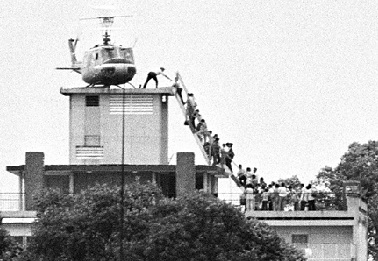
Those previews of the war-to-come teased American viewers with a possible January opening in domestic multiplexes nationwide. And when it arrived, the production didn’t disappoint. It had its dazzling Star Wars-style graphics, its own theme music and logos, and its stunningly prime-timed first moments (Disneyesque fireworks over Baghdad). As a show, it was calibrated for controlled thrills, anxiety, and relief from its opening laser-guided, son et lumière spectacular to its final triumphant helicopter descent on the U.S. embassy in Kuwait (which was meant to replay in reverse indelible final images of helicopters fleeing Saigon).
And what a show that war was, a kind of program-length commercial similar to those pioneered by toy companies in the previous decade that had turned TV cartoons into animated toy catalogs. It was as if the whole post-Vietnam era had been building toward nothing but that 43-day-long ad, intent on selling domestic and foreign markets on the renewal of American power as well as on the specific weapons systems that were renewing that power. In this way, the Gulf War of 1991 hawked the leading-edge aspects of the country’s two foremost exports: arms and entertainment.
Almost a quarter of a century later, amid the rubble of a chaotic Greater Middle East, America’s third Iraq war drags on, as Washington officials insist that it has years still to go. Meanwhile, Iraq itself, having experienced two American invasions, a prolonged occupation, and an era of “reconstruction” (which proved to be largely an era of deconstruction), as well as the birth of a jihadist oil-mini-state in its midst, now threatens to split into Shiite, Sunni, and Kurdish cantonments. Given what’s happened in the 24 years since, who now remembers any of the triumphalist glories of that first conflict in the Gulf? And here’s a guarantee: no matter how few still remember the highlight reels from that moment, even fewer remember the American war that, in a sense, began it all, the one that TomDispatch regular Greg Grandin, author of The Empire of Necessity: Slavery, Freedom, and Deception in the New World, recalls today: the invasion of Panama. Tom Engelhardt
The war to start all wars
The 25th anniversary of the forgotten invasion of Panama
By Greg GrandinAs we end another year of endless war in Washington, it might be the perfect time to reflect on the War That Started All Wars — or at least the war that started all of Washington’s post-Cold War wars: the invasion of Panama.
Twenty-five years ago this month, early on the morning of December 20, 1989, President George H.W. Bush launched Operation Just Cause, sending tens of thousands of troops and hundreds of aircraft into Panama to execute a warrant of arrest against its leader, Manuel Noriega, on charges of drug trafficking. Those troops quickly secured all important strategic installations, including the main airport in Panama City, various military bases, and ports. Noriega went into hiding before surrendering on January 3rd and was then officially extradited to the United States to stand trial. Soon after, most of the U.S. invaders withdrew from the country.
In and out. Fast and simple. An entrance plan and an exit strategy all wrapped in one. And it worked, making Operation Just Cause one of the most successful military actions in U.S. history. At least in tactical terms.



 Now, scientists say a peculiar event took place just two days before the storm: Flocks of songbirds fled the area en masse. Many golden-winged warblers had just finished a 1,500-mile migration to Tennessee when they suddenly flew south on a 900-mile exodus to Florida and Cuba. At that time, the storm was somewhere between 250 and 560 miles away. The researchers said that the birds somehow knew about the impending storm.