Paul Goble writes: Commentators have long celebrated the fact that the USSR broke up with little violence in 1991 – the conflicts in Abkhazia, Tajikistan, Nagorno-Karabakh, Transdniestria and Chechnya typically have been treated as exceptions that prove the rule. But now, many of the unresolved issues from 23 years ago are leading to violence as in Ukraine.
In an editorial article in today’s Vedomosti, Nikolay Epple and Maksim Trudolyubov argue that for two decades, Russia and Ukraine sought to avoid the outcome that had occurred in Serbia and Croatia, but that did not mean that “the revolutionary processes” in the two were “overcome but only “put off”.
The ongoing crisis in Ukraine shows more sharply than ever before that Ukrainians cannot avoid facing some critical issues any longer, including “the geopolitical choice between Europe and Russia, real sovereignty or dependence on ‘the elder brother,’ the unification of the country on the basis of a new national self-consciousness or its split via ‘federalization.’”
And “the development of the postponed revolution in Ukraine will inevitably have an impact on Russia as well” because “the exit of Ukraine from the post-Soviet space will confront Russia with the need to reformat its own historical matrix.” [Continue reading…]
Category Archives: Analysis
Ukraine crisis showcases Russian military revamp
Reuters reports: Holding military drills on Ukraine’s border and sending bombers to the edge of NATO airspace, Russia’s newly reformed armed forces are in just the kind of regional confrontation it was redesigned for, experts say.
Moscow has increased defence spending by about 30 percent since its 2008 war with Georgia, and those who study it say the money has been spent not just on hardware but on a much more flexible military structure.
The result, they say, is a more streamlined force that can mobilise key units in a matter of days and support President Vladimir Putin’s goal to reassert Russian influence over countries it once controlled within the former Soviet Union. [Continue reading…]
Persistent Saudi-U.S. differences hurt Syria strategy
Reuters reports: Differences between the United States and Saudi Arabia over Middle East policy persist, despite attempts to shore up their old alliance, and may prove calamitous for Syrian rebels.
Although there is evidence that some American weapons are starting to find their way to more moderate groups fighting Syrian President Bashar al-Assad, disagreements over what to supply, and to whom, have hindered the fight.
Rebels lament a lack of anti-aircraft missiles to help counter Assad’s air force.
Saudi Arabia and Qatar have been funding the rebels for years now, arguing that the war in Syria is a battle for the future of the Middle East, pitting pro-Western forces against Riyadh’s main enemy Iran and Islamist militants.
However, while the administration of U.S. President Barack Obama also blames Assad for the violence and wants him to leave power, it sees the conflict very differently.
American officials fear involvement in a messy civil war for which they see no clear military solution and which threatens to radicalize a new generation of Islamists who hate the West.
Among the rebels, the failure of the Saudis and the Americans to cooperate better stirs disillusion. Two hours of talks between Obama and Saudi King Abdullah in March appear to have done little to alter that sentiment. [Continue reading…]
Saudi Arabia’s military exercise was a goodbye wave to America
Faisal Al Yafai writes: When one of the most powerful militaries in the Middle East holds the largest military exercise in its history, the region and allies would be wise to look beyond the explosions and manoeuvres at the political intent.
Last week’s “Abdullah Sword” military exercises in the north-east of Saudi Arabia brought together 130,000 troops, as well as military jets, helicopters and ships. With the notable exception of Qatar, all the GCC countries were there to observe the exercises, as well as the head of Pakistan’s army.
On the surface, the exercises were timed to coincide with the ninth anniversary of the accession of King Abdullah of Saudi Arabia. But military movements of this order send messages. But to whom?
The obvious answer is Iran, Saudi’s great regional rival, or one of the three states that the Saudis are most concerned about – Syria, Iraq or Yemen. And it will not have escaped Tehran’s notice that the CSS-2 ballistic missiles that Riyadh paraded for the first time last week can easily reach any part of Iran.
Certainly, a message of strength was being telegraphed to the region. But there was also another one, over the heads of the region, to the United States: if you leave, the region can defend itself. [Continue reading…]
Why China hates being No. 1
Minxin Pei writes: Few countries would turn down the title of world’s largest economy. You can count China among them.
Only the United States has enjoyed the immense power and prestige conferred by this position in the last 140 years (the U.S. surpassed Great Britain as the world’s largest economy in 1872 and has held the spot ever since). But last week, the Chinese government reacted with thinly disguised animosity to an authoritative economic report announcing that China would overtake the United States in 2014 as the world’s largest economy in terms of purchasing power parity (PPP).
According to the International Comparison Program of the World Bank, in 2011, the Chinese economy totaled $13.5 trillion in purchasing power parity. It is on target to grow 24% between 2011 and 2014, compared to 7.6% cumulative growth for the U.S. For its part, the U.S. had $15.5 trillion in PPP in 2011. The Chinese economy at the end of this year is expected to have $16.7 trillion in PPP, slightly bigger than the $16.6 trillion projected for the U.S.
Before the release of the latest World Bank report, the consensus estimate among economists was that China would surpass the U.S. as the world’s largest economy in PPP terms in 2019. That China has managed to catch up with the U.S. five years sooner is largely due to the effects of the financial crisis and the Great Recession, which caused anemic growth in the U.S. but affected the Chinese economy only moderately.
Instead of bragging about its coronation as the world’s No. 1 economy, China first tried to delete the reference to the new PPP estimate of its economy in the World Bank report and then all but suppressed its coverage within China’s domestic media.
On the surface, Beijing’s unfriendly reaction makes no sense. Ever since the Tiananmen crackdown in 1989, the Chinese Communist Party has relied on economic growth as the most important source of its legitimacy. Being crowned the world’s largest economy should only help reinforce the party’s claims of credit for bringing prosperity and international respect to China. And Chinese foreign policymakers have been skillfully playing the expectations game around the world. By pointing to the inevitable rise of China as the world’s largest economy and the relative decline of the U.S., Beijing has had considerable success in changing the economic and geopolitical calculations in many capitals, notably in Africa, Latin America, and the Middle East.
So, why does Beijing dislike being called No. 1 now? [Continue reading…]
Is Net neutrality dead?
Bill Moyers: If I told you that sovereign powers were about to put a toll booth on the street that leads from your house to the nearest Interstate, allowing your richest neighbors to buy their way to the open road while you were sent to the slow lane, you would no doubt be outraged. Well, prepare to scream bloody murder, because something like that could be happening to the Internet. [Transcript]
The reasons the negotiations between Israel and the Palestinians collapsed
This week the Israeli columnist, Nahum Barnea, spoke to senior American officials involved in Secretary of State John Kerry’s peace effort and heard their explanation for the talks’ failure. Barnea writes, “what they told me is the closest thing to an official American version of what happened.”
Let’s go back to the beginning. Was this round not doomed for failure from day one?
“The negotiations had to start with a decision to freeze settlement construction. We thought that we couldn’t achieve that because of the current makeup of the Israeli government, so we gave up. We didn’t realize Netanyahu was using the announcements of tenders for settlement construction as a way to ensure the survival of his own government. We didn’t realize continuing construction allowed ministers in his government to very effectively sabotage the success of the talks.
“There are a lot of reasons for the peace effort’s failure, but people in Israel shouldn’t ignore the bitter truth – the primary sabotage came from the settlements. The Palestinians don’t believe that Israel really intends to let them found a state when, at the same time, it is building settlements on the territory meant for that state. We’re talking about the announcement of 14,000 housing units, no less. Only now, after talks blew up, did we learn that this is also about expropriating land on a large scale. That does not reconcile with the agreement.
“At this point, it’s very hard to see how the negotiations could be renewed, let alone lead to an agreement. Towards the end, Abbas demanded a three-month freeze on settlement construction. His working assumption was that if an accord is reached, Israel could build along the new border as it pleases. But the Israelis said no.”
[…]
Compare the current round of talks to Henry Kissinger’s efforts after the 1973 Yom Kippur War, an effort that led to disengagement agreements between Israel and Syria, and Israel and Egypt. Compare it to James Baker’s effort after the first Gulf War, an effort that led to the Madrid Peace Conference in 1991.“At the end of a war there is a sense of urgency,” they said. And then one of them added bitterly: “I guess we need another intifada to create the circumstances that would allow progress.
“20 years after the Oslo Accords, new game rules and facts on the ground were created that are deeply entrenched. This reality is very difficult for the Palestinians and very convenient for Israel.”
[…]
Were you surprised when you discovered that the Israelis don’t really care what happens in the negotiations?“Yes, we were surprised. It surprised us all along the way. When (Moshe) Ya’alon, your defense minister, said that the only thing Kerry wants is to win a Nobel Prize, the insult was great. We were doing this for you and for the Palestinians. Of course, there were also American interests at play.
“A lot of people told us – ‘don’t stop. Keep going.’ We told them: ‘It’s in your hands. Take responsibility for your own fate.’ But, stuck in their own ways, they preferred we do their job for them. Public apathy was one of our biggest problems.
“One of the Palestinians who participated in the talks told an Israeli participant: ‘You don’t see us. We’re transparent, we’re hollow.’ He had a point. After the second intifada ended and the separation barrier was built, the Palestinians turned into ghosts in the eyes of the Israelis – they couldn’t see them anymore.”
It almost sounds like you wish for an intifada.
“Quite the opposite, it would be a tragedy. The Jewish people are supposed to be smart; it is true that they’re also considered a stubborn nation. You’re supposed to know how to read the map: In the 21st century, the world will not keep tolerating the Israeli occupation. The occupation threatens Israel’s status in the world and threatens Israel as a Jewish state.”
The world is being self-righteous. It closes its eyes to China’s takeover of Tibet, it stutters at what Russia’s doing to Ukraine.
“Israel is not China. It was founded by a UN resolution. Its prosperity depends on the way it is viewed by the international community.”

Behind the masks in Ukraine, many faces of rebellion
The New York Times reports from Slovyansk: The rebel leader spread a topographic map in front of a closed grocery store here as a Ukrainian military helicopter flew past a nearby hill. Ukrainian troops had just seized positions along a river, about a mile and a half away. The commander thought they might advance.
He issued orders with the authority of a man who had seen many battles. “Go down to the bridge and set up the snipers,” the leader, who gave only a first name, Yuri, said to a former Ukrainian paratrooper, who jogged away.
Yuri commands the 12th Company, part of the self-proclaimed People’s Militia of the Donetsk People’s Republic, a previously unknown and often masked rebel force that since early April has seized government buildings in eastern Ukraine and, until Saturday, held prisoner a team of European military observers it accused of being NATO spies.
His is one of the faces behind the shadowy paramilitary takeover. But even with his mask off, much about his aims, motivations and connections remains murky, illustrating why this expanding conflict is still so complex.
Yuri, who appears to be in his mid-50s, is in many ways an ordinary eastern Ukrainian of his generation. A military veteran, he survived the Soviet collapse to own a small construction business in Druzhkovka, about 15 miles south of here.
But his rebel stature has a particular root: He is also a former Soviet special forces commander who served in Afghanistan, a background that could make him both authentically local and a capable Kremlin proxy.
In this war, clouded by competing claims on both sides, one persistent mystery has been the identity and affiliations of the militiamen, who have pressed the confrontation between Russia and the West into its latest bitter phase.
Moscow says they are Ukrainians and not part of the Russian armed forces, as the so-called green men in Crimea turned out to be.
Western officials and the Ukrainian government insist that Russians have led, organized and equipped the fighters.
A deeper look at the 12th Company — during more than a week of visiting its checkpoints, interviewing its fighters and observing them in action against a Ukrainian military advance here on Friday — shows that in its case neither portrayal captures the full story. [Continue reading…]
Death stalks Muslims as Myanmar cuts off aid
The New York Times reports: By the time the baby girl was brought to the makeshift pharmacy, her chest was heaving, her temperature soaring. The supply of oxygen that might have helped was now off limits, in a Doctors Without Borders clinic shut down by the government in February.
A hospital visit was out of the question; admission for Rohingya Muslims, a long-persecuted minority, always requires a lengthy approval process — time that the baby, named Parmin, did not have. In desperation, the pharmacy owner sent the family to the rarely staffed Dapaing clinic, the only government emergency health center for the tens of thousands of Rohingya Muslims herded into displaced people’s camps. Although it was just 4 p.m., the doors were shuttered.
“We became like crazy people, running everywhere,” the child’s grandmother, Daw Mu Mu Lwin, said. With no good choices left, the family returned to the pharmacy, where Parmin died, untreated, three and a half hours later, cradled in her grandmother’s arms.
The baby’s death was part of a rapidly expanding death toll and humanitarian crisis among the Rohingya, a Muslim minority that Myanmar’s Buddhist-led government has increasingly deprived of the most basic liberties and aid even as it trumpets its latest democratic reforms. [Continue reading…]
How Russia conquered Eastern Ukraine without firing a shot
James Miller writes: Ever since it became clear that Russian forces were operating in Crimea, it’s been a pretty safe assumption that almost any information flowing out of Moscow has been BS used to justify Russia’s Ukrainian land grab.
But Russia had been slowly choking off dissent and independent media long before its takeover of Crimea — it’s just that the Kremlin accelerated the process once the crisis began. And that was no accident, as the dissemination of propaganda is a crucial part of Moscow’s strategy to gain control of eastern (and perhaps the rest of) Ukraine.
On the surface, it appears that Vladimir Putin is poised to use the same strategy he employed in Crimea. Soon after then-president Viktor Yanukovych fled Ukraine, spetsnaz (Russian Special Forces) airborne units joined with personnel from the Black Sea fleet who were already stationed on the Crimean peninsula, then proceeded to capture government buildings, erect checkpoints, and eventually gain control of the entire region. With the peninsula under Russia’s military control, Moscow installed allies in the Crimean government, held a referendum, and used the result — an unconstitutional sham in which even children voted — to justify the official annexation of Crimea into the Russian Federation.
A close look at what’s been happening in eastern Ukraine reveals key differences, however. For starters, eastern Ukraine didn’t already have Russian military installations and troops stationed there. In addition, eastern Ukraine is much larger, with a far bigger population. Traditional thinking holds that in order to control a region that large, Russia would need a full-scale military invasion — and with tens of thousands of troops and armored vehicles stacked up just a few miles from Ukraine’s border, many observers are waiting for those forces to inevitably pour in.
But that may never need to happen, because Russia has a weapon at its disposal in eastern Ukraine that has arguably proved more effective than all of its military hardware could have ever been. This weapon has already defeated anything the interim government in Kiev — or the entirety of the international community, for that matter — has wielded against it.
That weapon is the Kremlin’s propaganda machine. [Continue reading…]
Ukraine crisis: The strategic importance of Slavyansk
RUSI Analysis: The Ukrainian military operation that began this morning (2 May) in Slavyansk seems to have been directed against a lesser problem for the Kiev government than anything that has happened recently in Donetsk, Luhansk or Kharkiv. But there are hard strategic reasons why this small city has become the new focus of the Ukrainian crisis over recent days. It is at the centre of an escalating game of deterrence that both Kiev and Moscow are playing against each other.
In the event of a conventional Russian military invasion of the territories of eastern Ukraine it is highly unlikely that Kiev’s troops could do more than buy a certain amount of time. In any direct military confrontation Ukrainian forces would lose. That does not mean, however, that the government in Kiev is without any military cards to play.
Kiev knows that it has a strategic reserve of Kalashnikov assault rifles and other light weapons stored in Ukraine as a mobilisation reserve dating back to Soviet times. It has hinted quietly but strongly in back channels between Ukrainian and Russian military establishments that it might be prepared to open this strategic reserve of weapons to an eastern Ukrainian population prepared to resist any Russian military incursions. Since the stockpile consists of up to five million weapons, the prospect would be a nightmare for Russian military planners if they realistically prepared to move into eastern areas of Ukraine. The prospect of civil war and an anti-Russian insurgency on an unprecedented scale with unpredictable consequences represents a real – if extremely dangerous – bargaining chip for Kiev. [Continue reading…]
This map shows how Russia is deploying military assets near border with Ukraine http://t.co/cOa01ABHVX pic.twitter.com/CxCf8UDEum
— Washington Post (@washingtonpost) May 2, 2014
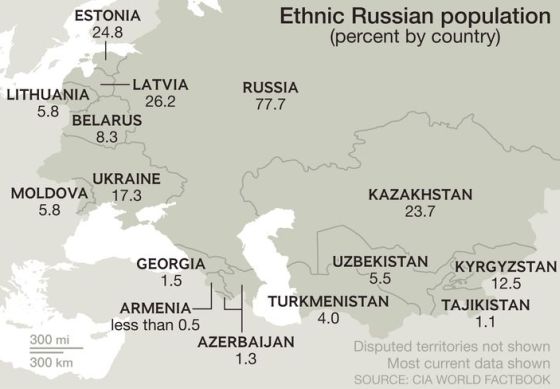
Ethnic Russians: Pretext for Putin’s Ukraine invasion?

National Geographic: It’s been more than 20 years since the disintegration of the U.S.S.R., but the effect of that breakup on its people remains a daily reality for many. Almost overnight, some 25 million ethnic Russians became a diaspora. By 2003, about eight million of them were reabsorbed by Russia. About half of that number came from Central Asia, where relations between Russians and the indigenous Turkic nationalities were often strained.
Relations have also been fraught with difficulty in the Baltic countries where ethnic Russians have been particularly vocal about feeling disenfranchised after independence. About one-third of ethnic Russians living in Latvia are considered “non-citizens” and not allowed certain rights, including the right to vote or hold office. The country has been reprimanded by the UN for failing to encourage integration, yet, at the same time, intermarriage between ethnic Latvians and Russians has increased after independence despite official tensions. Intermarriage has long been common between ethnic Russians and Ukrainians as well — yet another factor that could complicate identity issues as parts of Ukraine vote on whether to secede.
Are there other post-Soviet countries with large Russian populations that could soon face the kind of upheaval that Crimea and eastern Ukraine are experiencing? Historian [Alexei] Miller says the answer doesn’t just lie in where you can find ethnic Russians on a map — but also on whether the Kremlin might benefit from becoming entangled in yet another crisis.
“What Putin is doing in Ukraine is not caused by the wish to save Russians but by geo-strategic motives,” Miller says, adding that Russia’s motivations may be much like those of the U.S. when it says it is fighting for democracy—in countries that happen to have oil riches. The question other former republics must ask, he says, is, “Do we really treat Russians fairly enough, and does Putin have enough important strategic interests in our country to use discrimination of Russians as an instrument of his involvement?”
How Putin has turned organized crime into a tool of statecraft and war
Mark Galeotti writes: When U.S. Secretary of State John Kerry accused Russia of trying to impose its will through the “barrel of a gun and the force of a mob,” he could just as well have said “the force of the mob.” After all, this is the new model of asymmetric conflict in which Moscow is using myriad covert, third-party, and deniable agents to extend its power. Among them are local gangsters, both petty and powerful, who are providing everything from local political allies to street muscle. In the process, Moscow is demonstrating the extent to which organized crime can be used as a tool of statecraft and war.
Although Russian state agents clearly are working in eastern Ukraine, from Spetsnaz special forces to intelligence officers, the exact number is hard to define. In any case, it is undeniable that the overwhelming majority of the camouflaged gunmen seizing buildings, blocking roads, and skirmishing with loyalist forces are either locals — including defectors from the notorious Berkut special police — or else irregular Russian volunteers who have been allowed or encouraged to cross the border and join the conflict.
Some in the new generation of local paramilitary commanders — warlords, we’d call them in other settings — appear to be gangsters who have spotted an opportunity to convert underworld might into upperworld power. The infamous Russian lieutenant colonel who appeared to introduce the Horlivka police to their new commander in mid-April was later identified as a local criminal, for example. More seriously, a closer look at some of the figures emerging as power brokers in the Russian-dominated east reveals distinctly dubious ties.
To a large extent this reflects the endemic criminalization of the Ukrainian state under successive leaders. Like Russia, Ukraine experienced a massive upsurge in organized crime in the 1990s, when new political and economic systems were being created at a time of catastrophically weak state control. Overt gangsterism in the streets was matched by the rise of a new elite who often blended political, economic, and criminal enterprises. Unlike Russia, though, there was no subsequent reassertion of the primacy of the state, something that did not so much eliminate organized crime as house-train it, bringing it back under the dominance of the political elite.
As a result, Ukraine headed into this current crisis already undermined and interpenetrated by criminal structures closely linked to cabals of corrupt officials and business oligarchs. However, a particular problem is the extent to which many local gangs — and not just in the Russian-speaking east — are connected with Russian organized crime networks. In Crimea, not only was the new premier, Sergei Aksyonov, allegedly a mobster nicknamed “Goblin” in the 1990s (he has denied this, but the one time he tried challenging the claim in court, his case was dismissed), but the new political elite is drawn largely from the former one, richly seeded with known and identified criminals. [Continue reading…]
U.S. sanctions on Russia have so far had little tangible effect
The New York Times reports: As it tries to punish Moscow for its intervention in Ukraine, the White House asserts that the sanctions it has imposed have had a “significant impact” on Russia’s economy, but their real effect so far, according to economic specialists, appears to be more psychological than tangible.
White House officials have pointed to the fall of the Russian ruble and Moscow stock markets as evidence of the success they have had in pressuring the Kremlin. Yet the ruble and Russian markets fell before President Obama began imposing sanctions. Today, in fact, both the ruble and the markets are slightly stronger than they were before the first sanctions were announced.
Russia’s economic downturn predated any action by the United States or Europe and, to some extent, predated the Ukraine crisis. Specialists said the volatility surrounding Ukraine has clearly aggravated Russia’s economic problems by sapping international confidence, punishing its credit standing and increasing investor wariness, but it is not clear how much of that stems specifically from the sanctions. [Continue reading…]
The Wall Street Journal reports: Angela Merkel is carrying a clear message from Germany’s business lobby to the White House: No more sanctions.
Several of the biggest names in German business — including chemical giant BASF, engineering group Siemens AG, Volkswagen AG, Adidas AG and Deutsche Bank AG — have made their opposition to broader economic sanctions against Russia clear in recent weeks, both in public and in private. (Read the latest updates on the crisis in Ukraine.)
As a result, Germany’s position on additional, tougher sanctions is unlikely to shift, barring a dramatic escalation of the conflict in Ukraine — a message Ms. Merkel is expected to deliver to President Barack Obama when they meet in Washington on Friday, officials in Berlin say. [Continue reading…]
Neanderthals were not less intelligent than modern humans, scientists find
The Guardian reports: Scientists have concluded that Neanderthals were not the primitive dimwits they are commonly portrayed to have been.
The view of Neanderthals as club-wielding brutes is one of the most enduring stereotypes in science, but researchers who trawled the archaeological evidence say the image has no basis whatsoever.
They said scientists had fuelled the impression of Neanderthals being less than gifted in scores of theories that purport to explain why they died out while supposedly superior modern humans survived.
Wil Roebroeks at Leiden University in the Netherlands said: “The connotation is generally negative. For instance, after incidents with the Dutch Ajax football hooligans about a week ago, one Dutch newspaper piece pleaded to make football stadiums off-limits for such ‘Neanderthals’.”
The Neanderthals are believed to have lived between roughly 350,000 and 40,000 years ago, their populations spreading from Portugal in the west to the Altai mountains in central Asia in the east. They vanished from the fossil record when modern humans arrived in Europe.
The reasons for the demise of the Neanderthals have long been debated in the scientific community, but many explanations assume that modern humans had a cognitive edge that manifested itself in more cooperative hunting, better weaponry and innovation, a broader diet, or other major advantages.
Roebroeks and his colleague, Dr Paola Villa at the University of Colorado Museum in Boulder, trawled through the archaeological records to look for evidence of modern human superiority that underpinned nearly a dozen theories about the Neanderthals’ demise and found that none of them stood up.
“The explanations make good stories, but the only problem is that there is no archaeology to back them up,” said Roebroeks.
Villa said part of the misunderstanding had arisen because researchers compared Neanderthals with their successors, the modern humans who lived in the Upper Palaeolithic, rather than the humans who lived at the same time. That is like saying people in the 19th century were less intelligent than those in the 21st because they didn’t have laptops and space travel.
“The evidence for cognitive inferiority is simply not there,” said Villa. “What we are saying is that the conventional view of Neanderthals is not true.” The study is published in the journal Plos One. [Continue reading…]
It’s always worth remembering that modernity as it is lived (rather than as it is written about) is nothing more than a name for the present — that point which stands right on the edge of an unknown future. In this sense all humans and other hominids have lived in a modern condition and their innovations have been defined by what was contemporary.
If comparisons can usefully be made between humans and their closest kin at different points in history, rather than judge them on the basis of the artifacts they have created, a more interesting question is how well each has been attuned to the environment that supports them.
That attunement probably cannot be scientifically quantified since in part it would have to be measured through attributes that might leave no physical traces — such as knowledge about the medicinal properties of plants.
Since the arc of human progress has largely been defined by our increasing ability to cut ourselves off from the world in which we live, in terms of environmental attunement, the human of today is less advanced than a Neanderthal.
Ukraine and the fear of war in Europe
Der Spiegel reports: Following the apparent failure of the Geneva agreements, the inconceivable suddenly seems possible: the invasion of eastern Ukraine by the Russian army. Fears are growing in the West of the breakout of a new war in Europe.
These days, Heinz Otto Fausten, a 94-year-old retired high school principal from Sinzig, Germany, can’t bear to watch the news about Ukraine. Whenever he sees images of tanks on TV, he grabs the remote and switches channels. “I don’t want to be subjected to these images,” he says. “I can’t bear it.”
When he was deployed as a soldier in the Ukraine, in 1943, Fausten was struck by grenade shrapnel in the hollow of his knee, just outside Kiev, and lost his right leg. The German presence in Ukraine at the time was, of course, part of the German invasion of the Soviet Union. But, even so, Fausten didn’t think he would ever again witness scenes from Ukraine hinting at the potential outbreak of war.
For anyone watching the news, these recent images, and the links between them, are hard to ignore. In eastern Ukraine, government troops could be seen battling separatists; burning barricades gave the impression of an impending civil war. On Wednesday, Russian long-range bombers entered into Dutch airspace — it wasn’t the first time something like that had happened, but now it felt like a warning to the West. Don’t be so sure of yourselves, the message seemed to be, conjuring up the possibility of a larger war. [Continue reading…]
How a passive police force is fueling Ukraine’s crisis
Dan Peleschuk reports: A rally by pro-Ukraine supporters here on Monday night got off to a smooth start.
Hordes of armored police were dispatched to guard protesters as they marched peacefully down the city’s main street.
But when pro-Russian thugs wearing masks and brandishing crude weapons caught up to them, mayhem ensued. The tight police cordon peeled away, leaving the pro-unity protesters open to vicious beatings.
It’s not the first time that’s happened.
Whether it’s protecting eastern Ukraine’s embattled pro-unity protesters or defending local administrative buildings from seizures by anti-government rebels, law enforcement here has proven largely useless. Instead, it’s playing into the hands of pro-Russian rebels, further inflaming a crisis that’s threatening to tear the country apart at the seams.
Observers say a mix of pervasive corruption, split loyalties and sense of self-preservation is to blame. [Continue reading…]
The Kremlin’s marriage of convenience with the European far right
Anton Shekhovtsov writes: For its massive information war waged against the Euromaidan protests and the consequent revolution that has toppled the authoritarian regime of pro-Russian Viktor Yanukovych, the Kremlin presumably mobilised all its lobbying networks in the West. This revealed what experts have long suspected, namely that today’s European extreme right parties and organisations are the most ardent supporters of Putin’s political agenda.
Crimea, 16 March. Here they are: international ‘observers’ at the illegal and illegitimate ‘referendum’ held in the Autonomous Republic of Crimea occupied by the Russian ‘little green men.’ The overwhelming majority of the ‘observers’ are representatives of a broad spectrum of European extreme-right parties and organisations: Austria’s Freiheitliche Partei (FPÖ) and Bündnis Zukunft, Belgian Vlaams Belang and Parti Communautaire National-Européen, Bulgarian Ataka, French Front National, Hungarian Jobbik, Italian Lega Nord and Fiamma Tricolore, Polish Samoobrona, Serbian ‘Dveri’ movement, Spanish Plataforma per Catalunya. They were invited to legitimise the ‘referendum’ by the Eurasian Observatory for Democracy & Elections (EODE) – a smart name for an ‘international NGO’ founded and headed by Belgian neo-Nazi Luc Michel, a loyal follower of Belgian convicted war-time collaborationist and neo-Nazi Jean-François Thiriart. Presented by Michel as ‘a non-aligned NGO’, the EODE does not conceal its anti-Westernism and loyalty to Putin, and is always there to put a stamp of ‘legitimacy’ on all illegitimate political developments, whether in Crimea, Transnistria, South Ossetia or Abkhazia. Moscow’s money talks.
Yet the EODE is only a drop in the ocean of extensive co-operation between the Kremlin and the European far right. Front National’s Marine Le Pen now visits Moscow on a seemingly regular basis: in August 2013 and April 2014 she had meetings with Vice Prime Minister Dmitry Rogozin and Speaker of the Russian parliament Sergey Naryshkin. Le Pen’s adviser on geopolitical matters Aymeric Chauprade participated, as an ‘expert’, in the meeting of the Committee for Family, Women and Children Issues in the Russian parliament to endorse the laws banning adoption of Russian orphan children by LGBT couples. Several former members of the Front National run ProRussia.TV, an extension of the Kremlin’s international PR instruments such as Russia Today and the Voice of Russia. [Continue reading…]