Category Archives: Editorials

Would Trump consider launching a tactical nuclear strike against ISIS?

That was a question posed by Fred Ryan, publisher of the Washington Post, in a meeting between Donald Trump and the paper’s editorial board on Monday.

You mentioned a few minutes earlier here you’d knock out ISIS — you’ve mentioned that many times. You’ve also mentioned the risk of putting American troops in a danger area. If you could substantially reduce the risk of harm to ground troops, would you use a battlefield nuclear weapon to take out ISIS?

Trump: I don’t want to use… I don’t want to start the process of nuclear. Remember, one thing that everybody has said, I’m a counter-puncher.

Note that Trump wouldn’t rule out using nuclear weapons — he merely said he wouldn’t start the process.

Last month Reuters reported that the theft of radioactive material last year “has raised fears among Iraqi officials that it could be used as a weapon if acquired by Islamic State.”

Fears of a nuclear-armed ISIS were fueled today by Britain’s defense minister who confirmed, “this is a new and emerging threat.”

If ISIS was to use a dirty bomb, or, so to speak, start the process, Trump seems to have just strongly inferred that he would throw a “counter-punch” with a tactical nuclear strike. Indeed, maybe the existing warnings are sufficient for Trump to see a process in motion.

It’s hard to imagine a strategic blunder of greater proportions as this would subsequently be seen by friends and foes alike both as an unjustifiable use of American power (deterrence means nothing to ISIS) while also opening the door to a new age of unleashed nuclear force.

That the Trump team is oblivious to the value of refraining from using nuclear weapons became evident in December when campaign spokesperson Katrina Pierson said on Fox’s The O’Reilly Factor: “What good does it do to have a good nuclear triad if you’re afraid to use it?”

Towards the end of the Post interview, Trump returned to the issue of nuclear weapons after being asked:

Do you think climate change is a real thing? Is it man… human caused?

Trump: I think there is a change in weather. I am not a great believer in man-made climate change… not a great believer. There is certainly a change in weather that goes, and if you look they had global cooling in the 1920s and now they have global warming, although now they don’t know if they have global warming. They call it all sorts of different things — now they’re using extreme weather I guess more than any other phrase. I am not — I know it hurts me with this room and I know it’s probably a killer with this room — but I am not a believer (perhaps there’s a minor effect) but I’m not a big believer in man-made climate change.

Don’t good businessmen hedge against risks, not ignore them?

Trump: Well, I just think we have much bigger risks. I mean I think we have militarily tremendous risks. I think we are at tremendous peril. I think our biggest form of “climate change” is — that we should worry about — is nuclear weapons. The biggest risk to the world to me — I mean I know that President Obama thought climate change — to me the biggest risk is nuclear weapons. That is climate change. That is a disaster. And we don’t even know where the nuclear weapons are right now. We don’t know who has them. We don’t know who is trying to get them. The biggest risk for the world and for this country is nuclear weapons — the power of nuclear weapons.

Trump’s thinking process is primitive.

As is sadly commonplace, he doesn’t understand the difference between weather and climate. He uses the language of an anti-intellectual who conspiratorially believes that terminology is designed to bamboozle the uneducated — as though scientists keep on tossing out new phrases all of which simply mean changeable weather. He thinks climate change and extreme weather are interchangeable terms.

But recognizing that as an expression climate change has an emotive yield — that its users hope to generate alarm — he uses it as he has used it before, to circle back to nuclear weapons.

Rather than convey that he truly understands the gravity of having control of a nuclear arsenal, Trump hints that he’s starting to get a tantalizing glimpse of what it might mean for him to grasp that power — and use it.

Would he launch a nuclear strike against ISIS? Trump clearly sees the maximum value in leaving the world guessing.


Facebooktwittermail

Progressive only on Palestine?

Yesterday, I saw someone on Facebook express his disgust for Hillary Clinton’s speech at AIPAC by concluding that the most dangerous presidential candidates are first Clinton, second Cruz, and third Trump.

Underneath this outrage there clearly lurked a tenuous hope that Clinton’s message might have been different — that along with the predictable pandering there might have been a modicum of truth telling.

Still, it makes more sense to be disappointed that any politician chooses to speak at an AIPAC conference rather than disappointed by what they end up saying after having crossed that threshold. Everyone knows in advance that these are servile and self-serving exercises.

If we need to score such performances in some way, the criteria on which they should be assessed are their measures of cynicism, shamelessness, gall, hyperbole, and obsequiousness. By those measures, everyone tends to compete very closely.

For that reason, it’s debatable how much value there is in analyzing the specific content of any AIPAC speech when there is arguably no other venue in which such little weight can be attached to what anyone says.

Nevertheless, there is a risk that a small constituency of American voters, on the basis of her AIPAC speech (and her political history), are now leaning in the direction of believing that it would be worse to see Hillary Clinton enter the White House than it would be for Donald Trump to be elected.

Phil Weiss writes:

If there was any doubt that Hillary Clinton is running to the right of Donald Trump on Israel, she removed it this morning with a fist-pumping hard-right speech to the Israel lobby group AIPAC that mentioned Israeli settlements just once, in passing, and continually derided the idea of American “neutrality” in the conflict, which Trump has embraced.

Often projecting an adamant posture in the speech, Clinton said she was willing to use force against Iran if it violates the Iran deal, praised Israeli PM Benjamin Netanyahu, and promised to invite the PM to the White House in one of her first acts in office. She concluded the speech by thrusting her fist in the air as she vowed to take the relationship to the “next level” so that Israel and the U.S. could face the future together.

When Trump addressed the AIPAC conference yesterday afternoon, he offered a clue of how the “neutrality” of a Trump administration would work:

When I’m president, believe me, I will veto any attempt by the U.N. to impose its will on the Jewish state. It will be vetoed 100 percent.

He also said:

The United States can be useful as a facilitator of negotiations, but no one should be telling Israel that it must be and really that it must abide by some agreement made by others thousands of miles away that don’t even really know what’s happening to Israel, to anything in the area. It’s so preposterous, we’re not going to let that happen.

And in the most loyal expression of fealty to the Zionist lobby, Trump promised:

We will move the American embassy to the eternal capital of the Jewish people, Jerusalem.

Let’s assume that Trump is no less cynical than any other politician in serving up the sentiments that AIPAC wants to hear. Would it be worth voting for him on the basis of some tentative hope that he might turn out to be a great Middle East deal maker? Or, simply because you imagine that in relation to Israel, Clinton could be worse.

Hell no!

The fact that for some people, Palestine is the only issue, doesn’t actually make it the only issue. It just means they have chosen to reduce politics to the singular focus of their own passion.

Ironically, for some Palestine watchers, as humanitarian as their sensibilities might be, in recent years their focus has become so tightly constrained, they have largely averted their gaze from the worst humanitarian crisis of the twenty-first century — even as it unfolds right next door in Syria.

To be open-minded about a Trump presidency solely on the basis that on a few occasions he has broken ranks with the pro-Israel political establishment, is to overlook the fact that whatever his actions on this issue might turn out to be, he would certainly be more active in many other arenas — active in ways that pose all kinds of adverse consequences.

Even if one adopts a thoroughly agnostic position and decides that it’s impossible to predict what a President Trump might do, the question is: Do you want to take the risk of finding out?

This much we already know: Trump is a demagogue. He is vain, ignorant, extraordinarily arrogant, and deceitful. He promotes xenophobia and mob violence. He is a misogynist and a bully.

However dark your view of the U.S. presidency might be, Donald Trump isn’t fit for office.

As sickened as many Americans feel about the corrupt nature of this country’s political culture, sending Trump to Washington makes no more sense than employing an arsonist to put out a fire.

Facebooktwittermail

The Madison Valleywood Project: A media-tech alliance formed to fight ISIS

Kaveh Waddell writes: On January 8, White House Chief of Staff Denis McDonough, Attorney General Loretta Lynch, the directors of the FBI and the NSA, the director of national intelligence, and other officials traveled to San Jose, California, to meet in secret with tech-company executives. The officials asked for the executives’ advice for how to launch counter-messaging campaigns on social media, according to reports. And a few weeks later, Secretary of State John Kerry made his way to Universal Studios, where he met with a dozen Hollywood studio executives to discuss how film and storytelling could be used to counter extremist narratives, reports said.

The culmination of the government’s efforts came just last month, when officials packed a room to capacity for a closed-door meeting at the Justice Department in Washington, D.C. There, the three elements of the government’s push came together both in person and in name: The agenda that was distributed to participants bore the title “Madison Valleywood Project,” in honor of the three main industries in attendance.

The meeting, which was scheduled to take three hours, was a chance to connect attendees whose worlds don’t usually intersect. After Carlin gave opening remarks, a New York-based branding consultant presented an overview of ISIS media strategies and recruiting tactics. Then, participants broke into eight-person teams and had an hour to storyboard a messaging plan.

The government played host and incubator, but left the creative work to the guests, who also included documentary filmmakers, political consultants, NGO representatives, and even a video-game developer. “We tried to cast a wide net,” said the administration official with knowledge of the meeting. “A lot of effort went into ensuring that each table had a person from each community.” Each table also included someone from the government.

Sitting next to Carlin, Jeffrey connected with another of his tablemates, a D.C.-based political consultant who staffed Obama’s 2008 and 2012 campaigns. The two began to talk about one of the main hurdles that the anti-extremist project faces: how to fund it.

They’re considering setting up a 501(c)(3) non-profit or a foundation, which would allow American companies to donate toward the cause. It’s important the money come from the private sector and individuals, Jeffrey said. “It can’t look like anything political or part of the U.S. government.”

One reason the government wants to stay out of the equation is to preserve the credibility of whatever the participants produce. For a would-be terrorist, the U.S. government probably isn’t the most trusted source for information. Officials are bringing people together, and giving them advice and information, but they appear to want the final product to be free of the baggage of being connected to the feds. [Continue reading…]

That’s right: ISIS recruits aren’t big fans of Uncle Sam, but they use social media, seem impressed by Hollywood blockbuster-style violence, and are responsive to slick advertising.

The logic of bringing together Hollywood, Madison Avenue, and Silicon Valley to fight ISIS, makes sense, kind of — except it really doesn’t.

The masters of form in this arena seem about as clueless as anyone else when it comes to content. There’s a consensus, apparently, that they need to come up with a “positive message.”

ISIS is appealing to people who want to bring about a radical change in the world and participate in the fulfillment of what they regard as a utopian vision. A plausible alternative would need to go some distance in appealing to such grandiose ambitions.

Whatever this as-yet unfunded project ends of producing, seems likely to be as half-baked as its conception.

If they are really intent on countering the propaganda coming from ISIS, then at the outset they surely need to be as focused and serious about their own undertaking as is ISIS’s own propaganda machine.

There’s no point coming up with a brand if you don’t have a product.

Facebooktwittermail

The Intercept, busy denouncing critics of Trump, now says media hasn’t done enough to denounce Trump

trump

Glenn Greenwald writes:

As Donald Trump’s campaign predictably moves from toxic rhetoric targeting the most marginalized minorities to threats and use of violence, there is a growing sense that American institutions have been too lax about resisting it. Political scientist Brendan Nyhan on Sunday posted a widely cited Twitter essay voicing this concern, arguing that “Trump’s rise represents a failure in American parties, media, and civic institutions — and they’re continuing to fail right now.” He added, “Someone could capture a major party [nomination] who endorses violence [and] few seem alarmed.”

Actually, many people are alarmed, but it is difficult to know that by observing media coverage, where little journalistic alarm over Trump is expressed.

Really? Everywhere I look there has been no shortage of voices of alarm — everywhere other than, perhaps, The Intercept.

Greenwald and his colleagues have too often seemed more concerned about the hypocrisy of Trump’s critics than about Trump.

On March 4, for instance, Greenwald wrote:

in many cases, probably most, the flamboyant denunciations of Trump by establishment figures make no sense except as self-aggrandizing pretense, because those condemning him have long tolerated if not outright advocated very similar ideas, albeit with less rhetorical candor.

The same day, The Intercept’s Jon Schwarz wrote:

Over 90 “members of the Republican national security community” have now signed an open letter to express their united opposition to a Donald Trump presidency. The letter makes many reasonable criticisms of Trump for his “military adventurism,” “embrace of the expansive use of torture,” and “admiration for foreign dictators such as Vladimir Putin.”

But some of Trump’s critics have no standing here, given that they’ve publicly supported or even directly participated in the same kinds of things for which they are now criticizing him.

At the end of February, The Intercept’s Zaid Jilani saw “Trump moving the GOP to a more dovish direction” — the context of that dubious prediction being the fact that Trump’s success “is setting off alarm bells among neoconservatives who are worried he will not pursue the same bellicose foreign policy that has dominated Republican thinking for decades.”

One gets the sense that at The Intercept, a resurgence of the neocons strikes louder alarm bells than Trump’s rising power.

But today Greenwald writes:

Imagine calling yourself a journalist, and then — as you watch an authoritarian politician get closer to power by threatening and unleashing violence and stoking the ugliest impulses — denouncing not that politician, but, rather, other journalists who warn of the dangers.

Except that seems to be pretty much what Greenwald himself and his colleagues have been doing.

Sounding the alarm about Trump has been the mainstay of the mainstream media for months — even though that alarm has often been diluted by the false expectation that Trump would cause his own campaign to implode.

The problem for those whose own overriding preoccupation is criticism of the establishment/government/media has been a reluctance to echo a mainstream critique of Trump and thereby risk appearing to be in alignment with the forces one rigidly opposes.

Those who pound too hard on the anti-establishment drum are opening up a real danger in November.

If, as seems likely, it comes down to a choice between Donald Trump and Hillary Clinton, a significant number of Bernie Sanders’ current supporters may decide not to vote for the establishment candidate, Clinton, and some may even opt for Trump, not because they agree with him but because they see intrinsic value in shaking up the system.

If, for the sake of his readers, Glenn Greenwald wants to unequivocally register the degree to which he is indeed alarmed by Trump, maybe he can say right away that in a Clinton vs. Trump general election, in spite of the mountain of misgivings he has about Clinton, he will nevertheless vote for her. But maybe he won’t.

(And just in case anyone is wondering: In my state’s primary, I just voted for Bernie Sanders. If the general election turns out to be Clinton vs. Trump, I’ll vote for Clinton.)

Facebooktwittermail

Trump takes cue from Assad by casting critics as terrorists

A couple of days ago, a Syrian-American tweeted:


Even though Trump didn’t make the call, he clearly has no shame in following Assad’s example by accusing a protester of having ties to ISIS after rushing the stage at a Dayton rally.


Needless to say, Trump’s accusation is baseless, as Heavy.com reports:

Tommy Dimassimo, a student at Wright State University in Dayton, has been an avid supporter of the Black Lives Matter movement and Vermont Senator and presidential candidate Bernie Sanders on social media.

The video [which Trump tweeted] seems to have been created by a troll, the same person who started a Facebook page called “Tommy dimassimo wasn’t hugged enough as a kid.”

The Arabic caption on the original video appears to be a joke, including a phrase that roughly translates to saying Dimassimo thought he’d be a big man by standing on the American flag, but really has a small penis.

When George Bush launched the war on terrorism, his rhetoric was a bountiful gift to tyrants around the world. In its response to 9/11, the U.S. had effectively issued a free license for global political oppression which could henceforth all be conducted in the name of fighting terrorism.

Donald Trump has brought that gift back home and anyone who wonders how he would operate as president, merely needs to see how he now demonizes his adversaries.

Yet among some reactionary anti-imperialists, there is a notion that, bad as Trump might be, Hillary Clinton would be worse. Clinton is supposedly the ultimate war-maker whereas Trump strangely gets cast as some sort of man of peace.

For instance, at Counterpunch, William Blum says of Trump:

He speaks of Russia and Vladimir Putin as positive forces and allies, and would be much less likely to go to war against Moscow than Clinton would.

On the Syrian dictator, Trump said last September: “Assad, to me, looks better than the other side,” and in January he claimed that Clinton and Obama “created ISIS.”

Those who want to see Trump as an anti-interventionist should note that in the same speech in Biloxi, Mississippi, he proudly asserted in front of a crowd of thousands of supporters, “I am the most militaristic person in this room.”

On the nuclear deal that Obama struck with Iran, Trump warns: “I will police that [deal], to a level that they [Iran] will not believe even exists.”

Anyone who thinks that a president Trump who has vowed to expand America’s military strength would turn out to be a stabilizing influence in the world, seems to be indulging in wishful thinking.

But let’s suppose that Trump did indeed turn out not to start any wars overseas, there isn’t a shred of evidence that he has the capacity to be the “great unifier” at home that he claims to be.

Trump builds unity in the same way that every tyrant employs: by fomenting hatred of the enemy.

The enemy is a revolving target. It alternates between immigrants, Muslims, the media, China, and now, disruptive protesters.

The result of this approach is always the same: division.

Although he keeps on winning primary after primary, Trump is viewed across America more unfavorably than any other major candidate — and yet he’s likely to become the Republican nominee.

He may even become president. As he correctly says, Clinton’s supporters lack “fervor,” while Bernie Sanders faces a struggle in the Democrat delegate count.

The risk is that out of cynicism about the political process, or out of a sense perhaps that America might be getting what it deserves, Trump’s half-hearted critics may hand him power — power gained not because of the breadth of his support but because too many people underestimated the threat he poses to this country.

Facebooktwittermail

Donald Trump’s strongman strategy

trump

To the mild frustration of reporters and commentators, Donald Trump has thus far run a presidential campaign that is virtually content-free when it comes to policy substance.

The main thing he promises to deliver if he becomes president is Donald Trump. He isn’t asking voters to support what he stands for; he wants Americans to support him.

And as for why anyone should support him, his reason is plain: I’m the man. I’m stronger than anyone who tries to challenge me. I can make America great because I am great.

Each time Trump casually generates outrage, he demonstrates his growing power. He parades his ability to act without constraint and baits the media which promptly and obediently declares, “this time Trump’s gone too far.”

Yet as both he and they know, on the contrary, he’s just shown that none of his rivals or critics have the power to rein him in. Like a boxing champion, he continues waiving his fist in the air to the delight of his admirers.

When Trump refused to disavow the Ku Klux Klan this weekend, did this have anything to do with his views about the KKK? I very much doubt it. Instead, it much more likely revealed what he thinks of Jake Tapper and CNN. Trump wasn’t about to jump through a disavowal hoop on the command of a journalist.

Trump has made it abundantly clear how he views the media, not only through his countless verbal expressions of contempt, but also through demeaning the press at campaign rallies by forcing them into pens, like farmyard animals — a humiliation that news organizations accept because of their own greed.

Since Trump is running as a strongman for America, all he has to do is pick fights and win them. It doesn’t matter what the fight is about — just that he’s the one who comes out on top.

When the pope seemed to be picking a fight with him, Trump backed down — that was a fight that offered no reward.

When Trump runs as the Republican candidate in the general election, he won’t need to be the most popular candidate in order to win — he’ll just need to get the most votes. In other words, it probably won’t matter who he is running against if he is successful in generating a higher turnout from his supporters than that of his opponent.

In this regard, Trump’s trump card is the fact that he mostly appeals to Americans who are loyal to strong leaders and obedient to their commands.

Last month, Max Ehrenfreund wrote:

One of the reasons that Donald Trump has flummoxed pollsters and political analysts is that his supporters seem to have nothing in common. He appeals to evangelical and secular voters, conservative and moderate Republicans, independents and even some Democrats. Many of his supporters are white and don’t have a college degree, but he also does well with some highly educated voters, too.

What’s bringing all these different people together, new research shows, is a shared type of personality — a personality that in many ways has nothing to do with politics. Indeed, it turns out that your views on raising children better predict whether you support Trump than just about anything else about you.

Matthew MacWilliams, a doctoral candidate at the University of Massachusetts, Amherst, conducted a poll in which Republicans were asked four questions about child-rearing. With each question, respondents were asked which of two traits were more important in children:

  • independence or respect for their elders;
  • curiosity or good manners;
  • self-reliance or obedience;
  • being considerate or being well-behaved.

Psychologists use these questions to identify people who are disposed to favor hierarchy, loyalty and strong leadership — those who picked the second trait in each set — what experts call “authoritarianism.” That many of Trump’s supporters share this trait helps explain the success of his unconventional candidacy and suggests that his rivals will have a hard time winning over his adherents.

When it comes to politics, authoritarians tend to prefer clarity and unity to ambiguity and difference. They’re amenable to restricting the rights of foreigners, members of a political party in the minority and anyone whose culture or lifestyle deviates from their own community’s.

“For authoritarians, things are black and white,” MacWilliams said. “Authoritarians obey.”

When Donald Trump calls out his troops on November 8, they will obey.

Facebooktwittermail

In Libya, Obama chose to lead from behind; in Syria it’s now feed from behind

The New York Times reports: Most of the Russian and American aircraft traversing Syria have been warplanes firing missiles and dropping bombs. But under an international agreement to aid Syrians trapped in the fighting, Russian planes will soon be dropping food in an operation partly financed by the United States.

The United Nations World Food Program will start its first airdrops in Syria in coming days, relief officials said Thursday. The main focus is Deir al-Zour, an eastern Syrian city where more than 200,000 inhabitants are ringed by forces of the Islamic State, which has made land access impossible.

Under the emergency aid agreement, truck convoys began supplying food and medicine to five besieged towns in other parts of Syria on Wednesday. Staffan de Mistura, the United Nations special envoy for the Syrian conflict who helped to negotiate the final arrangements, had hinted that airdrops were an option for areas that are unreachable by land.

The World Food Program will use aircraft provided by a Russian contractor for the drops, which are conducted by parachute from high altitudes, said Bettina Luescher, a spokeswoman for the agency. [Continue reading…]

If the U.S. administration wanted to salvage a few crumbs of credibility among the Syrians who it has otherwise deserted, it could have seized this opportunity in public diplomacy — just as the Russians have.

It’s all very well to say that getting aid to those in need is more important than taking credit, but somehow, I doubt very much that U.S. decision-making at this juncture has been guided by humility. Moreover, Russia’s interest in taking the lead is surely guided by its own desire to do exactly what the Assad regime has in its long-running manipulation of UN aid distribution: support it’s military strategy by steering aid towards its own supporters.

Obama might persist in his passive approach to Syria because he sees himself as the choreographer of America’s departure from the Middle East, but walking away is much easier said than done.

Syria has become a global crisis precisely because so many governments and populations outside the conflict thought it could be ignored or viewed calmly from a comfortable distance.

Meanwhile, many of those who in the past argued most vehemently against Western intervention have since become cheerleaders of Russia’s intervention — erstwhile anti-militarists who turn out to be secret admirers of Vladamir Putin’s muscularity.

Facebooktwittermail

How to lose sight of war crime immorality

msf-hospital

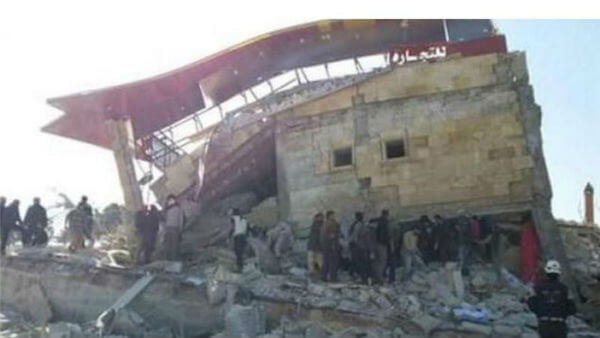
After the U.S. dropped bombs on a hospital run by Doctors Without Borders (Médecins Sans Frontières (MSF) in the Afghan city of Kunduz on October 3, Glenn Greenwald wrote:

Doctors who travel to dangerous war zones to treat injured human beings are regarded as noble and trustworthy. They’re difficult to marginalize and demonize. They give compelling, articulate interviews in English to U.S. media outlets. They are heard, and listened to.

MSF has used this platform, unapologetically and aggressively. Its staff are clearly infuriated by the attack on their hospital and the deaths of their colleagues and patients. From the start, they have signaled an unwillingness to be shunted away with the usual “collateral damage” banalities and, more important, have refused to let the U.S. military and its allies get away with spouting obvious falsehoods.

Greenwald shared MSF’s disgust in response to statements which amounted to justifications for war crimes.

Following the latest airstrikes on MSF hospitals in Syria, Greenwald’s reaction has so far been much more muted. It has yet to go beyond a couple of tweets which rather than being directed at the likely culprit of these war crimes, Russia, focus instead on the hypocrisy of the U.S. government.


Indeed, the U.S. can’t credibly denounce Russia for bombing MSF hospitals in Syria when it has done the same in Afghanistan.

By the same token, however, how can Greenwald credibly denounce American war crimes if he’s going to refrain from denouncing Russia’s?

He can’t be accused of being a hypocritical U.S. official. He doesn’t represent the American government.

Maybe at the moment he’s suspending judgment about who was responsible for the latest airstrikes in Syria — even though MSF says the attack was “deliberate” and says “either the [Syrian] government or Russia” was “clearly” responsible:


That’s a pointless question in this case since as far as Russia is concerned, there is nothing to investigate.

As TASS reports:

Asked for a comment regarding reports a hospital in Syria’s Idlib province had been bombed, as well as claims the Russian air group was responsible, [Russian presidential spokesman Dmitry] Peskov invited everybody to rely “on the root source first and foremost.” “In this particular case the representatives of Syrian authorities are the root source,” he said.

Peskov recalled that Syria’s ambassador to Russia, Riyadh Haddad, said on Tuesday the hospital in Idlib province was destroyed by the Americans, and not the Russian air group.

If Greenwald actually believed Haddad’s claim, I would expect him to be now denouncing U.S. airstrikes on MSF hospitals in Syria, but he isn’t — most likely because he realizes the Syrian ambassador was spouting obvious falsehoods.

Instead, Greenwald’s primary interest is in using these war crimes as an opportunity to take shots at the U.S. government — even though as Physicians for Human Rights (PHR) and others have documented, attacks on medical facilities are neither accidental nor incidental to the conflict: they are an integral feature of the war strategy used by Assad and his allies.

Writing in the New England Journal of Medicine in December, doctors with PHR said:

Since the conflict began in 2011, PHR has documented the killings of 679 medical personnel, 95% of them perpetrated by government forces. Some personnel were killed in bombings of their hospitals or clinics; some were shot dead; at least 157 were executed or tortured to death.

The issue here is that anyone who wants to resolutely challenge American double standards needs, for the sake of credibility, to avoid having their own double standards on war crimes.

As for the notion that Greenwald, as an American, has a duty to challenge his own government rather than Russia’s, he might pause to consider that his tweets and articles probably attract more attention in the Kremlin than they do in the White House.

Facebooktwittermail

Aleppo airlift: Maybe the U.S. has not run out of options in Syria

berlin-airlift

After I posed the question, can the U.S. take action to protect Aleppo? a reader reasonably asked: What would a productive engagement look like? Indeed.

For several years, the off-the-shelf answer to this question has included imposing a no-fly zone. The frequency with which this option has been proposed — and then ignored or dismissed — has undermined its credibility. Even so, it’s worth remembering that the northern no-fly zone enforced following the First Gulf War in 1991 provided the basis for the development of enduring Kurdish self-rule in what has since become the most stable part of Iraq. American actions in the Middle East are not always destined to make things fall apart.

The U.S. and its allies could have imposed a no-fly zone in Syria. But President Obama delayed long enough for that option to get knocked off the table by Vladimir Putin.

The latest high-profile proponents of a no-fly zone, Michael Ignatieff and Leon Wieseltier, seem to be engaged in an exercise in wishful thinking.

I don’t doubt that their outrage over American inaction is heartfelt. Even so, they gloss over the fact that since Russia now controls Syrian airspace, there isn’t the faintest chance the Obama administration would be willing to try and impose a no-fly zone because — as officials keep on saying — the U.S. isn’t going to risk starting World War Three.

Does that mean, therefore, that U.S. Syria policy now rests in the hands of John Kerry and his efforts to breath life into a political track — an approach that has little more vitality than the Middle East peace process? If that’s true, then the conventional wisdom is probably right: nothing can be done.

Dualistic thinking is always convenient. Debate gets simplified if we only have to weigh up two options. Other options are easy to marginalize, not necessarily because they are unworthy of consideration but because the debate risks becoming open-ended if too much gets brought to the table. Thus the current debate has largely been reduced to military action versus diplomacy and with the former ruled out, Kerry ends up as the embodiment of U.S. Syria policy. Unfortunately for him, diplomatic successes are much harder to accrue than frequent flier miles — especially when the U.S. has no bargaining power.

The Russians now say that they intend to carry on bombing Syria through the rest of this month while proposing a truce in March. Translated into plain English, that means they will continue bombing until their current military objectives have been accomplished.

Russia’s UN Ambassador Vitaly Churkin says that their airstrikes are being conducted in a “transparent manner” and says Russia’s critics are politically exploiting humanitarian issues.

“They rather crudely use humanitarian matters in order to play, we believe, a destructive role as far as the political process is concerned,” he says.

So this is Russia’s position: It claims it’s military actions are constructive while it accuses the proponents of diplomacy of undermining the political process.

No one should be in any doubt: for Assad and his powerful allies, Geneva is now just a sideshow — a useful distraction and an occasional stage for diplomatic games.

With no military options and no effective diplomacy, it’s easy to see why so many have concluded that nothing can be done.

But there’s never nothing…

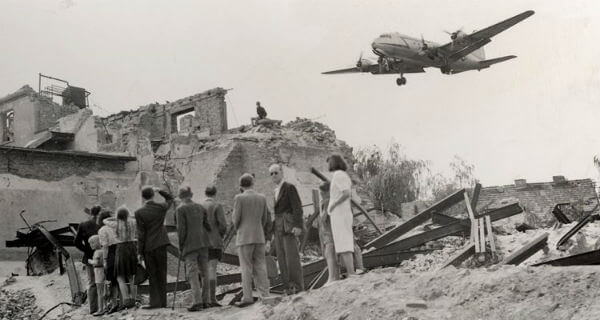
In 1948, having as many as one million soldiers based in Germany, the Soviet Union tightened a blockade around Berlin. At that time, the U.S. had 31,000 combat troops in West Germany. It seemed very reasonable to conclude that there was nothing the West could do to prevent the whole of Berlin coming under the control of the Soviets. The only way of preventing that outcome was to break the blockade and launch an airlift, unprecedented in scale.

The airlift began on June 24 and was anticipated to run for three weeks. The Communist press in East Berlin mocked the project, describing it as “the futile attempts of the Americans to save face and to maintain their untenable position in Berlin.”

Over the following weeks and months, the U.S., Britain, and France, succeeding in delivering up to 6,000 tons of supplies every day, as a result of which on May 12, 1949, the Soviets lifted the blockade. The operation continued through the end of September in order to amass a sufficient stockpile of supplies in the event that the airlift needed to be restarted.

In the course of the airlift’s operation, 2,326,406 tons of supplies were carried on 278,228 flights. And this was at a time that Europe was still weighed down by the economically crippling effects of World War Two.

The cost of the Berlin airlift was equivalent to less than the United States gives to Israel each year in military aid.

In August 2014, President Obama was persuaded to intervene in Iraq to provide humanitarian assistance to 40,000 Yazidis, trapped in the Sinjar Mountains, under threat from ISIS. The operation continued for a few days and the Yazidis were led to safety by Kurdish fighters from the PKK and YPG. This wasn’t reminiscent of 1948, but it was an emergency response.

At times of crisis the U.S. has often shown its willingness and capacity to make constructive interventions. (Acknowledging that fact doesn’t require we ignore America’s destructive impact on the world.)

What the U.S. did in Berlin and the Sinjar Mountains does not offer a template for humanitarian operations in Syria, although it might suggest new ways to consider the application of military resources to serve humanitarian goals.

Obama might be unwilling to risk direct conflict between American and Russian fighter jets patrolling the same skies, but when the U.S. started sending cargo planes into Berlin, in was on the assumption that the Soviets would not risk a war by attacking non-combatant aircraft. The same principle could apply to Syria. Whatever Churkin claims, delivering food, clothing, and medicine to those in need is a legitimate humanitarian endeavor.

UN Resolution 2165 was passed with Russia’s support to “ensure that humanitarian assistance, including medical and surgical supplies, reaches people in need throughout Syria through the most direct routes,” but the UN’s ability to make good on that promise is currently being obstructed by both Russia and the Assad regime.

Moreover, the UN has increasingly come under fire from Syrians who see humanitarian aid being used to support the Assad regime. “For many of us in Syria, the UN has turned from a symbol of hope into a symbol of complicity,” besieged Syrians wrote in a letter to Stephen O’Brien, the UN Undersecretary for Humanitarian Affairs.

There are cities across Syria under siege with populations facing starvation. If the U.S. was to start humanitarian airlift operations whose scope might initially be quite limited, it would send several important messages:

  • Assad’s policy of siege warfare will not continue unchallenged
  • The West has not turned its back on those Syrians now facing starvation
  • Russia is not being given a free hand in shaping Syria’s future

This isn’t a political solution for the war in Syria and the logistical challenges would be huge, but facing emergencies has more to do with the willingness to act than it has with being able to construct the perfect plan.

Discovering what is possible often requires ignoring the many ways in which one risks failing. If the Berlin airlift had been proposed on the assumption that it would need to continue for 15 months, it would most likely have been dismissed as impossible and never undertaken.

Facebooktwittermail

Can the U.S. take action to protect Aleppo?

flight-from-Aleppo

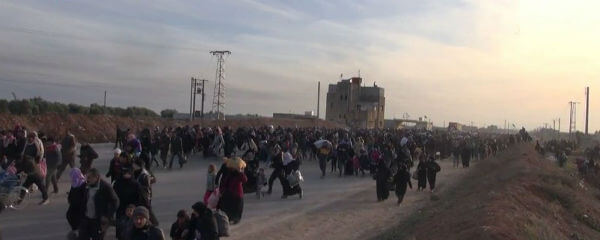
Michael Ignatieff and Leon Wieseltier write: Aleppo is an emergency, requiring emergency measures. Are we no longer capable of emergency action? It is also an opportunity, perhaps the last one, to save Syria. Aleppo is the new Sarajevo, the new Srebrenica, and its fate should be to the Syrian conflict what the fate of Sarajevo and Srebrenica were to the Bosnian conflict: the occasion for the United States to bestir itself, and for the West to say with one voice, “Enough.” It was after Srebrenica and Sarajevo — and after the air campaign with which the West finally responded to the atrocities — that the United States undertook the statecraft that led to the Dayton accords and ended the war in Bosnia.

The conventional wisdom is that nothing can be done in Syria, but the conventional wisdom is wrong. There is a path toward ending the horror in Aleppo — a perfectly realistic path that would honor our highest ideals, a way to recover our moral standing as well as our strategic position. Operating under a NATO umbrella, the United States could use its naval and air assets in the region to establish a no-fly zone from Aleppo to the Turkish border and make clear that it would prevent the continued bombardment of civilians and refugees by any party, including the Russians. [Continue reading…]

Any military strategy that’s designed “to recover our moral standing” is dubious — and not simply because there are those who doubt that the U.S. possessed much the moral standing in the first place.

The effectiveness of a military strategy can’t be assessed on the basis of the worthiness of its non-military goals.

The authors in their sweeping assertion that they are offering “a perfectly realistic path,” dodge the awkward details on how this would work.

Are they assuming that once the boundaries of this no-fly zone had been defined, Russian and Syrian aircraft would then obediently comply?

Or do they assume that as soon as a few jets had been shot down the intended lesson would have swiftly been learned?

Turkey already shot down a Russian jet on the edge of this arena. What lessons, if any, have been drawn from that incident and are they now being applied to this future scenario?

“If the Russians and Syrians sought to prevent humanitarian protection and resupply of the city, they would face the military consequences,” we are told by the armchair generals.

“Military consequences” is a phrase of political bluster — especially when coming from two writers who profess no military expertise. If pressed to spell out what these military consequences might be, I expect Ignatieff and Wieseltier would defer to the actual generals.

My point here is not to dismiss the idea that at this late hour there might be a constructive military intervention in Syria, but simply to say that such an argument needs more detail and substance and fewer passionate declarations. It needs to credibly show how this would work rather than simply why it should be undertaken.

Currently, Obama administration officials are cynically curtailing all discussion about their military options by claiming that they only have two choices: start World War III or do essentially nothing (beyond repeating their mantra that their is no military solution in Syria).

“What do you want me to do, go to war with Russia?” John Kerry is reported to have asked a Syrian NGO representative in London last week.

The choice is false but it is gladly being picked up by ideological anti-interventionists who are attracted by the rhetorical utility of this device when offered to those who have little interest in questioning its validity.

To those who insist on framing this crisis in terms of World War III, I would ask two questions: What makes you think it hasn’t already begun? And why do you think its defining attribute necessarily involves a clash between the U.S. and Russia?

A world war involves global instability and a contagion of violent conflict. There are active conflicts in Pakistan, Afghanistan, Yemen, Iraq, Syria, Turkey, Egypt, and Libya. There is unrest in Saudi Arabia, Bahrain, Palestine, Israel, and elsewhere.

As the EU struggles to handle the refugee crisis, European unity is being fractured, placing its future in jeopardy.

If through the power of inattention, Americans could indeed successfully insulate themselves from the effects of global strife, then perhaps this could endure as a land of blissful ignorance.

Instead, what is more predictable is that the more disengaged the U.S. becomes, the less influence it will have and the fewer options it can consider.

No one will benefit from America’s self-imposed paralysis.

Facebooktwittermail

Putin, Assad, and the nexus of torture and terror

Assad

Last October, Patrick Cockburn welcomed the arrival of Russian forces in Syria, suggesting that the “intervention of Russia could be positive in de-escalating the war”. He wrote:

Overall, it is better to have Russia fully involved in Syria than on the sidelines so it has the opportunity to help regain control over a situation that long ago spun out of control. It can keep Assad in power in Damascus, but the power to do so means that it can also modify his behaviour and force movement towards reducing violence, local ceasefires and sharing power regionally.

Posturing as a neutral observer, Cockburn no doubt preferred the language of “de-escalation” rather than military solutions, yet having noted that “Russia is at least a heavy hitter, capable of shaping events by its own actions,” he could hardly have been surprised by the massive onslaught on Aleppo over the last few days.

After Obama’s hollow demands for Assad’s departure, Washington has now moved towards what almost amounts to a quiet alliance with the regime by shutting down what was left of a meager weapons supply to rebel groups.

As Emile Hokayem writes:

Just as Russia escalates politically and militarily, the Obama administration is cynically de-escalating, and asking its allies to do so as well. This is weakening rebel groups that rely on supply networks that the U.S. oversees: In the south, the United States has demanded a decrease in weapons deliveries to the Southern Front, while in the north, the Turkey-based operations room is reportedly dormant.

The result is a widespread and understandable feeling of betrayal in the rebellion, whose U.S.-friendly elements are increasingly losing face within opposition circles. This could have the ironic effect of fragmenting the rebellion — after years of Western governments bemoaning the divisions between these very same groups.

Assad is far from being able to declare he has won the war, but he is close to winning the argument about how it gets framed.

He always claimed that he was fighting terrorism — deploying the rhetorical gift which neoconservatism freely bestowed on authoritarian rulers around the globe after 9/11 — and before long, it looks like this is how the war in Syria will neatly be defined: the regime vs ISIS and al Qaeda. And that’s a fight Assad has no interest in winning.

Nevertheless, it’s worth being reminded why the continuation of Assad’s rule should not be mistaken as a harbinger of peace. If a year or two from now, violence no longer rains down from the sky in the form of barrel bombs and Russian airstrikes, it will most likely continue without restraint in the domain where this regime has always exercised its ruthless power: by imprisoning, torturing, and murdering its opponents.

In “Out of Sight, Out of Mind: Deaths in Detention in the Syrian Arab Republic,” a newly released report for the UN Human Rights Council, we learn:

Interrogators and guards employed gruesome methods of torture to kill detainees. In 2014, a detainee held in a centre under the control of the 4th Division of the Syrian army had his genitals mutilated during torture. Bleeding severely and left without treatment, he died three days later. A detainee of a Military Security branch in Homs witnessed an elderly man being severely beaten, and then hung by his wrists from the ceiling. The guards burned his eyes with a cigarette, and pierced his body with a heated, sharp metal object. After hanging in the same position for three hours, the man died.

Other detainees died as a result of injuries and wounds sustained during torture. Victims received little or no medical care to treat the wounds and developed severe infections that eventually led to their demise. In the Air Force Intelligence Branch in Aleppo, a detainee suffered severely from an infected wound in his leg sustained during torture. Unable to stand up, he was eventually placed in the corridor outside the cell, receiving no medical care. After a few days, fellow detainees observed that he was dead. His family was later able to obtain the body through unofficial channels. Due to marks of torture and the severe emaciation of his corpse, his family could first only recognise him by an identifying tag. A 15-year-old boy detained in 2013 by the 4th Division in a detention facility near Yafour (Rif Damascus) reported seeing several male detainees dying due to torture and inhuman prison conditions and denial of medical assistance.

A large number of deaths were caused by the squalid conditions in which detainees were kept. Prison conditions were similar across detention facilities. They included severely overcrowded cells where prisoners were often forced to stand and sleep in shifts, stripped to their underwear. Lack of clean drinking water, sanitation, lice infestations and other unhygienic conditions caused the spread of disease and infections. Many prisoners were forced to use their toilet as a source of drinking water.

Anyone who believes this is “the lesser of two evils” or the kind of toughness required for “stability,” is delusional.

On the contrary, this type of institutionalized violence has long had an instrumental role in fostering terrorism.

Facebooktwittermail

Invasion of the body snatchers

Jacob Weisberg writes: “As smoking gives us something to do with our hands when we aren’t using them, Time gives us something to do with our minds when we aren’t thinking,” Dwight Macdonald wrote in 1957. With smartphones, the issue never arises. Hands and mind are continuously occupied texting, e-mailing, liking, tweeting, watching YouTube videos, and playing Candy Crush.

Americans spend an average of five and a half hours a day with digital media, more than half of that time on mobile devices, according to the research firm eMarketer. Among some groups, the numbers range much higher. In one recent survey, female students at Baylor University reported using their cell phones an average of ten hours a day. Three quarters of eighteen-to-twenty-four-year-olds say that they reach for their phones immediately upon waking up in the morning. Once out of bed, we check our phones 221 times a day — an average of every 4.3 minutes — according to a UK study. This number actually may be too low, since people tend to underestimate their own mobile usage. In a 2015 Gallup survey, 61 percent of people said they checked their phones less frequently than others they knew.

Our transformation into device people has happened with unprecedented suddenness. The first touchscreen-operated iPhones went on sale in June 2007, followed by the first Android-powered phones the following year. Smartphones went from 10 percent to 40 percent market penetration faster than any other consumer technology in history. In the United States, adoption hit 50 percent only three years ago. Yet today, not carrying a smartphone indicates eccentricity, social marginalization, or old age.

What does it mean to shift overnight from a society in which people walk down the street looking around to one in which people walk down the street looking at machines? [Continue reading…]

As one of those eccentric, socially marginalized but not quite old aged people without a smartphone, it means I now live in a world where it seems the mass of humanity has become myopic.

A driver remains stationary in front of a green light.

A couple sit next to each other in an airport, wrapped in silence with attention directed elsewhere down their mutually exclusive wormholes.

A jogger in the woods, hears no birdsong because his ears are stuffed with plastic buds delivering private tunes.

Amidst all this divided attention, one thing seems abundantly clearly: devices tap into and amplify the desire to be some place else.

To be confined to the present place and the present time is to be trapped in a prison cell from which the smartphone offers escape — though of course it doesn’t.

What it does is produce an itch in time; a restless sense that we don’t have enough — that an elusive missing something might soon appear on that mesmerizing little touchscreen.

The effect of this refusal to be where we are is to impoverish life as our effort to make it larger ends up doing the reverse.

Facebooktwittermail

How popular are Britain First and its Islamophobic ‘Christian patrols’?

britain-first-golding

The Washington Post reports: It’s a video that depicts just the sort of civilizational clash that extremists everywhere crave: Christians walking down a central shopping street in Britain. Muslim storekeepers and passerby hurling verbal abuse. A push. More abuse from both sides. And finally, police intervening to keep the warring clans apart.

The video, a slick propaganda job by the virulently anti-Muslim group Britain First, became a viral hit when the organization posted it to its Facebook page, racking up millions of views.

But there was more to the story than what the video showed.

The video was filmed on Jan. 23 in the multicultural British town of Luton, 30 miles north of London. The town, a former industrial powerhouse that is today known for its budget-flight-focused airport, has become a magnet for both Islamist and Islamophobic extremists. It’s often the canvas upon which hate groups unfurl their provocative displays.

And so it was when Britain First came to town for the fourth time in two years for what it termed a “Christian Patrol.”

The group — a far-right rival of the homegrown English Defense League — specializes in anti-Muslim street theater, while dressing itself in the garb of a devoutly Christian organization. Members wear dark green paramilitary-style uniforms, and march with oversized crosses through Muslim-majority areas, or even through mosques. [Continue reading…]

The garb of a devoutly Christian organization whose members wear dark green paramilitary-style uniforms?

Would the Washington Post refer to the Ku Klux Klan as bearing the symbols of a devoutly Christian organization because — like Britain First — its members like to march carrying large crosses?

There’s no question that these knuckleheads and self-described defenders of British culture have as little right to speak in the name of Christianity as Anjem Choudary has to present himself as the voice of Islam. But easy as Paul Golding and his rowdy followers might be to dismiss, do they actually stand at the vanguard of a much wider but less visible movement stretching across Britain?

The Washington Post picked up this story because Britain First’s recent Luton video went viral, but how much political significance derives from social media popularity?

Britain’s Labour Party, now under the leadership of Jeremy Corbyn who enjoys more grass root support than he does in parliament, has a Facebook page with 422,000 likes.

Britain First’s Facebook page has 1,289,000 likes!

But what do all these “likes” actually mean?

Paul Golding probably thinks they mean a lot and this might explain why he felt confident enough to run in the upcoming election to become Mayor of London. Moreover, he probably thinks it’s imperative that he, or someone like him, be able to govern the British capital city given that his leading opponent, Sadiq Khan, is a Muslim.

The election will take place on May 5, and the most recent YouGov poll gives Khan a clear lead (45%) over his closest rival, Zac Goldsmith (35%).

Further down the field comes George Galloway (Respect Party), who is just one point ahead of British National Party candidate, David Furness, who is himself, one point ahead of Golding.

That is to say, 1% of London voters say they support the BNP while 0% support Britain First.

Maybe the antics of Golding and his motley crew deserve less attention than does the promise of what would surely be a victory for multiculturalism: the increasingly likely election of London’s first Muslim mayor.

Facebooktwittermail

America shouldn’t remain indifferent to the crisis in Europe

Natalie Nougayrède writes: In 1947 George Marshall, the US secretary of state, went to Europe. He was shocked by what he saw: a continent in ruins, and rampant hunger. The mood in Paris, Berlin and other capitals was resigned and doom-laden. On returning to Washington, Marshall told President Truman that something dramatic needed to be done – and very soon. The initiative would have to come from Washington, he said.

On 5 June, in a speech to students at Harvard, Marshall announced his European recovery programme. It became, in the words of the British politician Ernest Bevin, “a lifeline to sinking men”. The Marshall plan not only helped Europe back on its feet, it laid the groundwork for the cooperation that ultimately led to the creation of the European Economic Community, the European Union’s predecessor.

In Davos this week Joe Biden, the US vice-president, may well have had a shock similar to Marshall’s. Of course today’s gloom in Europe is not comparable to the devastation left by the second world war – but alarmist language is being heard all the same. Manuel Valls, the French prime minister, has spoken of a risk of European “dislocation”. “Europe has forgotten that history is fundamentally tragic,” he said. Joachim Gauck, the German president, also used the word “tragic” when describing Europe’s difficulties over the refugee crisis.

Europe today is in such a shambles that it is not absurd to ask whether the US should again do something about it, or whether the old continent even matters to American strategic interests any more. The answer to both questions should be a resounding “yes”.

It is obviously unrealistic to think the US is likely to repeat the kind of assistance it deployed in 1947. But the US urgently needs to seriously re-engage on European matters. Failing that, it risks seeing the European project unravel, with more disorder pouring into and across the continent and, ultimately, the loss of key allies.

Europe is currently struggling with the danger of Brexit and major security threats (which include terrorism, and Russian aggression), as well as the political fallout of the refugee crisis. It’s not that US action in itself would miraculously solve all these problems, but its aloofness has arguably contributed to making them worse. [Continue reading…]

Update in response to comments: Natalie Nougayrède’s reference to the Marshall Plan seems to have led readers to conclude the lifeline she’s calling for is financial. After all, that’s what foreigners always do, isn’t it: beg for money from the U.S.!

Actually, her first appeal is for Obama to be forthright in making it clear that the U.S. has a strong interest in Britain remaining in the EU. The British naively and nostalgically cling on to the UK’s (one-sided) “special relationship” with the U.S.. A wake up call from Washington might alienate a few people, but I think they’d be outnumbered by those who recognized that this kind of counsel was well-intentioned and realistic. Moreover, departure from the EU would have much larger repercussions than diminishing the value of U.S.-UK relations. It may well lead to the rapid breakup of the UK as Scotland seeks swift independence so that it can remain in the EU.

How much would this piece of political engagement cost the U.S.? Nothing.

Second, she calls for “more US political leverage” in supporting a common European defense policy. Cost? Nothing.

Third, “the US cannot continue to treat the refugee crisis destabilising Europe as if it were a far-flung problem that doesn’t affect its direct interests. Around 4.5 million refugees have fled the Syrian civil war. The US has taken just 2,600.”

Refugees are not only fleeing from Syria but also Iraq and Afghanistan (and many other countries).

Instability across the Middle East cannot be attributed solely to American meddling and yet in the last two decades there was no single action that had a more destabilizing effect than the decision to invade Iraq.

Americans who supported the war and many of those who opposed it are now apparently unified in believing that, like a hit-and-run driver, the best course of action is to flee the scene of the crime.

Certainly, those who argue that America’s military interventions invariably seem misguided have plenty of evidence to support their argument.

But when it comes to the issue of helping Europe handle the refugee crisis, the primary impediment in the U.S. is not financial; it’s Islamophobic cowardice.

After the United States had finished carpet-bombing Vietnam and dousing its jungles with Agent Orange and the war’s failure had become undeniable, part of the aftermath of that unconscionable and delusional intervention was that there was sufficient decency in the U.S. to accept what eventually amounted to 1.3 million refugees settling here.

For the U.S. to now step up and welcome tens or even hundreds of thousands more refugees from the Middle East is not to make some unreasonable demand on American generosity. It’s part of paying the price of war.

It’s one thing to argue in advance against meddling in the affairs of other countries and on that basis to promote a relatively benign insularity, but when the meddling has been rampant and long-running, then insularity is just another name for irresponsibility. The United States doesn’t have the option of becoming Switzerland.

Having said that, Nougayrède’s appeal here is less blaming and by no means strident: it is for the U.S. to recognize that it really does have a stake in Europe’s future and it should not remain a mute bystander watching the European project fall apart.

Is that too much to ask?

Facebooktwittermail

Behind disputed views of Jewish identity looms a much larger question about the future of inclusive societies

The Guardian reports: The US State Department has moved to back America’s ambassador to Israel in a febrile and escalating row over his remarks on Monday that Israel applied law in the occupied West Bank differently to Palestinians and Israelis.

Ambassador Daniel Shapiro’s unusually critical comments drew harsh criticism from ministers in Israel’s rightwing government – including from the Israeli prime minister, Binyamin Netanyahu.

Shapiro was also publicly lambasted on Israeli television on Tuesday by a former aide to Netanyahu who used the deeply offensive Hebrew word “yehudon” – which translates as “little Jew boy” – to disparage the ambassador. The term is used by rightwing Israelis against other Jews – particularly those in the diaspora – whom they regard as not being sufficiently Jewish or pro-Israel. [Continue reading…]

The remarks by Aviv Bushinsky, who served as Netanyahu’s chief of staff when he was finance minister in Ariel Sharon’s governmen, are reminiscent of an incident reported by the Washington Post in 1997.

U.S. Ambassador Martin Indyk, still seething at a two-week-old slur, ran into his accuser Thursday and fixed him with a glare. According to Ephraim Sneh, a Labor Party member of Israel’s legislature, this is what happened next:

“The last time someone called me a Jew boy,” Indyk said, harking back to school days in Australia, “I was 15 years old and he got a punch in the face.”

A right-wing legislator, Rehavam Zeevi, had indeed called Indyk a yehudon — Hebrew invective translated variously as “Jew boy,” “yid,” or “kike” — at a parliamentary caucus late last month. He looked up from his seat at a memorial service for the late Yitzhak Rabin and glared back at Indyk. “Try me,” Zeevi replied. Then, taunting Indyk, he added distinctly: “yehudon, yehudon.”

Zeevi, a retired general who is chief of the ultranationalist Moledet (Homeland) party, apparently meant to say that Indyk, the first Jewish U.S. ambassador here, betrayed his coreligionists by pressuring the Israeli government for concessions in peace talks with the Palestinian Authority. Zeevi’s political platform, the most extreme of any party in the parliament, calls for expulsion of Arabs from the West Bank to make room for Jews.

A.B. Yehoshua, one of Israel’s most famous novelists, has for many years been among the most vocal in promoting this view that Jews who remain living outside Israel are only, as he says, “partial Jews.”

But instead of being preoccupied with where Jews plant their bodies, he and those who share his views, might consider where the Jewish conscience may better thrive.

In 2003, Avraham Burg, former member of the Knesset, a chairman of the Jewish Agency for Israel and a Speaker of the Knesset, who was born in Jerusalem, wrote:

It turns out that the 2,000-year struggle for Jewish survival comes down to a state of settlements, run by an amoral clique of corrupt lawbreakers who are deaf both to their citizens and to their enemies. A state lacking justice cannot survive. More and more Israelis are coming to understand this as they ask their children where they expect to live in 25 years. Children who are honest admit, to their parents’ shock, that they do not know. The countdown to the end of Israeli society has begun.

It is very comfortable to be a Zionist in West Bank settlements such as Beit El and Ofra. The biblical landscape is charming. From the window you can gaze through the geraniums and bougainvilleas and not see the occupation. Traveling on the fast highway that takes you from Ramot on Jerusalem’s northern edge to Gilo on the southern edge, a 12-minute trip that skirts barely a half-mile west of the Palestinian roadblocks, it’s hard to comprehend the humiliating experience of the despised Arab who must creep for hours along the pocked, blockaded roads assigned to him. One road for the occupier, one road for the occupied.

This cannot work. Even if the Arabs lower their heads and swallow their shame and anger forever, it won’t work. A structure built on human callousness will inevitably collapse in on itself. Note this moment well: Zionism’s superstructure is already collapsing like a cheap Jerusalem wedding hall. Only madmen continue dancing on the top floor while the pillars below are collapsing.

As much as all of this might sound purely like a struggle over Jewish identity, it mirrors an affliction in which people across the globe withdraw into their various ethnic, religious, or ideological ghettos of identification and their cherished definitions of my people.

The testing ground for challenging this trend is now Europe.

Last year, Burg wrote:

In a generation in which we Israelis have forgotten how to be sensitive and empathetic to minorities, to those who are different, to the persecuted, and many American Jews are swallowed up in their comfort zones of white society and are abandoning their partnership with the “others,” in America, the “United States of Europe” is presenting a new model of identity – a union between those who are different, and the “other.” It’s a model no different from the American one which seeks to assimilate all into a monochromatic American democracy.

Further, Europe is the current meeting point between Islam and the West. Some of that encounter involves clashes, and some involves learning. The Christian continent is learning to make space for other, rich and varied identities. My friends, Ziya from Bangladesh, Shaida whose family is from Turkey and Rob from Jamaica, are impressive Europeans, and Europe is better off with them. Just like Shaul from Venice, Yoop from Amsterdam and Brian from London – there is no dissonance between their Jewish heritage and their European identity. The discourse between white, Christian Europe and those who are different is fascinating. More important is the dialogue between Western Europe and the Muslim forces in its midst.

The Muslim world and some of its members are embarking on a long journey toward the Western values of freedom, equality and brotherhood. The institutionalization of Western Islam in the heart of Europe – that which is absorbing values of democracy while remaining true to Muslim tradition – is where the strategic potential exists for bridging the gaps peacefully in the generations to come. It’s not happening in the Middle East or North America, but only in Europe. That is where the vanguard of humanity and humaneness is to be found.

Since Burg wrote this, the vision of Europe has become profoundly challenged by an expanding refugee crisis, acts of terrorism, growing nationalism, cultural protectionism, and the drumbeats of xenophobia and Islamophobia.

Both in Europe and the U.S., it often seems like the political momentum favors those who promote retreat in its various forms — through strengthening borders, heightened national security, and disengagement from foreign affairs.

At the same time, the inexorable global trends point in the opposite direction as populations expand and people choose or are compelled to cross borders.

In such a world, the task of building more inclusive societies is not an idealistic goal; it has become an urgent necessity.

Facebooktwittermail

How to create a better politics

I didn’t watch President Obama’s State of the Union speech on Tuesday, but news reports alerted me to this passage:

A better politics doesn’t mean we have to agree on everything. This is a big country, with different regions and attitudes and interests. That’s one of our strengths, too. Our Founders distributed power between states and branches of government, and expected us to argue, just as they did, over the size and shape of government, over commerce and foreign relations, over the meaning of liberty and the imperatives of security.

But democracy does require basic bonds of trust between its citizens. It doesn’t work if we think the people who disagree with us are all motivated by malice, or that our political opponents are unpatriotic. Democracy grinds to a halt without a willingness to compromise; or when even basic facts are contested, and we listen only to those who agree with us. Our public life withers when only the most extreme voices get attention. Most of all, democracy breaks down when the average person feels their voice doesn’t matter; that the system is rigged in favor of the rich or the powerful or some narrow interest.

It’s easy to view politics as a marketplace in which trading is taking place as competing constituencies haggle over power. From that perspective, the only question is which group best represents your interests and if no such group exists, politics then becomes a dull spectator sport. Such a marketplace is inevitably dominated by the loudest voices.

Even if that characterization is reasonably accurate, it is likely to have a constricting effect.

Politics seen as jostling power groups, makes those groups into somewhat static entities and it saps a spirit of inquiry.

If the activity of asking and answering questions — an activity that needs to be driven by curiosity — seems pointless, it gets replaced by a much less constructive exercise: the solidification of opinion through affiliation.

In other words, politics is reduced to the question of who you want to stand with and who you stand against.

In the Republican response to Obama’s speech, South Carolina Governor Nikki Haley said:

Some people think that you have to be the loudest voice in the room to make a difference. That is just not true. Often, the best thing we can do is turn down the volume. When the sound is quieter, you can actually hear what someone else is saying. And that can make a world of difference.

It would be easy to dismiss these appeals from Obama and Haley to reduce the level of rancor in politics as simply calls for a cosmetic change — as though politics can be reformed by making it more pleasant. But I don’t think these calls for a tone change should be trivialized.

The dynamic at issue is driven by the cycle of attention-seeking and attention-giving.

Donald Trump’s success has had less to do with either his financial independence or his alignment with a large segment of the population, than it has with his skill in co-opting the services of the mass media.

He took reality TV to the next level (cliche intended) by turning a presidential campaign into a form of mass entertainment. Trump supporters commonly say that a significant part of his appeal is that they find him entertaining. The tedium of politics has been turned into a raucous circus with Trump as ringmaster.

He couldn’t have done this without the help of a media which salivates at each and every opportunity to boost ratings and make more money.

Ultimately, this is an issue of American values. If creating wealth is the axis around which American life turns, then the media will inevitably function like every other branch of commerce.

The health of any society, however, requires a balance between self-interest and collective interests.

If government, the legal system, the media, education, medicine, and the arts, are controlled by commerce then we all end up as the slaves of profit.

Facebooktwittermail

Scientists who give science a bad name

shadow9

According to theoretical physicist and cosmologist, Lawrence Krauss, gravitational waves “may have been discovered!!”


The earlier rumor Krauss referred to was this:


LIGO stands for Laser Interferometer Gravitational-Wave Observatory — a project involving more than 900 scientists. Krauss isn’t one of them.

Following Krauss’s tweet in September, LIGO spokesperson Gabriela González, a physicist at Louisiana State University in Baton Rouge, told Davide Castelvecchi she was “upset at the possibility that someone in the LIGO team might have initiated the rumour, although Krauss and other researchers told me [DC] that they did not hear it directly from members of the LIGO collaboration. ‘I give it a 10–15% likelihood of being right,’ says Krauss, who works at Arizona State University in Tempe.”

Krauss has now boosted his confidence level to 60% — a surprisingly high level given that he says this:

“I don’t know if the rumour is solid,” Krauss told the Guardian. “If I don’t hear anything in the next two months, I’ll conclude it was false.”

González now tells Ian Sample at The Guardian:

“The LIGO instruments are still taking data today, and it takes us time to analyse, interpret and review results, so we don’t have any results to share yet.

“We take pride in reviewing our results carefully before submitting them for publication – and for important results, we plan to ask for our papers to be peer-reviewed before we announce the results – that takes time too!” she said.

At this point, it seems like the story might reveal more about Lawrence Krauss than it says about gravitational waves.

What makes Krauss’s excitement so uncontainable when the news will definitely come out — if and when there is news — without his help?

Scientists have a duty to fulfill a role as public educators and there has never before been a time when this need has been greater. To a degree this is an evangelical role, but as with every other individual who assumes such a position, each is at risk of becoming intoxicated by the reverential respect they receive from their audience as message and messenger become intertwined.

This may then lead to an over-extension of authority — exactly what Krauss and fellow scientists who dub themselves antitheists are guilty of when they make pronouncements about religion.

Here’s Krauss on religion and xenophobia:

Last night, The Guardian reports:

More than 200 far-right extremists have been arrested after they went on a rampage during a xenophobic rally in the German city of Leipzig, setting cars on fire and smashing windows.

Many of the extremists were already known to police as football hooligans and wrought chaos on Monday in an area known to be left-leaning, while thousands of supporters of the anti-migrant Pegida movement held an anti-refugee demonstration elsewhere in the city, authorities said.

A total of 211 arrests were made after the Connewitz district of the eastern city was attacked, police confirmed.

Are we to view this as a modern-day crusade in which German Christians purge their fatherland of the invading Muslim hordes?

On the contrary, I doubt very much that many (or perhaps even any) of those involved would be particularly ardent in expressing any religious faith. What is likely beyond doubt is that they were all white.

Xenophobia is generally a form of racism and the xenophobes don’t close ranks on the basis of theological quizzing — they can identify their cohorts and their enemies simply through the color of their skin.

When religion and racism intermingle, the underpinning of the racism is much less likely to be found in religious doctrine itself than it is on prevalent affiliations based on racial, national and cultural identity.

If as they claim, the antitheists want to rescue humanity from religion because of its irrationality, why focus on religion alone? There are many other forms of irrational behavior that are equally if not more destructive.

For instance, the religion in modernity which through advertising relentlessly promotes more widespread and unquestioning faith than that found in any conventional religion, is consumerism: the belief that the acquisition of material goods is the key to human happiness.

You are what you own — I know of no other idea that is more irrational and yet holds such a firm grip on so much of humanity.

This religion has grown more rapidly and more extensively than any other in human history and in the process now jeopardizes the future of life on Earth.

In terms of doctrine, most conventional religions oppose materialism. As the Bible says:

Do not store up for yourselves treasures on earth, where moth and rust destroy, and where thieves break in and steal. But store up for yourselves treasures in heaven, where neither moth nor rust destroys, and where thieves do not break in or steal.

The antitheists are going to say this is a bad investment because heaven doesn’t exist, but in doing so they devalue the ecological wisdom contained in such religious efforts to rein in human avarice.

The core criticism of religion is directed at its appeal to beliefs that have no empirical foundation and yet what’s strange about focusing on doctrine is that it glosses over the gulf between belief and practice.

Arguably, the destructive impact of religion derives mostly from the fact that so many believers fail to practice what they profess. They situate the locus of meaning in the wrong place by thinking, this is who I am, rather than this is how I live. In so doing, they inhabit identity traps: static forms of self-definition that obscure the dynamic and interactive nature of human experience.

On this issue, Lawrence Krauss and others could learn a lot from Neil deGrasse Tyson:

Facebooktwittermail

From Tailhook to Cologne — the patterns in sexual violence

cologne-attacks

On New Year’s Eve, as many as 1,000 young men who according to police and witnesses were of north African and Arab appearance, took part in mass sexual violence and assaults on women outside the railway station in the German city of Cologne. BBC News reports that more than 100 women and girls have come forward with reports of sexual assault and robbery.

One victim, named as Busra, spoke of a sense of lawlessness outside the station, where the attackers felt they could do as they pleased.

“They felt like they were in power and that they could do anything with the women who were out in the street partying,” she said.

“They touched us everywhere. It was truly terrible.”

One of the most obvious parallels that is now being drawn is with the mass sexual assaults in Cairo that, as The Guardian reported in 2013, “have been endemic at Tahrir protests since at least the 2011 revolution”.

An internal report by Germany’s national police, the Bundespolizei, obtained by Der Spiegel, lists police officers’ experiences including one who quoted a suspect as saying: “I’m a Syrian! You have to treat me kindly! Mrs. Merkel invited me.”

Cologne’s mayor, Henriette Reker, has drawn scorn by suggesting that young women and girls need to protect themselves by adopting a code of conduct which includes, as The Independent reports, “maintaining an arm’s length distance from strangers, to stick within your own group, to ask bystanders for help or to intervene as a witness, or to inform the police if you are the victim of such an assault.”

As the accounts of victims of the attacks make clear, such a code would have been impossible to adopt on New Year’s Eve:

One woman, whose identity has been protected, told German television how gangs of men assaulted her in the crowd.

“All of a sudden these men around us began groping us,” she said. “They touched our behinds and grabbed between our legs. They touched us everywhere.

“So my girlfriend wanted to get out of the crowd. When I turned around one guy grabbed my bag and ripped it off my body.”

She said she felt in extreme danger, but there were no police officers to help.

“I thought to myself that if we stay here in this crowd they could kill us, they could rape us and nobody would notice. I thought we simply had to accept it.

“There was no one around us who helped or was in a position to help. All I wanted was to get out.

“I was scared that I wouldn’t leave this crowd alive. I was scared that if someone showed up with a knife I could be raped in the middle of the street.”

In another account reported by BBC News, a 17-year-old British girl described what she witnessed:

I was at Cologne on New Year’s Eve with my boyfriend. Upon arriving at 10pm at the train station, I felt afraid the moment I saw the strange behaviour of the people around me.

The main station was full of wobbly teenagers and young adults, of all ages, some possibly below 18, very drunk and unaware of their whereabouts. Some had already passed out on the floor in their own vomit.

Bottles were smashed on the ground and you could feel shards of glass crunching beneath your feet with every step.

Fights had taken place in the station and police were trying to contain them, but the amount of fighting made it difficult for the police to focus on every individual dispute.

We walked towards the exit of the station towards the cathedral, only to be welcomed by a huge crowd blocking the exits.

We heard a woman screaming and crying somewhere in the midst of this crowd, appearing to be escaping from a foreign man, who was shouting back and pointing his finger at her and chasing her with his accomplices.

Later on, we saw two men corner women at the cathedral and touch them while they were screaming for help and trying to fight back.

For those in Europe and North America who want to gin up fears of immigrants and refugees, the events in Cologne will seem to demonstrate that their fears are warranted, that Donald Trump’s proposed ban on Muslims is justifiable, and that those of us who repeat the slogan, “refugees welcome!” are naive.

Understandably, the attacks have sent shock-waves through Germany.

In an interview by Human Rights Watch reporting on sexual violence in Egypt in 2013, a young man in typical Western attire with gelled hair, says: “It’s not a good habit, it’s wrong, but they [women] lead us to do this. From the way they dress. From the way they walk. Everything. They push Egyptian men to do this.”

A young woman, in hijab, says: “It has happened to me several times but I don’t always react, because I’m afraid of the reaction from the guy in front of me. And I’m afraid the people around me won’t back me up.”

Al Jazeera reported in 2014:

Many Egyptian men, including members of the police force, either downplay or shrug off sexual harassment, reflecting popular views that women either should remain at home or bring trouble on themselves by dressing provocatively if they go out on the street.

“She can’t go anywhere without me,” Capt. Ahmed Mahmoud, a police officer in a working-class Cairo neighborhood, told the Huffington Post in May, speaking about his wife. “If a woman is wearing provocative clothing, the change needs to come from her.”

If this blame-the-victim mentality represented a distinctive feature of Middle Eastern societies, it might be difficult to counter the arguments being made by those in the West who want to block the entry of refugees, especially young men.

The fact is, however, that a pandemic of sexual violence involves the same factors:

  • a sense of impunity among perpetrators
  • the perpetrators’ belief that their victims deserve to be abused
  • the expectation among victims that they have little chance of finding justice

The perpetrators of most of this violence are not mobs on the rampage; they are the victims’ own intimate partners.

Both on the streets and behind closed doors, alcohol is often a contributing factor.

A 2014 report by the European Union Agency for Fundamental Rights which found that an estimated 3.7 million women in the EU had been the targets of sexual violence during the preceding 12 months, noted:

Prevalence of physical and/or sexual violence by a current partner is also markedly higher among women whose partner gets drunk frequently. If a current partner is said never to drink, or never to drink so much as to get drunk, the prevalence of this type of violence was 5%. The prevalence climbs, however, to 23% for women whose current partner gets drunk once a month or more often.

In the 1991 Tailhook scandal involving the U.S. Navy and Marines, 83 women and seven men were victims of sexual assault and harassment. The 4,000 attendees in Las Vegas “viewed the annual conference as a type of ‘free fire zone’ wherein they could act indiscriminately and without fear of censure or retribution in matters of sexual conduct or drunkenness,” according to a Pentagon investigation.

While cultural factors in sexual violence should not be ignored, there are ultimately two reasons why this kind of conduct is so commonplace:

  • the perpetrators know they can get away with it;
  • they know this because other men so often turn a blind eye.

Those who now claim that in defense of “our women” we need to guard against a foreign threat, are choosing to ignore the fact that the far more pervasive threat is much closer to home in the familiar face of a former boyfriend, an ex-husband, boyfriend, husband, father, step-father, brother, cousin, friend, or a neighbor.

Guys, the collective failure here is ours.

Facebooktwittermail