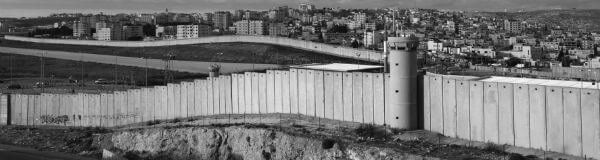
Following Trump’s logic and his imperative of vigilance, it sounds as though the world — just to be safe — can’t have too many walls.
In Europe the principle of open borders functioning in the Schengen Area is currently in peril.
If, as seems increasingly likely, the presidential election in the U.S. ends up being a contest between Trump and Clinton, it’s possible that Trump just defined the battle line in a useful way.
He obviously wants to use Israel’s wall to justify his own wall plans and he’s assuming that Clinton’s ties to Israel mean she wouldn’t dare question their security measures.
Nevertheless, Israel’s wall has symbolic significance that stretches far beyond the Israeli-Palestinian conflict.
Ever since the end of the Cold War, there has been a broad consensus that the breakdown of divisions around the world has inherent value and the creation of divisions causes trouble.
While the value of this principle has most often been measured in economic terms and the rewards concentrated in the hands of powerful corporations, the human desire for people to be able to connect seems far greater than the need to stand apart.
Those who want to wall themselves in so they can keep others out are in a minority that perceives itself as embattled.
The walls supposedly designed to make people feel safe also solidify their fears.
The wall is both a metaphor and a literal expression of the conflict between inclusion and exclusion.
Have we reached a point in history where we must now reverse tracks and head back into the past — into a world defined by its rigid divisions? Would not such a world be anything less than a retreat from humanity?
No doubt, in a debate, Clinton would skirt around Israel’s wall — perhaps just by reiterating the official line that it is a temporary measure — but she could not pick a better theme around which to shape her campaign than by presenting herself as someone dedicated to breaking down divisions versus an opponent who is actively divisive.
Am I indulging in an internationalist liberal fantasy?
Perhaps. But however deeply entrenched divisiveness has become, unless we quickly learn how to shake it off, our common fate will be ruin.
After a 52-minute video made by al-Kataib, the media outlet of Somalia’s al-Qaeda-affiliate, al-Shabaab, was posted on YouTube yesterday, it was swiftly removed. YouTube has a long-standing policy of banning videos that incite violence.
As the ABC News report above shows, the element in the video which has grabbed the media’s attention is its use of Donald Trump’s recent call for Muslims to be prohibited from entering the United States.
Here’s the part of the video which features Trump — although, by the time you read this post, YouTube will have removed this clip, which is why I’m also posting a transcript:
First we see the American imam, Anwar al-Awlaki, making a prediction about the fate of Muslims who continue living in the U.S. — Awlaki was killed by a U.S. drone strike in Yemen in 2011. Then comes a clip of Trump and then Awalaki again.
Awlaki, date unknown: Muslims of the West, take heed and learn from the lessons of history. There are ominous clouds gathering in your horizon.
Yesterday, America was a land of slavery, segregation, lynching, and Ku Klux Klan. And tomorrow it will be a land of religious discrimination and concentration camps.
Trump speaking at a campaign rally on December 7: Guys remember this and listen: Donald J Trump is calling for a total and complete shutdown of Muslims entering the United States [cheers] until our country’s representatives can figure out what [expletive bleeped] is going on [cheers and applause].
Awlaki: The West will eventually turn against its Muslim citizens. Hence, my advice to you is this: You have two choices, either hijra or jihad. You either leave or you fight. You leave and live among Muslims, or you stay behind and follow the example of Nidal Hassan [perpetrator of the Fort Hood mass shooting] and others who fulfilled their duty of fighting for Allah’s cause.
In response to pressure from Western governments, YouTube and other social media channels are becoming increasingly aggressive in blocking the distribution of terrorist propaganda. There is understandable frustration at the fact that the internet is being used to threaten the very societies within which this global communications system was created.
Censorship can easily backfire, however, and this is happening with the removal of clips of the new al-Shabaab video.
After the full-length version had been removed, snippets which just showed the al-Awalaki statement and Trump, have also been removed (as I noted above).
It is clear that these videos are being posted by Trump critics rather than al-Shabaab supporters and their removal is breathing life into a conspiracy theory being propagated by some Trump supporters: that the al-Shabaab video itself is a fabrication created by the Clinton campaign!
It seems likely that there are some Trump supporters who — following the lead of Bashar al-Assad supporters — are using YouTube’s community guidelines in order to silence criticism.
Although in the short clips of the al-Shabaab, Awlaki is indeed inciting violence, the clips themselves are clearly not being posted in order to incite violence — they have been posted to show how Trump’s rhetoric serves as a propaganda gift for jihadists.
By removing these clips, YouTube is playing straight into the hands of conspiracy theorists.
At the same time, censorship also buttresses the perception among ISIS and al Qaeda supporters, that the West feels threatened by “the truth.”
It’s worth remembering the trajectory Awlaki followed which eventually led to him promoting terrorism from Yemen.
In 2000, he supported George Bush’s campaign to become president and after 9/11 believed his own emerging role must be to serve as bridge between America and all Muslims.
At midnight on Sept. 14, 2001, Awlaki, then a young Yemeni-American imam at the prominent Dar al-Hijrah mosque in Falls Church, Va., finished a long day by answering an email from his younger brother about the terrorist attacks of a few days before. ‘‘I personally think it was horrible,’’ he wrote to Ammar, a college student in New Mexico at the time. ‘‘I am very upset about it.’’ He added, ‘‘The media are all over us.’’ Anwar was disconcerted, but perhaps also pleased that an onslaught of reporters had turned his Friday prayers, or jummah, into a circus. ‘‘At jummah today we had ABC, NBC, CBS and The Washington Post.’’ He closed on a positive note, hinting at a noble purpose, to be sure, but also displaying a trace of personal ambition: ‘‘I hope we can use this for the good of all of us.’’
Though the country was in mourning, a sense of defiant unity emerged. A non-Muslim neighbor of Dar al-Hijrah organized a candlelight vigil around the building to show solidarity with the mosque. Roughly 80 residents of a nearby apartment building sent over a note saying, ‘‘We want your congregation to know that we welcome you in this community.’’ Journalists, hunting for an authoritative voice from the Muslim community, began to pass regularly under the mosque’s grand marble arches or to gather in Awlaki’s modest family home. He denounced the 9/11 attacks but in the same breath would criticize America’s record in the Middle East. Reporters were impressed. The New York Times wrote that Awlaki, just 30, was being ‘‘held up as a new generation of Muslim leader capable of merging East and West.’’ He relished the spotlight. He seemed to be quite self-consciously auditioning for a dual role: explainer of Islam to America and of America to Muslims. ‘‘We came here to build, not to destroy,’’ he declared from his pulpit. ‘‘We are the bridge between America and one billion Muslims worldwide.’’
The challenge presented by ISIS, al Qaeda and other jihadist groups is more than one of security and communications. At its core, this is a moral challenge.
The jihadists present themselves as offering the solution to a moral problem: a way for Muslims to confront the immorality, corruption, and hypocrisy they see in the contemporary Western-dominated world.
An effective counter-jihadist strategy cannot simply brush off this critique of the West. It has to present an alternative solution.
Currently, who has the more credible voice? Donald Trump, Hillary Clinton, or Anwar al-Awlaki?
Unfortunately, it’s Awlaki.
As Shane observed:
Awlaki’s pronouncements seem to carry greater authority today than when he was living, because America killed him.
Right now, it’s easy to castigate Trump for providing terrorists with fodder for propaganda, but we mustn’t forget the extent to which the U.S. led by Bush and then Obama, has helped reinforce the jihadists’ narrative — by opening Guantanamo; through the use of torture, rendition and secret prisons; through the disastrous war in Iraq; through drone strikes in Afghanistan, Yemen, and Somalia; through continuing to prop up authoritarian regimes across the Middle East; through allowing the Assad regime to destroy Syria, and through failing to broker an end to the Israeli-Palestinian conflict.
The real challenge for Western political leaders and whoever becomes the next U.S. president is not whether they can destroy ISIS and effectively tackle global terrorism.
It is this: How can they regain sufficient moral authority that their words carry weight? How can they restore some much-needed respect for democracy?
In a global failure of governance, the Middle East can be viewed as the emergency room, while in the West, governance suffers from chronic illness for which symptom-relief is the only treatment on offer.
It’s time we face up to the fact that terrorism is just a symptom what ails the world. Indeed, much of the time a global obsession with terrorism is having the effect of turning our attention away from broader issues that undermine the health of societies and our ability to survive on this planet.
This isn’t a question of striving for some kind of unattainable and contestable moral purity. No one wants to live under the control of zealots. It’s about trying to create societies in which government is no longer a dirty word, where ordinary citizens receive the respect they deserve, and in which individuals are no longer cynical about the possibilities for securing collective interests.
In a word, it’s about the restoration of honesty in public life.
Americans are famously ignorant about global geography. While many are apologetic about this deficit, it often gets waved off as a cultural gap that doesn’t really need filling — a bit like learning the metric system: useful in theory but something that most people are quite content to live without.
One of the latest widely cited examples speaks to the fact when it comes to acquiring knowledge about the world, the tutor that too many Americans rely on is Hollywood.
An editorial in Abu Dhabi’s The National (the English-language newspaper from the Gulf that mustn’t be called Persian) says:
A week of international ridicule over a poll that found about 30 per cent of Republican voters supported military aggression against the fictional Arab city of Agrabah has not sent the story away on a magic carpet. In a new poll conducted by WPA research, 44 per cent of Democratic voters questioned would support the United States taking in refugees from Agrabah, a made-up location from Disney’s Aladdin. Roughly 28 per cent said they were indifferent.
The latest poll sheds additional light on the mainstream American sentiment about the Middle East. It is clear that ignorance about the geography and people of the region extends across party lines.
It doesn’t just cut across party lines; it also unites some experts with those who naively view them as being reliably informed.
For instance, in an article on Clausewitz and ISIS that I posted here recently, David Johnson, a senior political scientist at the RAND Corporation, was quoted, saying:
If you go to Istanbul and look south the Caliphate is right there. You can point to it. It’s a state that views us as an enemy. What’s the mystery?
Before joining RAND, Johnson had a 24-year U.S. Army career “in a variety of command and staff assignments in the United States, Korea, and Europe,” so maybe he never went to Istanbul. If he had, he should have known that if you look south you will see the Sea of Marmara and beyond that, the southern half of the Marmara region of Turkey.
The territory under ISIS’s control is nowhere near in sight, being hundreds of miles off to the east-southeast, beyond Turkey’s borders in Syria and Iraq.
Call this an instance of matter-of-fact ignorance — which might be seen as an American specialty.
Ignorance is not a crime. Indeed, nothing is more important than recognizing the limits of ones knowledge if that knowledge is to be advanced. The worst mistake, however, is to imagine one knows (or be willing to pretend one knows) what one does not.
That is what leads to ill-conceived pronouncements on the fate of Agrabah and its imaginary residents.
Just imagine how much less raucous the internet would be (or how many more don’t knows pollsters would count) if everyone applied a bit more caution and discipline in differentiating between the known and the unknown, distinguishing between fact and opinion, and in acknowledging that what they may have chosen to repeat is merely hearsay.
If there’s one thing I’m grateful for Donald Trump expressing, it’s his contempt for political correctness.
There is no value in sensitivity if it merely serves to mask bigotry.
Discourse in which, for instance, racism has been thoroughly expunged, turns out to be discourse in which racists can freely participate with much less risk of being challenged.
Trump is being disingenuous, of course, in claiming that he disavows political correctness, because it’s actually an indispensable tool in his art of deceit. He panders to and expresses his own Islamophobia when saying he’d stop Muslims entering the U.S. but at the same time, postures as Muslim-friendly by claiming he loves Muslims.
Political correctness is no substitute for honesty. Indeed, this has been its most corrosive effect: that it inhibits people from honestly expressing their views and exposing their prejudices.
Richard Falk picks up this theme when noting that in the U.S., in the name of being politically correct and culturally sensitive, many Americans avoid referring to Christmas in deference to non-Christians who don’t celebrate this holy day. Falk, however, gladly appropriates the word and in this celebration sees universal meaning.
As a Jew in America I feel the tensions of conflicting identities. I believe, above all, that while exhibiting empathy to all those have been victimized by tribally imposed norms, we need to rise above such provincialism (whether ethnic or nationalistic) and interrogate our own tribal and ‘patriotic’ roots. In this time of deep ecological alienation, when the very fate of the species has become precarious, we need to think, act, and feel as humans and more than this, as empathetic humans responsible for the failed stewardship of the planet. It is here that God or ‘the force’ can provide a revolutionary comfort zone in which we reach out beyond ourselves to touch all that is ‘other,’ whether such otherness is religious, ethnic, or gendered, and learning from Buddhism, reach out beyond the human to exhibit protective compassion toward non-human animate dimensions of our wider experience and reality. It is this kind of radical reworking of identity and worldview that captures what ‘the Christmas spirit’ means to me beyond the enjoyment of holiday cheer.
From this vantage point, the birth of Jesus can be narrated with this universalizing voice. The star of Bethlehem as an ultimate source of guidance and the three wise kings, the Maji, who traveled far to pay homage to this sacred child can in our time bestow the wisdom of pilgrimage, renewal, and transformation that will alone enable the human future to grasp the radical wisdom of St. Augustine’s transformative: “Love one another and do what thou wilt.” Put presciently in a poem by W.H. Auden, “We must love one another or die.”
I referred to Falk appropriating Christmas, aware that there are Christians who might object to a Jew saying what Christmas means (even though Jesus was Jewish) and in order to raise the wider issue that seems to be popping up with unfortunate frequency: one of the bastard children of political correctness, cultural appropriation.
Cultural appropriation is a phrase that can usefully be applied in limited and rather obvious ways.
In 1992, when Hindu nationalists destroyed the 16th-century Babri Masjid mosque in Ayodhya, Uttar Pradesh, India, they did so in the name of reclaiming the site of the birthplace of the god, Rama. This came 464 years after Muslim invaders had apparently destroyed a Hindu temple at this site. In the intervening period, Hindus and Muslims had both worshiped at the same location.
When conflicting parties with differing cultural identities each claim to own the same place and then alternately snatch it from one another, this can reasonably be described as cultural appropriation.
While each advocates its claim in the name of one divine authority or another, all are saying exactly the same thing: this is mine; it’s not yours.
But when someone in Los Angeles practices yoga in an effort to fine-tune a perfect body, does this degrade Indian culture? Have they claimed as their own, something that belongs to someone else? Not really.
The proliferation of yoga studios across America and the secularization of yoga by treating it as a form of fitness training, has done nothing to close off opportunities for people to explore yoga as a spiritual discipline or learn about its roots in Indian culture. Indeed, the fact that yoga has exported so easily is not because it got stolen by cultural plunderers, but because it comes out of a culture that fosters a universal sense of belonging.
India is a country of dizzying dynamism, one that has always eagerly absorbed elements from other cultures into its own while proudly sharing the best of its own culture with the world. “All humanity’s greatest is mine,” wrote poet Rabindranath Tagore, who won the 1913 Nobel Prize in Literature. “The infinite personality of man (as the Upanishads say) can only come from the magnificent harmony of all human races. My prayer is that India may represent the co-operation of all the peoples of the world.” Tagore — who, incidentally, wrote India’s national anthem — founded a university whose motto translates to, “Where the whole world meets in a single nest.”
This is the essence of cosmopolitanism. Obviously, power plays a role in the way cultures develop. Symbols and practices can be wrenched from their traditional contexts and used in ways that are disrespectful. When privileged American kids party while wearing Native American headdresses, it looks like they’re donning the spoils of a long-ago war. But the way that some contemporary activists would silo different cultures — as if anything that travels from outside the West is too fragile to survive a collision with raucous mixed-up modernity — is provincialism masquerading as sensitivity. There’s no such thing as cultural purity, and searching for it never leads anywhere good.
Across the globe, many cultures are under threat — languages are being forgotten and indigenous wisdom lost. But the idea that a culture can be protected behind barriers of insulation, treats culture as a static entity that is preservable. If it has arrived at such a condition, it is most likely already dead.
An endangered language can only be protected by being taught, spoken, and shared. It either grows or withers. Likewise and more broadly, cultures are fertilized at their margins where the familiar and unfamiliar interact, thereby generating new cultural forms.
What threatens culture more than anything else is the commercially driven shift away from cultural creation to cultural consumption.
To the extent that culture is something we passively absorb rather than actively construct, the infinitely varied vantage points from which we each see the world will get overshadowed by whatever forms can be most easily reproduced and massively distributed.
Culture is what we make it. It cannot be kept alive in empty vessels.
Those who brand others as heretics are not generally amenable to the proposition that the heretic deserves a fair hearing. Which is to say: the very idea of a heresy is that it represents a form of belief that must be dealt with by suppression rather than analysis.
Kyle Orton, a young Middle East analyst from England, has just been granted the opportunity to propagate an unthinkable heresy on the op-ed pages of the New York Times: he asserts that ISIS did not come into existence as a result of the war in Iraq but instead that its emergence can be traced to a process of Islamization in Iraq that began in the 1980s.
A kneejerk response comes from Glenn Greenwald:
NYT publishes an op-ed from a neocon think tank exonerating Iraq War as the cause of ISIS, instead blaming Saddam https://t.co/FytKEPzaRQ
As someone who so often likes to deploy a lazy guilt-by-association line of attack, Greenwald dismisses the article by branding it as having come from a neocon think tank — that being the Henry Jackson Society — along with an implicit rebuke directed at the New York Times.
Sal Rotman makes an appropriate response:
@ggreenwald labelling the author a neocon is not a worthy substitute for a substantive critique of the arguments.
Indeed, but for Greenwald to make such a critique, he’d probably have to know much more about Iraq’s recent history than he does — so he opts for the easy route of denunciation by branding. Call someone a neocon and it goes without saying — supposedly — than anything they say can be dismissed.
The question as to whether Orton is a neocon (even if one accepts the label being applied to his employer), seems somewhat trivial — unless one is convinced that a neocon is someone whose every utterance is false. Which is to say: unless one views a neocon as a kind of heretic.
The only serious question is whether Orton’s historical analysis is sound — a judgement that many of us are not in a position to make. What many of us can do, however, is assess the coherence of the argument, its plausibility and the extent to which it rings true.
Interestingly, although Greenwald thinks Orton is exonerating the war in Iraq, he apparently missed the fact that Orton views the trend of Islamization in the 1990s as having occured while “Iraqis fell back on their faith for solace under the harsh international sanctions.”
One might argue, therefore, that ISIS was just as much a product of the 1991 Gulf War as it was the 2003 Iraq War — but not wholly a product of either.
It’s true that disbanding the Iraqi Army after 2003 put professional soldiers at the service of the Sunni insurgency. It’s also true that Al Qaeda in Iraq — the small, foreign-led nucleus of what became the Islamic State — used poorly run American prisons like Camp Bucca to recruit former regime elements. But the significant fact is that those who assumed leadership roles in the Islamic State’s military council had been radicalized earlier, under Mr. Hussein’s regime.
There was never any “Baathist coup” of former regime elements inside the Islamic State, as some analysts assume, because these men had long since abandoned Baathism. They joined Al Qaeda in Iraq early after the invasion as an act of ideological conviction, and when Al Qaeda in Iraq’s leadership was nearly destroyed in 2008-10, these officers were the last men standing precisely because of their superior counterintelligence and security skills.
It was these Salafized former military intelligence officers — led by Samir al-Khlifawi, also known as Haji Bakr, who had joined the group in 2003 and rose to be the so-called caliph’s deputy, until he was killed in 2014 — who planned the Islamic State’s dramatic expansion into Syria. There, they set up a Saddam Hussein-style authoritarian regime that was the launchpad for the jihadists’ invasion of Iraq in 2014.
From a cursory look at his earlier blog posts, it appears Orton’s analysis is based in part on the research findings of Samuel Helfont, whose PhD dissertation on religion and politics in Saddam Hussein’s Iraq was itself based on newly-released records from the Iraqi state and Baath Party. That sounds like a stronger foundation for a thesis than would be provided, for instance, by an individual like “curveball.” It’s certainly worth more careful consideration than for it to simply be dismissed with a tweet.
For those still concerned about which political litmus tests Orton might pass or fail, I would point out that the route he followed in order to recently get hired by the Henry Jackson Society did not seem to be distinctly ideological.
After a misbegotten degree in zoology (biology), I completed a social science Masters in Humanitarian Studies at the Liverpool School of Tropical Medicine that comprised elements of geopolitics, history, and practical skills in running a humanitarian program, the logical end-point of which would be work with a non-governmental organisation.
I have travelled quite widely, especially in Eastern Europe having been to all of the old Soviet satellite States except Romania, and in the Balkans — Bosnia, Serbia, and Croatia. I have also been to Turkey and Israel, took part in a voluntary course (teaching) in Kenya, and worked in Lebanon for my Masters on the healthcare system for the Syrian refugees.
Having long been interested in the Arab world, and especially in ways that it might be reformed, I was very interested when the rebellions came to that region at the end of 2010, and followed the course of this “Arab Spring” from its inception. The carnage in Syria and its obvious importance for that whole region have made the subject my primary focus.
According to Hezbollah’s Al-Manar, Samir Qantar, a Lebanese commander who had become a high-profile figure in the group, was killed by an Israeli airstrike in Damascus on Saturday.
Israeli officials welcomed the news but did not confirm responsibility for the attack.
While Hezbollah had no hesitation in accusing Israel, as Raed Omari notes, Syrian officials have been more circumspect:
Remarkably enough, the Syrian account of the incident resembled to a greater degree that of Israel – no confirmation and no refuting.
But the Syrian statements on Qantar’s killing were worded with a heavy Russian military presence in the background and they were inseparable from new political developments on Syria and the new international coalitions in the making.
It can’t be that the Israelis launched an airstrike on Syria now without coordination with their Russian allies who now control Syria’s airspace. And if the Syrians confirmed that Israeli jets killed Qantar, then they would appear as either having prior knowledge of the plan or have no sovereignty over their country.
Who actually killed the 54-year-old Qantar? In my opinion, Israel is a likely perpetrator but the question is how its jets flew over Syria now without being spotted by the Russian satellites and space power. The Russian silence on the incident is also worth-noting.
Meanwhile, a Syrian rebel group has released a statement claiming that they were responsible for Qantar’s death.
The New York Times quotes a Druze militia group that said the building which was targeted had been hit by “four long-range missiles.”
An Israeli columnist quotes “Western sources” claiming that Qantar was a “ticking bomb.”
The sources said Kuntar had recently not been working on behalf of Hezbollah, but rather acting with increasing independence alongside pro-Assad militias in Syria.
The attack in Damascus comes at a moment when, according to Israeli sources, “Iran has withdrawn most of the Revolutionary Guards fighters it deployed to Syria three months ago.”
Assuming that this was indeed an Israeli airstrike, it appears to have not only been aimed at an individual, but also intended to send some additional messages: that Israel is not unduly constrained by Russia’s air operations in Syria and that the Hezbollah fighters propping up the Assad regime are more expendable than their Iranian counterparts.
Regardless of who fired the missile, Sayed Hassan Nasrallah, the secretary-general of Hezbollah, has already made his decision: this was Israel. Now, the question is, how will Nasrallah respond to another high-level assassination?
Some think Hezbollah’s falling popularity with the Sunni majority in the Middle East due to its meddling in the Syrian conflict could use a boost, and a conflict with Israel would help.
Others say Hezbollah is stretched, and a war with the powerful Israeli military is the last thing the Shia group needs.
The current situation mirrors the immediate aftermath of an Israeli pilotless drone strike on 18 January in the Golan that killed Jihad Mughniyeh — son of former Hezbollah military commander Imad Mughniyeh — an Iranian general and five other Hezbollah fighters. Hezbollah struck back 10 days later with an anti-tank missile ambush against an Israeli army convoy at the foot of the Shebaa Farms hills, killing an officer and a soldier.
Following the ambush, Hezbollah Secretary General Hassan Nasrallah said in a speech that the rules of engagement that had defined the tit-for-tat conflict between Hezbollah and Israel were over.
“From now on, if any Hezbollah resistance cadre or youth is killed in a treacherous manner, we will hold Israel responsible and it will then be our right to respond at any place and at any time and in the manner we deem appropriate,” he said.
Nasrallah is due to speak Monday night and will probably reaffirm that commitment, which will ensure a state of tension along Israel’s northern border in the coming days.
The concept of reciprocity is a cornerstone of Hezbollah’s defense strategy against Israel, which may offer a clue as to the party’s response to Kuntar’s assassination. In the years following the 2006 War, Nasrallah has articulated on several occasions Hezbollah’s strategy of retaliating in kind for Israeli actions against Lebanon in a future conflict — if Israel bombs Beirut, Hezbollah bombs Tel Aviv; if Israel blockades Lebanese ports, Hezbollah will blockade Israeli ports with its long-range anti-ship missiles; if Israel invades Lebanon, Hezbollah will invade Galilee.
Even on a tactical level, Hezbollah has sought to achieve reciprocity against Israel. In October 2014, Hezbollah mounted a roadside bomb ambush in the Shebaa Farms that wounded two Israeli soldiers in response to the death a month earlier of a party military technician who died when a booby-trapped Israeli wire-tapping device exploded.
The January anti-tank missile attack against the Israeli convoy in the Shebaa Farms also sought to echo Israel’s deadly drone missile strike in the Golan 10 days earlier.
“They killed us in broad daylight, we killed them in broad daylight… They hit two of our vehicles, we hit two of their vehicles,” Nasrallah said at the time.
How many mass movements in search of political rights would have been pronounced failures if success had to be established in just five years?
The quest for women’s rights has continued throughout human history and continues today.
Palestinians, Kurds, Tibetans, Kashmiris, and numerous other groups of indigenous peoples have for many decades campaigned and fought for their rights, often with very limited success.
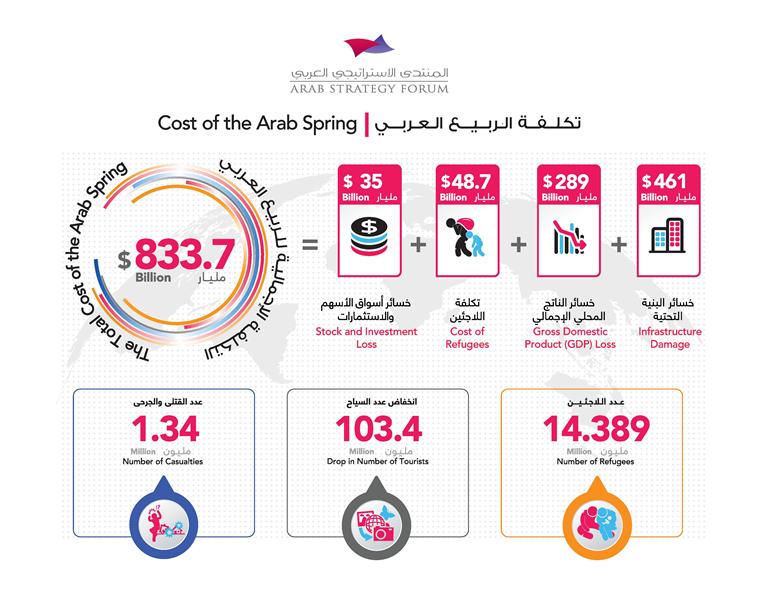
But when it comes to the Arab Spring, those who stand to lose most from the expansion of political rights across the region, are now — not surprisingly — only too eager to pronounce it an expensive failure.
As some of the region’s autocratic rulers and their advisers gathered in Dubai this week and soberly measured the “cost of the Arab Spring,” they should also — had they been honest — have been celebrating the rise of ISIS.
From Dubai to Tehran and from Riyadh to Cairo, it has been ISIS that has saved the day. The Arab Strategy Forum should have invited Abu Bakr al-Baghdadi as their guest of honor.
Don’t get me wrong. I’m not promoting any of the conspiracy theories about ISIS being the creation of a foreign government (be that the Saudis, the Turks, the Israelis, or the Americans — which of those being the culprit would depend merely on who the proponent such a theory sees as the worst enemy).
ISIS saved the day through its savagery by convincing nearly everyone else that political stability is worth more than any kind of political freedom.
Much as it will often be repeated that the need to destroy ISIS has never been more urgent, those whose rule is currently being legitimized by ISIS’s existence will be quite content for this war to be a valiant fight that sees no end.
And those blinkered by the conviction that the U.S. government is the architect of all the world’s afflictions, need to recognize that conflict in the Middle East is now being driven from many engine rooms — in Damascus, Moscow, Tehran, Jerusalem, Ankara, Riyadh, Cairo, Abu Dhabi, Doha, Beirut, Raqqa and elsewhere — in pursuit of incompatible agendas.
Among those costs, the greatest are not measured in dollars — the numbers of casualties and refugees. And these are not costs of the Arab Spring; they are, above all, the cost of the Assad regime’s refusal to respect the rights of the Syrian people.
Ever since I became a U.S. citizen, I’ve got a kick out of the fact that when re-entering this country (after visits to the UK), after presenting my passport, the immigration official commonly returns it to me, saying: “welcome back.”
Maybe this happens more often for travelers coming through laid-back Atlanta than somewhere like New York City, but it’s an endearing friendly touch where one otherwise confronts the cold face of bureaucracy and security.
Across the globe, crossing a border tends to be a dehumanizing experience when who we are is so sharply defined by a piece of paper.
As a dual national and British citizen, it’s frankly unimaginable that a representative of the government there would offer any kind of greeting.
Once back in the U.S., however, I would find it a bit disturbing if a fellow citizen wanted to reassure me that I’m welcome here, since, supposedly, we both share equal rights and an equal claim to American identity.
Even so, since I wasn’t born here and since I “have an accent” (to which I like to respond: who doesn’t?), it’s not difficult for me to understand why I might be viewed by some Americans as an outsider. Indeed, the term “naturalization” has always struck me as being an oxymoron. An innate attribute is either there or it isn’t — I don’t see how it can be inserted.
For that reason, I’m inclined to defer moderately to those Americans who feel like an American who was born in this country is in some sense more American than those of us who were born elsewhere.
That shouldn’t imply any discrimination in terms of status or rights — it’s simply an observation about depth of enculturation.
Which brings me to Muslim Americans, a large proportion of whom were indeed born in this country and have never lived anywhere else.
When someone such as Mark Zuckerberg reaches out to Muslims and says, “I want you to know that you are always welcome here,” I realize this kind of message is well-intended, but it isn’t deeply inclusive.
One American should never be so presumptuous as to tell another American that they are welcome here.
What is called for at this time is something much more radical. What is being contested is the meaning of solidarity.
Some Americans are saying that we now need to stand together to protect ourselves from foreign threats. This kind of unity divides humanity into two camps: Americans and non-Americans. And this division undercuts the very notion of humanity.
It becomes clear then, that the actual rift here is between those for whom their experience of being American is subordinate to their experience of being human, and those for whom their identity as Americans, trumps all others.
Is someone who gives such preeminence to national identity, really capable of any genuine expression of solidarity?
If you’re ability to empathize with another person depended on first knowing what kind of citizenship they held or which religion they practiced, how could such empathy be heartfelt?
I have to wonder whether those Americans who are afraid of Muslims are not also, to a lesser degree, afraid of each other?
Empathy is the core human recognition. It is the knowledge that your experience of pain is the same as mine; that love, joy, grief, and anger are universal emotions.
Where this knowledge is lacking, or where it gets buried beneath a rigid national identity, xenophobia and Islamophia are merely symptomatic of a degradation of an underlying sense of humanity.
Americans who do not see themselves as indivisibly part of humanity, should be less concerned about how they protect America than what they think it means to be human.
And since so many American-firsters describe themselves as Christians, they might begin a process of self-inquiry by reminding themselves that according to their own belief system, they are the descendants of a human lineage that traces back to a single source preceding all national identities.
Republican consultant, Frank Luntz, gathered a focus group of 29 past and present Donald Trump supporters in Virginia a few days ago and, among other things, asked them to come up with a phrase that characterizes Barack Obama.
These were some of the responses:
pathetic, jellyfish marshmallow, naive, lost, out of touch, clueless, ineffective, elitist, doesn’t respect American values, anti-American, un-American, zero leadership, out of his depth…
Luntz responded to the group: “Anti-American, un-American… Barack Obama? Seriously?”
For these Trump supporters there was no question.
In no doubt about their own identity as Americans and that Obama lacks an American character, their gravitation towards Trump seems to derive mostly from their perception that the billionaire stands out as authentically American:
he gives the image he’s not going to put up with any crap… his personality is so large… he’s entertaining… he looks presidential and he acts presidential… he’s a leader… I’m voting for the person… we’re tired of weak candidates [like John McCain and Mitt Romney]
Luntz probed further: “[Trump] used the word ‘shit’ [when saying he would ‘bomb the shit out of ISIS’]; that’s presidential?”
The group responded with a loud “yes,” fists waving and applause.
It matters less what Trump says than how he says it. He talks tough and he’s impolite and that makes him an American and makes him trustworthy among those who share this view of the American spirit.
If the general election ends up being a contest between Trump and Hillary Clinton, no doubt a significant portion of Trump’s support will come not only from his perceived Americanness but also from the notion that ruling the U.S. is a job for a man.
The fact that presidential campaigns are largely personality contests has been true for decades. In that respect, Trump has done nothing to reshape American politics.
Luntz concludes, seeming to confirm that this is very much a reflection of contrasting perceptions of personality: “I don’t believe there would be a Trump candidacy if there wasn’t an Obama presidency.”
If that’s true, it would be easy to infer that it meant that white America wasn’t ready for a black president, and to some degree that must be the case, but the criticisms thrown at Obama clearly express distaste and contempt for the way he carries himself.
Following the death of Benedict Anderson on Sunday — Anderson was an expert on Indonesia and the origins of nationalism — Christopher Dickey, noting the influence Indonesian culture played in Obama’s personal development, wrote:
As Edward L. Fox pointed out in a delightful essay a couple of years ago, the no-drama character of the American president is best understood as behavior learned when he was a boy, from the time he was 6 until he was 10, going to elementary school on the island of Java in Indonesia.
When Obama was being mocked by the other kids because of his dark skin, his mother encouraged him to adopt the kind of bearing and conduct associated with Javanese kings and the word halus, a regal sort of imperturbability. To this day, there are little tells, like the way Obama points with this thumb on top of his hand, rather than with his forefinger, which was considered very impolite; or the way he sometimes stands with his eyes down in a debate, not a broken man, but one containing his emotion.
In Anderson’s 1990 essay “The Idea of Power in Javanese Culture,” he wrote that halus is “the quality of not being disturbed… Smoothness of spirit means self-control, smoothness of appearance means beauty and elegance, smoothness of behavior means politeness and sensitivity. Conversely, the antithetical quality of being kasar means lack of control, irregularity, disharmony, ugliness, coarseness, and impurity.”
Which also sounds like a description of Donald Trump — the ugly American.
For Americans who despise Trump, the challenge he poses goes beyond the dangerous effects of his demagoguery, but towards the disquieting recognition that he may indeed be more typically American than a large portion of his critics.
Evan Soltas and Seth Stephens-Davidowitz write: Hours after the massacre in San Bernardino, Calif., on Dec. 2, and minutes after the media first reported that at least one of the shooters had a Muslim-sounding name, a disturbing number of Californians had decided what they wanted to do with Muslims: kill them.
The top Google search in California with the word “Muslims” in it was “kill Muslims.” And the rest of America searched for the phrase “kill Muslims” with about the same frequency that they searched for “martini recipe,” “migraine symptoms” and “Cowboys roster.”
People often have vicious thoughts. Sometimes they share them on Google. Do these thoughts matter?
Yes. Using weekly data from 2004 to 2013, we found a direct correlation between anti-Muslim searches and anti-Muslim hate crimes.
There are about 1,600 searches for “I hate my boss” every month in the United States. In a survey of American workers, half of the respondents said that they had left a job because they hated their boss; there are about 150 million workers in America.
In November, there were about 3,600 searches in the United States for “I hate Muslims” and about 2,400 for “kill Muslims.” We suspect these Islamophobic searches represent a similarly tiny fraction of those who had the same thoughts but didn’t drop them into Google. [Continue reading…]
Oh brother!
Let’s cut some slack for Soltas since he hasn’t graduated yet, but Stephens-Davidowitz dubs himself a data scientist. I guess he’s illustrating the fact that the quality of analysis generally matches the quality of the data.
Don’t get me wrong. I have little doubt that Islamophobia is peaking in the U.S. right now — much to Donald Trump’s advantage and with a lot of his assistance. What is much harder to determine is what qualifies as an Islamophobic search query.
As much as search algorithms have advanced over the last two decades, search engines have yet to perfect the art of mind-reading. The raw material they still work with is words — the thoughts that might lie behind those words remains a mystery.
If someone wants to kill Muslims, they might type “kill Muslims” in Google — although I’m not sure exactly what the query would be meant to solicit.
On the other hand, someone with a basic understanding of how Google works — that it matches queries with documents in which the query terms appear — might do the same search because they want to find out who’s writing about killing Muslims.
In other words, the query, “kill Muslims,” might be an expression of Islamophobia, or, it might be an inquiry about the prevalence of Islamophobia.
This is true even if the query is “I want to kill Muslims” because Google has no way of differentiating between the person making the query and the author of the documents it matches to that query.
Type “kill Muslims” into Google and what you’ll find — apart from references to this op-ed — is much of the hard data on Islamophobia, such as a compilation of reports on hate crimes targeting Muslims occurring across the U.S. just this week.
It’s unlikely Donald Trump will be planning to visit the UK any time soon. He might not get labelled as an “undesirable person” by the British government, as was the Islamophobic Dutch politician, Geert Wilders. Even so, since more than half a million Britons have already made it clear he’s unwelcome, I doubt that Trump would accept having to face the humiliation of seeking consent to travel to the country viewed by most Americans as the United States’ closest ally — a trip that in other circumstances doesn’t even require a visa.
Nicola Sturgeon, the first minister of Scotland, has revoked Mr. Trump’s status as a business ambassador to Scotland, and Robert Gordon University in Aberdeen has stripped him of an honorary degree.
Prime Minister David Cameron, of the Conservative Party, castigated Mr. Trump’s position [on Muslims] as “divisive, unhelpful and quite simply wrong,” while J. K. Rowling, the author of the best-selling Harry Potter books, described Mr. Trump as worse than the series’ archvillain, Lord Voldemort.
Zac Goldsmith, a Conservative Party candidate for mayor of London, called Mr. Trump “repellent” and “one of the most malignant figures in modern politics,” according to news reports.
Trump has already cancelled a trip to Israel after having been criticized by Benjamin Netanyahu, while the Washington Post’s “Right Turn” Israel-friendly columnist, Jennifer Rubin, says Trump is “now is effectively a persona non grata” in the Jewish state.
It’s worth noting that Trump had already alienated himself from Jewish and Christian Zionists by refusing to express his commitment to Jerusalem as Israel’s “undivided capital.”
Trump is also now the target of a new campaign launched by activist hackers in Anonymous, which warned the presidential candidate, “think twice before you speak anything,” while claiming to have taken down the website for Trump Tower in New York City.
And in an effort to weaken Trump’s position in the business community, a new petition has been launched to “dump Trump” from the PGA Tour.
Will any of this have much impact on Trump’s supporters?
Certainly not those of the variety to whom Olivia Nuzzi spoke:
James “Owen” Greeson said it so casually that it almost didn’t sound strange.
He was talking about how, at 76 years old, he’s never picked a winner, has always thrown his weight behind some presidential candidate who’s got no shot. This time was no different, but he didn’t much care. He sent $2,700 from Georgia, where he lives, to Donald Trump’s campaign coffers, just because he likes the guy and thinks he’s entertaining, not because he figured he could be president. It’s not that Trump isn’t fit for the office or too divisive to get the votes. “Come on,” he said, “they’ll kill him before they let him be elected.”
He meant it literally.
“George Wallace was shot,” he said, by way of explanation. And in case I wasn’t convinced, “Huey Long was shot.
“If you get too popular, you’re gonna get dusted off, you know? That should be Donald’s biggest concern, that somebody busts a cap in his ass.”
Greeson, calm and soft spoken, was already sure that the government had orchestrated the 9/11 attacks, so what was one more death, really?
“It looked like a false flag to me, come on!” he said. “Two buildings burn like that? There’s been fires in other countries that burned for 15 hours and the buildings didn’t collapse.” (He said he wasn’t sure who did 9/11, but that Dick Cheney was a good guess.)
After Donald Trump announced, on Monday, a plan to stop Muslims from entering the U.S. “until our country’s representatives can figure out what is going on,” I set out to talk to his donors about how it made them feel. I’d interviewed Trump donors before and found that above all else, they are quite a lot like the candidate himself. They aren’t all crazy or hateful or prone to shouting, necessarily, but they are fed up and they are politically incorrect. They feel as if the world and the country is changing too rapidly for us to understand it, and they resent being told that their questions are impolite or emblematic of a deeper intolerance. They see in Trump someone who would protect their interests the way he has protected his own, someone who would make a “yuge,” great deal for their benefit, perhaps. Like, really, really great. Big league.
So far, Trump’s success has not been achieved in spite of making enemies, but on the contrary, in large part it’s because he is so good at riling up his opponents. By co-opting the services of the media, his campaign has cost him virtually nothing and the criticisms he now faces, mostly have the effect of reinforcing the convictions of his base.
America is a country with few deep-rooted natives. Nearly everyone’s ancestral tree leads somewhere else. In spite of this, the mark of foreignness is skin color. If you’re white and have an American accent, no one’s going to ask you when your family emigrated here — even though, without exception, every single white American’s roots lead overseas.
The truism that this is a nation of immigrants, repeatedly gets denied by a white America endowed with a sense of belonging which often doubts the capacity of non-whites to be full equals in sharing an American identity.
How then, can someone who knows no other country than this one and yet who is perceived and treated as though in some subtle or crude sense they are foreign, fully share in the experience of belonging that every human being deserves?
If at this moment of heightened xenophobia, we look at alienation through the narrow prism of counter-terrorism and only ask how just a handful of individuals become radicalized, we are likely to ignore the implications of much wider issues, such as inequality, cultural identity, and citizenship.
America succeeds or fails by one measure alone: its ability to sustain an inclusive society.
Donald Trump could not currently threaten this inclusivity were it not for the fact that that he speaks for so many other white Americans who have conferred on themselves the right to determine who does or does not belong here.
America doesn’t need to wall itself in; what it needs is fewer self-appointed gatekeepers.
As Moshe Dayan, the Israeli military leader and politician, once said: “If you want to make peace, you don’t talk to your friends. You talk to your enemies.”
So why not negotiate with ISIS?
Hilary Benn, the Labour Party’s Shadow Foreign Minister who led a revolt of opposition MPs by voting in favor of Britain’s entry into the air campaign against ISIS in Syria, went back to his Leeds Central constituency this weekend to explain his position.
Members of the Stop the War Coalition, challenged Benn, saying that Britain should negotiate with ISIS.
In Britain and elsewhere, a lot of people are going to see an exchange like this as an argument between diplomacy and militarism, remembering perhaps Winston Churchill’s famous observation: “To jaw-jaw is always better than to war-war.”
Anyone who says we can’t negotiate with ISIS, is easy to cast as being addicted to the use of brute force. This perception gets further reinforced as politicians hammer their podiums declaring, we must destroy ISIS.
So again: why not negotiate with ISIS?
Here’s why: Negotiation requires compromise and the discovery of common ground and for ISIS to negotiate it would have to abandon the goals which are the reason for its existence.
In the latest issue of Dabiq, ISIS’s 65-page color magazine, the possibility of a truce between the West and ISIS is raised and they say that in such an event “nothing changes for the Islamic State… It will continue to wage war against the apostates until they repent from apostasy. It will continue to wage war against the pagans until they accept Islam… Thereafter, the slave markets will commence in Rome by Allah’s power and might.”
Wild rhetoric, no doubt, but what we already know is that on a more limited territorial scale, ISIS practices exactly what it preaches. It has no interest in co-existing with those it opposes. It is engaged in what it regards as a Manichean struggle which allows for no other possibility than the death, subjugation, or submission of its enemies.
The contents of Dabiq might be dismissed as propaganda written merely to appeal to the grandiose fantasies of ISIS recruits, but a newly published translation of an internal ISIS document appearing in The Guardian today shows that the organization is not only earnest in its goals but also in their meticulous application.
As far as foreign policy is concerned, again we see an utterly uncompromising position, modeled, it is claimed, on the example of earlier caliphates.
The objective in relation to “heretic communities” is “dispersing their groupings so there no longer remained any impeding opinion, strength or ability, and the Muslim alone remains the master of the state and decision-making and no one is in conflict with him.”
“Whereof one cannot speak, thereof one must be silent,” wrote Ludwig Wittgenstein.
I think that applies to the phrase “bruv” coming out of David Cameron’s mouth.
Still, he meant well:
As Muhbeer Hussain, founder of British Muslim Youth, says, the man who defiantly challenged the Leytonstone attacker, is “a hero for the British Muslim community for speaking out against this.”
As a formal exercise, denunciations and condemnations nearly always ring hollow.
“We strongly condemn the recent attacks…”
Blah blah blah… Ya don’t say?
That’s not to suggest these statements are insincere; it’s just that they are generally so predictable they have become a somewhat pointless ritual.
What’s radically different is when the denunciation comes from someone in the moment who in that moment spontaneously uses words to upend the meaning of an act of violence. This is when language grasps its real power.
This is what happened last night at the Leytonstone Underground station in London after a 29-year-old man stabbed a 56-year-old man, while shouting, “this is for Syria.”
VIDEO: Bystander shouts 'you aren't a Muslim' at man that attacked commuter in London tube station this evening.
pic.twitter.com/u0q00ZQKa7
I’m going to make some wild guesses and see if I can deconstruct what happened here:
1. The man with the knife was a Muslim (and probably British).
2. He had no idea who he was stabbing other than that he assumed his victim was British and not a Muslim and thus could be held responsible for the actions of the British government following its recent decision to start bombing Syria.
3. The attacker felt like he was standing up for Muslims.
A bystander, a Muslim Londoner, having witnessed what happened, videos the arrest and as a Muslim policemen handcuffs the attacker, the bystander calls out: “You ain’t no Muslim bruv [brother].”
Again, another assumption: he was directing this statement at the attacker, not the policeman.
For good reason, the bystander has received widespread praise.
#YouAintNoMuslimBruv – the power of language. One sentence pushes away extremists and unites everyone else. This is our stance now. Great.
Echoing the gunmen in the Paris attacks, the attacker in London chose the phrase “this is for Syria,” but in spite of ISIS’s large presence on Twitter, the hashtag that’s trending now is #YouAintNoMuslimBruv — it isn’t #ThisIsForSyria.
Some Muslims aren’t happy about this.
@LinahAlsaafin Tagic & infuriating that Muslim community conditioned 2 distance selves via de facto apologism as means of self-preservation.
I understand why Muslims feel like they shouldn’t be expected to denounce the actions of extremists — such condemnations inevitably sound like an expression of collective guilt. But this isn’t what happened in London.
At a moment when a guy has posed a threat to everyone around him and he’s claiming to be acting in the name of Muslims, another Muslim deftly cuts down that claim in an expression of solidarity that unites Muslims and non-Muslims, Londoners (who come from all quarters of the globe) and everyone else.
ISIS wants Muslims and non-Muslims to spill each other’s blood in an apocalyptic war, but instead we have to stand together.
#YouAintNoMuslimBruv shows how it can be done.
One Muslim brothers words representing the voice of millions… #YouAintNoMuslimBruv
A shirtless man, armed with a straight razor from a barbershop and suspected of having just attempted to rob a bank, stands surrounded by at least five Miami Beach Police officers. After failing to comply with their commands, the suspect is shot and killed.
Meanwhile, in London a suspected terrorist who is not only armed with a knife but has already stabbed and seriously injured a 56-year-old man, gets surrounded by British police officers. The suspect doesn’t just fail to comply with demands from the police — he continues threatening anyone nearby with his knife. Nevertheless, the police are able use a taser to bring him down, handcuff and arrest him.
Are the British police more courageous than their American counterparts?
I don’t know.
The immediate difference derives from police tactics. But the wider difference is that Britain isn’t burdened by a popular gun fetish or a cartoon culture in which adults talk about “good guys” and “bad guys.”
A commenter on YouTube sarcastically asks: “In America, do you have more chance of being killed by ISIS or the cops?”
“Right now it looks like he’s a wacky gun enthusiast and a police buff, yet he was going around pretending to be a federal agent – that’s troubling,” a source told the New York Daily News.
Mark Vicars
He had a fake federal air marshal ID in one pocket, a Ruger .380-caliber pistol in the other and was driving around Long Island with ballistic body armor and a loaded AR-15 assault rifle. He also had an arsenal of weapons at his gated home.
But don’t worry folks, Mark Vicars wasn’t a threat to anyone, Nassau County officials insisted Friday.
The amount of firepower is comparable to what terror couple Syed Farook and Tashfeen Malik had during the massacre they committed Wednesday in San Bernardino, Calif.
So why did the Nassau County Police Department spokesman Det. Lt. Richard LeBrun tell reporters, “At this time we don’t see any immediate threat to the public”?
[C]ops don’t believe that Vicars was up to anything nefarious — except for masquerading as a federal agent.
“We don’t see any nexus to any terrorism at this time,” LeBrun said, adding that no anti-American literature or links to terrorism were found at his home.
(Note also that in the current climate, “anti-American literature” is apparently a red flag raising suspicions of terrorism. It sounds like the police were less alarmed by the weapons Vicars owned, than they would have been had they found in his possessions a few books by Noam Chomsky.)
Even if it turns out that there’s no evidence to suspect Vicars might be ideologically motivated to engage in an act of terrorism, why should a heavily armed individual like this be any less a cause for public concern?
Along with his arsenal of weapons (“seven illegal firearms, three high-capacity magazines and 8,300 rounds of ammunition”) he was found (without prescription) to be in possession of steroids used for muscle growth — drugs known to cause aggression and violence.
For America’s gun lovers, pieces of steel are symbols of personal freedom, even though for many such individuals, this bond of affection thinly masks underlying fears of the rest of society.
This is the paradox of gun-bound right-wing patriotism: the country in whose name so much red-blooded passion gets vented, is one upon whose streets it is supposedly only safe to walk while carrying a weapon.
If Mark Vicars needed body armor, muscle armor, an arsenal, and a fake identity in order to feel strong, there must be a very weak and vulnerable man on the inside.
Unfortunately, fear is contagious and nowadays grips some sections of American society.
Unfortunately, the fearful are liable to lash out — to shoot first and ask questions later.
At a time such as this, a country needs leaders who through their own example can demonstrate that courage is stronger than fear. Instead, we are left to choose between the strident and the timid — an environment in which the loudest voices easily drown out all others.
A society built on fear will ultimately be no society at all, since fear leads to isolation.
As much as ISIS and other terrorist groups do indeed pose a real threat to America, a much greater threat is posed by fear itself because of the corrosive effect this has on social bonds.
Far from making America stronger, the easy availability of weapons simply makes this country more dangerous.
Rather than looking for ways to individually and collectively become more defended, reinforcing and amplifying our fears, what we need are more expressions of human solidarity and mutual support.
Unity built around antipathy is just another way of validating fear. Our real strength, however, can only be found on common ground — an understanding of and commitment towards a shared destiny.
The carnage unleashed by Syed Rizwan Farook and his wife Tashfeen Malik in San Bernardino, is yet another reminder of how easy it is for anyone to go on the warpath inside a country that remains awash with guns.
Once again the need for more effective gun control has been highlighted. And once again, I guarantee that gun owners are rushing to dealers to expand their home arsenals in anticipation of new laws.
Indeed, the only predictable consequence of another spectacular display of gun violence in America, is that it always boosts gun sales.
As the gun lobby likes to say, guns don’t kill people, and as Daniel Patrick Moynihan more accurately stated: bullets do.
And yet it’s easier to legally buy bullets and stockpile them by the thousand, than it is to legally get a prescription for OxyContin.
The U.S. government deems an array of drugs so dangerous that they are regulated as “controlled substances” — even though none are manufactured in pills containing a lethal dose.
Bullets, on the other hand, while always designed to contain a lethal dose of kinetic force, are as easy to buy as candy.
Guns are indeed relatively harmless — no more dangerous than any other heavy object — absent the fuel supply of violence: ammunition.
While taxation might have some effect, it seems to me that the levers of control would need more precision. Why not set absolute limits on how many bullets an individual can purchase and retain. And why not have those wishing to replenish their stocks be required to return their spent cartridges?
Control the supply and then maybe there’s some chance of stemming the violence.
Four years ago, the New York Times reported: In 1993, a United States senator with one of the great political brains of 20th-century America, Daniel Patrick Moynihan, said that we ought to forget gun control as a way to stanch criminal violence. It was hopeless, Senator Moynihan pointed out: even if the sale of new guns was totally forbidden, there were already enough guns in homes and private hands to last the country for 200 years.
“These mostly simple machines last forever,” Mr. Moynihan said.
But he wasn’t through.
“On the other hand, we have only a three-year supply of ammunition.”
His solution: Increase the tax on bullets. He wouldn’t raise the tax on ammunition typically used for target shooting or hunting. But he proposed exorbitant taxes on hollow-tipped bullets designed to penetrate armor and cause devastating damage.
“Ten thousand percent,” Mr. Moynihan said.
That would have made the tax on a 20-cartridge pack of those bullets $1,500. “Guns don’t kill people; bullets do,” said Senator Moynihan, a Democrat who died in 2003.
Another sharp political mind, the comedian Chris Rock, argued that the price of bullets ought to be even higher than what the senator had suggested.
“If a bullet costs $5,000, there’d be no more innocent bystanders,” he said during a routine in the film “Bowling for Columbine.”
In June, the City of New York sold 28,000 pounds of spent shell casings to a an ammunition dealer in Georgia, where they were to be reloaded with bullets. Anyone with $15 can buy a bag of 50, no questions asked, under Georgia law. As The New York Times reported, the city has previously sold shell casings — which are collected at the police target shooting range — to scrap metal dealers, but in this case the highest bidder was the ammunition store.
It was perfectly legal. And jarring, considering that the mayor, Michael R. Bloomberg, has made aggressive gun regulation one of his prime causes, at no small risk to any national political ambitions he might harbor. He has arranged sting buys and filed lawsuits against firearms dealers in other states who, in his view, flouted even the easygoing regulatory regimen of recent years.
But surely, it couldn’t make any sense for the city itself to put more bullets into the weapons economy by recycling casing? After all, the city destroys perfectly usable — and sellable — guns that it recovers from criminals. The sale of the casings must have been the product of someone in an unnoticed cubicle in city government, simply following the bidding rules by rote.
You might think that when learning about the sale, the mayor would have said, “Thanks for the tip.”
Instead, City Hall rose in chorus to sing of the constitutional freedom to own guns and the bullets that go in them. Indeed, the city would gladly sell the next batch of shell casings to a high-bidding ammunition dealer, said John Feinblatt, the criminal justice coordinator. (The dealers of super-size soft drinks, now facing mayoral regulation, must be wondering why the founding fathers couldn’t have added “and drink soda” after the right to “bear arms.”)
Asked about the sale on Monday, the mayor said that people could legally own guns and bullets.
Then one of the most experienced and professional of New York television reporters, Mary Murphy of WPIX, asked Mr. Bloomberg if the city was going to change its policy and not sell shell casings to ammunition dealers. Mr. Bloomberg set forth into a minisermon about how it was an act of integrity.
“This is the public’s money that we are stewards of, and deliberately deciding to sell things at lower prices than the marketplace commands makes no sense at all, and if you think about it, would create chaos and corruption like you’ve never seen,” he said.
Ms. Murphy pressed on: “Does it send the wrong message though?”
The mayor scolded her as if she were an errant schoolgirl.
“Miss, Miss,” Mr. Bloomberg said. “Either you want to ask a question and I give you an answer, or please come to the next press conference and stand in the back.”
Oh, dear.
Bill Cunningham, a former aide to Senator Moynihan and Mr. Bloomberg, said that the senator would have been delighted to discover that he was aligned on the issue with Chris Rock.
“Pat would have liked that,” Mr. Cunningham said, “although we’d have to answer his query, ‘Who is Mr. Rock?’ ”
This website or its third-party tools use cookies, which are necessary to its functioning. By closing this banner, you agree to the use of cookies.