Vali Nasr writes: Contrary to what pessimists are saying, the Islamic State in Iraq and Syria’s sudden sweep across northern Iraq does not have to end with the Middle East’s borders redrawn. That would be a calamity; the United States should do all it can to avoid it. And we can — if American diplomacy, rather than military intervention, is the main tool.
Yes, America may have to resort to surgical airstrikes to help Iraq check the advance of this extremist group, known as ISIS. But in the end, Iraq can be pulled back fully from the brink only if its quarreling sects agree to share power under a new constitution. And that will not happen unless American diplomats re-engage as mediators among the sectarian leaders.
The Shiite-Sunni divide has grown too wide for Iraqis to reconcile their differences by themselves, and Iraq’s neighboring powers are in no position to be honest brokers. Iran stands firmly behind Iraq’s Shiites, while Saudi Arabia and Turkey sympathize with its Sunnis.
So Americans alone have the ability to bring together all the stakeholders to end the fighting. Once we take on that role, the cooperation of the three regional powers would be not only useful, but essential. [Continue reading…]
Category Archives: ISIS
ISIS executing Sunni religious leaders
McClatchy reports: The Islamic State’s executions of 13 Sunni Muslim clerics last month in Mosul, Iraq’s second largest city, were a move by the radical Sunni movement to silence moderate voices among Iraq’s Sunnis, and they deserve greater attention than they’ve received, the top United Nations expert on religious freedom said.
“Here a Sunni movement is executing Sunni religious leaders. That should make us think,” Heiner Bielefeldt, the U.N.’s special rapporteur on freedom of religion or belief, told McClatchy. “It’s important to focus more attention on these particular killings, because here we are not talking about Sunnis versus Shias. This is a very clear case of atrocities committed against their own people, against religious leaders from Sunni Islam who probably have a less simplistic understanding of what Islam means.”
The executions are particularly poignant after the appearance Friday of the Islamic State’s leader, Abu Bakr al Baghdadi, leading prayers in Mosul’s Great Nurridin Mosque. One of the first clerics executed in Mosul, according to the United Nations, was the imam of that very mosque, Muhammad al Mansuri. [Continue reading…]
Kurdish independence: Harder than it looks
Joost Hiltermann writes: The jihadist blitz through northwestern Iraq has ended the fragile peace that was established after the 2007-2008 US surge. It has cast grave doubt on the basic capacity of the Iraqi army—reconstituted, trained and equipped at great expense by Washington—to control the country, and it could bring down the government of Prime Minister Nouri al-Maliki, whose eight-year reign has been marred by mismanagement and sectarian polarization. But for Iraqi Kurds, the offensive by the Islamic State of Iraq and Greater Syria (ISIS) and other groups has offered a dramatic opportunity: a chance to expand their own influence beyond Iraqi Kurdistan and take possession of other parts of northern Iraq they’ve long claimed as theirs.
At the heart of these “disputed areas” is the strategic city of Kirkuk, which the disciplined and highly motivated Kurdish Peshmerga took over in mid-June, after Iraqi soldiers stationed there fled in fear of advancing jihadists. A charmless city of slightly less than one million people, Kirkuk betrays little of its past as an important Ottoman garrison town. The desolate ruin of an ancient citadel, sitting on a mound overlooking the dried-out Khasa River, is one of the few hints of the city’s earlier glory. Yet Kirkuk lies on top of one of Iraq’s largest oil fields, and with its crucial location directly adjacent to the Kurdish region, the city is the prize in the Kurds’ long journey to independence, a town they call their Jerusalem. When their Peshmerga fighters easily took over a few weeks ago, there was loud rejoicing throughout the Kurdish land.
But while the Kurds believe Kirkuk’s riches give them crucial economic foundations for a sustainable independent state, the city’s ethnic heterogeneity raises serious questions about their claims to it. Not only is Kirkuk’s population—as with that of many other Iraqi cities, including Baghdad itself—deeply intermixed. The disputed status of its vast oil field also stands as a major obstacle to any attempt to divide the country’s oil revenues equitably. To anyone who advocates dividing Iraq into neat ethnic and sectarian groups, Kirkuk shows just how challenging that would be in practice. [Continue reading…]
Kurdish forces seize control of two key Iraqi oil fields
The Wall Street Journal reports: Kurdish Peshmerga forces took control of production facilities at two key oil fields near the northern city of Kirkuk Friday, in a politically-charged move that is likely to worsen already frayed relations between the Kurdistan Regional Government and Baghdad.
In statements that cast dramatically opposing views of the event, the central government and KRG confirmed Kurdish Peshmerga forces had taken control of oil fields around Kirkuk on Friday morning, and expelled employees of Iraq’s central-government controlled North Oil Company.
The move places Iraq’s prize northern oil field in the hands of the KRG; the Kirkuk field alone could add 250,000 barrels a day to the region’s oil production capacity. Though Kurdish forces have held control of the disputed and oil-rich town of Kirkuk since insurgents overran the nearby town of Mosul, until now they have not sought control of the oil infrastructure.
However, the KRG claimed it moved to secure control of the oil fields Friday after learning that Baghdad planned to sabotage recently-built infrastructure that could help transport oil from the northern oil fields through Kurdistan to Turkey for export.
“This morning’s events have shown that the KRG is determined to protect and defend Iraq’s oil infrastructure whenever it is threatened by acts of terrorism or, as in this case, politically motivated sabotage,” the KRG said in a statement. [Continue reading…]
Iraq’s crisis won’t be resolved just by fighting, Sunni leader says
On July 9, the Washington Post conducted an interview with Osama al-Nujaifi, the most recent speaker of Iraq’s parliament and one of the country’s leading Sunni lawmakers, at his headquarters in Baghdad.
The government is currently fighting Sunni militants in the north. But I’ve heard some Sunnis refer to what is happening as a “revolution.” How do you describe what’s happening?
Yes, it is a revolution. But at the same time, the terrorists are taking advantage of it.
It’s a revolution that started a year and a half ago, as peaceful demonstrations. [The government] didn’t deal with it according to the constitution. Instead, they faced it with force. So it turned into a military movement.
But it wasn’t as broad as we see now. The Islamic State in Iraq and Syria (ISIS) [which now calls itself the Islamic State] took advantage of the gap between the government and the people, and they invaded and occupied Iraqi cities.
ISIS controls important military areas, but the wider geographical area is in the hands of tribes and armed groups who are rebelling against the government, and who before that were fighting the Americans.
We need to differentiate between these groups and the terrorists. We need to face ISIS militarily. But these other groups should be dealt with politically. [Continue reading…]
Iraq illusions
Jessica T. Mathews writes: The story most media accounts tell of the recent burst of violence in Iraq seems clear-cut and straightforward. In reality, what is happening is anything but. The Islamic State of Iraq and al-Sham (ISIS), so the narrative goes, a barbaric, jihadi militia, honed in combat in Syria, has swept aside vastly larger but feckless Iraqi army forces in a seemingly unstoppable tide of conquest across northern and western Iraq, almost to the outskirts of Baghdad. The country, riven by ineluctable sectarian conflict, stands on the brink of civil war. The United States, which left Iraq too soon, now has to act fast, choosing among an array of ugly options, among them renewed military involvement and making common cause with Iran. Alternatives include watching Iraq splinter and the creation of an Islamist caliphate spanning eastern Syria and western Iraq.
Much of this is, at best, misleading; some is outright wrong. ISIS, to begin, is only one of an almost uncountable mélange of Sunni militant groups. Besides ISIS, the Sunni insurgency that has risen up against the government of Nouri al-Maliki includes another jihadi group, Ansar al-Islam (Supporters of Islam), as well as the Military Council of the Tribes of Iraq, comprising as many as eighty tribes, and the Army of the Men of the Naqshbandi Order, a group that claims to have Shiite and Kurdish members and certainly includes many Sunni Baathists once loyal to Saddam Hussein.
This is a partial list. The important point is that within the forces that have proven so powerful in recent weeks are groups with profound differences, even mutual hatred. ISIS, for example, has turned on al-Qaeda, its parent, for being too moderate, and considers Baathists to be infidels. These disparate groups are fighting together now, yes, but they won’t be together for long. And they have been fighting in places where local populations are friendly to them. It will be a different matter when they meet the tough and motivated Kurdish peshmerga or Shiite forces in the Shiites’ own regions.
The story, which has seemed to be all about religion and military developments, is actually mostly about politics: access to government revenue and services, a say in decision-making, and a modicum of social justice. True, one side is Sunni and the other Shia, but this is not a theological conflict rooted in the seventh century. ISIS and its allies have triumphed because the Sunni populations of Mosul and Tikrit and Fallujah have welcomed and supported them—not because of ISIS’s disgusting behavior, but in spite of it. The Sunnis in these towns are more afraid of what their government may do to them than of what the Sunni militia might. They have had enough of years of being marginalized while suffering vicious repression, lawlessness, and rampant corruption at the hands of Iraq’s Shia-led government.
What is happening now—not its details, but its essentials—was clearly evident at the time of President Bush’s “surge” seven years ago. The premise for the added American troops then was that insecurity in Iraq blocked political reconciliation. If the violence could be reduced, the administration argued, reconciliation would follow—but it didn’t. The important agreements on the eighteen political “benchmarks” specified by the US never were carried out and haven’t been to this day. (They included, for example, laws that were supposed to distribute oil revenue equitably and reverse the purge of Baathists from government.) When a government is wrenched apart, especially an authoritarian one, a struggle for political power immediately fills the vacuum. In Iraq the struggle has been, and continues to be, within sectarian groups almost as much as between them. [Continue reading…]
Iraqi soldier tells of desertion as militants attacked refinery: ‘Our officers sold us out’
The Washington Post reports: Ammar, an Iraqi Shiite Muslim, was so eager as a teenager to join his country’s army that he considered lying about his age. Three years after he finally joined, he found himself defending an oil refinery as it came under attack in late June by Sunni militants.
What happened next left him convinced that the Iraqi army was broken: His brigade commanders fled, leaving their men behind.
And with that, Ammar and about 400 fellow soldiers also decided that night to leave the refinery, joining the thousands of Iraqi troops who have deserted since the Islamic State began capturing territory across northern Iraq last month.
Over the past three weeks, nearly one-tenth of Iraq’s 700,000 active soldiers have shed their uniforms, according to Michael Knights of the Washington Institute, who has extensive contacts in the Iraqi military. Iraqi officials have estimated that the number might be as high as 90,000.
The Iraqi government is now rushing tens of thousands of new recruits through basic training, and it has solidified alliances with Iran-backed Shiite militias and enlisted their help in joint operations. But experts and Iraqi soldiers say additional manpower is unlikely to remedy a weakness that contributed to the army’s collapse and is highlighted by Ammar’s account of the chaos that unfolded at the Baiji refinery: poor leadership. [Continue reading…]
ISIS declares: ‘there will be no World Cup in Qatar’

A profile of the ISIS leader, Abu Bakr al-Baghdadi, who is now the self-declared Caliph Ibrahim, included these details about his past:
His friends remember him as polite and rather quiet. In fact, few took notice of the bespectacled student who would sit at the back of the classroom.
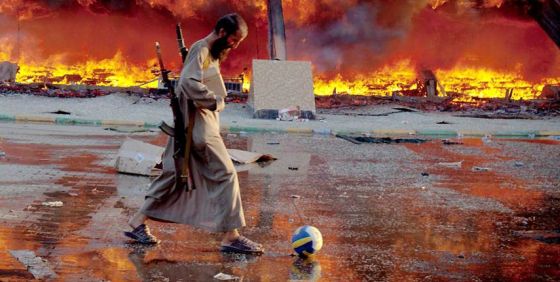
The only time he shone was on the football field, playing for the team from the local mosque where he would also occasionally, though not very impressively, lead the congregation in prayer.
“He was the Messi of our team,” said Abu Ali, a fellow player and worshipper at the mosque, making comparison with the Lional Messi, the Argentinian striker. “He was our best player.”
If Baghdadi’s zealotry was fueled in part by his own unfulfilled ambitions — a form of psychological corruption that could be described as the metastasization of talent — maybe he traded in fantasies about playing in the World Cup in exchange for the higher goal of becoming Caliph.
Whatever the motive, he now is apparently intent on making sure his followers won’t get distracted by the 2018 World Cup.
At The Turbulent World of Middle East Soccer, James M. Dorsey reports:
A purported letter by the Islamic State, the jihadist group that controls chunks of Syria and Iraq, has warned world soccer body FIFA not to hold the 2022 World Cup in Qatar, reviving concerns first raised in a FIFA security assessment warning two weeks before it was awarded the tournament that there could be a high risk of terrorist attacks.
The letter, first published on Alplatformmedia.com, a jihadist website, and reprinted in an Egyptian newspaper, suggested that soccer would be banned in areas controlled by the group because it constituted “a deviation from Islam.” The letter further indicated that conservative, energy-rich Gulf states were on the target list of the Islamic State, which has conquered parts of northern Iraq with lightning speed and declared a caliphate in territories it controls.
The letter, if genuine, comes amid heated Islamist debate about whether soccer is a legitimate sport according to Islamic precepts; the targeting by some Islamist groups, including the Islamic State, Somalia’s Al Shabab and Nigeria’s Boko Haram of soccer fans; and mounted controversy about the integrity of the Qatari bid to host the World Cup.
Anyone who happens to have watched the current World Cup on the BBC might — like me — have been perplexed by a detail in the iconography they have used for promoting Brazil 2014: toy footballers including one with no head. Another threat from ISIS?

U.S. ignored warnings before ISIS takeover of a key border city
The Daily Beast reports: Three weeks ago, a group of leaders from the opposition Free Syrian Army warned U.S. officials that a strategic city along the Iraqi border was about to fall to ISIS. It was the latest in a long series of increasingly anxious cries for help. The rebels never heard back from the Americans.
Five days ago, the predictions came true. Free Syrian Army units in the city of Der al Zour handed over their territory to the Islamic State of Iraq and al Sham, following weeks of desperate requests for help to international officials, including a direct appeal in a private meeting with U.S. Ambassador to the United Nations Samantha Power.
“[The U.S. officials] showed an understanding of the situation but there was no movement at all,” the commander of the FSA battalion near Der al Zour told The Daily Beast in an interview. “There’s no clear American position in that part of Syria. We told the Americans we are going to fight ISIS and ISIS is close to us, but they did nothing.”
Two leaders of the Free Syrian Army in eastern Syria told The Daily Beast that the moderate rebels in the area greatly outnumbered the ISIS fighters returning from Iraq in stolen American-made vehicles. But the FSA battalion, weakened from months of being under siege, did not have enough ammunition to engage ISIS in the fight. They retreated south, giving up what they controlled of Der al Zour to ISIS without ISIS having to fire a shot.
“Der al Zour was surrounded for several months by ISIS and the regime. The siege included no food and water. Our battalion was weakened,” the FSA commander said. “The FSA numbers are big, but we don’t have weapons, we don’t have ammunition, we don’t have anything.”
For several weeks prior, FSA leaders had tried to sound the alarm. If Der al Zour fell to ISIS, the extremist group would have control of the transportation routes from their stronghold in Raqqa, Syria to their new territories in northern Iraq. The area is also rich in oil and gas resources and was the last FSA stronghold along the rapidly disappearing Iraq-Syria border. [Continue reading…]
ISIS is about to destroy Biblical history in Iraq
Christopher Dickey reports that soon after ISIS took control of Mosul: the minions of the self-appointed caliph of the freshly self-declared Islamic State, Abu Bakr al-Baghdadi, paid a visit to the Mosul Museum. It has been closed for years for restoration, ever since it was looted along with many of Iraq’s other institutions in the wake of the culturally oblivious American-led invasion of 2003. But the Mosul Museum was on the verge of reopening, at last, and the full collection had been stored there.
“These groups of terrorists—their arrival was a brutal shock, with no warning,” Iraqi National Museum Director Qais Hussein Rashid told me when he visited Paris last week with a mission pleading for international help. “We were not able to take preventive measures.”
Indeed, museum curators and staff were no better prepared than any other part of the Iraqi government. They could have learned from al-Baghdadi’s operations in neighboring Syria that a major source of revenue for his insurgency has been the sale of looted antiquities on the black market. As reported in The Guardian, a windfall of intelligence just before Mosul fell revealed that al-Baghdadi had accumulated a $2 billion war chest, in part by selling off ancient artifacts from captured Syrian sites. But the Iraqi officials concerned with antiquities said the Iraqi intelligence officers privy to that information have not shared it with them.
So the risk now — the virtual certainty, in fact — is that irreplaceable history will be annihilated or sold into the netherworld of corrupt and cynical collectors. And it was plain when I met with Rashid and his colleagues that they are desperate to stop it, but have neither the strategy nor the resources to do so. [Continue reading…]
Life in Mosul under the rule of ISIS
According to an NBC News report, the most common complaint in Mosul these days is about lack of electricity: “We all thought ISIS fighters will hurt people, but they did not do so,” said shop owner Fahad, referring to militants from the Islamic State of Iraq and al-Sham (ISIS). “It is 100 percent safe here. The only thing we suffer from is the lack of public services.”
The shop owner’s sentiments run counter to reports of brutality carried out by the militants elsewhere. As recently as Wednesday, Iraqi security forces found 53 corpses, blindfolded and handcuffed, south of Baghdad, Reuters reported.
The identity and sectarian affiliation of the dead people was not immediately clear, but the Sunni insurgents have boasted of killing hundreds of captive Shi’ite army troops after capturing the city of Tikrit on June 12. They put footage on the Internet of their fighters shooting prisoners.
ISIS overran Mosul two days before that fight, marking the first of many key victories for the fighters in a lightning offensive through Iraq. The assault triggered an exodus of refugees, with many Shiites fleeing northern Iraq amid fears of sectarian violence at the hands of the Sunni extremists.
While many Shiites left Mosul, those who stayed behind are being treated “just like Sunnis — in a very good way,” insisted Fahad, a 30-year-old Sunni who asked that NBC News only use his first name.
Fahad said he and others initially feared for the safety of their female relatives at the hands of the violent militants.
“We prepared to defend our houses and families, but after a while, we started to see the truth,” he said. “They did not rape a single woman, they did not force people to leave their houses and did not chase innocent people – except those who are wanted.”
Shortly after capturing Mosul, ISIS fighters roamed the city handing out leaflets warning residents away from smoking and drinking alcohol, and promising that lawbreakers would be dealt with under Islamic law, according to The Associated Press. Women also were told to stay home as much as possible.
But ISIS has largely held off on enforcing the group’s strict interpretation of Islamic law, according to residents. [Continue reading…]
IAEA statement on seized nuclear material in Iraq
Following reports that ISIS seized nuclear material used for scientific research at Mosul University, the IAEA issued the following statement:
The IAEA is aware of the notification from Iraq and is in contact to seek further details. On the basis of the initial information we believe the material involved is low-grade and would not present a significant safety, security or nuclear proliferation risk. Nevertheless, any loss of regulatory control over nuclear and other radioactive materials is a cause for concern.
Holder pushes for witch-hunt against potential terrorists
For several decades, thousands of Americans — some of them religious extremists, some ethnic supremacists and most believing that they have God on their side — have been traveling to the Middle East to fight in a foreign army notorious for committing war crimes and abusing human rights.
Americans are free to join the Israel Defense Forces so long as Israel does not declare war on the United States. There is no law that stands in the way of this kind of foreign military enrollment, even though some radicalized Americans who have followed this path went on to become terrorists.
Never is an American who moves to Israel, even one who illegally constructs a home on Palestinian land in the West Bank, referred to as a “potential terrorist” — that potentiality supposedly can only be found in Muslims.
The New York Times now reports:
Attorney General Eric H. Holder Jr. on Tuesday implored more European countries to adopt American-style counterterrorism laws and tactics, including undercover stings to prevent potential terrorists from traveling to Syria.
Mr. Holder’s speech in Oslo amounted to a full-throated endorsement of America’s pre-emptive counterterrorism strategy, which began in earnest under President George W. Bush after the Sept. 11 attacks. The F.B.I. has created elaborate ruses to ensnare people who express interest in joining terrorist groups or attacking America. That has led to a number of high-profile cases but has also attracted criticism that the United States is manufacturing terrorism cases and entrapping Muslims.
Prosecutors have also arrested people before they boarded international flights, charging them with providing support to terrorist groups. Such laws do not exist in every country.
“In the face of a threat so grave, we cannot afford to be passive,” Mr. Holder said in prepared remarks. “Rather, we need the benefit of investigative and prosecutorial tools that allow us to be pre-emptive in our approach to confronting this problem. If we wait for our nations’ citizens to travel to Syria or Iraq, to become radicalized, and to return home, it may be too late to adequately protect our national security.”
Try and unpack the meaning of the phrase become radicalized and some mangled reasoning quickly surfaces.
If the process of radicalization had not begun before an individual decided to abandon their home and travel to Syria or Iraq, does that mean that the U.S. or any other Western government should view, for instance, anyone who wants to go and work in a refugee camp in Syria as a potential terrorist?
On the other hand, if it is conceded that this mysterious psychological transformation called radicalization is determined not so much by where an individual is physically located as much as what they are influenced by and how they perceive those people they identify with as being under threat, then the premise of the geographically located terrorist breeding ground starts to fall apart.
In those cases where individuals have had the opportunity to explain their motives for turning towards extremism, the most common explanations are that it has been a response to witnessing the impunity with which Israel uses violence to subjugate the Palestinian people, or because they believe that the United States used 9/11 to launch a war on Islam. In other words, they became radicalized by watching the news — not by traveling to Syria or by participating in online jihadist forums.
Even during the era of McCarthyism when conservatives were whipping up anti-communist hysteria in America, the question posed by the House Committee on Un-American Activities, was: “Are you now or have you ever been a member of the Communist Party of the United States?”
If Eric Holder had been on that committee maybe they would have been asking: “Are you now, have you ever been, or might you ever become a member of the Communist Party of the United States?”
In truth, the U.S. government has no business nor skill in predicting the future and hunting for potential terrorists.
The growth of ISIS has been driven by its success on the battleground — not the failure of foreign governments to monitor their own citizens.
And the challenge ISIS presents will not be met by hoping it destroys itself.
More than anything else, Americans are victims of simplistic narratives — analysis all too often gets reduced to kindergarten language about “good guys” and “bad guys,” while reference to “moderates” and “extremists” passes for nuanced interpretation.
In large part this results from the fact that the actors on the ground are so rarely included in the discussion.
As a recent conversation on Britain’s Channel 4 News illustrates, however, it is possible to talk about what is happening in Syria and Iraq while acknowledging that despite the gruesome headlines, the participants in this conflict are by-and-large self-motivated, autonomous adults.

The Iraqi generals who once served Saddam and now run ISIS
The Daily Telegraph reports: Documents seized from the house of a member of the Islamic State in a raid by the Iraqi military have revealed, for the first time and in remarkable detail, the leadership structure of this secretive organisation.
Whilst al-Baghdadi’s predecessors, including Abu Musab al-Zarqawi – who led the group when it was known as ISI – reportedly kept power very centralised, the new jihadist leader has assigned deputies to manage everything from military stores and roadside bomb attacks to the finances of the organisation.
“I describe Baghdadi as a shepherd, and his deputies are the dogs who heard the sheep [the Islamic State’s members],” said Hisham al-Hashimi, a security analyst who had access to the documents. “The strength of the shepherd comes from his dogs.”
The information, which was found on memory sticks taken from the home of Abu Abdul Rahman al-Bilawi, al-Baghdadi’s military chief of staff for Iraqi territory, who was killed in the military raid, identified two key deputies who are charged with managing terrain controlled by the Islamic State in Syria and in Iraq respectively.
Unlike al-Baghdadi both of these men formerly held senior roles in the Iraqi military and are seasoned in battle.
Abu Ali al-Anbari, who is charged with managing operations in the parts of Syria controlled by the Islamic State, was a major general in the Iraqi military under ousted dictator Saddam Hussein, Mr Hashimi said. He’s said to hail from the northern Iraqi province of Mosul.
Abu Muslim al-Turkmani was a lieutenant colonel in the Iraqi military’s intelligence core under and also spent time as a special forces officer.
“These men the reasons behind the strength of Abu Bakr al-Baghdadi. They are the key people who keep him in power,” said Mr Hashimi.
Mr Hashimi claimed that there are now 25,000 men in Iraqi who have sworn allegiance to the Islamic State.
This figure was also, separately, quoted to the Telegraph by a senior ranking member of the Iraqi military, who spoke on condition of anonymity.
Mr Hashimi said: “Each of these men have a job within the organisation, a geographical area in which they must work, and a monthly salary.”
There are reportedly approximately 1000 medium and top level field commanders, who all have technical, military and security experience.
Salaries range from $300 to $2000 per month depending on the job post.
The mood in Baghdad
Patrick Cockburn writes: In early June, Abbas Saddam, a private soldier from a Shia district in Baghdad serving in the 11th Division of the Iraqi army, was transferred from Ramadi, the capital of Anbar province in western Iraq, to Mosul in the north. The fighting started not long after he got there. But on the morning of 10 June the commanding officer told his men to stop shooting, hand over their rifles to the insurgents, take off their uniforms and get out of the city. Before they could obey, their barracks were invaded by a crowd of civilians. ‘They threw stones at us,’ Abbas recalled, ‘and shouted: “We don’t want you in our city! You are Maliki’s sons! You are the sons of mutta! You are Safavids! You are the army of Iran!”’
The crowd’s attack on the soldiers shows that the fall of Mosul was the result of a popular uprising as well as a military assault by Isis. The Iraqi army was detested as a foreign occupying force of Shia soldiers, regarded in Mosul – an overwhelmingly Sunni city – as creatures of an Iranian puppet regime led by Nouri al-Maliki. Abbas says there were Isis fighters – always called Daash in Iraq after the Arabic acronym of their name – mixed in with the crowd. They said to the soldiers: ‘You guys are OK: just put up your rifles and go. If you don’t, we’ll kill you.’ Abbas saw women and children with military weapons; local people offered the soldiers dishdashes to replace their uniforms so that they could flee. He made his way back to his family in Baghdad, but he hasn’t told the army he’s here because he’s afraid of being put on trial for desertion, as happened to a friend. He feels this is deeply unjust: after all, he says, it was his officers who ordered him to give up his weapon and uniform. He asks why Generals Ali Ghaidan Majid, commander of ground forces, and Abboud Qanbar, deputy chief of staff, who fled Mosul for Kurdistan in civilian clothes at the same time, haven’t been ‘judged and executed as traitors’.
Shock at the disintegration of the army in Mosul and other Sunni-majority districts of northern Iraq is still determining the mood in Baghdad weeks later. The debacle marks the end of a distinct period in Iraqi history: the period between 2006 and 2014 when the Iraqi Shia under Maliki sought to dominate the country much as the Sunni had done under Saddam Hussein. The Shias’ feeling of disempowerment after the Mosul collapse has been so unexpected that they believe almost any other disaster is possible. [Continue reading…]
Evidence of a sectarian massacre south of Baghdad
The Associated Press reports: Iraqi officials discovered 50 bodies, many of them blindfolded and with their hands bound, in an agricultural area outside a city south of Baghdad on Wednesday, raising concerns over a possible sectarian killing amid the battle against a Sunni insurgency.
The lightning sweep by the insurgents over much of northern and western Iraq the past month has dramatically hiked tensions between the country’s Shiite majority and Sunni minority. At the same time, splits have grown between the Shiite-led government in Baghdad and the Kurdish autonomy region in the north.
In an address on Wednesday, Prime Minister Nouri al-Maliki accused the Kurdish zone of being a haven for the Islamic extremists and other Sunni insurgents. He did not provide any evidence, and the claims are likely to only further strain Baghdad’s ties which the Kurds, whose fighters have been battling the militant advance in the north.
The bodies, all of them with gunshot wounds, were found in the predominantly Shiite village of Khamissiya outside the city of Hillah, located some 95 kilometers (60 miles) south of Baghdad, said military spokesman Brig. Gen. Saad Maan Ibrahim. He said an investigation was underway to determine the identities of the dead as well as the circumstances of the killings. [Continue reading…]
Leading jihadist thinker condems ISIS caliphate
Al Monitor reports: Jordanian Islamist groups have rejected the announcement of an Islamic caliphate by al-Qaeda offshoot the Islamic State (IS, formerly the Islamic State of Iraq and al-Sham) on territory it has seized in Iraq and Syria, a move they see as a “rush job,” “forced” and “illegitimate.”
The Sunni militant organization declared itself a caliphate on June 29, renamed itself “Islamic State“ and proclaimed its leader, Abu Bakr al-Baghdadi, caliph of the Muslim world.
Salafist and al-Qaeda spiritual leader Assem Barqawi, better known as Abu Muhammad al-Maqdisi, one of the most influential voices in Salafist Islam, dismissed the declaration of a new caliphate in a lengthy statement posted July 1 on his website branding the group “deviant” and against the principles of both Islam and Sharia. [Continue reading…]
Thomas Hegghammer writes: A number of the world’s most senior jihadi ideologues have already come out against ISIS on the caliphate question, and the criticism from supporters of al-Qaida and groups like Jabhat al-Nusra, the al-Qaida-anointed jihadi group in Syria, has been scathing. Meanwhile, ISIS has so far only received the pledge of allegiance (bay’a) from a small number of minor clerics, dissidents from al-Qaida in the Arabian Peninsula (AQAP) and al-Qaida in the Islamic Maghreb (AQIM), and groups in the Syrian-Iraqi theater that were at risk of being swallowed by ISIS anyway. To be sure, ISIS has also seen many declarations of support from grassroots sympathizers around the world, but it is unclear whether these are newly won adherents or people who were cheering on ISIS already. As [J.M.] Berger put it in another article, it looks like “ISIS threw a party and nobody came.”
This raises the question: why did they do it? It is hard to believe that ISIS simply miscalculated and genuinely thought the entire jihadi movement would submit to their authority. ISIS is not an isolated sect, but a tech-savvy bureaucracy that monitors enemy Twitter accounts and consumes academic literature (in fact, they will probably read this very article). They must have known the lay of the ideological land. We should therefore not dismiss the move as ideological excess, but rather assume it was based on a careful calculus.
It is possible, for example, that this was a bid for the youth vote in the jihadi movement. ISIS may have realized it was not going to win over the pro-al-Qaida old guard anyway, but that there was a potential to further increase its appeal among young recruits, especially abroad. Bear in mind that for the past three years, virtually all of the world’s new jihadi foreign fighters have gone to Syria, where a majority has joined ISIS. By comparison, only a handful have gone to Pakistan, Yemen, or Algeria to train with al-Qaida and its affiliates. Moreover, ISIS has arguably been the biggest game in town the past year in terms of visibility on the jihadi Internet. Finally, with its battlefield advances in Iraq over the past month, ISIS has demonstrated real-life impact that other jihadi groups can only dream of. New recruits—who tend to be young, male, and impatient—may be attracted to the group that gets things done. Declaring a caliphate consolidates this youth appeal by adding another element of bravado to the ISIS project. In such a context, heavy criticism from the ideological establishment may paradoxically bestow an underdog image on ISIS, which younger recruits may find attractive. [Continue reading…]
Why one Canadian woman joined ISIS’s Islamic state
CBC News reports: Eight months ago, Umm Haritha, a 20-year-old woman from Canada, made her way to Turkey against her parents’ wishes with a half-empty suitcase and $1,500.
Within a week she was in Syria, and a few weeks later she was married to Abu Ibrahim al-Suedi, a 26-year-old Palestinian from Sweden fighting for Islamic State in Iraq and Syria (ISIS), the Sunni jihadist group battling the Syrian regime.
It is not clear whether Umm Haritha’s marriage to Abu Ibrahim was arranged before her travel to Syria. Regardless, it only lasted five months.
On May 5, Abu Ibrahim, whose real name is Taha Shade, was in a car en route to a meeting in Deir ez-Zor with members of rival faction Jabhat al-Nusra. What was meant to be a gathering to finalize a peace treaty between ISIS and al-Nusra turned deadly when an al-Nusra fighter on a motorbike sped up to Shade’s car and detonated his explosive belt.
At the time, Shade was wearing his own explosive belt, which also went off and blew him to pieces.
Two days later, Umm Haritha tweeted about her husband’s death, calling on “Allah” to “destroy those who backstabbed the brothers and resurrect Abu Ibrahim with noor [light] from every piece of his body.”
Umm Haritha’s journey to Syria highlights an underreported part of the western Jihadist experience in Syria. [Continue reading…]