Category Archives: GOP

Donald Trump’s vision for America

president-trump

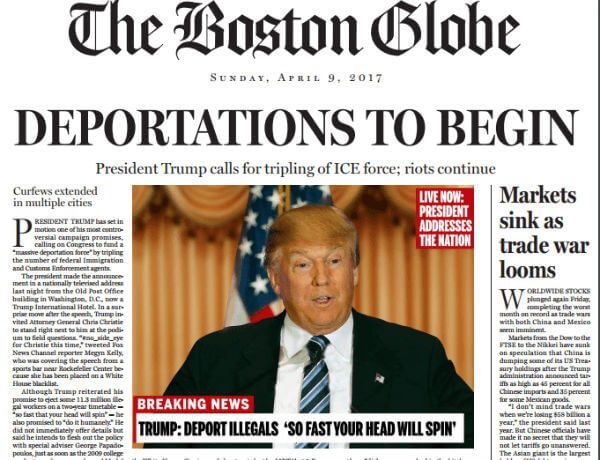
In an editorial, the Boston Globe says: Donald J Trump’s vision for the future of our nation is as deeply disturbing as it is profoundly un-American.

It is easy to find historical antecedents. The rise of demagogic strongmen is an all too common phenomenon on our small planet. And what marks each of those dark episodes is a failure to fathom where a leader’s vision leads, to carry rhetoric to its logical conclusion. The satirical front page of this section [shown above] attempts to do just that, to envision what America looks like with Trump in the White House.

It is an exercise in taking a man at his word. And his vision of America promises to be as appalling in real life as it is in black and white on the page. It is a vision that demands an active and engaged opposition. It requires an opposition as focused on denying Trump the White House as the candidate is flippant and reckless about securing it.

After Wisconsin, the odds have shrunk that Trump will arrive in Cleveland with the requisite 1,237 delegates needed to win the nomination outright. Yet if he’s denied that nomination for falling short of the required delegates, Trump has warned, “You’d have riots. I think you’d have riots.” Indeed, who knows what Trump’s fervent backers are capable of if emboldened by the defeat of their strongman at the hands of the hated party elite. [Continue reading…]

Facebooktwittermail

Sheldon Adelson and top GOP donors retreat to the sidelines

Politico reports: Dispirited over a Republican Party primary that has devolved into an ugly, damaging fight, some of the GOP’s biggest financiers are reevaluating whether to invest in the 2016 presidential contest at all.

Among those on the sidelines: Sheldon Adelson, the billionaire casino mogul who hosted the Republican Jewish Coalition’s spring meeting at his Venetian hotel this weekend. His apparent ambivalence about 2016 was shared by many RJC members here. With grave doubts about the viability of the few remaining Republican contenders, many of these Republican donors have decided to sit out the rest of the primary entirely. And while some are reluctantly getting behind a remaining candidate, others are shifting their attention to congressional contests.

On Friday morning, during a meeting of the group’s board, Arthur Finkelstein, an iconic Republican strategist who has advised numerous politicians over the past four decades, presented polling data that showed Donald Trump sitting at historically low approval numbers among American Jews, according to three attendees who described the off-the-record meeting. Ted Cruz, despite an aggressive recent push to court Jews, fared little better.

Following the nearly 30-minute presentation, the group turned to a discussion about what’s next in the race. While some in the room spoke in favor of Cruz, others expressed reservations about his prospects in the general election. Trump, meanwhile, had little support: Not one person volunteered to raise money for him if he were the nominee. [Continue reading…]

Facebooktwittermail

How Joseph McCarthy henchman Roy Cohn became Donald Trump’s mentor

Michael Kruse writes: The reporter from the Washington Post didn’t ask Donald Trump about nuclear weapons, but he wanted to talk about them anyway. “Some people have an ability to negotiate,” Trump said, of facing the Soviet Union. “You either have it or you don’t.”

He wasn’t daunted by the complexity of the topic: “It would take an hour and a half to learn everything there is to learn about missiles,” he said.

It was the fall of 1984, Trump Tower was new, and this was unusual territory for the 38-year-old real estate developer. He was three years away from his first semi-serious dalliance with presidential politics, more than 30 years before the beginning of his current campaign—but he had gotten the idea to bring this up, he said, from his attorney, his good friend and his closest adviser, Roy Cohn.

That Roy Cohn.

Roy Cohn, the lurking legal hit man for red-baiting Sen. Joe McCarthy, whose reign of televised intimidation in the 1950s has become synonymous with demagoguery, fear-mongering and character assassination. In the formative years of Donald Trump’s career, when he went from a rich kid working for his real estate-developing father to a top-line dealmaker in his own right, Cohn was one of the most powerful influences and helpful contacts in Trump’s life. [Continue reading…]

Facebooktwittermail

The politics of backlash

Roger Cohen writes: There is a global backlash against rising inequality, stagnant middle-class incomes, politicians for sale, social exclusion, offshoring of jobs, free trade, mass immigration, tax systems skewed for giant corporations and their bosses, and what Pope Francis has lambasted as the “unfettered pursuit of money.”

The backlash takes various forms. In the United States it has produced an angry election campaign. The success of both Donald Trump on the right and Bernie Sanders on the left owes a lot to the thirst for radical candidates who break the mold. Trump is unserious and incoherent; Sanders is neither of those things. But they both draw support from constituencies that feel stuck, reject politics as usual, and perceive a system rigged against them.

Hillary Clinton’s chief predicament, apart from the trust issue, is that she represents the past in a world where the post-cold-war optimism that accompanied her husband’s arrival in the White House almost a quarter-century ago has vanished. To embody continuity these days is political suicide.

In an interesting essay in the journal STIR, Jonna Ivin writes: “People want to be heard. They want to believe their voices matter. A January 2016 survey by the Rand Corporation reported that Republican primary voters are 86.5 percent more likely to favor Donald Trump if they ‘somewhat agree or ‘strongly agree’ with the statement, ‘People like me don’t have any say about what the government does.”’ [Continue reading…]

Facebooktwittermail

Why Trump can’t break the GOP

trump

Jacob S. Hacker and Paul Pierson write: Everywhere you look, in the year of Donald J. Trump, observers are talking about a national party realignment or a Republican death spiral. Our two-party system has not undergone a major realignment since the South became solidly Republican. There has not been a major-party demise since the Whigs collapsed on the eve of the Civil War.

Mr. Trump (or Ted Cruz) could very well lead the party to a decisive and divisive defeat. If it was catastrophic enough, it could lead to changes in party strategy. Yet predictions of a Republican crackup should be greeted with skepticism. While rumors of the death of the Republican Party have been common in recent presidential elections, they have proved again and again to be vastly exaggerated.

The gap between expectations and political realities reflects two mistakes: The first is to overestimate the centrality of presidential contests to our system of checks and balances.

The second is to misunderstand the recent Republican electoral successes — which rest less on effective governance than on attacking government, and especially the occupant of the Oval Office. [Continue reading…]

Facebooktwittermail

Trump’s nomination would be ‘a historic election defeat just waiting to happen’

The New York Times reports: Mr. Trump has become unacceptable, perhaps irreversibly so, to broad swaths of Americans, including large majorities of women, nonwhites, Hispanics, voters under 30 and those with college degrees — the voters who powered President Obama’s two victories and represent the country’s demographic future. All view him unfavorably by a 2-to-1 margin, according to a recent New York Times/CBS News poll.

In some states, Mr. Trump has surprised establishment-aligned Republicans with his breadth of support beyond the less-educated men who form his base. Even so, his support in the nominating process, in which some 30 million people may ultimately vote, would be swamped in a general election, when turnout is likely to be four times that.

“We’re talking about somebody who has the passionate devotion of a minority and alternately scares, appalls, angers — or all of the above — a majority of the country,” said Henry Olsen, a conservative analyst. “This isn’t anything but a historic election defeat just waiting to happen.” [Continue reading…]

Facebooktwittermail

Is Donald Trump actually a fascist?

The Toronto Star reports: Google Donald Trump, and it won’t be long before the “f” word comes up.

The word is “fascist.” And it’s back in a way that hasn’t been seen for years, as opponents grope for a term that matches the repulsion that a majority of Americans feel for The Donald.

Former Mexican president Vicente Fox has all but called Trump a fascist — and used another “f-word” for his proposed border wall.

Historian Fedja Buric compared him with founding fascist Benito Mussolini. And New Republic editor Jamil Smith said it straight out: “yes, Donald Trump is a fascist.”

Trump even went too far for tub-thumping far right radio host Glenn Beck, who lumped him with “Adolph Hitler in 1929,” on ABC-TV.

But those who have made an academic study of fascism say although Trump and his Coalition of the Chilling may share some of the characteristics of past fascists, the jaw-jutting reality star doesn’t quite squeeze into the classic 20th-century mould. [Continue reading…]

Facebooktwittermail

The overlooked star of the Trump show is the crowd

trump-bw

Gwynn Guilford writes: Over the span of three days in March, in far-flung corners of Ohio, more than 20,000 people—retired schoolteachers, hair stylists, chinos-clad Young Republicans, Nicaraguan immigrants, Vietnam vets, primly coiffed soccer moms—braved downpours, traffic, muscle spasms, hunger, and protesters for a chance to behold, in the very tanned flesh, Donald J. Trump, billionaire, business genius, TV star, and, very possibly, the next president of the United States. One of those people was me.

I went, first and foremost, to answer a deceptively simple question: How has Trump defied pretty much every rule not just of electoral politics, but of contemporary civil discourse to lead the race for the Republican party’s nomination for president? Set aside for one moment the economic conditions that we know have made Trump’s rise possible. What about those of the human psyche? What does Trump’s improbable rise reveal about how Americans understand themselves, what they imagine for their country, what they crave in their leaders?

To find answers to these questions, I decided to become part of Trump’s audience, not just its observer. For three days in mid-March, I buried my reporter credentials in my bag and lost myself in the throngs of Trump supporters at rallies in Cleveland, Cincinnati, and Youngstown. What I experienced astonished me. I’m far from being a Trump supporter; in fact I object to most of his views. But as I shuffled out of a Youngstown aircraft hangar, I became aware of the unsettling but very real possibility that, in the thrill of the moment, I’d been chanting along with the Trump crowd. (I don’t think I did, but I can’t be sure). Indeed, it felt like I had just taken part in an epic psychological experiment.

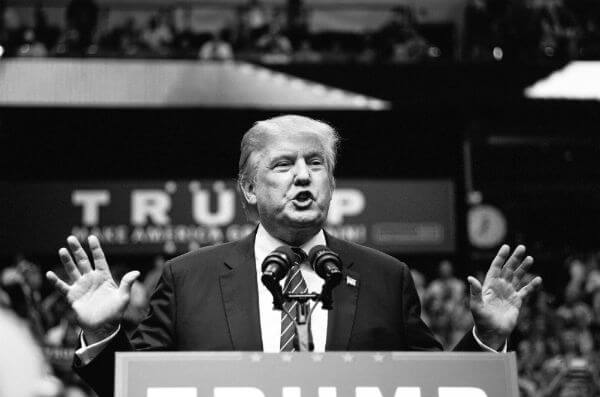
Spending three straight days in the audience taught me one crucial thing. The overlooked star of the Trump show is the crowd—the single-voiced creature that roars “Mexico!” when asked about wall construction, and emits a foghorn of boos when reminded of reporters cooped in a pen at the rear of the room. From within the Trump rally masses, I felt the strange sea-change that fuses 20,000 individuals into one being, I felt its power swell, and sometimes it felt good. [Continue reading…]

Facebooktwittermail

Adventures in the Trump Twittersphere

Zeynep Tufekci writes: Every morning since August, I have steeled myself to enter an alternate universe. I scroll through social media feeds where people are convinced that Congress funds the Islamic State, that our president hates this country and wants it to fail and that Donald J. Trump is the only glimmer of hope in this bleak landscape.

It’s my look at a list of Twitter users whom I’ve identified as Trump supporters. Some accounts have only a few followers while some have tens of thousands. (No one comes close to Mr. Trump himself, at more than seven million.) They include people of many professions and backgrounds. I found them by reading at responses to news media or political accounts, and then went on to seek out other accounts they followed. It’s a large, sprawling network.

As an academic, I study social media and social movements, from the uprising in Egypt to Black Lives Matter. As I watched this election season unfold, I wanted to gain a better understanding of the power of the Trump social media echo chamber. What I’ve been reading has surprised even my jaded eyes. It’s a world of wild falsehoods and some truth that you see only rarely in mainstream news outlets, or hear spoken among party elites.

It’s popular to argue today that Mr. Trump’s success is, in part, a creation of the traditional news media — cable networks that couldn’t get enough of his celebrity and the ratings it brought, and newspapers that didn’t scrutinize him with enough care. There is some truth in that, but the contention misses a larger reality.

Mr. Trump’s rise is actually a symptom of the mass media’s growing weakness, especially in controlling the limits of what it is acceptable to say. [Continue reading…]

Facebooktwittermail

Trump attack on Geneva Conventions denounced by ex-officers and advocates

The Guardian reports: Retired senior military officers and human rights advocates are reacting with disgust at Republican presidential frontrunner Donald Trump’s description of the Geneva Conventions as a “problem” for the conduct of US wars.

At an appearance in Wisconsin on Wednesday that was obscured by his suggestion that women who choose abortion should face punishment, Donald Trump was also quoted as saying: “The problem is we have the Geneva Conventions, all sorts of rules and regulations, so the soldiers are afraid to fight.”

Trump has previously advocated killing the families of terror suspects; torture “a hell of a lot worse” than waterboarding; and widespread bombing campaigns against Islamic State, which operates in civilian-packed areas. The Geneva Conventions provide the basis for protections against war crimes, privileging the status of civilians and detainees during wartime.

Several retired officers said the comments called into question Trump’s fitness to serve as commander-in-chief, saying that service members operating in line with his predilections would be tasked with behavior ranging from the disgraceful to the illegal.

“Donald Trump cannot possibly understand [Geneva] because he has neither the experience, the expertise or the moral compass to grasp it,” said Steve Kleinman, an air force reserve colonel and an interrogations expert. [Continue reading…]

Facebooktwittermail

Donald Trump may sound like a clown, but he is a rhetoric pro like Cicero

Joe Romm writes: A key purpose of hyperbole is to express the emotion of anger, as Aristotle explained in classic work, “Rhetoric,” the first in-depth study of the art. Aristotle explains the hyperboles “show vehemence of character; and this is why angry people use them more than other people.”

When Trump makes wildly over-the-top claims — he’s going to build a wall and make Mexico pay for it — it has no effect on his supporters to point out that this is hyperbolic nonsense. Quite the reverse. Trump’s claim moves them emotionally and persuades them precisely because it is hyperbolic nonsense. They are angry, and he’s showing that he is angry too — which is vastly more effective communications than the bland assertions by the professional politicians that they “understand” there is a lot of anger out there.

“Your language will be appropriate if it expresses emotion and character,” notes Aristotle. “To express emotion, you’ll employ the language of anger in speaking of outrage; the language of disgust and discrete reluctance to utter a word when speaking of impiety or foulness; the language of exultation for a tale of glory.”

Trump loves the rhetorical device of phony “reluctance” to utter a word or phrase: “She just said a terrible thing. You know what she said? Shout it out because I don’t want to say. OK you’re not allowed to say and I never expect to hear that from you again. She said — I never expect to hear that from you again — she said he’s a pussy…. That’s terrible! Terrible.”

This figure, apophasis (from the Greek word for “to deny”), emphasizes a point by pretending to deny it, stresses an idea or image by saying you don’t want talk about it, as with Trump’s use of “pussy.” A favorite of Cicero’s — “I will not even mention the fact that you betrayed us in the Roman people by aiding Catiline” (63 BC) — it’s also called paralipsis (from the Greek word for “omission”).

Trump, however, is more Ciceronian than Cicero himself:

  • “I was going to say ‘dummy’ Bush; I won’t say it. I won’t say it,”
  • “I refuse to call Megyn Kelly a bimbo, because that would not be politically correct,”
  • “Unlike others, I never attacked dopey Jon Stewart for his phony last name. Would never do that!”
  • “I promised I would not say that she [Carly Fiornia] ran Hewlett-Packard into the ground, that she laid off tens of thousands of people and she got viciously fired. I said I will not say it, so I will not say it.”

Seriously — but then again, this should be very serious, selecting a President.

Shakespeare and the great rhetoricians of the past knew and regularly used some two hundred figures of speech. Equally important, they knew which figures expressed which kind of emotion and hence when to use them to get the desired emotional effect.

In recent months, scholars have pointed out Trump’s use of a great many different figures beyond hyperbole (including various figures of repetition) — he uses more figures more often than any of the other major candidates. They’ve called him “a brilliant master of rhetoric” who has “plundered the figures of classical rhetoric.” [Continue reading…]

Facebooktwittermail

Trump says that after 9/11 Bush should have ‘just gone to the beach and enjoyed the ocean and the sun’

In an interview with the New York Times, Donald Trump said: Every bad decision that you could make in the Middle East was made. And now if you look at it, if you would go back 15 years ago, and I’m not saying it was only Obama, It was Obama’s getting out, it was other people’s getting in, but you go back 15 years ago, and I say this, if our presidents would have just gone to the beach and enjoyed the ocean and the sun, we would’ve been much better off in the Middle East, than all of this tremendous death, destruction, and you know, monetary loss, it’s just incredible. ’Cause we’re further, we’re far worse off today than we were 15 years ago or 10 years ago in the Middle East. Far worse. [Continue reading…]

Maybe the trip to the beach should have been preceded by some national mourning, cleaning up the attack sites, and improving airline security, but who can argue with Trump’s colorfully expressed conclusion that the war on terrorism has been an utter failure?

On the international front, the urgent priorities after 9/11 should have been to isolate al Qaeda by putting pressure on the Taliban, Pakistan, and Saudi Arabia.

Bush’s principle problem was that he had surrounded himself with the wrong people — and there’s every reason to believe that is exactly what Trump would do too.

Facebooktwittermail

An American divide

McClatchy reports: “The establishment is anybody with big money who can get to the Congressmen and lobbyists,” said Judy Surak, a nurse from Clemson, South Carolina.

All over South Carolina, ask the people reveling in the music at Greenville Heritage Main Street Fridays, or starting their day with homemade onion sausage at Lizard’s Thicket on Two Notch Road in Columbia to define the establishment, and they usually echo Surak.

They often add a gentle qualifier: They don’t want to blow up the political system. They just want it to be more responsive, to work better.

“The country’s long-term problems have to be fixed within the system we have,” said Mark Cruise, a Columbia executive.

The most wary tend to be better educated, higher earning, older voters, according to the national poll. They tend to see establishment figures easing in and out of lucrative, comfortable jobs, climbing ladders to success that seem unavailable to the rank and file who populate South Carolina’s office cubicles.

Of 78 members of Congress who left after the 2010 elections, four out of five found work with lobbying firms or clients, state or federal governments or political action committees.

One of Bill Clinton’s former White House spokesmen hosts an influential network Sunday talk show. NBC hires Chelsea Clinton as a “special correspondent,” paying her a reported $600,000 annually, far above the typical pay for a reporter with no journalistic experience.

The ties are intricate and deep. Five Treasury secretaries in the past three presidential administrations have either headed big Wall Street firms, or became top executives after leaving their jobs.

Every member of the U.S. Supreme Court has at least one Ivy League degree. Every president elected since 1988 is an Ivy Leaguer. So are Clinton and Trump.

Even among Republican presidential candidates who insist they’re running against the establishment, establishment ties have served them well.

Sen. Ted Cruz, a Texas Republican, promotes himself as a maverick, but has two Ivy League degrees and worked in state and federal governments before being elected. Gov. John Kasich of Ohio was a congressman for 18 years, then was a senior executive at Lehman Brothers’ investment banking division. Trump’s company is building a luxury hotel five blocks from the White House.

Somehow, many see Trump through a different lens.

“He has all he ever wanted. He doesn’t have to bother with this,” explained Elaine Verma, a Kiawah Island court reporter. “He just has the best interests of the United States at heart.” [Continue reading…]

Nicholas Kristof writes: I personally made the mistake of regarding Trump’s candidacy as a stunt, scoffing at the idea that he could be the nominee. Mea culpa.

We failed to take Trump seriously because of a third media failing [the first being that the news media gave Trump $1.9 billion in free publicity, and the second being that the media treated Trump as a farce]: We were largely oblivious to the pain among working-class Americans and thus didn’t appreciate how much his message resonated. “The media has been out of touch with these Americans,” [Ann] Curry notes.

Media elites rightly talk about our insufficient racial, ethnic and gender diversity, but we also lack economic diversity. We inhabit a middle-class world and don’t adequately cover the part of America that is struggling and seething. We spend too much time talking to senators, not enough to the jobless.

All this said, I have to add that I don’t know if more fact-checking would have mattered. Tom Brokaw of NBC did outstanding work challenging Trump, but he says that when journalists have indeed questioned Trump’s untrue statements, nothing much happens: “His followers find fault with the questions, not with his often incomplete, erroneous or feeble answers.” [Continue reading…]

Once a system is perceived as rigged, its agents lose social authority — and that opens a space in which authority is up for grabs and the loudest voices will be those who claim their own authority on the basis that they operate outside the establishment. Paradoxically, authority is easily transferred to those who possess none.

Someone like Kristof can spend as much time as he wants talking to jobless Americans, but that won’t change his status as a member of the establishment. It won’t increase his level of influence among those Americans who are open to the influence of people like Alex Jones.

Half of Republicans don’t believe in evolution. 40% of conservative Republicans think global warming will never happen. 43% of Republicans think that President Obama is a Muslim.

Alex Jones now claims that “the establishment is announcing that they do intend to cancel the presidential election in this country.” And he says the mainstream media is being encouraged to report it “like it’s no big deal.”

In a Facebook video, Jones hands over to his cameraman, Buckley Hamman, who says: “Whether or not Trump is the person that we all hope and believe that he is, he is our last best hope at this point…”

“That’s right,” Jones interjects, “the establishment is scared of him.”

“They don’t have a right to come steal the elections and steal the government and be run by foreign interest, like communist China and all these other foreign governments and Saudi Arabia, telling us we can’t have Donald Trump. Donald Trump could be a monster and I would say we have to vote for him because these foreign mass murderers tell us he’s the worst guy in history.”

Hamman adds: “He is aware, he is open and he is conscious to the idea of the world being enslaved. And he is pissed off about it and he doesn’t want to have it happen any more… And look at how brilliant he is at manipulating the media.”

And who does Trump hold up as an authoritative media source? Alex Jones.

The problem in a broken political system where the mainstream media has largely abandoned its responsibility as a fourth estate, is that the doors get flung open to false prophets — people whose passion for “truth telling” and “exposing lies,” can seduce an audience ripe for a populist, xenophobic message.

Facebooktwittermail

Humans of New York founder takes on Donald Trump

The New York Times reports: Brandon Stanton, the nimble shutterbug behind the immensely popular photo blog Humans of New York, has worked hard to filter politics and moral judgments out of his posts, intent on maintaining objectivity as he captures his subjects in words and on film, letting them speak for themselves.

That changed last week when Mr. Stanton, 32, shed his sedulously cultivated neutrality to take on Donald J. Trump, excoriating the Republican presidential candidate in a 300-word Facebook post presented as an open letter to Mr. Trump.

“I’ve watched you retweet racist images,” the post read in part. “I’ve watched you retweet racist lies. I’ve watched you take 48 hours to disavow white supremacy. I’ve watched you joyfully encourage violence, and promise to ‘pay the legal fees’ of those who commit violence on your behalf.”

The reaction was explosive. Within eight hours the post was shared 712,000 times, eventually garnering more than 2.2 million “likes,” 1,131,389 shares and 69,000 comments, making it among the most-shared posts in the history of Facebook. In the process, it turned Mr. Stanton, already a best-selling author, into a web sensation. [Continue reading…]

Facebooktwittermail

Would Trump consider launching a tactical nuclear strike against ISIS?

That was a question posed by Fred Ryan, publisher of the Washington Post, in a meeting between Donald Trump and the paper’s editorial board on Monday.

You mentioned a few minutes earlier here you’d knock out ISIS — you’ve mentioned that many times. You’ve also mentioned the risk of putting American troops in a danger area. If you could substantially reduce the risk of harm to ground troops, would you use a battlefield nuclear weapon to take out ISIS?

Trump: I don’t want to use… I don’t want to start the process of nuclear. Remember, one thing that everybody has said, I’m a counter-puncher.

Note that Trump wouldn’t rule out using nuclear weapons — he merely said he wouldn’t start the process.

Last month Reuters reported that the theft of radioactive material last year “has raised fears among Iraqi officials that it could be used as a weapon if acquired by Islamic State.”

Fears of a nuclear-armed ISIS were fueled today by Britain’s defense minister who confirmed, “this is a new and emerging threat.”

If ISIS was to use a dirty bomb, or, so to speak, start the process, Trump seems to have just strongly inferred that he would throw a “counter-punch” with a tactical nuclear strike. Indeed, maybe the existing warnings are sufficient for Trump to see a process in motion.

It’s hard to imagine a strategic blunder of greater proportions as this would subsequently be seen by friends and foes alike both as an unjustifiable use of American power (deterrence means nothing to ISIS) while also opening the door to a new age of unleashed nuclear force.

That the Trump team is oblivious to the value of refraining from using nuclear weapons became evident in December when campaign spokesperson Katrina Pierson said on Fox’s The O’Reilly Factor: “What good does it do to have a good nuclear triad if you’re afraid to use it?”

Towards the end of the Post interview, Trump returned to the issue of nuclear weapons after being asked:

Do you think climate change is a real thing? Is it man… human caused?

Trump: I think there is a change in weather. I am not a great believer in man-made climate change… not a great believer. There is certainly a change in weather that goes, and if you look they had global cooling in the 1920s and now they have global warming, although now they don’t know if they have global warming. They call it all sorts of different things — now they’re using extreme weather I guess more than any other phrase. I am not — I know it hurts me with this room and I know it’s probably a killer with this room — but I am not a believer (perhaps there’s a minor effect) but I’m not a big believer in man-made climate change.

Don’t good businessmen hedge against risks, not ignore them?

Trump: Well, I just think we have much bigger risks. I mean I think we have militarily tremendous risks. I think we are at tremendous peril. I think our biggest form of “climate change” is — that we should worry about — is nuclear weapons. The biggest risk to the world to me — I mean I know that President Obama thought climate change — to me the biggest risk is nuclear weapons. That is climate change. That is a disaster. And we don’t even know where the nuclear weapons are right now. We don’t know who has them. We don’t know who is trying to get them. The biggest risk for the world and for this country is nuclear weapons — the power of nuclear weapons.

Trump’s thinking process is primitive.

As is sadly commonplace, he doesn’t understand the difference between weather and climate. He uses the language of an anti-intellectual who conspiratorially believes that terminology is designed to bamboozle the uneducated — as though scientists keep on tossing out new phrases all of which simply mean changeable weather. He thinks climate change and extreme weather are interchangeable terms.

But recognizing that as an expression climate change has an emotive yield — that its users hope to generate alarm — he uses it as he has used it before, to circle back to nuclear weapons.

Rather than convey that he truly understands the gravity of having control of a nuclear arsenal, Trump hints that he’s starting to get a tantalizing glimpse of what it might mean for him to grasp that power — and use it.

Would he launch a nuclear strike against ISIS? Trump clearly sees the maximum value in leaving the world guessing.

Facebooktwittermail

Why terrorism doesn’t help Donald Trump

Jamelle Bouie writes: Americans who read outlets like the New York Times woke up to detailed and largely accurate information about Tuesday’s attacks in Brussels, which killed and wounded dozens. Americans who watched cable news, on the other hand, woke up to Donald Trump, who presented these attacks—like the ones in Paris—as a boon for his campaign. “This is a subject that is very dear and near to my heart, because I’ve been talking about it much more than anybody else,” he said. “And it’s probably why I’m No. 1 in the polls. Because of the fact that I say we have to have strong borders. We have to be very vigilant and careful who we allow into our country.”

Meanwhile, some journalists were frustrated with the networks’ choice to give attention to Trump and essentially let him campaign on the destruction in Brussels before the bodies had even been counted. “ ‘Terrorist attacks help Trump’ isn’t a thing that just happens. It happens because after attacks, voters see his face on every TV network,” wrote Jill Filipovic, a columnist for the Guardian. “America may be one major terrorist attack from Donald Trump as president,” said Blake Hounshell, editorial director at Politico.

Both Trump and his critics are operating from the belief that terrorism, even abroad, helps the most reactionary and illiberal candidates in an election. Trump was the chief GOP beneficiary of the Paris attacks, which helped him build a larger lead over his rivals. In an apparently anti-establishment year, with many Americans driven variously by economic anxiety, racism, and deep fears of external threat, it’s easy to believe that Trump could ride the Brussels attack to more votes and a shorter path to the White House.

At the same time, there’s reason to think this just isn’t true. Americans do become more conservative in the face of physical threat. Fears over terrorism, for example, helped George W. Bush win a second term. But Bush was a sitting president who led the national response after the attacks on Sept. 11, 2001. For millions of Americans, he was a credible voice on the subject.

The same is not true of Donald Trump. As evidenced by his almost absurdist dialogue with the editorial board of the Washington Post, Trump doesn’t know anything about terrorism or national security. [Continue reading…]

Facebooktwittermail

Following Brussels attacks, Ted Cruz says the U.S. should ‘patrol and secure’ its Muslim neighborhoods

Quartz reports: Apparently trying to one-up Donald Trump in aggressive rhetoric after attacks in Brussels today, March 22, that left at least 31 dead, Ted Cruz issued a statement calling for the US to “patrol and secure its Muslim neighborhoods.”

“For years, the West has tried to deny this enemy exists, out of a combination of political correctness and fear. We can no longer afford either. Our European allies are now seeing what comes of a toxic mix of migrants who have been infiltrated by terrorists and isolated, radical Muslim neighborhoods,” said the would-be Republican presidential nominee.

Cruz’s statement came after another one this morning, in which he simply vowed to fight “radical Islamic terrorism.” It also comes after his main rival Donald Trump went on a media blitz calling for the US to close its borders to Muslim immigration, describing Brussels as a “disaster city” and Belgium a “horror show.” “This all happened because frankly there’s no assimilation. They are not assimilating for whatever reason. They don’t want laws that we have, they want Sharia law, and you say to yourself, at what point, how much of this do you take?” Trump said. [Continue reading…]

Facebooktwittermail