Category Archives: GOP

How Donald Trump won the GOP nomination

John Cassidy writes: Despite the best efforts of the Never Trump movement, it has been clear for some time that Donald Trump is destined to be the Republican candidate for President in 2016. His sweeping victory in New York, a couple of weeks ago, confirmed his popularity among the white suburban voters who make up the key voting bloc in the G.O.P. And his decisive win in Indiana, on Tuesday, more or less settled things. Ted Cruz, in suspending his candidacy, was only accepting the inevitable.

I noted a couple of months ago that one of the big problems with the Never Trump movement was that it didn’t have a credible candidate. Once Marco Rubio flamed out, its only options were John Kasich, who had won but a single state (his own), and the stridently reactionary Cruz. Republican primary voters have their idiosyncrasies and prejudices, but in one respect they are just like other Americans. Presented with a choice of voting for Cruz or A.N. Other, a majority of them opted for the latter — a fact that played greatly to Trump’s advantage.

Still, even Trump appeared to be surprised by his sixteen-point margin of victory in the Hoosier State. In a speech at Trump Tower, Trump said that he hadn’t expected Cruz to drop out just yet. The Texas Senator’s decision occasioned a rhetorical flip-flop on Trump’s part. Earlier in the day he had suggested that Cruz’s father, Rafael, who is now an evangelical preacher, had aided and abetted Lee Harvey Oswald, a claim arising from an article that had appeared in the National Enquirer. In his speech, Trump now paid tribute to Cruz’s “whole beautiful family.”

It has been evident ever since Trump announced his candidacy, eleven months ago, that there was virtually nothing he wouldn’t say to tar his rivals or anyone else who dared to challenge him. This is the candidate who referred to Rick Perry as a dimwit; criticized Carly Fiorina’s appearance; claimed that John McCain wasn’t a war hero; appeared to suggest, during a televised debate, that Megyn Kelly was menstruating; and compared Ben Carson to a child molester. Ultimately, none of these statements did much damage to Trump’s campaign. Arguably, they enhanced it.

Historians and political scientists will be debating for decades how Trump got to this point, but any convincing explanation must acknowledge his talents as a demagogue and pugilist. Speaking on CNN last night, David Axelrod, one of the many commentators who initially dismissed Trump’s candidacy, said, “He’s proven himself to be very resourceful and very skilled.” Axelrod pointed, in particular, to Trump’s mastery of television and social media. On Fox, Rich Lowry, the editor of the National Review, which has been in the vanguard of the Never Trump movement, said, “I have to tip my hat to what Trump has achieved.” Citing the fact that Trump didn’t have any pollsters or, until recently, any political organization to speak of, Lowry added, “It is completely incredible.”

That it is. But there are two factors in Trump’s rise that help to account for it: the febrile environment he has been operating in, and the potency of his message. [Continue reading…]


Facebooktwittermail

A surprising number of Americans dislike how messy democracy is. They like Trump

John R. Hibbing and Elizabeth Theiss-Morse write: Donald Trump’s candidacy – or more to the point, his substantial and sustained public support — has surprised almost every observer of American politics. Social scientists and pundits note that Trump appeals to populists, nativists, ethnocentrists, anti-intellectuals and authoritarians, not to mention angry and disaffected white males with little education.

But few have noticed another side of Trump’s supporters. A surprising number of Americans feel dismissive about such core features of democratic government as deliberation, compromise and decision-making by elected, accountable officials. They believe that governing is (or should be) simple, and best undertaken by a few smart, capable people who are not overtly self-interested and can solve challenging issues without boring discussions and unsatisfying compromises.

Because that’s just what Trump promises, his candidacy is attracting those who think someone should just walk in and get it done. His message is that our country’s problems are straightforward. All we need is to get “great people, really great people” to solve them. No muss, no fuss, no need to hear or take seriously opposing viewpoints. Trump’s straight-talking, unfiltered, shoot-from-the-hip style promises a leader who will take action – instead of working toward a consensus among competing interests. That sounds perfect to the millions of Americans who are just as impatient with standard democratic procedures. [Continue reading…]

Facebooktwittermail

How democracy can turn into tyranny

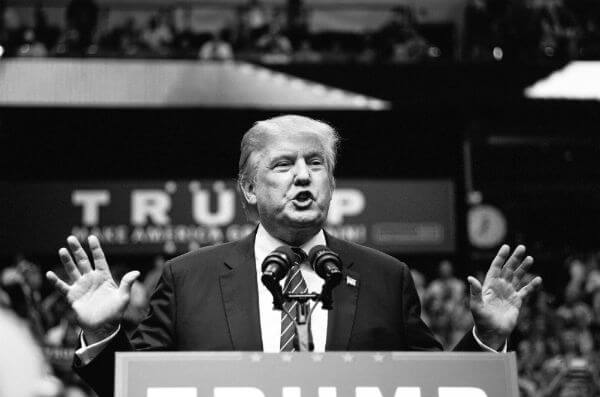
trump-bw

Andrew Sullivan writes: As this dystopian election campaign has unfolded, my mind keeps being tugged by a passage in Plato’s Republic. It has unsettled — even surprised — me from the moment I first read it in graduate school. The passage is from the part of the dialogue where Socrates and his friends are talking about the nature of different political systems, how they change over time, and how one can slowly evolve into another. And Socrates seemed pretty clear on one sobering point: that “tyranny is probably established out of no other regime than democracy.” What did Plato mean by that? Democracy, for him, I discovered, was a political system of maximal freedom and equality, where every lifestyle is allowed and public offices are filled by a lottery. And the longer a democracy lasted, Plato argued, the more democratic it would become. Its freedoms would multiply; its equality spread. Deference to any sort of authority would wither; tolerance of any kind of inequality would come under intense threat; and multiculturalism and sexual freedom would create a city or a country like “a many-colored cloak decorated in all hues.”

This rainbow-flag polity, Plato argues, is, for many people, the fairest of regimes. The freedom in that democracy has to be experienced to be believed — with shame and privilege in particular emerging over time as anathema. But it is inherently unstable. As the authority of elites fades, as Establishment values cede to popular ones, views and identities can become so magnificently diverse as to be mutually uncomprehending. And when all the barriers to equality, formal and informal, have been removed; when everyone is equal; when elites are despised and full license is established to do “whatever one wants,” you arrive at what might be called late-stage democracy. There is no kowtowing to authority here, let alone to political experience or expertise.

The very rich come under attack, as inequality becomes increasingly intolerable. Patriarchy is also dismantled: “We almost forgot to mention the extent of the law of equality and of freedom in the relations of women with men and men with women.” Family hierarchies are inverted: “A father habituates himself to be like his child and fear his sons, and a son habituates himself to be like his father and to have no shame before or fear of his parents.” In classrooms, “as the teacher … is frightened of the pupils and fawns on them, so the students make light of their teachers.” Animals are regarded as equal to humans; the rich mingle freely with the poor in the streets and try to blend in. The foreigner is equal to the citizen.

And it is when a democracy has ripened as fully as this, Plato argues, that a would-be tyrant will often seize his moment. [Continue reading…]

Facebooktwittermail

Racist Trump fan arrested with stockpile of pipe bombs after threatening Obama

Huffington Post reports: A fanatical Donald Trump supporter, who was arrested by the FBI in Oregon this week after repeatedly threatening to kill President Barack Obama and federal agents, had multiple pipe bombs in his home, authorities alleged in court on Friday.

John Martin Roos, a 61-year-old from Oregon, has been charged with communication of a threat in interstate commerce, and additional charges are likely forthcoming. Roos first came onto the federal government’s radar after a “concerned citizen” brought Roos’ Facebook and Twitter postings to the FBI’s attention in February, according to an affidavit from Special Agent Jeffrey Gray.

In one Jan. 31 Facebook post cited by the FBI, Roos referred to agents as “pussies” and wrote he would “snipe them with hunting rifles everywhere.” (Despite his threats to kill members of law enforcement, he also complained on Facebook earlier this month about the “liberal media … slamming police.”) In a post in November that was also cited by the FBI, Roos spoke out against accepting refugees and threatened to kill Obama. [Continue reading…]

Facebooktwittermail

Journalist who profiled Melania Trump hit with barrage of antisemitic abuse

The Guardian reports: Journalist Julia Ioffe has experienced this kind of harassment before: in Vladimir Putin’s Russia.

In the 24 hours since her profile of Donald Trump’s wife, Melania, appeared in GQ magazine, the Russian-American journalist has received a torrent of antisemitic, vitriolic and threatening messages from supporters of the Republican frontrunner.

In the deeply disturbing response to her piece, Ioffe said she sees a frightening future of what freedom of the press – and the country – might look like under President Trump.

“What happens if Donald Trump is elected?” Ioffe said. “We’ve seen the way he bids his supporters to attack the media, his proposal to change libel laws to make it easier to sue journalists.” [Continue reading…]

Facebooktwittermail

President Trump fills world leaders with fear: ‘It’s gone from funny to really scary’

The Guardian reports: Dangerous, foolish, irrational, scary, terrifying, irresponsible, a clown, a disaster. These are just some of the words used to describe the prospect of a Donald Trump presidency by politicians, diplomats and analysts around the world.

As the businessman gave his first major policy address since becoming frontrunner for the Republican presidential nomination on Wednesday, Guardian correspondents in Washington and around the globe asked the international community whether it was prepared for the swaggering billionaire to occupy the White House.

Many said they still cannot believe the nation that elected its first black president just eight years ago will now rush to embrace a man who has offended Mexicans, Muslims and others. The possibility that Trump might actually win fills great swaths of the planet with dread – with the apparent and notable exception of Vladimir Putin’s Russia – with concerns over everything from trade to the nuclear trigger. [Continue reading…]

Facebooktwittermail

President Trump will put America first, save humanity, forever be the peacemaker, and bring home the bacon

Donald Trump says the United States needs a coherent foreign policy. Indeed. Can he offer one? Not yet.

It was only last month that Trump said on foreign policy that “my primary consultant is myself and I have a good instinct for this stuff.”

Apparently one of the results of Trump’s internal deliberations is that he now needs some input from outside.

“My goal is to establish a foreign policy that will endure for several generations. That’s why I also look and have to look for talented experts with approaches and practical ideas” — experts like Walid Phares, who apparently needing to hold his practical ideas in reserve, promised in advance: “There will be no details in this speech.”

Or to put it another way: all packaging; no content.

My foreign policy will always put the interests of the American people and American security above all else.

To our friends and allies, I say America is going to be strong again. America is going to be reliable again. It’s going to be a great and reliable ally again. It’s going to be a friend again. We’re going to finally have a coherent foreign policy based upon American interests and the shared interests of our allies.

We’re getting out of the nation-building business and instead focusing on creating stability in the world. Our moments of greatest strength came when politics ended at the water’s edge. We need a new rational American foreign policy, informed by the best minds and supported by both parties, and it will be by both parties — Democrats, Republicans, independents, everybody, as well as by our close allies.

… we must as a nation be more unpredictable. We are totally predictable. We tell everything. We’re sending troops. We tell them. We’re sending something else. We have a news conference. We have to be unpredictable. And we have to be unpredictable starting now.

I will seek a foreign policy that all Americans, whatever their party, can support, so important, and which our friends and allies will respect and totally welcome. The world must know that we do not go abroad in search of enemies, that we are always happy when old enemies become friends and when old friends become allies, that’s what we want. We want them to be our allies.

We want the world to be — we want to bring peace to the world.

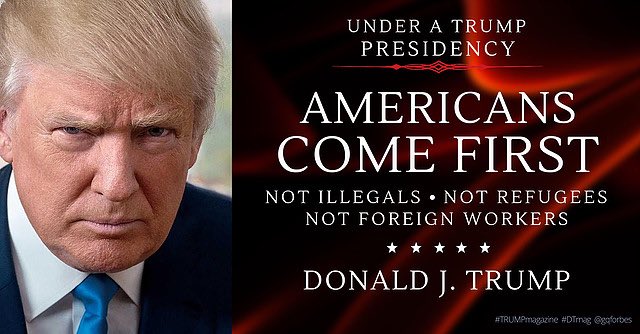
No country has ever prospered that failed to put its own interests first. Both our friends and our enemies put their countries above ours and we, while being fair to them, must start doing the same. We will no longer surrender this country or its people to the false song of globalism. The nation-state remains the true foundation for happiness and harmony. I am skeptical of international unions that tie us up and bring America down and will never enter…

The world is most peaceful and most prosperous when America is strongest. America will continue and continue forever to play the role of peacemaker. We will always help save lives and indeed humanity itself, but to play the role, we must make America strong again.

Facebooktwittermail

Trump’s ‘America First’ has ugly echoes from U.S. history

Susan Dunn writes:My foreign policy will always put the interests of the American people, and American security, above all else. That will be the foundation of every decision that I will make. America First will be the major and overriding theme of my administration.”

It is extremely unfortunate that in his speech Wednesday outlining his foreign policy goals, Donald Trump chose to brand his foreign policy with the noxious slogan “America First,” the name of the isolationist, defeatist, anti-Semitic national organization that urged the United States to appease Adolf Hitler.

The America First Committee actually began at Yale University, where Douglas Stuart Jr., the son of a vice president of Quaker Oats, began organizing his fellow students in spring 1940. He and Gerald Ford, the future American president, and Potter Stewart, the future Supreme Court justice, drafted a petition stating, “We demand that Congress refrain from war, even if England is on the verge of defeat.”

Their solution to the international crisis lay in a negotiated peace with Hitler. Other Yale students — including Sargent Shriver, who served in the Kennedy and Johnson administrations, and Kingman Brewster, the chairman of the Yale Daily News, future president of Yale and ambassador to the Court of St. James — joined their isolationist crusade. [Continue reading…]

Facebooktwittermail

Inside Trump adviser Manafort’s world of politics and global financial dealmaking

The Washington Post reports: Paul Manafort was hired by Donald Trump to bring the wisdom of an old Washington hand to a campaign of political novices and provide expertise on the arcane art of counting convention delegates.

But beneath the image of a campaign wise man is a more complex picture of a veteran consultant who has pursued parallel careers as a lobbyist, political adviser and global dealmaker. He has parlayed political relationships around the world into an array of intricate financial transactions with billionaire oligarchs and other controversial investors that have at times spurred legal disputes.

In one case, Manafort tried unsuccessfully to build a luxury high-rise in Manhattan with money from a billionaire backer of a Ukrainian president whom he had advised.

In another deal, real estate records show that Manafort took out and later repaid a $250,000 loan from a Middle Eastern arms dealer at the center of a French inquiry into whether kickbacks were paid to leading politicians in a 1995 presidential campaign.

And in another business venture, a Russian aluminum magnate has accused Manafort in a Cayman Islands court of taking nearly $19 million intended for investments, then failing to account for the funds, return them or respond to numerous inquiries about exactly how the money was used. [Continue reading…]

Facebooktwittermail

Italy’s most racist politician comes to Philly to help Donald Trump

The Daily Beast reports: Matteo Salvini, Italy’s most openly racist politician and leader of the far-right Northern League party, loves Donald Trump. And The Donald apparently loves him back.

Salvini, who has called German Chancellor Angela Merkel’s policy to accept Syrian refugees a disaster, and who has been pictured with a bulldozer on the edge of Roma camps, tweeted a selection of pictures of himself at a Trump rally in Philadelphia. In one, he poses with the frontrunner for the Republican presidential nomination in what appears to be a somewhat awkward “thumbs up” moment with the caption, “Go, Donald, Go!”

Salvini, who is in the United States to promote Italian culture (as opposed to any other culture), then met with Trump for around 20 minutes after the rally, which was held on April 25—the day Italy celebrates its liberation from fascism and a holiday Salvini does not celebrate. “Matteo, I hope you will soon become the prime minister of Italy,” Trump said, according to ANSA news service. Salvini then returned the sentiment, saying he hoped the Republican hopeful would be elected to the White House on November 8.

The Italian politician is widely known in Italy and throughout Europe for his radical right-wing rallies, during which it is common for him to slip on a black shirt to pay homage to the Fascist era. His rallies have often included people waving photos of Benito Mussolini, who he has praised for his “efficiency” and “dedication” to the country. [Continue reading…]

Facebooktwittermail

These Syrian-American Christians love Trump because they say he’s like Assad

The Daily Beast reports: Perched on a hard orange seat high above the dirt floor of the Pennsylvania Farm Show Complex & Expo Center, waiting for the Harrisburg Trump rally to start, Pastor Joseph Moussa told me Donald Trump gives him hope, in part, because he reminds him of Assad.

Yes, that Assad — Bashar al-Assad — the one whose army is accused of killing upwards of a quarter-million Syrians. In some important ways, Moussa said, Trump and Assad sound similar. And he likes it.

Besides appreciating Trump’s plainspokenness and apparent invulnerability to pressure from lobbyists, Moussa and other Syrian-American Christians living in Pennsylvania like Trump for a unique reason: They think he will do the least to undermine Assad — and, by extension, the most to protect their fellow Christians back in Syria.

“Mr. Trump, he is the only candidate that ever said, ‘I am an evangelical and I am proud of it, and I am gonna protect the Christians,’” he said.

Like any other ethnic group, Pennsylvania’s Syrian-American community isn’t a monolith. And describing it in sweeping terms is as foolish as it is uninformative. But conversations with numerous Syrian-American leaders in the Keystone State indicate that Trump may find many devoted supporters among their numbers. Many of these Christians fervently back Bashar al-Assad, as they feel he treats Syria’s Christians fairly and is their best protection against spreading Islamist extremism in the region. So they like Trump, as they feel he’s their best hope for limiting Western intervention on behalf of the rebels seeking to take down Assad. To an extent, they see Trump and Assad as two of a kind when it comes to protecting the region’s Christians. [Continue reading…]

Facebooktwittermail

The ‘nasty effect,’ and why Donald Trump supporters mistrust the media

Callum Borchers writes: Here’s a theory: Trump backers feel personally offended by coverage that suggests they must be stupid to support him. Insulted, they refuse to accept information presented by media outlets that disrespect them.

Think about it: When someone calls you an idiot, then tells you what to do (or not do), do you listen? Even if the instructions are sound, your wounded brain is inclined to tune them out and go the opposite direction.

A study published this week by the Associated Press-NORC Center for Public Affairs Research and the American Press Institute suggests that insulting news consumers is indeed a major problem. In a survey of more than 2,000 people, 38 percent said “yes” when asked, “Have you ever had an experience with a news and information source that made you trust it less for any reason?”

What were the reasons? Factual errors and perceived biases were the top answers. No surprise there. But the third-biggest cause of diminished trust — cited by 24 percent of those who have had a bad experience — was finding “something about the content personally offensive.” [Continue reading…]

Facebooktwittermail

Trump’s new image-maker honed his ‘dark’ arts in Ukraine

trump-bw

Financial Times reports: The Donald Trump who greeted supporters in the lobby of Trump Tower on Tuesday night bore little resemblance to the Republican frontrunner of yore.

Atypically gracious and restrained, Mr Trump spoke coherently on jobs and the economy, referred respectfully to his Republican opponents as “Senator Cruz” and “Governor Kasich” and stuck to his prepared remarks. Gone were the lewd insults or jabs at the press.

It was a political makeover like few had seen before — and it bore all the trappings of his new campaign chief, Paul Manafort.

A DC veteran political operative who has worked for the likes of Gerald Ford and George H W Bush, Mr Manafort, 67, was hired by Mr Trump last month to bring order to the Trump campaign and cement Mr Trump’s delegate count, a thorny issue ahead of the Republican National Convention.
Yet Mr Manafort’s true gift lies in political resuscitations and re-brandings, say former business associates.
Over a 40-year career in Washington, he has attempted to engineer them for a cast of, sometimes unsavoury, clients that include Angola’s Jonas Savimbi, the Saudi government, and the Philippines’ Ferdinand Marcos.

But it is his work with Ukraine’s former president, Viktor Yanukovich, that stands out as a particular showcase both of Mr Manafort’s talents — and the controversy surrounding their use. [Continue reading…]

Facebooktwittermail

Trump terrifies world leaders

trump-bw

Politico reports: Obama hears world leaders’ fears about the Republican front-runner so often that he has developed a speech meant to ease their nerves.

First, he walks them through the Republican primary process: Trump has had success, but there are big states yet to vote and the front-runner could still stumble. Then he explains the complications of the GOP convention and how weak rules and convoluted balloting could leave Trump a loser. And finally, Obama assures America’s allies that Hillary Clinton can defeat the Manhattan billionaire.

It’s a familiar routine but not a particularly successful one. They respond — sometimes directly to Obama and other top administration officials, sometimes stewing privately about being brushed off again — that the Obama administration has been downplaying Trump’s odds for six months.

“Most people said that he didn’t have the wit, wisdom or wealth to get very far in the primaries,” said Peter Mandelson, a member of the British Cabinet under Prime Ministers Tony Blair and Gordon Brown, as well as a former European commissioner for trade who remains in touch with many leaders. “And they’ve been wrong.”

Now, world leaders cop to being afraid of a Trump presidency, and they’re making preparations: scrambling to get deals done with the Obama administration while they still have the chance.

Leaders, members of their governments, even their aides are so spooked that they don’t want to say anything, and many privately admit that it’s because they think he’ll win, and a quote now could mean a vengeful President Trump going after them personally next year.

“As we’re on the record, I’m rather hesitant to give you big headlines on this,” said Olli Rehn, the Finnish minister of economic affairs. “In Europe, we are concerned about the U.S. possibly turning toward a more isolationist orientation. That would not be good for United States, good for Europe, good for the world. We need the U.S. engaged in global affairs in a constructive, positive way.”

They’re not caught up in some gushy lament about what’s become of American politics, as Obama has sometimes framed the conversations when he’s talked about them publicly. They’re worried about what it means for them: for their arms deals, for their trade deals, for international funding and alliances that they depend on.

“However much people recoiled from George W. Bush or have been disappointed by Obama, they see Trump as off the Richter scale,” Mandelson said. “The reason for that is not that he must be stupid — nobody thinks that — but that he’s disdainful, unscrupulous, prepared to say anything to harvest the populist vote. And that makes people frightened.”

Then there are the more parochial concerns: that Trump’s rise will encourage and empower their own nationalists. [Continue reading…]

Facebooktwittermail

2016 U.S. election critical to success of Paris climate pact

Climate Central reports: The 2016 presidential election is likely to be enormously consequential to the success of the Paris climate agreement, due to be signed Friday at the United Nations, and the ability of the United States to lead the world in reducing greenhouse gas emissions to keep global warming to “well below” 2°C (3.6°F).

Climate Central asked more than a dozen climate and political scientists and other experts how the outcome of that election will affect the climate pact.

The consensus was clear: If a Republican administration is elected in November, the Paris agreement would be severely undermined and any efforts to cut greenhouse gas emissions on a global scale will be cast into doubt. If a Democratic administration is elected, the Paris agreement will remain intact. [Continue reading…]

Facebooktwittermail

College student is removed from Southwest Airlines flight because he spoke Arabic

The New York Times reports: A college student who came to the United States as an Iraqi refugee was removed from a Southwest Airlines flight in California earlier this month after another passenger became alarmed when she heard him speaking Arabic.

The student, Khairuldeen Makhzoomi, a senior at the University of California, Berkeley, was taken off a flight from Los Angeles International Airport to Oakland on April 6 after he called an uncle in Baghdad to tell him about an event he attended that included a speech by United Nations Secretary General Ban Ki-moon.

“I was very excited about the event so I called my uncle to tell him about it,” he said.

He told his uncle about the chicken dinner they were served and the moment when he got to stand up and ask the secretary general a question about the Islamic State, he said. But the conversation seemed troubling to a nearby passenger, who told the crew she overheard him making “potentially threatening comments,” the airline said in a statement.

Mr. Makhzoomi, 26, knew something was wrong as soon as he finished his phone call and saw that a woman sitting in front of him had turned around in her seat to stare at him, he said. She headed for the airplane door soon after he told his uncle that he would call again when he landed, and qualified it with a common phrase in Arabic, “inshallah,” meaning “god willing.”

“That is when I thought, ‘Oh, I hope she is not reporting me,’ because it was so weird,” Mr. Makhzoomi said.

That is exactly what happened. An Arabic-speaking Southwest Airlines employee of Middle Eastern or South Asian descent came to his seat and escorted him off the plane a few minutes after his call ended, he said. The man introduced himself in Arabic and then switched to English to ask, “Why were you speaking Arabic in the plane?” [Continue reading…]

Facebooktwittermail

Islamist radicals are a threat. But do you need to attack their religion?

Ishaan Tharoor writes: Islam is not a monolithic thing. It’s embraced by multitudes that speak different languages, think different thoughts and grapple with different challenges every day. It has no central, governing institution and no shortage of internal debates and schisms.

Some analysts point out that the attacks on Islam aren’t really about religion, per se. “Their ‘cultural racism’ portrays Muslims as an irremediable, jihadist fifth column,” writes journalist and critic Adam Shatz in an incisive essay about the Charlie Hebdo editorial and its boosters. “Their fear of Islam has less to do with the religion than with the people who practice it.”

That was very much on show in the face of Europe’s migrant crisis, when fears of a “jihadist fifth column” consumed a segment of the Western public and shaped the response to what aid groups and the United Nations desperately plead is, first and foremost, a humanitarian tragedy in the Middle East.

Given the violence in Brussels and Paris, these fears are understandable. But it’s a case of seeing a vast forest when there are only a few trees.

“Claiming that Europe faces a Muslim invasion has become standard fare for a range of politicians and political parties in Europe,” noted Nate Schenkkan, the project director behind a recent Freedom House report on the rise of illiberal politics in parts of the continent. “This kind of speech undermines democracy by rejecting one of its fundamental principles — equality before the law. There is a danger that this kind of hateful, paranoid speech will lead to violence against minorities and refugees.”

This “hateful, paranoid speech” has its obvious political uses, though. Fiery populists on both sides of the pond have pointed to the threat of Islam when campaigning, often with success, in recent local elections.

The trouble is that pinning the radicalization and criminality of a small minority on whole communities — a whole religion, even — obscures more than it reveals. It reduces to abstraction what are far more complicated and important problems to consider, such as lapses in security and intelligence as well as troubles over assimilation and integration.

And, as myriad experts on counterterrorism policy and the Middle East have argued, it trades in the same logic that is employed by Islamist organizations.

“Promoting a clash of civilizations and destroying the reality of productive coexistence between Muslims and non-Muslims was always at the heart of al-Qaeda’s strategy. The Islamic State has avowed the same goal of eliminating the ‘gray zones’ of toleration,” writes Marc Lynch, professor of international affairs at George Washington University. “With American political discourse these days, the prospects for escaping the iron logic of this strategy have never looked more dismal.” [Continue reading…]

Facebooktwittermail

Muslims used to love living in Tennessee — now it’s a nightmare

BuzzFeed reports: The fire department called before dawn. Daoud Abudiab and his 13-year-old daughter were already awake, so they got in the car quickly. From about a mile away, Abudiab saw a plume of black smoke rising above the low skyline and started getting nervous. He thought back to the arguments over whether to mark the Islamic Center of Columbia, Tennessee, the only mosque in the hundred-mile stretch between Nashville and Huntsville, with a large sign or a small, unassuming one. They had opted for a large one.

Abudiab and his daughter could feel the heat of the fire when they stood at the yellow police tape. A black swastika was spray-painted on the mosque’s facade. Flames pushed out from the burst windows and up through the collapsed roof. Abudiab’s wife arrived with the rest of the kids, followed by other congregants and their families.

Abudiab looked at the women and all he saw was headscarves. “Go home,” he pleaded. “Don’t go out. Don’t go to Walmart. Don’t go anywhere.”

The ringleader of the band of white supremacists who burned down the mosque with Molotov cocktails justified the act by saying, “What goes on in that building is illegal according to the Bible.” This was February 2008. The theory of Barack Obama’s crypto-Islamism was faint chatter on the fringes. But in the years after Obama’s election, Tennessee became a key battleground in a national anti-Muslim movement whose influence has culminated, for now, in the presidential campaigns of Republican frontrunners Donald Trump and Ted Cruz, both of whom are being advised by people whose views on Islam were once considered too extreme for mainstream politics. [Continue reading…]

Facebooktwittermail