Category Archives: Obama administration

White House loves aggressive journalism abroad — but not at home

video platformvideo managementvideo solutionsvideo player

White House press secretary Jay Carney began yesterday’s briefing by praising journalists who have died covering the unrest in Syria: Marie Colvin and Rémi Ochlik as well as Anthony Shadid. During the press briefing, ABC News’ Jake Tapper challenged Carney on the White House’s double standards.

TAPPER: The White House keeps praising these journalists who are — who’ve been killed –

CARNEY: I don’t know about “keep” — I think –

TAPPER: You’ve done it, Vice President Biden did it in a statement. How does that square with the fact that this administration has been so aggressively trying to stop aggressive journalism in the United States by using the Espionage Act to take whistleblowers to court?

You’re — currently I think that you’ve invoked it the sixth time, and before the Obama administration, it had only been used three times in history. You’re — this is the sixth time you’re suing a CIA officer for allegedly providing information in 2009 about CIA torture. Certainly that’s something that’s in the public interest of the United States. The administration is taking this person to court. There just seems to be disconnect here. You want aggressive journalism abroad; you just don’t want it in the United States.

CARNEY: Well, I would hesitate to speak to any particular case, for obvious reasons, and I would refer you to the Department of Justice for more on that.

I think we absolutely honor and praise the bravery of reporters who are placing themselves in extremely dangerous situations in order to bring a story of oppression and brutality to the world. I think that is commendable, and it’s certainly worth noting by us. And as somebody who knew both Anthony and Marie, I particularly appreciate what they did to bring that story to the American people.

I — as for other cases, again, without addressing any specific case, I think that there are issues here that involve highly sensitive classified information, and I think that, you know, those are — divulging or to — divulging that kind of information is a serious issue, and it always has been.

TAPPER: So the truth should come out abroad; it shouldn’t come out here?

CARNEY: Well, that’s not at all what I’m saying, Jake, and you know it’s not. Again, I can’t — specific –

TAPPER: That’s what the Justice Department’s doing.

CARNEY: Well, you’re making a judgment about a broad array of cases, and I can’t address those specifically.

TAPPER: It’s also the judgment that a lot of whistleblowers’ organizations and good government groups are making as well.

CARNEY: Not one that I’m going to make.

Although these are legitimate challenges Tapper is making, it’s hard not to feel that they might have more bite if the person he was directing them at was neither a former reporter nor married to a senior correspondent for ABC News. It’s easy to understand why the White House picked a journalist for this role, but the press and the press secretary should never be this close.


Facebooktwittermail

42 reasons to dismiss Susan Rice’s rage

Rami G. Khouri writes: I chuckled softly to myself last week when I followed the news coverage of how angrily the U.S. ambassador to the United Nations, Susan Rice, condemned the Russian and Chinese vetoes of a Security Council resolution that sought to end the escalating conflict in Syria. The media emphasized that Rice was really, really angry, as only a righteous American ambassador can be when condemning moves by other great powers to use their veto to stop collective action by the council in the service of applying the rule of law.

Rice said that she was “disgusted” by the double veto, and added that, “A couple of members of this council remain steadfast in their willingness to sell out the Syrian people and shield a craven tyrant.”

She was correct, of course, and we should all share her anger at the double veto, because the ongoing killings by all sides in Syria are unacceptable by any standards. We should take her position seriously because displays of public anger by ambassadors are noteworthy in themselves, and this is especially true for ambassadors of powerful countries like the United States that send their army around the world at will, usually at great cost to all involved.

Yet I chuckle nevertheless, because am not sure whether we should assess Ms. Rice’s outburst at the level of Russian and Chinese policy, conditions in Syria, the work of the U.N. Security Council, or the foreign policy consistency or duplicity of the United States.

Each of these domains is significant. Yet try as I may, I cannot take Rice and the U.S. seriously here, because the U.S. sets the world’s gold standard on using vetoes in the Security Council to shield criminal activity, by Israel in particular. I am not sure if Rice and the U.S. government think the world is stupid or merely perpetually servile to American swagger.

Facebooktwittermail

Obama-appointed U.S. trade adviser linked to illegal deal in Congolese gold

The Guardian reports: A US trade adviser appointed by Barack Obama orchestrated a deal to buy gold worth millions of dollars from a wanted Congolese warlord, according to a UN report.

Kase Lawal, a Nigerian-born US oil tycoon, transferred millions of dollars to the notorious rebel leader Bosco Ntaganda between December 2010 and February 2011 as part of the deal, the report by the UN’s Group of Experts on the Democratic Republic of the Congo (DRC) states.

If true, this would be a contravention of UN resolutions banning individuals or organisations from financing illegal armed groups in the wartorn eastern DRC.

The UN report says Lawal, the chairman and chief executive of the Houston-based oil firm Camac, was aware he was paying Ntaganda.

Obama put Lawal on the US advisory committee for trade and policy negotiations in September 2010, just months before the deal with Ntaganda.

All efforts to reach Lawal failed. Camac said it had no comment on the allegations, but said: “Camac is a law-abiding company and we disagree with the representations made in the report.” The White House did not respond to a request for comment.

Facebooktwittermail

The Wall Streeters Obama loves most

Bill Moyers and Michael Winship write: We’ve already made our choice for the best headline of the year, so far:

“Citigroup Replaces JPMorgan as White House Chief of Staff.”

When we saw it on the website Gawker.com we had to smile — but the smile didn’t last long. There’s simply too much truth in that headline; it says a lot about how Wall Street and Washington have colluded to create the winner-take-all economy that rewards the very few at the expense of everyone else.

The story behind it is that Jack Lew is President Obama’s new chief of staff — arguably the most powerful office in the White House that isn’t shaped like an oval. He used to work for the giant banking conglomerate Citigroup. His predecessor as chief of staff is Bill Daley, who used to work at the giant banking conglomerate JPMorgan Chase, where he was maestro of the bank’s global lobbying and chief liaison to the White House.

Daley replaced Obama’s first chief of staff, Rahm Emanuel, who once worked as a rainmaker for the investment bank now known as Wasserstein & Company, where in less than three years he was paid a reported eighteen and a half million dollars.

The new guy, Jack Lew – said by those who know to be a skilled and principled public servant – ran hedge funds and private equity at Citigroup, which means he’s a member of the Wall Street gang, too. His last job was as head of President Obama’s Office of Management and Budget, where he replaced Peter Orzag, who now works as vice chairman for global banking at – hold onto your deposit slip — Citigroup.

Facebooktwittermail

Obama panders to Jewish donors

JTA reports: President Obama’s reelection campaign unveiled a video featuring testimonials from Israeli leaders a day after he raised $500,000 from Jewish donors.

The video, e-blasted Friday to Jewish supporters by David Axelrod, a top campaign official, intersperses speeches by Obama to Jewish audiences and at the United Nations with testimonials culled from news broadcasts.

The Forward reports: At a fundraiser for Jewish supporters in Manhattan, President Obama reaffirmed his commitment to military cooperation with Israel, and to the imposition of tough sanctions on Iran.

The 100-person gathering on January 19 at high-end Upper East Side restaurant Daniel raised upwards of half a million dollars, according to an estimate by Alan Solow, a former chair of the Conference of Presidents of Major American Jewish Organizations and one of the event’s hosts.

“Since I’ve been in office, we have unequivocally said that Israel’s security is non-negotiable,” Obama told the audience, echoing remarks made at a November fundraiser with Jewish donors in New York. “Part of that has been to make sure that we’ve got the strongest military cooperation that we’ve ever had between our two nations. That’s not my opinion, by the way, that’s the Israeli government’s opinion.”

In an off-the-record question and answer session, Obama “made very clear that he’s serious about prohibiting Iran from acquiring a nuclear weapon,” Solow said. Though the president maintained that the hopes for achieving those ends are through sanctions, he said that the Iranians are aware that all options are on the table.

Facebooktwittermail

Dear Andrew Sullivan: Why focus on Obama’s dumbest critics?

Conor Friedersdorf writes: After reading Andrew Sullivan’s Newsweek essay about President Obama, his critics, and his re-election bid, I implore him to ponder just one question. How would you have reacted in 2008 if any Republican ran promising to do the following?

(1) Codify indefinite detention into law; (2) draw up a secret kill list of people, including American citizens, to assassinate without due process; (3) proceed with warrantless spying on American citizens; (4) prosecute Bush-era whistleblowers for violating state secrets; (5) reinterpret the War Powers Resolution such that entering a war of choice without a Congressional declaration is permissible; (6) enter and prosecute such a war; (7) institutionalize naked scanners and intrusive full body pat-downs in major American airports; (8) oversee a planned expansion of TSA so that its agents are already beginning to patrol American highways, train stations, and bus depots; (9) wage an undeclared drone war on numerous Muslim countries that delegates to the CIA the final call about some strikes that put civilians in jeopardy; (10) invoke the state-secrets privilege to dismiss lawsuits brought by civil-liberties organizations on dubious technicalities rather than litigating them on the merits; (11) preside over federal raids on medical marijuana dispensaries; (12) attempt to negotiate an extension of American troops in Iraq beyond 2011 (an effort that thankfully failed); (14) reauthorize the Patriot Act; (13) and select an economic team mostly made up of former and future financial executives from Wall Street firms that played major roles in the financial crisis.

I submit that had Palin or Cheney or Rumsfeld or Rice or Jeb Bush or John Bolton or Rudy Giuliani or Mitt Romney proposed doing even half of those things in 2008, you’d have declared them unfit for the presidency and expressed alarm at the prospect of America doubling down on the excesses of the post-September 11 era. You’d have championed an alternative candidate who avowed that America doesn’t have to choose between our values and our safety.

Yet President Obama has done all of the aforementioned things.

Pretend that you knew, circa 2008, that President Cheney or Palin or Rice or Rumsfeld or Giuliani would do all those things — but that, on the bright side, they’d refrain from torturing anyone else, end Don’t Ask, Don’t Tell, sign a bank bailout, and pass a health-care bill that you regard as improving on the status quo starting in 2014. Would you vote for them on that basis?

I submit that you would not. And if they were elected, and four years later were running for re-election, would you focus on the stupidity of the least persuasive attacks on their tenure? Or would you laud their most incisive critics? I believe that you’d be among their most incisive critics.

Facebooktwittermail

Netanyahu’s war against Obama

Max Blumenthal writes:

The US presidential election campaign that kicked off January 3 with the Iowa caucuses was the subject of a curious article attacking President Barack Obama in the mass circulation Israeli daily newspaper, Israel Hayom.

“US President Barack Obama is ‘naïve’ and needs to face up to the threat presented by the rise of the Muslim Brotherhood across the Middle East, Israel’s National Security Council concluded during a strategic discussion several days ago,” Israel Hayom reported.

The Israeli National Security Council consists of Benjamin “Bibi” Netanyahu’s closest advisers. And Israel Hayom is not just another right-leaning Israeli tabloid. Referred to by Israelis as the “Bibiton,” or Bibi’s mouthpiece, the paper is an instrument that gives him extraordinary political leverage. The obviously planted article in Israel Hayom rang like a bell sounding the start of Netanyahu’s own campaign in helping the Republican Party oust Obama from the White House.

Israel Hayom’s genesis demonstrates the depth of Netanyahu’s connections in Republican circles. It was created by one of Netanyahu’s top financial supporters, a Las Vegas-based casino tycoon named Sheldon Adelson, who is also a major donor to the conservative wing of the Republican Party. Adelson’s closest relationship is with former Speaker of the House Newt Gingrich, a longtime ally of Netanyahu who has been running a rancorous campaign for the Republican presidential nomination.

Netanyahu’s less than subtle intervention has become an open issue in Israeli politics. Opposition leader Tzipi Livni of the Kadima Party has criticized Netanyahu for damaging the US-Israeli relationship. “Netanyahu spoke about consensus,” Livni said in May, “and if there is a consensus in Israel, it’s that the relationship with the US is essential to Israel, and a prime minister that harms the relationship with the US over something unsubstantial is harming Israel’s security and deterrence.”

But Livni’s warning has been ignored. Rather than hesitating, the prime minister and his inner circle are moving full steam ahead in their political shadow campaign whose ultimate goal is to remove Obama. Bibi’s war against Obama is unprecedented. While Israeli prime ministers have tried to help incumbent presidents, none have ever waged a full-scale campaign to overthrow them. [Continue reading…]

Facebooktwittermail

Nuclear scientists are not terrorists

In an op-ed for the New Scientist, Debora MacKenzie writes: Attempts to derail a country’s nuclear programme by killing its scientists “are products of desperation”, says [William] Tobey [of the Belfer Center for Science and International Affairs at Harvard University] – citing a US effort to kill legendary physicist Werner Heisenberg during the second world war, abandoned at the last minute only when the would-be assassin decided Heisenberg was not involved in a Nazi nuclear effort after all.

“Nuclear scientists are not terrorists,” says Tobey in the BAS this week. Killing them at best delays bomb development, by removing key people and perhaps deterring young scientists from careers in nuclear science. But it will not stop bomb development.

These slim advantages are far outweighed, Tobey says, by the downsides: possible retaliation, reduced chances for diplomacy, tighter security around nuclear installations and a pretext for Iran to hamper IAEA monitoring.

Iran has already accused the IAEA of abetting the assassinations by publicising confidential Iranian lists of key nuclear scientists and engineers.

The IAEA needs such information, as talks with nuclear personnel are considered essential for verifying safeguards against diverting uranium to bombs, says Tobey. Making this process harder only makes sense if the people behind the assassinations think it is too late for safeguards and that slowing bomb R&D by killing scientists is therefore more expedient.

The Israeli columnist Ron Ben-Yishai writes: The most curious question in the face of these incidents is why Iran, which does not shy away from threatening the world with closure of the Hormuz Straits, has failed to retaliate for the painful blows to its nuclear and missile program? After all, the Revolutionary Guards have a special arm, Quds, whose aim (among others) is to carry out terror attacks and secret assassinations against enemies of the regime overseas.

Moreover, if the Iranians do not wish to directly target Western or Israeli interests, they can prompt their agents, that is, Hezbollah, Islamic Jihad and other groups, to do the job. In the past, Iran did not shy away from carrying out terror attacks in Europe (in Paris and Berlin) and in South America (in Buenos Aires,) so why is it showing restraint now?

The reason is apparently Iran’s fear of Western retaliation. Any terror attack against Israel or another Western target – whether it is carried out directly by the Quds force or by Hezbollah – may prompt a Western response. Under such circumstances, Israel or a Western coalition (or both) will have an excellent pretext to strike and destroy Iran’s nuclear and missile sites.

This sounds like a confirmation that Israel is indeed wanting to provoke Iran in order to start a war.

But here’s the paradox: if Iran is intent on developing nuclear weapons then it has ever incentive to continue keeping its powder dry. Why should it jeopardize its nuclear program by succumbing to provocation?

On the other hand if Israel’s covert war does indeed succeed in triggering a full-scale war, this may be an indication that Iran never intended to go further than develop a nuclear break-out capacity.

At the same time, the idea that Iran can only strike back through some form of violence, ignores the economic and psychological levers that it can pull much more easily.

The question may not be how much provocation Iran can withstand but rather how high can the price for oil rise before the global economy buckles?

Facebooktwittermail

Killing of Iranian scientist imperils former Marine

The Washington Post reports: The assassination Wednesday of an Iranian nuclear scientist in northern Tehran increases the peril for an Iranian American who was sentenced to death Monday, analysts said.

Iranian officials quickly blamed the scientist’s killing on the United States, ratcheting up tensions between the two countries and making it less likely that Amir Mirzaei Hekmati, a 28-year-old former U.S. Marine arrested in August and accused of spying for the CIA, will be released anytime soon.

“Unfortunately, the greater the escalation is, the greater the likelihood that the perceived costs of executing him decline,” said Trita Parsi, president of the National Iranian American Council and author of a new book about the Obama administration’s dealings with Iran.

In recent years, there has been an increase in mysterious explosions at military and industrial sites in Iran. Three scientists involved in Iran’s nuclear program have been assassinated, and a computer virus called Stuxnet wreaked havoc on the program.

As Tehran faces tighter international sanctions, a faltering economy and continued scrutiny of its nuclear program, the country’s justice system has turned its attention to Iranian Americans.

There has been a string of arrests of dual nationals in recent years. Typically, Iran charges them with espionage and sometimes shows them on state-run television making “confessions,” under what the detainees later say was duress. Negotiations have usually led to the detainees’ release after several months, sometimes after the announcement of a lengthy prison sentence.

But even analysts who believe Hekmati is being used as a bargaining chip say they were taken aback by the swiftness and harshness of his sentence.

The U.S. government, which does not have diplomatic relations with Iran, has said that Hekmati is not a spy. The CIA has declined to comment on the case, but Art Keller, a former CIA case officer, said Hekmati does not fit the profile of an undercover agent.

“I have a hard time believing that we would send someone over under his true name with his military affiliation well known,” he said. “That’s what you have alias documents for.”

Facebooktwittermail

The smell of war

Iranian Christians pray during New Year Mass at the Vank church in the central city of Isfahan, Iran, on Sunday, January 1, 2012. (AP Photo/Vahid Salemi)

Hooman Majd writes: The ransacking of the British embassy capped an annus horribilis for the Iranian leadership. Throughout the year, the supreme leader, Ayatollah Ali Khamenei, Ahmadinejad, and every politician in between have seemingly been at odds with each other over just about every possible matter of state. The result is an uncertainty and nervousness among officials, and a kind of political paralysis in which it has become hard for people to know exactly who is in charge, or even whom to blame for policy gone bad. But it was also a terrible year for the Iranian people. They are baffled by the West’s approach to dealing with their country’s nuclear program — the stated aim is a change in policy, but the result is only general hardship. Big-city dwellers complain about rampant inflation, a strangled economy, and general inconvenience on a daily basis.

On the street, nowhere is the impact more evident than at any one of the many foreign exchange bureaus where Iranians gather to monitor the flat screens that show the almost minute-by-minute slide in the rial. Men and women gather at the kiosks to buy dollars as a hedge against crippling inflation; many think that the government will soon run out of greenbacks as international sanctions clinch Iranian banks. The country’s financial culture is cash — there are no credit cards — and the government routinely pumps hundred-dollar bills into circulation in an effort to keep the currency stable. The strategy has backfired. By the end of last year, confidence that the regime could withstand international financial pressure — particularly after the British government cut all financial ties with Tehran — had sunk to an all-time low.

By December, escalating talk of military strikes, promoted by respectable Western and Israeli politicians, analysts, and commentators — in the pages of this journal, too — raised anxieties in Tehran to a level not witnessed in many years. In years past, war over the nuclear program had always been the subject of chatter in Iran, but few took it very seriously. In fact, if war came up in ordinary conversation, it was mentioned jokingly. In December, however, my optician, an older Isfahani with a wry sense of humor who hosts a salon of sorts with locals every evening in his shop, captured the mood of the city when he said of the worry over a coming war, “You can smell it,” he said. “This time, you can smell it.”

If you live in Iran it is hard to imagine what the West, particularly the United States, is trying to accomplish. No one doubts that Israeli and Western operators are behind recent assassinations of nuclear scientists on the streets of Tehran. And the sudden frequency of “accidents” at various factories and Revolutionary Guards bases (which a majority — their government’s denial notwithstanding — also believe are the work of foreign agencies) has done nothing to change the minds of either government officials or the general public about the nuclear program.

Few in Iran believe that the nuclear program is a quest for a Shia bomb to obliterate Israel once and for all. No, the Iranian people, from my greengrocer to college students who resent their government, still consider the nuclear question in generally nationalistic terms. The particular regime in power is of passing relevance. So sanctioning Iran’s central bank and embargoing Iranian oil, tactics the White House may be using as a way to avoid having to make a decision for war, will neither change minds in Tehran nor do much of anything besides bring more pain to ordinary Iranians. And making life difficult for them has not, so far, resulted in their rising up to overthrow the autocratic regime, as some might have hoped in Washington or London.

Facebooktwittermail

United States condemns latest murder of an Iranian nuclear scientist

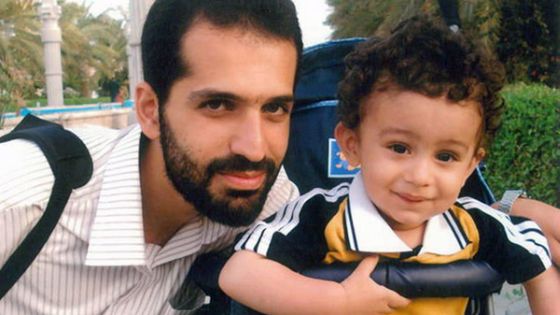
Mostafa Ahmadi Roshan with his son. Roshan is the fifth Iranian nuclear scientist whose murder is being linked to Israel.

The New York Times reports: As arguments flare in Israel and the United States about a possible military strike to set back Iran’s nuclear program, an accelerating covert campaign of assassinations, bombings, cyberattacks and defections appears intended to make that debate irrelevant, according to current and former American officials and specialists on Iran.

The campaign, which experts believe is being carried out mainly by Israel, apparently claimed its latest victim on Wednesday when a bomb killed a 32-year-old nuclear scientist in Tehran’s morning rush hour.

The scientist, Mostafa Ahmadi Roshan, was a department supervisor at the Natanz uranium enrichment plant, a participant in what Western leaders believe is Iran’s halting but determined progress toward a nuclear weapon. He was at least the fifth scientist with nuclear connections to be killed since 2007; a sixth scientist, Fereydoon Abbasi, survived a 2010 attack and was put in charge of Iran’s Atomic Energy Organization.

Iranian officials immediately blamed both Israel and the United States for the latest death, which came less than two months after a suspicious explosion at an Iranian missile base that killed a top general and 16 other people. While American officials deny a role in lethal activities, the United States is believed to engage in other covert efforts against the Iranian nuclear program.

The assassination drew an unusually strong condemnation from the White House and the State Department, which disavowed any American complicity. The statements by the United States appeared to reflect serious concern about the growing number of lethal attacks, which some experts believe could backfire by undercutting future negotiations and prompting Iran to redouble what the West suspects is a quest for a nuclear capacity.

“The United States had absolutely nothing to do with this,” said Tommy Vietor, a spokesman for the National Security Council. Secretary of State Hillary Rodham Clinton appeared to expand the denial beyond Wednesday’s killing, “categorically” denying “any United States involvement in any kind of act of violence inside Iran.”

Facebooktwittermail

Does Washington really prefer ‘proxies’ like Israel?

In the war of nerves between Washington and Tehran, the U.S. enjoyed a couple of moves this week that reinforced America’s preferred image as homeland of the good guys. The U.S. Navy rescued Iranian fisherman not once but twice, while Iran sentenced an American to death.

Is it likely that anyone in Washington would want to spoil this good guys/bad guys story by exploding a bomb in its midst?

An Associated Press report suggests that when it comes to Iran the U.S. now prefers to outsource the dirty work to “proxies like Israel.”

Since when did Israel serve as a proxy for the United States?

When the Obama administration meekly requested the Israelis to promise that they would not unilaterally launch an attack on Iran, the Israelis declined. That’s not how a proxy operates.

Indeed, since the threat that Iran supposedly poses is much more to Israel than the United States, it’s pretty clear that it is the U.S. that serves as a proxy for Israel — not the other way around.

With that in mind, this passage from the AP report is worth noting:

Current and former U.S. officials say Washington prefers proxies like Israel to carry out operations inside Iran, and that up until two years ago, the U.S. and Israel coordinated actions against Iran closely. But the officials say the White House halted such cooperation after Israeli Prime Minister Benjamin Netanyahu took power.

The officials, past and present, spoke on condition of anonymity to discuss sensitive strategic negotiations.

In the event that a military intervention might be needed to halt Iran’s progress toward nuclear weapons capability, they said counterterrorist officials had considered allowing Israel to use the U.S.-Afghan Shindand Airbase, in western Afghanistan, to launch an air strike against Iranian weapons facilities.

The White House won’t cooperate with Netanyahu — now there’s a story ready-made for GOP presidential candidates to jump all over.

Officials considered (note the past tense) allowing Israeli jets to operate out of Afghanistan — however implausible that might be, it’s certainly an idea the Israelis would welcome getting spread around.

Again, enter Republican candidates solemnly pledging that under their administration, Israel will have the right to use U.S. military bases in Afghanistan (or probably anywhere else on the planet for that matter).

There’s a theme here and it’s about who controls the narrative.

Perhaps the clearest indication of who is not in control of the narrative came out of the State Department this morning.

Spokesperson Victoria Nuland responded to questions:

QUESTION: You probably have seen the news that an Iranian nuclear scientist was killed. I wonder what your reaction is. Would you condemn this killing?

MS. NULAND: We’ve seen the reports of the death of the Iranian scientist as a result of an apparent bombing. We condemn any assassination or attack on an innocent person, and we express our sympathies to the family.

QUESTION: The Iranians have accused Israel and the United States of carrying out this killing. Any truth to that?

MS. NULAND: I don’t have any information to share one way or the other on that.

QUESTION: You don’t want to deny killing him?

MS. NULAND: Obviously, we – as I said, we condemn the loss of innocent life.

QUESTION: That’s not a denial as such.

MS. NULAND: I’m not prepared to speak one way or the other. I, frankly —

QUESTION: You didn’t want to deny it.

QUESTION: Would the scientist come under innocent life?

MS. NULAND: Say again?

QUESTION: Would the scientist come under your definition of innocent life?

MS. NULAND: Again, I don’t think I have anything further to say on this, that we condemn violence of any kind.

QUESTION: Don’t you think he’d be a logical target, given the pressure from Israel and the U.S. against —

MS. NULAND: I’m not going to speak to who may or may not have done this, one way or the other.

QUESTION: Why are you not willing to rule out that the United – I mean, the United States did not – they’ve alleged this. Why are you unwilling to say, “Of course we didn’t do this. We don’t —

MS. NULAND: Well, first of all, I don’t think this Department has any information further to what I’ve already said, which we condemn the loss of innocent life.

At this point a footnote has been added to the transcript: “The United States strongly condemns this act of violence and categorically denies any involvement in the killing.” No attribution is given for this sentence, though it echoes Secretary of State Hillary Rodham Clinton who told reporters today: “I want to categorically deny any United States involvement in any kind of act of violence inside Iran.”

Assuming that Clinton’s denial was not a bald-faced lie, it seems reasonable to infer that as is widely believed, this assassination (and previous ones) have been conducted under Israeli direction. Nuland’s unwillingness to say anything probably reflects a number of things:

  • That administration officials do not want to create the impression that the U.S. is the junior and less informed partner in the indivisible relationship with Israel;
  • that administration officials do not want to reveal any lack of enthusiasm for Israel’s covert operations in Iran;
  • and that silence is sometimes the only way of fabricating the illusion of unity.

Israel on the other hand, enjoys the fact that even while its international image whithers, it has no shortage of proxies available in the U.S. to help push its own narrative on Iran — through the press and through the presidential election.

Facebooktwittermail

Assassination in Tehran: An act of war?

M.J. Rosenberg writes: I rarely learn anything meaningful from reading The Atlantic‘s Jeffrey Goldberg. In my opinion, his tight relationship with the Israeli government and its lobby here greatly influences his take on both foreign and domestic events. Although he occasionally deviates from the Israeli line, he not only appears very uncomfortable doing so, he tends to correct course fairly rapidly.

Nonetheless, in a Goldberg column about Iran this week, there was one paragraph that was dead-on and which he will have a hard time taking back (should he be so inclined).

Writing about a piece in the current edition of Foreign Affairs that endorses bombing Iran as a neat and cost-free way to address its nuclear program, Goldberg explains why he thinks the author, Council on Foreign Relations fellow Matthew Kroenig, is wrong. Goldberg says he now believes:

…that advocates of an attack on Iran today would be exchanging a theoretical nightmare — an Iran with nukes — for an actual nightmare, a potentially out-of-control conventional war raging across the Middle East that could cost the lives of thousands Iranians, Israelis, Gulf Arabs and even American servicemen.

Think about that for a minute. Uber-hawk Jeffrey Goldberg is saying that the threat posed by Iran is a “theoretical nightmare” while a war ostensibly to neutralize that threat would present an “actual nightmare.”

No critic of U.S. policy toward Iran could say it better or would say it differently. And why would we?

According to the International Atomic Energy Agency, Iran has not yet made the decision to go nuclear. Speaking to CBS’ Face the Nation last Sunday, Defense Secretary Leon Panetta made the same point. Iran is not working on the bomb.

We do know, as Goldberg says, that a “potentially out-of-control conventional war raging across the Middle East” could “cost the lives of thousands of Iranians, Israelis, Gulf Arabs and even American servicemen.”

And that makes the decision against war a no-brainer. As Goldberg puts it:

Now that sanctions seem to be biting — in other words, now that Iran’s leaders understand the President’s seriousness on the issue — the Iranians just might be willing to pay more attention to proposals about an alternative course.

That alternative course would be an attempt “to try one more time to reach out to the Iranian leadership in order to avoid a military confrontation over Tehran’s nuclear program.”

In short, dialogue.

The United States, to this day, has never attempted a true dialogue with the Tehran. Even under President Obama, all we have done is issue demands about its nuclear program and offer to meet to discuss precisely how they comply with those demands.

That is not dialogue and it’s not negotiation; it’s an ultimatum.

Facebooktwittermail

Another nuclear scientist assassinated in Tehran

Mostafa Ahmadi-Roshan

An Iranian university professor and deputy director at Natanz enrichment facility was killed in a terrorist bomb blast in a Northern Tehran neighborhood on Wednesday morning, the Fars News Agency reports.

Some guy says this was a joint operation carried out by Mossad and the Iranian terrorist group, Mujahideen-e Khalq (MEK) — though when I say “some guy,” if that’s taken to imply that the source of this information is a man, I am perhaps being too specific.

Richard Silverstein heard about the Mossad-MEK connection from his “own confidential Israeli source.” This attribution of responsibility for the attack may indeed be accurate, but to describe a source no more specifically than to say that this source is an “Israeli” tells us next to nothing. It does however allow newspaper journalists to repeat this “information” as though it was news. Hence the Fars News Agency itself repeats Silverstein’s claim and tries to boost his credibility by describing him as “a senior Jewish American journalist.” Israel’s Ynet plays the same game, though with the embellishment that Silverstein’s source has been elevated to a “senior Israeli source.”

Having said all that, it seems reasonable to assume that this attack — an attack that were it to take place anywhere outside Iran would widely be described as a terrorist attack — was conducted with the direct or indirect involvement of the Israeli and/or United States governments.

One of the strange ethical anomalies of the era in which we live is that an American president willingly accepts responsibility for authorizing assassinations conducted by special forces or drone-launched Hellfire missiles, even though in both types of operation the target may be mistaken and innocent bystanders frequently get killed, yet no government official is willing to claim responsibility for a cold-blooded murder. For the killing to be legitimized it has to given the legal pretext that it is being conducted on a “battlefield” during a “war.”

For as long as the streets of Tehran are not regarded as a battlefield and neither the United States nor Israel is officially at war with Iran, no one will acknowledge that a campaign of state terrorism is indeed being waged, since to do so would be offer an open invitation for Iran to respond in kind.

Bloomberg reports:

Today’s attack “comes in the middle of heightened tensions and it helps Iran to play on a sense of threat that it is under a lot of pressure,” Gala Riani, a Middle East analyst at London-based forecaster IHS Global Insight, said by telephone. “It can also be beneficial to more extremist elements in the government who are supporting further military drills in the Strait of Hormuz.”

Iran conducted naval exercises near the Strait of Hormuz for 10 days that ended early this month.

Previous attacks against Iranian nuclear scientists include the assassination of Massoud Ali-Mohammadi, killed by a bomb outside his Tehran home in January 2010, and an explosion in November of that year that took the life of Majid Shahriari and wounded Fereydoun Abbasi-Davani, who is now the head of Iran’s Atomic Energy Organization.

Oil pared losses of as much as 0.6 percent after the report on Roshan’s death. Crude for February delivery was at $102.25 a barrel, up 1 cent, in electronic trading on the New York Mercantile Exchange at 4:06 p.m. Singapore time.

“While it is difficult to gauge the impact of the scientists’ deaths on the country’s nuclear development, Iranian officials have already acknowledged they have a human-resources problem in the program largely because of the sharp political differences within the country,” Meir Javedanfar, lecturer on Iranian politics at the Herzliya Interdisciplinary Center in Israel, said in a telephone interview.

The explosion follows an Iranian court’s Jan. 9 decision to sentence an American of Iranian descent, Amir Mirzaei Hekmati, to death for spying. U.S. State Department spokesperson Victoria Nuland said allegations that Hekmati worked for the CIA were “simply untrue.”

Facebooktwittermail

Obama administration’s mixed message on regime change in Iran

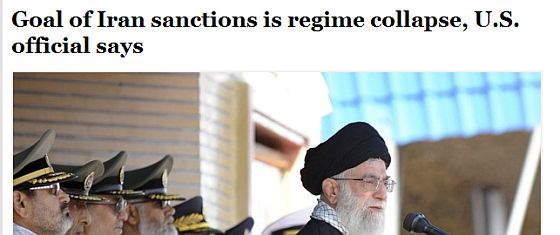
How does a senior U.S. intelligence official tell a Washington Post reporter that the administration’s goal in imposing sanctions on Iran is to bring about regime change, if that is not in fact the goal?

Washington Post -- By Karen DeYoung and Scott Wilson, Tuesday, January 10, 4:22 PM

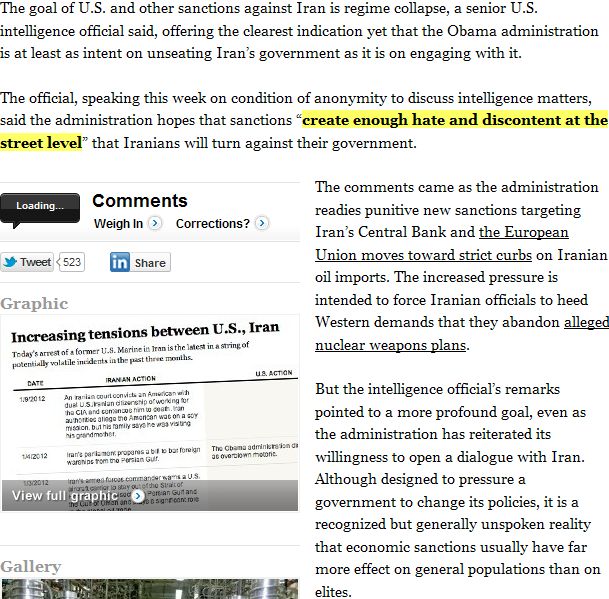
The article (cached version) with this headline (which was later substantially re-written) begins:

The revised version of the article, under a revised headline, “Public ire one goal of Iran sanctions, U.S. official says”, begins:

The Obama administration sees economic sanctions against Iran as building public discontent that will help compel the government to abandon an alleged nuclear weapons program, according to a senior U.S. intelligence official.

In addition to influencing Iranian leaders directly, the official said, “another option here is that [sanctions] will create hate and discontent at the street level so that the Iranian leaders realize that they need to change their ways.”

The intelligence official’s remarks pointed to what has long been an unstated reality of sanctions: Although designed to pressure a government to change its policies, they often impose broad hardships on a population.

So who would this senior intelligence official be? CIA director David Petraeus? And was he misquoted? Or was he being too candid? Or is the Washington Post colluding with the administration in sending out a mixed message?

Facebooktwittermail

U.S. citizen’s death sentence heightens tensions with Iran

The New York Times reports: Iran’s judiciary yesterday sentenced to death an imprisoned American convicted of espionage for the CIA, a punishment that shocked his family and was imposed against a backdrop of increasingly bellicose relations with the United States over the disputed Iranian nuclear program.

The sentence against the American, Amir Mirzaei Hekmati, 28, a retired Marine, was likely to become a new point of contention, and possible bargaining leverage, in Iran’s struggle against the West over its nuclear program. A tightening vise of sanctions, which threaten vital oil sales and with them Iran’s economy, has left Tehran feeling besieged and has pushed relations with the United States and its allies to the lowest ebb since the 1979 Islamic Revolution.

In retaliation, Tehran announced on Sunday that it had begun to enrich uranium at a second site, after having threatened to close the Strait of Hormuz to shipping, a measure that would severely curtail oil shipments.

The details of the case against Hekmati have been cloaked in secrecy since he was detained in August in Iran, to which his family said he had traveled to visit his grandparents. Official confirmation that he was even in Iranian custody was not provided until last month. The White House and the State Department, noting that Iranian prosecutors have a history of coercing confessions, denied that Hekmati was a spy and called for his immediate release. The CIA declined to comment.

Facebooktwittermail