Category Archives: Obama administration

The surreal state solution

Sandy Tolan writes:

It’s always bizarre to watch the cheering throng of US congressmen, their pockets lined with AIPAC contributions, fawn over a visiting Israeli leader as if he were a conquering war hero of their own.

But seen on YouTube from the West Bank, Binyamin Netanyahu’s fanciful walk through Middle East diplomacy, and his disingenuous endorsement of peace and democracy – accompanied by an estimated 55 standing ovations – was truly surreal.

If a member of Congress were to actually bother to travel through the West Bank, he or she could be forgiven for wondering what the Israeli prime minister was talking about when he promised to make “painful compromises”.

Huge and expanding settlement blocs cut ever deeper into Palestinian lands, each day making the establishment of a viable and contiguous Palestinian state more difficult to imagine. One settler city of 20,000 – Ariel – sits nearly halfway to Jordan from the Mediterranean. Maale Adumim, population 34,000, lies well east of Jerusalem, on the way to the Jordan Valley.

In support of this settlement project, Israeli military jeeps and armored trucks crisscross the would-be future Palestine. This week, on a three and a half hour round trip drive between Ramallah and Jenin, I saw a dozen such patrols.

Near Nablus, a Palestinian vehicle was pulled over to the side of the road, with a soldier pointing his M-16 at the driver. Further on, an Israeli bulldozer scraped the land, uprooting an olive tree – the heart of Palestinian rural culture and economy.

Now Netanyahu is trying to cement Israeli policy of endless land seizures with a diversionary tactic – insisting that Palestinians acknowledge Israel as the national state of the Jewish people.

Yet he well knows that in the Oslo agreement of 1993, Palestinians formally accepted Israel’s existence and agreed to their own painful compromise: giving up 78 per cent of historic Palestine in exchange for establishing a state on the remaining land in the West Bank and Gaza.

By making a new demand, Netanyahu has moved the goal posts – insisting that a nation where one in every five people is Arab be formally recognised as a state for Jews only. This may make sense for a delusional congress, but why would any Palestinian leader agree to that?


Facebooktwittermail

Israel apparently doing nothing to enforce international sanctions on Iran

Haaretz reports:

Benjamin Netanyahu, who endlessly preaches the need for firm action against Iran to prevent it from acquiring nuclear arms, is not lifting a finger to stop Israeli companies and individuals indirectly trading with Iran.

The Ofer Brothers Group may be scurrying into damage control in Israel, Singapore, London and Washington, after the United States blacklisted it for trading with Iran, but Israel seems to be doing nothing to enforce international sanctions on Iran.
Prime Minister Benjamin Netanyahu, who endlessly preaches the need for firm action against Iran to prevent it from acquiring nuclear arms, is not lifting a finger to stop Israeli companies and individuals indirectly trading with Iran.

Nor is he acting against international companies and corporations that operate in Iran, while maintaining huge contracts with Israeli companies – including state bodies like the Electric Corporation and Airport Authority.

This incompetence, bordering on grave deficiency, is causing severe damage to the image of both Israel and its prime minister.

The Jerusalem Post adds:

A day after the US State Department announced it would impose sanctions on Israeli company the Ofer Brothers Group for its role in the sale of a tanker to a banned Iranian company, anti-corruption watchdog group Ometz sent a letter to the attorney general asking him to conduct a thorough investigation into the company’s Israeli holdings.

The Ofer Brothers group was identified as one of seven companies facing US sanctions, for its part in a September 2010 transaction that provided a tanker valued at $8.65 million to the Islamic Republic of Iran Shipping Lines.

According to a fact sheet released by the State Department, the Ofer Brothers Group, together with Singapore based Tanker Pacific, “failed to exercise due diligence and did not heed publicly available and easily obtainable information that would have indicated that they were dealing with IRISL.

“By imposing these sanctions, we’re sending a clear message to companies around the world: Those who continue to irresponsibly support Iran’s energy sector or help facilitate Iran’s efforts to evade US sanctions will face significant consequences,” read the statement.

Ofer Brothers Group denied it had knowingly traded with a company that has ties to Iran.

In its letter, Ometz wrote that in light of the potential harm to the company following the sanctions, and due to the fact that the Ofer Brothers Group controls a considerable portion of Israel’s export and foreign trade which might also be affected by the sanctions, it was asking the Attorney General to order a police investigation into all the Ofer family’s companies in relation to the alleged offenses pointed out by the US government, which are also violations of Israeli laws.

The New York Times reports:

While the State Department’s decision caused Israel considerable embarrassment, it was the timing that created the greatest stir. It came soon after Mr. Netanyahu’s friction with Mr. Obama over using the 1967 borders as a basis for solving the Israeli-Palestinian conflict.

“Nobody wants to over-interpret the choice of timing,” said an Israeli official who was speaking on the condition of anonymity for diplomatic reasons, “but there was no objective reason for the State Department to come out with the announcement on that precise day.”

“Does this carry meaning? I am unable to tell you. But you cannot blame anybody for being suspicious,” he said.

The Obama administration dismissed any connection between the sanctions and Mr. Netanyahu’s visit. “These sanctions take months” to work through the Department of Treasury’s vetting process, a senior administration official said. “There is a process.”

Still, the awkward fact remains that a corporation owned by one of Israel’s most prominent business families has been blacklisted for dealings, however indirect, with Iran.

Facebooktwittermail

Senate Democrats expected to side with Republicans against Obama on Israel border issue

The Hill reports:

Senate Democrats are expected to support a resolution intended as a rebuff to President Obama’s call for basing Middle East peace talks on the 1967 Israeli-Palestinian borders.

It would be a rare rebuke of the president by the upper chamber and a sign that Democrats are worried about the impact of last week’s speech on the U.S.-Israel relationship and pro-Israel constituents.

Democrats in both chambers are scrambling to fix the damage caused when Obama called for the 1967 borders and land swaps as a basis for peace.

Some Democrats have tried to downplay the rift, but Israel’s strongest supporters in Congress say there’s no denying that Obama made a tactical mistake in handling the relationship.

“I wish that the president had not made the speech on Thursday, particularly not made it — I gather — without much consultation” with Israel, said Sen. Joe Lieberman (Conn.), an Independent who caucuses with Democrats. “So I think it was a tactical mistake.”

Lieberman said he was reassured by the president’s follow-up speech to the American Israel Public Affairs Committee (AIPAC) on Sunday but thinks additional steps need to be taken.

He is working with Sen. Orrin Hatch (R-Utah) on a resolution that would show broad consensus within Congress that the 1967 Israeli-Palestinian borders are not only “indefensible,” as Israeli Prime Minister Benjamin Netanyahu stated, but also contrary to U.S. national security interests.

Draft language of the resolution states “it is contrary to the U.S. policy and national security to have the borders of Israel return to the boundaries of 1949 or 1967.”

Facebooktwittermail

Europe’s Obamaphilia says more about its own weakness than the US president

Gary Younge writes:

In his book Audacity of Hope, Barack Obama described himself as a Rorschach test – the famous psychological experiment where people are shown a series of ink blots and asked to identify what they see in them. There is no right answer. But each response in its own way, is thought to reveal the patient’s obsessions and anxieties.

So it is with Obama. In the last week he has been disparaged as the “most successful food stamp president in history” by Newt Gingrich and a spineless “black mascot” of Wall Street by the prominent black academic Cornel West.

“I serve as a blank screen on which people of vastly different political stripes project their own views,” he said. “As such I am bound to disappoint some if not all of them.”

But one of the most curious things about those who support him most is not their disappointments – given their high hopes for him, that’s to be expected – but their enduring devotion in the face of those disappointments. It’s as though each single disillusionment is consumed as its own discrete letdown. String them together and you have not a narrative of failing to deliver on promises, but a litany of isolated, separate chapters – each with its own caveats, exceptions and explanations.

Facebooktwittermail

Netanyahu’s Congress

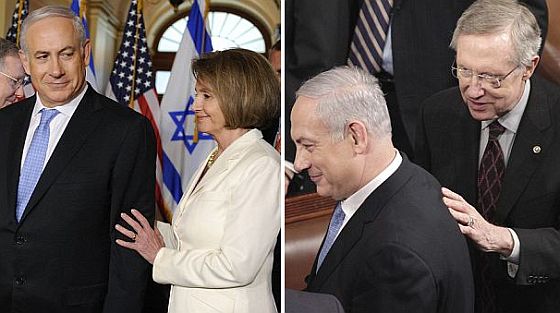
Benjamin Netanyahu being caressed in Congress this morning by Nancy Pelosi and Harry Reid

Josh Ruebner writes:

Gliding down the aisle of the House of Representatives like a popular president about to deliver the State of the Union address, escorted by a phalanx of dozens of ebullient Members of Congress, Israeli Prime Minister Benjamin Netanyahu entered a joint meeting of Congress today to a round of hearty handshakes and a thunderous standing ovation.

In a post-speech press conference, Senate Majority Leader Harry Reid gushed that Netanyahu delivered an “all-star” address, and Netanyahu proclaimed it a “great day” for Israel. And, in the self-contained world that is Capitol Hill, who could blame them for believing it to be so?

For in a world in which Israel finds itself as isolated as ever by a growing and successful Palestinian civil society-led international movement of boycott, divestment, and sanctions (BDS) against its apartheid policies; in which Palestinians are taking matters into their own hands diplomatically and pushing to have the United Nations admit the State of Palestine as a full member of the organization this fall; and in which even the President of the United States appears disgruntled by Israel’s intransigent ongoing colonization of Palestinian land, at least on Capitol Hill, Netanyahu can still play the ace up his sleeve to aplomb and then chum around like the king of the castle.

There on Capitol Hill, Netanyahu still has friends like Senator Chuck Schumer, who told a Jewish radio program that “One of my roles, very important in the United States Senate, is to be a shomer [guard]—to be a or the shomer Yisrael [guard of Israel]. And I will continue to be that with every bone in my body.” With friends like these wrapped around his little finger, no wonder Netanyahu’s forcible denunciations of international law were met with such rapturous approbation by Members of Congress who applauded his rejectionism dozens of times.

Justin Elliot lists the lines of Netanyahu’s speech that won 29 standing ovations.

Facebooktwittermail

Exposing Netanyahu

Paul Pillar writes:

Probably the most significant take-away from the past few days of U.S.-Israeli dialog is to shed light on the true intentions of Israeli Prime Minister Benjamin Netanyahu regarding peace with the Palestinians. Although Netanyahu finally allowed the phrase “Palestinian state” to pass his lips for the first time almost two years ago, this past week in Washington provided further confirmation of what had been apparent all along: that whatever conception Netanyahu may have of such a “state,” it is not a formula having any chance of becoming the basis for—to use Netanyahu’s own words from his joint appearance with President Obama on Friday—“a peace that will be genuine, that will hold, that will endure,” or probably even what most of the rest of the world would consider a state. Netanyahu is smart enough to realize this, which is to say he is content to let the status quo endure indefinitely. Israel will maintain that status quo through brute force—military force within the territories, and political force in Washington.

The drop-the-veil moment during this past week was the importunate lobbying by Netanyahu’s government before President Obama delivered his Middle East speech on Thursday at the State Department (and doesn’t that say something right there—where else would one see a foreign government get in the last lobbying licks on a president’s speech, even at the expense of delaying the speech?) to omit any mention of the 1967 borders as the basis for negotiating land swaps and an eventual territorial settlement. The president mentioned that anyway, and in the joint appearance on Friday Netanyahu said nothing about land swaps, instead denouncing the 1967 borders as not being a suitable basis for anything. As Mr. Obama correctly noted in his address to AIPAC on Sunday, there was nothing new in his mention of 1967-borders-with-swaps. It has long been recognized as the only formula that has any hope of being the basis for a successful negotiation. It has been the basis for several official proposals, including one by Israeli Prime Minister Ehud Olmert in 2008. It also has been at the center of several unofficial proposals, including ones from people whose concern for Israel cannot be doubted (such as a plan offered by David Makovsky of the Washington Institute for Near East Policy).

So for Netanyahu, not only is the land allotted to the Jewish state in the UN partition plan of the 1940s not enough, and not only is the larger territory that became the State of Israel with what we call the 1967 borders not enough. Even with land swaps that would extend Israel farther into the West Bank and include the large majority of the settlements Israel has constructed on land seized in the 1967 war, that would still not be enough for him. How much would be enough? One can speculate on what crumbs of land would be left to the Palestinians, but speculation is not required to have an idea based on Netanyahu’s own statements of what such a “state” would entail: Israeli control of the airspace, no military of its own, and, as the prime minister mentioned on Friday, a “long-term” Israeli military presence along the Jordan River. It sounds like a bantustan that would make Bophuthatswana look like a paragon of sovereignty. But trying to envision the details of such an entity is pointless because it is a non-starter very likely intended to be rejected.

Facebooktwittermail

Dennis Ross: Netanyahu’s man in the White House

The New York Times reports:

Mr. Ross is the most senior member of a coterie of American diplomats who have advised presidents stretching back to Ronald Reagan. Unlike many of his colleagues, Mr. Ross has thrived in Republican and Democratic administrations.
“Dennis is viewed as the éminence grise, a sort of Rasputin who casts a spell over secretaries of state and presidents,” said Aaron David Miller, a Middle East expert who has worked with him over several administrations and says he is an admirer. “But in the end, it’s the president who makes the ultimate decisions.”

Denis R. McDonough, the deputy national security adviser, said: “Dennis brings to the discussion a recognition of the vital importance of peace to the parties, but also to the United States. He’s in many ways dedicated much of his professional life to getting there.”

Mr. Ross initially began his tenure in the Obama administration as a senior Iran policy maker at the State Department. But in the summer of 2009, just a few months into his job at State, Mr. Ross moved to the White House, where he kept his Iran portfolio and eventually assumed a broader role that has allowed him to take part in developing Mr. Obama’s response to the upheavals in the Arab world.

His move came as the White House and Mr. Netanyahu were in a standoff over settlement construction. Over time, administration officials say, Mr. Ross took more of a role over Arab-Israeli policy. In September 2009, Mr. Obama abandoned his insistence on a settlement freeze in the face of Israeli recalcitrance.

“If Dennis Ross was in the inner circle in the early days, this administration would not have made that colossal settlements error,” Mr. Foxman said. “He would have said, ‘Don’t go there.’ ”

Once at the White House, Mr. Ross became invaluable, administration officials said, because of his close relationship not only with Mr. Netanyahu, but with the Israeli prime minister’s top peace negotiator, Yitzhak Molcho.

Mr. Ross demonstrated his growing influence last October, when the administration was pressing Mr. Netanyahu to agree to a three-month extension of his moratorium on settlement construction. Mr. Netanyahu balked.

So Mr. Ross devised a generous package of incentives for Israel that included 20 American fighter jets, other security guarantees, and an American pledge to oppose United Nations resolutions on Palestinian statehood. Many Middle East analysts expressed surprise that the administration would offer so much to Israel in return for a one-time, 90-day extension of a freeze.

Facebooktwittermail

Obama makes peace with AIPAC

If there’s one way of registering that President Obama could be saying something of significance while he’s addressing AIPAC, it’s during those passages when he gets no applause.

This morning he got plenty of applause when he assured the pro-Israel lobby that a negotiated border between Israel and a Palestinian state will not end up being the 1967 border.

But when he outlined the degree to which the regional and wider international environment has changed and implicitly acknowledged that Israel and the US are out of step with these changes, the audience was silent.

[A] new generation of Arabs is reshaping the region. A just and lasting peace can no longer be forged with one or two Arab leaders. Going forward, millions of Arab citizens have to see that peace is possible for that peace to be sustained.

And just as the context has changed in the Middle East, so too has it been changing in the international community over the last several years. There’s a reason why the Palestinians are pursuing their interests at the United Nations. They recognize that there is an impatience with the peace process, or the absence of one, not just in the Arab World — in Latin America, in Asia, and in Europe. And that impatience is growing, and it’s already manifesting itself in capitals around the world.

Before Obama arrived at the Washington DC convention center where AIPAC is assembled, AIPAC supporters gathered outside were heard yelling through a bullhorn: “Kill Obama.” I’ve seen no reports of anyone getting arrested for trying to incite the assassination of the president.

Ron Kampeas summed up the mood in this way: “When Obama is in the room, AIPAC is supportive. When he is out of the room, skeptical.”

Earlier, Reuters reported:

Some prominent Jewish Americans are rethinking their support for President Barack Obama’s 2012 re-election bid after he effectively called on Israel to give back territory it has occupied since 1967 to Palestinians.

The backlash after Obama’s keynote speech on the Middle East has Democratic Party operatives scrambling to mollify the Jewish community as the president prepares to seek a second term in the White House.

Obama on Thursday called for any new Palestinian state to respect the borders as they were in 1967, prompting Israeli Prime Minister Benjamin Netanyahu to tell him bluntly that his vision of how to achieve Middle East peace was unrealistic.

“He has in effect sought to reduce Israel’s negotiation power and I condemn him for that,” former New York Mayor Ed Koch told Reuters.

Koch said he might not campaign or vote for Obama if Republicans nominate a pro-Israel candidate who offers an alternative to recent austere budgetary measures backed by Republicans in Congress.

Koch donated $2,300 to Obama’s campaign in 2008, according to filings with the Federal Election Commission.

“I believed that then-Senator Obama would be as good as John McCain based on his statements at the time and based on his support of Israel. It turns out I was wrong,” he said.

Despite the stormy reaction to Obama’s remarks, some commentators noted talk of the 1967 borders was nothing new.

“This has been the basic idea for at least 12 years. This is what Bill Clinton, Ehud Barak and Yasser Arafat were talking about at Camp David, and later, at Taba,” Jeffrey Goldberg wrote on The Atlantic website.

“This is what George W. Bush was talking about with Ariel Sharon and Ehud Olmert. So what’s the huge deal here?”

Exit polls from the 2008 election showed 78 percent of Jewish voters chose Obama over his Republican rival Senator McCain.

“I have spoken to a lot of people in the last couple of days — former supporters — who are very upset and feel alienated,” billionaire real estate developer and publisher Mortimer Zuckerman said.

“He’ll get less political support, fewer activists for his campaign, and I am sure that will extend to financial support as well.”

Facebooktwittermail

Obama: Doomed to disappoint

John J Mearsheimer writes:

Barack Obama gave a major speech on the Middle East on Thursday, May 19, and it is clear from the subsequent commentary that he impressed few people. The main reason for this is that he did not say much new or indicate that there would be any serious changes in US policy in the region. It was essentially more of the same with some tweaking here and there. Nevertheless, he did manage to anger some people. For example, Israel’s hard-line supporters were outraged that he said: “Palestine should be based on the 1967 lines with mutually agreed swaps.” For them, the 1967 borders are “Auschwitz borders” and thus can never serve as a basis for negotiations.

Many Palestinians, on the other hand, did not like Obama’s assertion that it made little sense for them to go to the UN General Assembly this September and win recognition for a Palestinian state based on the 1967 borders. Surely they also noticed that shortly after saying “every state has the right to self-defence, and Israel must be able to defend itself,” the president said that the Palestinians would have to be content with “a sovereign non-militarised state,” which means that they would not be able to defend themselves against Israel – or any other state for that matter. Hypocrisy appears to be wired into the DNA of US foreign policy makers.

Obama’s failure to impress and move US Middle East policy in new directions raises the intriguing question: Did he blow an opportunity to give a truly important speech at what appears to be a plastic moment in history? I think not. The sad fact is that Obama has remarkably little manoeuvre room on the foreign policy front. The most important item on his agenda is settling the Israeli-Palestinian conflict, and there he knows what has to be done: Push both sides toward a two-state solution, which is the best outcome for all the parties, including the United States. Indeed, he has been trying to do just that since he took office in January 2009. But the remarkably powerful Israel lobby makes it virtually impossible for him to put meaningful pressure on Israeli Prime Minister Benjamin Netanyahu, who is committed to creating a Greater Israel in which the Palestinians are restricted to a handful of disconnected and impoverished enclaves. And Obama is certainly not going to buck the lobby – with the 2012 presidential election looming larger every day.

Facebooktwittermail

Our revolt is not Obama’s

Ahdaf Soueif writes:

This wasn’t slipping poison into the honey; it was smearing chemical sweeteners on to toxic pellets. Barack Obama listed what he sees as his country’s “core interests” in my country Egypt and my region; his country’s “core principles” governing how it will act towards us, and his policies to promote US interests within the frame of US principles. Let’s translate the US president’s description of his “core interests in the region” into effects on the ground:

“Countering terrorism” has implicated (at least) Egypt, Syria and Jordan in the US’s extraordinary rendition programme, turning our governments into torturers for hire and consolidating a culture of security services supremacy and brutality that is killing Syrian protesters today and manifests itself in Egypt as a serious counter-revolution.

“Stopping the spread of nuclear weapons” highlights consistent US double standards as Arab nuclear scientists are murdered, the US threatens Iran, and Israel happily develops its illicit arsenal.

“Securing the free flow of commerce” has meant shoving crony capitalism down our throats, bribing governments to sell our national assets and blackmailing us into partnerships bad for us.

“Supporting Israel” has led to land, resources and hope being stolen from Palestinians while Egypt becomes their jailer and dishonest broker, losing its credibility and self-respect.

Obama has all the information above; he knows that Hosni Mubarak’s dedication to delivering US “core interests” is why the Egyptian millions demanded his departure, why Tahrir proclaimed him an “agent of America and Israel”, and why he is now under arrest.

The blame is not all with America. We had a regime that was susceptible, that became actively complicit; assiduously finding ways to serve US and Israeli interests – and ruin us. But: we got rid of it. Peaceably, with grace and within the law. We Got Rid of It.

So when Obama says, “We will continue to do” the things described above, it’s a challenge. When he adds, “with the firm belief that America’s interests are not hostile to people’s hopes; they are essential to them” – it’s obfuscation and an insult to every citizen across the world – including Americans – who followed our revolutions with empathy and with hope.

Facebooktwittermail

How Obama got bin Laden and lost Pakistan

The New York Times reports:

China has agreed to immediately provide 50 JF-17 fighter jets to Pakistan, a major outcome of a visit by Prime Minister Yousaf Raza Gilani to Beijing this week, Pakistani officials said Thursday.

China and Pakistan have jointly produced the JF-17 aircraft, but the new planes would be equipped with more sophisticated avionics, the officials said. The latest jet fighters would be paid for by China, they said.

The announcement came as Pakistan’s already tense relations with the United States soured further after the killing of Osama bin Laden deep inside Pakistan on May 2.

Last week, Pakistan’s spy chief denounced the United States in a rare briefing before Parliament in which he condemned the American raid for breaching Pakistan’s sovereignty. Parliament, in turn, called for the government to revisit relations with the United States.

Mr. Gilani’s visit to Beijing served as a pointed reminder of Pakistani suggestions that the government might seek to recalibrate relations with the United States, using China to offset what many here view as an overdependence on Washington.

Facebooktwittermail

The borders of Auschwitz

David Ben-Gurion, Israel’s first prime minister, had he not died before 1967, would surely have been disappointed to hear it said that he and fellow Zionists who fought to create a Jewish state had such meager success that in its first two decades of existence, Israel was barely an improvement on Auschwitz.

It’s hard to know who should be more offended by that assessment: the victims of the Holocaust or Israel’s founders?

In his response to President Obama’s suggestion that Israel should — with mutually agreed land swaps with Palestinians — retreat to its 1967 borders, Benjamin Netanyahu says that such a move would place Israel behind “indefensible” borders.

Netanyahu is alluding to a phrase now employed by many on the right that he himself once invoked: “the borders of Auschwitz.”

In the New York Times, Robert Mackey and Elizabeth Harris explain:

That resonant phrase, which suggests that Israelis would face genocide should they withdraw fully from the land they have occupied since the end of the 1967 war, is based on a mangled version of a remark made by the Israeli diplomat Abba Eban in 1969. According to Haaretz, Mr. Eban told the German newsweekly Der Spiegel in that year: “We have openly said that the map will never again be the same as on June 4, 1967. For us, this is a matter of security and of principles. The June map is for us equivalent to insecurity and danger. I do not exaggerate when I say that it has for us something of a memory of Auschwitz.”

Israeli leaders have frequently used some version of this phrase to invoke the existential dread of the Holocaust when pressed to withdraw from the occupied territories as part of a peace agreement.

In 2002, Ariel Sharon told William Safire that a proposed Saudi peace plan was unacceptable because, “Israel cannot return to the ‘67 borders. Abba Eban long ago called them ‘Auschwitz borders’; Israel would not be able to exist.”

A decade earlier, when another Israeli leader, Yitzhak Shamir, expressed his outrage when the administration of President George H. W. Bush called for a freeze on Jewish settlements in the occupied territories — in exchange for $10 billion in American loan guarantees — The Times reported that a senior official in the prime minister’s office, a young Benjamin Netanyahu, complained that Israel was being asked to accept, “the borders of Auschwitz.”

Writing about the use and abuse of this phrase in 2007, the Haaretz columnist Bradley Burston observed that the right-wing Israeli politicians who had frequently invoked Mr. Eban to support their refusal to cede territory were less likely to mention another of his famous maxims: “Israel’s birth is intrinsically and intimately linked with the idea of sharing territory and sovereignty.”

Facebooktwittermail

Obama granted Netanayhu a major diplomatic victory

Aluf Benn writes:

Prime Minister Benjamin Netanyahu can feel satisfied while flying to Washington Thursday night. U.S. President Barack Obama has granted Netanyahu a major diplomatic victory.

In return for his call for the establishment of a Palestinian state based on 1967 borders with agreed land swaps, without defining the size of these lands, Obama accepted Netanyahu’s demands for strict security arrangements and a gradual, continuous withdrawal from the West Bank.

He suggested beginning negotiations on borders and security arrangements, and delaying discussions on the core issues such as Jerusalem and refugees.

More importantly, Obama scornfully rejected the Palestinian initiative to attain recognition at the United Nations and to isolate Israel, demanded the Palestinians return to negotiations, and called on Hamas to recognize Israel’s right to exist. These points came straight out of the policy pages of the Prime Minister’s Bureau in Jerusalem. Netanyahu could not have asked for more: Obama outright rejects Palestinian President Mahmoud Abbas’ recognition campaign, as well as the Palestinian reconciliation agreement.

It seems that the new Fatah-Hamas unity has saved Netanyahu from a much more aggressive and binding speech on the part of Obama.

Obama could have also delivered his Mideast speech during the impending AIPAC conference, which he will attend this coming Sunday.

Facebooktwittermail

Every state has the right to self-defense — except a Palestinian state

After returning to the White House having delivered his much anticipated Middle East speech, I imagine President Obama now eagerly awaits news on how quickly and handsomely he will be rewarded by nervous campaign donors who were still unsure about his loyalty to Israel. The cash will no doubt now start rolling in.

As for security, every state has the right to self-defense, and Israel must be able to defend itself – by itself – against any threat. Provisions must also be robust enough to prevent a resurgence of terrorism; to stop the infiltration of weapons; and to provide effective border security. The full and phased withdrawal of Israeli military forces should be coordinated with the assumption of Palestinian security responsibility in a sovereign, non-militarized state.

Every state has the right to self-defense, unless it’s a Palestinian state. In a Palestinian state the primary responsibility of its security forces will be to protect Israel.

From Israel, Larry Derfner comments:

In his speech on the Middle East, Obama gave the Palestinians nothing and gave Israel a lot, which means he strengthened the status quo, which Israel is perfectly happy with and only the Palestinians want to change. By saying the Israeli-Palestinian border should be based on the ’67 line, he just repeated what Clinton said publicly about a year ago (and what her husband said in the White House a decade ago). What was new, or at least newer, was his endorsement of Netanyahu’s call for a “non-militarized” Palestine – which is a contradiction to a sovereign Palestine, something Obama claimed also to support. And by mentioning the need to stop the smuggling of weapons into Palestine, he might have been giving a nod to Netanyahu’s demand to keep the Israeli army on the Jordan Valley. Also, he repeated his opposition to the Palestinians’ plan to seek recognition from the UN in September. In all, a very, very good day for the occupation. But I think Obama just lost the Palestinians. Abbas cannot go along with this prescription, none of them can. They have to go to the UN, they have to go ahead with the popular resistance, to go out into the street en masse – to the settlements, to the army outposts, to the fence, and hope for the Tahrir effect – to win the world to their side – and for this, they must remain non-violent – and shame Israel in the eyes of the world and force Obama and the other timid Western leaders to force Israel to end the occupation. There’s just no other way. I’d thought that maybe after killing Bin Laden, Obama would have the political capital to pressure Israel. Whether he has it or not, he’s too timid, or too election-minded, to use it. To the cause of peace and justice in Israel and Palestine, he just became a write-off.

Who could have predicted that after two years, Obama’s greatest achievement is that he increasingly makes George Bush look like a man of substance.

To my ear, the best worst paragraph in the speech was this:

That is the choice that must be made – not simply in this [Israeli-Palestinian] conflict, but across the entire region – a choice between hate and hope; between the shackles of the past, and the promise of the future. It’s a choice that must be made by leaders and by people, and it’s a choice that will define the future of a region that served as the cradle of civilization and a crucible of strife.

At least when Dubya delivered a vacuous statement like this, he’d make it a bit more entertaining by mangling a few words or making an inappropriate facial expression.

Facebooktwittermail

Follow the money

The Wall Street Journal reports:

Jewish donors and fund-raisers are warning the Obama re-election campaign that the president is at risk of losing financial support because of concerns about his handling of Israel.

The complaints began early in President Barack Obama’s term, centered on a perception that Mr. Obama has been too tough on Israel.

Some Jewish donors say Mr. Obama has pushed Israeli leaders too hard to halt construction of housing settlements in disputed territory, a longstanding element of U.S. policy. Some also worry that Mr. Obama is putting more pressure on the Israelis than the Palestinians to enter peace negotiations, and say they are disappointed Mr. Obama has not visited Israel yet.

One top Democratic fund-raiser, Miami developer Michael Adler, said he urged Obama campaign manager Jim Messina to be “extremely proactive” in countering the perception in the Jewish community that Mr. Obama is too critical of Israel.

He said his conversations with Mr. Messina were aimed at addressing the problems up front. “This was going around finding out what our weaknesses are so we can run the best campaign,” said Mr. Adler, who hosted a fund-raiser at his home for Mr. Obama earlier this year.

“Good friends tell you how you can improve. They don’t tell you ‘everything’s great’ and then you find out nobody buys the food in your restaurants,” he said.

It is difficult to assess how widespread the complaints are. Many Jews support Mr. Obama’s approach to the Middle East, and his domestic agenda. But Jewish fund-raisers for Mr. Obama say they regularly hear discontent among some supporters.

Facebooktwittermail

Assassination nation: Are there any limits on President Obama’s license to kill?

James Bovard writes:

How much evidence should the US government be obliged to show before it kills an American citizen?

None, according to the Obama administration.

And how much evidence should the government be obliged to possess of an American’s wrongdoing before officially targeting them for killing?

That’s a secret, according to the Obama team.

As part of its war against violent extremism, the Obama administration now claims a right to kill Americans without a trial, without notice, and without any chance for targets to legally object. On May 6, the US government launched a drone attack to try to kill a US citizen in Yemen. The Obama administration alleges that Anwar al-Awlaki, an American born Muslim cleric, helped spark killings at Fort Hood, Texas, and an attempt to blow up a jetliner in 2009. Mr. Awlaki might be a four-star bad guy, but government press releases and background briefings have not previously been sufficient to justify capital punishment. The drone attack failed to terminate Awlaki, though two other people were killed.

The US government has admitted that it has added the names of other Americans to a list for targeted killing. The American Civil Liberties Union sued last year to compel the government “to disclose the legal standard it uses to place US citizens on government kill lists,” but was thwarted when the Obama administration claimed the entire program was a “state secret.” Last December, federal Judge John Bates dismissed the ACLU’s lawsuit because “there are circumstances in which the Executive’s unilateral decision to kill a US citizen overseas” is “judicially unreviewable.”

Assuming that Obama doesn’t lose his appetite for extrajudicial killing, it seems likely that missiles fired from drones will remain his weapon of choice. Old-fashioned death squads leave open the inconvenient possibility that the assassination target might attempt to surrender.

Did Osama bin Laden have his empty hands held high just before he was shot in the head? We can only be sure that any awkward record of such a fact would remain sealed in a vault for many decades.

Facebooktwittermail

Anticipation builds (in Washington) for Obama’s big Mideast speech

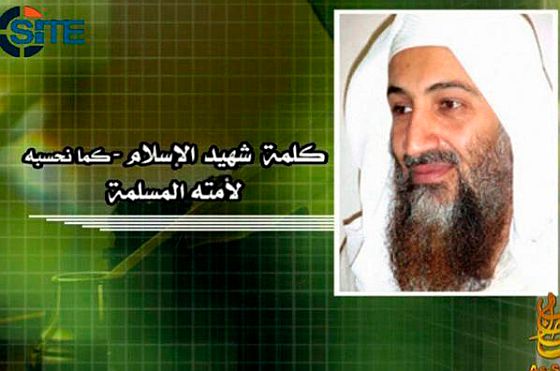
Osama bin Laden might be dead, but al Qaeda still operates a nimble media outfit.

Just as the US media drone anticipating President Obama’s speech later this morning started to grow tiresome, Obama’s words got preempted by Osama’s.

I can’t help wondering what his assassination would have looked like if it had occurred immediately after he expressed support for the Arab Awakening.

In an audio message recorded shortly before his death, Reuters reports:

Bin Laden praised the Egyptian revolution and urged Arab protesters to maintain their momentum, adding: “I believe that the winds of change will envelope the entire Muslim world.”

“This revolution was not for food and clothing. Rather, it was a revolution of glory and pride, a revolution of sacrifice and giving. It has lit the Nile’s cities and its villages from its lower reaches to the top,” he said.

“To those free rebels in all the countries — retain the initiative and be careful of dialogue. No meeting mid-way between the people of truth and those of deviation.”

Bin Laden made no specific reference to Libya, Syria, Bahrain and Yemen, where pro-democracy protesters have had less success than in Egypt and Tunisia, but said Israel, reviled by many ordinary Arabs, was worried by the unrest.

Bin Laden called on young Arabs to consult “those of experience and honesty” and to set up a framework that would allow them to “follow up events and works in parallel… to save the people that are struggling to bring down their tyrants.”

How significant is Osama’s endorsement of the uprisings? It probably won’t have much influence on the average demonstrator in Syria, Bahrain, Libya, Egypt, or Yemen. But it might result in a few would-be jihadists joining the political mainstream.

Meanwhile, how much influence is Obama likely to have two years after his previous and much-hyped Cairo speech turned out to be hollow rhetoric?

McClatchy’s Hannah Allam just took the pulse of the Arab street:

Most common responses when I asked random Egyptians about watching Obama’s #MEspeech: He’s speaking? When? About what?

Facebooktwittermail