Category Archives: Obama administration

White House ‘deeply disappointed’ after British court upholds the law. Judge says MI5 operates ‘culture of suppression’

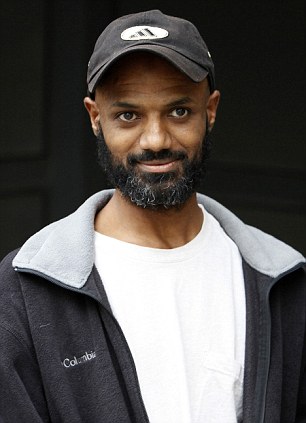
The story of Binyam Mohamed is probably one of the most under-reported stories of the war on terrorism — it has still only partially been told. If, as the former Guantanamo prisoner alleges, he had his genitals sliced with a scalpel after being captured by the US, then the defenders of so-called “harsh interrogation techniques” should finally be rendered mute and duly shamed.

The Daily Mail said:

By any measure, the treatment meted out to Binyam Mohamed was medieval in its barbarity.

Shackled in total blackness in the CIA’s ‘dark prison’ in Kabul, he was forced to listen to ear-splitting music 24 hours a day for a month.

In Morocco he was hung from walls and ceilings and repeatedly beaten, his penis and chest were sliced with a scalpel and hot, stinging liquid poured into the open wounds.

‘They cut all over my private parts,’ he wrote in his diary. ‘One of them said it would be better just to cut it off, as I would only breed terrorists.’

The Obama administration, which has consistently acted like putty in the hands of the intelligence services, regards the exposure of criminal actions by those services as a national security threat. In truth it is the US-sanctioned use of torture that poses a much more serious threat to this nation.

As The Guardian noted, the ruling by three of Britain’s most senior judges, “shattered the age-old ­convention that the courts cannot ­question claims by the government relating to national security, whatever is done in its name, in an unprecedented ruling that is likely to cause deep anxiety among the security and intelligence agencies.”

This is how democracy is supposed to work. Both in Britain and the US, all too often the phrase “national security” really means protection of the power-holders. A judiciary that is truly independent cannot allow any government to protect its own interests at the expense of the nation it serves.

Afua Hirsch describes in greater legal detail how the British government disregarded 400 years of legal precedence in its effort to suppress revelations about the use of torture.

The Guardian reported:

MI5 faced an unprecedented and damaging crisis tonight after one of the country’s most senior judges found that the Security Service had failed to respect human rights, deliberately misled parliament, and had a “culture of suppression” that undermined government assurances about its conduct.

The condemnation, by Lord Neuberger, the master of the rolls, was drafted shortly before the foreign secretary, David Miliband, lost his long legal battle to suppress a seven-paragraph court document showing that MI5 officers were involved in the ill-treatment of a British resident, Binyam Mohamed.

Amid mounting calls for an independent inquiry into the affair, three of the country’s most senior judges – Lord Judge, the lord chief justice, Sir Anthony May, president of the Queen’s Bench Division, and Lord Neuberger – disclosed evidence of MI5’s complicity in Mohamed’s torture and unlawful interrogation by the US.

So severe were Neuberger’s criticisms of MI5 that the government’s leading lawyer in the case, Jonathan Sumption QC, privately wrote to the court asking him to reconsider his draft judgment before it was handed down.

The judges agreed but Sumption’s letter, which refers to Neuberger’s original comments, was made public after lawyers for Mohamed and media organisations, including the Guardian, intervened.

They argued that Neuberger had privately agreed with Sumption to remove his fierce criticisms without giving then the chance to contest the move.

At The Atlantic, Marc Ambinder said:

The White House hinted today that it may have to alter long-standing intelligence sharing arrangements with the United Kingdom after the release of information provided to the Brits about the confinement and interrogation of one of its citizens, Binyam Mohamed.

“The United States government made its strongly held views known throughout this process. We appreciate that the UK Government stood by the principle of protecting foreign government intelligence in its court filings,” said Ben LaBolt, a White House spokesperson. “We’re deeply disappointed with the court’s judgment today, because we shared this information in confidence and with certain expectations.”

LaBolt’s statement hinted that the US might reevaluate the type of information it shares with British counterterrorism and intelligence agencies.

“As we warned, the court’s judgment will complicate the confidentiality of our intelligence-sharing relationship with the UK, and it will have to factor into our decision-making going forward. This just means that we need to redouble our efforts to work through this challenge, because the UK remains a key partner in our collective efforts to suppress terrorism and other threats to our national security.”

With respect to LaBolt, I think this is a bluff. The US shares more raw data and polished intel product with Britain on a daily basis than any other country in the world, and that’s not going to change. Perhaps the US will be more careful in certain documents that might find their way into the UK court system — but it’s hard to imagine that intelligence cooperation between the two countries will really be damaged by today’s revelation.


Facebooktwittermail

Why the Rahm administration betrayed the Obama campaign

Zack Exley on why the Rahm administration betrayed the Obama campaign:

Policy and political strategy in American politics have been completely divorced from one another. The political strategists who ran Obama’s campaign allowed him — or maybe it was just that kid Jon Favreau? — to run on a big, clear, inspiring mission: “A nation healed. A world repaired. An America that believes again.” Note: I didn’t say detailed, just big and inspiring! But after the victory, like Garibaldi they took their applause and walked into the sunset (or OFA). In fact, they had to: because, according to the caste system of American politics they knew about the romance of campaigning, but not the realpolitik of governing.

The American people, like people everywhere, are hopeful. They gave Obama a chance to make good on such big words as “hope” and “change” in office. But then the policy wonks took over. Big, clear policies worth fighting for were unthinkable for these particular people, because they see industry and Wall Street as more important than the American people. To be fair, most of them are just trying to be realistic, not malicious: they would prefer to stand up for the American people, but industry and Wall Street are simply more powerful and must be appeased.

Therefore, neither “Medicare for Everyone,” nor a direct bailout for tens of millions of Americans who were victimized by Wall Street were ever a possibility. But in ruling out those kinds of pro-people policies, the administration deactivated the American people. The massive grassroots organization that propelled Obama to victory seemed to evaporate into thin air in the months after the election.

Facebooktwittermail

Daylight robbery

Bloomberg:

President Barack Obama said he doesn’t “begrudge” the $17 million bonus awarded to JPMorgan Chase & Co. Chief Executive Officer Jamie Dimon or the $9 million issued to Goldman Sachs Group Inc. CEO Lloyd Blankfein, noting that some athletes take home more pay.
The president, speaking in an interview, said in response to a question that while $17 million is “an extraordinary amount of money” for Main Street, “there are some baseball players who are making more than that and don’t get to the World Series either, so I’m shocked by that as well.”

“I know both those guys; they are very savvy businessmen,” Obama said in the interview yesterday in the Oval Office with Bloomberg BusinessWeek, which will appear on newsstands Friday. “I, like most of the American people, don’t begrudge people success or wealth. That is part of the free- market system.”

Simon Johnson comments:

Does the president truly not understand that Dimon and Blankfein run banks that are regarded by policymakers and hence by credit markets as “too big to fail”?

This is the antithesis of a free-market system.

True. But there’s a crucial cultural dimension to what Obama is saying.

The love of money and the celebration of the accumulation of personal wealth are core American values. To criticize the wealthy is to take a stance that is widely seen as un-American. Indeed, the widely-held assumption is that the only plausible motive anyone might have for denouncing the rich is envy. And to be tarred with the slur “envious” is to be cast into a social margin occupied by that most pathetic type of American: the loser.

So, if you want to stay on the side of the winners, you say: Mr Blankfein, you just snatched a cool $9 million. Good for you!

Meanwhile, those of us who are not burdened with the vanity of the president or the fear of being called un-American, can name Blankfein’s reward what it is: theft.

And just in case anyone might be in any doubt whether Goldman Sachs is run by crooks, consider the fact that the current debt crisis in Greece — which has sent shock-waves through the global economy — was brought about in large part because Goldman Sachs created a mechanism through which the Greek government has for most of the last decade been able to conceal its debt.

Der Spiegel reports:

Goldman Sachs helped the Greek government to mask the true extent of its deficit with the help of a derivatives deal that legally circumvented the EU Maastricht deficit rules. At some point the so-called cross currency swaps will mature, and swell the country’s already bloated deficit.

Greeks aren’t very welcome in the Rue Alphones Weicker in Luxembourg. It’s home to Eurostat, the European Union’s statistical office. The number crunchers there are deeply annoyed with Athens. Investigative reports state that important data “cannot be confirmed” or has been requested but “not received.”

Creative accounting took priority when it came to totting up government debt.Since 1999, the Maastricht rules threaten to slap hefty fines on euro member countries that exceed the budget deficit limit of three percent of gross domestic product. Total government debt mustn’t exceed 60 percent.

The Greeks have never managed to stick to the 60 percent debt limit, and they only adhered to the three percent deficit ceiling with the help of blatant balance sheet cosmetics. One time, gigantic military expenditures were left out, and another time billions in hospital debt. After recalculating the figures, the experts at Eurostat consistently came up with the same results: In truth, the deficit each year has been far greater than the three percent limit. In 2009, it exploded to over 12 percent.

Now, though, it looks like the Greek figure jugglers have been even more brazen than was previously thought. “Around 2002 in particular, various investment banks offered complex financial products with which governments could push part of their liabilities into the future,” one insider recalled, adding that Mediterranean countries had snapped up such products.

Greece’s debt managers agreed a huge deal with the savvy bankers of US investment bank Goldman Sachs at the start of 2002. The deal involved so-called cross-currency swaps in which government debt issued in dollars and yen was swapped for euro debt for a certain period — to be exchanged back into the original currencies at a later date.

Facebooktwittermail

U.S.: Easing Gaza siege would help counter Goldstone

Think of Gaza as a hospital patient whose lips have been stitched closed. Israeli doctors point to an IV drip and say: “Look. We are taking great care to make sure the patient stays alive.” American consultants suggest that it would really be better to remove a couple of stitches so that a tube can be inserted in the patient’s mouth. It would look much more humane. Right.

Haaretz reports:

The United States has suggested to Israel that easing the Gaza blockade would help counter the fallout from the Goldstone report on alleged war crimes during Operation Cast Lead a year ago.

Friday, United Nations Secretary General Ban Ki-moon is expected to present a report to the General Assembly on the implementation of the report’s recommendations by Israel and the Palestinian Authority.

The U.S. message on the blockade was relayed last week when a Foreign Ministry delegation met in Washington with senior officials from the State Department and the White House. Much of the meeting dealt with steps that Israel could take to help the United States and others block the Goldstone report and prevent it from reaching the International Criminal Court in The Hague.

Heading the Israeli delegation was the Foreign Ministry’s deputy director for international organizations, Eviatar Manor. The delegation met with officials including the U.S. assistant secretary of state for democracy, human rights and labor, Michael Posner, and President Barack Obama’s adviser on human rights, Samantha Power.

Facebooktwittermail

How the CIA became dumb and dangerous

Melvin A Goodman and Philip Giraldi — former CIA officers with decades of experience — both agree that the agency’s focus on paramilitary operations has undermined its core intelligence mission.

Giraldi writes:

It has been observed that no countries on the earth but the United States and Israel claim extraterritoriality, i.e. the right to seize or attack anyone anywhere and at any time based on evidence that is secret. The foul-up at Base Chapman [in which seven CIA officers were killed in a suicide attack] is reflective of the transformation of CIA into a Washington-sanctioned retribution machine, something not unlike the terrorist groups that it claims to oppose rather than an intelligence agency. It is telling that after the slaughter at Base Chapman senior Agency officers immediately announced that they would get revenge and the pace of drone attacks has dramatically increased, killing few or no actual terrorists but many civilians and further destabilizing an already tottering Pakistan. The broader problems that the Agency is experiencing are revealed in CIA’s eight years of largely unrewarding effort against “international terrorism,” a symptom of a systemic failure to understand much less identify and penetrate groups that are, ironically, constantly looking for volunteers to fill their ranks. CIA’s traditional strength in recruiting agents and collecting intelligence has all but disappeared, subsumed into a paramilitary mission to launch hellfire missile firing drones, which is also almost certainly a reflection of the White House’s perception of what needs to be done. If that is so, the tactic is ultimately self defeating in that it produces more enemies that it is able to eliminate, making failure in Afghanistan an absolute certainty.

Likewise, Goodman says:

In a democracy, where laws are derived from broad principles of right and wrong and where those principles are protected by agreed procedures, it is not in the interest of the state to flout those procedures at home, or to permit extra-legal activities abroad, which have complicated the task of maintaining credible relations with our allies in the battle against terrorism.

The CIA’s most important mission remains the preparation of independent analysis of international issues for senior decision makers; therefore, it is essential to protect the integrity of objective and balanced intelligence. The CIA gives far too much attention to support for the Pentagon and to current intelligence. In the past, CIA analysis served to contradict or at least temper the worst-case analysis of the Pentagon, but this is no longer the case.

President Harry Truman created the CIA to produce strategic intelligence that was not beholden to policy and political interests; President Obama must restore this mission.

Facebooktwittermail

Can Obama take charge?

Paul Krugman describes the current crisis in Washington and its parallels with the collapse of Poland at the end of the eighteenth century:

…given the state of American politics, the way the Senate works is no longer consistent with a functioning government. Senators themselves should recognize this fact and push through changes in those rules, including eliminating or at least limiting the filibuster. This is something they could and should do, by majority vote, on the first day of the next Senate session.

Don’t hold your breath. As it is, Democrats don’t even seem able to score political points by highlighting their opponents’ obstructionism.

It should be a simple message (and it should have been the central message in Massachusetts): a vote for a Republican, no matter what you think of him as a person, is a vote for paralysis. But by now, we know how the Obama administration deals with those who would destroy it: it goes straight for the capillaries. Sure enough, Robert Gibbs, the White House press secretary, accused Mr. Shelby of “silliness.” Yep, that will really resonate with voters.

After the dissolution of Poland, a Polish officer serving under Napoleon penned a song that eventually — after the country’s post-World War I resurrection — became the country’s national anthem. It begins, “Poland is not yet lost.”

Well, America is not yet lost. But the Senate is working on it.

The problem with locating the root of the problem in what has become a dysfunctional Senate, is that it turns the administration into a victim. Krugman might bemoan the White House’s ineffectual defense mechanisms but he’s essentially sidelining the heart of the problem: a weak president.

Facebooktwittermail

‘When Guantanamo walked in the door, Rahm walked out’

In her New Yorker piece on Attorney General Eric Holder and the Khalid Sheikh Mohammed trial, Jane Mayer describes White House Chief of Staff, Rahm Emanuel’s role in blocking the investigation of torture by the CIA:

Emanuel viewed many of the legal problems that [Greg] Craig [Obama’s first White House counsel] and Holder were immersed in as distractions. “When Guantánamo walked in the door, Rahm walked out,” the informed source said. Holder and Emanuel had been collegial since their Clinton Administration days. Holder’s wife, Sharon Malone, an obstetrician, had delivered one of Emanuel’s children. But Emanuel adamantly opposed a number of Holder’s decisions, including one that widened the scope of a special counsel who had begun investigating the C.I.A.’s interrogation program. Bush had appointed the special counsel, John Durham, to assess whether the C.I.A. had obstructed justice when it destroyed videotapes documenting waterboarding sessions. Holder authorized Durham to determine whether the agency’s abuse of detainees had itself violated laws. Emanuel worried that such investigations would alienate the intelligence community. But Holder, who had studied law at Columbia with Telford Taylor, the chief American prosecutor in the Nuremberg trials, was profoundly upset after seeing classified documents explicitly describing C.I.A. prisoner abuse. The United Nations Convention Against Torture requires the U.S. to investigate credible torture allegations. Holder felt that, as the top law-enforcement officer in the U.S., he had to do something.

Emanuel couldn’t complain directly to Holder without violating strictures against political interference in prosecutorial decisions. But he conveyed his unhappiness to Holder indirectly, two sources said. Emanuel demanded, “Didn’t he get the memo that we’re not re-litigating the past?”

Facebooktwittermail

Iran ratchets up atom work despite sanctions threat

Reuters reports:

Iran’s president gave instructions on Sunday for the production of higher-grade nuclear reactor fuel, prompting the United States and Germany to threaten carefully targeted new sanctions against Tehran.

President Mahmoud Ahmadinejad’s announcement raised the stakes in Iran’s dispute with the West, but he said talks were still possible on a nuclear swap offer by world powers designed to allay fears the Islamic Republic is making an atomic bomb.

U.S. Defense Secretary Robert Gates said the response by Iran, a major oil exporter which says its nuclear program is to make electricity and not bombs, was very disappointing.

Deutsche Welle added:

US Senator Joe Lieberman, who heads the Senate Committe on Homeland Security, told the German Press Agency dpa that the world faces a choice between imposing tough sanctions against Iran or launching a military strike.

Lieberman was the last speaker of the day on Saturday and obviously frustrated at the Iranian Foreign Minister’s late-night speech on Friday didn’t mince his words.

“We have a choice here: to go to tough economic sanctions to make diplomacy work or we will face the prospect of military action against Iran,” Lieberman said.

That is because a nuclear-armed Iran would create chaos in the Middle East, send oil prices soaring and shatter any hope of an end to the Israeli-Palestinian conflict, he said.

“They should just accept the existing (IAEA) proposal,” Lieberman told dpa.

Facebooktwittermail

School bombing exposes Obama’s secret war inside Pakistan

The Times:

The discovery of three American soldiers among the dead in a suicide bombing at the opening of a girls’ school in the northwestern Pakistan town of Dir last week reignited the fears of many Pakistanis that Washington was set on invading their country.

Barack Obama has banned the Bush-era term “war on terror” and dithered about sending extra troops to Afghanistan, but across the border in Pakistan, the US president has dramatically stepped up the covert war against Islamic extremists.

US airstrikes in Pakistan, launched from unmanned drones, are now averaging three a week, triple the number last year. “We’re quietly seeing a geographical shift,” an intelligence officer said.

For the past month drones have pounded the tribal region of North Waziristan in apparent retaliation for the murder of seven CIA officers in Afghanistan by a Jordanian suicide bomber working with the Pakistani Taliban.

At TomDispatch, Pratap Chatterjee wrote:

In recent years, many commentators and pundits have resorted to “the Vietnam analogy,” comparing first the American war in Iraq and now in Afghanistan to the Vietnam War. Despite a number of similarities, the analogy disintegrates quickly enough if you consider that U.S. military campaigns in post-invasion Afghanistan and Iraq against small forces of lightly-armed insurgents bear little resemblance to the large-scale war that Presidents Lyndon B. Johnson and Richard Nixon waged against both southern revolutionary guerrillas and the military of North Vietnamese leader Ho Chi Minh, who commanded a real army, with the backing of, and supplies from, the Soviet Union and China.

A more provocative — and perhaps more ominous — analogy today might be between the CIA’s escalating drone war in the contemporary Pakistani tribal borderlands and Richard Nixon’s secret bombing campaign against the Cambodian equivalent.

Facebooktwittermail

Why the U.S. is back on the road to Damascus

Time magazine on the new phase in US-Syrian relations:

Unlike many U.S. embassies in the Arab world that have been forced by security concerns to move from the center of capital cities to fortress-like suburban compounds, the Damascus embassy still occupies prime real estate — just a stone’s throw from the residence of Syrian President Bashar al Assad. Syria’s much feared state security apparatus keeps close tabs on everyone entering and leaving the embassy, but it also helps keeps the embassy relatively safe from the occasional jihadist sneak attack. In turn, living close to the Americans may also help Assad sleep more easily at night, say Damascene wags, because the proximity of the embassy would make the U.S. and Israel think twice about every trying to dropping a bomb on him.

But news that the embassy is set, for the first time in five years, to have have a resident ambassador is a sign that the “can’t live with ’em/can’t live without ’em” U.S.-Syrian relationship is about to enter a new phase. The State Department has presented the credentials of Robert Ford, former U.S. Deputy Ambassador to Iraq, to the Syrian government for approval as ambassador in Damascus, according to the Syrian government. The Ambassador’s residence in Damascus has been empty ever since the Bush Administration accused the Assad regime of orchestrating the 2005 assassination of Lebanese former Prime Minister Rafik Hariri, and removed then-Ambassor Margaret Scobey in protest.

Haaretz reported:

Syria is ready to respond to Israeli “aggression”, Syrian Minister of Information Mohsen Bilal said Sunday, in an escalating war of words between the two countries.

Speaking at a seminar near the Israeli border, Bilal said that Syria would “stand in the face of Israeli ambitions.”

Speaking just kilometres from the Golan Heights – a strategically important plateau at the intersection of Israel, Syria and Lebanon seized by Israel in the 1967 Six-Day War – Bilal said the contentious area was at “the core” of Syria’s interests and vowed it would return to Syria.

Facebooktwittermail

The inner circle that is destroying the Obama presidency


From the Financial Times:

At a crucial stage in the Democratic primaries in late 2007, Barack Obama rejuvenated his campaign with a barnstorming speech, in which he ended on a promise of what his victory would produce: “A nation healed. A world repaired. An America that believes again.”

Just over a year into his tenure, America’s 44th president governs a bitterly divided nation, a world increasingly hard to manage and an America that seems more disillusioned than ever with Washington’s ways. What went wrong?

Pundits, Democratic lawmakers and opinion pollsters offer a smorgasbord of reasons – from Mr Obama’s decision to devote his first year in office to healthcare reform, to the president’s inability to convince voters he can “feel their [economic] pain”, to the apparent ungovernability of today’s Washington. All may indeed have contributed to the quandary in which Mr Obama finds himself. But those around him have a more specific diagnosis – and one that is striking in its uniformity. The Obama White House is geared for campaigning rather than governing, they say.

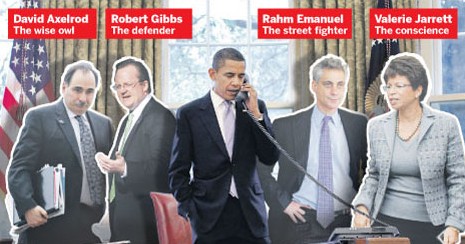
In dozens of interviews with his closest allies and friends in Washington – most of them given unattributably in order to protect their access to the Oval Office – each observes that the president draws on the advice of a very tight circle. The inner core consists of just four people – Rahm Emanuel, the pugnacious chief of staff; David Axelrod and Valerie Jarrett, his senior advisers; and Robert Gibbs, his communications chief.

Two, Mr Emanuel and Mr Axelrod, have box-like offices within spitting distance of the Oval Office. The president, who is the first to keep a BlackBerry, rarely holds a meeting, including on national security, without some or all of them present.

With the exception of Mr Emanuel, who was a senior Democrat in the House of Representatives, all were an integral part of Mr Obama’s brilliantly managed campaign. Apart from Mr Gibbs, who is from Alabama, all are Chicagoans – like the president. And barring Richard Nixon’s White House, few can think of an administration that has been so dominated by such a small inner circle.

Steve Clemons, who provides an extended analysis of the FT piece, comments that unless Obama swiftly installs a Team B, “the Obama brand will be totally bust in the very near term.”

Facebooktwittermail

Off with his head!

Matthew Yglesias writes:

If the President wants to do something like implement a domestic policy proposal he campaigned on—charge polluters for global warming emissions, for example—he faces a lot of hurdles. He needs majority support on a House committee or three. He also needs majority support on a Senate committee or three. Then he needs to get a majority in the full House of Representatives. And then he needs to de facto needs a 60 percent supermajority in the Senate. And then it’s all subject to judicial review.

But if Scooter Libby obstructs justice, the president has an un-reviewable, un-checkable power to offer him a pardon or clemency. If Bill Clinton wants to bomb Serbia, then Serbia gets bombed. If George W Bush wants to hold people in secret prisons and torture them, then tortured they shall be. And if Barack Obama wants to issue a kill order on someone or other, then the order goes out. And if Congress actually wants to remove a president from office, it faces extremely high barriers to doing so.

Whether or not you approve of this sort of executive power in the security domain, it’s a bit of a weird mismatch. You would think that it’s in the field of inflicting violence that we would want the most institutional restraint. Instead, the president faces almost no de facto constraints on his deployment of surveillance, military, and intelligence authority but extremely tight constraint on his ability to implement the main elements of the his domestic policy agenda.

This kind of presidential power looks “weird” if viewed from a constitutional vantage point but maybe not as weird as an expression of American culture.

Having moved to this country twenty years ago from the country that America successfully wrestled its independence from, it’s often struck me that Americans did not fully reject the concept of monarchical rule; they simply wanted a kind of modified monarchy.

First off, the monarch would need to be a native — a vehement “no” to foreign rule.

Next, the monarch would need to be one of the people, be elected and not restricted to a line of inheritance. It wasn’t that Americans did want a king; they simply wanted everyone to be able to nurture the fantasy that some day they too might become the king.

But dynasties are OK. In fact, the occasional dynasty helps burnish the executive’s regal image.

And what’s more befitting of the powers of an American king than that he should be able to occasionally proclaim: “Off with his head!”

Who knows, maybe in a few years the old regal custom of hosting public executions will be re-instituted. No doubt they’d get excellent ratings on cable news.

Facebooktwittermail

Murder with impunity

Glenn Greenwald writes:

… even if you’re someone who does want the President to have the power to order American citizens killed without a trial by decreeing that they are Terrorists (and it’s worth remembering that if you advocate that power, it’s going to be vested in all Presidents, not just the ones who are as Nice, Good, Kind-Hearted and Trustworthy as Barack Obama), shouldn’t there at least be some judicial approval required? Do we really want the President to be able to make this decision unilaterally and without outside checks? Remember when many Democrats were horrified (or at least when they purported to be) at the idea that Bush was merely eavesdropping on American citizens without judicial approval? Shouldn’t we be at least as concerned about the President’s being able to assassinate Americans without judicial oversight? That seems much more Draconian to me.

It would be perverse in the extreme, but wouldn’t it be preferable to at least require the President to demonstrate to a court that probable cause exists to warrant the assassination of an American citizen before the President should be allowed to order it? That would basically mean that courts would issue “assassination warrants” or “murder warrants” — a repugnant idea given that they’re tantamount to imposing the death sentence without a trial — but isn’t that minimal safeguard preferable to allowing the President unchecked authority to do it on his own, the very power he has now claimed for himself? And if the Fifth Amendment’s explicit guarantee — that one shall not be deprived of life without due process — does not prohibit the U.S. Government from assassinating you without any process, what exactly does it prohibit?

Greenwald makes a series of excellent points but I would add one major point that really should come in front of the whole discussion: the idea that a legal distinction should be made between American citizens and non-Americans is a thoroughly un-American idea.

The Declaration of Independence does not say:

We hold these truths to be self-evident, that all Americans are created equal, that they are endowed by their Creator with certain unalienable Rights, that among these are Life, Liberty and the pursuit of Happiness.

It didn’t say “Americans”, it said “all men” — a declaration of what were taken to be universal human values.

To be concerned about whether the president has claimed to right to murder Americans is really missing the point. What in practice this and the former president are doing is not exercising any kind of specially fabricated legal right; they are committing murder exclusively where they believe they can get away with it.

Assassinations taking place in the tribal areas of Pakistan, in Yemen and Somalia, are all occurring in environments whose lawlessness means that US government officials can be reliably confident that they can act with relative legal impunity.

Facebooktwittermail

‘It’s better to join the Taliban; they pay more money.’


When President Obama announced his 30,000-strong troop surge in December he said: “these additional American and international troops will allow us to accelerate handing over responsibility to Afghan forces and allow us to begin the transfer of our forces out of Afghanistan in July of 2011.”

It was another example of what has become all too familiar: Obama’s ability to govern like Bush without sounding exactly like Bush. He might as well have simply reused Bush’s line and said: “As Afghan forces stand up, we will stand down.” The difference in language is trivial. The real difference between now and 2005 when Bush said that in reference to Iraqi forces is that it turns out Bush’s objective was a bit more realistic.

Consider Rod Nordland’s portrayal or the way the Afghan National Police force is shaping up:

The NATO general in charge of training the Afghan police has some tongue-in-cheek career advice for the country’s recruits.

“It’s better to join the Taliban; they pay more money,” said Brig. Gen. Carmelo Burgio, from Italy’s paramilitary Carabinieri force.

That sardonic view reflects a sobering reality. The attempts to build a credible Afghan police force are faltering badly even as officials acknowledge that the force will be a crucial piece of the effort to have Afghans manage their own security so American forces can begin leaving next year.

Though they have revamped the program recently and put it under new leadership, Afghan, NATO and American officials involved in the training effort list a daunting array of challenges, as familiar as they are intractable.

One in five recruits tests positive for drugs, while fewer than one in 10 can read and write — a rate even lower than the Afghan norm of 15 percent literacy. Many cannot even read a license plate number. Taliban infiltration is a constant worry; incompetence an even bigger one.

Now consider this description of the resistance that US Marines are facing in Helmand Province:

In areas where they have built bases, the Marines have undermined the Taliban’s position. But the insurgents have consolidated and adapted, and remain a persistent and cunning presence.

On the morning of the sweep, made by Weapons Company, Third Battalion, First Marines, a large communications antenna that rose from one compound vanished before the Marines could reach it. The man inside insisted that he had seen nothing. And when the Marines moved within the compounds’ walls, people in nearby houses released white pigeons, revealing the Americans’ locations to anyone watching from afar.

The Taliban and their supporters use other signals besides car horns and pigeons, including kites flown near American movements and dense puffs of smoke released from chimneys near where a unit patrols.

“You’ll go to one place, and for some reason there will be a big plume of smoke ahead of you,” said Capt. Paul D. Stubbs, the Weapons Company commander. “As you go to the next place, there will be another.”

“Our impression,” he added, “is the people are doing it because they are getting paid to do it.”

The people are getting paid… right.

You don’t have to be a Holywood screenwriter to see this description — the smoke signals, pigeon alerts and so forth — as a classic image of resistance. The foreign fighters are better armed, but the resistance fighters have the home-turf advantage — they’re being protected by the civilian population. Do the civilians have to get paid for their services? Conceivably, but I kind of doubt it. More likely it simply comes down to knowing who are “our boys”.

Facebooktwittermail

Which is more dangerous: reckless or clueless?

When Obama took office, many citizens of this nation (including me) let out a sigh of relief, comforted by the thought that a reckless fool had been replaced a calm and sometimes inspiring realist.

How can a year seem like such a long time ago?

Engagement turned out to a piece of campaign pap that fizzled out when the administration discovered that face-to-face contact with Americans does not in the eyes of America’s adversaries have the irresistible appeal it was supposed to have. When you come to the table a smile and a handshake turns out not to be enough.

So what’s Obama’s fallback plan when it comes to confronting Iran?

First we should note that Obama never really challenged the Bush/neocon paradigm in the first place: confrontation with Iran.

Now, since talks went nowhere we’re into the phase escalation: Obama ditched the European missile defense plans (which might have been a smart way of placating the Russians) but now he’s sending in Patriot missiles to be positioned right on Iran’s doorstep. The New York Times reports:

“Our first goal is to deter the Iranians,” said one senior administration official. “A second is to reassure the Arab states, so they don’t feel they have to go nuclear themselves. But there is certainly an element of calming the Israelis as well.”

Adhmadinejad, on the other hand, promises a February 11 “telling blow to global powers.” What kind of blow? I predict it’ll be something symbolic and not quite as dramatic as his language suggests, but who knows.

Meanwhile, Gen James Jones, Obama’s national security adviser, has warned that Iran might lash out at Israel through its surrogates, Hezbollah and Hamas.

Sorry, but this is exactly the kind of regurgitated conventional wisdom we should expect from a man who gives every appearance of functioning on autopilot.

Did Jones happen to hear Lebanon’s Prime Minister Saad Hariri warn last week that an attack on Hezbollah by Israel would be viewed as an attack on Lebanon? This from the poster-boy of the Cedar Revolution which five years ago was taken by the Bush administration as the herald of democracy spreading across the Middle East.

What’s my point? Hariri, who might view Hezbollah warily nevertheless recognizes that it is not an Iranian surrogate waiting to be unleashed on Israel. The Islamist party’s primary focus is on its own domestic constituency and the wider interests of Lebanon.

If a war with Iran was to erupt, would Hezbollah and Hamas have a role? Quite likely, but that doesn’t mean that these groups are sitting around awaiting their commands from masters in Tehran. They have their own political agendas that are not subordinate to the interests of the Iranians.

And if my comments about Jones sound harsh, just watch his keynote address at the J Street conference in October last year where he said: “Of all the problems the administration faces globally, that if there was one problem that I would recommend to the president that if he could do anything he wanted, he could solve one problem, this [the Israeli-Palestinian conflict] would be it.”

Ah, if only he was in a position to make such a recommendation. If only he had the president’s ear…

If only Obama’s push for Middle East peace hadn’t turned out to epitomize a wasted year in office.

General Jim Jones, President Obama’s National Security Advisor, addresses J Street’s first national conference from Isaac Luria on Vimeo.

Facebooktwittermail

Covering up homicide

In his State of the Union speech, President Obama said: “… in the last year, hundreds of al Qaeda’s fighters and affiliates, including many senior leaders, have been captured or killed — far more than in 2008.”

He could have said “we have killed…” just to make it clear that he includes himself as an actor, not an observer, in the killing process. And he could also have said “and we killed a bunch of innocent bystanders as well.” But maybe when it comes to al Qaeda, there is in Obama’s mind no such person as an innocent bystander. Maybe the children, wives and grandparents are “affiliates”.

In Pakistan the concept of an innocent bystander has not been abandoned and what Obama touts as great success is perceived as an ongoing unrelenting massacre.

Here are some of the latest damning numbers – numbers that no doubt many an American journalist will hesitate to report because they haven’t been confirmed by the holiest of sources, the Pentagon:

Afghanistan-based US predators carried out a record number of 12 deadly missile strikes in the tribal areas of Pakistan in January 2010, of which 10 went wrong and failed to hit their targets, killing 123 innocent Pakistanis. The remaining two successful drone strikes killed three al-Qaeda leaders, wanted by the Americans.

The rapid increase in the US drone attacks in the Pakistani tribal areas bordering Afghanistan can be gauged from the fact that only two such strikes were carried out in January 2009, which killed 36 people. The highest number of drone attacks carried out in a single month in 2009 was six, which were conducted in December last year. But the dawn of the New Year has already seen a dozen such attacks.

Note that all of these Predator attacks came after the CIA team widely reported as having been responsible for Predator targeting had been killed in the Khost bombing.

Now if it became known that the US government was responsible for sending gunmen into restaurants where mafia-style they left their targets riddled with bullets in front of horrified onlookers, even if there were no innocent bystanders killed, there would be public outrage. The government would be accused of having stooped to using the methods of gangsters.

Instead, we fire missiles, destroy the restaurant and kill everyone in it and even if it turns out the target had already left, somehow it’s OK. It was an innocent mistake. It happened in a distant country. We’ll never hear the names of the dead.

Facebooktwittermail

Israel is very pleased with the cage in which it has trapped Obama

Zvi Bar’el in Haaretz:

Speeches, so it turns out, are an excellent substitute for policy. There’s no solution to the problem of radical Islam? Talk about reaching out in friendship to moderate Islam. The Israeli-Palestinian conflict is stuck? Talk about the legitimate rights of the Palestinians. The war on Al-Qaida is not progressing? Speak of building a nation in Afghanistan. Iran is being impudent? Issue an elegant warning. Wait a year. Let it be forgotten and then make another speech. Erase all that did not succeed, bypass the major crises and continue on to the next year.

Indeed, President Barack Obama’s State of the Union address reveals that what stirred the world’s imagination during the past year, what led to his being awarded the Nobel Peace Prize, what caused sandstorms in Middle Eastern and Muslim states and sowed terror in Israel – simply popped like a bubble. Not a single word on the Middle East peace process. Only a restrained “promise” to Iran’s leaders of “growing consequences.” No new outstretched arm to moderate Islam. A word about human rights? Nothing. Just let us make it through the year in peace.

The great vision came down to local politics. To fighting against tribes, gangs, or, in the case of Israel, nationalist parties. Whoever thought that Obama would fulfill the message of Arab-Israeli peace can, like Obama, kick himself for nurturing lofty expectations. But if Obama can chalk up his meager achievements in the Middle Eastern marketplace to inexperience – as if every U.S. president has to reinvent the wheel – that doesn’t absolve the Israelis from paying the bill.

Gideon Levy:

Looking at the way the right acts makes one go green with envy and want to learn from them. Four hundred criminal cases opened against opponents of the 2005 Gaza Strip disengagement, people who threw oil, acid, garbage and stones at soldiers and police, were closed last week and their criminal record expunged. Fifty-one MKs voted in favor of the closure, nine against. That is the true map of Israeli politics (and society). Only about seven percent of the lawmakers believed that this was a worthless and dangerous decision. All the rest agreed with it, or did not bother to vote or take an interest.

Neither did anyone think to apply a similar rule to 800 protesters against Operation Cast Lead, who were arrested and charged, perhaps because they are Arabs, nor to the dozens arrested for protesting in the East Jerusalem neighborhood of Sheikh Jarrah, perhaps because they are leftists. Left-wing demonstrators never acted as violently as the settlers do, but no one thinks about pardoning them. Not even a semblance of equality before the law, not even the appearance of justice for all – that is unnecessary in a place where public shame no longer exists.

Robert Fisk:

Area C doesn’t sound very ominous. A land of stone-sprinkled grey hills and soft green valleys, it’s part of the wreckage of the equally wrecked Oslo Agreement, accounting for 60 per cent of the Israeli-occupied West Bank that was eventually supposed to be handed over to its Palestinian inhabitants.

But look at the statistics and leaf through the pile of demolition orders lying on the table in front of Abed Kasab, head of the village council in Jiftlik, and it all looks like ethnic cleansing via bureaucracy. Perverse might be the word for the paperwork involved. Obscene appear to be the results.

Palestinian houses that cannot be permitted to stand, roofs that must be taken down, wells closed, sewage systems demolished; in one village, I even saw a primitive electricity system in which Palestinians must sink their electrical poles cemented into concrete blocks standing on the surface of the dirt road. To place the poles in the earth would ensure their destruction – no Palestinian can dig a hole more than 40cm below the ground.

Inside Israeli land grabs, Real News Network:

Uri Avnery:

He hops here and he hops there. Hops to Jerusalem and hops to Ramallah, Damascus, Beirut, Amman (but, God forbid, not to Gaza, because somebody may not like it). Hops, hops, but doesn’t take anything out of his pouch, because the pouch is empty.

So why does he do it? After all, he could stay at home, raise roses or play with his grandchildren.

This compulsive traveling reveals a grain of chutzpah. If he has nothing to offer, why waste the time of politicians and media people? Why burn airplane fuel and damage the environment?

Facebooktwittermail

Why the defense and oil industries must be in love with Iran and al Qaeda

The Obama administration is quietly working with Saudi Arabia and other Persian Gulf allies to speed up arms sales and rapidly upgrade defenses for oil terminals and other key infrastructure in a bid to thwart future military attacks by Iran, according to former and current U.S. and Middle Eastern government officials.

The initiatives, including a U.S.-backed plan to triple the size of a 10,000-man protection force in Saudi Arabia, are part of a broader push that includes unprecedented coordination of air defenses and expanded joint exercises between the U.S. and Arab militaries, the officials said. All appear to be aimed at increasing pressure on Tehran.

The efforts build on commitments by the George W. Bush administration to sell warplanes and antimissile systems to friendly Arab states to counter Iran’s growing conventional arsenal. The United Arab Emirates and Saudi Arabia are leading a regionwide military buildup that has resulted in more than $25 billion in U.S. arms purchases in the past two years alone.

Facebooktwittermail