Category Archives: Obama administration

Obama’s secret prisons

Obama’s secret prisons

One quiet, wintry night last year in the eastern Afghan town of Khost, a young government employee named Ismatullah simply vanished. He had last been seen in the town’s bazaar with a group of friends. Family members scoured Khost’s dust-doused streets for days. Village elders contacted Taliban commanders in the area who were wont to kidnap government workers, but they had never heard of the young man. Even the governor got involved, ordering his police to round up nettlesome criminal gangs that sometimes preyed on young bazaar-goers for ransom.

But the hunt turned up nothing. Spring and summer came and went with no sign of Ismatullah. Then one day, long after the police and village elders had abandoned their search, a courier delivered a neat, handwritten note on Red Cross stationary to the family. In it, Ismatullah informed them that he was in Bagram, an American prison more than 200 miles away. U.S. forces had picked him up while he was on his way home from the bazaar, the terse letter stated, and he didn’t know when he would be freed.

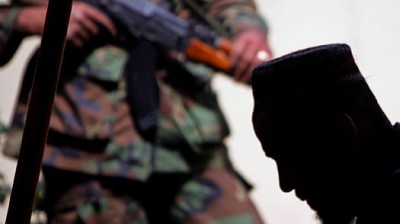
Sometime in the last few years, Pashtun villagers in Afghanistan’s rugged heartland began to lose faith in the American project. Many of them can point to the precise moment of this transformation, and it usually took place in the dead of the night, when most of the country was fast asleep. In the secretive U.S. detentions process, suspects are usually nabbed in the darkness and then sent to one of a number of detention areas on military bases, often on the slightest suspicion and without the knowledge of their families.

This process has become even more feared and hated in Afghanistan than coalition airstrikes. The night raids and detentions, little known or understood outside of these Pashtun villages, are slowly turning Afghans against the very forces they greeted as liberators just a few years ago. [continued…]

Facebooktwittermail

The sanctity of military spending

The sanctity of military spending

In sum, as we cite our debtor status to freeze funding for things such as “air traffic control, farm subsidies, education, nutrition and national parks” — all programs included in Obama’s spending freeze — our military and other “security-related” spending habits become more bloated every year, completely shielded from any constraints or reality. This, despite the fact that it is virtually impossible for the U.S. to make meaningful progress in debt reduction without serious reductions in our military programs.

Public opinion is not a legitimate excuse for this utterly irrational conduct, as large percentages of Americans are receptive to reducing — or at least freezing — defense spending. A June, 2009 Pew Research poll asked Americans what they would do about defense spending, and 55% said they would either decrease it (18%) or keep it the same (37%); only 40% wanted it to increase. Even more notably, a 2007 Gallup poll found that “the public’s view that the federal government is spending too much on the military has increased substantially this year, to its highest level in more than 15 years.” In that poll, 58% of Democrats and 47% of Independents said that military spending “is too high” — and the percentages who believe that increased steadily over the last decade for every group.

The clear fact is that, no matter how severe are our budgetary constraints, military spending and all so-called “security-related programs” are off-limits for any freezes, let alone decreases. Moreover, the modest spending freeze to be announced by Obama tomorrow is just the start; the Washington consensus has solidified and is clearly gearing up for major cuts in Social Security, Medicare and Medicaid, with the dirty work to be done by an independent “deficit commission.” It’s time for “everyone” to sacrifice and suffer some more — as long as “everyone” excludes our vast military industry, the permanent power factions inside the Pentagon and intelligence community, our Surveillance and National Security State, and the imperial policies of perpetual war which feed them while further draining the lifeblood out of the country. [continued…]

Obama liquidates himself

A spending freeze? That’s the brilliant response of the Obama team to their first serious political setback?

It’s appalling on every level.

It’s bad economics, depressing demand when the economy is still suffering from mass unemployment. Jonathan Zasloff writes that Obama seems to have decided to fire Tim Geithner and replace him with “the rotting corpse of Andrew Mellon” (Mellon was Herbert Hoover’s Treasury Secretary, who according to Hoover told him to “liquidate the workers, liquidate the farmers, purge the rottenness”.)

It’s bad long-run fiscal policy, shifting attention away from the essential need to reform health care and focusing on small change instead.

And it’s a betrayal of everything Obama’s supporters thought they were working for. Just like that, Obama has embraced and validated the Republican world-view — and more specifically, he has embraced the policy ideas of the man he defeated in 2008. A correspondent writes, “I feel like an idiot for supporting this guy.” [continued…]

Obama would ‘rather be really good one-term president’

President Obama, buffeted by criticism of his massive health care reform bill and election setbacks, said today he remained determined to tackle health care and other big problems despite the political dangers to his presidency.

“I’d rather be a really good one-term president than a mediocre two-term president,” he told ABC’s “World News” anchor Diane Sawyer in an exclusive interview today. [continued…]

Editor’s Comment — As though he’s in a men’s store trying out a new suit for size, Obama’s trying on the One-Termer — wants to see if he likes the cut.

If as a bold political choice this president was to make a commitment not to run for re-election, that could be a decisive way of breaking free from the stranglehold of powerful interest groups. But with this statement, as in so many others, there’s nothing bold about what Obama is doing.

Bob Herbert, who is clearly clutching hold of the last straws of hope, sees tomorrow’s State of the Union speech as an slim opportunity for the renewal of faith: “Americans want to know what he stands for, where his line in the sand is, what he’ll really fight for, and where he wants to lead this nation. They want to know who their president really is.”

This really is the most damning statement: that after one year Americans have less of a sense of who occupies the White House than they did before he took office – back when he was perceived as an unknown.

The One-Termer — Obama doesn’t need to decide whether it’s a good fit or he can afford it — they’re giving them away for free. Try it on and it’s yours for keeps.

Facebooktwittermail

U.S. mulls legality of killing American al Qaeda “turncoat”

U.S. mulls legality of killing American al Qaeda “turncoat”

White House lawyers are mulling the legality of proposed attempts to kill an American citizen, Anwar al Awlaki, who is believed to be part of the leadership of the al Qaeda group in Yemen behind a series of terror strikes, according to two people briefed by U.S. intelligence officials.

One of the people briefed said opportunities to “take out” Awlaki “may have been missed” because of the legal questions surrounding a lethal attack which would specifically target an American citizen. [continued…]

Editor’s Comment — I’m not a lawyer, but isn’t this the way it works? If someone has an Arabic name, then citizenship is secondary. So long as they are “taken out” overseas, preferably in a state or area with a reputation for lawlessness, then legal process fits comfortably into the tip of a Hellfire missile. Extra latitude is of course provided when the “target” is not white.

But maybe the Justice Department could provide a little extra clarity — some new designations in citizenship status just so everyone understands which American citizens can be executed on the basis of a presidential order and which can’t. As for non-Americans, well, America has always reserved the right to kill them as and when it sees fit.

The drone surge

One moment there was the hum of a motor in the sky above. The next, on a recent morning in Afghanistan’s Helmand province, a missile blasted a home, killing 13 people. Days later, the same increasingly familiar mechanical whine preceded a two-missile salvo that slammed into a compound in Degan village in the tribal North Waziristan district of Pakistan, killing three.

What were once unacknowledged, relatively infrequent targeted killings of suspected militants or terrorists in the Bush years have become commonplace under the Obama administration. And since a devastating December 30th suicide attack by a Jordanian double agent on a CIA forward operating base in Afghanistan, unmanned aerial drones have been hunting humans in the Af-Pak war zone at a record pace. In Pakistan, an “unprecedented number” of strikes — which have killed armed guerrillas and civilians alike — have led to more fear, anger, and outrage in the tribal areas, as the CIA, with help from the U.S. Air Force, wages the most public “secret” war of modern times.

In neighboring Afghanistan, unmanned aircraft, for years in short supply and tasked primarily with surveillance missions, have increasingly been used to assassinate suspected militants as part of an aerial surge that has significantly outpaced the highly publicized “surge” of ground forces now underway. And yet, unprecedented as it may be in size and scope, the present ramping up of the drone war is only the opening salvo in a planned 40-year Pentagon surge to create fleets of ultra-advanced, heavily-armed, increasingly autonomous, all-seeing, hypersonic unmanned aerial systems (UAS). [continued…]

Facebooktwittermail

The meaning of the Eikenberry cables

The meaning of the Eikenberry cables

It was apparent as early as the summer of 2009 that Obama had no political choice but to throw in his lot with Petraeus and McChrystal and the “full-up” commitment of troops. Only a more far-sighted regard for prudence could have drawn him the other way.

And, in fact, Obama went in even faster than the generals asked him to; and he did so, we now can see, in open disregard of the practical wisdom of the Eikenberry cables. He did it on the supposition that the sooner he went in big, the sooner he could get out big. In a flattering article by Peter Baker on the “process” of the troop decision, President Obama was quoted as saying, of a left-to-right time chart of contemplated troop deployments: “I want this pushed to the left.” That is, move them in faster. Make the whole thing fast so we can have a credible ending by 2011. But Ambassador Eikenberry had already told him why “pushing” the graph in this way was a fantasy — a case of wishful thinking to the point of irresponsibility.

It is inconceivable that a president acting on a candid estimate of the commitment he was requiring of his country, would, in response to the Eikenberry cables, finally have bowed to the generals. No one could have done so whose guiding light was prudence and the direction of a wise policy. What drove this decision, instead, was Barack Obama’s desire for an appearance of conventional solidity. He had said so many times that Afghanistan was the right war. How could he unsay it? [continued…]

Facebooktwittermail

Haiti: Obama’s Katrina — and Israel’s mission accomplished

Haiti: Obama’s Katrina

Four years ago the initial medical response to Hurricane Katrina was ill equipped, understaffed, poorly coordinated and delayed. Criticism of the paltry federal efforts was immediate and fierce.

Unfortunately, the response to the latest international disaster in Haiti has been no better, compounding the catastrophe.

On Tuesday, Jan. 12, a major earthquake overwhelmed a country one hour south of Miami whose inhabitants include American citizens and their relatives. Thanks to the Internet, pictures of the death and destruction were familiar to the world within hours, and the need for a massive influx of relief and specialized medical care was instantaneously apparent. While particular fatalities such as head injuries or massive blood loss are rarely treatable in mass casualty situations, delayed deaths from infection may be preventable.

On Wednesday, the day after the quake, we organized a relief team in cooperation with the U.S. State Department and Partners in Health (a Boston-based humanitarian organization) to provide emergency orthopedic and surgical care. We wanted to reach the local hospitals in Haiti immediately—but were only allowed by the U.S. military controlling the local airport to land in Port-au-Prince Saturday night. We were among the first groups there. [continued…]

Israeli team preparing to leave Haiti

The Israeli medical and rescue team in Haiti will finish operations on the devastated island nation in the next few days, according to the Israel Defense Forces.

The team’s members are set to return to Israel by Thursday.

The decision to bring the team home came after the arrival of additional aid forces to Haiti, including military and civilian assistance from the United States that is now providing regular medical services, according to a statement released Monday by the IDF. Local hospitals also are functioning as well. [continued…]

Facebooktwittermail

The return of the neocons

The return of the neocons

Technically, there is nothing “neo” about conservatives like Robert Kagan, the historian and another Washington Post columnist, or John Podhoretz, the editor of Commentary; each is a son of one of neoconservatism’s founding fathers. Indeed, no strain in American politics is so dynastic. It is akin to the right-wing Likud Party in Israel, whose religion and politics, world view, and succession rituals the neocons often share. The definitions, and analogy, are inexact, but both groups have recent ties to Europe and are haunted by the Holocaust, which has left them feeling wounded, suspicious, and sometimes bellicose, determined never again to be naive or to trust the world’s good intentions. Both spent decades in the po-litical wilderness before miraculously acquiring power; both begat “princes” who defied the normal generational tensions and allied themselves with their kingly fathers. When Bill Kristol rose to praise Irving that morning, he was really picking up his scepter.

Had you Googled “neoconservative” and “death” that day, four days after the 89-year-old Kristol expired, you’d have found lots on their long-rumored—and for some, much-anticipated and -savored—demise. On both the left and right, neoconservatism was deemed a spent force. Its ideas, Foreign Policy magazine had pronounced, “lie buried in the sands of Iraq.”

But obituaries can be premature. At the moment, in fact, the neocons seem resurrected. One of their own, Frederick Kagan of AEI (Robert’s younger brother), helped turn around the war in Iraq by devising and pushing for the surge there. More recent-ly, President Obama—whose foreign–policy pronouncements (nuanced, multi-lateral, interdependent) and style (low-key, self-critical, conciliatory, collegial) were a repudiation of neoconservative assertiveness—has swung their way, or so they believe. First, he’s sending an additional 30,000 troops to Afghanistan, nearly as many as leading neocons had sought. Then came his Nobel Prize acceptance speech, which, with its acknowledgment of the need for force, its nod to dissidents in Iran and elsewhere, and its talk about good and evil, was surprisingly congenial.

As if on cue, a Nigerian man with explosives in his crotch nearly brought down an American airliner over Detroit on Christmas Day, leaving the neocons feeling further vindicated and energized. Obama, who’d ratcheted up his rhetoric after an initial response that Bill Kristol and other neocons considered too tepid, had been “mugged by reality,” Kristol declared. It was an obvious homage to his father, who’d long ago defined “neocon” as a liberal to whom just that had happened. “Whether they praise or denounce Obama, the neocons are winning,” says Jacob Heilbrunn, a senior editor at The National Interest and author of They Knew They Were Right: The Rise of the Neocons (2008). “They’ve got him embracing the surge in Afghanistan and on the run for being ‘soft on terrorists.’ Either way, he ends up catering to them.” With Obama further weakened by an electoral repudiation in Massachusetts, that process might only intensify. [continued…]

Obama quietly continues to defend Bush’s terror policies

Although the FBI has acknowledged it improperly obtained thousands of Americans’ phone records for years, the Obama administration continues to assert that the bureau can obtain them without any formal legal process or court oversight.

The FBI revealed this stance in a newly released report, troubling critics who’d hoped the bureau had been chastened enough by its own abuses to drop such a position.

In further support of the legal authority, however, the Justice Department’s Office of Legal Counsel backed the FBI in a written opinion issued this month.

The opinion by the OLC — the section that wrote the memos that justified enhanced interrogation techniques during the last administration — appears to be yet another sign that the Obama administration can be just as assertive as Bush’s in claiming sweeping and controversial anti-terrorism powers. [continued…]

CIA deaths prompt surge in U.S. drone strikes

… officials deny that vengeance is driving the increased attacks, though one called the drone strikes “the purest form of self-defense.”

Officials point to other factors. For one, Pakistan recently dropped restrictions on the drone program it had requested last fall to accompany a ground offensive against militants in South Waziristan. And tips on the whereabouts of extremists ebb and flow unpredictably.

A C.I.A. spokesman, Paul Gimigliano, declined to comment on the drone strikes. But he said, “The agency’s counterterrorism operations — lawful, aggressive, precise and effective — continue without pause.”

The strikes, carried out from a secret base in Pakistan and controlled by satellite link from C.I.A. headquarters in Virginia, have been expanded by President Obama and praised by both parties in Congress as a potent weapon against terrorism that puts no American lives at risk. That calculation must be revised in light of the Khost bombing, which revealed the critical presence of C.I.A. officers in dangerous territory to direct the strikes. [continued…]

Editor’s Comment — The question that the New York Times‘ Washington-based reporters (true to form) fail to address is this: If the Khost bombing killed CIA officers who were critical in choosing the targets for drone attacks, how have subsequent targets been chosen? Are we supposed to believe that right in the aftermath of this huge blow to the CIA’s drone operation, a flood of valuable intelligence swept in?

How convenient… and improbable.

Facebooktwittermail

After the Massachusetts massacre

After the Massachusetts massacre

It was not a referendum on Barack Obama, who in every poll remains one of the most popular politicians in America. It was not a rejection of universal health care, which Massachusetts mandated (with Scott Brown’s State Senate vote) in 2006. It was not a harbinger of a resurgent G.O.P., whose numbers remain in the toilet. Brown had the good sense not to identify himself as a Republican in either his campaign advertising or his victory speech.

And yet Tuesday’s special election was a dire omen for this White House. If the administration sticks to this trajectory, all bets are off for the political future of a president who rode into office blessed with more high hopes, good will and serious promise than any in modern memory. It’s time for him to stop deluding himself. Yes, last week’s political obituaries were ludicrously premature. Obama’s 50-ish percent first-anniversary approval rating matches not just Carter’s but Reagan’s. (Bushes 41 and 43 both skyrocketed in Year One.) Still, minor adjustments can’t right what’s wrong.

Obama’s plight has been unchanged for months. Neither in action nor in message is he in front of the anger roiling a country where high unemployment remains unchecked and spiraling foreclosures are demolishing the bedrock American dream of home ownership. The president is no longer seen as a savior but as a captive of the interests who ginned up the mess and still profit, hugely, from it. [continued…]

The man Obama needs to fix America is … Karl Marx

There is something almost tragi-comic in Hillary Clinton’s use of the Berlin Wall as an analogy for China’s internet censorship. The Chinese Communist Party hardly shares the American view of Cold War history; the implication that unrestrained Googling will bring down authoritarian regimes is unlikely to persuade Beijing that internet censorship is a bad thing.

But while Winston Churchill’s metaphorical “iron curtain” separated western capitalism from the sclerotic planned economies of the socialist world, what lies behind the US secretary of state’s “information curtain” is the world’s most dynamic capitalist economy, providing credit on which the US’s own economy now depends. While the West endures anaemic growth rates and massive unemployment, China’s double-digit stimulus-based recovery is the envy of all.

The transition from third-world agrarian basket case to the world’s second largest economy in just three decades has been overseen by a Communist Party with a monopoly on power and complete dedication to the pursuit of wealth through capitalism. Its response to the recession was to inject hundreds of billions of dollars into infrastructure projects, consumer subsidies and measures to ensure that banks kept on lending.

Despite (indeed, perhaps because of) that programme’s evident success, doom-mongers abound in the western media. China will overheat; its property bubble will burst; it will be dragged down by over-capacity; the absence of democracy will strangle its entrepreneurs. And so on. But these prophecies are not new, and Chinese capitalism has proven remarkably resilient, nurtured by a government that is authoritarian but not unresponsive. [continued…]

Facebooktwittermail

Biden says U.S. will appeal Blackwater case dismissal

Biden says U.S. will appeal Blackwater case dismissal

Vice President Joseph R. Biden Jr. promised Iraqi leaders on Saturday that the United States would appeal the dismissal of manslaughter charges against five Blackwater Worldwide security contractors involved in a deadly shooting here that has inflamed anti-American tensions.

Mr. Biden, tasked by the Obama administration to oversee policy in Iraq, made the statement after a day of meetings with Iraqi leaders that dealt, in part, with a political crisis that has erupted over the March 7 parliamentary elections. American officials view the vote, a barometer of the durability of Iraq’s political system, as a crucial date in American plans to withdraw tens of thousands of combat troops from Iraq by the end of August.

The vice president expressed his “personal regret” for the Blackwater shooting in 2007, in which contractors guarding American diplomats opened fire in a crowded Baghdad traffic circle, killing 17 people, including women and children.

“A dismissal is not an acquittal,” he said after meeting President Jalal Talabani. [continued…]

Facebooktwittermail

Helping the Haitians over there so that we don’t have to help them here

Haiti relocating homeless, port repairs needed

Haitians are fleeing their quake-ravaged capital by the hundreds of thousands, aid officials said Friday, as their government promised to help nearly a half-million more move from squalid camps on curbsides and vacant lots into safer, cleaner tent cities.

Aid officials said some 200,000 people have crammed into buses, nearly swamped ferries and set out even on foot to escape the ruined capital. For those who stay, foreign engineers have started leveling land on the fringes of the city for tent cities, supposedly temporary, that are meant to house 400,000 people. [continued…]

Editor’s Comment — As the US is in the process of sending 20,000 troops to Haiti, one has to wonder how their mission has been conceived. Is this first and foremost what it purports to be, a humanitarian endeavor? Or is the highest priority in the minds of US government planners to prevent a massive exodus? Is this all about helping the Haitians over there so that we don’t have to help them here? Is the Obama administration afraid of being accused of being soft on refugees?

Before there were even any American marines’ boots on the ground, the message from the skies was unambiguous: “Listen, don’t rush on boats to leave the country,” said Raymond Joseph, Haiti’s ambassador in Washington, in a broadcast to homeless and destitute Haitians repeated for hours on end. “If you do that, we’ll all have even worse problems. Because, I’ll be honest with you: If you think you will reach the U.S. and all the doors will be wide open to you, that’s not at all the case. And they will intercept you right on the water and send you back home where you came from.”

To heal Haiti, look to history, not nature

The sound of Haiti’s suffering is deafening now but behind it one can hear already a familiar music begin to play. Haiti must be made new. This kind of suffering so close to American shores cannot be countenanced. The other evening I watched a television correspondent shake his head over what he movingly described as a “stupid death” — a death that, but for the right medical care, could have been prevented. “It doesn’t have to happen,” he told viewers. “People died today who did not need to die.” He did not say what any Haitian could have told him: that the day before, and the day before that, Haiti had seen hundreds of such “stupid deaths,” and, over the centuries, thousands more. What has changed, once again, and only for a time, is the light shone on them, and the volume of the voices demanding that a “new Haiti” must now be built so they never happen again.

Whether they can read or not, Haiti’s people walk in history, and live in politics. They are independent, proud, fiercely aware of their own singularity. What distinguishes them is a tradition of heroism and a conviction that they are and will remain something distinct, apart — something you can hear in the Creole spoken in the countryside, or the voodoo practiced there, traces of the Africa that the first generation of revolutionaries brought with them on the middle passage.

Haitians have grown up in a certain kind of struggle for individuality and for power, and the country has proved itself able to absorb the ardent attentions of outsiders who, as often as not, remain blissfully unaware of their own contributions to what Haiti is. Like the ruined bridges strewn across the countryside — one of the few traces of the Marines and their occupation nearly a century ago — these attentions tend to begin in evangelical zeal and to leave little lasting behind.

What might, then? America could start by throwing open its markets to Haitian agricultural produce and manufactured goods, broadening and making permanent the provisions of a promising trade bill negotiated in 2008. Such a step would not be glamorous; it would not “remake Haiti.” But it would require a lasting commitment by American farmers and manufacturers and, as the country heals, it would actually bring permanent jobs, investment and income to Haiti.

Second, the United States and other donors could make a formal undertaking to ensure that the vast amounts that will soon pour into the country for reconstruction go not to foreigners but to Haitians — and not only to Haitian contractors and builders but to Haitian workers, at reasonable wages. This would put real money in the hands of many Haitians, not just a few, and begin to shift power away from both the rapacious government and the well-meaning and too often ineffectual charities that seek to circumvent it. The world’s greatest gift would be to make it possible, and necessary, for Haitians — all Haitians — to rebuild Haiti. [continued…]

Facebooktwittermail

Gates says Taliban must take legitimate Afghan role

Gates says Taliban must take legitimate Afghan role

The United States recognizes that the Taliban are now part of the political fabric of Afghanistan, Defense Secretary Robert M. Gates said here on Friday, but the group must be prepared to play a legitimate role before it can reconcile with the Afghan government.

That means, Mr. Gates said, that the Taliban must participate in elections, not oppose education and not assassinate local officials. [continued…]

Afghan insurgent outlines peace plan

One of the three main leaders of the Afghan insurgency, mercurial warlord Gulbuddin Hekmatyar, has a long history of switching sides, and once fought against his current Taliban allies.

Now, he has held out the possibility of negotiating with Afghan President Hamid Karzai and outlined a roadmap for political reconciliation, opening what could be the most promising avenue for Mr. Karzai’s effort to peacefully resolve the conflict.

It is far from certain that any talks with Mr. Hekmatyar will begin, let alone succeed. But in contrast to Taliban leader Mullah Omar and allied insurgent chief Sirajuddin Haqqani, who refuse any talks with Kabul as long as foreign troops remain in the country, Mr. Hekmatyar took a much more conciliatory line in a recent video.

“We have no agreement with the Taliban—not for fighting the war, and not for the peace,” said Mr. Hekmatyar, who commands the loyalty of thousands of insurgents. “The only thing that unites the Taliban and [us] is the war against the foreigners.” [continued…]

U.S. ambassador puts brakes on plan to utilize Afghan militias against Taliban

The U.S. ambassador to Afghanistan and senior Afghan officials have resisted moving forward with a bold and potentially risky initiative to support local militias in Afghanistan that are willing to defend their villages against insurgents, according to U.S. officials.

Their concerns have slowed the implementation of a key effort to provide security in places where there are relatively few NATO forces or Afghan police and Army units. U.S. military officials had wanted to get the initiative — developed under the leadership of Gen. Stanley A. McChrystal, the top commander in Afghanistan — off to a quick start this year.

The plan was to take advantage of the emergence of informal village security forces that were taking up arms against outside insurgents. The hope was that the new program could yield thousands of new security forces relatively fast, bridging the gap until more army and police forces could be trained. But before the initiative can be implemented on a broader scale, Ambassador Karl W. Eikenberry must approve the release of more money for it. [continued…]

Facebooktwittermail

Detainees will still be held, but not tried, official says

Detainees will still be held, but not tried, official says

The Obama administration has decided to continue to imprison without trials nearly 50 detainees at the Guantánamo Bay military prison in Cuba because a high-level task force has concluded that they are too difficult to prosecute but too dangerous to release, an administration official said on Thursday.

However, the administration has decided that nearly 40 other detainees should be prosecuted for terrorism or related war crimes. And the remaining prisoners, about 110 men, should be repatriated or transferred to other countries for possible release, the official said, who spoke on the condition of anonymity because he was not authorized to speak about the numbers.

There are just under 200 detainees left at the detention center.

President Obama established the task force shortly after his inauguration last year as part of his administration’s effort to deal with the detainee issues left behind by the Bush administration. It was facing a deadline of Friday to complete its work. [continued…]

Facebooktwittermail

The official response begins

The official response begins

When a cover-up is exposed, nothing is more telling than the first reactions from those who are involved. Do they maintain their stories and face potentially aggravated consequences? Or do they simply remain silent? In making this choice, they often telegraph the depth of their anxiety and concern.

Last night on MSNBC’s Countdown with Keith Olbermann, I focused on the first responses to “The Guantánamo ‘Suicides.’” Colonel Michael Bumgarner, the former commander at Camp America, had sent an email to the Associated Press, the text of which AP confirmed to me, in which he said he would have to get clearance from the Defense Department to speak, but then stated:

This blatant misrepresentation of the truth infuriates me. I don’t know who Sgt. Hickman is, but he is only trying to be a spotlight ranger. He knows nothing about what transpired in Camp 1, or our medical facility. I do, I was there.

This statement merits closer inspection. The first sentence is a classic nondenial denial. It appears on the surface to deny part of the account, but in fact denies nothing. Bumgarner needs to state specifically what allegations he considers inaccurate. His failure to do so is telling. [continued…]

Facebooktwittermail

Obama’s lost senate seat is a victory for Netanyahu

Obama’s lost senate seat is a victory for Netanyahu

The Republican upset in the race for the U.S. Senate seat held for nearly half a century by liberal Edward M. Kennedy reflects a huge victory for opponents of U.S. President Barack Obama – and also for Prime Minister Benjamin Netanyahu.

Scott Brown defeated once-favored Martha Coakley for the Massachusetts seat even after U.S. President Barack Obama rushed to Boston on Sunday to try to save her candidacy.

Over the past nine months, Netanyahu has managed to curb pressure from Obama, who enjoys a Democratic majority in both houses of Congress. Now, however, Obama will be more dependent on the support of his Republican rivals, the supporters and friends of Netanyahu. [continued…]

Facebooktwittermail

Aftershock hits Haiti; U.S. troops guard convoys in Port-au-Prince

Aftershock hits Haiti; U.S. troops guard convoys in Port-au-Prince

A massive aftershock jolted awake thousands of earthquake victims and relief workers in this ravaged capital early Wednesday, sparking new cries of fear and sorrow even as an enormous international aid effort continued. [continued…]

U.S. troops pour into Haiti on aid mission

The U.S. Army arrived to Haiti’s capital in dramatic style on Tuesday, landing on the lawn of the crumpled presidential palace in Black Hawk helicopters to the cheers of Haitians eager for help and more security after last week’s earthquake. [continued…]

US mercenaries set sights on Haiti

We saw this type of Iraq-style disaster profiteering in New Orleans, and you can expect to see a lot more of this in Haiti over the coming days, weeks and months. Private security companies are seeing big dollar signs in Haiti thanks in no small part to the media hype about “looters.” After Katrina, the number of private security companies registered (and unregistered) multiplied overnight. Banks, wealthy individuals, the US government all hired private security. I even encountered Israeli mercenaries operating an armed checkpoint outside of an elite gated community in New Orleans. They worked for a company called Instinctive Shooting International. (That is not a joke). [continued…]

Doctor: misinformation and racism have frozen recovery effort at General Hospital in Port-au-Prince

“Tere are no security issues,” says Dr. Evan Lyon of Partners in Health, reporting from the General Hospital in Port-Au-Prince in Haiti, where 1,000 people are in need of operations. Lyon said the reports of violence in the city have been overblown by the media and have affected the delivery of aid and medical services. [continued…]

Facebooktwittermail

The crime of not “looking backward”

The crime of not “looking backward”

The single biggest lie in War on Terror revisionist history is that our torture was confined only to a handful of “high-value” prisoners. New credible reports of torture continuously emerge. That’s because America implemented and maintained a systematic torture regime spread throughout our worldwide, due-process-free detention system. There have been at least 100 deaths of detainees in American custody who died during or as the result of interrogation. Gen. Barry McCaffrey said: “We tortured people unmercifully. We probably murdered dozens of them during the course of that, both the armed forces and the C.I.A.” Gen. Antonio Taguba said after investigating the Abu Ghraib abuses and finding they were part and parcel of official policy sanctioned at the highest levels of the U.S. Government, and not the acts of a few “rogue” agents: “there is no longer any doubt as to whether the current administration has committed war crimes. The only question that remains to be answered is whether those who ordered the use of torture will be held to account.”

Despite all of this, our media persists in sustaining the lie that the torture controversy is about three cases of waterboarding and a few “high-value” detainees who were treated a bit harshly. That’s why Horton’s story received so little attention and was almost completely ignored by right-wing commentators: because it shatters the central myth that torture was used only in the most extreme cases — virtual Ticking Time Bomb scenarios — when there was simply no other choice. Leading American media outlets, as a matter of policy, won’t even use the word “torture.” This, despite the fact that the abuse was so brutal and inhumane that it led to the deaths of helpless captives — including run-of-the-mill detainees, almost certainly ones guilty of absolutely nothing — in numerous cases. These three detainee deaths — like so many other similar cases — illustrate how extreme is the myth that has taken root in order to obscure what was really done. [continued…]

Facebooktwittermail

Don’t send these, the homeless, tempest-tossed to me

Homeless Haitians told not to flee to U.S.

America has a message for the millions of Haitians left homeless and destitute by last week’s earthquake: Do not try to come to the United States.

Every day, a United States Air Force cargo plane specially equipped with radio transmitters flies for five hours over the devastated country, broadcasting news and a recorded message from Raymond Joseph, Haiti’s ambassador in Washington.

“Listen, don’t rush on boats to leave the country,” Mr. Joseph says in Creole, according to a transcript released by the Pentagon. “If you do that, we’ll all have even worse problems. Because, I’ll be honest with you: If you think you will reach the U.S. and all the doors will be wide open to you, that’s not at all the case. And they will intercept you right on the water and send you back home where you came from.”

Homeland Security and Defense Department officials say they are taking a hard line to avert a mass exodus from the island that could lead to deaths at sea or a refugee crisis in South Florida. Haiti’s capital, Port-au-Prince, is about 700 miles from Miami.

So far, there has been no sign of Haitians trying to flee the island by boat, United States officials say. Nor has there been a mass exodus of Haitians into the neighboring Dominican Republic, except for about 3,000 injured people who are being treated at hospitals just over the Dominican border, officials there say.

But United States officials say they worry that in the coming weeks, worsening conditions in Haiti could spur an exodus. They have not only started a campaign to persuade Haitians to stay put, but they are also laying plans to scoop up any boats carrying illegal immigrants and send them to Guantánamo Bay, Cuba.

Department of Homeland Security officials have also transferred 200 illegal immigrants from the Krome Service Processing Center here — a federal jail for people awaiting deportation — to make room for a possible influx of Haitian migrants.

The State Department has also been denying many seriously injured people in Port-au-Prince visas to be transferred to Miami for surgery and treatment, said Dr. William O’Neill, the dean of the Miller School of Medicine at the University of Miami, which has erected a field hospital near the airport there.

“It’s beyond insane,” Dr. O’Neill said Saturday, having just returned to Miami from Haiti. “It’s bureaucracy at its worse.” [continued…]

Escaping the capital as help is arriving

Wharf Jérémie on this city’s edge was all chaos and destruction on Monday, with upturned shipping containers lying in the sea and pigs foraging on piles of refuse. But for a thousand or more seeking a ride on rickety boats away from the ruined capital, the wharf was a means to something hopeful: escape.

“Our home is destroyed,” said Yanique Verly, 33, who sells vegetables on the street. She waited for a boat to take her and her three children to her home on Haiti’s western coast. “My only hope is to return to my family’s arms.”

Ms. Verly joined thousands of others, as the exodus from the capital accelerated on Monday, by boat, bus, car and truck, in uncertain quest for shelter, fresh water and stability in the countryside. They sought to leave an anarchic city marked by acute shortages of basic goods and aid efforts hampered by bottlenecks and security fears. [continued…]

Facebooktwittermail

The Guantánamo “suicides”: A Camp Delta sergeant blows the whistle

The Guantánamo “suicides”: A Camp Delta sergeant blows the whistle

When President Barack Obama took office last year, he promised to “restore the standards of due process and the core constitutional values that have made this country great.” Toward that end, the president issued an executive order declaring that the extra-constitutional prison camp at Guantánamo “shall be closed as soon as practicable, and no later than one year from the date of this order.” Obama has failed to fulfill his promise. Some prisoners are being charged with crimes, others released, but the date for closing the camp seems to recede steadily into the future. Furthermore, new evidence now emerging may entangle Obama’s young administration with crimes that occurred during the Bush presidency, evidence that suggests the current administration failed to investigate seriously—and may even have continued—a cover-up of the possible homicides of three prisoners at Guantánamo in 2006.

Late in the evening on June 9 that year, three prisoners at Guantánamo died suddenly and violently. Salah Ahmed Al-Salami, from Yemen, was thirty-seven. Mani Shaman Al-Utaybi, from Saudi Arabia, was thirty. Yasser Talal Al-Zahrani, also from Saudi Arabia, was twenty-two, and had been imprisoned at Guantánamo since he was captured at the age of seventeen. None of the men had been charged with a crime, though all three had been engaged in hunger strikes to protest the conditions of their imprisonment. They were being held in a cell block, known as Alpha Block, reserved for particularly troublesome or high-value prisoners. [continued…]

Facebooktwittermail

Iran praises West’s ‘realism’ on nuclear issue

Iran praises West’s ‘realism’ on nuclear issue

Ian on Tuesday welcomed what it called the West’s newfound “realism” on Tehran’s nuclear programme after world powers failed to decide on new sanctions.

China, meanwhile, urged flexibility on the standoff over Iran’s nuclear drive and a return to negotiations.

However, Defence Minister Ahmad Vahidi renewed a warning that Iran’s forces could hit Western warships in the Gulf if it comes under attack over the nuclear standoff.

On the diplomatic front, foreign ministry spokesman Ramin Mehmanparast told reporters: “Speaking of sanctions is repetitive and it is not constructive.

“Some Western countries … should correct their approach and be realistic about our (nuclear) rights. And we feel there are traces of realism to be seen,” he added. [continued…]

China urges flexibility over Iran

China on Tuesday urged flexibility in the standoff over Iran’s nuclear drive, as well as a return to negotiations, after world powers failed to reach a decision on whether to hit Tehran with new sanctions.

“China has all along proposed the proper settlement of the Iran nuclear issue through dialogue and consultation,” foreign ministry spokesman Ma Zhaoxu told reporters.

“We hope relevant parties can enhance consultations, show flexibility and promote the early peaceful solution of the relevant issue in a proper manner.”

Ma was speaking after representatives of six world powers who met in New York on Saturday failed to reach a decision on whether to impose new sanctions on Iran over its long-standing nuclear defiance.

The meeting brought together senior officials from four of the five permanent UN Security Council members — Britain, France, Russia and the United States — as well as Germany.

But the fifth member China, signalling its reluctance to back tougher sanctions pushed by the West, sent a lower-level diplomat, winning praise from Tehran. [continued…]

Facebooktwittermail