
Category Archives: Obama administration

Tackling climate change: America’s failure to lead by example

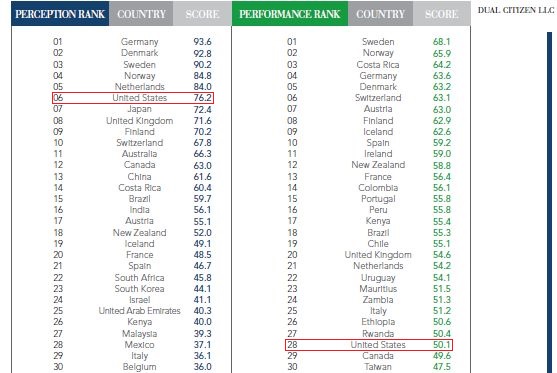
Since 2010, the Global Green Economy Index has been tracking the transition away from fossil-fuel based economies, consider two elements of a green economy: perception and performance. Countries with a high perception score are viewed as environmentally conscious leaders, while performance measures actual investment in green energy, overall infrastructure and development.

In these terms, the U.S. ranks #6 in perception, just behind the leading northern European countries, but #28 in performance, ranking below countries such as Costa Rica, Colombia, Peru, Kenya, Brazil, Chile, Uruguay, Mauritius, Zambia, Ethiopia, and Rwanda.

Global-Green-Economy-Index

China and India are also failing to match performance with perception — China ranks #13 in perception and #55 in performance, while India ranks #16 and #49.

Sweden and Norway stand out in having performance rankings (#1 and #2) that are slightly better than their perception rankings (#3 and #4) — two countries that face the high energy demands created by cold climates, short winter days, and extensive road systems.

Facebooktwittermail

White House-Pentagon friction reveals weakness of coalition against ISIS

Mark Perry writes: When U.S. President Barack Obama appointed retired Marine Gen. John Allen to serve as his special envoy to the global coalition against the Islamic State, the news was greeted with applause from the jihadi group’s greatest enemies. Kurdish and Iraqi Sunni leaders welcomed the appointment, with good reason — these same leaders had requested that Allen, widely known as one of Obama’s favorite generals, be appointed to the position.

But not everyone was pleased, especially at the Pentagon, where top generals had deep misgivings over how Obama had chosen to manage the campaign against the Islamic State.

Among the dissenters was the head of U.S. Central Command, Gen. Lloyd Austin, who took a dim view of Allen’s role. Austin complained to aides that Allen would report directly to the president — bypassing both himself and Gen. Martin Dempsey, the chairman of the Joint Chiefs of Staff. Austin believed that Allen’s appointment would lead to confusion about who was really leading the effort, a senior U.S. officer who serves with Austin told me several days after the appointment. “Why the hell do we need a special envoy — isn’t that what [Secretary of State] John Kerry’s for?” this senior officer asked.

Austin’s private doubts echoed the deep skepticism among a host of serving and retired officers who served in the region, this same senior officer said. [Continue reading…]

The Daily Beast reports: Top military leaders in the Pentagon and in the field are growing increasingly frustrated by the tight constraints the White House has placed on the plans to fight ISIS and train a new Syrian rebel army.

As the American-led battle against ISIS stretches into its fourth month, the generals and Pentagon officials leading the air campaign and preparing to train Syrian rebels are working under strict White House orders to keep the war contained within policy limits. The National Security Council has given precise instructions on which rebels can be engaged, who can be trained, and what exactly those fighters will do when they return to Syria. Most of the rebels to be trained by the U.S. will never be sent to fight against ISIS.

Making matters worse, military officers and civilian Pentagon leaders tell The Daily Beast, is the ISIS war’s decision-making process, run by National Security Adviser Susan Rice. It’s been manic and obsessed with the tiniest of details. Officials talk of sudden and frequent meetings of the National Security Council and the so-called Principals Committee of top defense, intelligence, and foreign policy officials (an NSC and three PCs in one week this month); a barrage of questions from the NSC to the agencies that create mountains of paperwork for overworked staffers; and NSC insistence on deciding minor issues even at the operational level.

“We are getting a lot of micromanagement from the White House. Basic decisions that should take hours are taking days sometimes,” one senior defense official told The Daily Beast.

Other gripes among the top Pentagon and military brass are about the White House’s decision not to work with what’s left of the existing Syrian moderate opposition on the ground, which prevents intelligence sharing on fighting ISIS and prevents the military from using trained fighters to build the new rebel army that President Obama has said is needed to push Syrian President Bashar al-Assad into a political negotiation to end the conflict. [Continue reading…]

Facebooktwittermail

The FBI’s secret House meeting to get access to your iPhone

National Journal reports: The Obama administration is ramping up its campaign to force technology companies to help the government spy on their users.

FBI and Justice Department officials met with House staffers this week for a classified briefing on how encryption is hurting police investigations, according to staffers familiar with the meeting.

The briefing included Democratic and Republican aides for the House Judiciary and Intelligence Committees, the staffers said. The meeting was held in a classified room, and aides are forbidden from revealing what was discussed.

Facebooktwittermail

Only top legislators informed of White House computer attack

Reuters reports: An attack by hackers on a White House computer network earlier this month was considered so sensitive that only a small group of senior congressional leaders were initially notified about it, U.S. officials said on Thursday.

The officials said the Democratic and Republican leaders of the Senate and the House of Representatives and the heads of the Senate and House Intelligence Committees, collectively known as the “Gang of Eight,” were told last week of the cyber attack, which had occurred several days earlier.

Security experts said this limited group would normally be informed about ultra-secret intelligence operations and notifying them of a computer breach in this way was unusual. [Continue reading…]

Facebooktwittermail

U.S., Iran relations move to détente

The Wall Street Journal reports: The Obama administration and Iran, engaged in direct nuclear negotiations and facing a common threat from Islamic State militants, have moved into an effective state of détente over the past year, according to senior U.S. and Arab officials.

The shift could drastically alter the balance of power in the region, and risks alienating key U.S. allies such as Saudi Arabia and United Arab Emirates who are central to the coalition fighting Islamic State. Sunni Arab leaders view the threat posed by Shiite Iran as equal to or greater than that posed by the Sunni radical group Islamic State, also known as ISIS or ISIL.

Israel contends the U.S. has weakened the terms of its negotiations with Iran and played down Tehran’s destabilizing role in the region.

Over the past decade, Washington and Tehran have engaged in fierce battles for influence and power in Iraq, Syria, Lebanon and Afghanistan fueled by the U.S. overthrow of Iraqi strongman Saddam Hussein and the Arab Spring revolutions that began in late 2010. U.S. officials still say the option of military action remains on the table to thwart Iran’s nuclear program.

But recent months have ushered in a change as the two countries have grown into alignment on a spectrum of causes, chief among them promoting peaceful political transitions in Baghdad and Kabul and pursuing military operations against Islamic State fighters in Iraq and Syria, according to these officials.

The Obama administration also has markedly softened its confrontational stance toward Iran’s most important nonstate allies, the Palestinian militant group Hamas and the Lebanese militant and political organization, Hezbollah. American diplomats, including Secretary of State John Kerry , negotiated with Hamas leaders through Turkish and Qatari intermediaries during cease-fire talks in July that were aimed at ending the Palestinian group’s rocket attacks on Israel, according to senior U.S. officials.

U.S. intelligence agencies have repeatedly tipped off Lebanese law-enforcement bodies close to Hezbollah about threats posed to Beirut’s government by Sunni extremist groups, including al Qaeda and its affiliate Nusra Front in Syria, Lebanese and U.S. officials said. [Continue reading…]

Facebooktwittermail

The collapse of order in the Middle East

freemanIn a speech delivered in Washington DC today, Chas Freeman said: Da`ish [ISIS] and the 15,000 foreign jihadis it has attracted are an existential threat to Arab societies and a potential menace to Muslim societies everywhere. Da`ish poses no comparable threat to the United States. Some Americans argue therefore that Da`ish doesn’t matter. A few suggest that, because tight oil and shale gas production is making North America energy self-sufficient, what happens in the Middle East as a whole should also no longer matter much to Americans. But the Persian Gulf is where international oil prices are set. If you doubt this, ask an American tight oil producer what’s happening in today’s energy markets and why. Without stability in West Asia, the global economy is also unstable.

Da`ish aspires not only to destroy the states of the Mashriq – the Arab East – but to conquer their territories and use their resources to mount attacks on the United States, European countries, Russia, and China. It wants to get its hands on the world’s major energy reserves. Its depredations are a current threat only to stability in West Asia, but its recruitment efforts are as global as its aspirations. Quite aside from the responsibility the United States bears for creating the conditions in which this dangerous cult could be born and flourish, Da`ish threatens American interests abroad today. It promises to threaten American domestic tranquility tomorrow. It sees inflicting harm on the West as a central element of its mission.

For all these reasons, Da`ish cannot be ignored by the United States or other nations outside the Middle East. It requires a response from us. But Da`ish must be actively countered first and foremost by those it targets within the region, not by the United States and its Western allies. This means that our response must be measured, limited, and calculated to avoid relieving regional players of the primary responsibility for protecting themselves from the menace to them that Da`ish represents.

Muslims – whether Shiite or Sunni or Arab, Kurd, Persian, or Turk – now have an expanding piece of Hell in their part of the Earth, a growing foulness near the center of Islam. It is almost certainly a greater threat to all of them than they have ever posed to each other. Da`ish will not be contained and defeated unless the nations and sects on its regional target list – Shiite and Sunni alike – all do their part. We should not delude ourselves. The obstacles to this happening are formidable.

Virtually every group now fighting or being victimized in Iraq, Syria, and Lebanon has engaged in or been accused of terrorism by the others. Sectarian violence continues to stoke hatred in the region. The religious animosities between Shi`ites and Sunnis are more intense than ever. The geopolitical rivalry between Iran and the Gulf Arabs remains acute. The political resentments between Turks, Kurds, and Arabs and between Arabs and Persians are entrenched. Each describes the other as part of the problem, not part of the solution.

Unity of command, discipline, and morale are the keys to both military and political success. Da`ish has all three. Its opponents do not. Some are dedicated to the defense of Shiite privilege. Others assign priority to dislodging Shiite or secular authority. Some insist on regime change. Others seek to prevent it. A few support Islamist democratic movements. Others seek to suppress and eradicate them. Some fear terrorism from the victims and enemies of Da`ish more than they fear Da`ish itself. Most treat opposing Da`ish as a secondary strategic objective or a means of enlisting American and other foreign support in the achievement of other priorities, not as their primary aim.

With few exceptions, the states of the region have habitually looked to outside powers for leadership as well as firepower and manpower with which to respond to major security challenges. Despite vast imports of foreign weapons systems, confidence in outside backing has enabled the countries in the region to assume that they could avoid ultimate responsibility for their own defense, relying instead on their ability to summon their American and European security partners in times of crisis. But only a coalition with a strong Muslim identity can hope to contain and shrink Da`ish.

There is no such coalition at present. Every actor in the region has an agenda that is only partially congruent with the Da`ish-related agendas of others. And every actor focuses on the reasons it cannot abide or work with some or all of the others, not on exploring the points it has in common with them. [Continue reading…]

Facebooktwittermail

The crisis in U.S.-Israel relations is officially here

Jeffrey Goldberg writes: The other day I was talking to a senior Obama administration official about the foreign leader who seems to frustrate the White House and the State Department the most. “The thing about Bibi is, he’s a chickenshit,” this official said, referring to the Israeli prime minister, Benjamin Netanyahu, by his nickname.

This comment is representative of the gloves-off manner in which American and Israeli officials now talk about each other behind closed doors, and is yet another sign that relations between the Obama and Netanyahu governments have moved toward a full-blown crisis. The relationship between these two administrations— dual guarantors of the putatively “unbreakable” bond between the U.S. and Israel—is now the worst it’s ever been, and it stands to get significantly worse after the November midterm elections. By next year, the Obama administration may actually withdraw diplomatic cover for Israel at the United Nations, but even before that, both sides are expecting a showdown over Iran, should an agreement be reached about the future of its nuclear program.

The fault for this breakdown in relations can be assigned in good part to the junior partner in the relationship, Netanyahu, and in particular, to the behavior of his cabinet. Netanyahu has told several people I’ve spoken to in recent days that he has “written off” the Obama administration, and plans to speak directly to Congress and to the American people should an Iran nuclear deal be reached. For their part, Obama administration officials express, in the words of one official, a “red-hot anger” at Netanyahu for pursuing settlement policies on the West Bank, and building policies in Jerusalem, that they believe have fatally undermined Secretary of State John Kerry’s peace process.

Over the years, Obama administration officials have described Netanyahu to me as recalcitrant, myopic, reactionary, obtuse, blustering, pompous, and “Aspergery.” (These are verbatim descriptions; I keep a running list.) But I had not previously heard Netanyahu described as a “chickenshit.” [Continue reading…]

Facebooktwittermail

Nobel Peace Prize winners push Obama for release of torture report

Time reports: Twelve winners of the Nobel Peace Prize asked President Barack Obama late Sunday to make sure that a Senate report on the Central Intelligence Agency’s use of harsh interrogation tactics is released so the U.S. can put an end to a practice condemned by many as torture.

The release of the report, which is the most detailed account of the CIA’s interrogation practices in the wake of the Sept. 11, 2001 terrorist attacks, would be an opportunity for the U.S. and the world to come to terms with interrogation techniques that went too far, the laureates said in an open letter and petition. The release of the report by the Senate Select Committee on Intelligence has stalled as the Obama Administration the CIA, and lawmakers clashed over how much of it should be redacted.

American leaders have “eroded the very freedoms and rights that generations of their young gave their lives to defend” by engaging in and justifying torture, the peace prize winners said. The letter was published on TheCommunity.com, a project spearheaded by Peace Prize winner and international peacemaker José Ramos-Horta.

Facebooktwittermail

How congressional hawks plan to kill Obama’s Iran deal

Trita Parsi writes: Negotiations with Iran over the future of its nuclear program have not even concluded yet some members of Congress are preparing to manufacture a political crisis over a deal. Their beef? President Barack Obama may initially bypass Congress and suspend sanctions imposed on Iran to make a deal possible and only later ask lawmakers to end them permanently when it is determined that Iran has complied fully with its obligations under the deal.

Of course, many of the lawmakers complaining about the potential presidential end run voted to give him the right to waive sanctions when they passed sanctions legislation in 2010 and 2011. And, of course, only Congress can lift the sanctions permanently, so there wouldn’t be any circumventing to begin with.

So what’s really going on?

It’s very simple: If you prefer war with Iran over a deal with Iran – even one that would prevent it from building a bomb — your best and possibly last opportunity to kill the deal is immediately after the nuclear talks have concluded. That’s when distrust of Iran’s intentions will remain pervasive and when its commitment to carry out its side of the deal will still have to be demonstrated. Former House Majority Leader Eric Cantor pursued this tactic in January after an interim agreement was reached in November last year. [Continue reading…]

Facebooktwittermail

West waging a ‘CNN war’ in Syria as ISIS makes gains in Iraq

The Telegraph reports: On the barren wastes of Mount Sinjar, the Yazidis are once more surrounded and fighting for their lives.

“We saw Isil, there are daily clashes with Isil. Today and yesterday there was heavy fighting,” said one stranded Yazidi man, Dre’i Shamo, last week. “The situation is very tragic and critical.”

Further south, the advance of the jihadists of Islamic State of Iraq and the Levant on Baghdad continues, slower than before but still with no sign of a reversal of fortune. Another district fell last week, after a major military base the week before, while scores more innocent civilians have died in a rise in bombings in the city itself.

The jihadists have also reached Ramadi, the capital of Anbar province and the last major city in western Iraq not in Isil’s hands.

The world’s attention has been focused on the medium-sized Kurdish town of Kobane, on the Syria-Turkey border, whose accessibility has provided countless opportunities for telegenic news coverage of American air strikes, which have multiplied in size and number. But Kobane is a secondary focus of the war that has been waging in Syria for more than three years; and that war is itself supposed to be secondary in strategic heft for America and its allies, including Britain.

They have deemed Iraq the first target of the fight against Isil. Yet the number of air strikes in supposedly less significant Syria has now reached double that in Iraq, as America and its allies seek to bolster Kobane’s defences.

Analysts and some Iraqis now wonder whether President Barack Obama’s declared strategy in the Middle East has been abandoned in favour of pursuing a short-term agenda dictated by the news agenda: that the “CNN factor was at play”, as Ben Barry, a former British Army brigadier, put it after compiling a detailed analysis of the military situation in Iraq.

Isil may even have drawn the West into a trap – pouring second-grade but eager foreign recruits into the battle for Kobane, while pursuing their more important goals next door, he said.

“Kobane is right against the border,” he told The Telegraph. “It may be that Isil deliberately took the decision to attack there to draw US air power away from Anbar.” [Continue reading…]

Facebooktwittermail

Syrian rebels plead for U.S. military help as Assad forces close on Aleppo

McClatchy reports: Rebels opposed to President Bashar Assad called Friday for help from the U.S.-led coalition fighting the Islamic State, saying the Syrian military is close to encircling the city of Aleppo and cutting off rebel supply routes to Turkey.

In a statement, the Syrian Opposition Coalition, once hailed by the United States as the only legitimate representative of the Syrian people, called for U.S. assistance, warning of dire results if Assad’s forces are able to seize the town of Handarat, just north of the Aleppo city limits. That would cut the Castello road, which is the only route in and out of the rebel-held eastern portion of Aleppo, essentially trapping the rebel forces.

Whether the U.S. would even consider assisting the rebels, however, is unclear. A senior military official in the United States said the U.S. military had received similar requests in the past but that he did not know if this specific one had been received. U.S. officials have said that the battle against the Islamic State and not the fight to topple Assad is their current priority. [Continue reading…]

Facebooktwittermail

Obama administration gave cold shoulder to Israeli defense minister

Ynet reports: The US administration prevented Defense Minister Moshe Ya’alon from meeting with key officials during his visit to Washington, DC, American sources told Ynet on Friday.

The defense ministry did not comment, though sources close to Ya’alon said “the aim was to meet with the security echelon, and that was what happened.”

Ya’alon arrived on Tuesday to meet his counterpart, Secretary of Defense Chuck Hagel, and American intelligence officials. The Obama administration, however, refused the Israeli defense minister’s request to meet with other top officials, including Vice President Joe Biden, Secretary of State John Kerry, and the National Security Advisor Susan Rice.

The rejection was diplomatic blowback from Ya’alon’s remarks on Kerry, which were first revealed by Yedioth Ahronoth. The Israeli politician had called the top US diplomat “messianic and obsessive” behind closed doors, adding that “the only thing that could save us is Kerry winning a Nobel Peace Prize and leaving us alone.”

Unlike his predecessor in the job, Ehud Barak – who used to make diplomatic overtures during his Washington visits – the US administration refused to set any such meetings for Ya’alon. [Continue reading…]

Facebooktwittermail

How America’s top military leader dragged Obama back into Iraq

Mark Perry writes: Apart from an occasional Thursday afternoon meeting between Barack Obama and Defense Secretary Chuck Hagel at the White House, Gen. Martin Dempsey — the chairman of the Joint Chiefs of Staff — rarely has opportunities to get face time with the president. So when he does, he presses his advantage. One of the few times this happened was during the early evening hours of Aug. 6, when Dempsey joined Obama in his limousine at the State Department, where the president had been attending a session of the U.S.-Africa Leaders Summit. The ride to the White House allowed Dempsey his first one-on-one with Obama in several weeks. As the two sat across from each other in the presidential limousine, Dempsey turned to his commander-in-chief.

“We have a crisis in Iraq, Mr. President,” Dempsey said, according to a senior Pentagon official who spoke with the chairman about his discussion with Obama that same day. “ISIS is a real threat,” he added, using an alternative acronym for the military group the Islamic State in Iraq and the Levant, or ISIL. The senior Pentagon official with whom I spoke, and who paraphrased the Obama-Dempsey exchange, added that “Dempsey really leaned into him” on the crisis, saying it demanded “immediate attention.”

By that point, ISIL had overrun Mosul, a city of one million people in northern Iraq, seized stockpiles of heavy weapons from the hapless Iraqi military and was attacking thousands of ethnic Yazidis who had fled the conflict. According to the senior Pentagon official, the president listened carefully as Dempsey outlined the militants’ rapid military gains in western Iraq and warned that ISIL fighters were threatening Baghdad. “It’s that bad?” Obama asked, according to this person’s account. Dempsey was blunt. “Yes, sir,” he said, “it is.” (The White House, asked to characterize the president’s reaction, declined to comment.) [Continue reading…]

Facebooktwittermail

ISIS keeps up Syrian oil flow despite U.S-led strikes

Reuters reports: Islamic State is still extracting and selling oil in Syria and has adapted its trading techniques despite a month of strikes by U.S.-led forces aimed at cutting off this major source of income for the group, residents, oil executives and traders say.

While the raids by U.S. and Arab forces have targeted some small makeshift oil refineries run by locals in eastern areas controlled by Islamic State, they have avoided the wells the group controls.

This has limited the effectiveness of the campaign and means the militants are able to profit from crude sales of up to $2 million a day, according to oil workers in Syria, former oil executives and energy experts.

Facebooktwittermail

As U.S. attacks ISIS, Syria steps up assaults on moderate rebels

The Washington Post reports: Syrian government forces have dramatically intensified air and ground assaults on areas held by moderate rebels, attempting to deliver crippling blows as world attention shifts to airstrikes by a U.S.-led coalition against Islamic State militants in Iraq and Syria.

Since Monday, Syrian aircraft have targeted Aleppo in the north, the eastern suburbs of Damascus and southern areas near the Jordanian border, launching more than 210 airstrikes, said Rami Abdulrahman of the Britain-based Syrian Observatory for Human Rights, a group that monitors the civil war.

Rebels in Aleppo say President Bashar al-Assad’s military has escalated attacks in northern areas of the city, trying to cut the supply lines of opposition fighters inside Aleppo.

“During the last three days, we have been hit by over 120 barrel bombs,” said Ahmed Abu Talal, a rebel belonging to the Islamic Front group, referring to particularly deadly high-explosive bombs that are often dropped by helicopter. [Continue reading…]

Facebooktwittermail

Turkey’s president steps up criticism of U.S. airdrops to aid Kuridish fighters in Syria

The Washington Post reports: Turkey’s president sharpened criticism of U.S. airdrops to aid Syrian Kurdish fighters battling the Islamic State, but promised on Thursday that Kurdish reinforcements would soon arrive in the embattled border town of Kobane.

The dual messages from President Recep Tayyip Erdogan reflect the complicated political calculations for Turkey as part of the U.S.-led coalition seeking to cripple the Islamic State in Iraq and Syria.

Turkey is wary of the Syrian Kurds defending Kobane — just miles from the Turkish border — because of their ties to a Kurdish faction in Turkey that has waged a three-decade insurgency for greater rights. The U.S. airdrops of weapons and ammunition to Kobane is seen by Turkey as indirectly empowering the Turkish Kurdish rebels.

But NATO-member Turkey also is nervous that Kobane could fall to the Islamic State, which would gain another foothold along the Turkish border and possibly expand attacks on Turkish forces and targets. [Continue reading…]

Facebooktwittermail

As more U.S. airstrikes hit ISIS, Assad escalates bombing across Syria

BBC News reports: The Syrian military has stepped up air strikes on rebel areas dramatically, carrying out more than 200 in recent days, opposition activists say.

The Syrian Observatory for Human Rights said the raids took place mostly in western areas between midnight on Sunday and noon on Tuesday.

The UK-based group said there were many casualties, but did not give a figure.

The intensified strikes come as US-led forces continue to bomb Islamic State (IS) militants in Syria and Iraq.

US and Arab jets have been attacking IS positions in around the northern Syrian town of Kobane, where Kurdish fighters are under siege. [Continue reading…]

Facebooktwittermail

America’s failure in Afghanistan

Edward Girardet writes: The American-led invasion and occupation of Afghanistan is proving to be a failure. Against the advice of experienced diplomats, aid workers, journalists, and other analysts at the time, Washington’s decision to invade the country in October 2001 in a “war on terrorism” ignored basic realities as well as history. A top-down military approach exhibiting often astounding hubris hindered efforts to implement a more modest—and savvy—long-term development strategy that could have ameliorated a conflict that was already in its twenty-second year when U.S. and coalition forces intervened. It has been a costly thirteen-year involvement in lives and resources, with very little to show in the way of resolving Afghanistan’s problems. America’s war in Afghanistan may be as undistinguished as the failed Soviet occupation from 1979 to 1989. Everything now depends on the ability of the Afghan army, police, and militia to hold their own—and whether the country will succeed in producing a thriving economy based on its own sweat and with a credible, broad-based political system.

Given the overwhelmingly artificial nature of Afghanistan’s post-2001 economy, which has enriched more than a few U.S. security companies plus various Afghan politicians, warlords, and other members of the privileged elite, military downsizing is bound to be devastating to Afghan pocketbooks. In 2011, at the height of Operation Enduring Freedom, as Washington dubbed its involvement, the military occupation of Afghanistan, run by the North Atlantic Treaty Organization (NATO), stood at over 140,000 troops operating out of 800-odd bases throughout the country. Kandahar in the southeast, Bagram north of Kabul, and Camp Bastion in Helmand had become three of the world’s busiest military airfields: they handled hundreds of daily transport flights to Europe, the Middle East, and offshore aircraft carriers, as well as helicopter sorties against the Taliban and other insurgents.

By the end of 2013, the departure of the International Security Assistance Force (ISAF) incorporating forty-eight foreign armies, mainly from NATO, but also from countries such as Australia, Tonga, and Jordan, was well under way. Troops and equipment were being flown out daily, while ISAF and related military organizations had terminated most logistical contracts with private local and foreign companies. An indication of just how dependent Afghanistan had become on outside funding, this put more than 100,000 Afghans out of work and eliminated crucial income for up to two million dependents. [Continue reading…]

Facebooktwittermail
