Category Archives: Donald Trump

White House advisors called Ottawa to urge Trudeau to help talk Trump down from scrapping NAFTA

National Post reports: White House staff called the Prime Minister’s Office last month to urge Justin Trudeau to persuade President Donald Trump not to tear up the North American Free Trade Agreement, according to multiple Canadian government sources.

The unconventional diplomatic manoeuvre — approaching the head of a foreign government to influence your own boss — proved decisive, as Trump thereafter abandoned his threat to pull out of NAFTA unilaterally, citing the arguments made by Trudeau and Mexican President Enrique Pena Nieto as pivotal.

But the incident highlights the difficulties faced by governments all over the world when it comes to dealing with a president as volatile as Trump. [Continue reading…]

Facebooktwittermail

Trump wants a new Afghan surge. That’s a terrible idea

Douglas Wissing writes: Afghanistan today remains the largest U.S. military foreign engagement. From the peak of about 100,000 boots on the ground during the Obama-era surge, there are still almost 10,000 U.S. troops in Afghanistan, plus up to 26,000 highly paid contractors for the Department of Defense and other agencies. Each soldier costs about a million dollars a year. Economists estimate the Afghan war has already cost U.S. taxpayers around a trillion dollars. For the 2017 fiscal year, U.S. military and State Department operations in Afghanistan are costing about $50 billion—almost a billion dollars a week. (As a reference, the initial budget request for operations against ISIS in Syria was only $5 billion.)

Now the U.S. military is re-escalating in Afghanistan. The Marines are back in Helmand Province. In April, the Pentagon requested “a few thousand” more troops, since upped to 5,000. The booms are getting bigger, too. On April 15th, U.S. forces dropped the 22,000-pound MOAB, the largest non-nuclear bomb in the arsenal, on ISIS fighters in eastern Afghanistan. It is Surge 2.0.

As the Pentagon requests more troops and drops more and bigger bombs, it’s important to assess the dangers of another surge. And to consider whether another U.S. escalation can turn around an unwinnable war. Will Surge 2.0 be consequential, relevant, sustainable? Or will it be another futile chapter in an unwinnable war? [Continue reading…]

Facebooktwittermail

A case study in extremism inside the White House

Peter Maass writes: Steve Bannon, who is no stranger to controversy, faced a torrent of reproval when it was revealed not long ago that he had praised a detestable novel envisioning France invaded by an armada of brown-skinned migrants from India. The French novel is called “The Camp of the Saints,” and Bannon recommended it on several occasions when he was executive chairman of Breitbart News, to justify what he perceived as a mortal threat that whites face from immigration.

The book, published in the 1970s, had existed for decades as an obscure cornerstone of the utmost fringes of white racism. The Indian children in the novel were referred to as “little monsters,” and the adults were described as sexual maniacs who filled their ships with “rivers of sperm, streaming over bodies, oozing between breasts, and buttocks, and thighs, and lips, and fingers.” The novel ended with hundreds of thousands of them taking over France and, by extension, the West. When it came out in the United States, Kirkus Reviews noted that “the publishers are presenting ‘The Camp of the Saints’ as a major event, and it probably is, in much the same sense that Mein Kampf was a major event.”

Bannon, now a senior adviser to President Donald Trump, made his glowing comments during radio programs he hosted in 2015 and 2016. But his comments were brief and in passing. The most enthusiastic endorsement of the book from anyone at Breitbart, and certainly the longest endorsement, came from a young reporter who wrote a gushing 4,000-word article that said “all around the world, events seem to be lining up with the predictions of the book.” The article, which neglected to mention that “The Camp of the Saints” is widely regarded as utterly racist, merely described it as controversial, and made conspiratorial parallels between its fictional characters and Pope Francis, Marco Rubio, and even Glenn Beck.

The Breitbart reporter was Julia Hahn, a Bannon protégé who followed him into the White House as a special assistant to President Trump. Bannon and other alt-right figures in the West Wing, including Sebastian Gorka, have received enormous amounts of criticism for espousing ideas that are seen as racist or ridiculous. Gorka is reported to be leaving the White House, and there have been reports that Bannon might be edged out, too. But Hahn has gotten almost no notice for writing what appears to be the longest and most laudatory article about “The Camp of the Saints” that has appeared in the American media in recent years. The few in-depth stories about her getting a job at the White House have mostly focused on her lashing criticism of Paul Ryan, the House speaker whose conservative positions on immigration were far too permissive for Bannon, Hahn, and the rest of Breitbart. [Continue reading…]

Facebooktwittermail

How democracy gets hijacked

Carole Cadwalladr writes: In June 2013, a young American postgraduate called Sophie was passing through London when she called up the boss of a firm where she’d previously interned. The company, SCL Elections, went on to be bought by Robert Mercer, a secretive hedge fund billionaire, renamed Cambridge Analytica, and achieved a certain notoriety as the data analytics firm that played a role in both Trump and Brexit campaigns. But all of this was still to come. London in 2013 was still basking in the afterglow of the Olympics. Britain had not yet Brexited. The world had not yet turned.

“That was before we became this dark, dystopian data company that gave the world Trump,” a former Cambridge Analytica employee who I’ll call Paul tells me. “It was back when we were still just a psychological warfare firm.”

Was that really what you called it, I ask him. Psychological warfare? “Totally. That’s what it is. Psyops. Psychological operations – the same methods the military use to effect mass sentiment change. It’s what they mean by winning ‘hearts and minds’. We were just doing it to win elections in the kind of developing countries that don’t have many rules.”

Why would anyone want to intern with a psychological warfare firm, I ask him. And he looks at me like I am mad. “It was like working for MI6. Only it’s MI6 for hire. It was very posh, very English, run by an old Etonian and you got to do some really cool things. Fly all over the world. You were working with the president of Kenya or Ghana or wherever. It’s not like election campaigns in the west. You got to do all sorts of crazy shit.”

On that day in June 2013, Sophie met up with SCL’s chief executive, Alexander Nix, and gave him the germ of an idea. “She said, ‘You really need to get into data.’ She really drummed it home to Alexander. And she suggested he meet this firm that belonged to someone she knew about through her father.”

Who’s her father?

“Eric Schmidt.”

Eric Schmidt – the chairman of Google?

“Yes. And she suggested Alexander should meet this company called Palantir.”

I had been speaking to former employees of Cambridge Analytica for months and heard dozens of hair-raising stories, but it was still a gobsmacking moment. To anyone concerned about surveillance, Palantir is practically now a trigger word. The data-mining firm has contracts with governments all over the world – including GCHQ and the NSA. It’s owned by Peter Thiel, the billionaire co-founder of eBay and PayPal, who became Silicon Valley’s first vocal supporter of Trump. [Continue reading…]

Facebooktwittermail

U.S. far-right activists promote hacking attack against Macron

The New York Times reports: After months of trying to move the political needle in favor of Marine Le Pen in the French presidential election, American far-right activists on Saturday threw their weight behind a hacking attack against her rival, Emmanuel Macron, hoping to cast doubt on an election that is pivotal to France and the wider world.

The efforts were the culmination of a monthslong campaign against Mr. Macron after his candidacy began to gain steam earlier this year, with digital activists in the United States and elsewhere regularly sharing tactics, tips and tricks across the English- and French-speaking parts of the internet.

It is unclear whether the leaked documents, which some experts say may be connected to hackers linked to Russia, will affect the outcome of the election on Sunday between Ms. Le Pen, the far-right candidate from the National Front and Mr. Macron, an independent centrist. But the role of American far-right groups in promoting the breach online highlights their growing resolve to spread extremist messages beyond the United States.

“It’s the anti-globalists trying to go global,” said Ben Nimmo, a senior fellow of the digital forensics research lab at the Atlantic Council, a think tank, who has studied the far right’s recent efforts against Mr. Macron and others in France. “There’s a feeling of trying to export the revolution.” [Continue reading…]

Facebooktwittermail

Flynn was warned by Trump transition officials about contacts with Russian ambassador

The Washington Post reports: Former national security adviser Michael Flynn was warned by senior members of President Trump’s transition team about the risks of his contacts with the Russian ambassador weeks before the December call that led to Flynn’s forced resignation, current and former U.S. officials said.

Flynn was told during a late November meeting that Russian Ambassador Sergey Kislyak’s conversations were almost certainly being monitored by U.S. intelligence agencies, officials said, a caution that came a month before Flynn was recorded discussing U.S. sanctions against Russia with Kislyak, suggesting that the Trump administration would reevaluate the issue.

Officials were so concerned that Flynn did not fully understand the motives of the Russian ambassador that the head of Trump’s national security council transition team asked Obama administration officials for a classified CIA profile of Kislyak, officials said. The document was delivered within days, officials said, but it is not clear that Flynn ever read it.

The previously undisclosed sequence reveals the extent to which even some Trump insiders were troubled by the still-forming administration’s entanglements with Russia and its enthusiasm for a friendly relationship with the Kremlin. [Continue reading…]

Facebooktwittermail

How Trump makes dictators stronger

Anne Applebaum writes: When Reagan welcomed Ferdinand Marcos to the White House in 1982, for example, he was careful to speak of the history of U.S.-Philippine friendship, “forged in shared history and common ideals.” He also praised the Philippine constitution: “Independence, liberty, democracy, justice, equality . . . are engraved in our constitutions and embodied in our peoples’ aspirations.”

In his frequent and markedly enthusiastic comments about dictators, we hear no such aspirational language from President Trump. His admiration for men who torture and murder their opponents contains no historical or ethical nuance, no reference to theoretical ideals. Compare Reagan’s language in 1982 to Trump’s language a few weeks ago, when Abdel Fatah al-Sissi, Egypt’s brutal dictator, visited Washington. “I just want to let everybody know, in case there was any doubt, that we are very much behind President Sissi,” he told the cameras. “He’s done a fantastic job in a very difficult situation.”

Sissi has arrested tens of thousands of people, many of them tortured, many of them imprisoned for the “crime” of running independent charities or organizations.

His brutality is such that I’ve heard his prisons described as “factories for the creation of future Islamist fanatics.” His war on his people will increase instability in the region, not preserve it. Yet Trump’s language was not just positive but also personalized. Sissi, he declared, has been “very close to me from the first time I met him.”

For Sissi, this encounter was important: It helped to solidify his authority at home, justify his brutality and reinforce his power. [Continue reading…]

Facebooktwittermail

Trump and Bannon ‘personally intervened’ to save Sebastian Gorka

The Daily Beast reports: When the White House backed off its efforts to dump Sebastian Gorka on another federal agency, the controversial counterterrorism advisor had the president himself to thank, The Daily Beast has learned.

After news emerged last week that the Trump administration was setting the stage to move the British-born national security aide out of the White House, President Donald Trump and his chief strategist Stephen Bannon “personally intervened” to put a halt to Gorka’s White House eviction, two senior administration sources said.

Last Friday, The Daily Beast broke the news that the Trump administration had been actively exploring options to remove Gorka from the West Wing, where he serves as “deputy assistant” to the president, and place him at another federal agency. News of Gorka’s looming departure from the White House came amid security clearance issues and a mounting controversy over his involvement with a far-right Hungarian group notorious for its collaboration with the Nazi regime during the World War II. Gorka also holds fringe, clash-of-civilization views that many have criticized as anti-Muslim and extreme.

Senior administration sources described the situation to The Daily Beast last week as “a pain in the ass,” and said that Gorka—“biding his time” on the federal payroll—had virtually zero substantive duties at the White House or role in its decision-making or national-security policy decisions.

However, Gorka owes his continued presence in the White House to President Trump himself, who views him as a robust communicator of the administration’s anti-terrorism, anti-ISIS policies, particularly on conservative radio and TV interviews. [Continue reading…]

Facebooktwittermail

Mark Green withdraws as Trump’s Army secretary nominee, citing ‘false and misleading attacks’

The Washington Post reports: The Trump administration’s Army secretary nominee withdrew from consideration Friday, a senior defense official said, amid mounting opposition to past comments he made about Islam, evolution and gender issues.

Mark E. Green, a firebrand Republican state lawmaker in Tennessee and veteran of the Iraq War, blamed “false and misleading attacks against him” in a statement provided to media and confirmed to be legitimate by defense officials. The Pentagon and the White House had no immediate reaction to the move, but it came hours after a Defense Department spokesman declined to say whether Defense Secretary Jim Mattis still supported him for the job.

Green pulled out after a month of growing calls for the Trump administration to choose someone else for the job. Advocacy groups for lesbian, gay, bisexual and transgender people immediately launched an effort on Capitol Hill to block his nomination after it was announced April 7, saying his history of antagonism toward them made him an unacceptable choice. [Continue reading…]

Facebooktwittermail

The mystery behind a Flynn associate’s quiet work for the Trump campaign

The Washington Post reports: Jon Iadonisi, a friend and business associate of former national security adviser Michael Flynn, had two under-the-radar projects underway in the fall of 2016.

One of his companies was helping Flynn with an investigative effort for an ally of the Turkish government — details of which Flynn revealed only after he was forced to step down from his White House post.

At the same time, Iadonisi was also doing work for the Trump campaign, although his role was not publicly reported, according to people familiar with his involvement.

The project Iadonisi was engaged in for Trump’s campaign focused on social media, according to a person with knowledge of the arrangement. What that work consisted of — and why his company was not disclosed as a vendor in campaign finance reports — remains a mystery. [Continue reading…]

Facebooktwittermail

Why Trump’s budding bromance with Xi is doomed

The New York Times reports: President Xi Jinping of China and President Trump, despite vastly different personal styles, have several things in common.

They were both born to privilege. They both possess boundless self-confidence. Each seeks advice from a select inner circle, ignoring the big bureaucracies of his government.

Mr. Trump, not known for his effusive praise of world leaders, has talked up their relationship, saying in an interview on CBS’s “Face the Nation” last weekend that his relationship with China was “already acclaimed as being something very special, something very different than we’ve ever had.” He called Mr. Xi “a man that I’ve gotten to like and respect.”

But beneath the bonhomie, Chinese analysts say, fundamental differences of strategic interest are likely to undermine any personal ties Mr. Trump says he has forged with the Chinese leader. The romance, they say, may be more a short marriage of convenience.

Mr. Trump’s public effusiveness is barely reciprocated in China. The state-run media accords Mr. Trump polite coverage, much more so than it did President Barack Obama — a signal that the government, for the time being, would like the Chinese people to view the American president in a positive light.

Among foreign policy experts, however, there is skepticism that Mr. Trump’s flattery of Mr. Xi, and his reliance on the Chinese leader to bear down on North Korea over its nuclear program, will bring the results he wants. [Continue reading…]

Facebooktwittermail

Alex Jones will never stop being Alex Jones

Charlie Warzel reports: Jones has today found a place in a United States he helped create, led by a president he helped push into office. From the beginning, Donald Trump was a human distillation of Jones’ anti-establishment, anti-globalist, pro-libertarian, massively paranoid worldview; Jones, meanwhile, was an enthusiastic messenger for Trump’s campaign. There was Trump’s appearance on Jones’ show, in which he praised the host’s reputation as “amazing”; Infowars’ “Hillary for Prison” T-shirts, ubiquitous at campaign rallies; Jones’ championing of WikiLeaks’s emails dump and his characterization of Hillary Clinton as, among other things, “a complete wanton power-tripping self-worshipping devil worshipper”; and finally, in the earliest hours of November 9, a tearful Jones outlining Trump’s plan to “build a better world” while clinking champagne glasses with Trump adviser Roger Stone and listening to Frank Sinatra’s “My Way.”

After 15 years of obscurity, Jones has the audience and the influence he always wanted. And yet he is, somehow, off his game. He spent the first 100 days of the Trump administration — what should have been the honeymoon period — apologizing for his role in promoting the “Pizzagate” conspiracy theory, retracting his claims to stave off legal action, and, perhaps most unexpectedly, trying to convince a jury that some of his most salacious on-air diatribes were really just “performance art” all along.

Jones, an unwavering professional conspiracy theorist, is being interrogated about his true beliefs just as his golden age of conspiracy is ascendant. But conversations with 25 people in Jones’ orbit indicate that his troubles don’t stem from a split between the character and the human, but from the fact that Jones is eminently and unquestionably himself at all times. Jones has been this way since he was brawling among parked cars. It’s made him a fortune, but now that his moment is finally here, it could be his undoing. [Continue reading…]

Facebooktwittermail

Comey letter probably cost Clinton the election. So why won’t the media admit as much?

Nate Silver writes: Hillary Clinton would probably be president if FBI Director James Comey had not sent a letter to Congress on Oct. 28. The letter, which said the FBI had “learned of the existence of emails that appear to be pertinent to the investigation” into the private email server that Clinton used as secretary of state, upended the news cycle and soon halved Clinton’s lead in the polls, imperiling her position in the Electoral College.

The letter isn’t the only reason that Clinton lost. It does not excuse every decision the Clinton campaign made. Other factors may have played a larger role in her defeat, and it’s up to Democrats to examine those as they choose their strategy for 2018 and 2020.

But the effect of those factors — say, Clinton’s decision to give paid speeches to investment banks, or her messaging on pocket-book issues, or the role that her gender played in the campaign — is hard to measure. The impact of Comey’s letter is comparatively easy to quantify, by contrast. At a maximum, it might have shifted the race by 3 or 4 percentage points toward Donald Trump, swinging Michigan, Pennsylvania, Wisconsin and Florida to him, perhaps along with North Carolina and Arizona. At a minimum, its impact might have been only a percentage point or so. Still, because Clinton lost Michigan, Pennsylvania and Wisconsin by less than 1 point, the letter was probably enough to change the outcome of the Electoral College.

And yet, from almost the moment that Trump won the White House, many mainstream journalists have been in denial about the impact of Comey’s letter. The article that led The New York Times’s website the morning after the election did not mention Comey or “FBI” even once — a bizarre development considering the dramatic headlines that the Times had given to the letter while the campaign was underway. Books on the campaign have treated Comey’s letter as an incidental factor, meanwhile. And even though Clinton herself has repeatedly brought up the letter — including in comments she made at an event in New York on Tuesday — many pundits have preferred to change the conversation when the letter comes up, waving it away instead of debating the merits of the case.

The motivation for this seems fairly clear: If Comey’s letter altered the outcome of the election, the media may have some responsibility for the result. [Continue reading…]

Facebooktwittermail

Russia, feeling slighted by Trump, seeks a reset

The New York Times reports: Given the spotlight focused on Russia during the American presidential campaign and Donald J. Trump’s warm words as candidate for President Vladimir V. Putin, the Kremlin anticipated a starring role as foreign policy partner No. 1 under the Trump administration.

Instead, while President Trump has been feting every Theresa, Justin and Abdel Fattah at the White House or at his Mar-a-Lago estate in Florida, including a high-profile dinner with President Xi Jinping of China, Mr. Putin has had to content himself with three measly telephone calls since the inauguration.

“They feel slighted,” Vladimir Frolov, a prominent foreign policy analyst and columnist, said of the Russian leadership. [Continue reading…]

Facebooktwittermail

Palestinians for Trump: ‘He might be the one’

Politico reports: The Qalandia checkpoint, the main border crossing separating this Palestinian city from East Jerusalem, is not a great place for anyone in a hurry.

On a recent hot afternoon, all passage was halted without explanation as hundreds of Palestinians with permits to work, study or seek medical treatment in Israel—or who actually live there—were packed into a maze of thick iron cages surrounded by barbed wire and monitored by guard towers waiting to be searched, interrogated and, for many, once again humiliated.

After a lengthy delay, small groups were permitted through the turnstiles into the screening areas—some only after being among the unlucky temporarily locked between the heavy revolving bars by an unseen Israeli soldier in an armored guard station with tiny blast-resistant windows.

Though as an accredited American journalist I could have used a speedier route for my return to Jerusalem, I opted to pass through the checkpoint to experience it for myself. Countless Palestinians use the border crossing each day—a procedure Israeli officials say is necessary, like the physical barrier that cuts off much of the West Bank, to prevent terrorism. (The next day, a Palestinian woman stabbed an Israeli soldier at the same checkpoint, one in a recent spate of lone-wolf attacks.)

The daily routine at Qalandia is also a metaphor for the fits and starts of the long struggle to settle the Israeli-Palestinian conflict—which, measured by Israel’s control of the West Bank and Gaza, will reach the milestone next month of half a century on the anniversary of the 1967 Six-Day War.

But there is new glimmer of hope here that things can get moving: Donald Trump.

Trump will welcome Palestinian leader Mahmoud Abbas to the White House on Wednesday ahead of his own planned official visit to the region later this month. In my conversations here with Palestinian officials, I found them surprisingly upbeat about an American president who came to office vowing to crack down on Muslim immigration and who has backed away from longtime U.S. support for a two-state solution.

“The hints are very positive,” General Jibril Rajoub, a member of the central committee of Fatah, the moderate wing of the Palestinian leadership, told me over lunch in late April in a trendy restaurant, Caspar and Gambini’s, on Ramallah’s Al Jihad Street.

A senior Palestinian official, in one of a series of interviews with Politico Magazine, put it this way: “He might be the one to bring the political settlement.”

It is a sense of optimism that virtually no one here anticipated—and one that feels genuine, if also calculated to get into the good graces of the new American leader. Trump’s personal chemistry with hawkish Israeli Prime Minister Benjamin Netanyahu and the pro-settler views of his new ambassador to Israel, David Friedman, were both seen as early omens that the new American president would have little, if any, interest in the Palestinian issue and might even encourage more Israeli settlement construction in the West Bank.

But Rajoub, an urbane diplomat who runs the Palestinian Football Federation and was a longtime adviser to the late Palestinian leader Yasser Arafat, said the quiet but seemingly earnest visits to Ramallah in recent months of CIA Director Mike Pompeo and Jason Greenblatt, the New York lawyer serving as a Trump envoy, were surprisingly positive. [Continue reading…]

Facebooktwittermail

James Comey ‘mildly nauseous’ over idea he swayed the election

The New York Times reports: James B. Comey, the F.B.I. director, sharply defended his rationale for notifying Congress about new emails related to the Hillary Clinton investigation less than two weeks before Election Day, saying Wednesday that any suggestion he affected the vote’s outcome made him “mildly nauseous.”

Mr. Comey’s comments at a Senate Judiciary Committee oversight hearing were his first public explanation for his actions, which roiled the presidential campaign in its final days and cast a harsh spotlight on the F.B.I. director.

Mr. Comey said he went public on Oct. 28 because he believed that the emails found by his agents might provide insight into Mrs. Clinton’s reasons for using a private server as secretary of state and might change the outcome of the investigation. Failing to inform Congress, Mr. Comey said, would have a required an “act of concealment.”

“Concealment, in my view, would have been catastrophic,” he said, adding later that he knew the decision would be “disastrous for me personally.”

What Mr. Comey viewed as concealing, Justice Department officials viewed simply as following the rules. The F.B.I. does not normally confirm ongoing investigations. Senior Justice Department officials urged him not to send a letter to Congress informing them that the bureau was examining the new emails. [Continue reading…]

Facebooktwittermail

South Korea’s likely next president asks the U.S. to respect its democracy

The Washington Post reports: South Korea is on the brink of electing a liberal president with distinctly different ideas than the Trump administration on how to deal with North Korea — potentially complicating efforts to punish Kim Jong Un’s regime.

He is also a candidate who fears that the U.S. government has been acting to box him in on a controversial American missile defense system and circumvent South Korea’s democratic process.

“I don’t believe the U.S. has the intention [to influence our election], but I do have some reservations,” Moon Jae-in told The Washington Post in an interview.

Barring a major upset, Moon will become South Korea’s president Tuesday, replacing Park ­Geun-hye, who was impeached in March and is on trial on bribery charges. Because Park was dismissed from office, Moon will immediately become president if elected, without the usual transition period.

With Moon pledging to review the Park government’s decision to deploy the Terminal High Altitude Area Defense (THAAD) antimissile system, the U.S. military has acted swiftly to get it up and running. This has sparked widespread criticism here that the United States is trying to make it difficult, if not impossible, for Moon to reverse it. [Continue reading…]

The Associated Press reports: The anger is palpable on a narrow road that cuts through a South Korean village where about 170 people live between green hills dotted with cottages and melon fields. It’s an unlikely trouble spot in the world’s last Cold War standoff.

Aging farmers in this corner of Seongju county, more than 200 kilometers (125 miles) south of the capital Seoul, spend the day sitting by the asphalt in tents or on plastic stools, watching vehicles coming and going from a former golf course where military workers are setting up an advanced U.S. missile-defense system.

“Just suddenly one day, Seongju has become the frontline,” said a tearful Park Soo-gyu, a 54-year-old strawberry farmer. “Wars today aren’t just fought with guns. Missiles will be flying and where would they aim first? Right here, where the THAAD radar is.” [Continue reading…]

Facebooktwittermail

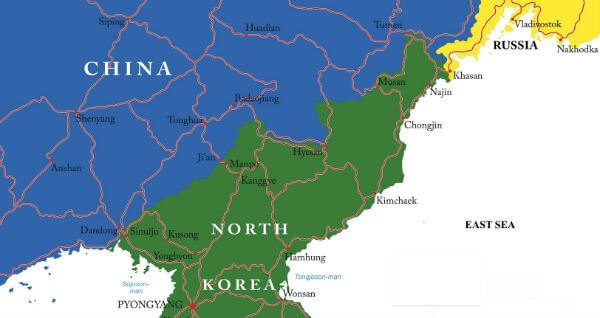
As U.S. and China find common ground on North Korea, is Russia the wild card?

Reuters reports: When North Korean leader Kim Jong Un sent Lunar New Year greetings this year, the first card went to Russian President Vladimir Putin, ahead of leaders from China and other allies of the isolated country, according to its official news agency.

Some academics who study North Korea argue Kim could be looking for Russia to ease any pain if China, which accounts for about 90 percent of North Korea’s trade, steps up sanctions against the isolated country as part of moves to deter its nuclear and missile programmes.

U.S. President Donald Trump lavished praise on Chinese President Xi Jinping last week for Beijing’s assistance in trying to rein in Pyongyang. A day later, U.S. Secretary of State Rex Tillerson pressed the United Nations Security Council to impose more sanctions to further isolate Pyongyang.

There is no sign of any sustainable increase in trade between Russia and North Korea, but business and transport links between the two are getting busier.

A new ferry service starting next week will move up to 200 passengers and 1,000 tonnes of cargo six times a month between North Korea and the Russian port of Vladivostok. [Continue reading…]

Facebooktwittermail