Category Archives: United Nations

The fight for Libya

Samia Nakhoul reports:

By the time the outside world agrees on a response to Libyan leader Muammar Gaddafi’s bloody onslaught against a popular revolt, it could all be over.

The advance of Gaddafi’s better-armed forces, who seem to have shown little regard for civilians when storming in to retake rebel strongholds, has outrun the slow pace of hesitant initiatives being discussed by European, U.S. and Arab leaders.

An Arab League call for the United Nations to impose a no-fly zone to protect the revolt, was welcomed by France, which has taken a lead in backing the rebels and will host G8 foreign ministers in Paris Monday.

But others, notably the United States and other European Union states such as Germany, remain very cautious about military engagement. No U.N. Security Council meeting had yet been scheduled, despite events racing in Libya.

“The international community is dragging its feet,” said Saad Djebbar, a London lawyer and expert on Libyan affairs. “The diplomatic pace is very slow. There is an urgency to act quickly before those people are finished off by Gaddafi’s forces.”

“The international community has to act now — not only to protect Benghazi from an onslaught but because of what it means for the rest of the world if Gaddafi is allowed to remain the leader of Libya,” said Geoff Porter, a U.S.-based political risk consultant who specializes in North Africa.

After the relatively peaceful and speedy overthrow of Arab strongmen in Egypt and Tunisia, Western disarray on Libya may persuade other authoritarian rulers facing unrest, from Yemen to Bahrain, that the best antidote to revolt is violence.

“If they allow Gaddafi to win, that would encourage other Arab despotic regimes to use brutal force against their people to stamp out revolt,” Djebbar said. “This will erase the gains of the people power we have seen in Egypt and Tunis.

“It sends a very bad signal to other movements.”

Reuters reports:

Muammar Gaddafi’s troops seized the strategic Libyan oil town of Brega on Sunday, forcing rebels to retreat eastward and putting extra pressure on world powers still deliberating on a no-fly zone.

The government offensive had already driven the rebels out of Ras Lanuf, another oil terminal 100 km to the west on the coast road, and the seizure of Brega and its refinery deprived the rebels of more territory and yet another source of fuel.

The government, in a message on state television, said it was certain of victory and threatened to “bury” the rebels, who it linked to al Qaeda and “foreign security services.”

Riad Kahwaji writes:

Some Arab defense experts believe it is time for the Arab States to stand up and take responsibilities in their own hands and come to the aid of the Libyans. Retired Major General Khaled Al-Bu Ainnain, former commander of the United Arab Emirates Air Force and Air Defense, believes that some GCC states and Egypt can mount a joint operation and successfully enforce an NFZ over Libya. “The UAE Air Force can deploy couple of squadrons – one F-16 Block 60 and another Mirage 2000-9 – the Saudi Air Force can deploy a couple of F-15S squadrons and Egypt a couple of F-16 squadrons out of Mersi Matrouh Air Base in western Egypt,” Al-Bu Ainnain said. “This would provide 120 fighters and attack aircrafts that would be backed with airborne early warning planes like Egyptian E-2C Hawkeye or Saudi AWACS, some unmanned aerial vehicles (UAV) for reconnaissance, and air-refueling tankers from Saudi Arabia and couple of Egyptian or UAE helicopter squadrons comp osed of Apache Longbow gunships, Blackhawks and Chinook helicopters, for search and rescue missions.” Crews and troops needed for the operation could be quickly airlifted to western Egypt, and even Algeria, within hours using a large fleet of UAE and Egyptian C-130 and Qatari C-17 transporters.

Observers believe the area of operations for any force executing an NFZ over Libya now would be confined to the area between the capital Tripoli and the City of Cert and down south to Sebha in the center. The rest of the country is under rebel control. The Libyan Air Force is comprised of aging Cold War-era Soviet supplied fighters like Su-22, MiG-21 and MiG-23 and one remaining operational Mirage F-1 and some 30 MiMi-24 Helicopter gunships. According to reports out of Libya, only few Su-22 and MiG-23 aircrafts were seen involved in the air raids in addition to MiMi-24 gunships. As for Air Defense, Gadhafi’s forces are believed to be in possession of a few batteries of Soviet-era SAM-2, SAM-3 and SAM-6 surface to air missiles. “All of the Libyan Air Defense SAM’s and radars can be taken out swiftly by the arsenal of smart weapons and cruise missiles in possession today by GCC and Egyptian Air Forces,” Al-Bu Ainnain said. “Runways can be destr oyed with bunker-busters to ground all the jets, and the gunships can be easily destroyed on the ground.” He pointed out that GCC and Egyptian Air Forces have considerably enhanced their joint-operations capabilities as a result of almost annual exercises they have done together along with the U.S. and some EU countries. “Issues related to command and control and interoperability would be resolved quickly which would ensure a smooth running of NFZ operations.”

The Washington Post reports:

Defense Secretary Robert M. Gates said Saturday that the U.S. military, already fighting two wars in Muslim nations, would have no trouble enforcing a no-fly zone over Libya if President Obama orders one.

The comments appeared designed to counter the criticism surrounding his earlier remarks on the issue and came as the Arab League endorsed a no-fly zone to protect Libya’s civilians from forces loyal to Libyan leader Moammar Gaddafi.

Gates indicated earlier this month that the creation of a no-fly zone would be a “big operation.” NATO would need to deploy an array of air power to target not only defense systems and fighter jets, but also the low-flying attack helicopters that Gaddafi has used against rebels and civilian protesters.

The assessment drew criticism, in particular, from those who favor a more aggressive American response to the Libyan conflict, now tilting back in favor of Gaddafi’s better-armed forces. Some accused Gates of inflating the dangers and scope of a no-fly zone mission over a large desert country with a small population.


Facebooktwittermail

Arab League calls on UN to enforce no-fly zone over Libya

The Wall Street Journal reports:

The Arab League on Saturday called on the United Nations Security Council to enforce a “no-fly zone” over Libyan airspace, marking a decisive diplomatic victory for rebel forces opposed to Moammar Gadhafi, the Libyan ruler.

The announcement will bolster calls by some European leaders to intervene in the violent confrontation between rebels and Col. Gadhafi’s military.

The U.S. and the European Union had deferred to the 22-member league of Arab nations to determine whether outside military forces should intervene.

The air superiority of forces loyal to Col. Gadhafi has helped tip the balance of power against the antigovernment uprising based in the eastern part of the country. On Saturday, government forces tightened their grip on the coastal road linking government-held territory to the rebel-controlled east, the Associated Press reported.

Col. Gadhafi’s forces all but routed rebels in the coastal oil-refining city of Ras Lanuf earlier this week and completed their assault on Zawiya, a rebel stronghold west of Tripoli, Libya’s capital.

Deliberations will now go to the U.N. Security Council, where permanent members China and Russia are thought to oppose the proposed no-fly zone.

Abdel Hafeez Goga, the deputy head of the Benghazi-based provisional rebel government, the Transitional National Council, praised the Arab League decision.

“We welcome and salute their decision and look at it as a step forward to the imposition of no-fly-zone imposition,” he told a news conference in Benghazi.

Facebooktwittermail

Poorly informed Libyans make emotive appeal for no-fly zone

Phyllis Bennis writes:

While the Libyan revolt is playing out in vastly different ways, and with far greater bloodshed, it is part and parcel of the democratic revolutionary process rising across the Arab world and beyond. And just as in Egypt, Tunisia, Yemen, Bahrain, and elsewhere, there is no evidence that the Libyan population supports foreign military involvement.

To the contrary, although at least part of the anti-Qaddafi leadership is indeed calling for some kind of military intervention, there appears to be widespread public opposition to such a call. Certainly there is fear that such foreign involvement will give credibility to Qaddafi’s currently false claims that foreigners are responsible for the uprising. But beyond that, there is a powerful appeal in the recognition that the democracy movements sweeping the Middle East and North Africa are indigenous, authentic, independent mobilizations against decades-long U.S.- and Western-backed dictatorship and oppression.

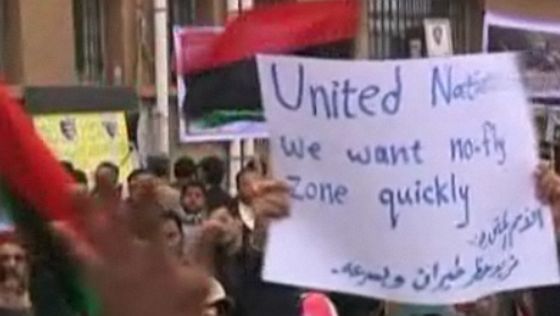
At a demonstration after a funeral for rebel fighters in Benghazi (shown in the video below) protesters can be seen holding up signs saying “Libyans Need No-Fly Zone” and “United Nations: we want no-fly zone quickly.”

Perhaps the signs were being held aloft by foreign agents, or maybe these particular Libyans have not been paying enough attention to Washington’s think tanks and don’t know how difficult a no-fly zone is to operate or what wider military involvement it might entail.
Or, maybe those outside Libya who refuse to make any distinction between a no-fly zone implemented in response to Libyan appeals and a no-fly zone imposed without consultation, simply don’t want to hear what Libyans are saying when it conflicts with the views to which so many non-interventionists seem so deeply attached.

Mustafa Abdul-Jalil, head of the Interim Transitional National Council based in Benghazi, in an interview with CNN reiterated his appeal for the international community to immediately impose a no-fly zone.

Is anyone listening?

There seems to be a highly questionable logic at work here among the opponents of a no-fly zone: if Gaddafi can effectively crush his opponents, then the uprising can’t have had enough popular support, but if there’s sufficient popular support, then no outside support is necessary.

In other words, the message to the revolution is this: if you’re going to win, you won’t need our help, but if you need our help, you probably won’t win. Good luck guys.

Does this have implications for the Palestinians?

Isn’t the Boycott, Divestment and Sanctions movement a form of foreign intervention?

If the Palestinians in the West Bank can’t muster the will or the force to kick out the Israeli occupiers, then maybe outsiders should not be making any effort to tip the balance of power.

Good revolutions, as the White House cynically says, grow organically. And believe me, contrary to all the anti-imperialist fear-mongering that’s going around right now, moderately tough-talk notwithstanding, Obama’s actually firmly on the side of the non-interventionists. The international community and especially the US and even more so the Pentagon, are loathe to get involved in this conflict.

So who do you want to align yourself with? US Defense Secretary No-No-Fly Zone Gates or Pro-No-Fly-Zone Mustafa Abdul-Jalil?

To those who argue that US involvement would undermine the credibility of the revolution, consider this observation by Salem Abdel Wahad, a 30-year-old Libyan rebel soldier:

We find one thing strange: the position of the United states. It’s impossible that the U.S. would not have imposed a no-fly zone, impossible, unless they have some agreement with Gaddafi against the Libyan people.

There is no neutrality in this war. If you don’t support the revolution, you are by default against it.

The debate for and against a no-fly zone is not closed, but it should at least be met on honest terms — without concealing the fact that Libyan appeals for a no-fly zone are only growing louder, and without claiming that a no-fly zone would inevitably lead to a full-blown Western intervention. Can a no-fly zone help or are there more effective alternatives?

Aviation Week spoke to two retired US Air Force generals who say that the difficulties in imposing a no-fly zone have been over-stated by the Pentagon.

Any attack, the two generals contend, would be far more limited in scope and greater in effect than critics have suggested.

“[Defense Secretary Robert] Gates has said that a no-fly zone can’t stop helicopters,” the first Gen. says “That’s wrong. There are only three places in Libya where helicopters can stage, fuel, rearm and re-equip – one in Tripoli, one in Benghazi and one in the eastern oil fields that are in the hands of the rebels. They are all near the coast. All the rest of Libya is barren.

“The U.S. Air Force has specialized in operations to take down integrated air defense, crater runways and destroy helicopter staging areas,” he says. “We know where they are. You can shoot down low-flying helicopter with Aim-9X Sidewinders. The suppression would take 24-48 hours with assets that aren’t being used for Iraq or Afghanistan.

Former US diplomat Peter Galbraith described the way a no-fly zone operates to Mark Colvin on Australia’s ABC News:

PETER GALBRAITH: Generally what happens is that once you’ve declared the no-fly zone, that the target air force is unwilling to fly its aircraft, of the pilots themselves individually are unwilling to fly and so by and large you don’t then need to have patrols to enforce it.

In the case of the no-fly zone that was over Iraq during the time that Saddam Hussein was in power, the Iraqis never actually challenged it, and so it was able to be enforced by a couple of planes patrolling every day.

MARK COLVIN: Do you first though have to take out their radar and other navigational aids?

PETER GALBRAITH: Not necessarily. Again if you declare it, there’s a good chance that the country will choose not to challenge it, or again that the pilots will stop to fly. But it’s also important to remember that in the case of Libya a significant purpose here is psychological. You have a country where a large segment of the population, including of the armed forces, has gone over to the rebellion.

The others may be sympathetic to the rebellion, or certainly are not necessarily committed to Gaddafi who are looking to say, to see how this is going to turn out. And once it’s clear, that Gaddafi is not going to remain in power, they are not going to defend him.

And so one of the purposes of declaring a no-fly zone is to send a signal that the international community is determined that he will not be able to put down the rebellion and this will perhaps hasten his departure or will make people, make it clear that he is not in fact going to succeed in putting down the rebellion.

Facebooktwittermail

The fight for Libya

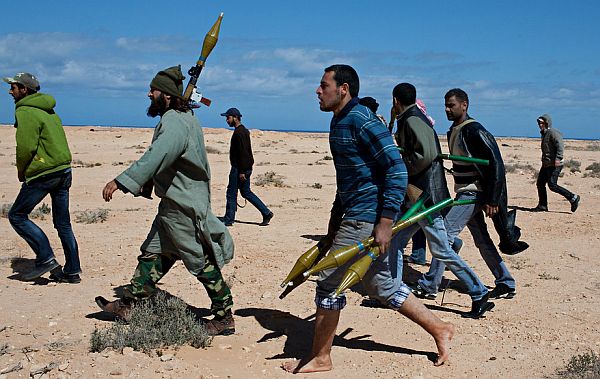
Chris McGreal reports from Ras Lanuf, where thousands of young volunteers now provide the bulk of the rebel force that has swept along Libya’s eastern coast:

Gaddafi’s air force has bombed Ras Lanuf repeatedly, cutting off the town’s water supply on Tuesday and destroying housing. On Monday the victims included a civilian, Mohammed Ashtal, who was killed with three of his children when an air strike hit their car.

The bombing has put the inexperienced fighters on edge as they constantly scan the sky for planes. Every now and then a shout goes up. Someone claims there is a MiG jet. No one can see it but hundreds of weapons let loose in a futile wave of fire in every direction. Young men swivel anti-aircraft guns, letting go bursts of shells with a deadening thud. Kalashnikov bullets pop furiously.

Not long after one such false alarm, the young fighters raced out of town towards the front despite the pleas of their more experienced commanders to maintain their defensive lines and positions guarding a nearby oil refinery.

It was all very worrying for Fathi Mohammed, torn between admiration of young men willing to risk their lives in pursuit of freedom and despair at their lack of discipline. The 46-year-old former captain in Gaddafi’s special forces is trying to instil some organisation in the bands of fighters who have descended on Ras Lanuf.

“They’re not under control,” he said. “Some of these guys, they just took guns from the military camp in Benghazi and came here without anyone knowing what they are doing. We are trying to make them into organised teams but it’s not easy.”

Rajab Hasan, another former soldier tasked with training, chipped in: “They need a leader. We don’t have enough leaders.”

Mohammed expressed his concern at the implications of all this carefully. The rebel army has done well until now, advancing and then staving off attempts by Gaddafi’s forces to break through. But he acknowledged that the rebels could face a problem if its enemy is able to launch a sustained attack.

Mohammed does not want to concede that defeat might be a possibility, even though a rumour has swept the rebels that Gaddafi is amassing tanks for a frontal assault. But he does recognise that victory is not certain. “It’s not impossible to get to Tripoli. If God is with us,” he said. Still, Mohammed does not question the courage of the young fighters. “They are brave. They have the courage. It’s a popular war. There’s a lot of enthusiasm.”

The New York Times reports:

In less than three weeks, an inchoate opposition in Libya, one of the world’s most isolated countries, has cobbled together the semblance of a transitional government, fielded a ragtag rebel army and portrayed itself to the West and Libyans as an alternative to Col. Muammar el-Qaddafi’s four decades of freakish rule.

But events this week have tested the viability of an opposition that has yet to coalesce, even as it solicits help from abroad to topple Colonel Qaddafi’s government.

Rebels were dealt military setbacks in Zawiyah and the on outskirts of Ras Lanuf on Tuesday, part of a strengthening government counteroffensive. Meanwhile, the oppostion council’s leaders contradicted one another publicly. The opposition’s calls for foreign aid have amplified divisions over intervention. And provisional leaders warn that a humanitarian crisis may loom as people’s needs overwhelm fledgling local governments.

“I am Libya,” Colonel Qaddafi boasted after the uprising erupted. It was standard fare for one of the world’s most outrageous leaders — megalomania so pronounced that it sounded like parody. It underlined, though, the greatest and perhaps fatal obstacle facing the rebels here — forging a substitute to Colonel Qaddafi in a state that he embodied.

“We’ve found ourselves in a vacuum,” Mustafa Gheriani, an acting spokesman for the provisional leadership, said Tuesday in Benghazi, the rebel capital. “Instead of worrying about establishing a transitional government, all we worry about are the needs — security, what people require, where the uprising is going. Things are moving too fast.”

“This is all that’s left,” he said, lifting his cellphone, “and we can only receive calls.”

The question of the opposition’s capabilities is likely to prove decisive to the fate of the rebellion, which appears outmatched by government forces and troubled by tribal divisions that the government, reverting to form, has sought to exploit. Rebel forces are fired more by enthusiasm than experience. The political leadership has virtually begged the international community to recognize it, but it has yet to marshal opposition forces abroad or impose its authority in regions it nominally controls.

The Guardian reports:

Nato has launched 24-hour air and sea surveillance of Libya as a possible precursor to a no-fly zone, amid signs of growing Arab support for western military intervention to stop the bombing of civilians.

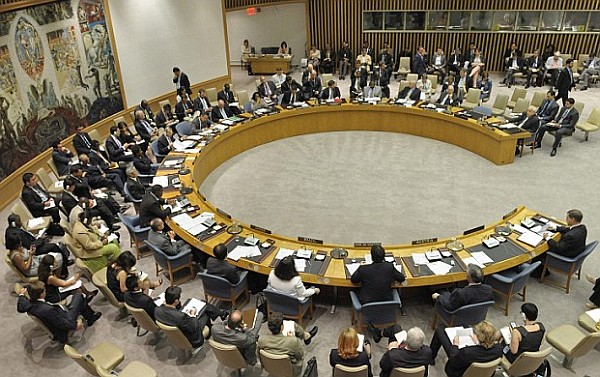
British and French diplomats at the UN headquarters in New York have completed a draft resolution authorising the creation of a no-fly zone which could be put before the security council within hours if aerial bombing by pro-Gaddafi forces causes mass civilian casualties.

“It would require a clear trigger for a resolution to go forward,” a western diplomat said. In such an event, there would be pressure on Russia and China not to use vetoes. Western officials believe support for a no-fly zone from the Islamic world, as well as from the Libyan opposition and Libyan diplomats at the UN, would put Moscow and Beijing on the defensive.

The Gulf Co-operation Council, the Organisation of the Islamic Conference and the secretary general of the Arab League have called for the protection of Libyan civilians while rejecting the intervention of western ground troops. Turkey, the most reluctant Nato member state, has relaxed its opposition and allowed contingency planning to go ahead.

The decision to step up air and sea monitoring was taken on Monday by the North Atlantic Council, a meeting of ambassadors from Nato’s 28 member states.

Foreign Policy reports:

The State Department believes that supplying any arms to the Libyan opposition to support their struggle against Col. Muammar al-Qaddafi would be illegal at the current time.

“It’s very simple. In the U.N. Security Council resolution passed on Libya, there is an arms embargo that affects Libya, which means it’s a violation for any country to provide arms to anyone in Libya,” State Department spokesman P.J. Crowley said on Monday.

Crowley denied reports that the United States had asked Saudi Arabia to provide weapons to the Libyan opposition, and also denied that the United States would arm opposition groups absent explicit international authorization.

Pressed by reporters to clarify whether the Obama administration had any plans to give arms to any of the rebel groups in Libya, Crowley said no.

“It would be illegal for the United States to do that,” he said. “It’s not a legal option.”

Crowley’s blanket statement seemed to go further than comments on Monday by White House spokesman Jay Carney, who said, “On the issue of … arming, providing weapons, it is one of the range of options that is being considered.”

The New York Times reports:

As wealthier nations send boats and planes to rescue their citizens from the violence in Libya, a new refugee crisis is taking shape on the outskirts of Tripoli, where thousands of migrant workers from sub-Saharan Africa have been trapped with scant food and water, no international aid and little hope of escape.

The migrants — many of them illegal immigrants from Ghana and Nigeria who have long constituted an impoverished underclass in Libya — live amid piles of garbage, sleep in makeshift tents of blankets strung from fences and trees, and breathe fumes from a trench of excrement dividing their camp from the parking lot of Tripoli’s airport.

For dinner on Monday night two men killed a scrawny, half-plucked chicken by dunking it in water boiled on a garbage fire, then hacked it apart with a dull knife and cooked it over an open fire. Some residents of the camp are as young as Essem Ighalo, 9 days old, who arrived on his second day of life and has yet to see a doctor. Many refugees said they had seen deaths from hunger and disease every night.

The airport refugees, along with tens of thousands of other African migrants lucky enough to make it across the border to Tunisia, are the most desperate contingent of a vast exodus that has already sent almost 200,000 foreigners fleeing the country since the outbreak of the popular revolt against Col. Muammar el-Qaddafi nearly three weeks ago.

Libya’s Interim Transitional National Council now has a website with this introductory statement:

In this important historical juncture which Libya is passing through right now, we find ourselves at a turning point with only two solutions. Either we achieve freedom and race to catch up with humanity and world developments, or we are shackled and enslaved under the feet of the tyrant Mu’ammar Gaddafi where we shall live in the midst of history. From this junction came the announcement of the Transitional National Council, a step on the road to liberate every part of the Libyan lands from Aamsaad in the east to Raas Ajdair in the west, and from Sirte in the north to Gatrun in the south. To liberate Libya from the hands of the tyrant Mu’ammar Gaddafi who made lawful to himself the exploitation of his people and the wealth of this country. The number of martyrs and wounded and the extreme use of excessive force and mercenaries against his own people requires us to take the initiative and work on the Liberalization of Libya from such insanities.

To reach this goal, the Transitional National Council announced its official establishment on 5th March 2011 in the city of Benghazi, stating its perseverance towards the aim of relocating its headquarters to our capital and bride of the Mediterranean, the city of Tripoli.

To connect with our people at home and abroad, and to deliver our voice to the outside world, we have decided to establish this website as the official window of communication via the world wide web.

May peace and God’s mercy and blessings be upon you
Long live Libya free and dignified

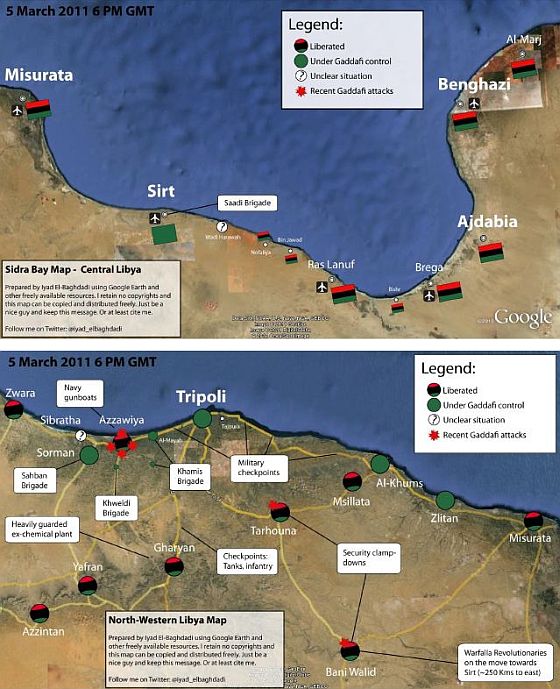
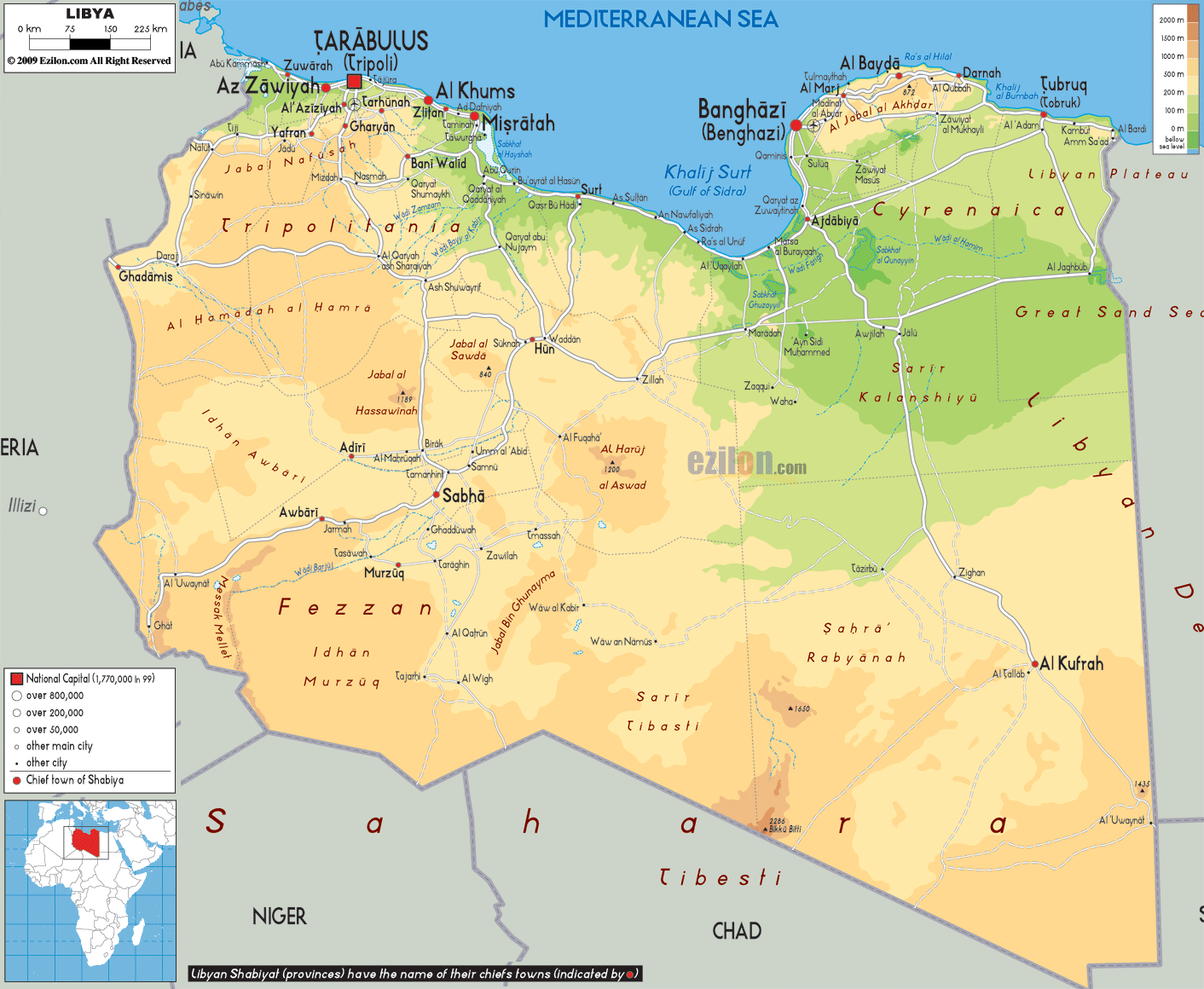
Map of the revolution:

Facebooktwittermail

Would intervention in Libya poison the Arab revolution?

Peter Singer writes:

The situation in Libya [has become] a test of how seriously the international community takes the idea of a responsibility to protect people from their rulers. The idea is an old one, but its modern form is rooted in the tragic failure to intervene in the Rwandan genocide in 1994. A subsequent UN inquiry concluded that as few as 2,500 properly trained military personnel could have prevented the massacre of 800,000 Tutsis.

Former US President Bill Clinton has said that the mistake he most regrets making during his presidency was his failure to push for intervention in Rwanda. Kofi Annan, who was then UN Under-Secretary-General for Peace-Keeping Operations, described the situation at the UN at the time as a “terrible and humiliating” paralysis.

When Annan became Secretary-General, he urged the development of principles that would indicate when it is justifiable for the international community to intervene to prevent gross violations of human rights. In response, Canada’s government established an International Commission on Intervention and State Sovereignty, which recommended that military intervention could be justified, as an extraordinary measure, where large-scale loss of life is occurring or imminent, owing to deliberate state action or the state’s refusal or failure to act. These principles were endorsed by the UN General Assembly at its special World Summit in 2005 and discussed again in 2009, with an overwhelming majority of states supporting them.

The principle fits the situation in Libya today. Yet the Security Council resolution contains no mention of the possibility of military intervention – not even the imposition of a no-fly zone over Libya to prevent Gaddafi from using planes to attack protesters.

One body with a special concern to transform the idea of the responsibility to protect into a cause for action is the Global Center for the Responsibility to Protect, at the City University of New York. It has called on UN members to uphold their 2005 commitments and put the responsibility to protect into action in Libya. It urges consideration of a range of measures, several of which were covered by the Security Council resolution, but also including a no-fly zone.

In addition to arguing that the responsibility to protect can justify military intervention, the International Commission on Intervention and State Sovereignty recommended a set of precautionary principles. For example, military intervention should be a last resort, and the consequences of action should not be likely to be worse than the consequences of inaction.

Whether these precautionary principles are satisfied in Libya requires expert judgment of the specifics of the situation. No one wants another drawn-out war like those in Iraq and Afghanistan. But Libya is not Iraq or Afghanistan – its population is only about one-fifth of either country’s, and there is a strong popular movement for a democratic form of government. Assuming that foreign military forces rapidly overwhelmed Gaddafi’s troops, they would soon be able to withdraw and leave the Libyan people to decide their own future.

Seumas Milne writes:

Those calling for western military action in Libya seem brazenly untroubled by the fact that throughout the Arab world, foreign intervention, occupation and support for dictatorship is regarded as central to the problems of the region. Inextricably tied up with the demand for democratic freedoms is a profound desire for independence and self-determination.

That is clear in reaction on the ground in Libya to the threat of outside intervention. As one of the rebel military leaders in Benghazi, General Ahmad Gatroni, said this week, the US should “take care of its own people, we can look after ourselves”.

No-fly zones, backed by some other opposition figures, would involve a military attack on Libya’s air defences and, judging from the Iraqi experience, be highly unlikely to halt regime helicopter or ground operations. They would risk expanding military conflict and strengthening Gaddafi’s hand by allowing the regime to burnish its anti-imperialist credentials. Military intervention wouldn’t just be a threat to Libya and its people, but to the ownership of what has been until now an entirely organic, homegrown democratic movement across the region.

Timothy Garton Ash writes:

A decade ago an independent international commission that elaborated on the idea of “responsibility to protect” spelled out six criteria for deciding whether military action is justified. Essentially a modernised version of centuries-old Catholic standards for “just war”, these criteria are: right authority, just cause, right intention, last resort, proportional means, and reasonable prospects. Bitter experience, from Kosovo to Afghanistan, has taught us that “reasonable prospects” (ie of success) may be the most difficult to judge and achieve.

Applying these criteria, I remain unconvinced that a no-fly zone over Libya is justified – at the time of writing. If it turns out that Gaddafi does still have a secret stock of chemical weapons, and can drop them from the sky, this judgment could change overnight. We should prepare contingency plans. But we have not yet exhausted all other avenues, including trying to pry Gaddafi’s cronies away from him by fair means and foul. A no-fly zone would be very difficult to enforce, and might not have anything more than a marginal impact on the ground.

Above all, any form of armed intervention by the west – and the US military says a no-fly zone would require initial bombing of Libyan radar and anti-aircraft facilities – would spoil the greatest pristine glory of these events, which is that they are all about brave men and women liberating themselves.

Facebooktwittermail

Libya uprising

The New York Times reports from Zawiya:

In this city 30 miles west of Tripoli, hundreds of people rejoiced in a central square on Sunday, waving the red, black and green flag that has come to signify a free Libya and shouting the chants that foretold the downfall of governments in Tunisia and Egypt: “The people want to bring down the regime.”

Rebels, in control of the city, had reinforced its boundaries with informal barricades, and military units that had defected stood guard with rifles, six tanks and anti-aircraft guns mounted on the backs of trucks. In the central square here, a mosque was riddled with enormous holes, evidence of the government’s failed attempt to take back this city on Thursday. Nearby lay seven freshly dug graves belonging to protesters who had fallen in that siege, witnesses said.

“We are really suffering for 42 years, and people are asking here for the same things as other people of the world — they want the real democracy,” said Ahmed El-Hadi Remeh, an engineer standing in the square. He and other residents told how they had used stones to repel the government’s forces.

Proving how close opposition control has come to the capital, where Col. Muammar el-Qaddafi maintains tight control, the confidence of the demonstrators in Zawiya was remarkable, all the more so because it was witnessed as part of the official tour for international journalists that Colonel Qaddafi’s government organized. The public relations effort, apparently intended to show a stable Libya to the outside world, appeared to backfire, as a tour of Tripoli had on Saturday.

Instead, the tour, whose minders were forced to wait at the city’s outskirts, showed a nation where the uprising had reached the capital’s doorstep, underscoring a growing impression that the ring of rebel control around Tripoli was tightening. But in a sign that the fight was far from over, armed government forces were seen massing around the city.

The Associated Press reports:

Two prominent U.S. Senators said Washington should recognize and arm a provisional government in rebel-held areas of eastern Libya and impose a no-fly zone over the area — enforced by U.S. warplanes — to stop attacks by the regime. U.S. Secretary of State Hillary Rodham Clinton echoed President Barack Obama’s demand for Gadhafi to relinquish power.

“We want him to leave,” she told reporters traveling with her Sunday to a U.N. meeting on Libya planned for Monday. “We want him to end his regime and call off the mercenaries and forces loyal to him. How he manages that is up to him.”

Gadhafi’s son, Seif al-Islam, claimed again that the country was calm and denied the regime used force or airstrikes against its own people. But human rights groups and European officials have put the death toll since unrest began in Libya nearly two weeks ago at hundreds, or perhaps thousands, though it has been virtually impossible to verify the numbers.

AP also reports:

The U.N. Security Council moved as a powerful bloc Saturday to try to halt Libyan leader Moammar Gadhafi’s deadly crackdown on protesters, slapping sanctions on him, his children and top associates.

Voting 15-0 after daylong discussions interrupted with breaks to consult with capitals back home, the council imposed an arms embargo and urged U.N. member countries to freeze the assets of Gadhafi, four of his sons and a daughter. The council also backed a travel ban on the Gadhafi family and close associates, including leaders of the revolutionary committees accused of much of the violence against opponents.

Council members additionally agreed to refer the Gadhafi regime’s deadly crackdown on people protesting his rule to a permanent war crimes tribunal for an investigation of possible crimes against humanity.

Carne Ross, a former British diplomat at the UN, comments:

[T]here are some strking things about this resolution:

  • Clear and early referral to the ICC (paras 4-8), including a demand that the ICC prosecutor brief the Council in two months’ time: this is remarkable. This is I think (and Barbara Plett thinks too) the first time the Council has voted unanimously for ICC referral. This resolution has also taken place very early in a conflict, only days after it began. In other words, the Council is moving in welcome fashion towards the preventive signalling required under the Responsibility to Protect doctrine (see my blog comment below). It is reacting almost as fast as news breaks of killing.
  • The second remarkable thing is that the Libya situation is clearly internal. The Council may have denoted it as a “threat to international peace and security” in the preambular paragraphs (though I think this reference has been watered down in negotiation) and by putting the res under Chapter VII of the Charter, but to any outside observer it’s pretty clear that the conflict is confined within Libya’s borders, so far. There is a clear and unambiguous reference to Responsibility to Protect in the preambular paras. This is in my memory the first time that the Council has acted so quickly and so decisively on an internal situation. I am very surprised that the Chinese, Indians etc went along with such clear language. International public opinion seems to be moving them. This is an important precedent too.
  • Thirdly, on a more political note, this resolution is putting the Libyan regime in the freezer – big time. The assets freeze, travel ban etc apply to named members of the regime. These measures will be legally obligatory for all member states to impose – the resolution is under Chapter VII of the charter. And the measures will be in place indefinitely. These sanctions are not time-limited and will require a further positive vote of the Council to be lifted. In other words, all P5 will have to agree, plus 9 non-permanents. Moreover, the criteria for sanctions lift are left very unclear. What this means in practice is the total international isolation of members of the Gadhaffi regime indefinitely.

Reuters reports:

Britain said on Sunday it had revoked Muammar Gaddafi’s diplomatic immunity, putting pressure on the Libyan leader to step down after his government’s bloody crackdown on a revolt against his rule.

Officials said the move, which backs up U.N. Security Council sanctions agreed on Saturday, was an unprecedented step by Britain against a serving head of state.

“It is time for Colonel Gaddafi to go,” Foreign Secretary William Hague told the BBC, in the strongest language Britain’s nine-month-old coalition has used so far about the crisis.

The diplomatic immunity of Gaddafi’s sons, family and household had also been revoked, Hague said.

Hague said Gaddafi appeared to have stocks of mustard gas, a potentially deadly chemical weapon, that had not been destroyed under a 2003 agreement to dismantle weapons of mass destruction (WMD).

“Some of those stocks do appear to exist although we are not sure what condition they are in,” Hague said.

Separately, Peter Mandelson, a close confidant of former British Prime Minister Tony Blair, said that Blair had been in contact with Gaddafi in the last few days.

The Independent adds:

According to Whitehall sources, Mr Blair made an initial call to the Libyan President, who has ordered helicopter gunships to fire on protesters he described as “rats” and “cockroaches”. The Middle East envoy urged him to cease the attacks. The sources suggested that, after consultations with the British Foreign Office, Mr Blair was told that the UK Government would prefer the Libyan President to step down, and so he agreed to phone him again and transmit that message. There was no comment from Mr Blair’s office yesterday. Government sources could not say last night whether ministers knew in advance about the initial phone call.

The first oblique hint that Mr Blair might be in active contact with the Libyan regime came in a routine briefing on Friday in which US State Department spokesman P J Crowley said the former PM was among the international figures that Secretary of State Hillary Clinton had spoken to during the day. Asked why Mrs Clinton called Mr Blair and if it was because of “his dealings with Gaddafi over the Lockerbie bomber”, the spokesman said of Mr Blair: “He has very important and valuable contacts inside of Libya.”

The Daily Telegraph reports:

Mercenaries captured in Libya are facing an uncertain future, writes Nick Meo in Al-Bayda.

Crowded into an empty classroom which was stinking of unwashed bodies and reeking of fear, Colonel Muammar Gaddafi’s defeated mercenary killers awaited their fate.

A week earlier the men – Libyan loyalists of the dictator and black African recruits – had been landed at airports throughout eastern Libya and sent out into the streets to shoot protesters in a murderous rampage. They killed dozens before they were overwhelmed by anti-Gaddafi militias.

The survivors were exhausted, filthy, far from home, and fearful of execution, even though they had been assured of good treatment. Fifty of them lay on mattresses on the floor in one classroom alone, with nearly 100 more in the same school building which was being used as a temporary prison. Most looked dazed. Some were virtually children.

“A man at the bus station in Sabha offered me a job and said I would get a free flight to Tripoli,” said Mohammed, a boy of about 16 who said he had arrived looking for work in the southern Libyan town only two weeks ago from Chad, where he had earned a living as a shepherd.

Facebooktwittermail

Libya uprising

The New York Times reports:

A bold effort by Col. Muammar el-Qaddafi to prove that he was firmly in control of Libya appeared to backfire Saturday as foreign journalists he invited to the capital discovered blocks of the city in open revolt.

Witnesses described snipers and antiaircraft guns firing at unarmed civilians, and security forces were removing the dead and wounded from streets and hospitals, apparently in an effort to hide the mounting toll.

When government-picked drivers escorted journalists on tours of the city on Saturday morning, the evidence of the extent of the unrest was unmistakable. Workers were still hastily painting over graffiti calling Colonel Qaddafi a “bloodsucker” or demanding his ouster. Just off the tour route were long bread lines where residents said they were afraid to be seen talking to journalists.

And though heavily armed checkpoints dominated some precincts of the city, in other neighborhoods the streets were blocked by makeshift barricades of broken televisions, charred tree trunks and cinder blocks left over from protests and street fights the night before.

“I have seen more than 68 people killed,” said a doctor who gave his name only as Hussein. “But the people who have died, they don’t leave them in the same place. We have seen them taking them in the Qaddafi cars, and nobody knows who there are taking the people who have died.” He added, “Even the ones with just a broken hand or something they are taking away.”

In some ways, the mixed results of Colonel Qaddafi’s publicity stunt — opening the curtains to the world with great fanfare, even though the stage is in near-chaotic disarray — is an apt metaphor for the increasingly untenable situation in the country.

On Friday, before the journalists arrived, his forces put down a demonstration in the capital only after firing on the protesters. There were reports that an armed rebel force was approaching the city on Saturday, but Colonel Qaddafi’s forces are believed to have blocked the way at the city of Surt, a stronghold of his tribe.

He is no longer in full control of the countryside either. Rebels now control about half the populous Mediterranean coast, including the strategic towns of Zawiyah and Misurata, not far from the capital and near important oil facilities.

Misurata (225km east of Tripoli) – Rally in front of the People’s Hall after city is liberated:

Press TV reports:

The youngest son of the embattled ruler Muammar Gaddafi has joined the pro-democracy protesters in Libya amid an unabated outpouring of rage against Gaddafi, reports say.

According to the reports, Saif al-Arab, Gaddafi’s youngest son, who was sent by his father to cooperate with Libyan security forces in the massive crackdown on pro-democracy protesters joined forces with the demonstrators in the eastern city of Benghazi on Thursday.

Saif al-Arab, who is widely regarded as the most low-profile of Gaddafi’s sons have also hinted that his father would commit suicide or flee to Latin America in the face of rising public outcry over his tyrannical rule.

Saif al-Arab is said to have had the backing of combat troops and had military equipment that was dispatched to the eastern parts of turmoil-hit Libya.

Bloomberg reports:

Libyan leader Muammar Qaddafi spent most of his 41 year-regime trying to sideline the country’s tribes. That may be something he’s now regretting as his power unravels.

Akram al-Qarfalli, a senior member of the Warfalla tribe, on Feb. 20 announced it was withdrawing support from Qaddafi, saying “he is no longer a brother.” The Al-Zawiya tribe threatened to halt the flow of oil if Qaddafi doesn’t stop killing protesters. By Feb. 23 most tribes were united in their opposition, says former interior minister, Abdul Fattah Younis.

“The tribes are powerful, especially outside urban centers,” said Charles Gurdon, a Libya analyst and managing director of the London-based Menas Associates political risk consulting firm, in a phone interview. “The fact the majority of them are now opposed to Qaddafi is probably the last nail in the coffin.”

Tribal loyalties form the bedrock of Libyan society. While Qaddafi says the patchwork of more than 100 tribes makes a slide into civil war inevitable if he’s ousted, academics and opposition members say they have been key in uniting Libyans against the regime and will help shape the country’s political future.

McClatchy reports:

Citing human rights abuses against peaceful demonstrators in Libya, President Barack Obama late Friday ordered that all the assets of dictator Moammar Gadhafi, his children and their wives be frozen in the United States, or in branches of U.S. banks.

The order comes as Gadhafi is losing his grip on power against massive opposition in his oil-rich nation, which began on Feb. 15. Eyewitnesses reported murders and abductions by Gadhafi’s security forces and by hired mercenaries from other African nations.

“I . . . find that there is a serious risk that Libyan state assets will be misappropriated by Gadhafi, members of his government, members of his family, or his close associates if those assets are not protected, ” Obama said in the order.

And in a statement, Obama said: “By any measure, Muammar el-Qaddafi’s government has violated international norms and common decency and must be held accountable. These sanctions therefore target the Qaddafi government, while protecting the assets that belong to the people of Libya.”

The New York Times reports:

One day after the United States closed its embassy in Tripoli and imposed unilateral sanctions against Libya, the United Nations Security Council prepared to meet in New York on Saturday to consider imposing international sanctions, including an arms embargo and an asset freeze and travel ban against Col. Muammar el-Qaddafi, his relatives and key members of his government.

Ahead of the meeting, diplomats from the United States, France, Germany and Britain circulated a draft resolution that also called for the referral of the violent crackdown in Libya to the International Criminal Court to investigate possible crimes against humanity.

But Turkey Prime Minister Recep Tayyip Erdogan on Saturday warned that sanctions would do more harm to Libya’s people than to Colonel Qaddafi, the Associated Press reported. He added: “We call on the international community to act with conscience, justice, laws and universal humane values — not out of oil concerns.”

The international community was being spurred to action by Ban Ki-Moon, the United Nations secretary general, who gave a dire description of the continuing violence against protesters in Libya on Friday, as well as an emotional plea from the Libyan ambassador to help his countrymen.

“Please United Nations, save Libya,” Ambassador Mohammed Shalgham told fellow diplomats in New York on Friday, as he publicly broke with the Qaddafi government. “I tell my brother Qaddafi, leave the Libyans alone.”

Facebooktwittermail

The UN’s duty to Libyans

Carne Ross writes:

I spent four and a half years negotiating resolutions on the Middle East at the UN Security Council. When it wishes, the council can make decisions in hours. We agreed a resolution condemning the 9/11 attacks in less than an hour, the morning after the attacks took place. Time is of the essence. The only message that Gadaffi will understand is one of real substance and force. Such a resolution should state, at a minimum:

• The demand that all violence cease immediately, and that if lethal force continues to be used, the government will face consequences. At this point, such consequences do not need to be spelled out (and would unlikely be agreed) but imply sanctions, and, in extremis, force.

• Immediate freezing of all assets and an explicit travel ban on members of the regime, until all violence is halted and has been fully investigated.

• Since Libya is not a party to the International Criminal Court, the Council can and should refer Libya to the ICC for an immediate investigation into possible war crimes.

• Demand that there be an immediate transition to a representative government, involving consulting civil society and all relevant political actors.

• The decision should be taken under chapter VII of the UN Charter, recognising that events in Libya are an international threat to international peace and security (there are already refugees flowing out of Libya), and requiring all UN members to comply (this reference also implies the threat of military enforcement action).

I would love to see the council agree a no-fly zone or exclusion zone, to prevent air attacks on civilians. However, unless someone is prepared to enforce such a ban, it is meaningless. Realistically, only the US has this capability and such a call would risk playing into Gaddafi’s hands in his specious claim that foreign forces are behind the unrest.

Facebooktwittermail

UN Security Council mirrors White House’s inaction on Libya

The UN Security Council just issued a Presidential Statement on Libya — a collective act of hand-wringing that serves as a substitute for a course of action. With so much concern, so many calls and its limp-wristed urging, this statement could have been written by President Obama himself.

The members of the Security Council expressed grave concern at the situation in Libya. They condemned the violence and use of force against civilians, deplored the repression against peaceful demonstrators, and expressed deep regret at the deaths of hundreds of civilians. They called for an immediate end to the violence and for steps to address the legitimate demands of the population, including through national dialogue.

The members of the Security Council called on the Government of Libya to meet its responsibility to protect its population. They called upon the Libyan authorities to act with restraint, to respect human rights and international humanitarian law, and to allow immediate access for international human rights monitors and humanitarian agencies.

The members of the Security Council called for international humanitarian assistance to the people of Libya and expressed concern at the reports of shortages of medical supplies to treat the wounded. They strongly urged the Libyan authorities to ensure the safe passage of humanitarian and medical supplies and humanitarian workers into the country.

The members of the Security Council underlined the need for the government of Libya to respect the freedom of peaceful assembly and of expression, including freedom of the press. They called for the immediate lifting of restrictions on all forms of the media.

The members of the Security Council stressed the importance of accountability. They underscored the need to hold to account those responsible for attacks, including by forces under their control, on civilians.

The members of the Security Council expressed deep concern about the safety of foreign nationals in Libya. They urged the Libyan authorities and all relevant parties to ensure the safety of all foreign nationals and facilitate the departure of those wishing to leave the country. The members of the Security Council will continue to follow the situation closely.

Maybe a Resolution will come later this week, but even if it does, it’s hard to imagine it will have any immediate impact on the bloodshed in Libya.

A sterner message is coming from eastern Libya or “Free Libya” as it is now being called, where captured mercenaries are being executed.

While foreign governments are focused on evacuating their own nationals, they might consider offering free passage to any of the remaining mercenaries to head back to Chad, Darfur or wherever else they came from — the sooner they pack their bags and get out, the better for everyone.

There are reports in the Arabic press that Egyptian officials have notified Tripoli that Egypt could intervene to protect the estimated two million Egyptians resident in Libya.

One of the strongest calls for action coming out of Washington came from Senator John Kerry:

The Qadhafi government’s use of deadly force against its own people should mean the end of the regime itself. It’s beyond despicable, and I hope we are witnessing its last hours in power. Libyans should have the opportunity to choose leaders who respect their basic rights. The question now is what can be done to send that message clearly and effectively. While it’s true that America has less influence in Tripoli than elsewhere in the region, we’re not without options, particularly in partnership with the broader international community. World leaders must together put Colonel Qadhafi on notice that his cowardly actions will have consequences. First, while Qadhafi himself is irredeemable, his senior military commanders need to know that their acquiescence in atrocities could open them to future international war crimes charges. Second, all American and international oil companies should immediately cease operations in Libya until violence against civilians ceases. The Obama administration also should consider reimposing U.S. sanctions that were lifted during the Bush era. Third, United Nations leadership is on the line. Libya’s mission to the U.N. bravely condemned their own government. … Fourth, the Arab League and African Union have an opportunity to create a new precedent in response to the crisis in Libya.

The most pointed message so far, however, has come from the leading Sunni scholar and TV preacher Sheikh Yousuf al-Qaradawi, head of the International Union of Muslim Scholars. In an interview on Al Jazeera yesterday, he said:

The truth is that I do not want to say anything to Al-Gaddafi, because one should only address people who are reasonable. People who are not reasonable should not be addressed. That man is no longer reasonable. He has been crazy for a long time….

Therefore, I address the Libyan army, which is definitely endowed with faith, manliness, and honor. They must not attack their own people. Who would kill their own people?! Would you sacrifice an entire people for the sake of a madman?! . . .

I hereby issue a fatwa to the officers and soldiers who can kill Mu’ammar Al-Gaddafi: Whoever among them can fire a bullet at him, thus relieving the country and the people of him, should do so. This man wants to annihilate the people, so I am protecting the people.

I rule that whoever can fire a bullet, and relieve us, as well as Libya and its great people, of this man’s evil and danger, should do so.

Facebooktwittermail

U.N. resolution on Israeli settlements puts Obama in a diplomatic bind

Tony Karon writes:

It was always going to be a struggle for the U.S. to dissuade its Arab allies from going ahead with a U.N. Security Council resolution condemning Israeli settlements. But last week’s “people power” rebellion in Tunisia has made Washington’s effort to lobby against the plan more difficult. Tunisia has given the autocratic leaders of countries such as Egypt and Jordan more reason to fear their own people. For those regimes, symbolically challenging unconditional U.S. support for Israel is a low-cost gesture that will play well on restive streets.

Going ahead with the resolution, which was discussed on Wednesday at the Security Council and demands an immediate halt to all Israeli settlement construction in the West Bank and East Jerusalem, is, of course, a vote of no-confidence in U.S. peacemaking efforts. And it creates a headache for the Obama Administration over whether to invoke the U.S. veto — as Washington has traditionally done on Council resolutions critical of Israel. The twist this time: the substance of the resolution largely echoes the Administration’s own stated positions.

Washington had hoped that signaling its intention to veto such a resolution would force the Palestinians and their Arab backers to hold it back. But they went ahead and placed it on the Council’s agenda (a vote is unlikely for a few more weeks), putting the U.S. on the spot. After all, the Obama Administration has demanded that Israel end settlement construction to allow peace talks to go forward. After a 10-month partial moratorium expired last September, Israel resumed vigorous construction, and has resisted pressure from Washington for any further freeze. U.S. Deputy U.N. Ambassador Rosemary DiCarlo said on Wednesday that the U.S. opposed bringing the settlement issue to the Council “because such action moves us no closer to a goal of a negotiated final settlement” and could even undermine progress toward it. But that argument is unlikely to convince most of the international community, given the obvious stalemate in the peace process — there are no negotiations under way, and the Palestinians have refused to restart them until Israel halts its settlement construction. Initial responses at the Security Council reflect unanimous international support for the demand that Israel stop building settlements. If a vote were held today, the U.S. would be the only possible nay.

Facebooktwittermail

Gazan youth’s manifesto for change

The Guardian reports:

The meeting takes place in a bare room in a block of flats in the centre of Gaza City. No photographs, no real names – those are the conditions.

This is the first time that a group of young Palestinian cyber-activists has agreed to meet a journalist since launching what it calls Gaza Youth’s Manifesto for Change. It is an incendiary document – written with courage and furious energy – that has captivated thousands of people who have come across it online, and the young university students are visibly excited, but also scared. “Not only are our lives in danger; we are also putting our families at risk,” says one of them, who calls himself Abu George.

Gaza Youth’s Manifesto for Change is an extraordinary, impassioned cyber-scream in which young men and women from Gaza – where more than half the 1.5 million population is under 18 – make it clear that they’ve had enough. “Fuck Hamas…” begins the text. “Fuck Israel. Fuck Fatah. Fuck UN. Fuck UNWRA. Fuck USA! We, the youth in Gaza, are so fed up with Israel, Hamas, the occupation, the violations of human rights and the indifference of the international community!”

It goes on to detail the daily humiliations and frustrations that constitute everyday life in the Gaza Strip, the Palestinian slice of land that Israel and Egypt have virtually sealed off from the world since Hamas was elected to power in 2006.

GAZAN YOUTH’S MANIFESTO FOR CHANGE

Fuck Hamas. Fuck Israel. Fuck Fatah. Fuck UN. Fuck UNWRA. Fuck USA! We, the youth in Gaza, are so fed up with Israel, Hamas, the occupation, the violations of human rights and the indifference of the international community! We want to scream and break this wall of silence, injustice and indifference like the Israeli F16’s breaking the wall of sound; scream with all the power in our souls in order to release this immense frustration that consumes us because of this fucking situation we live in; we are like lice between two nails living a nightmare inside a nightmare, no room for hope, no space for freedom. We are sick of being caught in this political struggle; sick of coal dark nights with airplanes circling above our homes; sick of innocent farmers getting shot in the buffer zone because they are taking care of their lands; sick of bearded guys walking around with their guns abusing their power, beating up or incarcerating young people demonstrating for what they believe in; sick of the wall of shame that separates us from the rest of our country and keeps us imprisoned in a stamp-sized piece of land; sick of being portrayed as terrorists, homemade fanatics with explosives in our pockets and evil in our eyes; sick of the indifference we meet from the international community, the so-called experts in expressing concerns and drafting resolutions but cowards in enforcing anything they agree on; we are sick and tired of living a shitty life, being kept in jail by Israel, beaten up by Hamas and completely ignored by the rest of the world.
There is a revolution growing inside of us, an immense dissatisfaction and frustration that will destroy us unless we find a way of canalizing this energy into something that can challenge the status quo and give us some kind of hope. The final drop that made our hearts tremble with frustration and hopelessness happened 30rd November, when Hamas’ officers came to Sharek Youth Forum, a leading youth organization (www.sharek.ps) with their guns, lies and aggressiveness, throwing everybody outside, incarcerating some and prohibiting Sharek from working. A few days later, demonstrators in front of Sharek were beaten and some incarcerated. We are really living a nightmare inside a nightmare. It is difficult to find words for the pressure we are under. We barely survived the Operation Cast Lead, where Israel very effectively bombed the shit out of us, destroying thousands of homes and even more lives and dreams. They did not get rid of Hamas, as they intended, but they sure scared us forever and distributed post traumatic stress syndrome to everybody, as there was nowhere to run.

We are youth with heavy hearts. We carry in ourselves a heaviness so immense that it makes it difficult to us to enjoy the sunset. How to enjoy it when dark clouds paint the horizon and bleak memories run past our eyes every time we close them? We smile in order to hide the pain. We laugh in order to forget the war. We hope in order not to commit suicide here and now. During the war we got the unmistakable feeling that Israel wanted to erase us from the face of the earth. During the last years Hamas has been doing all they can to control our thoughts, behaviour and aspirations. We are a generation of young people used to face missiles, carrying what seems to be a impossible mission of living a normal and healthy life, and only barely tolerated by a massive organization that has spread in our society as a malicious cancer disease, causing mayhem and effectively killing all living cells, thoughts and dreams on its way as well as paralyzing people with its terror regime. Not to mention the prison we live in, a prison sustained by a so-called democratic country.

History is repeating itself in its most cruel way and nobody seems to care. We are scared. Here in Gaza we are scared of being incarcerated, interrogated, hit, tortured, bombed, killed. We are afraid of living, because every single step we take has to be considered and well-thought, there are limitations everywhere, we cannot move as we want, say what we want, do what we want, sometimes we even cant think what we want because the occupation has occupied our brains and hearts so terrible that it hurts and it makes us want to shed endless tears of frustration and rage!

We do not want to hate, we do not want to feel all of this feelings, we do not want to be victims anymore. ENOUGH! Enough pain, enough tears, enough suffering, enough control, limitations, unjust justifications, terror, torture, excuses, bombings, sleepless nights, dead civilians, black memories, bleak future, heart aching present, disturbed politics, fanatic politicians, religious bullshit, enough incarceration! WE SAY STOP! This is not the future we want!

We want three things. We want to be free. We want to be able to live a normal life. We want peace. Is that too much to ask? We are a peace movement consistent of young people in Gaza and supporters elsewhere that will not rest until the truth about Gaza is known by everybody in this whole world and in such a degree that no more silent consent or loud indifference will be accepted.

This is the Gazan youth’s manifesto for change!

We will start by destroying the occupation that surrounds ourselves, we will break free from this mental incarceration and regain our dignity and self respect. We will carry our heads high even though we will face resistance. We will work day and night in order to change these miserable conditions we are living under. We will build dreams where we meet walls.

We only hope that you – yes, you reading this statement right now! – can support us. In order to find out how, please write on our wall or contact us directly: freegazayouth@hotmail.com

We want to be free, we want to live, we want peace.
FREE GAZA YOUTH!
GYBO
December, 2010

Gaza Youth Breaks Out at Facebook.

Facebooktwittermail

Lebanon is staring into the abyss

Fawaz Gerges writes:

Once again, Lebanon is on the brink of major social and political upheaval. Rumours of an impending armed clash between Hezbollah and the pro-western governing coalition have spread like wildfire among the Lebanese people, who are hoarding food and arms in anticipation of the worst.

On the surface of it, the current crisis revolves around a United Nations tribunal set up to investigate the 2005 assassination of prime minister Rafik Hariri in 2005. An indictment from the tribunal is imminent; there is increasing evidence that the tribunal will accuse members of Hezbollah, the Shia-dominated resistance movement, as having played a central role in the assassination. If true, this could provide the spark that ignites the next confrontation.

Hassan Nasrallah, the leader of Hezbollah, has repeatedly dismissed the tribunal as an “American-Israeli” tool intended to incite sectarian strife in Lebanon. He has warned that the looming indictment will be an act of war against his group. He has demanded that the Lebanese government – led by Saad Hariri, the son of the late prime minister – distance itself from the UN tribunal and renounce it before the indictment is released.

On a deeper level, the standoff reflects a broader institutional crisis. Lebanon’s institutions are dysfunctional and defective; they have failed dismally to mediate conflict among rival groups, as well as to integrate rising social forces into the political process. The Hariri tribunal is a case in point. Lebanon’s three major institutions, the presidency, the cabinet and the parliament, are paralysed, unable to solve the impending crisis.

Facebooktwittermail

What if the Palestinians turn to the U.N.?

Tony Karon writes:

Israel is worried, according to press reports in the country, that the United States will not “rush to veto” a planned U.N. Security Council resolution condemning ongoing Israeli settlement construction. The resolution is being drafted by Arab countries exasperated by the failure of the U.S. to pressure the Israelis to halt construction in the West Bank and East Jerusalem, which the U.N. deems illegal. The draft may be introduced as early as this week, according to Israeli media, and the Israeli foreign ministry is reportedly mustering a diplomatic full court press to counter the move. While the U.S. has a longstanding tradition of running interference for Israel at the U.N., the Obama Administration may find itself hard-pressed to veto a resolution condemning the same Israeli behavior that Washington itself has publicly deemed illegitimate — and which the Administration has spent months trying in vain to cajole the Israelis into halting.

The Palestinians have insisted, along with the Obama Administration, that Israel refrain from building settlements in occupied territory as a precondition for peace talks. Though the U.S. dropped that effort two weeks ago, the Palestinians continue to press the matter. Prime Minister Benjamin Netanyahu had late last year instituted a 10-month partial moratorium on construction, and talks between the two sides finally got under way in August. But the Palestinians called a halt a month later as Israel’s moratorium expired and construction resumed. And the best efforts of the Obama Administration to secure even a temporary reinstatement of the moratorium proved fruitless.

While Washington hopes to make progress by conducting parallel negotiations on substantive issues with both sides, the Palestinians and their Arab allies no longer seem willing to stay on that path and leave the matter in U.S. hands.

Facebooktwittermail

Dahieh: flashpoint of the colonial and anti-colonial struggle

Rami G Khouri writes:

Who would have thought that a gynecologist’s office in the Hizbullah-dominated southern Beirut suburb of Dahieh would be the symbolic place where the colonial and anti-colonial struggles of the past century would reach their confrontational peak and bring to a head this long-simmering war? Hizbullah leader Hassan Nasrallah’s call Thursday night for all Lebanese to stop cooperating with the Special Tribunal for Lebanon (STL), which is investigating and will soon indict those it believes killed former Prime Minister Rafik Hariri and 22 others five years ago, followed an attempt by STL officers to examine patient files in the doctor’s office in Dahieh a few days ago, presumably because the STL has evidence it believes implicates some Hizbullah personnel in the assassinations. Hizbullah supporters, mostly women, beat back the STL party and quickly heightened the political confrontation that has been brewing in the country for months.

Nasrallah’s open call to boycott and actively oppose the STL marks an historical moment of reckoning that is as dangerous as it was inevitable. This is because Hizbullah and the STL represent perhaps the two most powerful symbols of the two most important forces that have defined the Middle East for the past century or more: On the one hand, Western (including Israeli) interests and interventions that seek to shape this region in a manner that suits Western aims more than it suits indigenous rights, and, on the other hand, native Arab-Islamic-nationalist resistance that seeks to shape our societies according to Arab-Islamic worldviews as defined by a consensus of local actors, identities and forces.

Stripped to its core, this tension between Hizbullah and the STL is a microcosm of the overarching fact of the modern era in which Western-manufactured Arab statehood has generally failed to gain either real traction or sustained credibility; thus it has fallen on groups like Hizbullah to play a leading role in confronting Israeli and Western power in a manner that most Arab governments have been unable or unwilling to do.

Facebooktwittermail

It’s up to Obama whether the siege of Gaza continues

After the flotilla massacre committed by Israeli forces, Turkey’s call for an emergency meeting of the UN Security Council yesterday was to be expected. Turks are assumed to be among the dead — whose names and nationalities have still not been released. There are now hundreds of Turks being held in detention in Israel and Turkish ships were captured illegally in international waters in an action Turkey’s foreign minister described as “tantamount to banditry and piracy.”

What was equally predictable was that the Obama administration would only offer its support if action from the UN was so weak as to be worthless.

Had events of the last two days not disrupted their agendas, President Obama and Prime Minister Netanyahu would today have been servicing their individual political needs with smiles and handshakes on the steps of the White House. Absent that much-anticipated saccharine event, Obama was not about to turn around and support a stern rebuke to Israel.

The key Turkish demand presented to the Security Council was that the “blockade of Gaza must be ended immediately and all humanitarian assistance must be allowed in.”

Turkey was not alone. Britain’s new foreign secretary, William Hague, was equally unequivocal:

There can be no better response from the international community to this tragedy than to achieve urgently a durable resolution to the Gaza crisis.

I call on the Government of Israel to open the crossings to allow unfettered access for aid to Gaza, and address the serious concerns about the deterioration in the humanitarian and economic situation and about the effect on a generation of young Palestinians.

Universally there were calls for an inquiry. But the key to whether such an inquiry would be of any real value would be, minimally, its independence, and ideally that it would be international.

The statement finally issued by the Security Council is riddled with language surely crafted in the White House. It “calls for a prompt, impartial, credible and transparent investigation conforming to international standards.” Impartial, but not independent. International standards, but not international.

It does not call for an end to the siege but says “the situation in Gaza is not sustainable.” And there’s Obama’s lie.

Whether the siege of Gaza is lifted or sustained is up to Washington. If, when Netanyahu finally meets Obama, the US president was to say the embargo must end, Israel would have no choice. The siege of Gaza can only continue with US support and thus far, Obama refuses to withdraw that support. He says the situation is not sustainable, but through his actions Obama has a direct hand in perpetuating the suffering in Gaza.

“Unsustainable” is the signature of Obama’s self-declared impotence. It’s change over which he would like everyone else to believe he has no control. It’s the deceit through which he tells Americans and the world, I would if I could but I can’t.

Before the Security Council issued its statement and before it became clear that Obama was yet again going to throw away an opportunity to demonstrate his commitment to upholding international law, Stephen Walt wrote:

President Obama likes to talk a lot about our wonderful American values, and his shiny new National Security Strategy says “we must always seek to uphold these values not just when it is easy, but when it is hard.” The same document also talks about a “rule-based international order,” and says “America’s commitment to the rule of law is fundamental to our efforts to build an international order that is capable of confronting the emerging challenges of the 21st century.”

Well if that is true, here is an excellent opportunity for Obama to prove that he means what he says. Attacking a humanitarian aid mission certainly isn’t consistent with American values — even when that aid mission is engaged in the provocative act of challenging a blockade — and doing so in international waters is a direct violation of international law. Of course, it would be politically difficult for the administration to take a principled stand with midterm elections looming, but our values and commitment to the rule of law aren’t worth much if a president will sacrifice them just to win votes.

More importantly, this latest act of misguided belligerence poses a broader threat to U.S. national interests. Because the United States provides Israel with so much material aid and diplomatic protection, and because American politicians from the president on down repeatedly refer to the “unbreakable bonds” between the United States and Israel, people all over the world naturally associate us with most, if not all, of Israel’s actions. Thus, Israel doesn’t just tarnish its own image when it does something outlandish like this; it makes the United States look bad, too. This incident will harm our relations with other Middle Eastern countries, lend additional credence to jihadi narratives about the “Zionist-Crusader alliance,” and complicate efforts to deal with Iran. It will also cost us some moral standing with other friends around the world, especially if we downplay it. This is just more evidence, as if we needed any, that the special relationship with Israel has become a net liability.

In short, unless the Obama administration demonstrates just how angry and appalled it is by this foolish act, and unless the U.S. reaction has some real teeth in it, other states will rightly see Washington as irretrievably weak and hypocritical. And Obama’s Cairo speech — which was entitled “A New Beginning” — will be guaranteed a prominent place in the Hall of Fame of Empty Rhetoric.

Irretrievably weak and hypocritical — unfortunately the evidence was there even before Obama took office. His character, commitments, calculations and cynicism were all on open display as he watched in silence Israel’s war on Gaza.

Facebooktwittermail

Washington stuck on the sanctions track

As if to demonstrate that Washington refuses to be upstaged by lesser powers, Hillary Clinton blazed away in the campaign to impose not-quite crippling sanctions on Iran, after winning Russia and China’s agreement today on a draft resolution that will go to the Security Council.

The Wall Street Journal reports:

Washington called the proposed sanctions the toughest to date, but U.S. officials acknowledged they had to be softened in key areas to gain Russian and Chinese agreement.

And even as China joined in, Beijing also praised the last-minute deal Iran made with Brazil and Turkey to try to pre-empt the sanctions, calling the two efforts “dual tracks” and leaving some uncertainty over where China would ultimately side.

The agreement on a draft U.N. resolution was reached within the last several days. Senior administration officials said the timing of the announcement was intended as a direct response to the Turkish-Brazilian pact, in which Tehran renewed an offer to swap much of its nuclear fuel outside its borders for enrichment.

“This announcement is as convincing an answer to the efforts undertaken in Tehran over the last few days as any we could provide,” Secretary of State Hillary Clinton said on Tuesday.

Russian ambassador Vitaly Churkin told reporters that Russia would have preferred to wait a day or two after the Brazil-Iranian deal, but the U.S. wanted to put it on the table right away.

Western officials feared that the deal reached in Tehran could throw up new hurdles to the already-delayed sanctions regime.

Mrs. Clinton said Tuesday that while the U.S. believed Turkey and Brazil’s moves were “sincere efforts,” the U.S. and its fellow permanent members of the U.N. Security council were “proceeding to rally the international community on behalf of a strong sanctions resolution.”

There was no immediate, public reaction from Iranian officials late Tuesday to the announcement of a sanctions deal.

The Turkish and Brazilian efforts still could throw a wrench into the U.S. plans. Maria Luiza Ribeiro Viotti, Brazil’s ambassador to the U.N., told reporters outside the Security Council after seeing the draft that Brazil wasn’t ready to engage in negotiations over the text because of the “new situation” presented by the fuel-swap deal.

“It is the first time that the Iranians, at such a high level, have put in writing the swap, which creates a new confidence building,” she said. The fuel-swap deal is not “meant to address all the issues,” she added, “but it is a very important first step and we should seize this opportunity.”

Trita Parsi says:

Washington’s reaction to the Brazilian-Turkish deal has created some apprehension in the international community. The Obama administration has worked diligently to overcome the credibility gap America developed with the international community under President George W. Bush. One element of this effort was to utilize diplomacy as a premier tool of US foreign policy.

Punitive measures such as war or sanctions would no longer be the instruments of first resort. But the reaction to the Brazilian-Turkish deal may undo some of the progress the Obama administration has achieved with the international community. Washington’s lack of appreciation for the breakthrough may fuel suspicions of whether sanctions are pursued to achieve success in diplomacy, or whether diplomacy was pursued to pave the way for sanctions – and beyond.

Facebooktwittermail

UN envoy: Gaza an open-air prison

Yousef Munayyer writes:

“To cut down on gang-related crimes, policies could be put in place to curb the African-American population growth in places like Harlem and Compton. The government could consider cutting off welfare benefits for families in these urban areas to discourage births of blacks and cut down the supply of ‘superfluous young men’ who have nothing else to do in their lives but be preyed on by criminal gang leaders who give them a sense of belonging. Ultimately these policies are an effective way to limit gang related crimes.”

The absurdity and lack of logic in the above fictitious paragraph is overshadowed only by its offensive nature. Few would welcome such a view in 2010, but this kind of argument was made recently to an audience that received it with applause instead of disgust.

Martin Kramer, a fellow at Harvard University’s Weatherhead Center for International Affairs, made this argument at a conference in Israel last month. The only difference was that the population he sought to limit was Palestinians in Gaza to prevent “economically superfluous young men” from joining radical groups. He said that “if society cannot offer dignified pursuits for the fourth and fifth and sixth sons, then someone else will.”

He also supported lowering the fertility rate for Palestinians in Gaza and argued that this “will happen faster if the West stops providing pro-natal subsidies for Palestinians with refugee status.”

Facebooktwittermail