Category Archives: United Nations

Israel has no chance of stopping recognition of Palestinian state

Haaretz reports:

Israel’s ambassador to the United Nations, Ron Prosor, sent a classified cable to the Foreign Ministry last week, stating that Israel stands no chance of rallying a substantial number of states to oppose a resolution at the UN General Assembly recognizing a Palestinian state in September.

Sources in the Prime Minister’s Office, meanwhile, said Prime Minister Benjamin Netanyahu is considering not participating in this year’s General Assembly. Instead President Shimon Peres is likely to represent Israel.

Under the headline “Report from the frontline at the UN,” Prosor – considered one of the most experienced and senior Israeli diplomats – offered a very pessimistic estimate as to Israel’s ability to significantly affect the results of the vote. Even though he did not state so explicitly, Prosor implies that Israel will sustain a diplomatic defeat.

“The maximum that we can hope to gain [at the UN vote] is for a group of states who will abstain or be absent during the vote,” Prosor wrote, adding that his comments are based on more than 60 meetings he held during the past few weeks with his counterparts at the UN. “Only a few countries will vote against the Palestinian initiative,” he wrote.

Palestinian Authority President Mahmoud Abbas is expected to contact the UN secretary general on September 20 and ask for recognition of Palestine as a full member state of the UN. At the Foreign Ministry, the assessment is that in order to avoid an American veto, the Palestinians will seek a vote at the General Assembly and not at the Security Council, even though the former is less binding. The vote at the General Assembly will probably take place in October.

Foreign Ministry sources estimate that 130-140 states will vote in favor of the Palestinians. A major question mark remains over the position of the 27 member states of the European Union.

The EU’s head of foreign policy, Catherine Ashton, will meet with Benjamin Netanyahu and Foreign Minister Avigdor Lieberman in Jerusalem today, ahead of a meeting of the EU’s foreign ministers on September 3.

A senior source at the Foreign Ministry, which is busy trying to foil the Palestinian move at the UN, said that so far only five western countries have promised Israel they would vote against recognition of a Palestinian state – the U.S., Germany, Italy, the Netherlands and the Czech Republic.

“Most western countries will not be willing to be in the hall and vote against a Palestinian state,” the senior Foreign Ministry source said.

However, the stance of the four European countries may change in line with the wording of the resolution that the Palestinians will propose. If the text is moderate and includes the possibility of returning to the negotiating table immediately following the vote at the UN, these four states may alter their opposition and abstain.

At the Foreign Ministry they believe the EU’s 27 member states will be split between a large group that will support the Palestinians and two smaller groups that will abstain and oppose the resolution.

The Palestinian Foreign Minister, Riyad al-Maliki, said over the weekend that the Palestinian Authority is close to gaining the support of 130 states which will recognize a Palestinian state. This follows the recent recognition of a Palestinian state by Honduras and El Salvador.

China also announced it will support the Palestinian resolution at the UN.

The Palestinians estimate that Guatemala and several Caribbean island-states will also announce their recognition of a Palestinian state in coming weeks. Israel is continuing its international campaign to avert support for the resolution and a number of ministers are being dispatched to Africa and Asia.

Nonetheless, it appears that Benjamin Netanyahu has given up on the effort with his decision to avoid the UN General Assembly next month. “At this time the PM does not believe that his trip to the UN will contribute to a change in the vote on the resolution for Palestinian state recognition,” one of Netanyahu’s advisers said.

President Peres is probably going to take Netanyahu’s place. Lieberman, who will also travel to the UN, recommended to the PM that Peres address the General Assembly, so that the Israeli position which will be heard at the UN will be as conciliatory and moderate as possible.

Most senior Israeli officials believe that Israel should treat the UN vote as it did the Goldstone Report – as something unavoidable which must be condemned. A smaller group of officials, which includes foreign ministry officials, Shin Bet and IDF planning officers, believe Israel should try to influence the language of the resolution, aiming at a resumption of negotiations after the vote.


Facebooktwittermail

Obama’s secret war in Somalia where ‘the Americans are creating a monster’

“Mercenary” is a word with lots of ugly connotations — not least for men who’ve been jailed for being mercenaries.

So, Bancroft Global Development, a private company based in Washington DC currently providing “military services” for the US State Department and the UN in Mogadishu, doesn’t like the term “mercenaries.” It describes itself instead as a non-governmental organization dedicated to finding permanent solutions to violent conflict. It also has what might be a unique distinction of operating in the United States as a 501(c)3 not-for-profit charitable organization.

The Obama administration clearly doesn’t feel comfortable employing mercenaries or “mentors,” as Bancroft’s soldiers call themselves, and so they get paid by the governments of Uganda and Burundi who then get reimbursed by the State Department.

Richard Rouget, the French-born South-African Bancroft employee who is the primary source for the New York Times article cited below, let’s the company’s PR mask fall momentarily and reveals a 19th century colonial mentality when he refers to his Somali adversaries as “savages”.
In the 1970s, Rouget is said to have been active in neo-fascist organizations such as Groupe Union Défense (GUD).

This is how GUD (founded in 1968) and a similar ultra-right group, Unité Radicale, were described in The Guardian:

Both the GUD and UR, founded in 1998, are rabidly racist, anti-semitic and anti-American, declared enemies of “global, cosmopolitan finance”, supportive of the September 11 attacks and believers in la France blanche .

While they profess to be genuine “nationalist revolutionaries” rather than neo-Nazis, the paraphernalia of the Third Reich is never far from their gatherings.

Meanwhile, through its creation of the Somali National Security Agency — an intelligence organization financed largely by the CIA — the Obama administration is backing what one Somali official says is becoming a “government within a government.”

“No one, not even the president, knows what the NSA is doing,” he said. “The Americans are creating a monster.”

The New York Times reports:

Richard Rouget, a gun for hire over two decades of bloody African conflict, is the unlikely face of the American campaign against militants in Somalia.

A husky former French Army officer, Mr. Rouget, 51, commanded a group of foreign fighters during Ivory Coast’s civil war in 2003, was convicted by a South African court of selling his military services and did a stint in the presidential guard of the Comoros Islands, an archipelago plagued by political tumult and coup attempts.

Now Mr. Rouget works for Bancroft Global Development, an American private security company that the State Department has indirectly financed to train African troops who have fought a pitched urban battle in the ruins of this city against the Shabab, the Somali militant group allied with Al Qaeda.

The company plays a vital part in the conflict now raging inside Somalia, a country that has been effectively ungoverned and mired in chaos for years. The fight against the Shabab, a group that United States officials fear could someday carry out strikes against the West, has mostly been outsourced to African soldiers and private companies out of reluctance to send American troops back into a country they hastily exited nearly two decades ago.

“We do not want an American footprint or boot on the ground,” said Johnnie Carson, the Obama administration’s top State Department official for Africa.

A visible United States military presence would be provocative, he said, partly because of Somalia’s history as a graveyard for American missions — including the “Black Hawk Down” episode in 1993, when Somali militiamen killed 18 American service members.

Still, over the past year, the United States has quietly stepped up operations inside Somalia, American officials acknowledge. The Central Intelligence Agency, which largely finances the country’s spy agency, has covertly trained Somali intelligence operatives, helped build a large base at Mogadishu’s airport — Somalis call it “the Pink House” for the reddish hue of its buildings or “Guantánamo” for its ties to the United States — and carried out joint interrogations of suspected terrorists with their counterparts in a ramshackle Somali prison.

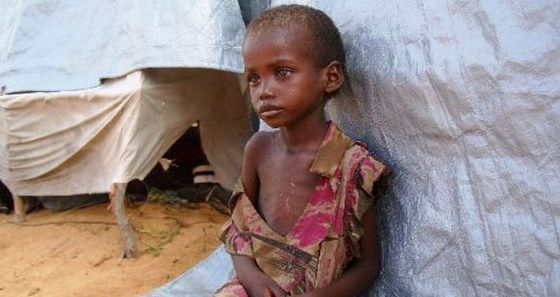
And while Washington continues to look at Somalia through the mind-numbing prism of “global terrorism,” the people of this war-torn nation struggle to survive.

A staggering ten percent of children under five are now dying from starvation every 11 weeks.

AFP reports:

Ten per cent of Somali children aged under five are dying every 11 weeks in the country’s devastating famine, which is spreading faster than aid agencies can cope with, UN officials warned on Wednesday.

The UN representative to Somalia also told the UN Security Council that warlords will take control of areas of Mogadishu abandoned by Islamist insurgents last weekend unless the transitional government quickly gets a grip.

The envoy, Augustine Mahiga, said about half the Somali population, about 3.7 million people, are now at risk from famine. The UN estimates that more than 12 million are affected across East Africa.

Across the famine zone, more than 13 children out of every 10,000 aged under five die each day, Mahiga said. ‘This means that 10 per cent of children under five are dying every 11 weeks. These figures are truly heart-wrenching,’ the envoy told the council, appealing for greater international assistance.

The UN has asked for one billion dollars for Somalia, but Catherine Bragg, the deputy UN emergency relief coordinator, said less than half the sum has been raised.

Facebooktwittermail

Israeli security forces’ September weapons

Ynet reports:

The Defense Ministry has invested more than NIS 75 million (roughly $22 million) in purchasing non-lethal weapons to disperse mass protests in preparation for possible September riots.

The Ministry is gearing up for possible riots in the West Bank, the Gaza Strip and inside Israel following the Palestinian plan to seek UN membership. Defense Ministry Director-General Udi Shani ordered the allocation of funds from the ministry’s budget as well as from foreign aid for the purchase of sophisticated crowd dispersal means.

Last May the IDF lacked appropriate means to prevent the infiltration of Palestinians from Syria and Lebanon during the “Nakba” and “Naksa” day events forcing the troops to use live ammunition. The IDF was criticized for causing injury to non-armed individuals.
Gearing Up

The crowd dispersal means will be divided between the police and the army: Police will get NIS 40 million-worth of equipment and the IDF will receive the equivalent of NIS 35 million. The majority of the non-lethal weapons will arrive in Israel towards September.

The Defense Ministry purchased gas grenades, “Federal” rifles mounted on vehicles and water tanks that can carry 2,500 liters to be installed on vehicles. The police and the IDF will have at least 17 vehicles with water spraying systems at their disposal by September.

The Ministry also purchased a small amount of electroshock taser guns to be used against protestors standing close to security forces, as well as a large amount of gas grenades, helmets and protective gear.

But the “star” acquisition is “the skunk” – a strong-scented substance which causes nausea and vomiting. The IDF will spray the substance from the ground or from the air in clashes with rioters. The Defense Ministry purchased massive amounts of “the skunk” which is manufactured in Israel. A senior security official described the acquisitions as a “dramatic step up in the security forces preparedness.”

Facebooktwittermail

U.N. slams Israel for lethal reply to protesters along Lebanese border

The Wall Street Journal reports:

The United Nations sharply criticized Israel for using live ammunition in May against Palestinian protesters who tried to scale an Israeli security fence on the Lebanese border, according to a U.N. report reviewed by The Wall Street Journal.

The confidential report to the U.N. Security Council, dated Friday, also accuses Israel of violating the 2006 cease-fire agreement that ended the six-week conflict between Israel and Hezbollah, the Lebanese Shiite group. The May 15 incident near Maroun al-Ras, Lebanon, led to seven deaths and 111 injuries.

The report also accuses about 1,000 protesters of a group of 10,000 that day of violating the cease-fire by carrying out a “provocative and violent act.”

The report appears to have further strained relations between the U.N. and Israel and is likely to increase Israel’s isolation amid an international campaign to challenge its policies on the occupied territories.

The U.N. blamed Israel for turning too quickly to live ammunition to stop the protesters advancing on the Israeli border. “Other than firing initial warning shots, the Israel Defense Forces did not use conventional crowd-control methods or any other method than lethal weapons against the demonstrators,” the report said. It added that the act “constituted a violation of [the cease-fire] resolution and was not commensurate to the threat to Israeli soldiers.”

Facebooktwittermail

Time to ditch the Oslo Accords

Akiva Eldar writes:

In October 1991 he came with U.S. President George H.W. Bush to the Madrid Conference, which squandered the fruits of the Gulf War victory. In September 1993 he celebrated, with U.S. President Bill Clinton, the birth of the battered Oslo Accords. In early 1997 he managed to get Prime Minister Benjamin Netanyahu to sign the Hebron Accord, which left tens of thousands of Palestinians to the mercy of the students of Rabbi Dov Lior of Kiryat Arba. In late 1998 he was among those who gave birth to the Wye River Memorandum, which died in infancy. In 2000 he was a senior partner to the reverberating failure of American diplomacy in Israeli-Syrian and Israeli-Palestinian negotiations. And here he is again, this time as U.S. President Barack Obama’s special envoy responsible for prolonging the death throes of the terminally ill patient known as the peace process.

Before Dennis Ross’ comeback, our acquaintance managed to write a new book (together with David Makovsky ) called “Myths, Illusions, and Peace: Finding a New Direction for America in the Middle East.”

It would be tough to find a bigger expert than Ross on the myths and illusions related to peace between Israel and the Palestinians. For years he has been nurturing the myth that if the United States would only meet his exact specifications, the Israeli right would offer the Arabs extensive concessions.

During the years he headed the American peace team, Israeli settlement construction ramped up. Now Ross, the former chairman of the Jewish People Policy Institute, is trying to convince the Palestinians to give up on bringing Palestinian independence for a vote in the United Nations in September and recognize the State of Israel as the state of the Jewish people – in other words, as his country, though he was born in San Francisco, more than that of Palestinian Authority President Mahmoud Abbas, who was born in Safed.

If they give up on the UN vote, Ross argues, then Netanyahu will be so kind as to negotiate a final-status agreement with them. Has anyone heard anything recently about a construction freeze in the settlements?

Ross is trying to peddle the illusion that the most right-wing government Israel has ever seen will abandon the strategy of eradicating the Oslo approach in favor of fulfilling the hated agreement. In an effort to save his latest boss from choosing between recognizing a Palestinian state at the risk of clashing with the Jewish community and voting against recognition at the risk of damaging U.S. standing in the Arab world, Ross is trying to drag the Palestinians back into the “peace process” trap.

If Obama really intended to justify his receipt of the Nobel Peace Prize, he would not have left the solution to the Israeli-Palestinian conflict in the hands of this whiz at the never-ending management of the conflict.

Let us hope that the Palestinians are not tempted to give up on the UN vote in favor of the appearance of negotiations, which will serve to further prolong settlement expansion under the cover of the Oslo Accords. All we need is to recall the statement by Netanyahu, in which he was recorded telling settlers in Ofra in 2001 that he had previously extorted from the Americans a commitment that he would be the one to determine what qualifies as the “defined military sites” in the territories that will remain under Israeli control.

Netanyahu said that from his perspective the entire Jordan Valley qualifies. “Why is this important?” he asked. “Because from that moment I put a halt to the Oslo Accords.”

As for Foreign Minister Avigdor Lieberman, the Palestinians need to trap him with his own words; he had previously threatened that if the United Nations recognizes a Palestinian state, Israel will annul the Oslo Accords.

If I were in Abbas’ place, I would tell Dennis Ross that he should tell his president to forget about negotiations without recognition in writing from Netanyahu stating that the permanent borders will be based on the 1967 lines with agreed-upon changes and committing to a total freeze of settlement construction during negotiations and a set timetable for withdrawal from the territories.

You don’t want Oslo? Fine, we don’t need it. No more “Palestinian Authority”; no more Area A, B or C (a division that has in effect created a Land of the Settlers on 60 percent of the territory ); no more “peace process.”

Restore military rule in the West Bank. At the same time, you can reoccupy Gaza and go back to Gush Katif.

According to the Oslo Accords, the final-status agreement was supposed to have been decided upon 13 years ago – meaning that we would be celebrating its bar mitzvah this year. On September 13, the accords themselves will be turning 18, the number signifying life in the Jewish mystical tradition. The time has come to put the Oslo Accords out of their misery.

Facebooktwittermail

The UN already voted for a Palestinian state — in 1947

Josh Ruebner writes:

Palestinians are now preparing an application for the State of Palestine to become a full member of the UN and engaging in a diplomatic offensive to add to the approximately 120 countries already recognizing Palestinian statehood in advance of this September’s UN General Assembly meeting.

The Obama administration is predictably and unalterably opposed to this initiative. At last month’s American Israel Public Affairs Committee policy conference, the president pledged that “No vote at the United Nations will ever create an independent Palestinian state…the United States will stand up against efforts to single Israel out at the United Nations…Israel’s legitimacy is not a matter for debate.”

By equating Palestinian efforts to seek their rights at the UN with the “delegitimization” of Israel and by attempting to subvert this initiative, President Obama is historically, morally, and politically wrong.

Although he may win applause from Israel’s supporters by claiming that the UN cannot vote for Palestinian statehood, President Obama is powerless to change the historical record. The UN already voted for the creation of an independent Palestinian state when it passed General Assembly Resolution 181 in 1947, partitioning historic Palestine into a Jewish state (55 percent of the territory) and an Arab State (45 percent), with Jerusalem as an open, international city. Ironically, this resolution would not have passed without the aggressive U.S. lobbying effort that accompanied it.

Ever since the UN voted to partition Palestine, at a time when Palestinians owned 93 percent of the land and Jews 7 percent, Israel’s ceaseless quest to depopulate, colonize, and annex as much Palestinian land as possible has been the primary factor preventing the establishment of an independent Palestinian state.

Palestinians have waited 64 years since the partition of Palestine to live in freedom on at least a portion of their homeland. By attempting to force Palestinians back to never-ending negotiations with Israel, President Obama is subjecting Palestinian freedom to Israel’s timetable.

Facebooktwittermail

The fight for Libya

Prospects fade for military overthrow of Gaddafi
Libyan rebels said on Friday they repulsed a government assault on the besieged city of Misrata but prospects faded for a military overthrow of Muammar Gaddafi.

NATO leaders acknowledged the limits of their air power, which has caused rather than broken a military stalemate, and analysts predicted a long-drawn out conflict that could end in the partition of the North African oil producer.

Alliance officials expressed frustration that Gaddafi’s tactics of sheltering his armor in civilian areas had reduced the impact of air supremacy and apologized for a second “friendly fire” incident on Thursday that rebels said killed five fighters. (Reuters)

Ex-Libyan minister foresees more defections
Another former aide to Colonel Muammar Gaddafi has sought asylum in Europe.

One-time Libyan energy minister Omar Fathi Bin Shatwan has fled to Malta.

In this first televised interview since the start of the rebellion, Bin Shatwan said time is running out for Gaddafi’s regime and more Libyan ministers would like to defect.

“Most of the people want to the same as Koussa and some others have done, but they cannot do it because they don’t have the chance to do it,” Bin Shatwan told euronews. (Euronews)

Torture and killing in Kenya – Britain’s double standards
This week, a British human rights lawyer backed by the Foreign Office managed to strong-arm an apology out of Libya’s revolutionary leadership for the actions of the man it is struggling to overthrow.

The apology and promise of compensation over Muammar Gaddafi’s supply of explosives used in IRA bombs and his role in blowing up the Pan Am flight over Lockerbie was made by the rebels in the name of the Libyan people as a whole – a move that astonished and offended many Libyans, who see no reason to take responsibility for the crimes of their oppressor.

But the Foreign Office shared the view of the British lawyer, Jason McCue, that saying sorry for something they had no hand in would somehow be good for the Libyan people as a whole by establishing a newfound commitment to human rights. The promise of money helps, of course.

The truth is that the revolutionary leadership, which has rather more pressing issues to hand such as keeping Gaddafi’s troops from overrunning Benghazi, felt it had to play along to bolster crucial support from the UK and the west. McCue even praised David Cameron for making the case a priority at the Foreign Office.

This demonstration of power politics is made all the more distasteful by the contrasting attitude of the British government at the high court toward victims of the most depraved torture, gruesome killings and mass hangings by Britain during Kenya’s struggle for independence.

Hiding behind legal contortions, the government is refusing to apologise or pay compensation for appalling abuses done in the name of and with the knowledge of the British state, with the intent of preserving a system of racist privilege for white settlers in the east African colony. (Chris McGreal)

Ban Ki-moon learns to love regime change
At U.N. headquarters, regime change has long been viewed as a toxic phrase.

Under former U.N. Secretary General Kofi Annan, the U.N. brass cringed when American politicians and diplomats, both Republican and Democratic, revealed that their true aim in pursuing U.N. arms inspections and sanctions in Iraq was the downfall of Saddam Hussein.

But in the past two months, U.N. Secretary General Ban Ki moon has reversed course, fully embracing the toppling of governments in Ivory Coast and Libya. On Monday, Ban authorized a U.N. military operation, backed by French military power, to strike at key military bases, and installations under the control of Ivorian strongman Laurent Gbabgo.

The operation — which included helicopter gunship attacks against army camps by blue-helmeted Ukrainian pilots — was ostensibly aimed at preventing Gbagbo’s forces from using their heavy weapons against civilians and U.N. personnel. But its impact on the conflict was decisive: The U.N. and French attacks had degraded Gbagbo’s last line of defense, clearing the way for a final offensive by followers of Ivory Coast’s president-elect Alassane Ouattara.

Within 24 hours, Gbagbo’s top generals had written to the United Nations with an offer to halt the fighting and surrender their weapons, together with a request that their fighters be protected. Gbagbo remained holed up in a bunker underneath the presidential residence, under attack by Ouattara’s forces.

The U.N. chief’s action in Ivory Coast is all the more surprising given his readiness throughout most of his term to accommodate some of the world’s most noxious governments, notably Burma, Sri Lanka and Sudan. Ban had bet much of his political capital upon his capacity to use personal, quiet diplomacy, to nudge the likes of Burmese junta leader Than Shwe, Sri Lankan president Mahinda Rajapaksa and Sudanese leader Omar Hassan al-Bashir, to moderate their mistreatment of their own people. (Colum Lynch)

Facebooktwittermail

The fight for Libya

The New York Times reports:

NATO will assume leadership from the United States of patrolling the skies over Libya but the military alliance remains divided over who will command aggressive coalition air strikes on Col. Muammar el-Qaddafi’s ground troops, NATO and American officials said Thursday.

After a day of confusion and conflicting reports out of NATO headquarters in Brussels, Secretary of State Hillary Rodham Clinton announced late Thursday in Washington that NATO had agreed to lead the allies in maintaining the no-fly zone. Effectively, that means that planes from NATO countries will fly missions over Libya with little fear of being shot down since Tomahawk missiles, most of them American, largely destroyed Colonel Qaddafi’s air defenses and air force last weekend.

But NATO balked at assuming responsibility, at least for now, of what military officials call the “no-drive zone, which would entail bombing Colonel Qaddafi’s ground forces, tanks and artillery that massing outside crucial Libyan cities, and doing so without inflicting casualties on civilians.

Late Thursday night a senior Obama administration official insisted that NATO had agreed to assume responsibility for the no-fly and “no-drive” zones but said the details remained to be worked out. The official’s statements appeared to contradict those of the secretary-general of NATO, Anders Fogh Rasmussen.

A NATO official said that two member nations, Germany and Turkey, objected to NATO participating in strikes that they consider beyond the mandate of the United Nations security resolution that authorized the military action in Libya.

Associated Press reports:

The international military operation against Libyan leader Moammar Gadhafi’s forces may last days or weeks — but not months, France’s foreign minister said Thursday, as allied countries tried to work out who will run the campaign.

Alain Juppe also said he hopes the airstrikes in Libya and the boisterous quest for freedom and democracy in the Arab world will serve as a warning to autocratic regimes elsewhere, including in Syria and Saudi Arabia.

“The job of dictator is now a high-risk job,” Juppe said, noting that some autocrats — including Gadhafi — have been targeted by the International Criminal Court.

Laura Rozen reports:

With a new poll showing 60 percent of the American public approves of the allied air campaign to protect Libyan civilians, it seems that popular opinion is leaning toward cautious support for the limited U.S. military intervention that President Barack Obama is conducting. But the same poll shows that Americans are deeply averse to endorsing deeper U.S. involvement if the current effort fails to restrain Libya’s Muammar Gadhafi.

The new Reuters/Ipsos poll, conducted on March 22, just four days into the air strikes, found that 40 percent of Americans oppose U.S. and allied military action in Libya, leaving no one in the undecided camp.

But while four in five Americans agree that the United States and allies should seek Gadhafi’s removal, they don’t support increasing U.S. military involvement to achieve that goal. If the current air strikes fail to curb Gadhafi’s crackdown on dissent in the country, almost one in three Americans say they don’t know what to do. One quarter say the U.N. should then send in peacekeeping troops. However, just 7 percent of those surveyed say that the United States and its allies should send in ground troops (“peacekeeping troops” seems merely a rhetorically less worrisome way to say “ground troops.”) A lukewarm 23 percent say the best path forward in that scenario would be to increase air strikes–essentially, more of the same.

Noman Benotman, a former leader of the Libyan Islamic Fighting Group, says:

Gaddafi has tried very hard to give the impression that the Libyan opposition is controlled by al-Qaeda. This ideas flies in the face of all the evidence. The opposition is a diverse coalition of Libyans from many tribal and political backgrounds. Just because some Islamists support the opposition against Gaddafi this does not make the opposition Islamist.

At the same time, there are some extremists who want to manipulate the Libyan conflict for their own ends. Al-Qaeda in the Islamic Maghreb (AQIM) is looking for ways to play a greater role in this conflict. Since the start of the year it has tried to move men and arms into Libya from its bases in Niger and Mali, near Libya’s southern border. At the same time, al-Qaeda’s leaders in Pakistan and Afghanistan are trying to portray the international intervention in Libya as a ‘crusader’ attack on Muslim in order to further their own agenda.

Colum Lynch reports:

In the rush to curtail Muammar al-Qaddafi’s military capacity to attack civilians in Libya, the U.N. Security Council voted unanimously on February 26 to impose a comprehensive arms embargo on Libya. But the measure also unwittingly impeded the effort of the Western-backed rebels to fight Qaddafi’s forces.

Paragraph 9 of Resolution 1970 required all U.N. members to “immediately take the necessary measures” to bar the sale, supply or transfer of weapons, mercenaries, or other supplies to Libya. The arms embargo, which was adopted before the rebels had emerged as a potential threat to the regime, included no exemptions for Qaddafi’s foes.

Ever since the passage of that first resolution, government lawyers from the United States, Britain and France have been looking to see if they can find a way around it, according to U.N.-based diplomats. The United States may have now found one.

Facebooktwittermail

Gilbert Achcar on the Western intervention in Libya

The Washington Post reports:

Buoyed by U.S. and allied airstrikes that relieved a siege of Benghazi, Libyan rebels launched an offensive early Monday aimed at retaking the strategic city of Ajdabiya, as Western warplanes continued pounding forces loyal to longtime leader Moammar Gaddafi.

Explosions and plumes of smoke marked the scene of the strikes against Gaddafi’s forces in Ajdabiya, about 100 miles south of the rebels’ de facto capital of Benghazi, and advancing rebels cheered when Western warplanes flew overhead. The rebels by Monday had regained control of Zuwaytinah, an oil terminal about 16 miles northwest of Ajdabiya that had been captured by loyalist forces last week, news agencies reported

Despite the airstrikes, however, Gaddafi’s forces were digging in outside Ajdabiya, which straddles highways that go north to Benghazi and east across the desert to Tobruk.

From a point about five miles from the northern entrance to Ajdabiya, rebels jumped into dozens of vehicles and made a massive push toward the city Monday when they heard jets in the air and the sounds of bombardment. But after about half a mile, the rebels came under fire from loyalist tank and mortar shelling and promptly turned back.

Afterward, rebel commanders said they plan to wait for more allied airstrikes against Gaddafi’s forces before pushing forward again.

In Benghazi, Libya’s second-largest city, anti-Gaddafi spokesmen said the rebels ultimately still plan to march on Tripoli, the Libyan capital where the 68-year-old strongman remains ensconced. Opposition spokesman Ahmed al-Hasi said the rebels would welcome more airstrikes but want to achieve their aims without the intervention of foreign ground troops, Reuters news agency reported.

Facebooktwittermail

The fight for Libya

The Los Angeles Times reports:

With his popularity at a record low and facing an election next year, French President Nicolas Sarkozy was in desperate need of a boost to his political stature.

And on Saturday, he got it.

The French leader, once dubbed Super Sarko by the local press for his eagerness to take the reins in global crises, summoned leaders from four continents to an emergency war council at the Elysee presidential palace in Paris to agree on military action against strongman Moammar Kadafi in Libya.

His 20 guests had barely reached an agreement when Sarkozy announced that French planes were already in the air preparing to strike.

With almost theatrical gravitas, Sarkozy said France had “decided to assume its role, its role before history” in stopping Kadafi’s “killing spree” against people whose only crime was to seek to “liberate themselves from servitude.”

Barely more than three years ago, Sarkozy gave Kadafi the red carpet treatment in Paris, welcoming him with open arms and allowing the Libyan leader to pitch a Bedouin tent near the Elysee. Now the French president was announcing that he was sending warplanes in to bomb him.

Beside Sarkozy was British Prime Minister David Cameron, France’s partner in the military offensive, talking tough but overshadowed by his Gallic counterpart.

The Guardian reports:

In Britain, the question Cameron was asked in the Commons after his statement on Friday was an understandable one: is the UK capable of such a military endeavour? The prime minister – speaking coincidentally eight years to the day since Tony Blair asked parliament for its backing for the invasion of Iraq – was in no doubt that the country was in good shape for the campaign, and he reminded MPs that the UK was still the world’s fourth-biggest spender on defence.

Indeed, it is arguable that one of the figures vindicated by events over the past 48 hours was Liam Fox. The defence secretary has overseen a sometimes brutal, relatively successful, campaign to lessen the size of the cuts to trim the Ministry of Defence’s £36bn of debt, arguing that Britain needs to retain its capability to strike quickly and decisively in an increasingly unpredictable world.

Libya, in more ways that one, has bolstered his cause. Only on Thursday – hours before the no-fly zone was approved by the UN – a confident-sounding Fox was promising defence unions that he would still find ways to reduce the fallout of last year’s strategic defence and security review, by promising to save thousands of threatened civilian jobs. Yet, just a fortnight earlier, he had kicked off the month by confirming that more than a 1,000 jobs would be axed from the RAF by September, with almost 1,700 to follow. Speculation clouded the future of the Tornado GR4 strike aircraft with reports that the squadron at RAF Lossiemouth would be axed.

Libya, Fox might believe, would put a stop to such reports, reaffirming the need for a varied and sizeable air force. The Tornado, after all, has excelled in battle and is likely to be the first British assets used against Gaddafi.

Foreign Policy reports:

As the U.N. Security Council voted the evening of March 17 to impose a no-fly zone over Libya, the international media broadcast the joyous reaction from the streets of Benghazi, the de facto capital of the Libyan opposition. Thousands of Libyans celebrated in the streets, waving the old Libyan flag that has become the revolution’s standard and firing guns happily into the air. A spokeswoman for the Libyan opposition said that the revolutionaries were “embracing each other” over the U.N. decision.

But until recently, Benghazi’s attitude toward outside intervention was different. The rebels’ attitude toward the role of the international community evolved as Col. Muammar al-Qaddafi’s forces advanced aggressively over the past week, threatening to use their superior firepower to quash the poorly armed rebellion.

Only two weeks ago, professionally designed posters were plastered on billboards around Benghazi’s elegant palm tree-lined streets reading: “No foreign intervention. Libyan people can do it alone.” Men and women in the city reacted defiantly to suggestions they needed outside support. Qaddafi had already tried to pin the uprising on al Qaeda — they wanted change to come exclusively from a homegrown movement free from allegations of outside influence.

Views quickly changed as Qaddafi’s military continued to advance across the country’s east. Even as the Security Council met to announce its decision, Qaddafi’s forces were shelling Ajdabiya, the last town on their march toward Benghazi. In a radio address, Qaddafi — perhaps in a show of propaganda — vowed that his forces would reach Benghazi that night, and that they would “show no mercy and no pity” to the rebels.

The New York Times reports:

In a Paris hotel room on Monday night, Secretary of State Hillary Rodham Clinton found herself juggling the inconsistencies of American foreign policy in a turbulent Middle East. She criticized the foreign minister of the United Arab Emirates for sending troops to quash protests in Bahrain even as she pressed him to send planes to intervene in Libya.

Only the day before, Mrs. Clinton — along with her boss, President Obama — was a skeptic on whether the United States should take military action in Libya. But that night, with Col. Muammar el-Qaddafi’s forces turning back the rebellion that threatened his rule, Mrs. Clinton changed course, forming an unlikely alliance with a handful of top administration aides who had been arguing for intervention.

Within hours, Mrs. Clinton and the aides had convinced Mr. Obama that the United States had to act, and the president ordered up military plans, which Adm. Mike Mullen, chairman of the Joint Chiefs of Staff, hand-delivered to the White House the next day. On Thursday, during an hour-and-a -half meeting, Mr. Obama signed off on allowing American pilots to join Europeans and Arabs in military strikes against the Libyan government.

The president had a caveat, though. The American involvement in military action in Libya should be limited — no ground troops — and finite. “Days, not weeks,” a senior White House official recalled him saying.

Facebooktwittermail

Libyans disappoint the anti-war movement and the anti-imperialists

The mere fact that Gaddafi has been served notice that continued military operations will bring reprisals has not been sufficient to persuade him to implement a unilateral ceasefire which he already promised. Benghazi is currently under attack.

Meanwhile, as missiles are coming down on the last refuge of the Libyan revolution, a strange message is going out to the people whose lives are still threatened by Gaddafi’s forces. Social activists and members of the anti-war movement want the revolutionaries to know that they feel betrayed and let down!

There are people in places like Montreal and Chicago who have dedicated their lives — or at least careers, or blogs, or speaking tours — to challenging the mighty forces of Western imperialism, and then the folks in Benghazi hand out an open invitation for NATO to come along and rescue them. Unforgivable!

Max Forte writes:

Elements of the rebel leadership have stained their own name, and stained their revolution. That is inescapable now. But what is damaging to all of us is the narrow, self-centered, provincialism of what is clearly a neo-colonial elite of former regime insiders serving as self-appointed “representatives of the Libyan people,” elites who like the neo-colonized, depend on aid from abroad as part of their self-fulfillment. Cheering for what will be a NATO-led operation, is a validation and legitimation of that organization, and in a time when budgets for education, health, public works, and programs for the poor are all being slashed across the West, they help to validate the need for maintaining heavy military spending. Nobody is out in the streets cheering universities and hospitals, but apparently they are out in the street cheering the bomb. Their provincialism was displayed in their lack of solidarity, or even passing concern, with social justice and anti-war activists in the West, in cases berating those of us who felt we should have a voice — these are, after all, our planes, our bombs, and our political leaders — because all we needed to know was that “Libyans” asked for this intervention. If that is a reflection of the kind of political work and solidarity-building they did at home, then no wonder they had to turn to artificial, prosthetic solutions. Not just the anti-war movement, and the anti-secrecy movement, will be damaged here, as the clock is turned back to 2003 — it is the very meaning of “revolutionary,” which can now be made to include those who would be clients of imperial patrons.

So, the current predicament of the Libyan revolution is not the result of the brutality of the regime and its oppressive rule, but because of its second-rate revolutionary leaders, their lack of political skill and their deficiencies in solidarity-building?

I guess the “fall” of the Libyans actually took place the first day they started shooting back and revealed that they lacked Gandhi’s commitment to non-violence. If only they had possessed the moral strength of their Western supporters-now-turned-critics and realized that Gaddafi could be toppled with pure love.

OK, I’ll dispense with the sarcasm. The fact is, I find it extraordinary, that anyone aligned with any kind of movement whose basis is human solidarity would not have enough empathy to recognize that people whose lives are under immediate threat, do not have the luxury of picking and choosing between possible sources of protection just for the sake of maintaining the ideological purity of their cause.

If revolutionaries in Tunisia and Egypt had been able to join forces with their counterparts in Libya and collectively bring down Gaddafi, that would have been the dream combination. But it couldn’t happen — or at least, it couldn’t happen soon enough.

And the idea that the Arab democratic revolution is now over because of Western intervention in Libya, conveniently skirts over the implications that Gaddafi’s victory might have for the wider revolution.

The Western intervention of the most dangerous and insidious form would be Western non-intervention as autocratic regimes, emboldened by Gaddafi’s success in crushing the Libyan revolution, followed in his footsteps and crushed revolts across the region while the US quietly took comfort in the restoration of “stability.”

Now that the Obama administration has veered off its previously steady and passive response to the region’s uprisings, the remaining regimes have become more — not less — vulnerable. Hence the Arab League’s support for Res. 1973. The Gulf states are desperate to demonstrate how supposedly different they are from Gaddafi because their inequities and centralization of power are so similar. Gaddafi might not indulge in the same level of gross opulence as his royal Arab counterparts, but he shares their fear of political freedom.

Maybe Benghazi is not populated by failed revolutionaries but the failure comes from the outside through a projection of revolutionary aspirations by those who are disappointed by the lack of revolutionary tendencies in their own societies.

The driving force behind the Arab democratic revolution in Libya and elsewhere is not a lofty desire to change the world — it’s simply a hunger among ordinary people to be able to control their own lives.

Facebooktwittermail

Libya – rough guide to the new UN Security Council resolution (1973)

Carne Ross writes:

Here’s a quick and provisional analysis of the main provisions of last night’s SCR 1973. I am not a lawyer, so my reading may not be wholly accurate, though I have negotiated a lot of these kind of resolutions, including on Libya and Iraq. This analysis should serve as a rough and ready guide.

Overall: the thrust of the resolution is to demand a ceasefire and to impose various military and non-military measures to seek to force the Libyan regime to fulfill its responsibility to protect civilians. The resolution authorizes military force in certain clear circumstances (eg to impose a No Fly Zone) but also in more general terms to protect civilians. The non-military measures amount to a significant tightening of sanctions on the Libyan regime, including an assets freeze on all Libyan government organisation and those indirectly controlled by the government (which would also presumably include Libyan oil companies – highly significant if so: effectively an oil embargo). Also, the resolution lays particular emphasis on regional calls for protection of civilians and No Fly Zones, eg by the Arab League and OIC.

Facebooktwittermail

The fight for Libya

Simon Tisdall writes:

Muammar Gaddafi’s ceasefire offer will not satisfy western leaders queuing up to take a shot at him – but it’s unclear what will. When the US and its allies invaded Iraq in 2003 the aim was to overthrow Saddam Hussein. When Nato entered Kosovo in 1999 its purpose was to stop ethnic cleansing by Slobodan Milosevic’s army. The precise objectives of the Libyan war 2011, and how they will be achieved, are less well-defined – and therefore, potentially problematic.

The ceasefire hastily announced by Libyan foreign minister Moussa Koussa in the wake of UN resolution 1973 authorising foreign military intervention will be seen as a welcome first step. Except that regime forces bombarding Misrata and other cities appeared not to hear the news. Given Tripoli’s talent for lies, the enforcement, verification, and permanence of a ceasefire could be a vexed and lengthy matter. It will not happen overnight.

Downing Street has tried to clarify what its eclectic alliance – including France, the US, Saudi Arabia, Qatar, Italy and Denmark (and maybe Malta) – thinks it is doing in Libya. David Cameron and Barack Obama agreed that “the violence against the Libyan people needed to cease, that Gaddafi should depart from power now, and that the Libyan regime should comply with the [UN] resolution immediately”, it said.

William Hague, the foreign secretary, added root and branch regime change to this wish list. “The Libyan people must be able to have a more representative government and determine their own future,” he said.

On this basis, the expanding aim of the intervention is not only to stop the violence and remove Gaddafi (and his sons) from power. Its more ambitious purpose is to oversee a democratic system on western lines in a largely undeveloped country that has never known representative governance and has no tradition of civil rights and individual freedoms. This sounds more like Afghanistan-style nation-building every minute.

A Reuters analysis says:

Finally confronted by a far stronger adversary, Muammar Gaddafi’s pragmatic instincts will be to stall, secure a truce and negotiate continued control of a rump regime based in Libya’s west.

His life as well as his rule at stake, the veteran autocrat will also tighten security control over his entourage to avert any repetition of the numerous coup attempts that have marked his 41 years in power, analysts say.

But his options have shrunk dramatically since the U.N. Security Council on Thursday evening endorsed a no-fly zone and “all necessary measures” to shield civilians from his forces.

Analysts who know Gaddafi, an old hand at surviving prolonged international isolation, say the goal of U.N.-backed action must be regime change.

Any endgame short of that will offer openings he can exploit. For example, some expect Gaddafi, adept at brinkmanship, to call for talks mediated by African statesmen to gain time and carve rifts in the coalition ranged against him.

“He’s a manipulator and a survivor,” said Saad Djebbar, a UK-based Libya expert.

“He shouldn’t be allowed to negotiate to stay on in Tripoli. He wants to engineer the division of Libya, like Korea was split into a North and a South in the 1950s.”

Reuters reports:

Muammar Gaddafi’s government said it was declaring a unilateral ceasefire in its offensive to crush Libya’s revolt, as Western warplanes prepared to attack his forces.

But government troops pounded the rebel-held western city of Misrata on Friday, killing at least 25 people including children, a doctor there told Reuters. Residents said there was no sign of a ceasefire.

And in the rebel-controlled east, the government declaration was dismissed as a ruse or a sign Gaddafi was desperate.

“We have to be very cautious. He is now starting to be afraid, but on the ground the threat has not changed,” a French spokesman said. Britain, like France a strong advocate of armed action, said it would judge Gaddafi by “actions, not his words”.

CNN reports:

Even as Secretary of State Hillary Clinton said the ultimate goal for the U.S. was to see Libya’s president cede power, a senior administration official says the U.N.-mandated no-fly zone and military action to support it would not necessarily last until Libyan leader Moammar Gadhafi steps down.
This official, who spoke on background because of the diplomatic sensitivity of the issue, said that “right now, we’re focused on stopping the violence.”

Clinton said Friday, “The first and overwhelming urgent action is to end the violence. And we have to see a clear set of decisions that are operationalized on the ground by Gadhafi’s forces to move physically a significant distance away from the east, where they have been pursuing their campaign against the opposition.”

The purpose of the no-fly zone, the administration official said, is to prevent Gadhafi from attacking his own people.

“It’s not designed to have him go. That’s not the purpose,” the official said. “The purpose of the military action is to prevent massive humanitarian loss of life, to stop the violence. If the violence stops, then you shouldn’t leap to say then the military action will continue until he leaves.”

The Guardian reports:

How soon before the no-fly, no-drive zone in Libya is enforced by US forces? According to US Air Force chief of staff Norton Schwartz, speaking to senators in Washington yesterday and reported by Foreign Policy – plans to impose a no-fly zone in a few days were “overly optimistic” and said: “It would take upwards of a week.”

The Washington Post reports:

In the streets and alleyways of this cowed and fearful city, the lingering traces of a crushed revolution are fading fast.

At one junction, the charred remains of incinerated tires burned by demonstrators are being flattened by traffic as Tripoli gradually returns to a semblance of normality. A scorched police station is operating again, with police in black uniforms and green bandanas sitting on stools outside. The bloodstains in a sandy side street where residents say soldiers opened fire with live ammunition have been washed away by spring rains.

And in Green Square, the symbolic heart of the city, government supporters gather on a daily basis, not anti-regime protesters, to chant slogans and brandish portraits in a triumphal assertion of Moammar Gaddafi’s continuing grip on power.

While the United Nations has now authorized military action to protect rebels in the far east of the country, it may now be too late to revive the failed uprising in the capital. Libya’s foreign minister may have declared a cease-fire on Friday, but in Tripoli, Gaddafi’s stronghold, the real battle for Libya appears already to have been fought and won by a regime that was willing to use live ammunition against its opponents.

Reuters reports:

Four New York Times journalists who were captured by Libyan forces while covering the conflict there will be released on Friday, the Times reported.

The son of Libyan leader Muammar Gaddafi, Seif al-Islam, told ABC News they would be released, and the Times reported that Libyan officials told the U.S. State Department on Thursday evening that all four would be released.

Facebooktwittermail

The fight for Libya

Hana El-Gallal, a law professor from Benghazi, writes:

The global community must act to stop Gaddafi and his forces reaching Benghazi. If he gets here, he will kill everyone. We in Benghazi, in what is left of Free Libya, have a very simple message for the Security Council. Please, do something. We are desperate for your help and you must do it now. It is the time to act and if you don’t there will be genocide. We are called rebels, but we are not rebels. We are a people that simply wants the same freedoms and liberties enjoyed by the people in the West. For 42 years, one man and his family have denied the people of Libya their dignity.

Whenever he gets to Benghazi, he will deny us our lives too.

Days ago, a no-fly zone could have been imposed and that would have helped. It would still help, but now it may be too late. Even so, it is not too late to help to stop him reaching us.

There are soldiers here, willing to fight for us, but we have no weapons. We are walking around gathering up what we can use to defend ourselves. I am a mother, not a member of al-Qa’ida; not a mujahideen. But when Gaddafi gets to Benghazi, I will have to be a fighter, not only to defend myself and my family, but also to defend the dignity of a people who have told the tyrant that has raped our country to go.

The world needs to know this will not happen unless we get help. We are a brave people and we will fight. But we will also lose without the help of the rest of the world. And if the international community does not act, it will remain of the conscience of the people that did nothing. China, with your riches; America, with your power; Europe, with your history – you will all be guilty of standing aside and letting Gaddafi massacre his innocent people. We did not want to fight, but we were forced to, and now, in our moment of need, we are calling for the world to come together and defend us from this evil man. It has been said the Libyan people do not want foreign troops on our soil, but which country does? Now it is too late for these arguments. Libya is not Iraq: it is full of desperate people and if the international community decides to send its armies, they will be greeted with joy; a joy that will replace what is now a growing sense of hopelessness.

We pray that our brothers and sisters can hold Ajdabiya. Gaddafi says that he has taken the town, but we know that our friends are still fighting for their lives, even if we know in our hearts that they won’t be able to hold on forever without assistance. And when Ajdabiya falls, there is then nothing to stop Gaddafi and his thugs reaching us here in Benghazi. We are all so frightened of what he will do when he gets here. We are all going to die.

We are all desperately waiting for the UN, or Nato, or the EU or anyone to act. Even the Arab League has called for action – what more of an invitation do people want? It the first time that the Arab League has called for action against one of its members: we have heard the call, but God knows that we have to see the action. We all know intervening in the affairs of another state is a controversial act. The world was sick when it released that inaction led to the deaths of thousands in Rwanda; the world said “never again”. That was only 15 years ago and, without urgent action, what happened in Rwanda will be repeated on the streets of Benghazi, maybe as soon as tomorrow.

We have all heard the speeches of Gaddafi and his sons: does the international community really believe that we are al-Qa’ida and on drugs? It will know that answer soon enough when, after Gaddafi reaches Benghazi, the pictures of our murdered children are shown around the world.

The Wall Street Journal reports:

Egypt’s military has begun shipping arms over the border to Libyan rebels with Washington’s knowledge, U.S. and Libyan rebel officials said.

The shipments—mostly small arms such as assault rifles and ammunition—appear to be the first confirmed case of an outside government arming the rebel fighters. Those fighters have been losing ground for days in the face of a steady westward advance by forces loyal to Libyan leader Moammar Gadhafi.

The Egyptian shipments are the strongest indication to date that some Arab countries are heeding Western calls to take a lead in efforts to intervene on behalf of pro-democracy rebels in their fight against Mr. Gadhafi in Libya. Washington and other Western countries have long voiced frustration with Arab states’ unwillingness to help resolve crises in their own region, even as they criticized Western powers for attempting to do so.

The Independent reports:

Even as the votes to take on the Libyan regime were cast last night, the battle for Benghazi had begun. Col Gaddafi’s warplanes carried out several strikes on the city as artillery volleys started to come in from units approaching from several directions.

The skies above were lit up by constant streams of anti-aircraft fire. Rebel fighters, buoyed by reports that the vote in New York had gone for military action, began to stream towards the western gates of the city.

Even as the violence flared they believed that, at last – a month to the day after Libya’s revolution began – their only realistic hope of avoiding defeat at the hands of the regime had finally come true. But there is a fierce battle ahead. The firefights took place with the constant background sound of mosques in the city playing chants of “Allah hu Akhbar” at high decibel through loudspeakers. The chant was taken up by the rebel fighters, the Shabbab, as they traded fire. Many of the exchanges were chaotic with heavy calibre guns used at random. Flames appeared in parts of the city with black smoke blending into the night sky.

Down below, however, Benghazi was a bright target for the warplanes. No attempt had been made to dim the lights in any of the public buildings in the centre and residential areas also lit up as people came out to windows and balconies to watch the action with some women ululating. The mood of the rebel fighters, who had suffered repeated defeats in recent weeks and had been forced to withdraw from town after town was buoyant. As he manned his anti-aircraft gun, Selim Astersi shouted: “The devil Gaddafi wants to come into Benghazi, we shall throw him back. Tonight we shall prove ourselves. We shall avenge all those he killed.”

Khalid Ibrahimi stopped his truck, carrying five fighters in the back, to ask: “Is it true that they have voted [at the UN] yes ? That is what we needed my brothers, we have got help at last.” At just after 1am local time, two explosions echoed through the waterfront followed by machine-gun fire. Shabaab fighters claimed infiltrators had come into the city but it seemed more likely that some ammunition had detonated.

Facebooktwittermail

UN Resolution 1973/2011 adopted

UN Security Council Resolution 1973/2011 on Libya – full text

10 in favour, zero against, five abstentions.

Voting for the resolution:
Permanent members: United States, Britain, France
Non-permanent members:: Bosnia and Herzegovina, Colombia, Gabon, Lebanon, Nigeria, Portugal, South Africa

Abstentions:
Permanent members: Russia, China
Non-permanent members: Germany, Brazil, India

The Resolution authorizes member states “to take all necessary measures… to protect civilians and civilian populated areas under threat of attack in the Libyan Arab Jamhariya, including Benghazi, while excluding an occupation force.”

Simon Tisdall writes:

With a boldness that the world had begun to believe he lacked, Barack Obama has gone for broke. The US wants Muammar Gaddafi’s head. It will not rest until he is deposed and there is regime change in Libya. And it will fight to get it.

Obama spent weeks pondering, prevaricating and posturing, infuriating Britain and France, arch advocates of military intervention. He used public appearances to prate professorially about plans, contingencies and downsides. He allowed senior administration officials such as Pentagon chief Robert Gates to give full vent to their doubts and misgivings about a possible Libyan quagmire.

Obama is already fighting two wars in Muslim countries he did not start – in Iraq, now all but finished, and Afghanistan. He did not want to author another. He did not want another foreign distraction ahead of his presidential re-election bid next year. He did not want the cost, the corpses or the inevitable collateral damage – political and human.

But gradually the pressure from hawkish Democrats such as John Kerry and Republicans such as John McCain began to tell. The escalating rhetoric from Downing Street and the Elysee Palace will have had an impact, too.

Obama finally made his mind up. The US would intervene to stop him. And there would be no half measures. All steps short of boots on the ground, as the US under-secretary of state William Burns put it are now urgently contemplated, with a view to immediate implementation.

That means possible, imminent air strikes as well as an air exclusion zone. It means direct head-on combat with Libya’s air force, if it chooses to fight. It means, potentially, western casualties, if pilots are shot down or bail out or are taken hostage. It could mean innocent civilian deaths as the EU’s foreign policy chief Lady Ashton warned last week. And if things do not go well, it may mean escalation beyond all that is envisaged now. Who knows when it will stop.

The immediate impact may be to stop Gaddafi’s advance on Benghazi in its tracks. If that happens, the revolution will have been salvaged, albeit at the very last moment. Whether it can endure is another matter entirely.

The US and its European and Arab allies will hope that Gaddafi, facing the prospect of overwhelming, punitive force, will quickly back down, observe the UN demand for a ceasefire, even agree to negotiations. But to be sure of saving Benghazi, a no-fly zone will not be enough. To drive home the point the game is up, it is likely allied air strikes on Gaddafi’s heavy armour and artillery will be required, and possibly also attacks directed at him personally, as Ronald Reagan tried in 1986.

Gaddafi acts like a bully and a coward. But he is full of bluster. Only a sudden, bloody nose will convince him to desist. This is he is probably about to receive. And the betting must be that, once the revised odds become clear, those remnants of the Libyan army and security forces that have so far remained loyal will desert him, too.

The longer term impact of the intervention is immeasurable – but disaster is certainly one possible outcome. Like the first Gulf war, the involvement and support of Arab countries means the Libyan war will not be defined, except by hardline jihadis and al-Qaida, as another western assault on Muslim lands. But if the fighting is prolonged, if Gaddafi does not quit and run, if his more able sons take up his cause, if the intervention makes things worse not better for ordinary people (as in Iraq), if there is no clear-cut win but ongoing low level conflict and resistance (as in Afghanistan), then Arab opinion will turn against the westerners once more. The post-9/11 nightmare of the Pentagon’s long war without end will reproduce on the shores of the Mediterranean.

But there is a reasonable prospect of success, too. If the rebels, rescued from annihilation, prove capable of creating a government able to take over the running of all of Libya, and not just the rebellious east, then Obama’s gamble could pay off.

If Gaddafi, no longer able to deploy superior firepower and mercenaries, is overthrown by his own people, it will be hailed as an improbable triumph for, among others, David Cameron, who took a harder line than most, earlier than most. Britain (and not Germany, which opposed intervention) may profit from the gratitude of a grateful people. If Libya falls to democracy, then like-minded reformers in Bahrain and elsewhere will be greatly heartened.

Obama and Cameron are looking for another Kosovo or Kuwait, not another Iraq. It’s a story, as they would prefer to write it, with a happy ending, producing a newly independent country, and another friend for the west. But they cannot control the outcome. Now they can only wait and hope they were right.

The New York Times reports:

In the most strident verbal attack on Colonel Qaddafi to date by an American official, Secretary of State Hillary Rodham Clinton said Thursday that the Western powers had little choice but to provide critical military backing for the rebels. “We want to support the opposition who are standing against the dictator,” she told an applauding audience in Tunisia on Thursday. “This is a man who has no conscience and will threaten anyone in his way.”

She added that Colonel Qaddafi would do “terrible things” to Libya and its neighbors. “It’s just in his nature. There are some creatures that are like that.”

The Qaddafi government responded to the potential United Nations action with threats.

“Any foreign military act against Libya will expose all air and maritime traffic in the Mediterranean Sea to danger and civilian and military facilities will become targets of Libya’s counter-attack,” it said in a statement carried on Libyan television and the official news agency, JANA, Reuters reported. “The Mediterranean basin will face danger not just in the short-term, but also in the long-term.”

There were reports on Thursday that warplanes were already bombarding the outskirts of Benghazi for a second day, opening shots, perhaps, in the battle. And after days of batterings at the hands of Qaddafi loyalists, the opposition forces welcomed the promise of Western assistance.

Rebel leaders doubted that the loyalist forces could mount an assault on Benghazi tonight, in that they were still contesting Ajdabiya, 100 miles to the south, on Thursday morning. But witnesses said there were skirmishes on the road to Benghazi in the afternoon, about 30 miles from Ajdabiya.

Mohamed, a rebel spokesman in the embattled, rebel held city of Misurata — the last major rebel foothold in the west — welcomed the new American tone. “We are very heartened yesterday by the moves in the United Nations Security Council and the urgency of the American stand,” he said, speaking over a satellite phone.

Facebooktwittermail

International alliance forming to stop Gaddafi

Libya’s Deputy Permanent UN Representative warns that a convoy of 400 military vehicles are headed to destroy Ajdabiya and that the UN must intervene in the coming hours.

The New York Times reports:

The prospect of a deadly siege of the rebel stronghold in Benghazi, Libya, has produced a striking shift in tone from the Obama administration, which is now pushing for the United Nations to authorize aerial bombing of Libyan tanks and heavy artillery to try to halt the advance of forces loyal to Col. Muammar el-Qaddafi.

The administration, which remains deeply reluctant to be drawn into an armed conflict in yet another Muslim country, is nevertheless backing a resolution in the Security Council that would give countries a broad range of options for aiding the Libyan rebels, including military steps that go well beyond a no-flight zone.

Administration officials — who have been debating a no-flight zone for weeks — concluded that such a step now would be “too little, too late” for rebels who have been pushed back to Benghazi. That suggests more aggressive measures, which some military analysts have called a no-drive zone, to prevent Colonel Qaddafi from moving tanks and artillery into Benghazi.

The United States is insisting that any military action would have to be carried out by an international coalition, including Libya’s Arab neighbors.

The rapid advance of forces loyal to Colonel Qaddafi, combined with rising calls from the Arab world to prevent a rout of the opposition, has changed the calculations of the administration, which had clung to a belief that interfering in a Middle East uprising could provoke an anti-American backlash.

“The turning point was really the Arab League statement on Saturday,” Secretary of State Hillary Rodham Clinton said Wednesday to reporters traveling with her in Cairo. “That was an extraordinary statement in which the Arab League asked for Security Council action against one of its own members.”

Mrs. Clinton said she was hopeful that the Security Council would vote no later than Thursday. The American ambassador to the United Nations, Susan E. Rice, is in intensive negotiations over the language of a resolution, sponsored by Lebanon, another Arab state, and backed by France and Britain.

This about-turn in the Obama administration’s position is being viewed with a measure of skepticism in some quarters. “Privately, some European officials expressed frustration with the Obama administration, with one saying he believed it was supporting strong measures in an attempt to draw a veto.”

What is particularly noteworthy is that the resolution is sponsored by Lebanon. Even while the country is still in the process of forming a new government, this UN initiative can most likely be attributed to Hezbollah, now the dominant political force in Lebanon.

Soon after the Feb 17 Revolution began, Hezbollah issued a strong condemnation of Gaddafi. On Feb 22, the Ahlul Bayt News Agency reported:

Hezbollah lashed out Monday at the “crimes committed by the Gaddafi regime” in Libya:
“Anyone with honor and consciousness in this world cannot, and should not, keep silent on the massacres that the Gaddafi regime is committing across the country on a daily basis, namely in Benghazi.

Terror and violence do not protect a regime that was founded on corruption and crime, from the will and determination of a people that has taken its decisive decision,” a Hezbollah statement read.

“Hezbollah firmly condemns crimes committed by the Gaddafi regime against the oppressed Libyan people. We also offer our sincere condolences to the families of those who were unjustly killed, just for demanding their rights. Hezbollah expresses support to the revolutionists in Libya and we pray that they will triumph over this arrogant tyrant,” the statement added.

“The criminality of this tyrant had first struck us deeply as Lebanese, when he kidnapped the Imam of the resistance Sayyed Moussa Sadr with his two dear companions. We ask Almighty Allah that the honorable revolutionists in Libya would be able to liberate Imam Sadr and his companions, just as they would be able to free Libya from all of its chains,” the statement concluded.

Facebooktwittermail