
The New York Times reports: More than three months into the American-led air campaign in Iraq and Syria, commanders are challenged by spotty intelligence, poor weather and an Iraqi Army that is only now starting to go on the offensive against the Islamic State, meaning that warplanes are mostly limited to hitting pop-up targets of opportunity.
Weekend airstrikes hit just such targets: a convoy of 10 armed trucks of the Islamic State, also known as ISIS or ISIL, near Mosul, as well as vehicles and two of the group’s checkpoints near the border with Syria. News reports from Iraq said the Islamic State’s leader, Abu Bakr al-Baghdadi, had been wounded in one of the raids, but American officials said Sunday that they were still assessing his status.
In Iraq, the air war is tethered to the slow pace of operations by the Iraqi Army and Kurdish forces. With relatively few Iraqi offensives to flush out militants, many Islamic State fighters have dug in to shield themselves from attack.
The vast majority of bombing runs, including the weekend strike near Mosul, Iraq’s second-largest city, are now searching for targets of opportunity, such as checkpoints, artillery pieces and combat vehicles in the open. But only one of every four strike missions — some 800 of 3,200 — dropped its weapons, according to the military’s Central Command. [Continue reading…]
Category Archives: US government
U.S. ties to terrorism in Iran
The New York Times reports: After a car bombing in southeastern Iran killed 11 Revolutionary Guard members in 2007, a C.I.A. officer noticed something surprising in the agency’s files: an intelligence report, filed ahead of the bombing, that had warned that something big was about to happen in Iran.
Though the report had provided few specifics, the C.I.A. officer realized it meant that the United States had known in advance that a Sunni terrorist group called Jundallah was planning an operation inside Shiite-dominated Iran, two former American officials familiar with the matter recalled. Just as surprising was the source of the report. It had originated in Newark, with a detective for the Port Authority of New York and New Jersey.
The Port Authority police are responsible for patrolling bridges and tunnels and issuing airport parking tickets. But the detective, a hard-charging and occasionally brusque former ironworker named Thomas McHale, was also a member of an F.B.I. counterterrorism task force. He had traveled to Afghanistan and Pakistan and developed informants inside Jundallah’s leadership, who then came under the joint supervision of the F.B.I. and C.I.A.
Reading the report, the C.I.A. officer became increasingly concerned. Agency lawyers he consulted concluded that using Islamic militants to gather intelligence — and obtaining information about attacks ahead of time — could suggest tacit American support for terrorism. Without specific approval from the president, the lawyers said, that could represent an unauthorized covert action program. The C.I.A. ended its involvement with Mr. McHale’s informants.
Despite the C.I.A.’s concerns, American officials continued to obtain intelligence from inside Jundallah, first through the F.B.I., and then the Pentagon. Contacts with informants did not end when Jundallah’s attacks led to the deaths of Iranian civilians, or when the State Department designated it a terrorist organization. [Continue reading…]
Federal judge says public has a right to know about FBI’s facial recognition database
Nextgov reports: A federal judge has ruled that the FBI’s futuristic facial-recognition database is deserving of scrutiny from open-government advocates because of the size and scope of the surveillance technology.
U.S. District Judge Tanya Chutkan said the bureau’s Next Generation Identification program represents a “significant public interest” due to concerns regarding its potential impact on privacy rights and should be subject to rigorous transparency oversight.
“There can be little dispute that the general public has a genuine, tangible interest in a system designed to store and manipulate significant quantities of its own biometric data, particularly given the great numbers of people from whom such data will be gathered,” Chutkan wrote in an opinion released late Wednesday.
Her ruling validated a Freedom of Information Act lawsuit filed by the Electronic Privacy Information Center that last year made a 2010 government report on the database public and awarded the group nearly $20,000 in attorneys’ fees. That government report revealed the FBI’s facial-recognition technology could fail up to 20 percent of the time. Privacy groups believe that failure rate may be even higher, as a search can be considered successful if the correct suspect is listed within the top 50 candidates. [Continue reading…]
Obama to send 1,500 more troops to Iraq as campaign expands
Reuters reports: President Barack Obama has approved sending up to 1,500 more troops to Iraq, roughly doubling the number of U.S. forces on the ground helping Iraqi and Kurdish forces battle the militant group Islamic State, U.S. officials said on Friday.
Obama’s decision greatly expands the scope of the U.S. campaign and the geographic distribution of American forces, some of whom will head into Iraq’s fiercely contested western Anbar province for the first time to act as advisers.
It also raises the stakes in Obama’s first interactions with Congress after his Democratic Party was thumped by Republicans in mid-term elections this week. The White House said it would ask Congress for $1.6 billion for a new “Iraq Train and Equip Fund” and billions more for operations to battle the group. [Continue reading…]
The Senate report on CIA interrogation is about to reignite debate over the killing of Osama Bin Laden
Jason Leopold writes: A few days before the fifth anniversary of the 9/11 attacks, then President George W. Bush gave a speech in the East Room of the White House where, for the first time, he acknowledged that the CIA had been holding more than a dozen “high-value” detainees who were subjected to “tough” interrogation methods at secret prisons “outside of the United States.”
Bush cited a number of terrorist plots that were thwarted after high-value captives were subjected to the CIA’s interrogation regimen. One was an attempt in 2003 by al Qaeda terrorists to attack the US consulate in Karachi, Pakistan “using car bombs and motorcycle bombs.”
In a long-awaited summary of a report on the CIA’s detention and interrogation program, the Senate Committee on Intelligence dissects Bush’s September 6, 2006 speech and reveals that the intelligence provided to Bush by the CIA about the Karachi operation was overstated. Interrogators, the summary asserts, could have obtained details about it without resorting to so-called “enhanced interrogation techniques” (EITs).
That’s just one example contained in the summary of the Senate Intelligence Committee’s report that Democrats say proves the CIA’s interrogation program was a failure and did not produce “unique” and “valuable” intelligence. That’s according to a half-dozen people familiar with the document who spoke to VICE News over the past three weeks on the condition of anonymity because the summary is still undergoing a final declassification review. [Continue reading…]
U.S. military chief praises Israel for limiting civilian casualties in recent war on Gaza
Reuters reports: The highest-ranking U.S. military officer said on Thursday that Israel went to “extraordinary lengths” to limit civilian casualties in the recent war in Gaza and that the Pentagon had sent a team to see what lessons could be learned from the operation.
Army General Martin Dempsey, the chairman of the Joint Chiefs of Staff, acknowledged recent reports criticizing civilian deaths during the 50-day Gaza war this year but told an audience in New York he thought the Israel Defense Forces “did what they could” to avoid civilian casualties.
Israel was criticized for civilian deaths during the conflict, including by the White House. More than 2,100 Palestinians were killed during the fighting, most of them civilians and many of them children, according to U.N. and Palestinian figures.
A Human Rights Watch report in September accused Israel of committing war crimes by attacking three U.N.-run schools in the enclave, while Amnesty International said in a report released on Wednesday that Israel showed “callous indifference” to the carnage caused by attacks on civilian targets. [Continue reading…]
The idea that through a ‘$13 billion settlement’ the Justice Dept cracked down on Chase was a carefully contrived fiction
Matt Taibbi reports: The average person had no way of knowing what a terrible deal the Chase settlement [reached in September, 2013] was for the country. The terms were even lighter than the slap-on-the-wrist formula that allowed Wall Street banks to “neither admit nor deny” wrongdoing – the deals that had helped spark the Occupy protests. Yet those notorious deals were like the Nuremberg hangings compared to the regulatory innovation that Holder’s Justice Department cooked up for Dimon and Co.
Instead of a detailed complaint naming names, Chase was allowed to sign a flimsy, 10-and-a-half-page “statement of facts” that was: (a) so short, a first-year law student could read it in the time it takes to eat a tuna sandwich, and (b) so vague, a halfway intelligent person could read it and not know anyone had done anything wrong.
The ink was barely dry on the deal before Chase would have the balls to insinuate its innocence. “The firm has not admitted to violations of the law,” said CFO Marianne Lake. But the deal’s most brazen innovation was the way it bypassed the judicial branch. Previously, federal regulators had had bad luck with judges when trying to dole out slap-on-the-wrist settlements to banks. In a pair of celebrated cases, an unpleasantly honest federal judge named Jed Rakoff had rejected sweetheart deals worked out between banks and slavish regulators and had commanded the state to go back to the drawing board and come up with real punishments.
Seemingly not wanting to deal with even the possibility of such a thing happening, Holder blew off the idea of showing the settlement to a judge. The settlement, says Kelleher, “was unprecedented in many ways, including being very carefully crafted to bypass the court system. . . . There can be little doubt that the DOJ and JP-Morgan were trying to avoid disclosure of their dirty deeds and prevent public scrutiny of their sweetheart deal.” Kelleher asks a rhetorical question: “Can you imagine the outcry if [Bush-era Attorney General] Alberto Gonzales had gone into the backroom and given Halliburton immunity in exchange for a billion dollars?”
The deal was widely considered a good one for both sides, but Chase emerged with barely a scratch. First, the ludicrously nonspecific language surrounding the settlement put you, me and every other American taxpayer on the hook for roughly a quarter of Chase’s check. Because most of the settlement monies were specifically not called fines or penalties, Chase was allowed to treat some $7 billion of the settlement as a tax write-off.
Couple this with the fact that the bank’s share price soared six percent on news of the settlement, adding more than $12 billion in value to shareholders, and one could argue Chase actually made money from the deal. What’s more, to defray the cost of this and other fines, Chase last year laid off 7,500 lower-level employees. Meanwhile, per-employee compensation for everyone else rose four percent, to $122,653. But no one made out better than Dimon. The board awarded a 74 percent raise to the man who oversaw the biggest regulatory penalty ever, upping his compensation package to about $20 million. [Continue reading…]
Obama to seek new authorization for fight against ISIS
The Washington Post reports: President Obama said Wednesday that he will ask Congress for new authority to combat the Islamic State, replacing the administration’s reliance on laws passed more than a decade ago to justify its current military operations against the militants in Syria and Iraq.
“The idea is to right-size and update whatever authorization Congress provides to suit the current fight rather than previous fights,” the president said at a White House news conference.
“We now have a different type of enemy; the strategy is different,” Obama said. “It makes sense for us to make sure that the authorization . . . reflects what we perceive to be not just our strategy over the next two or three months, but our strategy going forward.”
Obama pledged nearly 18 months ago to work with lawmakers to “refine and ultimately repeal” what he said were the outdated 2001 Authorization for the Use of Military Force, or AUMF, against al-Qaeda and the 2002 authority against Saddam Hussein in Iraq.
Since then, White House engagement with Congress on the issue has been minimal. [Continue reading…]
Latest U.S. airstrikes in Syria target groups fighting against Assad regime
The Associated Press reports: U.S. aircraft bombed al-Qaida’s Syrian branch as well as another hard-line rebel faction in northwestern Syria early on Thursday, activists said, in an apparent widening of targets of the American-led coalition against the Islamic State extremist group.
The series of airstrikes overnight targeted three different areas near the Turkish border, hitting a headquarters and a vehicle belonging to the al-Qaida-affiliated Nusra Front as well as a compound of the deeply conservative Ahrar al-Sham rebel group. It marked only the second time the United States had expanded its aerial campaign against Islamic State militants to hit other extremists in Syria.
There was no immediate confirmation from U.S. officials, but the apparent strikes took place amid a Nusra Front offensive that has routed Western-backed rebel groups from their strongholds in Syria’s Idlib province near the Turkish border. The timing suggests that Washington could be trying to curb the militant assault and destroy weapons supplies of hard-line rebels and al-Qaida fighters.
But by striking groups whose primary focus is fighting Syrian President Bashar Assad, the U.S. risks further enraging many Syrians in opposition-held areas who believe Washington is aiding Assad in his struggle to hold onto power in the country’s 3 ½-year-old civil war. Purported civilian casualties have only compounded those frustrations, and activists said Thursday that at least two children were killed in the overnight strikes. [Continue reading…]
Before Mark Udall leaves the Senate he should ‘leak’ the CIA torture report
Trevor Timm writes: America’s rising civil liberties movement lost one of its strongest advocates in the US Congress on Tuesday night, as Colorado’s Mark Udall lost his Senate seat to Republican Cory Gardner. While the election was not a referendum on Udall’s support for civil liberties (Gardner expressed support for surveillance reform, and Udall spent most of his campaign almost solely concentrating on reproductive issues), the loss is undoubtedly a blow for privacy and transparency advocates, as Udall was one of the NSA and CIA’s most outspoken and consistent critics. Most importantly, he sat on the intelligence committee, the Senate’s sole oversight board of the clandestine agencies, where he was one of just a few dissenting members.
But Udall’s loss doesn’t have to be all bad. The lame-duck transparency advocate now has a rare opportunity to truly show his principles in the final two months of his Senate career and finally expose, in great detail, the secret government wrongdoing he’s been criticizing for years. On his way out the door, Udall can use congressional immunity provided to him by the Constitution’s Speech and Debate clause to read the Senate’s still-classified 6,000-page CIA torture report into the Congressional record – on the floor, on TV, for the world to see.
There’s ample precedent for this. [Continue reading…]
Obama administration cuts funds for investigating Bashar al-Assad’s war crimes
Foreign Policy reports: The U.S. State Department plans to cut its entire $500,000 in annual funding next year to an organization dedicated to sneaking into abandoned Syrian military bases, prisons, and government facilities to collect documents and other evidence linking Syrian President Bashar al-Assad’s regime and its proxies to war crimes and other mass atrocities during the country’s brutal civil war, according to the recipient of the assistance and a senior U.S. official.
The move, which has not previously been reported, comes as the Obama administration is stepping up funding to collect evidence of war crimes in Iraq by the Islamic State, an extremist Islamist organization that has horrified the world with its mass killings, enslavement of women, and beheadings of ethnic minorities, foreign aid workers, and journalists, including two American reporters who were executed in recent months. The funding shift has raised concern among human rights advocates that the United States and its allies are reducing their commitment to holding the Syrian leader accountable for the majority of Syria’s atrocities because the interests of Washington and Damascus are converging over the fight against the Islamic State.
For the past two years, the U.S. State Department has channeled a total of $1 million in funds to the Commission for International Justice and Accountability (CIJA), a group of international war crimes prosecutors that sends local researchers, lawyers, and law students into Syrian battle zones to collect and extract files and other evidence that can help map the Syrian command structure and identify the military orders authorizing illegal activities, including barrel bomb campaigns, the starvation of besieged towns, and a spate of mass murders that have pushed the conflict’s death toll past 190,000 since March 2011.
The materials are part of a growing storehouse of evidence being collected inside Syria and then transported outside the country for safekeeping in the event that a court is set up at some time in the future for war crimes trials for senior regime officials. The commission has served as a critical plank of an American strategy aimed at assembling enough evidence to hold some of Syria’s worst violators of human rights accountable for their crimes at some point in the future.
But in an abrupt reversal, Obama administration officials recently notified the commission that the State Department would be eliminating its $500,000-a-year contribution, according to the group. [Continue reading…]
Tackling climate change: America’s failure to lead by example
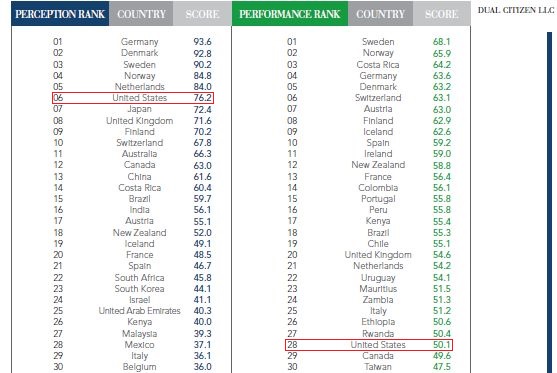
Since 2010, the Global Green Economy Index has been tracking the transition away from fossil-fuel based economies, consider two elements of a green economy: perception and performance. Countries with a high perception score are viewed as environmentally conscious leaders, while performance measures actual investment in green energy, overall infrastructure and development.
In these terms, the U.S. ranks #6 in perception, just behind the leading northern European countries, but #28 in performance, ranking below countries such as Costa Rica, Colombia, Peru, Kenya, Brazil, Chile, Uruguay, Mauritius, Zambia, Ethiopia, and Rwanda.

China and India are also failing to match performance with perception — China ranks #13 in perception and #55 in performance, while India ranks #16 and #49.
Sweden and Norway stand out in having performance rankings (#1 and #2) that are slightly better than their perception rankings (#3 and #4) — two countries that face the high energy demands created by cold climates, short winter days, and extensive road systems.
White House-Pentagon friction reveals weakness of coalition against ISIS
Mark Perry writes: When U.S. President Barack Obama appointed retired Marine Gen. John Allen to serve as his special envoy to the global coalition against the Islamic State, the news was greeted with applause from the jihadi group’s greatest enemies. Kurdish and Iraqi Sunni leaders welcomed the appointment, with good reason — these same leaders had requested that Allen, widely known as one of Obama’s favorite generals, be appointed to the position.
But not everyone was pleased, especially at the Pentagon, where top generals had deep misgivings over how Obama had chosen to manage the campaign against the Islamic State.
Among the dissenters was the head of U.S. Central Command, Gen. Lloyd Austin, who took a dim view of Allen’s role. Austin complained to aides that Allen would report directly to the president — bypassing both himself and Gen. Martin Dempsey, the chairman of the Joint Chiefs of Staff. Austin believed that Allen’s appointment would lead to confusion about who was really leading the effort, a senior U.S. officer who serves with Austin told me several days after the appointment. “Why the hell do we need a special envoy — isn’t that what [Secretary of State] John Kerry’s for?” this senior officer asked.
Austin’s private doubts echoed the deep skepticism among a host of serving and retired officers who served in the region, this same senior officer said. [Continue reading…]
The Daily Beast reports: Top military leaders in the Pentagon and in the field are growing increasingly frustrated by the tight constraints the White House has placed on the plans to fight ISIS and train a new Syrian rebel army.
As the American-led battle against ISIS stretches into its fourth month, the generals and Pentagon officials leading the air campaign and preparing to train Syrian rebels are working under strict White House orders to keep the war contained within policy limits. The National Security Council has given precise instructions on which rebels can be engaged, who can be trained, and what exactly those fighters will do when they return to Syria. Most of the rebels to be trained by the U.S. will never be sent to fight against ISIS.
Making matters worse, military officers and civilian Pentagon leaders tell The Daily Beast, is the ISIS war’s decision-making process, run by National Security Adviser Susan Rice. It’s been manic and obsessed with the tiniest of details. Officials talk of sudden and frequent meetings of the National Security Council and the so-called Principals Committee of top defense, intelligence, and foreign policy officials (an NSC and three PCs in one week this month); a barrage of questions from the NSC to the agencies that create mountains of paperwork for overworked staffers; and NSC insistence on deciding minor issues even at the operational level.
“We are getting a lot of micromanagement from the White House. Basic decisions that should take hours are taking days sometimes,” one senior defense official told The Daily Beast.
Other gripes among the top Pentagon and military brass are about the White House’s decision not to work with what’s left of the existing Syrian moderate opposition on the ground, which prevents intelligence sharing on fighting ISIS and prevents the military from using trained fighters to build the new rebel army that President Obama has said is needed to push Syrian President Bashar al-Assad into a political negotiation to end the conflict. [Continue reading…]
The FBI’s secret House meeting to get access to your iPhone
National Journal reports: The Obama administration is ramping up its campaign to force technology companies to help the government spy on their users.
FBI and Justice Department officials met with House staffers this week for a classified briefing on how encryption is hurting police investigations, according to staffers familiar with the meeting.
The briefing included Democratic and Republican aides for the House Judiciary and Intelligence Committees, the staffers said. The meeting was held in a classified room, and aides are forbidden from revealing what was discussed.
Airstrikes against ISIS do not seem to have affected flow of fighters to Syria
The Washington Post reports: More than 1,000 foreign fighters are streaming into Syria each month, a rate that has so far been unchanged by airstrikes against the Islamic State and efforts by other countries to stem the flow of departures, according to U.S. intelligence and counterterrorism officials.
The magnitude of the ongoing migration suggests that the U.S.-led air campaign has neither deterred significant numbers of militants from traveling to the region nor triggered such outrage that even more are flocking to the fight because of American intervention.
“The flow of fighters making their way to Syria remains constant, so the overall number continues to rise,” a U.S. intelligence official said. U.S. officials cautioned, however, that there is a lag in the intelligence being examined by the CIA and other spy agencies, meaning it could be weeks before a change becomes apparent.
The trend line established over the past year would mean that the total number of foreign fighters in Syria exceeds 16,000, and the pace eclipses that of any comparable conflict in recent decades, including the 1980s war in Afghanistan. [Continue reading…]
No one needs to be a foreign policy sage to understand that as much as anything else, ISIS is a product of the war in Iraq. But this observation barely qualifies as analysis — it’s more of a harumph; a way of bemoaning another of the consequences of a catastrophic military misadventure. Least of all should it be taken as a prescription for courses of action to be taken or avoided.
To say, for instance, that ISIS is a product of war and therefore more war will have the same effect is to treat war as having a homogeneous nature which in truth it lacks.
As is oft repeated: war is the continuation of politics by other means. But ISIS repeatedly makes it clear how it insists on practicing politics — submit to its rule or face death. It is ISIS which precludes non-military alternatives.
There really shouldn’t be much debate about whether ISIS needs to be fought. The real questions are about who fights, what are realistic goals, and what is the strategic context?
But the fight against ISIS should be a catalyst for and not a distraction from consideration of the region’s deeper ailments only some of which can be attributed to interference by external powers and the injurious effect of Zionism.
Either this continues to be a region that perceives itself through its own divisions or it engages in the long struggle of finding a common purpose. Hopefully that struggle does not have to postponed until after the death of every current national leader.
Only top legislators informed of White House computer attack
Reuters reports: An attack by hackers on a White House computer network earlier this month was considered so sensitive that only a small group of senior congressional leaders were initially notified about it, U.S. officials said on Thursday.
The officials said the Democratic and Republican leaders of the Senate and the House of Representatives and the heads of the Senate and House Intelligence Committees, collectively known as the “Gang of Eight,” were told last week of the cyber attack, which had occurred several days earlier.
Security experts said this limited group would normally be informed about ultra-secret intelligence operations and notifying them of a computer breach in this way was unusual. [Continue reading…]
Nobel Peace Prize winners push Obama for release of torture report
Time reports: Twelve winners of the Nobel Peace Prize asked President Barack Obama late Sunday to make sure that a Senate report on the Central Intelligence Agency’s use of harsh interrogation tactics is released so the U.S. can put an end to a practice condemned by many as torture.
The release of the report, which is the most detailed account of the CIA’s interrogation practices in the wake of the Sept. 11, 2001 terrorist attacks, would be an opportunity for the U.S. and the world to come to terms with interrogation techniques that went too far, the laureates said in an open letter and petition. The release of the report by the Senate Select Committee on Intelligence has stalled as the Obama Administration the CIA, and lawmakers clashed over how much of it should be redacted.
American leaders have “eroded the very freedoms and rights that generations of their young gave their lives to defend” by engaging in and justifying torture, the peace prize winners said. The letter was published on TheCommunity.com, a project spearheaded by Peace Prize winner and international peacemaker José Ramos-Horta.
How congressional hawks plan to kill Obama’s Iran deal
Trita Parsi writes: Negotiations with Iran over the future of its nuclear program have not even concluded yet some members of Congress are preparing to manufacture a political crisis over a deal. Their beef? President Barack Obama may initially bypass Congress and suspend sanctions imposed on Iran to make a deal possible and only later ask lawmakers to end them permanently when it is determined that Iran has complied fully with its obligations under the deal.
Of course, many of the lawmakers complaining about the potential presidential end run voted to give him the right to waive sanctions when they passed sanctions legislation in 2010 and 2011. And, of course, only Congress can lift the sanctions permanently, so there wouldn’t be any circumventing to begin with.
So what’s really going on?
It’s very simple: If you prefer war with Iran over a deal with Iran – even one that would prevent it from building a bomb — your best and possibly last opportunity to kill the deal is immediately after the nuclear talks have concluded. That’s when distrust of Iran’s intentions will remain pervasive and when its commitment to carry out its side of the deal will still have to be demonstrated. Former House Majority Leader Eric Cantor pursued this tactic in January after an interim agreement was reached in November last year. [Continue reading…]

The Port Authority police are responsible for patrolling bridges and tunnels and issuing airport parking tickets. But the detective, a hard-charging and occasionally brusque former ironworker named Thomas McHale, was also a member of an F.B.I. counterterrorism task force. He had traveled to Afghanistan and Pakistan and developed informants inside Jundallah’s leadership, who then came under the joint supervision of the F.B.I. and C.I.A.
