Defense Secretary Robert Gates must want Iran to build nuclear weapons. He didn’t say that directly. But how else should one interpret his latest threat against the embattled Persian Gulf state?
In what he said was his last major policy address, Secretary Gates expressed hope that Iraq would allow U.S. troops to remain. In fact, that’s a really bad idea, since America’s mission is over and Washington can’t afford to occupy the entire globe. Once defeated, forever occupied appears to be the secretary’s slogan. We are lucky that the Pentagon doesn’t still have army garrisons in Mexico, defeated back in 1848.
Secretary Gates talked about redeeming America’s blood “investment” and demonstrating that Washington planned to stay engaged in the region. He added: “It would be reassuring to the Gulf States. It would not be reassuring to Iran, and that is a good thing.”
Is it?
There obviously is much to dislike about Iran. An authoritarian theocracy with little sympathy for individual liberty. A troublesome meddler backing brutal Syria and aggressive Hezbollah. A regime with grudges against America’s favorite totalitarian theocracy, Saudi Arabia, and favorite democracy, Israel. A geopolitical adversary with strong connections in Iraq, which the Bush administration had hoped would become a base for American military operations. An untrustworthy government apparently developing nuclear weapons.
Obviously, none of these are good. But will failing to reassure Iran—in fact, doing the utmost to unsettle Iran—make the region safer? The fact that the regime is odious does not mean that it has no legitimate security concerns, concerns constantly exacerbated by Washington. If the United States does not reassure Tehran, the mullahs, and whoever might replace them, would be foolish to abandon their presumed nuclear program.
A prominent Pakistani journalist who investigated links between the military and al-Qaida has been found dead, triggering angry accusations against the powerful Inter-Services Intelligence spy agency.
Saleem Shahzad, Pakistan correspondent for a news service based in Hong Kong, disappeared on his way to a television interview in Islamabad on Sunday evening. On Tuesday, police said they found his body on a canal bank in Mandi Bahauddin, 80 miles south-east of the capital.
Shahzad’s abandoned car was found 25 miles away. Television images of his body showed heavy bruising to his face. Media reports said he had a serious trauma wound to the stomach.
Human Rights Watch had already raised the alarm over the disappearance of the 40-year-old father of three, citing a “reliable interlocutor” who said he had been abducted by ISI.
“This killing bears all the hallmarks of previous killings perpetrated by Pakistani intelligence agencies,” said a senior researcher for Human Rights Watch in south Asia, Ali Dayan Hasan. He called for a “transparent investigation and court proceedings”.
Other journalists reacted angrily, directly accusing ISI of responsibility on television and social media. “Any journalist here who doesn’t believe that it’s our intelligence agencies?” tweeted Mohammed Hanif, a bestselling author.
Al-Qaeda carried out the brazen attack on PNS Mehran naval air station in Karachi on May 22 after talks failed between the navy and al-Qaeda over the release of naval officials arrested on suspicion of al-Qaeda links, an Asia Times Online investigation reveals.
Pakistani security forces battled for 15 hours to clear the naval base after it had been stormed by a handful of well-armed militants.
At least 10 people were killed and two United States-made P3-C Orion surveillance and anti-submarine aircraft worth US$36 million each were destroyed before some of the attackers escaped through a cordon of thousands of armed forces.
An official statement placed the number of militants at six, with four killed and two escaping. Unofficial sources, though, claim there were 10 militants with six getting free. Asia Times Online contacts confirm that the attackers were from Ilyas Kashmiri’s 313 Brigade, the operational arm of al-Qaeda.
Three attacks on navy buses in which at least nine people were killed last month were warning shots for navy officials to accept al-Qaeda’s demands over the detained suspects.
The May 2 killing in Pakistan of Osama bin Laden spurred al-Qaeda groups into developing a consensus for the attack in Karachi, in part as revenge for the death of their leader and also to deal a blow to Pakistan’s surveillance capacity against the Indian navy.
The deeper underlying motive, though, was a reaction to massive internal crackdowns on al-Qaeda affiliates within the navy.
Several weeks ago, naval intelligence traced an al-Qaeda cell operating inside several navy bases in Karachi, the country’s largest city and key port.
“Islamic sentiments are common in the armed forces,” a senior navy official told Asia Times Online on the condition of anonymity as he is not authorized to speak to the media.
“We never felt threatened by that. All armed forces around the world, whether American, British or Indian, take some inspiration from religion to motivate their cadre against the enemy. Pakistan came into existence on the two-nation theory that Hindus and Muslims are two separate nations and therefore no one can separate Islam and Islamic sentiment from the armed forces of Pakistan,” the official said.
“Nonetheless, we observed an uneasy grouping on different naval bases in Karachi. While nobody can obstruct armed forces personnel for rendering religious rituals or studying Islam, the grouping [we observed] was against the discipline of the armed forces. That was the beginning of an intelligence operation in the navy to check for unscrupulous activities.”
The official explained the grouping was against the leadership of the armed forces and opposed to its nexus with the United States against Islamic militancy. When some messages were intercepted hinting at attacks on visiting American officials, intelligence had good reason to take action and after careful evaluation at least 10 people – mostly from the lower cadre – were arrested in a series of operations.
“That was the beginning of huge trouble,” the official said. [Continue reading…]
In the aftermath of 9/11 we worked in tandem; he was in Karachi, I was in Islamabad/Peshawar. After the US ”victory” in Afghanistan I went to visit him at home. He plunged me into Karachi’s wild side – in this and other visits. During a night walk on the beach he confessed his dream; he wanted to be Pakistan bureau chief for Asia Times, which he regarded as the K2 of journalism. He got it.
And then, years before ”AfPak” was invented, he found his perfect beat – the intersection between the ISI, the myriad Taliban factions on both sides of AfPak, and all sorts of jihadi eruptions. That was his sterling beat; and no one could bring more hardcore news from the heart of hardcore than Saleem.
I had met some of his sources in Islamabad and Karachi – but over the years he kept excavating deeper and deeper into the shadows. Sometimes we seriously debated over e-mails – I feared some dodgy/devious ISI strands were playing him while he always vouched for his sources.
Cornered by the law of the jungle, no wonder most of my Pakistani friends, during the 2000s, became exiles in the United States or Canada. Saleem stayed – threats and all, the only concession relocating from Karachi to Islamabad.
Now they finally got him. Not an al-Qaeda or jihadi connection. Not a tribal or Taliban connection, be it Mullah Omar or Tehrik-i-Taliban Pakistan. It had to be the ISI – as he knew, and told us, all along.
In an interview on the Real News Network recorded a few days before his murder, Shahzad described the transformation of al Qaeda over the last decade and that while the group itself has shrunk, its ideology has spread horizontally by incorporation inside and beyond the new Taliban.
First you have to understand this fact, that there are 17 Arab-Afghan groups which are operating inside Pakistani tribal areas and in Afghanistan, and most of these groups and most of the groups are aligned with al Qaeda but they are not part of al Qaeda — number one. And the strength of those 17 Arab-Afghan groups is over 1,000 approximately.
Second, those who are the members of al Qaeda are hardly 100, not more than 100.
The third thing is — and this is the most important thing — and that is the phenomenon of new Taliban — the new generation of those Afghan fighters, of the Pakistani fighters, or the fighters coming from the Pakistani tribal areas who previously pledged their allegiance to Mullah Omar and the Taliban, but now they — in the last ten years — they completely absorbed al Qaeda’s ideology inside-out, and they are more loyal to al Qaeda than to Mullah Omar or to the al Qaeda leaders, or to their jihadi commanders.
So this is the new group, this is al Qaeda horizontally, not only in Pakistan, Afghanistan, and the tribal areas, but all across the globe, like in Yemen, in Somalia and other parts, even in Europe, even in America. So this is the new generation on which al Qaeda is heavily banking on. And not only those, but it also includes the new converts, white Caucasians which are living in North Waziristan and in South Waziristan. And many of them were sent back to their countries of origin in Europe, Canada and America, and different countries. So, this was a completely new phenomenon. Al Qaeda grew horizontally in different directions.
Watch Shahzad’s last interview (in two parts) with the Real News Network:
Secret prisons operated by the US Central Intelligence Agency (CIA) on Polish territory violated international law and the Polish constitution according to legal experts, reported the daily Gazeta Wyborcza on Monday, citing sources close to an investigation.
The CIA held terror suspects inside a military intelligence training base in Stare Kiejkuty, north-eastern Poland from 2002 to 2005, anonymous Polish intelligence officers have said.
Public prosecutor Jerzy Mierzewski had wanted to charge officials from the 2001-2005 Democratic Left Alliance government with violating the constitution, unlawful detention and participation in crimes against humanity, the daily reported.
The left-wing party is today Poland’s second largest opposition party. Polish politicians who were in power when the prisons allegedly operated have denied allegations that CIA prisons were located in the country.
Mierzewski, however, was withdrawn from the case two weeks ago, the daily wrote. His supervisor, Dariusz Korneluk, declined to comment on the reason for the dismissal.
News that a US government intelligence body is going to start analysing the metaphors used in various languages will have brought wry smiles to the faces of writers and critics. Presumably, “Metaphor Program” agents won’t restrict themselves to metaphors as that particular word is often used metonymically for the whole of figurative language – similes, symbols or indeed any use of language that appears to be standing in for something else or representing something else. That in itself is no simple matter, as we shall see, but let it stand for the moment.
“I wandered lonely as a cloud …” to which we are entitled to ask, “What’s lonely about a cloud?” It’s a pretty rare Lake District sky that gives us one cloud on its own. But who says a lonely cloud would have to be on its own to be lonely? Maybe clouds are just lonely things – full of a sense of their isolation in an alienated world. If we find ourselves grasping at straws here, Wordsworth gives us help: “… that floats on high o’er vales and hills”, which suggests that he’s talking about the cloud’s detachment from the earth. It’s the higher-than-hills-ness, floatiness of the cloud that is important.
This is the kind of speculation that metaphor-divining specialises in and it’s fun to think of US spooks chewing over such matters – though presumably they will hire patriotic literature graduates to do the job.
Such servants to the US cause will be able to take their masters on a trip through a forest of suggestion, resonance and ambiguity in their quest to find the hidden value-systems in speakers’ and writers’ use of metaphor. We now know that Wordsworth’s idea of a writer being detached from the world, wrapped up in thoughts about nature and the imagination, was indeed ideological – as he warned us:
“The world is too much with us; late and soon,
Getting and spending, we lay waste our powers.
Little we see in Nature that is ours.”
So, straight away, our US allies can label early Wordsworth an anti-bourgeois subversive – someone who will need to be watched.
But what of Shakespeare? He poses the problem that we can never know for certain that this is Shakespeare talking or one of his many characters through whom he speaks: “Whether ’tis nobler in the mind to suffer/The slings and arrows of outrageous fortune …” This is dense stuff: a cast of thought has to compress our interactions and outcome into one notion: “fortune”, which then has to be personified into a form that can “behave” or have appurtenances, as in this case “slings and arrows”. Aha, militaristic metaphor! Fortune is armed and aggressive. Clearly, Hamlet is a potential terrorist. And indeed he was. Or tried rather ineffectually to be. But the writer who conjured him up? Probably not.
Riders on Boston subways and trolleys are accustomed to seeing placards that advertise research being conducted at the city’s many teaching hospitals. One that recently caught my eye, announcing an experimental “behavioral treatment,” posed this question to potential subjects: “Are you in the U.S. military or a veteran disturbed by terrible things you have experienced?”
Just below the question, someone had scrawled this riposte in blue ink: “Thank God for these Men and Women. USA all the way.”
Here on a 30 x 36 inch piece of cardboard was the distilled essence of the present-day relationship between the American people and their military. In the eyes of citizens, the American soldier has a dual identity: as hero but also as victim. As victims—Wounded Warriors —soldiers deserve the best care money can buy; hence, the emphasis being paid to issues like PTSD. As heroes, those who serve and sacrifice embody the virtues that underwrite American greatness. They therefore merit unstinting admiration.
Whatever practical meaning the slogan “support the troops” may possess, it lays here: in praise expressed for those choosing to wear the uniform, and in assistance made available to those who suffer as a consequence of that choice.
From the perspective of the American people, the principal attribute of this relationship is that it entails no real obligations or responsibilities. Face it: It costs us nothing yet enables us to feel good about ourselves. In an unmerited act of self-forgiveness, we thereby expunge the sin of the Vietnam era when opposition to an unpopular war found at least some Americans venting their unhappiness on the soldiers sent to fight it. The homeward-bound G.I. spat upon by spoiled and impudent student activists may be an urban legend, but the fiction persists and has long since trumped reality.
The Israel lobby is like the Mafia. It’s commonly understood how it works, who its leaders are, how they wield their power through intimidation, and to what effect. But there’s a big difference between knowing the identity of a Mafia boss and being able to throw him in jail. Usually an informant needs to be wired so that incriminating words can get caught on tape.
The following story recounted by MJ Rosenberg, who was himself once an AIPAC official, goes beyond the broad brushstrokes that are usually employed to describe the impact of the lobby on American politics. It is more akin to evidence from a wire — evidence that those who get on the wrong side of the lobby risk having their lives destroyed.
This week, following that tumultuous reception for Prime Minister Netanyahu at the congressional joint meeting, I want to share a personal recollection of how the Middle East status quo is preserved on Capitol Hill.
It was in 1988 and I was a foreign policy aide to Sen. Carl Levin (D-MI). One February day, Levin called me into his office to say that he was disturbed at a quote he saw in that day’s New York Times. An article quoted Israeli Prime Minister Yitzhak Shamir saying that he rejected the idea of withdrawing from any of the land Israel captured in the 1967 war:
Mr. Shamir said in a radio interview, ”It is clear that this expression of territory for peace is not accepted by me.”
Levin instantly understood what Shamir was saying. He was repudiating U.N. Security Council Resolutions 242 and 338 (which Israel had helped draft) which provided for “withdrawal of Israeli armed forces from territories occupied in the recent [1967] conflict” in exchange for peace and security. Those resolutions represented official U.S. and international policy then, and they still do.
But, in 1988, Shamir tried to declare them null and void.
Levin asked me to draft a letter to Secretary of State George Shultz stating that it was the view of the Senate that the U.N. Resolutions remained the policy of the U.S. whether Shamir liked it or not. Of course, the letter wasn’t written in that kind of language. It was more than polite. Additionally, Levin wanted it addressed to Shultz, not to Shamir, to avoid ruffling too many feathers in Israel.
I wrote the draft. Levin edited and re-edited it. Then he called in the head of AIPAC, Thomas A. Dine, to run the language past him. Tom said it was “great.” Levin told Dine that he would not embarass him by revealing that he had approved the letter.
Levin then asked me to deliver it to the Secretary of State but said that first he would try to round up a few other senators to join him in signing it. In an hour he had 30. He probably could have gotten three times as many but it was Friday afternoon and most of the senators had decamped.
I delivered the letter. Because Levin wanted to avoid a brouhaha, the Levin office did no press about it. It was essentially a secret initiative.
But then one of the senators who had the letter gave it to the New York Times. And within minutes the phones started ringing off the hook. Reporters and AIPAC donors (who had no idea Dine had signed off on the letter) were going crazy. Levin was asked to appear on all three Sunday morning talk shows. He declined. In fact, he took off for Moscow, on a long-planned trip. [Continue reading…]
First dinner of the Nobel Women’s Initiative conference on ending sexual violence in conflict, and I had the good fortune to sit in on a wide-ranging conversation that started when Anu Bhagwati, the former US Marine Corps company commander who runs a campaigning organisation called the Service Women’s Action Network, told us that of the patients treated in US military veteran hospitals for sexual assault and harassment, 39 per cent are men.
These men have not necessarily been attacked for their sexual orientation, says Bhagwati, although homophobia is still very strong in the US military, along with discrimination against women. She believes one of the key features that leads to a man being sexually attacked by his male comrades-in-arms may be some form of outsiderness. She recounted the case of a tough 6-ft heterosexual man in the infantry, who spoke with an East European accent and was regularly teased, but then was gang-raped by his colleagues.
The phenomenon of sexual violence in the US military is massively under-reported — when the US airforce commissioned Gallup to do a poll, one in five serving women said they had been raped or otherwise sexually assaulted, and one in twenty men; but very few had formally reported the attacks to their commanding officer (or they may have tried, and been brushed aside and further victimised — Anu said the East European was actually discharged from the army for ‘being gay’. Rape survivors in the military are, she said, ‘hounded and hounded’, and the ‘final insult’ is to be kicked out for spurious reasons).
When the Department of Defence conducted a formal survey of gender relations in the military in 2010, it found around 19,000 sexual assaults happen a year (though nothing like this number are reported). 19,000 assaults a year breaks down to 52 rapes or assaults a day, most of them, says Bhagwati, on women, and most — contrary to what one might believe — on bases, not ‘in theatre’ where US forces are on active military service. Of the 3158 official reports made last year, only a quarter happened in theatre.
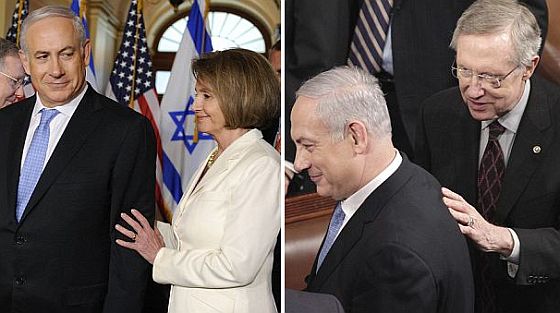
Gliding down the aisle of the House of Representatives like a popular president about to deliver the State of the Union address, escorted by a phalanx of dozens of ebullient Members of Congress, Israeli Prime Minister Benjamin Netanyahu entered a joint meeting of Congress today to a round of hearty handshakes and a thunderous standing ovation.
In a post-speech press conference, Senate Majority Leader Harry Reid gushed that Netanyahu delivered an “all-star” address, and Netanyahu proclaimed it a “great day” for Israel. And, in the self-contained world that is Capitol Hill, who could blame them for believing it to be so?
For in a world in which Israel finds itself as isolated as ever by a growing and successful Palestinian civil society-led international movement of boycott, divestment, and sanctions (BDS) against its apartheid policies; in which Palestinians are taking matters into their own hands diplomatically and pushing to have the United Nations admit the State of Palestine as a full member of the organization this fall; and in which even the President of the United States appears disgruntled by Israel’s intransigent ongoing colonization of Palestinian land, at least on Capitol Hill, Netanyahu can still play the ace up his sleeve to aplomb and then chum around like the king of the castle.
There on Capitol Hill, Netanyahu still has friends like Senator Chuck Schumer, who told a Jewish radio program that “One of my roles, very important in the United States Senate, is to be a shomer [guard]—to be a or the shomer Yisrael [guard of Israel]. And I will continue to be that with every bone in my body.” With friends like these wrapped around his little finger, no wonder Netanyahu’s forcible denunciations of international law were met with such rapturous approbation by Members of Congress who applauded his rejectionism dozens of times.
Justin Elliot lists the lines of Netanyahu’s speech that won 29 standing ovations.
If anyone was in any doubt that Capitol Hill is Israeli occupied territory, the adulation Benjamin Netanyahu received from Republicans and Democrats in Congress today makes it obvious where the loyalties of most of our so-called representatives lie.
“In Judea and Samaria [the West Bank], the Jewish people are not foreign occupiers,” Netanyahu declared as members of Congress stood, clapped and cheered.
Well, if that’s what Washington really believes then it’s time to toss the two-state solution out of the window.
Prime Minister Benjamin Netanyahu’s speech before a joint meeting of Congress today had all trappings of a state of the union address by a U.S. president with sky-high approval ratings.
Speaking to a packed House chamber with Speaker of the House John Boehner and Vice President Joe Biden over his shoulders, Netanyahu was interrupted at least 53 times by applause, including at least 29 standing ovations.
To put those numbers in perspective, 29 standing ovations eclipse the total that President Obama received at the State of the Union this year. Obama, in a speech that lasted much longer than Netanyahu’s, garnered 79 applause interruptions, but his remarks were met by only 25 standing ovations.
One of Netanyahu’s biggest applause lines was aimed directly at President Obama.
“Israel will not return to the indefensible boundaries of 1967,” Netanyahu said, prompting a big standing ovation.
Later the prime minister added: “Israel under 1967 lines would be only nine miles wide. So much for strategic depth. So it’s therefore vital — absolutely vital — that a Palestinian state be fully demilitarized, and it’s vital — absolutely vital — that Israel maintain a long-term military presence along the Jordan River.”
As Netanyahu himself pointed out, the President has not called on Israel to return to the exact 1967 borders. The President has said that a peace agreement should be “based on 1967 lines with mutually agreed swaps.”
Nevertheless, Netanyahu speech – and the thunderous bi-partisan response – was a clear challenge to the idea of using the 1967 boundaries – with or without “swaps” — as a basis for a peace deal.
Netanyahu also got big ovations with hard-line statements on two other perennial sticking points to Israeli-Palestinian peace agreements: No right of return for Palestinian refugees, and “Jerusalem will never again be divided. Israel must remain the united Capital of Israel.”
Netanyahu arguably got a warmer reception than President Obama received during his last state of the union and certainly a warmer reception than he’d receive at the Knesset. When the speech was over, he lingered for a while at the podium as it seemed he didn’t want to leave.
A pro Israeli advocate knocked a camera out of the hands of Alison Weir, President of the Council for the National Interest Foundation. The group just finished their press conference on what they call unjustifiable US Aid to Israel.
The two sides met when the Press Club scheduled a pro Israeli news conference to follow held in the same room. The altercation illustrates heightened tensions on differing views regarding America’s relationship with Israel.
The Council for the National Interest Foundation wants Americans to know how much of their tax dollars are going to Israel.
The Congress of the United States consists of 100 senators and 435 members of the House of Representatives; in effect, just 535 Americans are blocking efforts to bring peace to the Middle East. Why? Forget the pious guff about Israel being the region’s “only democracy” and a “valued friend and ally” of Washington. In the corrupt and dysfunctional US political system, where legislators are outnumbered by special interests, from the gun lobby to Big Pharma, the Israel lobby – specifically, the American Israel Public Affairs Committee (Aipac) that brags on its website about being “the most important organisation affecting America’s relationship with Israel” – has a financial stranglehold on both main parties. According to William Quandt, a former adviser on the Middle East to the Nixon and Carter administrations, “70 per cent to 80 per cent of all members of Congress will go along with whatever they think Aipac wants”.
It is Aipac that polices congressional votes on Israel, demands unconditional US support for the occupation of the West Bank and insists that Israel remain the largest single annual recipient of US foreign aid ($250 a year per Israeli, compared to $1 a year per African). Consider this: the upper and lower houses of Congress are more divided, polarised and partisan than in any other period in recent history. Democrats and Republicans agree on nothing. Except Israel.
Presidents who have tried to pressurise the Israelis – from Reagan to Obama – have found themselves attacked not just in the Knesset but in Congress. In the words of Paul Findley, a Republican from Illinois who served in the House of Representatives for 22 years before being
defeated by an Aipac-funded candidate in 1982: “Congress behaves as if it were a subcommittee of the Israeli parliament.” The irony is that there is far more heated debate about Israel’s actions on the floor of the Knesset than on Capitol Hill. “For 35 years, not a word has been expressed . . . in either chamber of Congress that deserves to be called debate on Middle East policy,” Findley wrote in 2002.
On 2 May 2002, after Ariel Sharon’s invasion of the West Bank and the destruction of the Jenin refugee camp, both houses of Congress overwhelmingly approved resolutions expressing “solidarity with Israel” – 352 to 21 in the House, 94 to two in the Senate.
On 20 July 2006, eight days after the start of Israel’s war against Lebanon, Congress passed a resolution endorsing Israeli military action by a vote of 410 to eight. On 9 January 2009, as the Palestinian death toll from the Israeli air assault on Gaza topped 700, the House of Representatives passed a resolution “reaffirming the United States’ strong support for Israel in its battle with Hamas”. The margin was 390 votes to five.
These comically one-sided resolutions illustrate the power and influence of the Israel lobby on Capitol Hill – and the way in which craven legislators in both main parties blindly throw their support behind any and every act of belligerence. As Uri Avnery, the Israeli author and peace activist, once remarked: if Aipac “were to table a resolution abolishing the Ten Commandments, 80 senators and 300 congressmen would sign it at once”.
Shortly after he was captured in March 2002 at a safe house in Faisalabad, Pakistan, following an early morning raid jointly conducted by the CIA, FBI, Pakistani police and Inter-Services Intelligence (ISI), Abu Zubaydah woke up at a black site prison in Thailand and discovered that his left eye had been surgically removed.
Zubaydah, who is wearing an eye patch in a photograph included in his Guantanamo threat assessment file released by WikiLeaks last month, apparently never consented to the medical procedure and to this day has no idea why it was done, according to one of Zubaydah’s attorneys.
“I can tell you that Abu Zubaydah has no explanation for the loss of his eye,” said Brent Mickum, who has represented Zubaydah in his since 2007. “He continually wants me to make inquiries to try and determine the circumstances for which he lost his eye, but no one has been forthcoming.”
On June 13th, a fifty-four-year-old former government employee named Thomas Drake is scheduled to appear in a courtroom in Baltimore, where he will face some of the gravest charges that can be brought against an American citizen. A former senior executive at the National Security Agency, the government’s electronic-espionage service, he is accused, in essence, of being an enemy of the state. According to a ten-count indictment delivered against him in April, 2010, Drake violated the Espionage Act—the 1917 statute that was used to convict Aldrich Ames, the C.I.A. officer who, in the eighties and nineties, sold U.S. intelligence to the K.G.B., enabling the Kremlin to assassinate informants. In 2007, the indictment says, Drake willfully retained top-secret defense documents that he had sworn an oath to protect, sneaking them out of the intelligence agency’s headquarters, at Fort Meade, Maryland, and taking them home, for the purpose of “unauthorized disclosure.” The aim of this scheme, the indictment says, was to leak government secrets to an unnamed newspaper reporter, who is identifiable as Siobhan Gorman, of the Baltimore Sun. Gorman wrote a prize-winning series of articles for the Sun about financial waste, bureaucratic dysfunction, and dubious legal practices in N.S.A. counterterrorism programs. Drake is also charged with obstructing justice and lying to federal law-enforcement agents. If he is convicted on all counts, he could receive a prison term of thirty-five years.
The government argues that Drake recklessly endangered the lives of American servicemen. “This is not an issue of benign documents,” William M. Welch II, the senior litigation counsel who is prosecuting the case, argued at a hearing in March, 2010. The N.S.A., he went on, collects “intelligence for the soldier in the field. So when individuals go out and they harm that ability, our intelligence goes dark and our soldier in the field gets harmed.”
Top officials at the Justice Department describe such leak prosecutions as almost obligatory. Lanny Breuer, the Assistant Attorney General who supervises the department’s criminal division, told me, “You don’t get to break the law and disclose classified information just because you want to.” He added, “Politics should play no role in it whatsoever.”
When President Barack Obama took office, in 2009, he championed the cause of government transparency, and spoke admiringly of whistle-blowers, whom he described as “often the best source of information about waste, fraud, and abuse in government.” But the Obama Administration has pursued leak prosecutions with a surprising relentlessness. Including the Drake case, it has been using the Espionage Act to press criminal charges in five alleged instances of national-security leaks—more such prosecutions than have occurred in all previous Administrations combined. The Drake case is one of two that Obama’s Justice Department has carried over from the Bush years.
Gabriel Schoenfeld, a conservative political scientist at the Hudson Institute, who, in his book “Necessary Secrets” (2010), argues for more stringent protection of classified information, says, “Ironically, Obama has presided over the most draconian crackdown on leaks in our history—even more so than Nixon.”
Describing Drake’s concerns that the NSA was showing a flagrant disregard for the constitutional rights of US citizens, Mayer writes:
Drake says that in the Air Force, where he learned to capture electronic signals, the FISA law “was drilled into us.” He recalls, “If you accidentally intercepted U.S. persons, there were special procedures to expunge it.” The procedures had been devised to prevent the recurrence of past abuses, such as Nixon’s use of the N.S.A. to spy on his political enemies.
Drake didn’t know the precise details, but he sensed that domestic spying “was now being done on a vast level.” He was dismayed to hear from N.S.A. colleagues that “arrangements” were being made with telecom and credit-card companies. He added, “The mantra was ‘Get the data!’ ” The transformation of the N.S.A., he says, was so radical that “it wasn’t just that the brakes came off after 9/11—we were in a whole different vehicle.”
Few people have a precise knowledge of the size or scope of the N.S.A.’s domestic-surveillance powers. An agency spokesman declined to comment on how the agency “performs its mission,” but said that its activities are constitutional and subject to “comprehensive and rigorous” oversight. But Susan Landau, a former engineer at Sun Microsystems, and the author of a new book, “Surveillance or Security?,” notes that, in 2003, the government placed equipment capable of copying electronic communications at locations across America. These installations were made, she says, at “switching offices” that not only connect foreign and domestic communications but also handle purely domestic traffic. As a result, she surmises, the U.S. now has the capability to monitor domestic traffic on a huge scale. “Why was it done this way?” she asks. “One can come up with all sorts of nefarious reasons, but one doesn’t want to think that way about our government.”
[Bill] Binney [former head of the NSA’s Signals Intelligence Automation Research Center, or SARC], for his part, believes that the agency now stores copies of all e-mails transmitted in America, in case the government wants to retrieve the details later. In the past few years, the N.S.A. has built enormous electronic-storage facilities in Texas and Utah. Binney says that an N.S.A. e-mail database can be searched with “dictionary selection,” in the manner of Google. After 9/11, he says, “General Hayden reassured everyone that the N.S.A. didn’t put out dragnets, and that was true. It had no need—it was getting every fish in the sea.”
The Libyan regime’s claims that Nato is attempting to assassinate Muammar Gaddafi have intensified following the apparent death of one of the leader’s sons and three of his grandchildren in an air strike on Tripoli.
Gaddafi was at the one-storey house in a residential area of Tripoli when the missile struck late on Saturday, according to the government spokesman Moussa Ibrahim.
In a rare acknowledgement that security around Gaddafi may not be watertight, Ibrahim told reporters that intelligence about Gaddafi’s whereabouts or plans must have been leaked to Nato. (The Guardian)
The claim that Muammar Qaddafi’s three grandchildren were killed in an airstrike conducted by NATO late Saturday is not true, an Al Arabiya source has revealed. A source close to the Qaddafi family has confirmed the death of Colonel Qaddafi’s youngest son, Saif al-Arab, in the airstrike but has denied the story that Mr. Qaddafi’s three grandsons were killed. (Al Arabiya)
Shashank Joshi writes: The death of Saif al-Arab Gaddafi, if confirmed, is likely to have come as a consequence of Nato’s increasingly aggressive tactics, undertaken by the alliance to shake up a stalemate in the conflict.
But his killing in an air strike is a grievous strategic error – militarily insignificant but diplomatically disastrous.
Towards the end of April, Nato states made a number of operational innovations. Three member states – Britain, France, and Italy – injected military advisers into rebel-held eastern Libya. Another, the US, began continuous patrols of armed drones.
Third, and most important, air strikes began to target command, control, communications and intelligence networks (known, in military parlance, as C3I). The Bab al-Aziziya compound includes all three such networks, and it was presumed that their disruption would disorient regime soldiers on the front line, cut off field commanders from Tripoli, and sow confusion in the ranks.
But was the strike also an assassination attempt?
Assassination of a head of state is illegal under international law, and forbidden by various US presidential orders. On the other hand, the targeted killing of those woven into the enemy chain of command is shrouded in legal ambiguity. (BBC News)
Britain has ordered the expulsion of the Libyan ambassador to London, Omar Jelban, in retaliation for an attack on the British embassy by a pro-Gaddafi crowd in Tripoli.
Jelban has been given 24 hours to leave the country.
“I condemn the attacks on the British embassy premises in Tripoli as well as the diplomatic missions of other countries,” said the foreign secretary, William Hague. “The Vienna convention requires the Gaddafi regime to protect diplomatic missions in Tripoli. By failing to do so that regime has once again breached its international responsibilities and obligations. I take the failure to protect such premises very seriously indeed.” (The Guardian)
They sniff with contempt at a passing car filled with Moammar Kadafi’s supporters. They turn up the volume on Al Jazeera just when a report chronicling the government’s attacks on civilians in rebel-held Misurata comes on.
Or they make a cryptic remark, like the driver working with the government minders assigned to monitor foreign reporters.
“God willing, spring will come soon,” he said.
But spring began weeks ago.
“God willing, in two weeks,” he said with a smile.
“Two weeks” is the time in which Libyans have been assuring themselves that their nightmare will come to an end. (Los Angeles Times)
Pro-Gaddaffi forces have been seen roaming the streets of Misurata wearing gas masks, contacts in Libya’s besieged city have reported to timesofmalta.com .
Sources at the hospital confirmed that pro regime troops were wearing gas masks. An independent source said there were reports that thousands of gas masks had been distributed to troops yesterday. (Times of Malta)
Shattered glass litters the carpet at the Libyan Down’s Syndrome Society, and dust covers pictures of grinning children that adorn the hallway, thrown into darkness by a NATO strike early on Saturday.
It was unclear what the target of the strike was, though Libyan officials said it was Muammar Gaddafi himself, who was giving a live television address at the time.
“They maybe wanted to hit the television. This is a non-military, non-governmental building,” said Mohammed al-Mehdi, head of the civil societies council, which licenses and oversees civil groups in Libya. (Reuters)
David Kenner writes: Bashar al-Assad never saw it coming. In a Jan. 31 interview with the Wall Street Journal, the Syrian autocrat boasted that his regime was immune from the revolutionary wave spreading across the Middle East because it “very closely linked to the beliefs of the people.”
Over the past month and a half, Syrians have made a liar out of their president. Small protests broke out in Damascus on March 15 and have slowly spread to towns and cities throughout the country. And as the movement has gained strength, Assad’s crackdown has increased in brutality. The Syrian regime has killed at least 450 people since the uprising began, according to human rights groups, and this week sent tanks into the mutinous southern town of Daraa to quell the protests.
So far, the regime’s attempts to quash the demonstrations have only caused them to increase in size. Tens of thousands of Syrians came out to the protests this Friday, with crowds demonstrating in more than 50 towns throughout the country. The protests’ growing strength has produced a reaction in Washington: Following days of escalating statements, President Barack Obama issued new sanctions today against three of the regime’s most notorious officials, including Bashar’s brother, Maher al-Assad. The U.N. Human Rights Council also denounced Assad’s use of violence against peaceful protesters on Friday, calling for a team to visit Syria in order to “ensur[e] full accountability” for those who perpetrated the attacks.
So who’s leading the charge against Assad? The president has accumulated no shortage of enemies over his decade-long rule, many of whom have little in common besides their enmity toward the Syrian president. If he continues his ruthless crackdown, however, it just may be enough to unite them. (Foreign Policy)
When protests erupted in March in the forlorn Syrian border town of Dara’a, demonstrators burned the president’s portraits, then set ablaze an unlikely target: the local office of the country’s largest mobile phone company, Syriatel, whose owner sits at the nexus of anger and power in a restive country.
Syriatel is owned by Rami Makhlouf, first cousin and childhood friend of President Bashar al-Assad and the country’s most powerful businessman. In the past decade, he has emerged as a strength and a liability of a government that finds its bastions of support shrinking and a figure to watch as Mr. Assad’s inner circle tries to deal with protests shaking his family’s four decades of rule.
Leery of the limelight, he is alternatively described as the Assad family’s banker or Mr. Five Percent (or 10, or whatever share gets the deal done). His supporters praise him for his investment in Syria, but they are far outnumbered by detractors, who have derided him in protests as a thief or worse. Sometimes more than Mr. Assad himself, he has become the lightning rod of dissent.
“We’ll say it clearly,” went a chant in Dara’a. “Rami Makhlouf is robbing us.”
Egypt had Ahmed Ezz, the steel magnate who favored tight Italian suits (and now faces trial in white prison garb). In Tunisia, it was Leila Traboulsi, the hairdresser who became the president’s wife, then a symbol of the extravagance of the ruling family. Mr. Makhlouf, 41, is Syria’s version, a man at the intersection of family privilege, clan loyalty, growing avarice and, perhaps most dangerously, the yawning disconnect between ruler and ruled that already reshaped authoritarian Syria even before the protests. (New York Times)
Zvi Bar’el writes: Israel’s Pavlovian response to Palestinian reconciliation, which included the usual threats of boycott, is the result of the ingrained anxiety of people who no longer control the process. For five years, Israel has done everything to change the outcome of Hamas’ watershed victory in the elections in the territories. It did not recognize the Hamas government or the unity government, and of course, it did not recognize the Hamas government that arose after that organization’s brutal takeover of the Gaza Strip.
Gaza became a synonym for Hamas; that is, for terror, and the West Bank stood for the land of unlimited possibilities. Israel made an enormous contribution toward building up Hamas into an institution, not only an organization. The cruel closure of Gaza, Operation Cast Lead, turning Gaza into a battle zone and the saga of kidnapped soldier Gilad Shalit, with Israel continuing to negotiate with Hamas while striking out against it – all this has transformed Gaza into a symbol of the occupation and a focus of international empathy.
Israel, in its diplomatic blindness, saw the product it helped manufacture as a huge diplomatic achievement. Its working assumption was that the split between Gaza and the West Bank would allow Israel to pursue the appearance of negotiations with Palestinian President Mahmoud Abbas, while fighting another part of the Palestinian people in Gaza. Israel interpreted the political conflict between Abbas and Hamas leaders Ismail Haniyeh in Gaza and Khaled Meshal in Damascus as an unsolvable ideological conflict and a reality in which, in Israel’s thinking, Palestine is divided not only into two regions, but into two mutually hostile peoples. Israel tortures one side while celebrating with the other at a ribbon-cutting ceremony at the opening of a shopping center. (Haaretz)
Israel has suspended tax transfers to the Palestinians, its finance minister said on Sunday, fearing the money will be used to fund Hamas after President Mahmoud Abbas struck a unity deal with the Islamists.
The Palestinian Authority (PA), led by U.S.-backed Abbas, asked foreign powers to stop Israel from blocking the transfers, which make up 70 percent of its revenues. A senior Palestinian official said Israel, by its action, had “started a war.”
Israeli Finance Minister Yuval Steinitz said he had suspended a routine handover of 300 million shekels ($88 million) in customs and other levies that Israel collects on behalf of the Palestinians under interim peace deals. (Reuters)
Serious differences have emerged within Iran’s top leadership, media reports suggest, pitting Mahmoud Ahmadinejad, the president, against Aytollah Ali Khamenei, the country’s supreme leader.
Ahmadinejad has boycotted cabinet meetings since Heider Moslehi, the intelligence minister, was reinstated after he was forced out of the government.
Moslehi was restored to the powerful post by Khamenei after Ahmadinejad had forced him to resign on April 17.
Ahmadinejad’s opponents, meanwhile, have seized the opportunity.
According to the Shargh newspaper, a group of 216 lawmakers, more than two-third of the 290 members in the Iranian parliament, have issued a letter to Ahmadinejad, urging him to call off his cabinet boycott for the good of the country.
“You are expected to follow the supreme leader,” the lawmakers wrote.
On Friday, a hardline cleric used his nationally broadcast sermon to indirectly warn Ahmadinejad that he would be moving into dangerous territory by escalating his challenges to Khamenei.
“Obedience to the supreme leader is a religious obligation as well as a legal obligation, without any doubt,” Ayatollah Ahmad Khatami said. He did not mention Ahmadinejad by name, but it was clear he was referring to the president. (Al Jazeera)
John Norris writes: In poll after poll, Americans overwhelmingly say they believe that foreign aid makes up a larger portion of the federal budget than defense spending, Social Security, Medicaid, Medicare, or spending on roads and other infrastructure. In a November World Public Opinion poll, the average American believed that a whopping 25 percent of the federal budget goes to foreign aid. The average respondent also thought that the appropriate level of foreign aid would be about 10 percent of the budget — 10 times the current level.
Compared with our military and entitlement budgets, this is loose change. Since the 1970s, aid spending has hovered around 1 percent of the federal budget. International assistance programs were close to 5 percent of the budget under Lyndon B. Johnson during the war in Vietnam, but have dropped since. (Washington Post)
The first four Directors of the CIA (from 1947-1953) were military officers, but since then, there has been a tradition (generally though imperfectly observed) of keeping the agency under civilian rather than military leadership. That’s why George Bush’s 2006 nomination of Gen. Michael Hayden to the CIA provoked so many objections from Democrats (and even some Republicans).
The Hayden nomination triggered this comment from the current Democratic Chairwoman of the Senate Intelligence Committee, Dianne Feinstein: “You can’t have the military control most of the major aspects of intelligence. The CIA is a civilian agency and is meant to be a civilian agency.” The then-top Democratic member of the House Intelligence Committee, Jane Harman, said “she hears concerns from civilian CIA professionals about whether the Defense Department is taking over intelligence operations” and “shares those concerns.” On Meet the Press, Nancy Pelosi cited tensions between the DoD and the CIA and said: “I don’t see how you have a four-star general heading up the CIA.” Then-Sen. Joe Biden worried that the CIA, with a General in charge, will “just be gobbled up by the Defense Department.” Even the current GOP Chair of the House Intelligence Committee, Pete Hoekstra, voiced the same concern about Hayden: “We should not have a military person leading a civilian agency at this time.”
Of course, like so many Democratic objections to Bush policies, that was then and this is now. Yesterday, President Obama announced — to very little controversy — that he was nominating Gen. David Petraeus to become the next CIA Director. The Petraeus nomination raises all the same concerns as the Hayden nomination did, but even more so: Hayden, after all, had spent his career in military intelligence and Washington bureaucratic circles and thus was a more natural fit for the agency; by contrast, Petraues is a pure military officer and, most of all, a war fighting commander with little background in intelligence. But in the world of the Obama administration, Petraeus’ militarized, warrior orientation is considered an asset for running the CIA, not a liability.
That’s because the CIA, under Obama, is more militarized than ever, as devoted to operationally fighting wars as anything else, including analyzing and gathering intelligence. This morning’s Washington Post article on the Petraeus nomination — headlined: “Petraeus would helm an increasingly militarized CIA” — is unusual in presenting such a starkly forthright picture of how militarized the U.S. has become under the 2009 Nobel Peace Prize winner:
They came, they saw, they conquered. This line pretty well sums up a little-reported but important story about the new tea partiers in the U.S. House of Representatives.
No sooner had they arrived than the corporate lobbying corps came to visit, saw what these supposed rebels were made of and quickly conquered them without a fight. The forces of big business needed only to lay out some campaign cash — and quicker than you can say, “Business as usual,” the budding lawmakers snatched up the money and immediately began carrying the lobbyists’ corporate agenda.
Check out the financial services subcommittee, which handles legislation affecting Wall Street bankers. Five tea partiers got coveted slots on this panel, and all five were suddenly showered with big donations from such financial lobbying interests as Goldman Sachs. Now, all five are sponsoring bills to undo parts of the recent reforms to reign in Wall Street excesses.
Steve Stivers of Ohio, for example, hauled in nearly $100,000 in just his first two months in office — 85 percent of it from the special interests his committee oversees. He insists that the cash he took from Goldman Sachs and others has nothing to do with his subsequent support of bills that Goldman is lobbying so strongly for. Stivers claims that his sole legislative focus is on jobs for Ohio’s 15th district.
Really? Among the deform-the-reform bills that Steve is carrying is one to let Wall Street giants avoid disclosing the difference in what the CEO is paid and what average employees make. Another would exempt billionaire private equity hucksters from regulation. I can see that these bills are great job extenders for the barons of Wall Street, but how do either of them create a single job in his district?
From Washington’s vantage, every Friday is becoming Black Friday in the Middle East. Muslim prayers turn to protests that keep building toward full-scale uprisings faster than anyone had predicted, and with potentially cataclysmic consequences nobody dares imagine. This Friday, the shock came in Syria, where President Bashar al-Assad runs one of the Middle East’s most repressive regimes. Across the country, protesters have grown ever more emboldened in recent weeks, and on Friday they poured into the streets by the tens of thousands to face the deadly fusillades of Assad’s security forces. More than 70 died. What did the White House have to say? From Air Force One: “We call on all sides to cease and desist from the use of violence.”
Surely President Obama can do better than that. Or perhaps not. The drama—the tragedy—increasingly apparent at the White House is of a brilliant intellect who is nonetheless confounded by events, a strategist whose strategies are thwarted and who is left with almost no strategy at all, a persuasive politician and diplomat who gets others to crawl out on limbs, has them take big risks to break through to a new future, and then turns around and walks away from them when the political winds in the United States threaten to shift. It’s not enough to say the Cabinet is divided about what to do. Maybe the simplest and in many ways the most disturbing explanation for all the flailing is offered by veteran journalist and diplomat Leslie H. Gelb: “There is one man in this administration who debates himself.” President Obama.
These patterns of behavior and their consequences have been on horrifying display in the blood-drenched streets of Misrata, Libya, where the population has begged for more support from NATO and the United States. But they did not begin with Libya, or with the surprise uprising in Tunisia in January or the stunning fall of Egypt’s President Hosni Mubarak in February. They were evident from Year 1 of the Obama presidency in his excruciating deliberations over the Afghan surge, in the hand extended ineffectually to Iran, and the lines drawn in the sand, then rubbed out and moved back, and further back, in the dismal, failed efforts to build a Palestinian peace process. But in Libya the crisis of American tentativeness has grown worse almost by the day. Muammar Gaddafi holds on, despite Obama’s demand for him to leave, and the civilians that the Americans, their allies, and the United Nations vowed to protect are being slaughtered.
This website or its third-party tools use cookies, which are necessary to its functioning. By closing this banner, you agree to the use of cookies.