Category Archives: Iran deal

EDITORIAL: The diplomatic shift

The who-knew-what-when questions and the larger story

According to President Bush, “it wasn’t until last week that I was briefed on the NIE that is now public.” National Security Adviser, Stephen Hadley, was yesterday even more specific: “…the intelligence community finally came to the judgments that they came to on this issue Tuesday of last week. The President was briefed on Wednesday.” Was that before or after Israel’s foreign delegation in Washington had been briefed?

Haaretz today reports that the findings of the National Intelligence Estimate, “did not catch the Israeli leadership by surprise. During their visit to Washington last week, Prime Minister Ehud Olmert, Foreign Minister Tzipi Livni and Defense Minister Ehud Barak were briefed on the report.” The Israelis arrived on Sunday and left on Wednesday evening.

So, given that the subtext for the Annapolis Conference was the configuration of an alliance aimed at containing Iran, are we to believe that just before Olmert left Washington (and just after Bush had been briefed), the Israeli prime minister was pulled aside by administration officials who said, “Oh, by the way, we’d like to share our latest intelligence findings on Iran’s nuclear weapons program – or lack thereof. We think you’ll find them interesting.” I suspect that didn’t happen. When Hadley says Bush was briefed on Wednesday, he’s probably being economical with the truth and might under cross-examination concede that “briefed” merely means being shown the final draft of a text with which Bush was already familiar. I’ll leave it to bloggers more tenacious than me to get to the bottom of this. It’s not that these aren’t interesting questions, but they risk generating more heat than light.
reflections.jpg

The hyperfocus on a major news day in Washington has the unfortunate effect of reinforcing the kinds of perception that were summed up today in the New York Times by the line, “Rarely, if ever, has a single intelligence report so completely, so suddenly, and so surprisingly altered a foreign policy debate here.”

There has actually been a build up to this watershed event, but because the build up didn’t fit the conventional wisdom, it has largely been unnoticed. The conventional wisdom has been that the administration — until yesterday — was on a fairly steady trajectory in the direction of a military confrontation with Iran. But over the last few months there have been a number of signs that inside the administration, the proponents of military action had in fact already lost the argument.

The resurgence of diplomacy has been quietly driven by Defense Secretary Robert Gates. Gates’ low-profile approach has meant that his efforts have frequently escaped the attention of the media. Even so, to be neither the focus of cable news nor blogosphere banter, is not to be politically ineffective. The pivotal role Gates has played in shifting the administration’s approach is described in Newsweek:

Late this summer, Secretary of Defense Robert Gates traveled to the Middle East, to Saudi Arabia, Egypt, Jordan, Kuwait and the United Arab Emirates. At each stop, high-ranking Arab officials anxiously asked him: was the United States preparing to attack Iran? Gates reassured them all that the United States had no plans to do so, at least any time soon. He wasn’t dramatic about it, says a Defense Department official who accompanied Gates on the trip but declined to be identified discussing secret talks. “He didn’t grab anyone’s arm and say, ‘I’ve got Cheney under control, wink, wink’,” says this official. But Gates was low-key, straightforward, steadying—calming, even soothing in a dry and matter-of-fact way. A little later, at the end of September, Gates met with the Democratic Senate Policy Committee (something his predecessor, Donald Rumsfeld, would never do). One of the senators nervously asked if the Bush administration was looking for a reason to bomb Tehran. “It would be a strategic calamity to attack Iran at this time,” Gates replied. Sen. Evan Bayh, who was at the meeting, told Newsweek: “You could almost feel the relief around the table. It was, ‘Well, I guess he’s not here just to repeat the party line.’ It was just such a breath of fresh air from Rumsfeld and the ‘my way or the highway’ attitude of others.”

While among Bush critics it has often been assumed that the so-called reality-based community only exists outside the administration, it seems clear that Gates belongs to this community and that while Bush and Cheney are unlikely to admit as much, it is under Gates’ tutelage that they are now willing to give diplomacy a chance. Cheney might remain a skeptic but the ball — at least for now — is out of his hands.

The time is now ripe for an initiative. Bush alluded to such a possibility today when he said, “There has been a moment during my presidency in which diplomacy provided a way forward for the Iranians. And our hope is we can get back on that path again.” He was harking back to 2003 but engaging in a bit of revisionism by neglecting to mention that it was he and the vice president who then refused to receive the diplomatic ball when it was being tossed in their direction by Iran. Is it now possible — even with Khatami partially out of the picture — that the administration is hinting that it might be open to another grand bargain?


Facebooktwittermail

NEWS & ANALYSIS: NIE fallout

Israel unconvinced Iran has dropped nuclear program

Israel today took a darker view of Iran’s nuclear ambitions than the assessment released by United States intelligence agencies yesterday, saying it was convinced that Iran was pursuing nuclear weapons.

It said Iran had probably resumed the nuclear weapons program the American report said was stopped in the fall of 2003. “It is apparently true that in 2003 Iran stopped pursuing its military nuclear program for a certain period of time,” Defense Minister Ehud Barak told Israeli Army Radio. “But in our estimation, since then it is apparently continuing with its program to produce a nuclear weapon.” [complete article]

A blow to Bush’s Tehran policy

President Bush got the world’s attention this fall when he warned that a nuclear-armed Iran might lead to World War III. But his stark warning came at least a month or two after he had first been told about fresh indications that Iran had actually halted its nuclear weapons program.

The new intelligence report released yesterday not only undercut the administration’s alarming rhetoric over Iran’s nuclear ambitions but could also throttle Bush’s effort to ratchet up international sanctions and take off the table the possibility of preemptive military action before the end of his presidency.

Iran had been shaping up as perhaps the dominant foreign policy issue of Bush’s remaining year in office and of the presidential campaign to succeed him. Now leaders at home and abroad will have to rethink what they thought they knew about Tehran’s intentions and capabilities. [complete article]

U.S. spies concoct a potent Iran brew

The timing of the report’s release is curious, coinciding both with Iranian President Mahmud Ahmadinejad’s crucial meeting with the heads of states of the Gulf Cooperation Council, where Ahmadinejad has made substantial progress in confidence-building by advancing the idea of security and economic cooperation in the region, and with critical discussions with the so-called “Five plus One” countries regarding the next United Nations steps against Iran. The Five plus One includes the five permanent members of the UN security Council – United States, the United Kingdom, France, Russia and China – plus Germany.

Irrespective of Hadley’s comments, the new NIE actually undermines much of the rationale behind the US-led push for a third round of US sanctions on Iran, by flatly contradicting what until now has been held as an article of faith by US politicians and much of the media. That is, the notion that Iran has been pursuing an open weapons program via its uranium-enrichment and reprocessing activities. [complete article]

‘Bomb, bomb, bomb; bomb, bomb, Iran’

There has been a lot of loose talk about Iran’s nuclear capabilities out on the campaign trail. Here is a sampling of campaign rhetoric undercut by the publication of the latest National Intelligence Estimate on Iran, representing the consensus view of the CIA and other U.S. intelligence agencies. [complete article]

Candidates hold to their stances on Iran

The campaigns of the leading Democratic candidates seized Monday on an intelligence report showing that Iran had halted its development of nuclear weapons, saying the findings justified their more cautious approach to Tehran.

Senator Hillary Rodham Clinton’s national security director, Lee Feinstein, said the report’s findings “expose the latest effort by the Bush administration to distort intelligence to pursue its ideological ends.” He added that the report “vindicates” Mrs. Clinton’s approach, which he described as “vigorous American-led diplomacy, close international cooperation and effective economic pressure, with the prospect of carefully calibrated incentives if Iran addresses our concerns.”

In fact, in September Mrs. Clinton, Democrat of New York, voted in favor of a Senate measure declaring the Iranian Revolutionary Guards “proliferators of mass destruction,” a vote that was condemned by her rivals in the Democratic field. After the vote, her aides issued a statement saying, “The Revolutionary Guards are deeply involved in Iran’s nuclear program.” [complete article]

How did a 2005 estimate on Iran go awry?

In the summer of 2005, senior American intelligence officials began traveling the world with a secret slide show drawn from thousands of pages that they said were downloaded from a stolen Iranian laptop computer, trying to prove that Iran was lying when it said it had no interest in building a nuclear weapon.

The slides detailed efforts to build what looked like a compact warhead for an Iranian missile and were portrayed by the Americans as suggesting that the Iranian military was working to solve the technical problems in building a bomb.

Now, that assertion has been thrown into doubt by a surprising reversal: the conclusion, contained in the declassified summary of a new National Intelligence Estimate on Iran’s nuclear programs, that Iran’s effort to master the technology of building a nuclear weapon had halted two years before those briefings. [complete article]

Facebooktwittermail

NEWS & EDITOR’S COMMENT: Intelligence community puts Cheney in restraints

U.S. says Iran ended atomic arms work

A new assessment by American intelligence agencies concludes that Iran halted its nuclear weapons program in 2003 and that the program remains on hold, contradicting an assessment two years ago that Tehran was working inexorably toward building a bomb.

The conclusions of the new assessment are likely to be major factor in the tense international negotiations aimed at getting Iran to halt its nuclear energy program. Concerns about Iran were raised sharply after President Bush had suggested in October that a nuclear-armed Iran could lead to “World War III,” and Vice President Dick Cheney promised “serious consequences” if the government in Tehran did not abandon its nuclear program.

The findings also come in the middle of a presidential campaign during which a possible military strike against Iran’s nuclear program has been discussed.

The assessment, a National Intelligence Estimate that represents the consensus view of all 16 American spy agencies, states that Tehran’s ultimate intentions about gaining a nuclear weapon remain unclear, but that Iran’s “decisions are guided by a cost-benefit approach rather than a rush to a weapon irrespective of the political, economic and military costs.” [complete article]

Editor’s Comment — This is a major defeat for Dick Cheney – perhaps even great enough to describe as a politically fatal blow. As Gareth Porter reported last month:

The US National Intelligence Estimate (NIE) on Iran has been held up for more than a year in an effort to force the intelligence community to remove dissenting judgments on the Iranian nuclear program. The aim is to make the document more supportive of Vice President Dick Cheney’s militarily aggressive policy toward Iran, according to accounts provided by participants in the NIE process to two former Central Intelligence Agency (CIA) officers.

But Cheney lost — big time. The White House’s response — peppered with phrases like “positive news,” “we have made progress,” the “estimate offers grounds for hope,” a solution can be found “without the use of force” — amounts to what Cheney and his neocon supporters should regard as a strategic defeat. The intelligence community (no doubt with strong support from defense secretary Gates and his allies) has effectively kneecapped the vice president.

Facebooktwittermail

NEWS, ANALYSIS & EDITOR’S COMMENT: U.S. Special Forces inside Iran?

U.S. wages covert war on Iraq-Iran border

While the PKK has been in the international spotlight in recent weeks, with Turkey mounting cross-border raids and threatening to launch an invasion of Iraq, not so much attention has been given to the Iranian offshoot, the PJAK. The group has been waging an insurgency against Tehran since 2004, which recently has escalated. A guerrilla leader told the New York Times last month that PJAK fighters had killed at least 150 Iranian soldiers and officials in Iran since August.

Iran accuses Washington of backing the group, and while the US denies this, local and foreign intelligence sources say the accusation is most likely true. According to a former US Special Forces (SF) commando currently based in Iraq who spoke on condition of anonymity, Special Forces troops are currently operating inside Iran, working with insurgent forces like the PJAK. “That’s what the SF does,” he said. “They train and build up indigenous anti-government forces.”

“The primary function of the Special Forces is to stand up guerrilla forces or counter-guerrilla forces,” said another former SF soldier, retired Major Mark Smith. While he was not specifically aware of SF teams training the PJAK, he said it would not be surprising if they were. And “they would be training in an obscure border area or in a location denied to anyone not directly involved”, he said.

He added that SF teams in Iran would be conducting strategic reconnaissance of possible nuclear and biological weapons sites, army headquarters, and significant individuals. “If they’re not doing these things in Iran, then they are remiss in their duties at the upper echelons of their command,” he said. [complete article]

Petraeus sought to prevent release of Iranians

Recent statements by the U.S. military that Iran had pledged to stop supplying weapons to Shi’ite militias in Iraq and that this alleged flow of arms may have stopped in August were part of a behind-the-scenes struggle over whether the George W. Bush administration should make a gesture to Iran by releasing five Iranian prisoners held since January.

When U.S. military experts found evidence that recently discovered weapons caches probably dated back to early 2007, it strengthened the hand of those in the administration arguing for the release and weakened the position of Vice President Dick Cheney and Gen. David Petraeus, who sought to scuttle any release by insisting that there was no evidence that Iran had changed its alleged policy of destabilizing Iraq. [complete article]

Annapolis and Iran

Is there room in these last months of a lame duck presidency to craft a modest opening to Iran, while maintaining a stout anti-Iranian coalition? Well, if we are to heed the cries of alarm emanating from the neo-conservatives as they watch their grandiose plans to add a third front to the War on Terror crumple into the dustbin of history, perhaps there really is something going on here.

Nevertheless, since this is a policy that dare not speak its name, even if these titillating signals are true, no turning point will be announced in blaring trumpets, and the message about Iran will be cloaked in vitriol and bile to prevent creating undue alarm among American conservatives and among the Arabs who are only now signing on to a long-term strategy to counter the “Iranian threat” but who also deeply fear the possibility of a sudden deal between the United States and Iran. (They can’t forget the shah and Iran-contra.)

The two individuals most likely to view these developments with quiet satisfaction are James Baker and Lee Hamilton, whose original policy prescriptions in the Iraq Study Group all seem to be coming true as George W. Bush approaches the precipice of his presidency. [complete article]

Editor’s Comment — The fundamental problem in trying to decipher the intention behind the administration’s mixed messages on Iran is that this presumes that the administration has an intention. Just as likely, these mixed messages are the expression of multiple intentions as conflicting factions inside the administration jostle for the upper hand, each acutely aware that a president who does not know his own mind, can be swayed.

Iranians say sanctions hurt them, not government

Banks HSBC, Credit Suisse and UBS cut business ties with Iran last year followed by Deutsche Bank, Commerzbank and BNP Paribas in 2007.

“Almost every month we get notes from European banks about ceasing their cooperation with Iran,” said an employee of an Iranian bank, who asked not to be identified.

A doctor, who also spoke on condition of anonymity, said: “We cannot open Letters of Credit in banks. Importing necessary material for medicines to treat patients who suffer cancer is becoming more difficult every day.”

Personal stories are common of how the financial sanctions are affecting those mostly well-off people who have foreign bank accounts or earn income from abroad.

Some say they will leave Iran if the United Nations imposes tougher sanctions; others are forced to use unofficial channels to get their cash.

Maryam Sharifa is one of many Iranians whose dollar account with a Western bank was closed in the past few months. Like many Iranians who lived abroad, she had kept her account open since returning to Iran.

“I had this account for 13 years in France. Do I look like a terrorist? Should I be punished just for being an Iranian?” said the 39-year-old mother of two. “I had to bring all that money with me here and buy a small apartment in Tehran.” [complete article]

Iran’s secret weapon: The Pope

The diplomatic chess game around Iran’s nuclear program includes an unlikely bishop. According to several well-placed Rome sources, Iranian officials are quietly laying the groundwork necessary to turn to Pope Benedict XVI and top Vatican diplomats for mediation if the showdown with the United States should escalate toward a military intervention. The 80-year-old Pope has thus far steered clear of any strong public comments about either Iran’s failure to fully comply with U.N. nuclear weapons inspectors or the drumbeat of war coming from some corners in Washington. But Iran, which has had diplomatic relations with the Holy See for 53 years, may be trying to line up Benedict as an ace in the hole for staving off a potential attack in the coming months. “The Vatican seems to be part of their strategy,” a senior Western diplomat in Rome said of the Iranian leadership. “They’ll have an idea of when the 11th hour is coming. And they know an intervention of the Vatican is the most open and amenable route to Western public opinion. It could buy them time.” [complete article]

Facebooktwittermail

NEWS & ANALYSIS: Confronting Iran

War is peace, sanctions are diplomacy

The White House is pressing ahead with its stated goal of persuading the UN Security Council to pass far-reaching sanctions to punish Iran for refusing to suspend its nuclear research program. Sanctions are what President George W. Bush is referring to when he pledges to nervous US allies that he intends to “continue to work together to solve this problem diplomatically.” The non-diplomatic solution in this framing of the “problem,” presumably, would be airstrikes on nuclear facilities in the Islamic Republic.

With its portrayal of UN and unilateral US sanctions as part of a diplomatic effort, the Bush administration has successfully confused much media coverage of the Iranian-Western confrontation over Iran’s enrichment of uranium. Sanctions are punitive measures, not serious diplomacy, and the Bush administration has never undertaken a sustained diplomatic initiative aimed either at inducing Iran to cease enriching uranium or at soothing broader US-Iranian tensions. Meanwhile, the Bush administration’s persistent refusal to take military options “off the table,” combined with its intensified rhetoric against Iran, has made sanctions palatable to allies, as well as to some of the most dovish members of Congress and the American public — but without addressing the political disputes that keep the US and Iran on a collision course. Congress, by and large, has merely greased the skids. [complete article]

U.S. electronic surveillance monitored Israeli attack on Syria

The U.S. provided Israel with information about Syrian air defenses before Israel attacked a suspected nuclear site in Syria, Aviation Week & Space Technology is reporting in its Nov. 26 edition.

The U.S. was monitoring the electronic emissions coming from Syria during Israel’s Sept. 6 attack, and while there was no active American engagement in the operation, there was advice provided, according to military and aerospace industry officials.

The first event in the raid involved Israel’s strike aircraft flying into Syria without alerting Syrian air defenses. The ultimate target was a suspected nuclear reactor being developed at Dayr az-Zawr. But the main attack was preceded by an engagement with a single Syrian radar site at Tall al-Abuad near the Turkish border.

The radar site was struck with a combination of electronic attack and precision bombs to allow the Israeli force to enter and exit Syrian airspace unobserved. Subsequently all of Syria’s air-defense radar system went off the air for a period of time that encompassed the raid, U.S. intelligence analysts told Aviation Week. [complete article]

Editor’s Comment — This report presents further evidence that, as Gareth Porter suggested earlier this week, “a more plausible explanation for the strike [than its being aimed at destroying a purported Syrian nuclear facility, is] that it was a calculated effort by Israel and the United States to convince Iran that its nuclear facilities could be attacked as well.”

A plan to attack Iran swiftly and from above

Massive, devastating air strikes, a full dose of “shock and awe” with hundreds of bunker-busting bombs slicing through concrete at more than a dozen nuclear sites across Iran is no longer just the idle musing of military planners and uber-hawks.

Although air strikes don’t seem imminent as the U.S.-Iranian drama unfolds, planning for a bombing campaign and preparing for the geopolitical blowback has preoccupied military and political councils for months.

No one is predicting a full-blown ground war with Iran. The likeliest scenario, a blistering air war that could last as little as one night or as long as two weeks, would be designed to avoid the quagmire of invasion and regime change that now characterizes Iraq. But skepticism remains about whether any amount of bombing can substantially delay Iran’s entry into the nuclear-weapons club. [complete article]

Iran warns of domino effect of nuclear attack

Iran warned today that an attack on its nuclear facilities would trigger a “domino” effect across the Middle East as deeply divided world powers met to review Teheran’s co-operation with United Nations resolutions.

Mohamed ElBaradei, the head of the UN’s International Atomic Energy Agency (IAEA) has endorsed Iranian promises that access to suspected nuclear facilities will increase in the months ahead. At a meeting of the body’s 35-country board of governors in Vienna today, battle lines were drawn both over Mr ElBaradei’s faith in an Iranian blueprint and the text of the IAEA’s latest report which said Iran had cleared up several key questions about its past research.

America and Britain are pushing for the UN to quickly impose a third round of sanctions on Iran to reinforce the drive to close the Islamic Republic’s secret programme of atomic research, which appears to be slowly yielding the capability to make a nuclear weapon.

China and Russia, which have not yet swung behind new sanctions, appear poised to back Mr ElBaradei’s calls for negotiators to be given more time. [complete article]

Iran’s Ahmadinejad slammed for accusing rivals

Iranian President Mahmoud Ahmadinejad is facing increasing criticism for his virulent personal attacks on rivals and acting as both “plaintiff and judge” in legal cases, media reported on Thursday.

He has drastically upped the stakes ahead of March parliamentary elections by accusing opponents of being “traitors” for not supporting the government’s confrontational stance in the nuclear crisis.

“The general climate of the country has been overwhelmed by propaganda against individuals,” complained an angry editorial in the hardline Jomhouri Eslami newspaper, close to Iran’s clerical establishment. [complete article]

Facebooktwittermail

NEWS & OPINION: Iran war dance

Iran eyes nuclear options abroad

Iranian President Mahmoud Ahmadinejad is to discuss with Arab nations a plan to enrich uranium outside the region in a neutral country such as Switzerland.

He made the announcement in an interview for Dow Jones Newswires in Saudi Arabia where he is attending a petroleum exporters’ summit.

Gulf Arab states recently proposed setting up a consortium to provide nuclear fuel to Iran and others.

The scheme could allay fears Iran is enriching uranium for a nuclear bomb. Iran has insisted that its right to pursue a civilian nuclear programme is not up for negotiation. [complete article]

War with Iran is a matter of words

Earlier this week, the nuclear-powered USS Enterprise carrier strike group concluded a three-day, multi-unit, intense exercise in the North Arabian Sea — an exercise that included two stealthy Tomahawk cruise missile carrying attack submarines!

It didn’t receive mention in the mainstream press. And it wasn’t discussed in the blogosphere. But, if it had been, it very likely would have been framed as one more piece of evidence that the Bush administration appears to be marching toward war with Tehran. Sure, the media would note that the Navy said, “This was a routine training exercise to help our forces maintain a full-range of readiness.” But that wouldn’t dissuade the true believers from thinking that pre-emptive war is near.

Except that it isn’t. [complete article]

Facebooktwittermail

ANALYSIS & EDITOR’S COMMENT: Is war talk just talk?

‘And then what?’ A strike on Iran may be one problem too many for Bush

Mr Bush himself has often been depicted as willing to use force to avoid going down in history as the president on whose watch Tehran made the decisive steps towards the bomb. But administration staff paint a very different picture of the president’s priorities during his last 14 months in office.

“For those problems we can solve, let’s solve them,” a senior administration official tells the Financial Times, setting out a framework the president has given his top staff. “For those that we cannot solve, let’s leave our successors a set of policies and instruments that provide them with, in our view, the best prospect for success after we leave office.”

Such comments almost sound like an advance excuse for not resolving the Iran dispute. But then the state of the US as a whole and the Bush administration in particular is very different from the days of 2002-03.

The terrorist attacks of September 11 2001 remain a powerful memory but the overwhelming support for Mr Bush that followed them is long gone. Instead of the enthusiasm America once exhibited for the invasion of Iraq and the toppling of Saddam Hussein, the country is now war-weary and its forces are already fighting in Iraq and Afghanistan. Oil is almost $100 a barrel and could go far higher in the event of an attack on Iran.

Of particular importance are the US military’s deep reservations about a pre-emptive attack on Iran, largely because of the uncertain consequences that would result. In addition, pragmatists have replaced hawks among Mr Bush’s closest colleagues. [complete article]

Editor’s Comment — Nothing seems more emblematic of the state of American presidential power than the fact that General Musharraf appears quite indifferent to its influence. And if there is a word that captures this moment it is “path.” If Pakistan can at least present the appearance of being oriented in the direction of democracy; if it can take one or two baby steps along that path, then that’s good enough for President Bush and his Secretary of State. It seems strange then that even when the president is clearly so weak that those competing to take his place are finding it so difficult to muster their own strength. Bush may have little power to shape the world, yet his administration seems as powerful as ever when it comes to shaping American political debate.

How to prevent Iran from acquiring nuclear weapons has been described as the defining foreign policy of the presidential race. Although that might currently be the case, the fact that it is, is not a reflection of a reality to which everyone is bound; it is a reflection of the weakness of the Democratic candidates in setting their own agendas.

Two questions on which the candidates should be pressed are these:

Firstly, as you strive to become the next president, will you allow the current presidency to define your own agenda?

And secondly, in as much as it can be assumed that dealing with Iran will be a major concern of the next president, do you anticipate that there will be other issues that command more of your attention — issues such as global warming?

Anyone with the courage to deconstruct the Iranian issue should start by posing a simple question: Is this about Iran or is it about nuclear weapons?

Nuclear proliferation is not unthinkable. In the space of a few years, India, Pakistan, and North Korea all barged into the nuclear club. Are we to understand then that whereas the new entries were undesirable, Iran’s possession of nuclear weapons would place it in a unique category? The suicidal state?

On the other hand, if we are to assume that Iran is not a country governed by people possessed by a death wish, then the issue must focus squarely on nuclear proliferation. Yet the underlying logic here is one that any eight-year old can understand. In the playground of global affairs we have two options: We either let the playground bullies make up rules that they can impose on others yet ignore themselves, or alternatively we accept that the strong and the weak must abide by an impartial set of rules that apply to everyone. In this case we would have to conclude that the issue is not Iran; it is a pressing need to halt proliferation which is itself an objective that can only exert the force of principle if bound to a practical effort to accomplish global nuclear disarmament. That’s an objective that several of the Democratic candidates tried on for size recently but one that thus far they have been much too timid to deploy for the purpose of setting the political agenda. It seems ironic that so many could aspire to become president, yet so few have much appetite for showing how they intend to be presidential.

Facebooktwittermail

OPINION & EDITOR’S COMMENT: The options table

Will wou attack Iran?

In the last few weeks, the Democratic field has settled on an attack against the frontrunner: Doublespeak. “I believe Senator Clinton should be held to the same standard that every one of us should be held to,” says John Edwards. “Tell the truth, no more double-talk.” Indeed, the Edwards camp even asked the Clinton campaign five simple question on Iraq, questions, “that every candidate should have to answer.”

The questions the Edwards camp asks are good ones. I too would like the various Democrats to go on the record as to whether they’ll leave permanent bases in Iraq. But here’s another question every campaign should have to answer, and that none of them have: Will you attack Iran in order to prevent their construction of a nuclear weapon?

That is, after all, the defining foreign policy question of the race. Iraq is a more acute concern, but so much of the damage there has already been done, and we are so hostage to the facts on the ground, that the differences and distinctions between the candidates are, in some ways, of relatively uncertain importance. Once in office, their actions on Iraq will be governed by the realities of the war and the domestic polls.

Not so with a nuclear Iran, where the executive really will be allowed to make the decision as to whether we launch air strikes, or whether we seek a policy of deterrence, negotiation, and engagement. Yet till now, the candidates have largely been allowed to divert such questions, and all have done so in the same way. Speaking at the Herzliya Conference, John Edwards said that, “to ensure that Iran never gets nuclear weapons, we need to keep all options on the table.” Asked by 60 Minutes where he would use military force to disrupt the Iranian weapon program, Barack Obama said, “I think we should keep all options on the table.” And Hillary Clinton, speaking to AIPAC, said, “We cannot, we should not, we must not, permit Iran to build or acquire nuclear weapons, and in dealing with this threat, as I have said for a very long time, no option can be taken off the table.” [complete article]

Editor’s Comment — It’s strange how a piece of gibberish — “no options can be taken off the table” — can so easily be elevated to the status of unassailable truth. Implicit in the assertion that options can’t be taken off the table is the idea that all possible options are cluttered there, in their abundance, all within easy reach. If this were not implied then we would perforce have to engage in as many debates about what can be put on the table as there are about what cannot be removed.

Consider then one option — on the table in as much as it is possible — that the Iranian conundrum be dealt with, with a finality that no one could dispute: a strategic nuclear strike. In as literal a sense as the expression can be used, Iran could be wiped off the map. The United States (and Israel) have the physical means to do this, but we all know it’s not going to happen because, fortunately, this is an option that is well and truly off the table. Neither Dick Cheney, nor Norman Podhoretz, nor Rudy Guiliani are going to say that incinerating 70 million Iranians is an option that must stay on the table.

Facebooktwittermail

NEWS: Staying on the path

Rice: Iran resolution doesn’t OK war

Secretary of State Condoleezza Rice said Sunday she does not believe a Senate resolution authorizes President Bush to take military action against Iran.

“There is nothing in this particular resolution that would suggest that from our point of view. And, clearly, the president has also made very clear that he’s on a diplomatic path where Iran comes into focus,” Rice said.

The Senate in late September voted 76-22 in favor of a resolution urging the State Department to designate Iran’s Islamic Revolutionary Guard Corps as a terrorist organization.

While the resolution, by Sens. Joe Lieberman, I-Conn., and Jon Kyl, R-Ariz., attracted overwhelming bipartisan support, a small group of Democrats said they feared labeling the state-sponsored organization a terrorist group could be interpreted as a congressional authorization of military force in Iran. [complete article]

Facebooktwittermail

NEWS & EDITOR’S COMMENT: Iran not scared by Israel (after strike on Syria)

Iranian FM: Israel is no military match for Tehran

Iran’s Foreign Ministry said on Monday that Israel poses no military threat to Iran, adding that any aggression on Israel’s part would spark retaliation and accusing Israel of trying to sabotage relations between Tehran and the International Atomic Energy Agency.

“The Zionist regime [Israel] is less than nothing to pose any kind of threat to Iran,” ministry spokesman Mohammad Ali Hosseini told reporters Sunday when questioned about recent comments on Tehran’s nuclear program made by Israeli officials.

It was not clear what Israeli threat Hosseini was referring to, but his statement came as Iran continues to defy international demands that it suspends uranium enrichment, a process that can produce fuel for a nuclear reactor or fissile material for a bomb. [complete article]

Editor’s Comment — I’ll hazard a guess about what Hosseini was referring to: the Israeli strike on Syria on September 6. Maybe this is the last Syria strike story — the one in which not even the word “Syria” appeared.

Facebooktwittermail

OPINION: War talk about Iran is a mistake

The spy who wants Israel to talk

Efraim Halevy, the former head of the Israeli intelligence agency Mossad, titled his memoirs “Man in the Shadows.” But now that he’s out in the sunlight, the 72-year-old retired spy chief has some surprisingly contrarian things to say about Iran and Syria. The gist of his message is that rather than constantly ratcheting up the rhetoric of confrontation, the United States and Israel should be looking for ways to establish a creative dialogue with these adversaries.

Halevy is a legendary figure in Israel because of his nearly 40 years of service as an intelligence officer, culminating in his years as Mossad’s director from 1998 to 2003. He managed Israel’s secret relationship with Jordan for more than a decade, and he became so close to King Hussein that the two personally negotiated the 1994 agreement paving the way for a peace treaty. So when Halevy talks about the utility of secret diplomacy, he knows whereof he speaks.

Of course, Halevy looks like the fictional master spy George Smiley — thinning hair, wise but weary eyes, the rumpled manner of someone who might have been a professor in another life. And Halevy has the gift of anonymity: You would look right past him in a crowded room, never imagining that he was the man who had conducted daring secret missions. After he appeared here with former CIA director George Tenet at a conference sponsored by the Brookings Institution’s Saban Center, Halevy agreed to sit down for an interview.

Halevy suggests that Israel should stop its jeremiads that Iran poses an existential threat to the Jewish state. The rhetoric is wrong, he contends, and it gets in the way of finding a peaceful solution to the Iranian nuclear problem.

“I believe that Israel is indestructible,” he insists. Iranian President Mahmoud Ahmadinejad may boast that he wants to wipe Israel off the map, but Iran’s ability to consummate this threat is “minimal,” he says. “Israel has a whole arsenal of capabilities to make sure the Iranians don’t achieve their result.” Even if the Iranians did obtain a nuclear weapon, says Halevy, “they are deterrable,” because for the mullahs, survival and perpetuation of the regime is a holy obligation. [complete article]

Facebooktwittermail

NEWS, ANALYSIS, OPINION & EDITOR’S COMMENT: Looking for Iran in Iraq

Iraq: Call an air strike

“… the literature on counter-insurgency is so enormous that, had it been put aboard the Titanic, it would have sunk that ship without any help from the iceberg. However, the outstanding fact is that almost all of it has been written by the losers.”
– Martin van Creveld, in The Changing Face Of War, 2006

Amid the George W Bush administration’s relentless campaign to “change the subject” from Iraq to Iran, how to “win” the war against the Iraqi resistance, Sunni or Shi’ite, now means – according to counter-insurgency messiah General David Petraeus – calling an air strike.

On a parallel level, the Pentagon has practically finished a base in southern Iraq less than 10 kilometers from the border with Iran called Combat Outpost Shocker. The Pentagon maintains this is for the US to prevent Iranian weapons from being smuggled into Iraq. Rather, it’s to control a rash of US covert, sabotage operations across the border targeting Iran’s Khuzestan province.

With the looming Turkish threat of invading Iraqi Kurdistan and President General President Musharraf’s new “let’s jail all the lawyers” coup within a coup in Pakistan, the bloody war in the plains of Mesopotamia is lower down in the news cycle – not to mention the interminable 2008 US presidential soap opera. Rosy spinning, though, still rules unchecked.

The Pentagon – via Major General Joseph Fil, commander of US forces in Baghdad – is relentlessly spinning there’s now less violence in the capital, a “sustainable” trend. This is rubbish. [complete article]

Iraqi fighters ‘grilled for evidence on Iran’

US military officials are putting huge pressure on interrogators who question Iraqi insurgents to find incriminating evidence pointing to Iran, it was claimed last night.

Micah Brose, a privately contracted interrogator working for American forces in Iraq, near the Iranian border, told The Observer that information on Iran is ‘gold’. The claim comes after Washington imposed sanctions on Iran last month, citing both its nuclear ambitions and its Revolutionary Guards’ alleged support of Shia insurgents in Iraq. Last week the US military freed nine Iranians held in Iraq, including two it had accused of links to the Revolutionary Guards’ Qods Force.

Brose, 30, who extracts information from detainees in Iraq, said: ‘They push a lot for us to establish a link with Iran. They have pre-categories for us to go through, and by the sheer volume of categories there’s clearly a lot more for Iran than there is for other stuff. Of all the recent requests I’ve had, I’d say 60 to 70 per cent are about Iran. [complete article]

Broken supply channel sent weapons for Iraq astray

As the insurgency in Iraq escalated in the spring of 2004, American officials entrusted an Iraqi businessman with issuing weapons to Iraqi police cadets training to help quell the violence.

By all accounts, the businessman, Kassim al-Saffar, a veteran of the Iran-Iraq war, did well at distributing the Pentagon-supplied weapons from the Baghdad Police Academy armory he managed for a military contractor. But, co-workers say, he also turned the armory into his own private arms bazaar with the seeming approval of some American officials and executives, selling AK-47 assault rifles, Glock pistols and heavy machine guns to anyone with cash in hand — Iraqi militias, South African security guards and even American contractors. [complete article]

Editor’s Comment — The path travelled by one of those Glocks is revealed in a report in The Guardian. The reporter describes interviewing a Sunni insurgent — one of America’s newly recruited fighters. “He pulled his pistol out and showed it to me. It was a Glock, supplied by the US to Iraqi security forces. ‘This belonged to the commander of al-Qaida here,’ he said. ‘They called him the White Lion. I killed him and got his gun.'”

Americans said to have proposed a six-month truce to the resistance groups

Al-Hayat says this morning that it has learned from “sources in the government and sources close to the armed groups” about a plan including a followup reconciliation meeting, to be arranged by the Iraqi Reconciliation Agency, but to be held under American and international auspices, along with a proposal for a six-month truce between the armed resistance groups and the American/Iraqi forces. [complete article]

Forced Iraq postings ‘may be necessary’

Four days before a deadline for Foreign Service officers to volunteer to go to Iraq or face the prospect of being ordered there, the State Department notified employees yesterday that “about half” of 48 open assignments there for next year have been filled.

“This reduces but does not eliminate the possibility that directed assignments may be necessary,” Deputy Secretary of State John D. Negroponte wrote in an e-mailed update. Filling the remaining jobs is still “the Department’s priority,” he said, adding that he is optimistic that more will volunteer. [complete article]

Editor’s Comment — The email had to come from Negroponte and not the Sectretary of State herself because madame secretary declines to use email. That’s right! “Rice does not use e-mail.”

Facebooktwittermail

NEWS & EDITOR’S COMMENT: Cheney meets resistance on Iran

Washington tells EU firms: quit Iran now

Multinational companies are coming under increasing pressure from the US to stop doing business with Iran because of its nuclear programme. European operators are facing threats from Washington that they could jeopardise their US interests by continuing to deal with Tehran, with increasing evidence that European governments, mainly France, Germany and Britain, are supporting the US campaign.

It emerged last night that Siemens, one of the world’s largest engineering groups and based in Germany, has pulled out of all new business dealings with Iran after pressure from the US and German governments. This follows the decision by Germany’s three biggest banks, Deutsche, Commerzbank, and Dresdner, to quit Iran after a warning from US vice-president Dick Cheney that if firms remain in Tehran, they are going to have problems doing business in the US. [complete article]

Iraqi sees thaw in U.S.-Iranian ties

An Iraqi official said Friday that he expected another round of talks this month including his government and those of Washington and Tehran, after the U.S. military freed nine Iranians it had detained in Iraq.

Two of the Iranians released early Friday by the U.S. were among five men detained in January in an American raid in the northern Iraqi city of Irbil. The U.S. had said they were members of Iran’s elite Quds Force, which Washington suspects of aiding Shiite Muslim militias in Iraq and smuggling armor-piercing bombs into the country. Tehran has said the five men are diplomatic staff at its Irbil consulate. [complete article]

Editor’s Comment — It’s often said that the complexity of Iran’s power structure makes it difficult for foreign governments to decipher Iran’s intentions. Tehran may well view Washington in the same way. While President Bush warns about the risk of World War III and Cheney is pushing forward on the economic war path, Defense Department officials are interested in reducing US-Iranian tensions. Not only have Iranian hostages been released, but the Navy has quietly returned to a one-carrier presence in the Gulf. At the same time, the intelligence community has been unwilling to arm Cheney with a National Intelligence Estimate on Iran — already held up for more than a year because in its current form it is “unsatisfactory” as support for Cheney’s military objectives.

Facebooktwittermail

EDITORIAL: Nuclear risks and nuclear realities

Nuclear risks and nuclear realities

General Musharraf today tossed a bone to his lapdogs in Washington — a promise of elections — and the White House wagged its tail and quickly applauded what it sees as “a good thing” — even while Pakistan’s dictator continued to bludgeon his political opponents. Three Pakistani politicians and a union leader were charged with treason today for making anti-government speeches and now face possible death sentences and in an attempt to thwart a protest rally, 500 members of Benazir Bhutto’s opposition party were arrested.

Having been a steady recipient of US aid — his military receives $100 million monthly in direct cash transfers which Musharraf can use however he pleases — the general is unlikely to be moved by threats that he might not be rewarded with any more F-16s.

Musharraf’s power and the White House’s impotence was further reinforced by the image of Deputy Secretary of State John Negroponte appearing on Capitol Hill in defense of Bush’s “indispensable” ally. “No country has done more in inflicting damage on the Taliban,” Negroponte said, yet in a little noticed development, it seems possible that even while Musharraf was instituting martial law in Pakistan and releasing Taliban prisoners, in Afghanistan Pakistan’s intelligence services might have had a role in the assassination of one of the Taliban’s most serious opponents. “The killing of Sayed Mustafa Kazimi, the 45-year-old Hazara Shi’ite leader from Parwan province of Afghanistan, to the northwest of Kabul, bears all the hallmark of a political assassination,” writes M K Bhadrakumar in Asia Times. He continues:

Evidently, those who plotted his assassination had a grand design. The Taliban lack the political sophistication to work with such foresight and planning. Of course, the Taliban have an old feud with the Hazara Shi’ites dating to the murder of Mazari in March 1995, when the Taliban, already approaching Kabul, entrapped him after inviting him for peace talks. He was tortured and murdered before his body was thrown out of a helicopter somewhere near Ghazni.

Observers of the Afghan scene may have forgotten the incident, but what comes readily to mind is that the suspicion still lingers that Mazari’s murder was the handiwork of Pakistan’s Inter-Services Intelligence (ISI).

The finger of suspicion must once again turn to the ISI over Kazimi’s killing, which raises the issue of what would be gained by removing him from the political landscape.

First, he comes from a region of Afghanistan which is very sensitive. Those who know the Afghan chessboard would acknowledge the supreme importance of controlling the provinces of Baghlan and Parwan. They form the gateway to the northern Amu Darya region, the Panjshir Valley to the east and the central Hazarajat region respectively.

Control of the mountain passes to the west of Baghlan was bitterly contested between the Taliban and the Northern Alliance. The hub was extremely important strategically. In political terms, it is possible to say that without exercising control of the hub, there can be no effective unity between the non-Pashtun ethnic groups of Tajiks and Hazaras (and even the Uzbekis).

Baghlan connects the predominantly Tajik areas with the Hazarajat region and is also on the main communication line between Kabul and Mazar-i-Sharif in the Amu Darya region. Baghlan itself is a mosaic where Pushtuns, Tajiks and Hazaras have traditionally vied for influence and control.

Kazimi hailed from Parwan and did much of his political work in his early years in Baghlan province, where he was quite popular. There is no better way of creating volatility, if not mayhem, in that sensitive region than through a political assassination. The ISI has used targeted political assassinations with devastating effect in Afghanistan many a time at critical junctures on the battlefield.

As everyone knows, Washington can only focus its attention on one thing at a time and with all eyes now on Pakistan, opportunities for reckless maneuvers present themselves elsewhere. Yet there are compelling reasons why Pakistan now looks like the most dangerous country in the world. Washington’s confidence in the security of Pakistan’s nuclear arsenal is largely invested in its confidence in one man: Lt. Gen. Khalid Kidwai, head of the special branch of the military known as the Strategic Plans Division in charge of operations and security. Kidwai represents what one former State Department official describes a the only “safe box within Pakistan’s army.” Irrespective of Kidwai’s close ties to U.S. military officials, the inherent vulnerability of Pakistan’s nuclear weapons has long been understood.

In October 2001, nuclear weapons expert, David Albright wrote:

Several observers have suggested that if Pakistan suffers a coup by forces hostile to the United States, the US military should be ready to provide security over the nuclear weapons (or even to take the weapons out of Pakistan entirely) without the permission of the Pakistani authorities.13 Others have raised the possibility of asking President Musharraf to allow the United States or China to take possession of Pakistan’s nuclear weapons during a coup.

Although such responses appear possible in theory, their implementation could be extremely difficult and dangerous. A U.S. military action to seize or cripple Pakistan’s strategic nuclear assets may encourage India to take similar action, in essence to finish the job. Even if India does nothing, a new Pakistani government may launch any remaining nuclear weapons at U.S. forces or against India.

In addition, removing the nuclear weapons would not be enough. The new government would inherit the facilities to make nuclear weapons. Extensive bombing would thus be required at several nuclear sites, including the relatively large Khushab reactor and New Labs reprocessing plant. These types of attacks risk the release of a large amount of radiation if they are to ensure that the facility is not relatively quickly restored to operation.

No wonder Washington is now in a state of paralysis. The administration’s fears will only be reinforced as critics such as Senator Biden compares Pakistan to Iran when in 1979 it shook off its own US-backed dictator.

As for present-day Iran, President Ahmadinejad’s announcement that Iran has 3,000 working uranium-enriching centrifuges is leading to renewed fears that Israel might respond by bombing the country’s nuclear facilities. In a familiar pattern, this warning was reported in The Times and then echoed around the Israeli press. Israel’s Transportation Minister Shaul Mofaz, who is also a former defense minister and IDF chief of General Staff, told the Conference of Presidents of Major American Jewish organizations in New York, “Iran’s nuclear program is proceeding like an express train. The diplomatic efforts to thwart Iran are like a slow train. If we cannot derail the Iranian train from the tracks, we are on the verge of a nuclear era that will totally alter the regional reality.” Yet the longer the crisis in Pakistan continues, the more widely it will be recognized that, as Ariel Sharon might have put, the nuclear realities on the ground are more significant than those that lie beyond the horizon.

Indeed, as one observer astutely notes:

An Iranian-instigated chemical or biological attack against Israel or the United States has been within the capability of the Iranian regime for at least a decade, and yet they have not launched one. Nor have the Iranians committed 9/11-style terrorist spectaculars against the U.S. homeland despite the relative ease and low cost of such attacks.

All this suggests that Iran understands, and respects, the limits of its aggression. Despite the end times rhetoric issuing forth from its demagogic president, the country has assiduously avoided acts that would invite a massive military retaliation. This is not indicative of a nation longing for a nuclear conflagration.

If Washington is to develop a new way of approaching Iran, the substance of one such means of engagement was outlined in Congress yesterday by Flynt Leverett. Testifying to the House Subcommittee on National Security and Foreign Affairs, Leverett said:

…when one asks Iranian diplomats, academics and officials what is required from the United States to condition a fundamental improvement in U.S.-Iranian relations, these Iranian interlocutors routinely talk about American acceptance of the Islamic Republic and recognition of a legitimate Iranian role in the region—and it is precisely American acceptance of the Islamic Republic and recognition of legitimate Iranian interests that is the core of what I describe as a “security guarantee”.

If in the eyes of President Bush, Pakistan’s military dictator can appear “indispensable,” is Iran’s desire for recognition of its own legitimacy really such a tall order? For this or any future administration to undergo such a shift in its alignments it needs to put aside the prism through which only strategic threats and assets can be seen and recognize that it is dealing with people and with nations. America’s interests can ultimately only be served by respecting the interests of others.

Facebooktwittermail

NEWS ANALYSIS OPINION & EDITOR’S COMMENTS: Iran, war, prisoners, oil, nuclear advances

The Iranian challenge

Iran will be the top foreign policy challenge for the United States in the coming years. The Bush Administration’s policy (insistence on zero enrichment of uranium, regime change and isolation of Iran) and the policy of the radicals around President Mahmoud Ahmadinejad (unlimited civilian nuclear capability, selective inspections and replacing the United States as the region’s dominant power) have set the two countries on a collision course. Yet the mere retirement of George W. Bush’s neocons or Ahmadinejad’s radicals may not be sufficient to avoid the disaster of war.

The ill-informed foreign policy debate on Iran contributes to a paradigm of enmity between the United States and Iran, which limits the foreign policy options of future US administrations to various forms of confrontation while excluding more constructive approaches. These policies of collision are in no small part born of the erroneous assumptions we adopted about Iran back in the days when we could afford to ignore that country. But as America sinks deeper into the Iraqi quicksand, remaining in the dark about the realities of Iran and the actual policies of its decision-makers is no longer an option.

A successful policy on Iran must begin by reassessing some basic assumptions:

1. Iran is ripe for regime change.

Not true. Although the ruling clergy in Iran are very unpopular, they are not going anywhere anytime soon. [complete article]

Editor’s Comment — At a moment when numerous contrasts and comparisons are being drawn between Iran and Pakistan, this is one among many that deserves underlining: non-nuclear Iran is more politically stable than nuclear Pakistan.

Noun + verb + 9/11 + Iran = Democrats’ defeat?

… there is nonetheless a method to all the mad threats of war coming out of the White House. While the saber- rattling is reckless as foreign policy, it’s a proven winner as election-year Republican campaign strategy. The real point may be less to intimidate Iranians than to frighten Americans. Fear, the only remaining card this administration still knows how to play, may once more give a seemingly spent G.O.P. a crack at the White House in 2008.

Whatever happens in or to Iran, the American public will be carpet-bombed by apocalyptic propaganda for the 12 months to come. Mr. Bush has nothing to lose by once again using the specter of war to pillory the Democrats as soft on national security. The question for the Democrats is whether they’ll walk once more into this trap.

You’d think the same tired tactics wouldn’t work again after Iraq, a debacle now soundly rejected by a lopsided majority of voters. But even a lame-duck president can effectively wield the power of the bully pulpit. From Mr. Bush’s surge speech in January to Gen. David Petraeus’s Congressional testimony in September, the pivot toward Iran has been relentless. [complete article]

See also, Inexorable march toward war with Iran? (Joseph L. Galloway).

U.S. ‘to release’ Iranians in Iraq

The US military in Iraq says it intends to release nine Iranians being held there, including two detained on suspicion of helping Shia militias.

They were among five Iranians who Tehran insists are diplomats seized in the Kurdish city of Irbil in January.

The announcement came as Iran opened two consulates in northern Iraq to improve ties with the Kurdish region.

Iran’s ambassador said the detention of the five men was an “illegal act against Iraqi sovereignty”. [complete article]

Editor’s Comment — Hmmm…. I wonder whether Centcom commander Admiral Fallon came back from Pakistan with word that this would be a good time to slip this one under the radar while Bush and Cheney were distracted?

US faces dilemma in targeting Iran’s oil

With oil above $95 a barrel, there are limits to how much pressure the U.S. is willing to place on Iran’s petroleum sector to influence a persistent nuclear standoff, analysts say.

The dilemma is pretty clear for the world’s largest energy consuming nation, which last week announced sanctions against several Iranian oil-services firms. Taking more aggressive action risks hurting America’s economy, while enriching Iran’s.

Washington is also limited by the reality that, even if it wanted to take a more bellicose stance, it can do little — short of military action — to hinder Iran’s oil sales at a time when global demand is bulging. [complete article]

See also, Oil passes $98 on weaker dollar (BBC).

Poll finds Americans split on taking military action in Iran

Americans are concerned about Iran’s nuclear program but split on whether military action should be undertaken if diplomacy and economic sanctions fail to stop it, according to a new USA TODAY/Gallup Poll.

The findings underscore public concern about an Iranian threat and a partisan divide over how to respond. Iran has emerged as a key issue in the presidential race, especially among Democrats.

While 46% of those surveyed say military action should be taken either now or if diplomacy fails, 45% rule it out in any case. Republicans are twice as likely as Democrats to endorse taking military steps. [complete article]

Experts: No firm evidence of Iranian nuclear weapons

Despite President Bush’s claims that Iran is pursuing nuclear weapons that could trigger “World War III,” experts in and out of government say there’s no conclusive evidence that Tehran has an active nuclear-weapons program.

Even his own administration appears divided about the immediacy of the threat. While Bush and Vice President Dick Cheney speak of an Iranian weapons program as a fact, Bush’s point man on Iran, Undersecretary of State Nicholas Burns, has attempted to ratchet down the rhetoric.

“Iran is seeking a nuclear capability … that some people fear might lead to a nuclear-weapons capability,” Burns said in an interview Oct. 25 on PBS.

“I don’t think that anyone right today thinks they’re working on a bomb,” said another U.S. official, who requested anonymity because of the issue’s sensitivity. Outside experts say the operative words are “right today.” They say Iran may have been actively seeking to create a nuclear-weapons capacity in the past and still could break out of its current uranium-enrichment program and start a weapons program. They too lack definitive proof, but cite a great deal of circumstantial evidence. Bush’s rhetoric seems hyperbolic compared with the measured statements by his senior aides and outside experts. [complete article]

Defiant Iran reaches key nuclear target

Iran has reached a key target of 3,000 centrifuges for uranium enrichment, President Mahmoud Ahmadinejad said on Wednesday, vowing to ignore UN resolutions calling for a halt to Tehran’s sensitive nuclear work.

“We have now reached 3,000 machines,” a defiant Ahmadinejad told a rally in the northeastern city of Birjand.

It was not the first time that the president had boasted that Iran had 3,000 centrifuges up and running. [complete article]

Facebooktwittermail

OPINION: Time to talk to Iran

Sen. Hagel’s message to Bush

Now is the time for the United States to active consider when and how to offer direct, unconditional, and comprehensive talks with Iran. The offer should be made even as we continue to work with our allies on financial pressure, in the UN Security Council on a third sanctions resolution, and in the region to support those Middle East countries who share our concerns with Iran. The November report by IAEA Director General ElBaradei to the IAEA Board of Governors could provide an opportunity to advance the offer of bilateral talks.

An approach such as this would strengthen our ability across the board to deal with Iran. Our friends and allies would be more confident to stand with us if we seek to increase pressure, including tougher sanctions on Iran. It could create a historic new dynamic in US-Iran relations, in part forcing the Iranians to react to the possibility of better relations with the West. We should be prepared that any dialogue process with Iran will take time, and we should continue all efforts, as you have, to engage Iran from a position of strength.

We should not wait to consider the option of bilateral talks until all other diplomatic options are exhausted. At that point, it could well be too late. [complete article]

Facebooktwittermail

NEWS, ANALYSIS & OPINION: The fabrication of war

Give Fareed Zakaria a medal!

Whereas the mainstream media appears to have taken as read largely unsubstantiated claims about Iran’s nuclear program representing an existential threat to Israel and others, and similarly unsubstantiated claims about Iran’s role in Iraq (which has lately become the Bush Administration’s fallacy d’jour in explaining its failures there), more sober heads begin the discussion by asking whether Iran’s nuclear program actually represent a threat, and if so, is it a threat of sufficient magnitude to justify the risk of potentially catastrophic consequences that military action would carry. And if not, are there options besides war and sanctions for responding to Iran’s undoubted growth as a regional power in the wake of — and as a result of — the U.S. invasions of Iraq and Afghanistan. Israel’s foreign minister, Tzipi Livni, has acknowledged behind closed doors that even if Iran had nuclear weapons, they would not, repeat NOT, pose an existential threat to Israel. Other top Israeli security officials have said the same thing. Yet Bush and the neocons are left unchallenged when they spin this line.

In an outstanding column in Newsweek two weeks ago, Zakaria did what few mainstream media figures are prepared to do when the President glibly tells Americans that the sky will fall unless they do his bidding — eschewing the deference that so often characterizes the media corps’ approach to the Bush Administration, Zakaria leaves his readers in no doubt that he thinks the President of the United States is a bullshitter, and a dangerous one at that. [complete article]

Wider Iranian threat is feared

While the White House dwells on Iran’s nuclear program, senior U.S. diplomats and military officers fear that an incident on the ground in Iraq is a more likely trigger for a possible confrontation with the Islamic Republic.

In one sign of their concern, U.S. military policymakers are weighing whether to release some of the Iranian personnel they have taken into custody in Iraq. Doing so could reduce the risk that radical Iranian elements might seize U.S. military or diplomatic personnel to retaliate, thus raising the danger of an escalation, a senior Defense official said.

The Bush administration has charged that Iran is funding anti-American fighters in Iraq and sending in sophisticated explosives to bleed the U.S. mission, although some of the administration’s charges are disputed by Iraqis as well as the Iranians. Still, the diplomatic and military officials say they fear that the overreaching of a confident Iran, combined with growing U.S. frustrations, could set off a dangerous collision. [complete article]

Iran: prepared for the worst

The resignation of Ali Larijani, secretary of Iran’s national-security council and top nuclear negotiator, on 20 October has provoked been much discussion about what it might reveal of Tehran’s complex intra-regime politics. What has been less remarked is that this was the second key personnel change among Iran’s governing elite in the past two months. This sequence of events, reflecting the key arguments and calculations of Iran’s top leaders, signifies the emergence of a revised political strategy designed to cope with with the heightened threat of United States military action. [complete article]

See also, U.S. spy planes violate Iran’s territorial integrity (Mehr News Agency) and Millions of Iranians ready for martyrdom – Ahmadinejad (Reuters).

Plan B (for ‘bombs’) after Iran fantasy fails

Vice President Dick Cheney and his neo-conservative allies in the George W Bush administration only began agitating for the use of military force against Iran once they had finally given up the illusion that regime change in Iran would happen without it.

And they did not give up the illusion until late 2005, according to a former high-level Foreign Service officer who participated in United States discussions with Iran from 2001 until late 2005.

Hillary Mann, who was the director for Persian Gulf and Afghanistan Affairs on the National Security Council (NSC) staff in 2003 and later on the State Department’s Policy Planning staff, observes that the key to neo-conservative policy views on Iran until 2006 was the firm belief that one of the consequences of a successful display of US military force in Iraq would be to shake the foundations of the Iranian regime. [complete article]

New sanctions likely to worry Moscow, Beijing more than Tehran

Karim Sadjadpour, an Iran expert, who has lived in Tehran for the International Crisis Group, says that the sanctions imposed by the United States on Iranian banks and on the Revolutionary Guards (IRGC) and Quds Force, are unlikely to have much of a financial impact on Tehran. “With world demand for oil mounting and oil prices so high it’s very difficult to isolate Iran financially these days,” he says, adding that the sanctions will have more impact in Moscow, Beijing, and European capitals. He adds that “China and Russia are more concerned about the prospect of the U.S. bombing Iran than of Iran getting a nuclear bomb.” [complete article]

Facebooktwittermail

EDITORIAL: The box on the Euphrates

The box on the Euphrates

Writing in The American Conservative, former CIA officer Philip Giraldi sees in the Syrian-nuclear-reactor story the hallmarks of a disinformation campaign:

In the intelligence community, a disinformation operation is a calculated attempt to convince an audience that falsehoods about an adversary are true, either to discredit him or, in an extreme case, to justify military action. When such a campaign is properly conducted, information is leaked to numerous outlets over a period of time, creating the impression of a media consensus that the story is true, as each new report validates earlier ones.
[…]
The [news] pieces [on the target of the Israeli air attack in Syria] have a common thread: they rely entirely on information provided by Israeli sources without independent corroboration. And the ongoing play they are getting in the international media, without much critical commentary and without direct attribution to Israel, mark them as classic disinformation.

As nuclear proliferation expert Jeffery Lewis notes, the latest revelation — that the “box-on-the-Euphrates” is at least four years old, its existence having already been noted by the intelligence community (IC) — provides a compelling explanation why national security adviser Stephen J. Hadley has kept such a tight lid on the dissemination of the “new” intelligence: “we’d already looked at the building and Hadley knew what the IC would say.”

In the absence of further hard evidence, the ensuing commentary and analysis, most of which is extremely sketchy, has nevertheless become conventional wisdom in part because a few usually reliable sources have given the narrative a veneer of credibility:

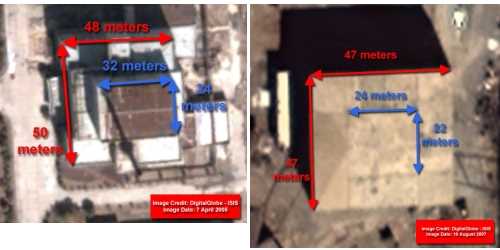
    — Respected former IAEA inspector, David Albright, has lent support to the idea that the box resembles the North Korean Yongbyon reactor based on not a lot more than the fact that the two buildings share the same diameter footprint. But whereas Yongbyon comprises a larger box with smaller boxes stacked on top of it, the image of the Syrian cube has been helpfully marked up with locations for imaginary boxes. “There also appears to be a faint square on top of the Syrian building’s roof. It is unclear whether something would be built there, but its dimensions, 24 meters by 22 meters, are consistent with the subsequent construction of an upper roof.” Four years after this faint square was first photographed, it remained a faint square [PDF].

boxes.jpg

    Global Security‘s John Pike refers to the site as being located in “the middle of nowhere” — everyone has now seen images of the barren location — yet one only needs to spend a few minutes on Google Earth to discover that the Box on the Euphrates lies right in the middle of Syria’s agricultural heartland with sizable communities either direction from this supposedly isolated location.

middle of nowhere

    This makes it all the more strange that nothing in the images appear to indicate the existence of a secure perimeter to this facilitiy — something that can easily be discerned if one looks at similar resolution images of, for instance, Israel’s nuclear facility at Dimona. However laid-back the Syrians might be, I’d wager that come the day that there was anything of high value at this site, there would be some serious security to keep out unwelcome intruders.
    — Washington’s high priest of gossip, Chris Nelson, after originally being convinced that the facility was related to Scud missile assembly, has now been won over to the nuclear reactor theory. The “evidence” that shifted his opinion? The fact that US-North Korea negotiator Chris Hill, in his recent Congressional testimony, did not refuted the theory. The absence of a denial is the same as an affirmation? Not according to my understanding of logic.

So what do we really know at this point?

A large cube-shaped building next to the Euphrates was visible from space in 2003. Given its size it must have taken a while to construct. The primary structure looked pretty much the same from above in August 2007. New images reveal that it’s not there now, the site has been leveled and it is reasonable to assume that the site clearing occured after, and very likely as a result of, an Israeli air force attack on September 6, 2007.

Do we have hard evidence that Syria was engaged in constructing a nuclear reactor? Not yet. Are any journalists hunting down that hard evidence? Probably not — why go to the trouble when you can kick back and get paid for schmoozing with John Bolton.

Meanwhile, IAEA director Mohamed ElBaradei is pissed off about the “bomb first and then ask questions later” approach. “I think it undermines the system and it doesn’t lead to any solution to any suspicion, because we are the eyes and ears of the international community. It’s only the agencies and inspectors who can go and verify the information.” He notes that in all the years that John Bolton and his cohorts have been making accusations about a Syrian nuclear program, “we have not received information about any nuclear-related activities, clandestine nuclear-related activities in Syria.”

Perhaps then we can infer that the real target of the Israeli strike was not a nuclear facility: it was the IAEA inspections processa troublesome log that the neocons are eager to clear off the road leading to Tehran.

Facebooktwittermail