Category Archives: Iran deal

America’s undying faith in war

Why more favor war in Iran while support for the Afghan effort is dropping

Recent polls reveal a curious contrast between the public’s current feelings about America’s ongoing war in Afghanistan and the possibility of the nation adding another front to its list of military engagements, this one in Iran.

Though most Americans aren’t ready to cut and run, an increasing number are having second thoughts about U.S. involvement in Afghanistan. A Pew Research Center November poll finds 56 percent endorsing the initial decision to use force, down 8 percentage points since January. Similarly, a late September Pew poll found support among Americans for keeping troops in Afghanistan until the country is stable stood at 50 percent—a hefty seven-point drop since June. This despite the fact that fully three-in-four Americans see a Taliban takeover in Afghanistan as a major threat to U.S. well-being.

Yet even as enthusiasm for involvement in Afghanistan faded, an October Pew Research survey, found that by a substantial 61 percent to 24 percent margin, Americans said that it is more important to prevent Iran from developing nuclear weapons than to avoid a military conflict with that country. True, the survey also found hefty support for direct negotiations—but most Americans just don’t think they’ll work. And when faced with the choice between a nuclear-armed Iran and military action, most Americans choose conflict. [continued…]

Editor’s Comment — In one of the well-known Sufi stories about Mullah Nasruddin, the mullah has just returned from the market with a basket of red hot chili peppers. He is sitting in a room eating one after another and his mouth swells and his lips bleed and a student finds him and asks in bewilderment why the mullah is punishing himself. Nasruddin replies: “I keep on thinking that the next pepper will be sweet.”

Such is America’s triumph of hope over experience when it comes to contemplating the next war — the war which will vindicate this nation for all its earlier misadventures. This is the pathological shadow of the American can-do, optimistic spirit: faith in a future uncolored by the past.

Happy Thanksgiving!

Facebooktwittermail

Experts say Iran may be ready for a nuclear deal

Experts say Iran may be ready for a nuclear deal

In contentious, high-stakes negotiations, deals are possible when both sides have a chance to declare victory, and that point may have been reached.

“If the Iranian endgame is to keep enrichment, and if the United States’ endgame is to make sure there are no nuclear weapons in Iran, then it can be a win-win,” said Trita Parsi, author of a book on Iran and president of the National Iranian American Council, an independent advocacy group in Washington. “Those who have been criticizing the administration for compromising or giving Iran a concession, they are wrong. It is not a concession to adjust to an unchanging reality.”

For Iran, this is not exactly about compromising — which it has shown little appetite for — as much as cooperating. For the West, it is not about winning concessions but about developing verifiable assurances that Iran is not producing weapons.

“I think the Iranians are simply in no mood to accept any serious limits on the expansion of their program,” said Flynt Leverett, director of the Iran Project at the New America Foundation. “From their point of view, they already suspended enrichment for almost two years, from 2003 to 2005, and from their perspective, they got nothing for that and they’re not going to do that again.”

But Mr. Leverett said Iran sees “that by expanding, they’ve gotten the attention of the international community and they have cards to play.”

And that may have been Iran’s primary goal from the start.

There are many analysts inside and outside Iran who say that Tehran’s objective has been to master — or at least appear to master — the process of preparing nuclear fuel, fashioning a warhead and providing the means to deliver that warhead, but not actually to build a weapon. [continued…]

‘Israel may attack Iran after December’

Israel is making preparations to carry out military attacks in Iran after December, a French magazine reported overnight Wednesday.

According to the report in Le Canard Enchainé quoted by Israel Radio, Jerusalem has already ordered high-quality combat rations from a French food manufacturer for soldiers serving in elite units and has also asked reservists of these units staying abroad to return to Israel.

The magazine further reported that in a recent visit to France, IDF Chief of General Staff Lt.-Gen. Gabi Ashkenazi told his French counterpart Jean-Louis Georgelin that Israel was not planning to bomb Iran, but might send elite troops to conduct activities on the ground there. [continued…]

Editor’s Comment — So, the bombing plans have now been shelved. Instead, Israel is going to send in commandos?

I kind of doubt it. The first problem is getting them in. I suppose the Kurds might oblige. But is Israel willing to risk seeing any of its soldiers taken prisoner and put on trial or used as human shields?

Facebooktwittermail

Israel’s never-ending war

Israel’s never-ending war

As Israel’s Prime Minister, Benjamin Netanyahu, and Palestinian Authority President Mahmoud Abbas, meet at the United Nations today, “both sides have made clear that they’ll essentially be humoring Obama, showing up because the President of the United States expects it of them and not to relaunch long-stalled ‘final status’ peace negotiations, as the administration had hoped,” writes Tony Karon at Time magazine.

The conventional wisdom among most seasoned observers of the conflict is that the status quo is untenable — that at some point both sides will have to arrive at a mutually acceptable way of implementing a two-state solution.

The process that might lead to that point is as murky as ever.

The possibility that receives less consideration is that Israelis, living in a country forged through war — a country that has never really known peace — having become resigned to the apparent necessity of remaining on a perpetual war footing, have now reached a point where war is more than tolerable: it is acceptable.

War is what created Israel, has allowed it to exist and will guarantee its perpetuation. Many Israelis may pay lip-service to the notion that peace is desirable, yet it is their willingness to engage in war that makes them feel safe.

For Ariel Siegelman, an Israeli soldier who fought in Gaza in a special forces unit of the IDF, the key lesson from the 2006 war in Lebanon was this: “We learned that we had been living in an imaginary world and that the most dangerous type of war is the one that you call peace. We learned that we are not in fact in a ‘peace process’ at all. We are at war.”

In the Washington Post just this week, Jackson Diehl pointed out that even as the UN’s damning report on the war on Gaza brought renewed critical attention to the most recent conflict, “Operation Cast Lead, as the three-week operation is known in Israel, is generally regarded by the country’s military and political elite as a success.” (Diehl, with apparent satisfaction, predicted: “As for the Goldstone report [PDF], the heat it briefly produced last week will quickly dissipate”.)

Claiming that the wars in Lebanon and Gaza had for Israel both been qualified successes, Diehl suggested that Israel is far less fearful than are most of its allies about picking a fight with Iran.

… as with Gaza, even a partial and short-term reversal of the Iranian nuclear program may look to Israelis like a reasonable benefit — and the potential blowback overblown.

Americans who do not share Diehl’s neoconservative perspective, don’t need to ask themselves whether they share Israel’s view of itself; they simply need to decide whether the United States has a responsibility (or any legitimate excuse) for sustaining Israel’s war machine.

Without American arms, the Jewish state will not be starved of materiel — there are plenty of non-US arms manufacturers who would happily pick up the new demand.

The only issue is whether we should regard Israel’s wars as ours.

* * *

Israel’s military might and its fighting forces have been celebrated by Israelis and Israel’s supporters through numerous songs and videos. Here are a few:

Facebooktwittermail

The numbers never lie — unless they come from Jackson Diehl

The numbers never lie — unless they come from Jackson Diehl

In yesterday’s Washington Post, deputy editorial page editor Jackson Diehl presented his case on how Israel “won” the war in Gaza and how this bodes well for the Israel’s prospects in the event that it launches an attack on Iran.

Reviving neocon hubris from days of yore, Diehl poo poos the dire predictions that some have made about the consequences of an attack on Iran’s nuclear facilities, saying: “even a partial and short-term reversal of the Iranian nuclear program may look to Israelis like a reasonable benefit — and the potential blowback overblown.”

To make his case, Diehl cites the lull in rocket attacks from post-war Gaza as proof of the “success” of the war.

Israel’s satisfaction starts with a simple set of facts. Between April 2001 and the end of 2008, 4,246 rockets and 4,180 mortar shells were fired into Israel from Gaza, killing 14 Israelis, wounding more than 400 and making life in southern Israel intolerable. During what was supposed to be a cease-fire during the last half of 2008, 362 rockets and shells landed. Meanwhile, between late 2000 and the end of 2008, Israeli forces killed some 3,000 Gazans.

Since April there have been just over two dozen rocket and mortar strikes — or less than on many single days before the war. No one has been seriously injured, and life in the Israeli town of Sderot and the area around it has returned almost to normal. Israeli attacks in Gaza have almost ceased, too: Since the end of the mini-war, 29 Palestinians, two of whom were civilians, have been killed by Israeli action.

A “ceasefire” during which 362 attacks occurred doesn’t sound like much of a ceasefire — except for the fact that Diehl is grossly misrepresenting the numbers. 324 of those attacks occurred after Israel unilaterally broke the ceasefire on November 4, 2008.

As I wrote in late December, a few days after the war began:

When, after ignoring the subject for several days, the New York Times finally got around to making an editorial pronouncement on the war on Gaza, it trotted out what is among most inattentive observers the conventional wisdom:

Hamas never fully observed the cease-fire that went into effect on June 19 and Israel never really lived up to its commitment to ease its punishing embargo on Gaza.

In fact, Hamas’ compliance with the ceasefire was stunningly disciplined. Don’t take my word for it. The proof comes from the Israeli government.

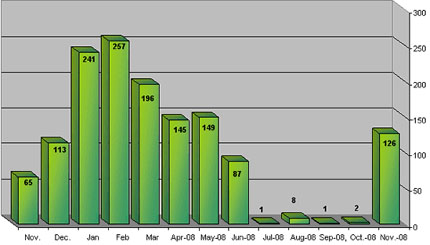
Look at this graph provided by the Israeli Foreign Ministry showing rocket attacks from Gaza per month during 2008.

From January through June there were an average of 179 rocket attacks per month. From July through October there were an average of 3 rocket attacks per month.

For the residents of Sderot, those months were indeed a period of calm. But the calm ended when Israel unilaterally broke the ceasefire right after the US elections and just before Hamas and Fatah sat down for crucial reconciliation talks in Cairo.

If Israel, as it would currently have the world believe, was so strongly in favor of extending the six-month ceasefire, why did it attach so little value to what had already been accomplished? Why did it not acknowledge the effectiveness with which Hamas was holding up its side of the bargain? Why did it not demonstrate that it valued the calm by lifting or at least easing the economic embargo on Gaza in a significant way?

All Israel accomplished was to confirm Hamas’ suspicions — suspicions shared by most Palestinians — that Israel cannot be trusted.

Did it matter to the Israelis that they could be damned by their own statistics? Apparently so, for within a few days of my drawing attention to the success of the truce, the Ministry of Foreign Affairs had removed the evidence.

As I then wrote:

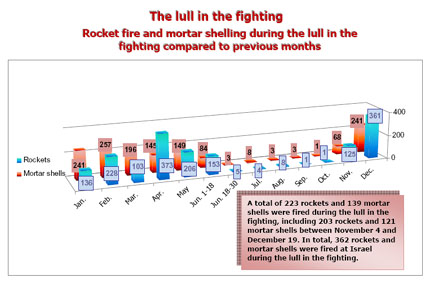
Now that the Israeli propaganda machine is revved up to full throttle, the image of an effective truce no longer suits the Israeli government’s purposes. Instead it has become more convenient to try and hide the numbers — with numbers! The foreign ministry has thus removed the simple graph shown above and replaced it with this:

In the earlier image, graph blocks dramatically portrayed the rise and fall in rocket fire rates. In the revised image, blocks of equal size (containing numbers) are used to obscure the graph. The effect, clearly intended, is to try and portray the lull as really nothing more than a minor undulation in a period of unremitting attacks.

The message Israel now wants to sell is that the truce never really worked. Instead of acknowledging that the truce effectively collapsed when Israel launched Operation “Double Challenge” on November 5, the rocket fire that followed that Israeli raid is being used to obscure the fact that rocket fire had effectively been curtailed up to that point.*

On the IDF Spokesman web site, a post on rocket statistics simply omits the part of the record that Israel now finds inconvenient to acknowledge:

  • Between Hamas’ takeover and the start of the Tahadiya (State of Calm), (June 14, 2007 – June 16, 2008), there was an average of over 361 attacks per month—an increase of an additional 350%.
  • On Nov. 4 – 5, Israel launched Operation “Double Challenge”, targeting a tunnel Hamas was building as part of a plan to kidnap Israeli soldiers.
  • From the end of Operation “Double Challenge” until the end of the Tahadiya, (Nov. 4 – Dec. 19, 2008) a period of only a month and a half, there were 170 mortars, 255 Qassams, and 5 Grads fired upon Israel’s civilian population centers.
  • Since the end of the Tahadiya (Dec. 19, 2009) until the beginning of Operation “Cast Lead,” (Dec. 27, 2008) a period of little more than a week, there were approximately 300 mortars and rockets fired onto Israel.
  • Since the begining of Operation “Cast Lead”, there have been an additional 500 launches, 284 of which have been verified as rockets (both Qassams and Grads), and 113 as mortars.

Was four months of calm really worthless? Given that it became the precursor to war, the answer now apparently is yes.

But it didn’t have to turn out this way. The effectiveness with which Hamas enforced a truce should have provided the impetus for Israel to lift its economic siege of Gaza.

Instead, we are once again witness to Israel’s seemingly insatiable appetite for war, even while it never tires of professing its love of peace.

* Should anyone doubt that the Israeli raid (official declarations about Israel’s commitment to the truce notwithstanding) constituted a unilateral breach of the truce, consider what Israel and the world’s response would have been in the event that the raid had been launched from Gaza. Hamas gunmen conducted a raid inside Israeli territory, killing six Israeli soldiers.

That wouldn’t have been described as a breakdown in the truce; it would have been regarded as an act of war.

Facebooktwittermail

US Jewish leaders push Obama to act on Iran

US Jewish leaders push Obama to act on Iran

Several hundred Jewish leaders and activists are planning to arrive here Thursday to urge top Obama administration officials and US congressmen to take action on Iran.

They are pushing for Congress to quickly pass an Iran sanctions bill sponsored by US House Foreign Affairs Committee Chairman Howard Berman and otherwise take serious economic and diplomatic steps to pressure Iran to abandon its pursuit of nuclear capabilities that threaten Israel.

“Congress is back, legislation is on the agenda, and this is September, when at some level decisions are being made in connection with Iran,” Anti-Defamation League Washington Director Jess Hordes said of the planning of the event.

His organization will be joining the United Jewish Communities, the Jewish Council for Public Affairs, the Conference of Presidents of Major American Jewish Organizations, the National Conference of Soviet Jewry and several other groups as part of the effort. [continued…]

U.S. says Iran could expedite nuclear bomb

American intelligence agencies have concluded in recent months that Iran has created enough nuclear fuel to make a rapid, if risky, sprint for a nuclear weapon. But new intelligence reports delivered to the White House say that the country has deliberately stopped short of the critical last steps to make a bomb.

In the first public acknowledgment of the intelligence findings, the American ambassador to the International Atomic Energy Agency declared on Wednesday that Iran now had what he called a “possible breakout capacity” if it decided to enrich its stockpile of uranium, converting it to bomb-grade material.

The statement by the ambassador, Glyn Davies, was intended to put pressure on American allies to move toward far more severe sanctions against Iran this month, perhaps including a cutoff of gasoline to the country, if it failed to take up President Obama’s invitation for serious negotiations. But it could also complicate the administration’s efforts to persuade an increasingly impatient Israeli government to give diplomacy more time to work, and hold off from a military strike against Iran’s facilities. [continued…]

Iran dims hopes for diplomacy

ran rejected any compromise with the West over its nuclear program Wednesday, as blunt comments from the Obama administration over Tehran’s bomb-making capability suggested that the two sides were headed toward a renewed diplomatic crisis.

Iran offered Western officials a long-awaited package of proposals to restart negotiations over its nuclear program. But diplomats who viewed the offer Wednesday said the document of fewer than 10 pages essentially ignored questions over Iran’s production of nuclear fuel and instead focused broadly on other international issues.

It made no mention of Tehran’s willingness to suspend its uranium-enrichment activities or to enter into substantive talks about the future of its nuclear program, they said. [continued…]

Russia ‘delivers SAMs to Syria’

Russia has begun deliveries of Pantsir S1 air-defense missiles to Syria, some of which are expected to be passed on to Iran, Syria’s strategic ally that has largely bankrolled the deal, according to the Interfax-AVN military news agency.

Interfax quoted Yuriy Savenkov, deputy director general of the Instrument Design Bureau, or KBP, as saying that deliveries started several weeks ago. KBP produces the Pantsir and other high-precision weapons.

Meantime, Kommersant quoted Alexei Fedorov, head of Russia’s United Aircraft Corp., as confirming the existence of a 2007 contract with Syria for eight twin-engined MiG-31E interceptors.

This aircraft, NATO codename Foxhound, can fly at three times the speed of sound and engage several targets at a range of up to 110 miles simultaneously. [continued…]

Taking Iran seriously

Given Iran’s shortening nuclear timetable and diplomatic challenges for forging an international consensus on sanctions, we urge Mr. Obama simultaneously to begin preparations for the use of military options. Now is the time for the president to reinforce his commitment to “use all elements of American power to prevent Iran from developing a nuclear weapon,” as he stated in February. We believe only a credible U.S. military threat can make possible a peaceful solution.

By showing that he has not taken the military option off the table, Mr. Obama may also be able to convince Israel to forgo a unilateral military strike while forcing Tehran to recognize the costs of its nuclear defiance. Furthermore, making preparations now will enable the president, should all other measures fail to bring Tehran to the negotiating table, to use military force to retard Iran’s nuclear program. We do not downplay the risks of this option and recognize its complications, but we do believe it to be a feasible option of last resort. [continued…]

Facebooktwittermail

Israeli war talk

Israel threatens military strike on Iran

President Shimon Peres has threatened that Israel will take military action against Iran if talks proposed by the US president Barack Obama fail to halt Iran’s nuclear programme. In an interview on the Israeli Kol Hai radio station on Sunday, Mr Peres warned that if the talks don’t soften the approach of the Iranian president, “we’ll strike him”.

Mr Peres ruled out the possibility of Israel engaging in a unilateral attack, and said: “We certainly cannot go it alone, without the US, and we definitely can’t go against the US. This would be unnecessary.”

The Israeli president’s statement comes just a few days after the US Vice President Joe Biden issued a high-level warning to Israel’s new government that it would be “ill advised” to launch a military strike against Iran.

Mr Peres also suggested that the arrest last week of 49 alleged agents of Hizbollah by Egyptian authorities was a blow to the Iranian president’s ambitions. [continued…]

Editor’s CommentIsrael threatens to attack Iran has become a dog-bites-man story. What’s significant here is that Peres went out of his way to say that Israel will not go it alone. An attack either gets US backing or it’s not going to happen.

The subtext here is that the Israelis are becoming genuinely afraid of a US-Israeli rift. And the driving force behind this rift is one that the Israel lobby is powerless to rein in: Avigdor Lieberman.

The diplomatic sleight of hand that the Israelis love to play is to gloss over disagreements and brush away criticisms by suggesting that the differences only exist in the eye of the beholder — that Israel and the US are of one heart, indivisible. But no one makes this posture more difficult than Lieberman, a man who is now too powerful to dismiss as a somewhat harmless embarrassment.

As Douglas Bloomfield wrote in the Jerusalem Post on Sunday, Lieberman “could do what the Arabs and their supporters could only dream of – drive a wedge between Americans and Israel.”

Netanyahu and threat of bombing Iran — the bluff that never stops giving?

Israel does not have the military capability to successfully eliminate Iran’s nuclear program. Even the most successful bombing campaign would only set back the known program for a few years — without affecting any potential clandestine program. This is not classified information. Military experts are well aware of Israel’s capabilities — and its limits.

Yet, the threat of military action, or rather the bluff, serves a purpose: Threats of military action militarizes the atmosphere. It creates an environment that renders diplomacy less likely to succeed — it may even prevent diplomacy from being pursued in the first place.

In the Iranian case, Netanyahu’s tough talk undermines the Obama administration’s prospects for diplomacy in the following ways.

Getting to the negotiating table has proven an arduous task for the US and Iran. Both sides are currently testing each other’s intentions, asking themselves if the other side is serious about diplomacy or if the perceived desire for talks is merely a tactical maneuver to either buy time or build greater international support for more confrontational policies down the road. From Tehran’s perspective, uncertainty about Washington’s intentions during the Bush administration was partly fueled by the insistence of the military option remaining on the table. Tehran seemed to fear entering negotiations that could have been designed to fail, since that could strengthen the case for military action against Iran. [continued…]

U.S. may drop key condition for talks with Iran

The Obama administration and its European allies are preparing proposals that would shift strategy toward Iran by dropping a longstanding American insistence that Tehran rapidly shut down nuclear facilities during the early phases of negotiations over its atomic program, according to officials involved in the discussions.

The proposals, exchanged in confidential strategy sessions with European allies, would press Tehran to open up its nuclear program gradually to wide-ranging inspection. But the proposals would also allow Iran to continue enriching uranium for some period during the talks. That would be a sharp break from the approach taken by the Bush administration, which had demanded that Iran halt its enrichment activities, at least briefly to initiate negotiations.

The proposals under consideration would go somewhat beyond President Obama’s promise, during the presidential campaign, to open negotiations with Iran “without preconditions.” Officials involved in the discussion said they were being fashioned to draw Iran into nuclear talks that it had so far shunned.

A review of Iran policy that Mr. Obama ordered after taking office is still under way, and aides say it is not clear how long he would be willing to allow Iran to continue its fuel production, and at what pace. But European officials said there was general agreement that Iran would not accept the kind of immediate shutdown of its facilities that the Bush administration had demanded. [continued…]

Iran says it controls entire nuclear fuel cycle

Iran now controls the entire cycle for producing nuclear fuel with the opening of a new facility to produce uranium fuel pellets, the Iranian president said Saturday.

Mahmoud Ahmadinejad made the speech two days after the inauguration of the facility which produces uranium oxide pellets for a planned 40-megawatt heavy-water nuclear reactor near the town of Arak, central Iran.

Production of nuclear fuel pellets is the final step in the long, complicated chain of nuclear fuel cycle. The U.S. and its allies have expressed concern over Iran’s developing nuclear program for fear it masks a nuclear weapons program — a charge Iran denies. [continued…]

Differences with US on Mideast ‘semantic’: Israel

Differences between Israel and the United States over the Middle East conflict are fundamentally semantic and will be harmonised within a few weeks, an Israeli minister said on Saturday.

“There are differences of approach toward the problems in the Middle East between our government and the administration of (US President Barack) Obama, but they point more to wording and semantics than to reality,” Transport Minister Israel Katz told public radio.

Israel’s hawkish new Prime Minister Benjamin Netanyahu “has already had meetings with American leaders, and our policies will converge,” he added. [continued…]

Israel lobbies Russia on Iranian arms sales

Israel has lobbied Russia to pull away from selling a strategic air-defense system to Iran but has received only vague assurances, Israeli defense sources said on Monday.

Last week Israel agreed to supply surveillance drones worth $50 million to Russia. The Israeli Haaretz newspaper said this followed a pledge by Moscow not to sell Iran the S-300, which could protect Iranian nuclear facilities against air strikes.

An Israeli defense official said he had no knowledge of such an undertaking by Russia in its talks with Israel on the matter. Moscow has given mixed messages on the prospects of Iran buying S-300s, a deal one Russian newspaper valued at $800 million. [continued…]

U.S. troops take part in Israel X-Band radar test

U.S. troops took part in a missile defense exercise in Israel last week that for the first time incorporated a U.S.-owned radar system deployed to the country in October.

About 100 Europe-based troops continue to operate the X-Band radar, which is intended to give Israel early warning in the event of a missile launch from Iran.

While it’s not a permanent assignment for U.S. troops, as long as the radar is in use, U.S. personnel will be there to operate it, U.S. European Command said. [continued…]


Facebooktwittermail

An Israeli attack on Iran

Realpolitik for Iran

Here’s one normalization scenario:

Iran ceases military support for Hamas and Hezbollah; adopts a “Malaysian” approach to Israel (nonrecognition and noninterference); agrees to work for stability in Iraq and Afghanistan; accepts intrusive International Atomic Energy Agency verification of a limited nuclear program for peaceful ends only; promises to fight Qaeda terrorism; commits to improving its human rights record.

The United States commits itself to the Islamic Republic’s security and endorses its pivotal regional role; accepts Iran’s right to operate a limited enrichment facility with several hundred centrifuges for research purposes; agrees to Iran’s acquiring a new nuclear power reactor from the French; promises to back Iran’s entry into the World Trade Organization; returns seized Iranian assets; lifts all sanctions; and notes past Iranian statements that it will endorse a two-state solution acceptable to the Palestinians.

Any such deal is a game changer, transformative as Nixon to China (another repressive state with a poor human rights record). It can be derailed any time by an attack from Israel, which has made clear it won’t accept virtual nuclear power status for Iran, despite its own nonvirtual nuclear warheads.

“Israel would be utterly crazy to attack Iran,” ElBaradei said. “I worry about it. If you bomb, you will turn the region into a ball of fire and put Iran on a crash course for nuclear weapons with the support of the whole Muslim world.”

To avoid that nightmare Obama will have to get tougher with Israel than any U.S. president in recent years. It’s time. [continued…]

Don’t flash the yellow light

It should go without saying that an Israeli attack on Iran would have disastrous consequences. No matter what Washington might claim, or how vociferously officials there denounce it, such an attack would be widely understood throughout the Muslim world as a joint U.S.-Israeli operation.

It would, as a start, serve as a powerful recruiting tool for extremist Islamist groups. In addition, an outraged Iran might indeed send commandos into Iraq, aid armed Iraqi groups determined to attack U.S. and government forces, shoot missiles into the Saudi or Kuwaiti oilfields, and attempt to block the Straits of Hormuz though which a significant percentage of global oil passes. Washington would certainly have to write off desperately needed cooperation in the war against the Taliban and al-Qaeda in Afghanistan and Pakistan. Any attack would only strengthen the reign of the mullahs in Iran and reinforce the country’s determination to acquire a nuclear deterrent force that would prevent future attacks. And keep in mind, Iran’s nuclear program has overwhelming public support, even from those opposed to the current regime.

Given the Netanyahu government’s visible determination to attack, an ambiguous signal from Washington, something far less than a green light, could be misread in Tel Aviv. Anything short of a categorical, even vociferous U.S. refusal to countenance an Israeli attack might have horrific consequences. So here’s a message to Obama from an observer in Israel: Don’t flash the yellow light — not even once. [continued…]

Peres makes rare hint at possible strike on Iran

President Shimon Peres had some unusually aggressive words for Iran Sunday, seemingly threatening military action if US President Barack Obama’s overtures to the Islamic republic fail to bear fruit.

In an interview with Kol Hai Radio, Peres also said that the arrest before the weekend of a Hizbullah terror cell in Egypt was a blow to Iranian President Mahmoud Ahmadinejad’s power.

“Ahmadinejad recruits forces against us, but there are also forces against him,” Peres said. “What happened in Egypt created a fierce opposition and we must unify all his opponents – the Sunnis and the Europeans, as well as those afraid of nuclear weapons and terror.”

Peres went on to say that he hoped Obama’s call for dialogue with Ahmadinejad would be heeded, but warned that if such talks don’t soften the Iranian president’s approach “we’ll strike him.” [continued…]

Why Israel will bomb Iran

From the standpoint of international relations theory, the scariest thing about recent Israeli rhetoric is that an attack on Iran lines up quite well with Israel’s rational interests as a superpower client.

While Israeli bluster is clearly calculated to push America to take a more aggressive stance toward Iran, that doesn’t mean the Israelis won’t actually attack if President Obama decides on a policy of engagement that leaves the Iranians with a viable nuclear option. In fact, the more you consider the rationality of an Israeli attack on Iran in the context of Israel’s relationship with its superpower patron, the more likely an attack appears. [continued…]

Editor’s Comment — Whatever you want to say about David Samuels’ argument, he certainly deserves credit for creative reasoning. That said, the idea that Israel bombing Iran could be a precursor to a grand bargain that delivers a Palestinian state is, I would say, a mighty stretch.

What interests me more about his piece is that it represents the common thread that unites all those who present a military solution to “the Iranian threat” as desirable, inevitable and necessary. That is, it presents an attack on Iran as an action that will have an upside (success being measured by how far Iran’s nuclear program is set back) but no significant downside. Warnings such as ElBaradei’s that an attack would “turn the region into a ball of fire” are dismissed. Israel’s missile defense systems are assumed to provide the Jewish state with adequate protection from a retaliatory attack. Hamas and Hezbollah have already been “taught a lesson,” while the international community is expected to be outwardly critical yet quietly grateful. Israel will have successfully demonstrated its regional dominance while Iran and its allies will sullenly resign themselves to accepting the status quo.

The risk assessment being made by attack-Iran proponents places all the risk in Iran’s acquisition of nuclear weapons and essentially none in the effects of an attack — an extraordinary replay of the arrogance that led to the war in Iraq.

There is however one major difference. The war in Iraq began during a period of global economic buoyancy. An attack on Iran, if it comes, is going to take place during a dire economic crisis. To blithely assume that Iran would not exploit its economic leverage in such a situation is beyond reckless. It suggests that those whose imaginations are shackled by their obsession with the fate of the Jewish state seem to think that Israel can prosper even while the world goes to ruin.

Facebooktwittermail

NEWS & ANALYSIS & EDITOR’S COMMENT: Let’s push up the price of oil

Pentagon official warns of Israeli attack on Iran

Senior Pentagon officials are concerned that Israel could carry out an attack on Iran’s nuclear facilities before the end of the year, an action that would have enormous security and economic repercussions for the United States and the rest of the world.

A senior defense official told ABC News there is an “increasing likelihood” that Israel will carry out such an attack, a move that likely would prompt Iranian retaliation against, not just Israel, but against the United States as well. [complete article]

Israel-Iran: Attack or feint

An Israeli strike is fraught with potential pitfalls and by no means guaranteed of striking a major blow to the Iranian nuclear program, which would likely require multiple raids and risk a major military escalation. (See US, Iran: Empty threats, by Kamal Nazer Yasin for ISN Security Watch.).

Any attack would also impact deleteriously on Israel’s improved position vis-à-vis western nations, the University of Haifa’s Dr Soli Shahvar told ISN Security Watch.

Referring to Iran, Kam said, “They have better air defenses than they had before, though the more sophisticated system [S-300] is probably not operational. […] Russia did supply Iran with a new, much better system [29 Tor M-1 systems].”

Russian officials relate that the S-300 surface-to-air missile is capable of intercepting aircraft at up to 27,000m and at an operating distance of 145km and believe it is superior to the Israeli-deployed US Patriot. Israeli defense analysts have confirmed that Iranian receipt of the system would make it far more difficult for the Israeli air force to attack Iranian targets. Russian supply of the system is far from assured. [complete article]

Tehran puts on a show of strength

Psychological warfare is on the rise. This weekend, a senior Iranian general, Mir-Faisal Bagherzadeh, said his country was digging 320,000 graves for American soldiers scheduled to fight in Iran. “In implementation of the Geneva Conventions, the necessary measures are being taken to provide for the burial of enemy soldiers. We have plans to dig 15,000 to 20,000 graves for each of the border provinces, or a total of 320,000,” he said, pointing out that some of them would be mass graves, if necessary. This was “to reduce the suffering of the families of the fallen in any attack against, and prevent the repetition of the long and bitter experience of the Vietnam War”.

These may sound like big words – similar to those barked by Saddam Hussein and his information minister Mohammad Said al-Sahhaf in 2003 – but they carry real impact on the psychology of American troops. Iraq – with its weak army and corrupted regime – was impossible to chew for the Americans. Nobody can imagine how difficult a war would be against 65 million Iranians, with a well-trained, well-armed military indoctrinated with Shi’ite Islam and a strong sense of purpose against the “great Satan”.

In addition to building the graves – which has actually started – the Iranians have several actions they could resort to if war were declared between now and the end of President George W Bush’s tenure at the White House in January.

They can incite the Shi’ites of nations where there are US military bases; Saudi Arabia (33%), Kuwait (36%), Bahrain (80%). They can incite the Kurds of Turkey and create problems with the Shi’ites of Yemen. They can unleash hell in Iraq through proxies like the Mahdi Army of Muqtada al-Sadr and the Supreme Iraqi Islamic Council. The Shi’ites of these countries have strong bonds to Iran and would listen and respond, if duty calls, and if the Americans or Israel went to war against Tehran. [complete article]

Editor’s Comment

The US will not allow Iran to hamper oil shipments through the Strait of Hormuz, said the US Navy’s Fifth Fleet commander, responding to earlier threats by the leader of Iran’s Revolutionary Guards.

They will not close it. They will not be allowed to close it,” said Vice-Adm. Kevin J. Cosgriff of the strait, one of the world’s most vital waterways for the shipping of hydrocarbons.

Vice Admiral Cosgriff said what a naval commander gets paid for saying. But even as he spoke, many in the oil markets, rather than being reassured, must have been remembering “Millennium Challenge 2002.” As that exercise demonstrated, protecting the Strait of Hormuz is easier said than done.

As for red lines, I suspect the one that vexes Israel more than any other, is one that is treated as unspeakable, lest by being spoken the idea acquires wider currency: that the world (including Israel) could learn to live with a nuclear Iran.

If and when the debate turns in that direction, then the game will have been lost and a new balance of power will eventually emerge — one within which Israel will be required to make accommodations rather than continuing to assume the position of being exceptional.

Facebooktwittermail

NEWS & EDITOR’S COMMENT: New York Times sends signal to Iran

U.S. says exercise by Israel seemed directed at Iran

Israel carried out a major military exercise earlier this month that American officials say appeared to be a rehearsal for a potential bombing attack on Iran’s nuclear facilities.

Several American officials said the Israeli exercise appeared to be an effort to develop the military’s capacity to carry out long-range strikes and to demonstrate the seriousness with which Israel views Iran’s nuclear program.

More than 100 Israeli F-16 and F-15 fighters participated in the maneuvers, which were carried out over the eastern Mediterranean and over Greece during the first week of June, American officials said. [complete article]

Editor’s Comment — Does the New York Times have a vital role to play in defending Israel from an Iranian nuclear threat? If the answer is ‘yes’, then I can understand why the paper would run a report like this. But if the paper’s primary responsibility is to report, then it has no business turning itself into an adjunct of either the US government or the Israeli government as it is doing so in this case. Performing government service here means disseminating information that no government official is willing to disseminate openly.

A senior Pentagon official who has been briefed on the exercise, and who spoke on condition of anonymity because of the political delicacy of the matter, said the exercise appeared to serve multiple purposes.

One Israeli goal, the Pentagon official said, was to practice flight tactics, aerial refueling and all other details of a possible strike against Iran’s nuclear installations and its long-range conventional missiles.

A second, the official said, was to send a clear message to the United States and other countries that Israel was prepared to act militarily if diplomatic efforts to stop Iran from producing bomb-grade uranium continued to falter.

“They wanted us to know, they wanted the Europeans to know, and they wanted the Iranians to know,” the Pentagon official said. “There’s a lot of signaling going on at different levels.”

But the NYT isn’t just describing the signaling — it’s part of the signaling loop. It thereby in the most insidious way inserts itself into a political process wherein it serves a role in applying pressure on all the parties involved.

Anonymous sourcing is required in a story like this, not because of — as the NYT puts it — “the political delicacy of the matter.” It’s used because journalists willing to prostitute themselves to their sources give those sources complete freedom to pick and choose which questions they want to answer. Indeed, they hand the reporter the story on a plate and then the newspaper happily gets the message out.

How would this story be approached if it was real journalism? It would dig into some of the key political question here: To what degree are the United States and Israel pursuing a coordinated political and military strategy in confronting Iran? Is the Pentagon — with a nod and a wink — helping relay Israel’s signal to Iran, or is it signaling to all concerned that Israel is a free agent whose actions might conflict with American interests?

These are the kinds of questions that don’t get answered when journalists turn themselves into the mouthpieces of anonymous sources.

How Iran would retaliate if it comes to war

Pressure is building on Iran. This week Europe agreed to new sanctions and President Bush again suggested something more serious – possible military strikes – if the Islamic Republic doesn’t bend to the will of the international community on its nuclear program.

But increasingly military analysts are warning of severe consequences if the US begins a shooting war with Iran. While Iranian forces are no match for American technology on a conventional battlefield, Iran has shown that it can bite back in unconventional ways.

Iranian networks in Iraq and Afghanistan could imperil US interests there; American forces throughout the Gulf region could be targeted by asymmetric methods and lethal rocket barrages; and Iranian partners across the region – such as Hezbollah in Lebanon – could be mobilized to engage in an anti-US fight. [complete article]

Facebooktwittermail

Updated – NEWS & EDITOR’S COMMENT: How to spot bullshit

The article linked to below has been updated. The White House has now issued a flat denial of the earlier JP report.

‘Bush intends to attack Iran before the end of his term’

US President George W. Bush intends to attack Iran in the upcoming months, before the end of his term, Army Radio quoted a senior official in Jerusalem as saying Tuesday.

The official claimed that a senior member of the president’s entourage, which concluded a trip to Israel last week, said during a closed meeting that Bush and Vice President Dick Cheney were of the opinion that military action was called for.

However, the official continued, “the hesitancy of Defense Secretary Robert Gates and Secretary of State Condoleezza Rice” was preventing the administration from deciding to launch such an attack on the Islamic Republic, for the time being.

The report stated that according to assessments in Israel, recent turmoil in Lebanon, where Hizbullah de facto established control of the country, was advancing an American attack.

Bush, the officials said, opined that Hizbullah’s show of strength was evidence of Iranian President Mahmoud Ahmadinejad’s growing influence. They said that according to Bush, “the disease must be treated – not its symptoms.”

In an address to the Knesset during his visit here last week, Bush said that “the president of Iran dreams of returning the Middle East to the Middle Ages.”

“America stands with you in firmly opposing Iran’s nuclear weapons ambitions,” Bush said. “Permitting the world’s leading sponsor of terror to possess the world’s deadliest weapon would be an unforgivable betrayal of future generations. For the sake of peace, the world must not allow Iran to have a nuclear weapon.” [complete article]

Editor’s Comment — This article requires careful reading. Here’s why I’d say it’s bullshit:

1. The headline. The statement is in quotes but the “quote” gets paraphrased in the article. If you’ve got a killer quote – even one from a nameless senior official – you don’t turn it into a paraphrase.

2. Straight after leading with the quoteless quote, the article pushes back by saying that Bush and Cheney are of “the opinion that military action is called for.” Being of the opinion its called for is not the same as saying its going to happen.

3. Is Ed Gillespie (or whoever this senior member of Bush’s entourage was) really going to say to the Israelis, “Bush and Cheney want to attack, but right now their hands are tied by Rice and Gates”? If that was the case, it sounds more like someone saying, “You know, we really want to help you, but we can’t.” More likely, the statement took a form something like this: “President Bush and Vice President Cheney are fully aware that military action may be called for before they leave office, but right now there’s a lot of debate going on between the White House and State and Defense on whether this is the right time to move ahead.”

4. When Bush stands up in front of the Knesset and says, “the world must not allow Iran to have a nuclear weapon,” he’s making it pretty clear that the US is not going to act unilaterally.

5. When Bush spoke directly to the Jerusalem Post a few days ago, he told them that “before leaving office he wants a structure in place for dealing with Iran.” That does not sound like a coded way of saying the US is going to attack Iran. It sounds very much like he saying that he’s going to make sure that the next president is hemmed in by the policies that the Bush administration has set.

Facebooktwittermail

NEWS & OPINION: An attack on Iran?

United States is drawing up plans to strike on Iranian insurgency camp

The US military is drawing up plans for a “surgical strike” against an insurgent training camp inside Iran if Republican Guards continue with attempts to destabilise Iraq, western intelligence sources said last week. One source said the Americans were growing increasingly angry at the involvement of the Guards’ special-operations Quds force inside Iraq, training Shi’ite militias and smuggling weapons into the country.

Despite a belligerent stance by Vice-President Dick Cheney, the administration has put plans for an attack on Iran’s nuclear facilities on the back burner since Robert Gates replaced Donald Rumsfeld as defence secretary in 2006, the sources said.

However, US commanders are increasingly concerned by Iranian interference in Iraq and are determined that recent successes by joint Iraqi and US forces in the southern port city of Basra should not be reversed by the Quds Force. [complete article]

Bluff and bloodshed

If there’s a war between the United States and Iran, it may well start on the water. After all, it’s happened before. Twenty years ago American ships were under fire in the Persian Gulf, and mines laid by the mullahs’ men nearly sank a U.S. guided missile cruiser. In April 1988 the American and Iranian navies fought the biggest air-sea battle waged since World War II. By the time it was over, carrier-based U.S. attack planes had sunk the frigate Sahand and disabled the frigate Sabalan, the pride of the Iranian navy.

That’s why the comment by Defense Secretary Robert Gates on Tuesday about the brief deployment of a second U.S. aircraft carrier to the gulf was so terse and so telling. “I don’t see it as an escalation,” Gates said. “I think it could be seen, though, as a reminder.”

Gates would know. He was deputy director of the Central Intelligence Agency back in 1988. He has seen firsthand the treacherous complexities, the bluff and the bloodshed, of war with Iran, whether fought in the shadows or on the high seas. And anyone who was out in the gulf at the time, as I was, can see similarities between then and now. But looking back at the last undeclared war with Iran, who is reminded of what, precisely? The challenge is to draw the right lessons. [complete article]

War with Iran? That will be for the next president

There was a moment in April 1990, when Saddam Hussein was appearing on the covers of all of the news magazines, threatening to “burn” half of Israel and brandishing new chemical and biological weapons, when we should have known that the United States would eventually go to war with Iraq. It was almost four months before Iraq’s invasion of Kuwait and most people hadn’t thought much about the country, but war gamers and planners in the Pentagon began shifting their attention.

We are now at a similar moment with Iran. Short of Iran invading one of its neighbors or attacking U.S. forces in some obvious and gross way, the Iran war isn’t going to be Dick Cheney’s war. It will be waged by Hillary Clinton, John McCain or Barack Obama. [complete article]

Facebooktwittermail

NEWS & ANALYSIS: The Iranian threat

Saudi cannot be launchpad for Iran attack: report

A leading Saudi newspaper on Saturday ruled out any attempt by the United States to use the oil-rich Gulf kingdom as a launchpad for a possible war on Iran over Tehran’s disputed nuclear programme.

Two days before a visit to Saudi Arabia by US President George W. Bush, the pro-government daily Al-Riyadh said: “We refuse to be used to launch wars or tensions with Iran. [complete article]

Iran’s Revolutionary Guard in secret Iraq talks with US

The head of the Iranian Revolutionary Guard Corps slipped into the green zone of Baghdad last month to press Tehran’s hardline position over the terms of the current talks with American officials, it was claimed last week.

Iraqi government sources say that Major-General Mohammed Ali Jafari, 50, travelled secretly from Tehran. Jafari appears to have passed through checkpoints on his way into the fortified enclave that contains the American embassy and Iraqi ministries, even though he is on Washington’s “most wanted” list. [complete article]

Iran encounter grimly echoes ’02 war game

There is a reason American military officers express grim concern over the tactics used by Iranian sailors last weekend: a classified, $250 million war game in which small, agile speedboats swarmed a naval convoy to inflict devastating damage on more powerful warships.

In the days since the encounter with five Iranian patrol boats in the Strait of Hormuz, American officers have acknowledged that they have been studying anew the lessons from a startling simulation conducted in August 2002. In that war game, the Blue Team navy, representing the United States, lost 16 major warships — an aircraft carrier, cruisers and amphibious vessels — when they were sunk to the bottom of the Persian Gulf in an attack that included swarming tactics by enemy speedboats. [complete article]

Iran urges agency to settle atomic case

Iran’s supreme leader, Ayatollah Ali Khamenei, told the visiting chief of the International Atomic Energy Agency on Saturday that Iran’s nuclear case should be handled by the I.A.E.A. and not the United Nations Security Council, which has imposed two rounds of sanctions on Tehran. [complete article]

Israel stressed to Bush that Iran is a nuclear ‘threat’: general

Iran poses a real nuclear threat and Israel made that point clear to US President George W. Bush during his visit this week, an Israeli defence official said Saturday. [complete article]

Facebooktwittermail

NEWS: Israel’s new intelligence estimate – mixed threats

Exclusive: Annual Israeli Intelligence Estimate

Deep pessimism alongside cautious optimism- those are the two key principles that emerge from this year’s Annual Israeli Intelligence Estimate. The report will be presented to the security cabinet in several days time by IDF Intelligence Chief Major-General Amos Yadlin, but the highlights are here for you now in a Ynet exclusive report.

The aforementioned pessimism concerns Iran’s nuclear ambitions. The American National Intelligence Estimate “dropped quite a bomb” on Israel’s struggle against Iran’s nuclear program, said officials within Israel’s defense establishment. The US report only diminishes the likelihood that the international community will impose harsh, effective sanctions on Iran and also that the US itself will strike Iranian nuclear facilities.

“It is clear to us now that no one will do the work for us,” one of the report’s authors told Ynet, Israel can now rely solely on its own military capabilities, if and when the Iranian nuclear program achieves its aims.

The differences of opinion among the Israeli and American intelligence communities stem from different methodologies for analyzing raw data. Washington and Jerusalem are in almost total agreement regarding the known facts, as the two supply each other with whatever information they posses. [complete article]

Israel: US Iran report may spark war

Israel’s public security minister warned Saturday that a U.S. intelligence report that said Iran is no longer developing nuclear arms could lead to a regional war that would threaten the Jewish state.

In his remarks — Israel’s harshest criticism yet of the U.S. report — Avi Dichter said the assessment also cast doubt on American intelligence in general, including information about Palestinian security forces’ crackdown on militant groups. The Palestinian action is required as part of a U.S.-backed renewal of peace talks with Israel this month.

Dichter cautioned that a refusal to recognize Iran’s intentions to build weapons of mass destruction could lead to armed conflict in the Middle East. [complete article]

Israeli envoys to U.S. to argue Iran still aiming for nuclear bomb

Israel has dispatched an unscheduled delegation of intelligence officials to the U.S. to try to convince it that Iran is still trying to develop nuclear weapon – contrary to the findings of a recent U.S. intelligence report, security officials say.

The delegation, which set off last week on its unscheduled mission, will wind up its visit this week, the officials said. They spoke on condition of anonymity because they were not authorized to discuss the matter with the media.

It was not clear what type of material the Israeli delegation – for the most part military intelligence officers – presented to U.S. officials.

“The U.S. and Israel will also hold additional joint formal meetings on the matter in coming weeks,” the Israeli officials said. “Israel will use these forums to try to persuade the Americans that Iran is trying to development nuclear weapons, and intends to present information classified as top secret for security reasons,” the officials said. [complete article]

Facebooktwittermail

ANALYSIS & EDITOR’S COMMENT: The Iranian strategic threat – shattered or just fractured?

They stole the threat from us

Iran is indeed deceptive, but it is not crazy. It operates according to a systematic political and diplomatic rationale. But since 1979 this political rationale has been swallowed up in international rhetoric, mainly American and Israeli, which has portrayed Iran as the ultimate global enemy. This is why the American report is such a great blow to Israel. The report does not dismiss the Iranian threat – though it does not substantiate it – but it snatches an important strategic asset from Israel. No longer can Israel play the regional power that charts the map of global strategic threats; the state that mobilized the world against Iran will now assume the role of nudnik.

But Israel’s real problem is that Iran is also losing its status as a strategic threat because of the report, and Israel will find it difficult to “enlist” Iran to promote its regional policy. For example, what justification will Israel have for demanding that Syria sever its relations with Iran as a condition for conducting negotiations once American intelligence has certified Iran as being somewhat acceptable? What good can come from emphasizing the ties between Iran and Hamas or Hezbollah when Iran is now portrayed as a state that no longer threatens the region? And why should the Annapolis conference be described as designed to stymie Iran?

Israel is not the only one with this problem. Its Arab counterparts, who are stuck in the same anti-Iran pit, are also panicking. When Iran’s nuclear threat is not recognized, two fronts collapse: the Iranian-Shi’ite front, which brought Israel closer to some of the Arab states, and the Israeli front against radical organizations such as Hezbollah and Hamas, or against Syria. In each of these fronts, Iran serves as a connecting axis, an enemy against which coalitions of interests were built and agreements between rivals were generated.

Thus, for example, most Arab countries perceive Iran’s involvement in Lebanon as not just an intervention by a foreign state in Arab affairs, but as a penetration by a hostile state. And Israel intensifies Hezbollah’s tactical threat into a strategic threat because of the Iran connection. Hamas is also accorded the status of a super-threat because of Israel’s efforts to link it with Iran, the mother of all threats, so that we almost forget that the Hamas threat is based only on Qassam rockets.

These enemies will revert to being only “local enemies,” not part of an axis of evil (which also collapses because of the American report). They will no longer be emissaries of a nuclear monster. Israel will have to go back to routine, boring enemies whom it can fight using checkpoints and electricity cuts. Back to Annapolis. Back to the grind.

After the fall of the Soviet Union, some people said the U.S. would have to manufacture a new strategic threat. It will be interesting to see what Israel does after the American report shattered its strategic threat. [complete article]

Editor’s Comment — The NIE, if viewed as a precision attack aimed at preventing military strikes on Iran in 2008, almost certainly hit its target. But if viewed as a strategic weapon designed to re-shape America and Israel’s approach to the Middle East, it remains to be seen whether an intelligence report alone is capable of bringing about such a sweeping effect.

Consider the difference between American views of Iran and North Korea. It is widely recognized that the North Korean people suffer a depth of oppression from their own government far greater than do the Iranians. The Islamic Republic of Iran, having become distanced from its revolutionary roots, is in many ways the most modern and Westernized of Middle Eastern countries. North Korea on the other hand is for good reason often referred to as the Hermit Kingdom. Iran put its nuclear weapons program on hold while North Korea forged ahead and put its own nuclear weapons to the test. North Korean power is concentrated in the hands of a mercurial leader, while Iranian power is more diffused through a complex power structure.

Why then should the NIE’s most significant “revelation” be the following claim?

Tehran’s decision to halt its nuclear weapons program suggests it is less determined to develop nuclear weapons than we have been judging since 2005. Our assessment that the program probably was halted primarily in response to international pressure suggests Iran may be more vulnerable to influence on the issue than we judged previously.

To say that Iran may be more vulnerable to influence than previously judged actually says more about that previous judgment than it says about Iran. And that judgment reveals the critical difference between the views of Iran and those of North Korea.

Iran is the nation state upon which American and Israeli Islamophobia is most sharply focused. Even though there are fewer reasons to regard North Korea as a rational actor, fear of North Korea’s sometimes unpredictable leadership is not matched with an image of some amorphous, demonic Korean threat.

North Korea’s inclusion in the “axis of evil” always looked like a feeble attempt to deflect the charge that the administration was waging a war on Islam. Yet in spite of its inclusion there was no matching and full-blooded demonization. As a result we are now witness to a spectacular turnaround in the Bush administration’s approach to a pariah state, known to be involved in nuclear proliferation. President Bush has just written to “Dear Chairman” Kim Jong Il, and the New York Philarmonic orchestra will soon land in Pyongyang in an effort to serenade the hermit out of its shell.

What hope is there that we might witness such conciliatory gestures aimed at Tehran?

The challenge for Iran is not merely that it nurture a budding understanding in Washington that the United States is actually dealing with a rational actor. The greater challenge lies in the undoing of a pervasive fear that has long been merchandised by people who have no interest in now either owning up to a purposeful deceit or abandoning a deep-seated prejudice.

Facebooktwittermail

ANALYSIS & OPINION: A new approach to Iran

Why containing Iran won’t work: Washington’s flawed new Middle East strategy

The Middle East is a region continuously divided against itself. In the 1960s, radical Arab regimes contested the legitimacy and power of traditional monarchical states. In the 1970s, Islamic fundamentalists rejected the prevailing secular order and sought to set the region on the path to God. In the 1980s, much of the Arab world supported the genocidal Saddam Hussein as he sought to displace Iran’s theocratic regime. Today, the Middle East is fracturing once more, this time along sectarian and confessional lines, with Sunnis clamoring to curb Shiite ascendance. Again and again, in the name of preserving the balance of power, U.S. policy has taken sides in the region’s conflicts, thus exacerbating tensions and widening existing cleavages. Beyond the Arab-Israeli conflict, the United States has shown limited interest in mediating conflicts, settling disputes, or bringing antagonists together. Washington sided with the conservative monarchies against Arab socialist republics, acquiesced in the brutal suppression of fundamentalist opposition by secular governments, buttressed Saudi power and the Iraqi war machine to temper Ayatollah Ruhollah Khomeini’s Islamist rage. It is now courting Sunni regimes to align against Iran and its resurgent Shiite allies. Every time, as Washington has become mired in the Middle East’s rivalries, its goal of stabilizing the region has slipped further away.

Instead of focusing on restoring a former balance of power, the United States would be wise to aim for regional integration and foster a new framework in which all the relevant powers would have a stake in a stable status quo. The Bush administration is correct to sense that a truculent Iran poses serious challenges to U.S. concerns, but containing Iran through military deployment and antagonistic alliances simply is not a tenable strategy. Iran is not, despite common depictions, a messianic power determined to overturn the regional order in the name of Islamic militancy; it is an unexceptionally opportunistic state seeking to assert predominance in its immediate neighborhood. Thus, the task at hand for Washington is to create a situation in which Iran will find benefit in limiting its ambitions and in abiding by international norms.

Dialogue, compromise, and commerce, as difficult as they may be, are convincing means. An acknowledgment by the U.S. government that Tehran does indeed have legitimate interests and concerns in Iraq could get the two governments finally to realize that they have similar objectives: both want to preserve the territorial integrity of Iraq and prevent the civil war there from engulfing the Middle East. Resuming diplomatic and economic relations between Iran and the United States, as well as collaborating on Iraq, could also be the precursor of an eventual arrangement subjecting Iran’s nuclear program to its obligations under the Nuclear Nonproliferation Treaty. If Iran enjoyed favorable security and commercial ties with the United States and was at ease in its region, it might restrain its nuclear ambitions. [complete article]

After the Iran NIE

Since the NIE’s release, Bush has emphasized the passages of the report that continue to sound warning bells. But this effort will be dismissed as—and, in fact, will be—lame propaganda unless he also acknowledges, and embraces, the positive passages.

If Bush wants the rest of the world to acknowledge the caveats, he has to acknowledge—and act on—the main message. In other words, if he wants Russia, China, and the European Union to continue the diplomatic pressure on Iran, he has to offer Iran diplomatic inducements. Pressure may be needed to keep the Iranians from resuming their nuclear-weapons program. But negotiations should be started, as a reward for halting their program—and the prospect of further rewards should be held out if they unwind their program still further.

Bush should have started serious talks with Iran two years ago, for a variety of reasons. The NIE offers two additional, compelling reasons for starting them now. [complete article]

The zero-sum fiasco

Bush’s woefully misguided invasion and occupation of Iraq in 2003, carried out under false pretences, has not only drained the United States treasury, but reduced Washington’s standing in the Middle East in a way not yet fully grasped by most commentators. Whereas Washington once played off Tehran against Baghdad, while involved in a superpower zero-sum game with the Soviet Union, the Bush administration is now engaged in a zero-sum game, as a virtual equal, with Iran. That is, America’s loss has become Iran’s automatic gain, and vice-versa. [complete article]

A new Chinese red line over Iran

The highly respected former Australian foreign minister Gareth Evans has assessed after a recent visit to Tehran and meetings with top Iranian officials that the outlines of a deal are emerging and the NIE “gives us the chance to break out of this impasse [of Iran insisting on its right to enrich]”. He suggested that the “red line” should no longer be the issue of enrichment, but could be between the “civilian and military capability” of NPT signatories, and if such a new red line would hold, “it would not matter whether Iran was capable of producing its own nuclear fuel”.

Evans added, “That [red] line will hold if we can get Iran to accept a highly intrusive monitoring, verification and inspection regime” with additional safeguards, and if Iran could be persuaded to “stretch out over time the development of its enrichment capability and to have any industrial-scale activity conducted not by Iran but by an international consortium”.

Evan assesses that Iran is “capable of being persuaded” if incentives include the lifting of sanctions and normalization of relations with the US. Evans concluded: “This is a country seething with both national pride and resentment against past humiliations, and it wants to cut a regional and global figure by proving its sophisticated technological capability. One only wishes that something less sensitive than the nuclear fuel cycle had been chosen to make that point.” [complete article]

Facebooktwittermail

NEWS, ANALYSIS & OPINION: NIE reverberations continue

Why the Pentagon is happy about the NIE

The latest National Intelligence Estimate on Iran was the final factor in a military equation that now appears to guarantee that there will be no war with Iran during the Bush Administration. It meshes with the views of the operational types at the Pentagon, who have steadfastly resisted the march to war led by some Administration hawks. The anti-war group was composed of Defense Secretary Robert Gates; Admiral Michael Mullen, chairman of the Joint Chiefs; and Admiral William Fallon, who oversees the U.S. forces that would have had to wage that war. In recent months, all have pushed back privately and publicly, on the wisdom of going to war with Tehran. Indeed, the Pentagon’s intelligence units were instrumental in forming the NIE’s conclusions.

The U.S. military contributes nine of the 16 intelligence agencies whose views are cobbled together in NIEs: the Counterintelligence Field Activity, the Air Force Intelligence, Surveillance and Reconnaissance Agency, Army Intelligence, the Defense Intelligence Agency, the Marine Corps Intelligence Activity, the National Geospatial-Intelligence Agency, the National Reconnaissance Office, the National Security Agency, and the Office of Naval Intelligence. Some critics have suggested that the military simply found a public way to quiet the drumbeat for war coming from Vice President Dick Cheney and his shrinking band of allies in the Administration.

There was no formal response from the Pentagon. It is evident, however, that the U.S. military, already strained by wars in Afghanistan and Iraq, has no appetite for a third war. That’s true even if a series of strikes against nuclear and other targets inside Iran were carried out by the Air Force and Navy, the two services who have sat, somewhat frustrated, on the sidelines as the Army and Marine Corps has done the heavy lifting in the two wars now under way. Some Pentagon officials welcomed the new NIE as evidence that the intelligence community is not tied to ideology, as some critics argued was true during the buildup to the Iraq war in 2003. [complete article]

Details in military notes led to shift on Iran, U.S. says

American intelligence agencies reversed their view about the status of Iran’s nuclear weapons program after they obtained notes last summer from the deliberations of Iranian military officials involved in the weapons development program, senior intelligence and government officials said on Wednesday.

The notes included conversations and deliberations in which some of the military officials complained bitterly about what they termed a decision by their superiors in late 2003 to shut down a complex engineering effort to design nuclear weapons, including a warhead that could fit atop Iranian missiles.

The newly obtained notes contradicted public assertions by American intelligence officials that the nuclear weapons design effort was still active. But according to the intelligence and government officials, they give no hint of why Iran’s leadership decided to halt the covert effort. [complete article]

Bush tells Iran to disclose nuclear activities

President Bush called on Iran to “come clean” about the scope of its nuclear activities Wednesday, as the White House made it clear there will be no change in its policy toward Tehran despite new intelligence questioning his claims about the country’s nuclear ambitions.

Traveling here for a political fundraiser, Bush indicated that he still sees Iran as a serious threat. He demanded that its leaders fully disclose details of its nuclear weapons program, which the intelligence community said Monday was shut down in the fall of 2003.

“The Iranians have a strategic choice to make,” Bush told reporters. “They can come clean with the international community about the scope of their nuclear activities and fully accept” the U.S. offer to negotiate if they suspend their nuclear enrichment program — “or they can continue on a path of isolation.” [complete article]

Iran’s nukes: now they tell us?

In August, National Intelligence Director McConnell ordered CIA Director Michael Hayden to have ready by Labor Day a new intelligence estimate reflecting the latest information. Hayden said he needed more time. McConnell set a Nov. 30 deadline. Because some of the information sources were new, Hayden decided to launch a “red team” counter-intelligence operation to make sure that the U.S. wasn’t falling for Iranian disinformation. In late October, the Persia House and red-team analysts offered their findings to Hayden and his deputy, Steve Kappes, around the coffee table in Hayden’s office. The red team found that the possibility of Iranian disinformation was “plausible but not likely.” That assessment led two of the 16 intelligence agencies, but not the CIA, to dissent from the final “high” degree of certainty that Iran had stopped its weapons program in 2003. On the other hand, there was general agreement on a “moderate” finding that Iran had not restarted the program. The National Intelligence Board met and reached its conclusions on Tuesday, Nov. 27. “The meeting took a little more than two hours,” a senior intelligence official told me. “There have been times when it has taken multiple meetings that went on for hours and hours to reach a consensus, especially when dealing with one of Iran’s neighbors.”

Hayden and his senior Iran analysts briefed President Bush on the new NIE on Wednesday, Nov. 28. But it seems apparent the President made little effort to figure out how his Administration could leverage the shocking candor of the intelligence report to his advantage in dealing with Iran. “He could have said to the Iranians, ‘This document shows that we’re not rushing to war. We’re not out to get you,'” said Kenneth Pollack, a National Security Council staff member during the Clinton Administration and author of The Persian Puzzle. “‘But we — and the rest of the world — are very concerned about your uranium-enrichment program, and so let’s sit down and talk about it.'”

Oddly, Bush didn’t seem to ask for a delay in the release of the report. He could easily have requested a few weeks for his Administration to chew over the import of the NIE, discuss it with our allies, organize a new diplomatic initiative to negotiate with the Iranians. As it was, Under Secretary of State Nicholas Burns briefed the U.N. Security Council members who had been considering a new round of sanctions against Iran about the same time that word of the NIE broke in the press. When it did, the Chinese, who had seemed surprisingly ready to approve the sanctions, started backing away from that position. [complete article]

See also, Spinning the NIE Iran report (Tony Karon), A pattern of deception (Dan Froomkin), White House Iran intel story 2.0 (TPM).

Facebooktwittermail

EDITORIAL: When reason prevails

When reason prevails

To some political observers there is something vaguely disappointing about witnessing events shaped by reason. Reasonable behavior is somewhat predictable and lacks the zest and drama of the unexpected.

In as much as news-watching is driven by the stimulating effect of the shock of the new, there is then a tendency for one revelation to trigger a desire that this be followed by a cascade of revelations. In the current context, this is provoking a notion that now, anything could happen.

In a game of whack-a-mole, as soon as the National Intelligence Estimate had knocked down the notion of the “mad mullahs”, the image of “mad dog” Israel popped up.

For the past several years, U.S. intelligence analysts have doubted hawkish U.S. and Israeli rhetoric that Iran is dominated by “mad mullahs” — clerics whose fanatical religious views might lead to irrational decisions. In the new NIE, the analysts forcefully posit an alternative view of an Iran that is rational, susceptible to diplomatic pressure and, in that sense, can be “deterred.”

“Tehran’s decisions are guided by a cost-benefit approach rather than a rush to a weapon irrespective of the political, economic and military costs,” states the NIE. Asked if this meant the Iranian regime would be “deterrable” if it did obtain a weapon, a senior official responded, “That is the implication.” He added: “Diplomacy works. That’s the message.”

But not so fast, says Seymour Hersh — “there’s always Israel… Israel can always decide to take military action.” And on CNN last night, Hersh continued. “I’m told that Olmert had a private discussion with Bush about it during Annapolis — before Annapolis. Bush briefed him about it.” This contradicts National Security Adviser Stephen Hadley’s claim that Bush was not briefed on the NIE until Wednesday — the day after the Annapolis Conference. Indeed, there is further evidence that the Israelis were informed well before the conference.

In today’s Haaretz, Amos Harel writes:

Israel has known about the report for more than a month. The first information on it was passed on to Defense Minister Ehud Barak, and to Shaul Mofaz, who is the minister responsible for the strategic dialog with the Americans. The issue was also discussed at the Annapolis summit by Barak and U.S. Secretary of Defense Robert Gates, and it seems also between Bush and Prime Minister Ehud Olmert.

What surprised Israel is the sharp turn from the previous line presented by the DNI [Director of National Intelligence, Mike McConnell], and the fact the report was made public. Based on his short comments yesterday, it seems Barak, like Olmert, is trying to avoid open disagreement with the U.S. government.

But the issue of the NIE is expected to create tension on two levels. It will cloud the tight cooperation between the two countries intelligence agencies, since now it will no longer look as if it is only a disagreement over timing, but a fundamental disagreement over Iran’s intentions. It will also cause a feeling of distress on the Israeli side, as now it will seem that the U.S. is abandoning Israel to fight alone.

But is there really much likelihood that Israel would take on the fight alone?

Some would argue that Israel’s September 6 strike on Syria was intended as a warning shot — a signal to Tehran that “mad dog” Israel can, if it chooses, just as easily strike Iranian targets. At the time, it was certainly easy to accept such an interpretation. Now, things look different.

It seems more reasonable — in accordance with the principle of Ockham’s razor (cleaving to the simplest explanation) — to believe that bombs dropped on Syria were intended to send a message to Syria, not Iran. The message? Just because of last summer’s mess in Lebanon, don’t get the idea that you’d stand a chance in a military confrontation with Israel. We can hit you whenever we want, wherever we want. Now we’ve made that clear, we’re ready to talk.

When it comes to Iran, the political challenge now is for those who until very recently were hysterically presenting Iran as the greatest threat to the world, to make an about face without losing face and say that Iran can now effectively be engaged.

Those still feeling the sting of the NIE’s claims will predictably revive Rumsfeld’s line of reasoning that the absence of evidence is not evidence of absence. But this always was, and remains, a faultless yet deceptive line of reasoning since the absence of evidence is not evidence of concealment. Just as there are still those who believe that Saddam Hussein’s WMD were never found because they were so well hidden, the same line is being used again: “The Israelis interpret the evidence to mean the Iranians have almost certainly continued to conduct their military nuclear program in secret.”

That’s all well and good, but while the masters-of-secrecy argument might have some limited value in sustaining the image of Iran’s government as a nefarious and deceptive entity, at the same time, it’s hard to plausibly argue in favor of missile strikes on targets so well hidden that their locations are unknown.

The neocons know the game is up and some of them are being surprisingly quick to concede the fact. Norman Podhoretz sees the intelligence community engaged in a scheme to “head off the possibility that the President may order air strikes on the Iranian nuclear installations.” But even if the father of neoconservatism doesn’t like what he sees, he concedes that the plot has worked.

Robert Kagan, perhaps the most nimble-minded among the neocons, says, “With its policy tools broken, the Bush administration can sit around isolated for the next year. Or it can seize the initiative, and do the next administration a favor, by opening direct talks with Tehran.” Part of Kagan’s motive for advocating talks now is that this “would give the United States a better chance to frame the discussion, at home and abroad.” Which is to say, a better chance for Kagan and his friends to frame the issues.

Be that as it may, the opportunity that has now opened up needs to be grasped. The question is, who is going to quickest off the mark in becoming the strongest advocate of a bold and strategic policy shift? Those who have nothing to advocate will do no more than sustain the culture of political reactivity in which nothing really gets said and nothing much gets done.

So far there are no signs that inside Bush’s brain there are any new neuronal pathways being tickled by an action potential. It’s time for Iran to “come clean” he says — and Ahmadinejad could say just the same. If the absence of cunning is a precondition for U.S.-Iranian talks, they’re not going to happen.

But Bush’s isn’t the only voice that needs to be heard right now. There are a bunch of folks waltzing around America at the moment claiming they want to lead the nation. OK. Now’s the time to show your mettle. And just in case anyone needs reminding: whether or not Iran has an active program for developing nuclear weapons, it does remain the strategically most important country in the Middle East.

The release of the NIE may have the effect of making presidential candidates think that Iran can quietly be dropped from the political agenda. This would be a mistake. The opportunity here is not limited to finding a new way to approach Iran; with some courage and imagination the conversation could actually start to shift away from its myopic focus on national security threats and towards a new focus on engagement. Instead of talking about how America must lead the world, save the world or protect itself from the world, it’s time to start talking about working together and raising America’s awareness of a convergence of national and global interests.

Facebooktwittermail

NEWS & ANALYSIS: Evolving perspectives on Iran

Time has come for U.S. to pursue talks with Iran

The American intelligence report that makes the option of a military strike against Iran – and possibly the next dose of sanctions – less likely to materialize gives us an important time-out to try a new avenue vis-a-vis the Islamic Republic.

That route would center on diplomacy aimed at neutralizing Tehran’s motivation to further pursue the development of nuclear arms. For some time now, Iran has held an internal debate – which sometimes reaches the Iranian media – on how far Tehran can go in defying international pressure to abandon its nuclear program. [complete article]

Europeans see murkier case for sanctions

The Bush administration’s new intelligence assessment that Iran halted its nuclear weapons program in 2003 is likely to complicate efforts to impose new sanctions on Iran at the United Nations Security Council, European officials said Monday.

The officials, who declined to be identified under normal diplomatic rules, stressed that their governments were formally studying the new assessment of Iran’s nuclear intentions and capabilities by the administration’s intelligence agencies.

But they added that they were struggling to understand why the United States chose to issue the report just two days after the six powers involved in negotiating with Iran — the United States, Russia, China, France, Britain and Germany — had decided to press ahead with a new Security Council resolution.

“Officially, we will study the document carefully; unofficially, our efforts to build up momentum for another resolution are gone,” said one European official involved in the diplomacy. [complete article]

Anatomy of an about-face on Iran

The new intelligence was considered compelling enough to call it to Bush’s attention in August. In a news conference at the White House on Tuesday, Bush said that the nation’s intelligence director, J. Michael McConnell, “came in and said, ‘We have some new information.’ ”

Bush said that McConnell did not provide details. “He didn’t tell me what the information was,” Bush said. “He did tell me it was going to take awhile to analyze.”

The decision to hold those details back has come under question because Bush and others in the administration continued in the succeeding months to use heated rhetoric to warn of the dangers posed by a nuclear-armed Iran. In October, Bush described that scenario as potentially pointing to World War III.

But U.S. intelligence officials said they felt compelled to employ that level of caution in part because of the searing experience surrounding the war in Iraq.

“Back in 2002, one of the knocks on the process at the time was that information was not vetted by analysts and was being rushed into the Oval Office,” said the senior U.S. intelligence official.

That experience showed, the official said, that bringing unvetted intelligence to senior officials could backfire.

This time, even as they vetted the new intelligence and launched into major revisions of the estimate on Iran’s nuclear program, intelligence officials said, they deliberately shielded analysts from administration officials and policymakers. [complete article]

Spies show Bush a way forward on Iran

The NIE does refer to the role of “international pressures” in halting Iran’s program, but contrary to Hadley’s argument, it suggests that the decision to halt weaponization was not prompted by threats and pressure. The key finding of the estimate also indicates that the intelligence community believes Iran is more likely to forego the nuclear weapons option if the United States deals with its security and political interests than if it relies on threats and sanctions.

The estimate concludes that the halt in the weapons program was ordered “in response to increasing international scrutiny and pressure resulting from exposure of Iran’s previously undeclared nuclear work”. That is a reference to the situation facing the Iranian leadership in 2003, when its acquisition of nuclear technology from Pakistani Abdul Qadeer Khan’s network had already been exposed but there was no threat of either military action or economic sanctions against Iran over the nuclear issue.

A major feature of the diplomatic situation in the autumn of 2003 was the willingness of Britain, France and Germany to negotiate an agreement with Iran on a wider range of security issues, based on voluntary Iranian suspension of uranium enrichment. [complete article]

Diplomatic “disaster” led to Iran intel spill?

The National Intelligence Estimate on Iran’s nukes has been in the works for months. So why did it get released now? Various commentators are guessing that hardening opposition had “caused Cheney and his team to fold their cards,” or that a Democratic-controlled Congress pushed the Director of National Intelligence, or that the spooks are trying to undermine Bush. The latter two, respectively, appear to be untrue and ridiculous, and Cheney’s team folding its cards sounds unlikely in the extreme.

Another possibility exists, though: the Bush administration may have wanted to salvage negotiations with Iran after the “disaster” this weekend in London. This story has been largely lost in the NIE furor, but the new Iranian nuclear negotiator, Saeed Jalili, told diplomats that all proposals made in previous negotiations over the nuclear issue were irrelevant – that the diplomatic efforts to date were for naught. This led to intimations that the negotiations would shut down, with one official quoted saying “we can’t do business with these guys at this point.” [complete article]

Facebooktwittermail