Category Archives: Israel-Palestinian conflict

Clinton: Israel’s settlement offer falls short of U.S. wishes

Clinton: Israel’s settlement offer falls short of U.S. wishes

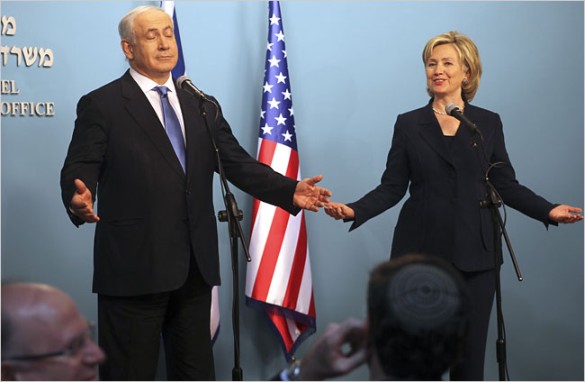
Israel’s offer to restrain settlement expansion is an unprecedented and positive step but still falls short of Washington’s wishes, U.S. Secretary of State Hillary Clinton said on Monday.

“The Israelis have responded to the call of the U.S., the Palestinians and the Arab world to stop settlement activity by expressing a willingness to restrain settlement activity,” she told reporters in the Moroccan city of Marrakesh.

“This offer falls far short of what our preference would be but if it is acted upon it will be an unprecedented restriction on settlements and would have a significant and meaningful effect on restraining their growth.” [continued…]

Editor’s Comment — Now as always, the substance of US-Israeli relations is a process through which agreements can be found on language.

Israel seeks and promotes the “right” language and it vigorous fights against the “wrong” language.

Meanwhile Israel will do whatever it chooses. It’s only concern with its American friends is that they have the good manners to talk about Israel’s actions in a favorable way. Thousands of housings units will continue to be built on occupied Palestinian territory but even as this is happening, Israel will be lauded for its “restraint.”

Benjamin Netanyahu is no doubt now glowing with satisfaction as his erstwhile harsh teacher, an administration that only a few months ago admonished the Israeli leader for not doing his “homework” on halting settlement growth, has now become an obedient and loving student.

Israel’s pathological view of peacemaking

Like Israel’s government, Israel’s public never tires of proclaiming to pollsters its aspiration for peace and its support of a two-state solution. What the polls do not report is that this support depends on Israel defining the terms of that peace, its territorial dimensions, and the constraints to be placed on the sovereignty of a Palestinian state.

An American president who addresses the Arab world and promises a fair and evenhanded approach to peacemaking is immediately seen by Israelis as anti-Israel. The head of one of America’s leading Jewish organizations objected to the appointment of Senator Mitchell as President Obama’s peace envoy because, he said, his objectivity and evenhandedness disqualified him for this assignment.

The Israeli reaction to serious peacemaking efforts is nothing less than pathological — the consequence of an inability to adjust to the Jewish people’s reentry into history with a state of their own following 2,000 years of powerlessness and victimhood.

Former Prime Minister Yitzhak Rabin, whose assassination by a Jewish right-wing extremist is being remembered this week in Israel, told Israelis at his inauguration in 1992 that their country is militarily powerful, and neither friendless nor at risk. They should therefore stop thinking and acting like victims.

Prime Minister Benjamin Netanyahu’s message that the whole world is against Israel and that Israelis are at risk of another Holocaust — a fear he invoked repeatedly during his address in September at the United Nations General Assembly in order to discredit Judge Richard Goldstone’s Gaza fact-finding report — is unfortunately still a more comforting message for too many Israelis. [continued…]

Palestinians say new U.S. approach imperils peace

Palestinian officials on Sunday criticized the United States for what one called “backpedaling” on demands that Israel stop settlement construction in the occupied West Bank, saying the Obama administration’s change of approach on the issue damaged the likelihood of a peace agreement.

“If America cannot get Israel to implement a settlement freeze, what chance do the Palestinians have of reaching agreement” on the even more complex set of issues involved in final peace talks, chief Palestinian negotiator Saeb Erekat said in a written statement.

“We are at a critical moment,” Erekat said. “The way forward, however, is not to drop the demand for Israel to comply with its obligations.” [continued…]

Editor’s Comment — This is how the narrative has been twisted:

Although Israeli Prime Minister Binyamin Netanyahu rebuffed the initial U.S. demand, he also offered alternatives that, while short of what the Palestinians wanted, were still characterized by Secretary of State Hillary Rodham Clinton over the weekend as “unprecedented” concessions made in hopes of helping direct talks resume.

Netanyahu has shown flexibility and the Palestinians are being intransigent. No suggestion that the Palestinians’ mistake was simply to believe that President Obama was a man of his word.

‘Barghouti to run for presidency if Abbas resigns’

Marwan Barghouti instead of Mahmoud Abbas? The associates of the senior Fatah leader jailed in Israel are examining the possibility that he will announce his candidacy for president should elections be held as planned and should the current president surprisingly decide not to run again for the post.

Recently, following the dead end reached in the peace talks, officials close to Palestinian President Mahmoud Abbas reported that the Abbas is exhausted. However, Abbas has not threatened to resign, though his associates say that the option cannot be ruled out that he will not run in the upcoming presidential elections.

“True the president is exhausted; true he is not satisfied with the situation; and true he prefers not to contend, but, as of now, and I say this with confirmed information, the president will be the Fatah candidate in the elections. The question is whether the elections will be held,” said a senior Fatah source to Ynet. [continued…]

Jordan and Egypt accuse Israel of ‘derailing’ peace efforts

Leaders of Jordan and Egypt on Sunday warned that Israel’s unilateral actions in East Jerusalem and other Arab areas were “derailing” efforts aimed at resuming peace negotiations with the Palestinians, and would thereby have a “catastrophic” effect on the region.

The remarks came in a joint communique issued at the end of a whirlwind visit to Cairo by Jordan’s King Abdullah II where he held talks with Egyptian President Hosni Mubarak, according to Jordan’s official Petra news agency.

The two leaders discussed the “catastrophic consequences on the region’s stability and security resulting from the failure to seize the current opportunity for making peace,” the statement said.] [continued…]


Facebooktwittermail

Two-State Solution: The Broadway Musical

Two-State Solution: The Broadway Musical

Remember a mere five months ago when Hillary Clinton, with all the toughness she had displayed during her primary campaign, said bluntly: “[Obama] wants to see a stop to settlements — not some settlements, not outposts, not ‘natural growth’ exceptions”?

The whole administration — presumably with expert coaching by Rahm Emanuel — was sending a strong message to Israel: We know your games and we’re not going to take any crap.

Freezing settlements — this was the litmus test for Benjamin Netanyahu to demonstrate his ability to engage in the so-called peace process.

Within a few weeks the administration’s Iran policy was in disarray — in the aftermath of the disputed presidential election — and terrified of the charge that he was being tough on Israel while soft on Iran, Obama’s resolve withered. Netanyahu bounced back and he has been riding high ever since.

Back in June, Netanyahu was admonished for not doing his homework. Now he’s thrown it in the trash and gets praise for offering “restraint on the policy of settlements” — even as Israel demolishes Palestinian homes in East Jerusalem and Palestinian citizens of Israel protest against the ethnic cleansing of Jerusalem.

Meanwhile, as Netanyahu mocks the idea that Washington has the capacity or will to apply pressure on an Israeli government, J Street, “the political arm of the pro-Israel, pro-peace movement,” after launching itself onto the stage of mainstream American politics through its first national conference last week, must somehow strive to keep the two-state-solution dream alive.

The two-state solution is indeed the stuff of dreams — at least the dreams of Zionists who find the idea of equality between Jews and non-Jews abhorrent, or as J Street’s Jeremy Ben-Ami puts it, “a nightmare for the Jewish people.”

Perhaps Washington is not the best place for dream believers. Maybe it’s time for a glitzy Two-State Solution on Broadway.

Oh look!

Bibi and Hillary are already auditioning.

J Street: Do we really need another Jewish-only road?

If you’re Palestinian, you know about checkpoints. There are over 600 checkpoints in the West Bank alone. They block, obstruct, frustrate and kill. Women die in childbirth at checkpoints, students are kept from attending school, parents from visiting their children, laborers from going to work. No one can swim in the sea. Israeli Jews are waved through checkpoints. They can swim in the sea. No problem. Jews travel freely on a complex system of Jewish-only roads and live on the Jewish side of the Separation Barriers along hundreds of miles of walls and fortified fences that keep Palestinians out. Palestinians live in an open air prison. Sometimes there is a moment of spring and the guards open the gates. But spring never lasts long. Blockades, nightly incursions, full-scale invasions, imprisonment, collective punishment, land theft, water theft, denial of education, health care, an economic future, frequent beatings and no freedom of movement is the daily bread of Palestinians. You can’t travel more than three miles without encountering a check point. Talk about stress.

J Street was a place where Jews talked to Jews about the Israeli-Palestinian conflict. Few Palestinians were present. Apparently they didn’t make it through the checkpoint. The narrative of J Street, like most Jewish narratives about the Israeli-Palestinian conflict, reflects the nature of the conflict as seen through a Jewish lens: Palestinians are physically absent. A Jew who seeks to express her activism in solidarity with Palestinians is in danger of loosing her ‘I love Israel’ card at a mainstream Jewish checkpoint. There were checkpoints at J Street. Some people were allowed in but not officially asked to participate, some were dis-invited, and some were not considered to be part of the conversation in the first place. [continued…]

Editor’s Comment — As Ahmed Moor eloquently puts it:

A purely Jewish focus on a more-than-Jewish problem causes many leftist Jews to take a paternalistic view of Palestinians. Rather than equals whose inalienable rights form the crux of the case against Zionism, the Palestinians are the clay of Jewish humanism, waiting to be fully actualized by thoughtful and reflective Jewish hands.

Facebooktwittermail

America, stop sucking up to Israel

America, stop sucking up to Israel

Now is the time to say to the United States: Enough flattery. If you don’t change the tone, nothing will change. As long as Israel feels the United States is in its pocket, and that America’s automatic veto will save it from condemnations and sanctions, that it will receive massive aid unconditionally, and that it can continue waging punitive, lethal campaigns without a word from Washington, killing, destroying and imprisoning without the world’s policeman making a sound, it will continue in its ways.

Illegal acts like the occupation and settlement expansion, and offensives that may have involved war crimes, as in Gaza, deserve a different approach. If America and the world had issued condemnations after Operation Summer Rains in 2006 – which left 400 Palestinians dead and severe infrastructure damage in the first major operation in Gaza since the disengagement – then Operation Cast Lead never would have been launched.

It is true that unlike all the world’s other troublemakers, Israel is viewed as a Western democracy, but Israel of 2009 is a country whose language is force. Anwar Sadat may have been the last leader to win our hearts with optimistic, hope-igniting speeches. If he were to visit Israel today, he would be jeered off the stage. The Syrian president pleads for peace and Israel callously dismisses him, the United States begs for a settlement freeze and Israel turns up its nose. This is what happens when there are no consequences for Israel’s inaction. [continued…]

Justice Goldstone and the Jews

We Jews should be very proud of Richard Goldstone. In an ancient tradition of Jewish self-questioning and uncomfortable truth-telling, the author of the recent report from the UN Fact Finding Mission on the Gaza Conflict has braved personal vilification and institutional mendacity to describe the crimes committed by Israeli forces in the course of their invasion of Gaza in December 2008.

To be sure, the Goldstone Report also itemizes the crimes of Hamas, notably in its campaign of rocket-firing into Israel. But the scale of human rights abuses by Israel vastly outdoes anything Hamas could hope to have achieved: Israeli civilian victims of Hamas rocket attacks numbered less than ten. The attack on Gaza by the IDF resulted in at least 1,100 Palestinian civilian deaths. The major perpetrator of human rights abuses in this conflict is without question the State of Israel, and Justice Goldstone records as much.

That the Israel of Benjamin Netanyahu has chosen to conduct an international campaign against Justice Goldstone and his report need not surprise us. Israel refused to cooperate with the UN investigation; long before its conclusions were published, Netanyahu had set in motion a campaign to deny and denigrate them. More dispiriting, and of greater political consequence, is the pitiful and humiliating response of the Obama Administration. The “fierce urgency of now” apparently required that Washington join Tel Aviv in discrediting the Goldstone Report, and with it the UN inquiry. [continued…]

Israel wants to seek, not have, peace with Syria

It’s hard not to marvel at Defense Minister Ehud Barak’s rhetorical skills, how he constantly invents a new way – an original expression – to not say anything. Last week he described Syria as a “central brick in any stable peace agreement.” But there will be no peace with Syria because Israel, according to Barak, “has sought in the past and will continue to seek in the future ways to advance peace with Syria.”

Still, Syria will certainly earn a few more terms of endearment, maybe even move up from “central brick” to “cornerstone,” and if it behaves itself, “linchpin.” Who knows, Syria may even win the gold and become the “bedrock” of a stable peace agreement. But because Israel is so busy seeking ways to advance peace with Syria, there will be no peace. [continued…]

Gas from Gaza, mobile phones in Palestine and a $1m peace prize …Tony Blair and the Middle Eastern Eldorado

… a Mail on Sunday investigation reveals that [Tony Blair] has been mixing business with Middle East politics since the early years of his premiership and that, since becoming a part-time peace envoy on leaving office in 2007, he has exploited his superb contacts to pursue a multi-million-pound fortune.

Some of the most potentially lucrative of those relationships can be traced back to that BG Gaza gas deal – connections that helped pave the way to the opening up of the Arab world’s new Eldorado, the colossal and mostly untapped wealth of Colonel Gaddafi’s Libya.

‘In Arabic, there is a special word – “eghtina”,’ said Khadr Musleh, a political analyst in the Palestinian West Bank capital, Ramallah.

‘It means “self-enrichment through public office”. It doesn’t imply anything illegal and in the Middle East it’s considered totally normal. Yet it is a little surprising to see a former British Prime Minister and international peace envoy behaving in the same way.’

Blair’s Middle East-focused business career has been a triumph. The access to the region’s rulers conferred by his position as an ex-PM and peace envoy must have huge attraction for potential clients of Tony Blair Associates, the secretive ‘consultancy’ that does not publish accounts which he runs with Jonathan Powell, his former Downing Street chief of staff. Its first clients are two of the world’s richest families – the royals of Kuwait and Abu Dhabi.

Tony Blair Associates is modelled on Henry Kissinger Associates, an outfit led by President Nixon’s former Secretary of State. Fittingly, perhaps, Kissinger was on the jury that awarded Blair the $1million Dan David Prize earlier this year, the ‘Israeli Nobel Prize’. Like Blair, Kissinger is employed by American bank JP Morgan. The citation praised Blair’s ‘exceptional leadership’ and ‘moral courage’.

Blair has promised to give most of the prize to his Faith Foundation, a charity set up to promote religious understanding. Thanks to his lucrative contract to advise JP Morgan for a salary of £2million a year, he does not need the money. [continued…]

Prosecutor: top scientist Nozette admitted actual spying for Israel

Did a federal prosecutor just make the inflammatory accusation that top government scientist Stewart Nozette has admitted to giving classified information to the Israeli government?

By our reading of this AP story, that’s exactly what happened at a hearing in U.S. district court in Washington yesterday.

Nozette is accused of attempted espionage for allegedly selling classified information to an FBI employee posing as a Mossad agent. But the Feds have explicitly said that Israel is not accused of any wrongdoing. [continued…]

Facebooktwittermail

Palestinian equal rights joins the progressive agenda on ‘The Daily Show’

Palestinian equal rights joins the progressive agenda on ‘The Daily Show’

The Daily Show With Jon Stewart Mon – Thurs 11p / 10c
Exclusive – Anna Baltzer & Mustafa Barghouti Extended Interview Pt. 1
www.thedailyshow.com
Daily Show
Full Episodes
Political Humor Health Care Crisis
The Daily Show With Jon Stewart Mon – Thurs 11p / 10c
Exclusive – Anna Baltzer & Mustafa Barghouti Extended Interview Pt. 2
www.thedailyshow.com
Daily Show
Full Episodes
Political Humor Health Care Crisis

Throughout the day I had been hearing on the grapevine that The Daily Show was having second thoughts about doing the show as they had been getting pressure to cancel it. [continued…]

Editor’s Comment — During a week in which J Street — an organization that is attempting to break AIPAC’s stranglehold on the issue of US-Israeli relations — held its first national conference in Washington DC, it’s interesting that Jon Stewart took the opportunity to turn to the issue of the Israeli-Palestinian conflict not by inviting J Street’s Jeremy Ben-Ami onto the show but instead, as Adam Horowitz notes, “a Palestinian leader demanding equal rights and an anti-Zionist Jew calling for boycott, divestment and sanctions to pressure Israel towards peace.”

One of the disappointing features of the way the interview got edited for broadcast was that by cutting out much of the applause, the editors took out one of the most significant messages: the Palestinian issue, framed as one of freedom and human rights, resonated well with Jon Stewart’s audience.

While Stewart himself tended to stick to the well-worn tracks that this is a seemingly intractable conflict, that the Palestinians need to stop anti-Semitic incitement, that the Arabs need to do their bit, Barghouti’s constant refrain was that the core issue here is freedom.

That’s a message the J Street and its mainstream two-state-solution supporters really don’t want to see placed at the center of the conversation. They seem to view the conflict not in terms primarily of human rights but in terms of the need to preserve the Jewish state — a state in relation to which Palestinians pose a “demographic threat”. The urgency of implementing a two-state solution is that unless it can be done fast, Palestinians will demand equal rights in a single state — a state in which (thanks to the Greater Israel project that has been in motion for the last 42 years) Jews will be in a minority. That possibility is in the eyes of some, “horrific“.

Squaring the circle and erasing the margins

The mission to move US policy through reforming the Jewish community’s debate over Israel/Palestine has clear political implications. Ben-Ami ended the opening evening by saying the movement J Street is a part of is a “movement rooted in love of Israel,” and while all are welcomed to join J Street in its work, “the heart of this movement has to be in the Jewish community.” From this perspective, it was telling that Gaza was not mentioned once the entire evening (except by Rabbi Andy Bachman who said it was no longer occupied). There was only one panel during the entire conference dedicated to “Palestinian perspectives,” and even the closing panel called “Why Two States? Why Now?” only included speakers to explain Israeli interests and American interests in promoting two states. Two of the most moving parts of the conference for me was hearing Laila El-Haddad, from the Gaza Mom blog, describe life in still occupied Gaza on the unofficial blogger’s panel. She told a story about how her family was almost unable to leave Gaza to visit her in the US and she is totally unable to enter her homeland. Later, Bassim Khoury, the ex-Minister of National Economy for the Palestinian Authority who recently quit in protest to their reaction to the Goldstone report, demonstrated “Israeli apartheid” in Jerusalem through a power point presentation outlining the gross discrepancies in municipal funding between Jews and Palestinians in the city. Both presentation injected an intense dose of reality into a proceeding that seems to be chugging along more on vision and hope.

J Street represents a very important rupture and opportunity in the supposed American Jewish consensus over Israel/Palestine which should be celebrated. Pushing this wedge into the heart of the community could only be a good thing. But, the tenor and message of the J Street conference would seem to indicate that the struggle to end the Israeli-Palestinian conflict can only be lead by Jews, after we conquer our own internal issues to reform our community, and on our agenda. Meanwhile, Palestinians will have to continue to catch the brunt of the Israel everyone loves so much. [continued…]

Elie Wiesel’s shocking stage appearance with mad preacher and anti-Semite John Hagee

On October 25, while an overflow crowd of 1,500 poured into the first convention of the progressive-leaning Israel-oriented lobbying organization J Street, Elie Wiesel addressed a crowd of 6,000 Christian Zionists at Pastor John Hagee’s “Night To Honor Israel.” According to the San Antonio Express News, while Wiesel sat by his side, Hagee trashed President Barack Obama, baselessly accusing him of “being tougher on Israel than on Russia, Iran, China and North Korea.”

Meanwhile, Israeli Ambassador Michael Oren, who appeared at Hagee’s Christians United for Israel summit earlier this year, rejected J Street’s request to speak at their convention, instead dispatching a low-level embassy official to “observe” the event. Oren then accused J Street of “impair[ing] Israel’s interests.”

In blessing Hagee while damning J Street, Wiesel and Oren chose an anti-Semitic group led by a far-right End Times theology preacher over a fledgling progressive organization that bills itself as “pro-Israel, pro-peace.” And both Wiesel and Oren seem to be embroiled in yet another controversy over involvement with the extremist preacher. [continued…]

Facebooktwittermail

Israel accused of rationing water to Palestinians

Israel accused of rationing water to Palestinians

Amnesty International on Tuesday accused Israel of denying Palestinians adequate access to water while allowing Jewish settlers in the occupied West Bank almost unlimited supplies.

Israel, the human rights group said, restricts availability of water in the Palestinian territories “by maintaining total control over the shared resources and pursuing discriminatory policies.”

“Israel allows the Palestinians access to only a fraction of the shared water resources, which lie mostly in the occupied West Bank while the unlawful Israeli settlements there receive virtually unlimited supplies,” Amnesty researcher Donatella Rovera said in a report.

Israel consumes four times more water than Palestinians, who use an average of 70 litres (16 gallons) a day per person, according to the report entitled: “Troubled waters – Palestinians denied fair access to water.” [continued…]

Facebooktwittermail

EU lawyers join drive to indict Israeli officers

EU lawyers join drive to indict Israeli officers

Israeli military officers who took part in Israel’s incursion of the Gaza Strip last winter may need to think twice before travelling to Europe.

Israeli media reported yesterday that human rights lawyers in the European Union are drawing up lists of names of Israeli military commanders alleged to be linked to war crimes committed in Gaza. The lawyers are hoping that the evidence they are collecting, including testimonies from Palestinians, will prompt countries such as Britain, Spain, the Netherlands, Belgium and Norway to arrest those Israelis linked to possible war violations who arrive on their soil.

The reports come as Israel is forging a battle against international efforts to bring it before a war crimes tribunal for its actions during the 22-day assault in the Gaza Strip in December and January. [continued…]

Israelis targeting grassroots activists

Israeli authorities are increasingly targeting and intimidating nonviolent Palestinian grassroots activists involved in anti-occupation activities who are drawing increased support from the international community.

Several weeks ago masked Israeli soldiers stormed the home of Ehab Jallad from the Jerusalem Popular Committee for the Celebration of Jerusalem as the Capital of Arab Culture for 2009.

“Around 3 a.m. the soldiers started kicking and banging on the door and threatened to break it down if I didn’t open immediately. My young daughters were terrified as they didn’t know what was happening,” recalled Jallad, a young Palestinian architect from Jerusalem. [continued…]

Facebooktwittermail

Who decided to go to war in Gaza (WHEN) and why?

Who decided to go to war in Gaza (WHEN) and why?

I want to know how and why it was decided to embark on Operation Cast Lead in the Gaza Strip and to expand it into a ground offensive. I want to know if the decisions were affected by the Israeli election campaign then underway and the change in U.S. presidents. I want to know if the leaders who launched the operation correctly judged the political damage it would cause Israel and what they did to minimize it. I want to know if those who gave orders to the Israel Defense Forces assumed that hundreds of Palestinian civilians would be killed, and how they tried to prevent this.

These questions should be at the center of an investigation into Operation Cast Lead. An investigation is necessary because of the political complexities that resulted from the operation, the serious harm to Palestinian civilians, the Goldstone report and its claims of war crimes, and the limits that will be imposed on the IDF’s freedom of operation in the future. There is no room to argue that the government should be allowed to govern without interference and investigations, with the public passing judgment at the ballot box. The government changed after the Gaza operation and the questions remain troublesome.

The investigations by the army and Military Police are meant to examine soldiers’ behavior on the battlefield. They are no substitute for a comprehensive examination of the activities of the political leadership and senior command, who are responsible for an operation and its results. It’s not the company or battalion commanders who need to be investigated, but former prime minister Ehud Olmert, Defense Minister Ehud Barak, former foreign minister Tzipi Livni, Chief of Staff Gabi Ashkenazi, and the heads of the intelligence chiefs and Foreign Ministry, who were party to the decisions. It is also important to investigate Barak and Livni’s election campaign advisers to find out if and how the campaign affected the military and diplomatic efforts. [continued…]

Editor’s Comment — Aluf Benn raises lots of important questions. One that he leaves out is this: Did Israel’s preparations for a war on Gaza in the first half of 2008 indicate that the truce with Hamas that began on June 18 last year was accepted by Israel in bad faith?

At the beginning of Operation Cast Lead, Haaretz reported:

Sources in the defense establishment said Defense Minister Ehud Barak instructed the Israel Defense Forces to prepare for the operation over six months ago, even as Israel was beginning to negotiate a ceasefire agreement with Hamas. According to the sources, Barak maintained that although the lull would allow Hamas to prepare for a showdown with Israel, the Israeli army needed time to prepare, as well.

The political line has always been “we had no choice,” but the truth might be that Israel’s leaders had made their choice for war well before it became “inevitable”.

Benn asks: “Who decided to bomb the flour mill and sewage treatment center in Gaza, and why?” Again, the question of when such facilities were added to a target list is extremely important. If the preparations that Barak referred to included drawing up target lists of this type then Israel would appear to have knowingly planned and committed war crimes, breaking the Fourth Geneva Convention that prohibits collective punishment.

One of the “lessons” of the 2006 war on Lebanon was that Israel didn’t have carefully developed target lists — that it quickly ran out of military targets and thereafter capriciously sought new and ill-conceived targets. That would imply that most of the targets in Gaza had been selected well before a single missile had been fired.

Facebooktwittermail

Where have all Israel’s friends gone?

“Where have all the friendships gone…”

Among all the members of our political, military and media establishments who are now suggesting an “inquiry”, there is no one – literally not one – who means by that a real investigation. The aim is to deceive the Goyim and get them to shut up.

Actually, Israeli law lays down clear guidelines for such investigations. The government decides to set up a commission of investigation. The president of the Supreme Court then appoints the members of the commission. The commission can compel witnesses to testify. Anybody who may be damaged by its conclusions must be warned and given the opportunity to defend themself. Its conclusions are binding.

This law has an interesting history. Sometime in the 50s, David Ben-Gurion demanded the appointment of a “judicial committee of inquiry” to decide who gave the orders for the 1954 “security mishap”, also known as the Lavon Affair. (A false flag operation where an espionage network composed of local Jews was activated to bomb American and British offices in Egypt, in order to cause friction between Egypt and the Western powers. The perpetrators were caught.)

Ben-Gurion’s request was denied, under the pretext that there was no law for such a procedure. Furious, Ben-Gurion resigned from the government and left his party. In one of the stormy party sessions, the Minister of Justice, Yaakov Shimshon Shapira, called Ben-Gurion a “fascist”. But Shapira, an old Russian Jew, regretted his outburst later. He drafted a special law for the appointment of Commissions of Investigation in the future. After lengthy deliberations in the Knesset (in which I took an active part) the law was adopted and has since been applied, notably in the case of the Sabra and Shatila massacre. [continued…]

Jordan’s ties with Israel turn cold

Jordan and Israel mark 15 years of peace today, but ties between both countries are cooler than ever.

Since the right-wing Israeli government of Benjamin Netenyahu took office in May, Jordan has been left further disappointed with its neighbour.

“Our relation is getting colder,” King Abdullah told Israel’s daily Haaretz newspaper this month. “Let’s remember that the peace treaty was signed as part of a process to achieve comprehensive peace. And the full potential of not just Jordanian-Israeli relations, but the whole region, will not be realised unless comprehensive peace is achieved.” [continued…]

Facebooktwittermail

As occupier, Israel must face up to Goldstone report

As occupier, Israel must face up to Goldstone report

Goldstone was born in June 1967. I am not referring to the judge from South Africa, but to his report, or more precisely, the notion that Israel needs a synonym for the soul-searching it must carry out after 42 years of occupation. In the 575 pages of the report that is loaded with details, names, numbers, a list of weapons, interrogation methods and articles of international law, three paragraphs hide among the conclusions on pages 521 and 522, numbered 1674 to 1676. Here lies the explanation for the tragic results of Operation Cast Lead.

In those paragraphs Goldstone uses the term “continuum” to establish that the operation cannot be understood on its own without assessing it as part of a chain of events, which also includes the complete closure of the Gaza Strip for three years, the policy of razing homes, the arrests, the interrogations and torture, not only in the Gaza Strip but also in the West Bank and East Jerusalem. In short, Operation Cast Lead is not an “incident.” It is a link in a chain as old as the occupation itself.

The equation Israel is demanding – between those wounded in the Gaza operation and those wounded in Sderot, between the Qassams and the F-16s, between the mortars and the tank that killed three of Dr. Ezzeldeen Abu al-Aish’s daughters, between Hamas and Israel – betrays a poor understanding of the report’s essence. Goldstone puts the symptom under the microscope and derives the illness. The result is a textbook whose title should have been “A manual for the occupier in the fifth decade.” [continued…]

Whatever Bibi wants, Bibi gets

Barack Obama is a rookie. At least, this is what the Israeli prime minister seems to think. So far, Benjamin Netanyahu has been able to maximize his gains at the expense of the U.S. president and the Palestinians while solidifying his own position in the process.

Consider last month’s trilateral meeting on the sidelines of the U.N. General Assembly. After months of tough and very public statements by top U.S. officials, Netanyahu was able to get the leader of the free world to concede on a settlement freeze and gave nothing in return. For Israeli hawks and their allies in the United States, this was a victory. But it did not come without costs, even leaving aside the effect on Palestinian Authority President Mahmoud Abbas’s domestic popularity. Heads of state around the world paid attention, and surely some of them thought of Obama: This man is a pushover. [continued…]

Jordan to Israel: Temple Mount violence derails peace efforts

Jordan warned Israel Police and religious Jewish radicals on Sunday that further provocation in the compound that houses the al- Aqsa Mosque in Jerusalem would “fuel violence in the region and jeopardize peace efforts”.

Clashes between Israeli police and youths armed with rocks broke out Sunday at the Noble Sanctuary/Temple Mount compound where the mosque is located. The confrontation was apparently sparked by calls by radical Jewish clerics to their followers to go up to the compound, and by calls by radical Muslim clerics for their followers to defend the site. [continued…]

Israel confirms settlers ramping up West Bank construction

The defense establishment confirmed that in recent weeks West Bank settlers have been making a noticeable effort to expedite construction, in an attempt to maximize the “facts on the ground” before the United States and Israel reach an agreement on a settlement freeze.

A senior security source said this week that the defense establishment’s view on the situation was reflected in reports published in Haaretz last Friday, which stated that extensive construction is currently being carried out in at least 11 settlements. [continued…]

Facebooktwittermail

Goldstone challenges US over Gaza report

Goldstone challenges US over Gaza report

Judge Richard Goldstone told Al Jazeera on Thursday that he is still waiting for the U.S. to back up its claim that his report on the war in Gaza has a number of flaws.

“The Obama administration joined our recommendation calling for full and good-faith investigations, both in Israel and in Gaza, but said that the report was flawed,” Goldstone told Al Jazeera.

The UN commission chairman said that if Washington points out the flaws, he would be ready to respond. “I have yet to hear from the Obama administration what the flaws in the report that they have identified are. I would be happy to respond to them, if and when I know what they are,” he said.

Israel’s attacks will lead to its isolation

Israel has been dealing one blow after another to the rest of the world. While China has still not recovered from Foreign Minister Avigdor Lieberman’s absence from the reception at its Tel Aviv embassy – a serious punishment for China’s support for the Goldstone report – France is licking its wounds after Prime Minister Benjamin Netanyahu “vetoed” a visit by the French foreign minister to Gaza. And Israel has dealt another blow: Its ambassador in Washington, Michael Oren, will boycott the conference next week of the new Israel lobby J Street.

China, France and J Street will somehow get by despite these boycotts, Turkey will also recover from the great vacationers’ revolt, and we can expect that even the Swedes and Norwegians will recover from Israel’s loud reprimands. But a country that attacks and boycotts everyone who does not exactly agree with its official positions will become isolated, forsaken and detestable: North Korea of today or Albania of yesterday. It’s actually quite strange for Israel to use this weapon, as it is about to turn into the victim of boycotts itself.

Israel strikes and strikes again. It strikes its enemies, and now it strikes out at its friends who dare not fall exactly in line with its official policies. The J Street case is a particularly serious example. This Jewish organization rose in America along with Barack Obama. Its members want a fair and peace-seeking Israel.

That’s their sin, and their punishment is a boycott. [continued…]

‘U.S. to stand by Israel in the fight against Goldstone report’

President Peres on Wednesday harshly condemned the Goldstone report and told the U.S. envoy to the United Nations, Susan Rice that, “It is outrageous that a respected institution like the United Nations provides a platform to spread lies and stories about Israel.”

The Goldstone report accuses Israel Defense Forces and Palestinian militants of war crimes and possible crimes against humanity during their Dec. 27-Jan. 18 conflict in the Gaza Strip.

The report also calls on the UN Security Council to refer the matter to the International Criminal Court at The Hague, which could prosecute Israeli officials for war crimes.

“The United Nations provides a stage for Ahmmadinejad, who threatens to annihilate Israel, and lets him stand judge,” continued Peres. “This is nothing short of ridiculous.”

Rice promised that the United States will continue to stand by Israel as a loyal friend in the fight against the Goldstone report. [continued…]

U.S., EU pile on pressure for Israel to create own panel on Gaza op

The United States and a number of important EU countries are pressing Israel to establish an independent commission of inquiry into the findings of the Goldstone report on last winter’s Gaza offensive.

British Prime Minister Gordon Brown and French President Nicholas Sarkozy, for example, have written a letter on the subject to Prime Minister Benjamin Netanyahu, and messages have been sent through diplomatic channels, in phone calls and in Netanyahu’s meetings with senior American and European officials, said a senior official in Jerusalem.

Netanyahu has yet to take a stance in debates in the cabinet and security cabinet on the issue, let alone decide on the matter. No decision is expected in the next few days, according to a source in the Prime Minister’s Bureau.

The main supporters of establishing a commission are Deputy Prime Minister Dan Meridor and Attorney General Menachem Mazuz, while the main opponents are Defense Minister Ehud Barak and Deputy Prime Minister Eli Yishai. [continued…]

Hamas: investigate attacks on Israeli civilians

Hamas authorities in the Gaza Strip should promptly implement the recommendations of the Goldstone report on Gaza by conducting credible investigations into serious laws-of-war violations by Palestinian forces, Human Rights Watch said in a letter sent October 20, 2009, to Prime Minister Ismail Haniya.

The United Nations Fact-Finding Mission on the Gaza Conflict, led by Justice Richard Goldstone, called on Hamas and Israel to investigate within six months alleged violations of the laws of war by their respective forces. The report said that Palestinian rocket attacks against Israeli population centers should be investigated as war crimes. The UN Human Rights Council voted on October 16 to endorse the recommendations of the Gaza report. [continued…]

Why we report on ‘open’ societies

Responding to Robert Bernstein’s NYT op-ed

Human Rights Watch was saddened to read in The New York Times on October 20, 2009 that its founding chair, Robert L. Bernstein, feels he must “join the critics” of our work on Israel. We fundamentally disagree with Mr. Bernstein’s views.

Human Rights Watch does not believe that the human rights records of “closed” societies are the only ones deserving scrutiny. If that were the case, we would not work on US abuses in Guantanamo Bay, police abuse in Brazil, the “untouchables” in India, or migrants in South Africa. “Open” societies and democracies commit human rights abuses, too, and Human Rights Watch has an important role to play in documenting those abuses and pressing for their end.

Human Rights Watch does not devote more time and energy to Israel than to other countries in the region, or in the world. We’ve produced more than 1,700 reports, letters, news releases, and other commentaries on the Middle East and North Africa since January 2000, and the vast majority of these were about countries other than Israel. Furthermore, our Middle East division is only one of 16 research programs at Human Rights Watch. The work on Israel is a tiny fraction of Human Rights Watch’s work as a whole.

It is not the case that Human Rights Watch had “no access to the battlefield” after the Israeli operation in Gaza in January 2009. Although the Israeli government denied us access, our researchers entered Gaza via the border with Egypt and conducted extensive interviews with victims, eyewitnesses, United Nations officials, local authorities, and others. As in war zones around the world, we also visited attack sites, analyzed ballistics evidence, photographed wounds, and examined autopsy and other medical reports.

Mr. Bernstein brought his concerns about our work on Israel to a full meeting of the Human Rights Watch Board of Directors in April. The board unanimously rejected his view that Human Rights Watch should report only on closed societies, and expressed its full support for the organization’s work.

Human Rights Watch stands fully behind the work we have done on Israel and around the world. [continued…]

Facebooktwittermail

Jordan king warns over US Mideast policy

Jordan king warns over US Mideast policy

Jordan’s king said in comments published Monday that the U.S. administration seems to be focusing more of its attention on Iran and less on resolving the Israeli-Palestinian conflict, saying time was running out to make peace.

In an interview with Italian daily La Repubblica, King Abdullah II said the region’s hopes for peace were huge at the start of the Obama administration, but now sees the “goal getting farther away.”

“I’ve heard people in Washington talking about Iran, again Iran, always Iran,” Abdullah was quoted as saying. “But I insist on, and keep insisting on the Palestinian question: the Israeli-Palestinian conflict is the most serious threat to the stability of the region and the Mediterranean.” [continued…]

Editor’s Comment — Having just won the Nobel Peace Prize for advancing global diplomacy, President Obama should reflect some more on how engagement really works. The United States will talk to its adversaries, Obama boldly declared before getting elected. So far so good.

But engagement is sure to lead to a dead end unless it functions effectively as a two-way street. Washington has shown its readiness to talk, but is it ready to listen? Engagement can be as boneheaded as non-engagement if it doesn’t involve listening.

Abdullah, Erdogan and others are telling the US that this administration’s approach to the Middle East is failing. Is the administration listening?

Stop Palestinian suffering for Mideast peace, says Erdoğan

Peace cannot be established in the Middle East when the suffering of the Palestinians continues and the Gaza Strip remains a wreck, Turkish Prime Minister Recep Tayyip Erdoğan said Monday.

Speaking at the Istanbul Forum organized by Stratim, Seta and the German Marshall Fund, Erdoğan said the Palestinian question is at the center of all problems in the Middle East. The prime minister recalled that Turkey vocalized its disapproval of the previous year’s bombing of the Gaza Strip, adding: “We criticized steps that were serving no purpose, but which increased suffering and sabotaged the peace process. We will continue to criticize it today, too. We will criticize anything similar taking place in other areas.” [continued…]

Turkish president: ‘Brave criticism’ of Israel to continue

Turkey will continue to criticize its ally Israel with “courage” if it engages in “mistakes”, Turkish President Abdullah Gül said Sunday, continuing the verbal sparring between the two countries over the situation in Gaza.

Turkey is one of the “rare” countries to have good relations with both Arab countries and Israel, Gul said during an interview with public teleivision TRT.

“But this does not mean that Turkey will not raise its voice against errors if they are made. We should not think that Turkey will keep silent,” he said. [continued…]

How do Turkey and Israel measure each other’s love?

…in Israel’s eyes, Turkey is seen as two states – one in the form of the military, twin sister of Israel, the other political, leaning toward Islam and making friends with Syria and Iran. Thus, insolent Israel decided in a typical manner not to take Turkey’s politicians seriously and to adopt the Turkish army. Israel was also certain all these years that Turkey, backward and poor, needed its sole friend in the Middle East because it was not accepted in the region due to its Ottoman history and close ties with Israel and the United States, and therefore could not do without Israel.

So in Israel, people have been quick to conclude that “something went wrong” in Turkey. Suddenly the government rules the army instead of the army, Israel’s loyal friend, telling the government what to do. Israelis did not think for a minute that the Turkish army might also have had enough.

Turkey has changed; inwardly, for the most part. In a long and difficult process it has become a more democratic country. The army is still dominant, but less public in its role in the civilian domain. Turkey has overcome most of its economic problems and has been transformed into a regional economic power. It is a real strategic asset for the United States, increasing its importance after the Iraq war. It has also developed a different regional strategy.

Whoever reads what Foreign Minister Ahmet Davutoglu says recognizes that Turkey aspires to become an influential player not only in the Middle East but also in the Caucasus and Asia. It is involved in the fighting in Afghanistan, is forming an economic alliance with Iraq, plans to invest billions of dollars in Egypt, and its annual trade with Iran stands at $9 billion, with Syria at $1.5 billion.

And here is the paradox. This is the only Muslim country that is not harshly criticized, whether by Iran or any Arab state, for having such close ties with Israel. As such, it could have served as an excellent mediator between Israel and the Arab countries had Israel not considered it an obvious satellite state. [continued…]

Facebooktwittermail

Goldstone: My mission – and motivation

Goldstone: My mission – and motivation

Israel and its courts have always recognized that they are bound by norms of international law that it has formally ratified or that have become binding as customary international law upon all nations. The fact that the United Nations and too many members of the international community have unfairly singled out Israel for condemnation and failed to investigate horrible human rights violations in other countries cannot make Israel immune from the very standards it has accepted as binding upon it.

Israel has a strong history of investigating allegations made against its own officials reaching to the highest levels of government: the inquiries into the Yom Kippur War, Sabra and Shatila, Bus 300 and the Second Lebanon War.

Israel has an internationally renowned and respected judiciary that should be envy of many other countries in the region. It has the means and ability to investigate itself. Has it the will? [continued…]

Editor’s Comment — The Netanyahu government’s stonewalling of the Goldstone inquiry does not appear to have purely been an act of self-protection; it also seems to reflect a national spirit of impunity rooted in the conviction: “We had no choice.”

Having turned this declaration into a battle cry, violence was cleansed of doubt as Israel embarked on its own jihad. “We went into Gaza and God went into Gaza with us,” was how one Israeli Special Forces soldier put it.

When the enemy’s homes have been flattened, their bodies incinerated, their land defiled and their water poisoned and all of this is being done under God’s watchful eye and under His protection, the killers return to their homes expecting glorification, not to become the targets of an international inquiry.

Facebooktwittermail

Gaza costs Israel another friend: there aren’t many left

Gaza costs Israel another friend: there aren’t many left

For years Israel has acted as if the unconditional support of the US would be enough to shield it for ever from the consequences of its behaviour – which is why last week was an unusually traumatic one for them.

No suicide bombers detonated themselves and no rockets or mortar shells fell, but the double whammy of a Turkish snub and a UN Human Rights Council vote shook Israelis even more than any aimless shelling would have done. Those two events signal profound changes that leave Israel paying a growing political price for the attack last winter that killed some 1,400 Palestinians and reduced Gaza to rubble.

It was the brutal pummelling of Gaza that prompted Turkey’s democratically elected government to break the silence among the region’s moderates and stand up for the Palestinians. At the time, the prime minister, Recep Erdogan, condemned the Israeli actions as war crimes, in language deemed intemperate and inappropriate by western leaders.

Curiously, Erdogan’s “intemperate” language was endorsed by the findings of a UN Human Rights Council investigation headed by the Jewish South African judge Richard Goldstone, known as a friend of Israel – findings that were adopted by the Council on Friday despite the efforts of the US and France to shield Israel from being formally accused of war crimes in an international body. [continued…]

Facebooktwittermail

Mitchell the man for the job?

Mitchell the man for the job?

Senator George Mitchell is one of America’s most impressive public servants.

He has served the state of Maine well, chaired any number of commissions for various presidents since his senate retirement and patiently plodded through years of work and negotiations with historically opposed foes in the Northern Ireland peace process and achieved peace.

However, he may not be the right envoy to restart Israeli-Palestinian talks.

Mitchell telegraphed the problem from the day that Barack Obama, the US president, announced his appointment on the first work day of the new administration.

Mitchell said that all parties would have to be patient and that it takes years for a process such as the one being envisioned – to create peace between two eventually viable states of Israel and Palestine – to come to fruition.

However, he failed to acknowledge that the negotiations over what Palestine would eventually become have been taking place for decades and have involved many US presidents.

He is not starting at zero and there is not much time left to achieve a new and more constructive ‘equilibrium’ between Israel and Palestine. I prefer the term ‘equilibrium’ over the more hopeful and naïve goal of ‘peace’. [continued…]

Facebooktwittermail

Israel: A fugitive state

Israel: A fugitive state

Do the innocent refuse to be questioned?

The Netanyahu government’s campaign to obstruct both the Goldstone inquiry and the report that it produced has been waged in the name of protecting Israel’s right of self-defense.

But Israel’s defenses are actually far weaker than the Goldstone critics care to admit: Israel is so vulnerable that it cannot withstand critical scrutiny or self-examination.

Gone are the days when an Israeli defense minister could be found by Israelis to “bear personal responsibility” for the massacre of hundreds of Palestinian civilians, as the Kahan Commission found Ariel Sharon after investigating his role in the Sabra and Shatila Massacre.

Now, Israel cannot even take the risk of conducting an independent investigation into alleged war crimes, let alone deal with the unpredictable outcome of such an investigation.

Instead, the defense of Israel now requires that all those who remain loyal to its interests and concerned about its preservation, maintain solidarity in a single mission: do everything possible to silence the Jewish state’s critics.

The underlying assumption seems to be that Israel will remain eternally an object of enmity; that the best it can hope for is that its enemies remain weak.

This is not merely the condition of a national identity; it percolates through to the outlook of individuals — an outlook that is inevitably misanthropic. It is to assume an existential orientation which regards the bulk of humanity as a harbor of ill-will.

For Israelis and many of their supporters, this situation ought to provoke a profound inquiry into the nature of antisemitism.

From where in the world does this ancient bigotry now draw most of its life?

In a pandemic of anti-Israel hostility?

Or might it find its most vital form of traction much closer to home, inside those very minds that perceive the rest of the world as other?

Are the Goldstone critics trying to defend Israel, or are they trying to sustain the image of an embattled state too fragile to survive the corrosive impact of investigation?

Mahmoud Ahmadinejad’s thesis is that Israel, like the Soviet Union, is destined to self-destruction. Michael Oren, Israel’s ambassador to the United States, seems susceptible to a similar fear.

Earlier this year, Oren wrote:

The breakdown of public morality, in my view, poses the greatest single existential threat to Israel. It is this threat that undermines Israel’s ability to cope with other threats; that saps the willingness of Israelis to fight, to govern themselves, and even to continue living within a sovereign Jewish state. It emboldens Israel’s enemies and sullies Israel’s international reputation. The fact that Israel is a world leader in drug and human trafficking, in money laundering, and in illicit weapons sales is not only unconscionable for a Jewish state, it also substantively reduces that state’s ability to survive.

Oren’s view has apparently subsequently shifted and he now seems to regard the results of the UN investigation as posing a greater threat to Israel than any other: “The Goldstone Report goes further than Ahmadinejad and the Holocaust deniers by stripping the Jews not only of the ability and the need but of the right to defend themselves.”

The ambassador might pause to consider this: A breakdown in public morality and an unwillingness to investigate alleged war crimes may in fact be intimately connected.

Facebooktwittermail

US: Security Council might not debate Goldstone Report

US: Security Council might not debate Goldstone Report

The endorsement of the Goldstone Report by the UN Human Rights Council (UNHRC) does not necessarily mean that it will be reviewed by the Security Council, US State Department spokesman Ian Kelly said Friday.

Earlier, the UNHRC voted to refer the report to the Security Council, possibly setting up international prosecution of Israelis and Palestinians accused of war crimes.

The report accused both Israel and the Palestinian terror group Hamas of committing war crimes in Gaza in their December-January conflict.

Kelly told reporters in Washington that the resolution had “an unbalanced focus and we’re concerned that it will exacerbate polarization and divisiveness.” [continued…]

Israel vents fury at ally Turkey over ‘barbaric’ TV drama

Israel’s increasingly troubled relations with its main ally in the Muslim world took a turn yesterday when it formally protested to Turkey over the “incitement” generated by a television series featuring fictional scenes of barbaric acts by Israeli soldiers.

The airing of the series, on Turkish
state television, coincides with tensions triggered by a decision last week by Ankara to exclude Israel – which it has severely criticised over last winter’s war in Gaza – from a planned Nato air exercise.

The acting Turkish ambassador, Ceylan Ozen, was summoned yesterday to the Israeli foreign ministry in protest at the drama series Ayrilik which shows soldiers brutalising Palestinians. In one abbreviated sequence shown on YouTube, a soldier is seen gratuitously shooting a girl at close range, killing her. In another, Palestinians are apparently about to be executed by a firing squad. [continued…]

An ordinary Israel

Is Israel just a nation among nations?

On one level, it is indeed an ordinary place. People curse the traffic, follow their stocks, Blackberry, go to the beach and pay their mortgages. Stroll around in the prosperous North Tel Aviv suburbs and you find yourself California dreaming.

On another, it’s not. More than 60 years after the creation of the modern state, Israel has no established borders, no constitution, no peace. Born from exceptional horror, the Holocaust, it has found normality elusive. [continued…]

Despite promises to Obama, construction continues in dozens of W. Bank settlements

Human rights activists monitoring the West Bank report that despite commitments Israel made to President Barack Obama’s administration last month, widespread building activity commenced three weeks ago in at least 12 settlements.

The work consists of ground preparation, pouring concrete and drilling construction foundations.

This work is not part of the projects that Israel and the United States had reached an understanding on. Prime Minister Benjamin Netanyahu and Defense Minister Ehud Barak had agreed with the administration to complete some 2,500 housing units that were already in various stages of construction at the time. The dozen sites do not appear on the list of 492 new housing units that the defense ministry issued after Barak approved their construction. Work on these units began after the list was released. [continued…]

ZOA praises Obama administration on Goldstone

The Zionist Organization of America is praising the Obama administration for “taking a principled stance” against the Goldstone Report.

The ZOA points to the remarks made at the UN Human Rights Council by U.S. Assistant Secretary of State for Democracy, Human Rights and Labor Michael Posner, in which he said that “we believe that the document is deeply flawed and disagree sharply with its methodology and many of its recommendations, including their extraordinarily broad scope.” [continued…]

Facebooktwittermail

Allies push Israel for Gaza probe

Allies push Israel for Gaza probe

Israel has come under pressure from its allies to investigate UN allegations of possible war crimes by its army during its Gaza offensive last winter.

Britain’s UN envoy urged Israel to hold “full, credible and impartial” investigations, echoing similar calls from his US and French counterparts. [continued…]

U.N. rights body considers condemning Israel on Gaza

Israeli and Palestinian leaders should launch investigations of alleged war crimes in Gaza to help rebuild trust and support peace, the U.N. High Commissioner for Human Rights said on Thursday.

At the opening of a U.N. Human Rights Council meeting on the issue, Navi Pillay said that all sides of the Middle East conflict were continuing to violate international law and voiced concern that transgressors are being left unpunished.

“A culture of impunity continues to prevail in the occupied territories and in Israel,” she told the 47-member body, calling for “impartial, independent, prompt and effective investigations into reported violations of human rights and humanitarian law.” [continued…]

In Gaza, actress Mia Farrow voices ‘outrage’ over blockade

Mia Farrow said Thursday she was outraged by conditions for children in the Gaza Strip after a blockade that has stretched for more than two years and a large-scale Israeli offensive against Hamas last winter.

The 64-year-old American actress also criticized Gaza militants’ rocket attacks on southern Israel, saying stopping them could lead to more international aid for the impoverished coastal strip. [continued…]

Facebooktwittermail

Why Palestinians have lost faith in Obama

Why Palestinians have lost faith in Obama

For a man who is sometimes seen as the Palestinian politician that the Israelis and the Americans like best, Prime Minister Salaam Fayyad was in a strikingly robust mood during a two-hour press conference in Ramallah yesterday. While too polite to criticise the Obama administration, he nevertheless had a clear message in the wake of the failure by the US to persuade the Israeli government of Benjamin Netanyahu to grant a freeze on Jewish settlement construction in the West Bank as a precursor to serious negotiations.

He suggested that the Palestinian leadership no longer had much interest in a “process for the sake of a process” and he questioned what Mr Netanyahu’s “equivocal” endorsement of a Palestinian state really meant.

Mr Fayyad had been much struck by a report from the Jerusalem Centre for Public Affairs, arguing that the 60 per cent of the West Bank controlled by Israel and designated as Area C under the Oslo accords, including the Jordan Valley, should not be handed over in any peace deal. If the Israeli establishment was envisaging a “Mickey Mouse state” along these lines, he said, then “it looks like it would not come close to what we have in mind.” [continued…]

Yishai: Deporting foreign children preserves Israel’s Jewish identity

Interior Minister and Shas Party chairman Eli Yishai plans “to muster all of Shas’ political power on the issue of the foreign workers,” he told Haaretz on Tuesday.

During a conversation with Prime Minister Benjamin Netanyahu on Monday, Yishai warned that if the cabinet rejects his demand that children of foreign workers not be given residency or citizenship in Israel, he will abdicate responsibility for the Immigration Authority, which is currently in his ministry’s purview, to the Prime Minister’s Office, and foment a coalition crisis to boot. [continued…]

Facebooktwittermail