Category Archives: Israel-Palestinian conflict

NEWS: Hamas no compromise on prisoners; Fatah’s popularity falling

Meshal: No compromise on terms for Shalit deal

The exiled leader of the militant Palestinian Hamas group said Friday that Israel Defense Forces soldier Gilad Shalit, captured by Hamas-linked militants in a cross-border raid in June 2006, will not be released without the freedom of Palestinians held in Israeli jails.

“The matter of the prisoners bloodies our heart,” Khaled Meshal said, indicating that it was a painful topic, and added that Gilad Shalit will not be released “unless our prisoners are released.” He did not give further details.

Meshal also said that Hamas rejected a European offer for an indirect meeting with Israel to discuss a possible truce, adding that the Palestinian people have no choice other than resistance. Speaking at a rally in Damascus marking Hamas’ 20th anniversary, Khaled Meshal also called on Palestinian President Mahmoud Abbas to hold unconditional talks with Hamas. [complete article]

Poll: Fatah losing support among West Bank, Gaza Palestinians

Despite international political and financial support, the popularity of the Fatah faction headed by Palestinian President Mahmoud Abbas has declined over the past month, partially because of mistrust in the group’s leaders, according to a poll published Friday.

Fatah still commands a strong lead over the Islamic militant Hamas group that controls Gaza, with 39 percent of Palestinians trusting it, as opposed to 16 percent backing for Hamas. But in November, 46 percent of those surveyed for a similar poll favored Fatah, and 13 percent backed Hamas.

Forty-one percent of those polled said they didn’t trust either faction, up from 32 percent in November. The telephone poll, conducted in late December by Near East Consulting, interviewed 959 Palestinians in the West Bank and Gaza. It had a margin of error of 3.2 percentage points. [complete article]

Facebooktwittermail

NEWS & FEATURE: A struggle rooted in land

A West Bank struggle rooted in land

From his hilltop farm, Daoud Nassar can see the sun rise over the Jordan Valley and set in the Mediterranean, an arc that spans the territorial breadth of his people’s conflict with Israel.

He also can see the neighbors whose rival claim has drawn the idyllic 100-acre plot deeply into that fight.

The only large Palestinian property to occupy high ground in this part of the West Bank, it is ringed by expanding Jewish settlements and coveted by the one perched on the nearest hill, 800 yards away.

For nearly a generation, Nassar and his family have stood their ground, unarmed, against pistol-toting settlers who have barricaded the farm’s dirt lanes, uprooted its olive groves, tried to bulldoze their own roads and disabled a tractor and a rooftop water tank.

The family has rebuffed anonymous Jewish callers offering blank checks for the property, and spent $145,000 in a marathon legal battle to keep the land that Nassar’s grandfather, a Christian from Lebanon, bought in 1916 when it was part of the Ottoman Empire. For more than 90 years, Nassars have worked the land, growing almonds, figs, grapes, olives, pears and pomegranates.

The feuding over these stark hills, ridges and valleys south and east of Bethlehem, a 27-square-mile region that includes the Nassar farm, is emblematic of the decades-old Israeli-Palestinian conflict — a struggle rooted in land. [complete article]

Mideast talks already tangled a month after Annapolis summit

US and Egyptian officials have criticized Israel’s move to renew building in Har Homa so soon after Annapolis, indicating that it undermines trust between the parties.

Mr. Olmert’s government has gone on the defensive about the decision. On the one hand, it says that the decision to build was made by a lower-ranking official in the Housing Ministry, which issued the tender without Olmert’s knowledge. On the other, it says that it has no intention of forfeiting the land of Har Homa to the Palestinians.

“In our view, this is not part of the problem with the Palestinians, we are building in the neighborhoods inside Jerusalem, we are not building new settlements,” Defense Minister Ehud Barak said at a meeting with Egyptian President Hosni Mubarek. “The Palestinians are far from implementing phase one of the road map, which calls for rooting out the terror infrastructure.”

Palestinian officials say that the building in Har Homa is going to be at the top of the agenda for Thursday’s meeting between Olmert and Abbas. Palestinians have demanded a cessation to all settlement building as a requisite step toward rebuilding expectations for peace. [complete article]

Facebooktwittermail

December 24 – news and opinion roundup

Notes on the post-Bush Mideast

A year from now, the Bush Administration will be emptying its desks into cardboard boxes and preparing to hand over to its successor. And, it’s a relatively safe bet that the menu of foreign policy crises and challenges it will leave in the in-trays of its successors will be largely unchanged from that facing the Bush Administration today. A combination of the traditional lame-duck effect of the final year of a presidency, and the decline in relative U.S. influence on the global stage — a product both of the calamitous strategic and tactical mistakes by the Bush Administration and of structural shifts in the global political economy that will limit the options available to his successor — suggest that even as he goes scurrying about the Middle East in search of a “legacy,” very little is going to change in the coming year. Indeed, the recurring theme in many of the crises Washington professes to be managing is the extent to which it is being ignored by both friend and foe. [complete article]

The rise of a fierce yet fragile superpower

For Americans, 2008 is an important election year. But for much of the world, it is likely to be seen as the year that China moved to center stage, with the Olympics serving as the country’s long-awaited coming-out party. The much-heralded advent of China as a global power is no longer a forecast but a reality. On issue after issue, China has become the second most important country on the planet. Consider what’s happened already this past year. In 2007 China contributed more to global growth than the United States, the first time another country had done so since at least the 1930s. It also became the world’s largest consumer, eclipsing the United States in four of the five basic food, energy and industrial commodities. And a few months ago China surpassed the United States to become the world’s leading emitter of CO2. Whether it’s trade, global warming, Darfur or North Korea, China has become the new x factor, without which no durable solution is possible.

And yet the Chinese do not quite see themselves this way. Susan Shirk, the author of a recent book about the country, “The Fragile Superpower,” tells a revealing tale. Whenever she mentions her title in America, people say to her, “Fragile? China doesn’t seem fragile.” But in China people say, “Superpower? China isn’t a superpower.”

In fact it’s both, and China’s fragility is directly related to its extraordinary rise. Lawrence Summers has recently pointed out that during the Industrial Revolution the average European’s living standards rose about 50 percent over the course of his lifetime (then about 40 years). In Asia, principally China, he calculates, the average person’s living standards are set to rise by 10,000 percent in one lifetime! The scale and pace of growth in China has been staggering, utterly unprecedented in history—and it has produced equally staggering change. In two decades China has experienced the same degree of industrialization, urbanization and social transformation as Europe did in two centuries. [complete article]

Poll victory for Hindu firebrand is blow to government election plans

To fans he is the “Lion of Gujarat”, saviour of Hindus and the brains behind one of India’s richest states. To critics he is a “merchant of death” with the blood of thousands of Muslims on his hands.

But love or hate Narendra Modi, the Hindu nationalist and Chief Minister of the western state of Gujarat has now staked his claim to leadership of his party – and perhaps his country.

His Bharatiya Janata Party (BJP) won 117 out of 182 seats in a local assembly election yesterday that became a barometer for the looming national elections. Congress won just 59 seats in the state poll that was spread over two weeks and which revived claims that Mr Modi had encouraged the slaughter of at least 2,000 Muslims in rioting in Gujarat in 2002. [complete article]

Pakistan’s tyranny continues

The chief justice of Pakistan’s Supreme Court, Iftikhar Muhammad Chaudhry, and his family have been detained in their house, barricaded in with barbed wire and surrounded by police officers in riot gear since Nov. 3. Phone lines have been cut and jammers have been installed all around the house to disable cellphones. And the United States doesn’t seem to care about any of that.

The chief justice is not the only person who has been detained. All of his colleagues who, having sworn to protect, uphold and defend the Constitution, refused to take a new oath prescribed by President Pervez Musharraf as chief of the army remain confined to their homes with their family members. The chief justice’s lawyers are also in detention, initially in such medieval conditions that two of them were hospitalized, one with renal failure.

As the chief justice’s lead counsel, I, too, was held without charge — first in solitary confinement for three weeks and subsequently under house arrest. Last Thursday morning, I was released to celebrate the Id holidays. But that evening, driving to Islamabad to say prayers at Faisal Mosque, my family and I were surrounded at a rest stop by policemen with guns cocked and I was dragged off and thrown into the back of a police van. After a long and harrowing drive along back roads, I was returned home and to house arrest. [complete article]

Uranium traces found on N. Korean tubes

U.S. scientists have discovered traces of enriched uranium on smelted aluminum tubing provided by North Korea, apparently contradicting Pyongyang’s denial that it had a clandestine nuclear program, according to U.S. and diplomatic sources.

The United States has long pointed to North Korea’s acquisition of thousands of aluminum tubes as evidence of such a program, saying the tubes could be used as the outer casing for centrifuges needed to spin hot uranium gas into the fuel for nuclear weapons. North Korea has denied that contention and, as part of a declaration on its nuclear programs due by the end of the year, recently provided the United States with a small sample to demonstrate that the tubes were used for conventional purposes.

The discovery of the uranium traces has been closely held by senior U.S. officials concerned that disclosure would expose intelligence methods and complicate the diplomatic process. North Korea has steadfastly refused to open up about its past practices, simply asserting that it is not engaged in inappropriate activities. However, the uranium finding will force U.S. negotiators to demand a detailed explanation from Pyongyang. [complete article]

CIA chief to drag White House into torture cover-up storm

The CIA chief who ordered the destruction of secret videotapes recording the harsh interrogation of two top Al-Qaeda suspects has indicated he may seek immunity from prosecution in exchange for testifying before the House intelligence committee.

Jose Rodriguez, former head of the CIA’s clandestine service, is determined not to become the fall guy in the controversy over the CIA’s use of torture, according to intelligence sources.

It has emerged that at least four White House staff were approached for advice about the tapes, including David Addington, a senior aide to Dick Cheney, the vice-president, but none has admitted to recommending their destruction.

Vincent Cannistraro, former head of counterterrorism at the CIA, said it was impossible for Rodriguez to have acted on his own: “If everybody was against the decision, why in the world would Jose Rodriguez – one of the most cautious men I have ever met – have gone ahead and destroyed them?” [complete article]

Wagons circled at CIA over tapes’ demise

Shortly after he arrived as CIA director in 2004, Porter J. Goss met with the agency’s top spies and general counsel to discuss a range of issues, including what to do with videotapes showing harsh interrogations of Al Qaeda detainees, according to current and former officials familiar with the matter.

“Getting rid of tapes in Washington,” Goss said, according to an official involved in the discussions, “is an extremely bad idea.”

But at the agency’s operational levels — especially within the branch that ran the network of secret prisons — the idea of holding on to the tapes and hoping their existence would never be leaked to the public seemed even worse.

Citing what CIA veterans regard as a long record of being stranded by politicians in times of scandal, current and former U.S. intelligence officials said the decision to destroy the tapes was driven by a determination among senior spies to guard against a repeat of that outcome. [complete article]

CIA needs more taping, experts say

The controversy over destroyed CIA videotapes has highlighted weaknesses in American intelligence agencies’ methods of interrogation of Al Qaeda suspects, according to current and former officials and experts, who say those methods are compromising the ability to extract critically important information about the threat from Islamic extremism.

Congress, the Justice Department and the CIA inspector general are investigating why the CIA destroyed tapes of its 2002 interrogations of two alleged senior Al Qaeda leaders, Abu Zubaydah and Abd al Rahim al Nashiri. Investigators think Zubaydah was recorded being waterboarded — a controversial tactic that mimics the experience of drowning. The tapes were destroyed in 2005.

By their own accounting, the CIA and other U.S. intelligence agencies have not videotaped the interrogations of potentially hundreds of other terrorism suspects. That indicates an outmoded level of secrecy and unprofessionalism, the interrogation experts contend.

They say that the U.S. is behind the curve of current best practices, and that videotaping is an essential tool in improving the methods — and results — of terrorism interrogations. And the accountability provided by recording is needed to address international concerns about the United States’ use of harsh, potentially illegal techniques, these experts add. [complete article]

5 myths about torture and truth

So the CIA did indeed torture Abu Zubaida, the first al-Qaeda terrorist suspect to have been waterboarded. So says John Kiriakou, the first former CIA employee directly involved in the questioning of “high-value” al-Qaeda detainees to speak out publicly. He minced no words last week in calling the CIA’s “enhanced interrogation techniques” what they are.

But did they work? Torture’s defenders, including the wannabe tough guys who write Fox’s “24,” insist that the rough stuff gets results. “It was like flipping a switch,” said Kiriakou about Abu Zubaida’s response to being waterboarded. But the al-Qaeda operative’s confessions — descriptions of fantastic plots from a man who intelligence analysts were convinced was mentally ill — probably didn’t give the CIA any actionable intelligence. Of course, we may never know the whole truth, since the CIA destroyed the videotapes of Abu Zubaida’s interrogation. But here are some other myths that are bound to come up as the debate over torture rages on. [complete article]

Iran cited in Iraq’s decline in violence

The Iranian government has decided “at the most senior levels” to rein in the violent Shiite militias it supports in Iraq, a move reflected in a sharp decrease in sophisticated roadside bomb attacks over the past several months, according to the State Department’s top official on Iraq.

Tehran’s decision does not necessarily mean the flow of those weapons from Iran has stopped, but the decline in their use and in overall attacks “has to be attributed to an Iranian policy decision,” David M. Satterfield, Iraq coordinator and senior adviser to Secretary of State Condoleezza Rice, said in an interview.

U.S. Ambassador to Iraq Ryan C. Crocker said that the decision, “should [Tehran] choose to corroborate it in a direct fashion,” would be “a good beginning” for a fourth round of talks between Crocker and his Iranian counterpart in Baghdad. Although the mid-December date scheduled for the talks was postponed, Crocker said he expects that the parties will convene “in the next couple of weeks.” [complete article]

In a force for Iraqi calm, seeds of conflict

The thin teenage boy rushed up to the patrol of American soldiers walking through Dora, a shrapnel-scarred neighborhood of the capital, and lifted his shirt to show them a mass of red welts across his back.

He said he was a member of a local Sunni “Awakening” group, paid by the American military to patrol the district, but he said it was another Awakening group that beat him. “They took me while I was working,” he said, “and broke my badge and said, ‘You are from Al Qaeda.’”

The soldiers were unsure of what to do. The Awakening groups in just their area of southern Baghdad could not seem to get along: they fought over turf and, it turned out in this case, one group had warned the other that its members should not pay rent to Shiite “dogs.”

The Awakening movement, a predominantly Sunni Arab force recruited to fight Sunni Islamic extremists like Al Qaeda in Mesopotamia, has become a great success story after its spread from Sunni tribes in Anbar Province to become an ad-hoc armed force of 65,000 to 80,000 across the country in less than a year. A linchpin of the American strategy to pacify Iraq, the movement has been widely credited with turning around the violence-scarred areas where the Sunni insurgency has been based.

But the beating that day was a stark example of how rivalries and sectarianism are still undermining the Americans’ plans. And in particular, the Awakening’s rapid expansion — the Americans say the force could reach 100,000 — is creating new concerns. [complete article]

U.S. officials see waste in Pakistan aid

After the United States has spent more than $5 billion in a largely failed effort to bolster the Pakistani military effort against Al Qaeda and the Taliban, some American officials now acknowledge that there were too few controls over the money. The strategy to improve the Pakistani military, they said, needs to be completely revamped.

In interviews in Islamabad and Washington, Bush administration and military officials said they believed that much of the American money was not making its way to frontline Pakistani units. Money has been diverted to help finance weapons systems designed to counter India, not Al Qaeda or the Taliban, the officials said, adding that the United States has paid tens of millions of dollars in inflated Pakistani reimbursement claims for fuel, ammunition and other costs.

“I personally believe there is exaggeration and inflation,” said a senior American military official who has reviewed the program, referring to Pakistani requests for reimbursement. “Then, I point back to the United States and say we didn’t have to give them money this way.”

Pakistani officials say they are incensed at what they see as American ingratitude for Pakistani counterterrorism efforts that have left about 1,000 Pakistani soldiers and police officers dead. They deny that any overcharging has occurred. [complete article]

Israel rejects truce with Hamas

Israel’s prime minister pledged Sunday to continue attacking Gaza militants, ruling out truce negotiations with Hamas amid widespread skepticism about the Islamic group’s ability to halt rocket attacks.

An Israeli cabinet minister, meanwhile, angered moderate Palestinians with another plan for new Jewish housing in a disputed part of Jerusalem, complicating renewed peace talks.

There have been almost daily reports of truce feelers from the embattled Islamic Hamas regime in Gaza, and Israeli defense officials have said they are examining the proposals.

But at the weekly cabinet meeting Sunday, Prime Minister Ehud Olmert rejected negotiations with Hamas because it has rebuffed international demands that it recognize Israel, renounce violence and endorse past peace accords. [complete article]

Rice: US has ‘no permanent enemies’

Secretary of State Condoleezza Rice on Friday held out the prospect of improved relations with the remaining two members of President Bush’s “axis of evil,” Iran and North Korea, as long as they meet international demands over their nuclear programs.

Rice said the Bush administration in its remaining year would welcome fundamental changes in its dealings with the two countries, as well as with Syria, and as an example pointed to warming ties with Libya, which renounced weapons of mass destruction in 2003. [complete article]

Facebooktwittermail

NEWS: Fighting in Gaza; Israel moves forward while standing still

Gaza missiles and Israeli operations continue

Five Palestinian fighters were killed and an Israeli soldier was badly wounded Thursday in central Gaza, about a mile from the border with Israel, the Israeli Army and Palestinian medics said.

In the afternoon, Palestinian militants fired three rockets toward southern Israel. One hit about 40 yards from a school in downtown Sderot, and 12 students were treated for shock, the Israeli police said.

At least two other Israeli soldiers were slightly wounded Wednesday night, when the operation began, and about 20 Palestinians were wounded Thursday, including a Reuters television journalist and a 7-year-old boy. Another Palestinian fighter was critically wounded in the combat, which the Israeli Army described as a routine raid to suppress rocket and mortar fire into Israel.

The casualties occurred in a week when Israel has stepped up day-to-day operations against Palestinian militants, especially Islamic Jihad, which has fired most of the rockets from Gaza. The Israeli soldier was severely injured when the Palestinians fired an antitank rocket. A helicopter took him to a hospital in Beersheba, and his family was notified, the army said. An army news release said that seven Palestinian gunmen had been killed in the operation. But Dr. Muawiya Hassanein, director of emergency services in Gaza, said that only five had died. [complete article]

Rice welcomes ‘good step’ from Israel on settlements

Israel took a “good step” when it dropped plans for a new Jewish settlement in east Jerusalem, US Secretary of State Condoleezza Rice said Thursday, adding it would have undercut new peace talks.

“I think it’s a good step,” Rice said in an exclusive interview with AFP after Israel’s housing ministry abandoned the plans for the Atarot area in east Jerusalem, which the Palestinians want as the capital of their future state.

“I don’t know the calculations that went into it, but obviously it’s helpful that you don’t have that decision to contend with,” she said, noting such moves “undermine confidence.”

Rice did not say whether or not she had talked to Israeli government officials after Housing Minister Zeev Boim mentioned the plans on Wednesday, but suggested that they took heed of previous criticism over similar moves. [complete article]

Facebooktwittermail

NEWS & EDITOR’S COMMENT: Promoting democracy in Israel; war on Hamas

Adalah center says it may seek supranational regime in ‘all historic Palestine’

The Arab minority rights center, Adalah, is considering a proposal calling for a “democratic constitution for a supranational regime in all of historic Palestine,” including the territory of Israel and the Palestinian Authority. This constitutes a shift from the proposed Democratic Constitution that Adalah offered as a constitution for Israel.

While it is not clear when this change occurred, Adalah sources said Wednesday that the effort does not aim to do away with Israel or delegitimize its existence.

Adalah announced in its monthly newsletter Wednesday that it seeks to establish a group of international experts, including Palestinians and Israelis, to help “finalize the text of the Democratic Constitution.”

In its proposal for a constitution for all historic Palestine, Adalah points to the European Convention on Human Rights as a model. [complete article]

For Israel’s Arab citizens, isolation and exclusion

Fatina and Ahmad Zubeidat, young Arab citizens of Israel, met on the first day of class at the prestigious Bezalel arts and architecture academy in Jerusalem. Married last year, the couple rents an airy house here in the Galilee filled with stylish furniture and other modern grace notes.

But this is not where they wanted to live. They had hoped to be in Rakefet, a nearby town where 150 Jewish families live on state land close to the mall project Ahmad is building. After months of interviews and testing, the town’s admission committee rejected the Arab couple on the grounds of “social incompatibility.” [complete article]

Editor’s Comment — The difference between Israel and South Africa is that the South African whites took pride in their racism and thus gave it a name and a rationale. Most Israeli Jews on the other hand are too attached to their pluralistic Western image and thus an approach described as ensuring “social compatibility” refuses to accept its real name: apartheid.

Israelis cool to an offer from Hamas on a truce

Officials in the Israeli prime minister’s office reacted coolly on Wednesday to an indirect approach by the Hamas leader in Gaza offering talks on a truce.

The offer was relayed through an Israeli reporter, Sleman al-Shafhe, of Channel 2 television. On a news broadcast on Tuesday night, Mr. Shafhe said Ismail Haniya, the leader of the Hamas government in Gaza, had called him earlier in the day to convey a message to the Israelis.

According to Mr. Shafhe, Mr. Haniya said he had the ability to stop the rocket fire directed at Israel from Gaza, on condition that Israel stopped the killing of Palestinians there and lifted the blockade of Gaza.

Mr. Haniya’s call followed Israeli military strikes that killed at least 10 Palestinians in Gaza between Monday night and Tuesday morning, in a concerted effort to suppress the rocket fire. Eight of those killed were from Islamic Jihad, which has been responsible for most of the recent rocket fire, and included a top commander of the group’s military wing, Israeli officials said. [complete article]

Israeli operations in Gaza meet little resistance in Washington

As Israel stepped up air attacks on Gaza this week, the Bush administration refrained from blocking any measures or criticizing Israel’s activity.

The Israeli Air Force last week renewed the practice known as “targeted killing” against members of the Palestinian Islamic Jihad group in Gaza. Israeli officials have said in recent weeks that if rocket fire against Israeli towns is not stopped, further escalation might be imminent, including a full-scale ground incursion into the Hamas-controlled strip.

Administration officials have directed all the blame for the deteriorating situation in Gaza onto Hamas, which seized control of the area in June. Israel, according to diplomatic sources in Washington, was not asked to scale down its actions or to refrain from a ground operation. “I haven’t heard of any red light,” an Israeli official said. The administration’s policy since the recent Annapolis, Md., peace summit entails a two-pronged approach toward the Palestinian Authority. On one hand, Washington will allow Israel to take tough measures against Hamas-ruled Gaza. On the other hand, assistance will be increased to the government of Fatah leader Mahmoud Abbas in the West Bank. At a December 17 donor conference in Paris, the administration pledged $550 million in aid to Abbas’s P.A., an amount that exceeds any previous American financial assistance to the Palestinians. [complete article]

Facebooktwittermail

NEWS & ANALYSIS: Aid to Abbas; divide and rule hasn’t broken Hamas

Palestinians ‘win $7bn aid vow’

Foreign aid of at least $7bn (£3.5bn) has been pledged to the Palestinians at a major donors’ conference in Paris, France’s foreign minister has said.

The figure cited by Bernard Kouchner exceeded the $5.6bn over three years which Palestinian President Mahmoud Abbas had asked for. [complete article]

“Follow us not them” – The Ramallah model: Washington’s Palestinian failure

George Bush’s “vision” of a resolution of the Israeli-Palestinian conflict is based on the supremacy of the “Ramallah model” over the “Gaza model.” U.S. policy intends that the advantages championed by Ramallah in negotiations with Israel and the economic revival enabled by international assistance will “strengthen Abu Mazen” and undermine the Palestininian majority for Hamas. In this contest, however, Hamas, from its base in Gaza, retains significant advantages. As long as the limitations of U.S. policy prevent an end to occupation, the Ramallah model will be compromised and the process of “strengthening Abu Mazen” will continue the process of Fateh’s marginalization and Hamas’s empowerment that has been the legacy of the Oslo era. [complete article]

Lack of confidence in peacemaking keeps Hamas’ popularity stable: Poll

A lack of confidence in recently renewed peacemaking between Israel and the Palestinians has kept Palestinian support for Hamas stable despite worsening conditions in the Gaza Strip, according to a poll released Monday.

However, the Islamic militant group’s popularity lags far behind that of the rival Fatah movement, said the Palestinian Center for Policy and Survey Research, an independent polling agency. [complete article]

Despite isolation, Gazans show allegiance for Hamas

About 200,000 Gazans rallied in support of Hamas on Saturday, the 20th anniversary of its founding.

It was a significant show of force from Hamas, which took over Gaza six months ago in a rapid rout of Fatah forces. The rally was intended to display popular “samoud,” or steadfastness, in the face of the diplomatic and economic isolation of Gaza, which Israel has declared a “hostile entity.” It was easily as large as one a month ago for its rival, the Fatah faction, on the anniversary of the death of Yasir Arafat, and estimates ranged up to 250,000 people. [complete article]

Hamas: Advanced defense plan ready for when IDF enters Gaza

Hamas’ armed wing said Monday that the Islamist organization has completed preparation of its new defense program and is ready to face the Israel Defense Forces when it invades the Gaza Strip.

The remarks were made by Iz a-Din al-Qassam’s spokesman, Abu Obeida, in an interview with the London-based Arabic-language newspaper Al-Hayat.

Abu Obeida said that the IDF has not yet encountered such a high level of resistance in its previous incursions into the Gaza Strip. “The Israeli army won’t know where the blows are coming from, and how its tanks will be hit by missiles in our possession,” Abu Obeida said, adding that IDF troops would encounter militants trained in new combat methods acting upon instruction from an operational command center shared by all of the Palestinian organizations. [complete article]

A daily exercise in humiliation

Under the supervision of an Israeli soldier clutching an M-16 assault rifle, Qassem Saleh begins his daily disrobing.

First, he lifts his bright orange shirt so the soldier can see there’s no bomb strapped to his torso. Then, after passing through a metal floor-to-ceiling turnstile, he undoes his belt and hands it over for examination to a second soldier, along with his wallet, mobile phone and cigarettes.

The second soldier peruses his documents and asks his reason for travel. The answer is a simple one: Mr. Saleh goes through all this, not to board a plane or visit a prison, but so that he can go home to his family after a day’s studies at An-Najah University in Nablus. It’s a process Israel says is necessary for security, but one that hundreds of thousands of Palestinians consider their daily humiliation. [complete article]

Israel to allow building in settlements

Israel will allow construction within built up areas of existing Jewish settlements in the occupied West Bank, but will not expand beyond those areas, Israeli officials said on Monday.

The position could widen the rift in U.S.-backed peace talks launched by Israeli Prime Minister Ehud Olmert and Palestinian President Mahmoud Abbas in Annapolis, Maryland last month.

The Palestinians say the negotiations, the first in seven years, hinged on Israel committing to halt all settlement activity, including so-called natural growth, as called for under a long-stalled “road map” peace plan.

The Bush administration has likewise urged Israel to stop settlement expansion.

A senior Israeli official said: “America doesn’t have to approve or not to approve if we are doing something that we think, as a sovereign state, we should do.” [complete article]

Israel bars violinist from Gaza peace concert

Famed conductor Daniel Barenboim spoke out against Israel Monday, following the refusal of the Israeli authorities one day earlier to allow a prominent Palestinian violinist to pass through the Erez border crossing and perform in a peace concert in the Hamas-controlled Gaza strip.

At a press conference in Berlin on Monday, the South American-born Jewish conductor expressed his “deep dismay at this blatant discrimination against a Palestinian musician, which prevented the orchestra from performing this vital humanitarian act for the people of Gaza.” [complete article]

Islamic Jihad swears revenge as 13 killed in IDF raids in Gaza

The Israel Defense Forces on Tuesday continued its assault on Gaza Strip militants responsible for the Qassam rockets that batter southern Israel on a daily basis, raising the death toll among Islamic Jihad and Hamas to 13 in the past 24 hours.

The strikes are the IDF’s most deadly military response in months to the frequent attacks from the Hamas-controlled territory. [complete article]

Facebooktwittermail

NEWS & OPINION: Israel needs another war; collective punishment continues in Gaza; Hamas turns twenty

Bring us war in Gaza

In the end, we will enter Gaza. Not because a “major blow” or “wide-scale operation” can really convince a million and a half people living under siege conditions and poverty that they have nothing left to lose and it is worthwhile to rebel against Hamas. This sense of helplessness already exists in any case. For this purpose, unbearable sanctions have been imposed, which are again based on the same distorted conception that failed in Lebanon.

According to this conception, if civilian targets are hit – and this time we are talking about civilians – the people will rebel against Hamas, and everything will be rosy. But we cannot ignore the contradiction here. If the Israeli sanctions – sharply reducing fuel supplies, the plan to cut electricity, closing crossing points and preventing the movement of goods – were really working, there would be no need for a military attack.

Can a military operation succeed where sanctions have failed? This is precisely the moment to remember that the Qassam rockets and arms smuggling via the Philadelphi route tunnels did not start after sanctions were imposed. They were there when the Israel Defense Forces fully controlled Gaza, when targeted and non-targeted liquidations were the rule, and when Israeli intelligence knew where every car was headed. The IDF’s reentry to the Strip, with all its armor and aerial might, assumes that this time the result will be different – without a convincing explanation. [complete article]

Sealed off by Israel, Gaza reduced to beggary

The batteries are the size of a button on a man’s shirt, small silvery dots that power hearing aids for several hundred Palestinian students taught by the Atfaluna Society for Deaf Children in Gaza City.

Now the batteries, marketed by Radio Shack, are all but used up. The few that are left are losing power, turning voices into unintelligible echoes in the ears of Hala Abu Saif’s 20 first-grade students.

The Israeli government is increasingly restricting the import into the Gaza Strip of batteries, anesthesia drugs, antibiotics, tobacco, coffee, gasoline, diesel fuel and other basic items, including chocolate and compressed air to make soft drinks.

This punishing seal has reduced Gaza, a territory of almost 1.5 million people, to beggar status, unable to maintain an effective public health system, administer public schools or preserve the traditional pleasures of everyday life by the sea.

“Essentially, it’s the ordinary people, caught up in the conflict, paying the price for this political failure,” said John Ging, director of the U.N. Relief and Works Agency in Gaza, which serves the majority refugee population. “The humanitarian situation is atrocious, and it is easy to understand why — 1.2 million Gazans now relying on U.N. food aid, 80,000 people who have lost jobs and the dignity of work. And the list goes on.” [complete article]

On 20th anniversary, Hamas vows never to recognize Israel

More than 200,000 Palestinians rallied yesterday in Gaza City to mark the Hamas movement’s 20th anniversary, where deposed Hamas prime minister Ismail Haniyeh said that whoever declares he will never recognize Israel earns “the people’s love.” The crowd chanted: “We will never recognize Israel.”

In a fiery speech, Haniyeh cited the achievements of Hamas and “the resistance” throughout the region. He cited Israel’s withdrawal from south Lebanon in 2000 and from Gaza in 2005, and the kidnapping of Israeli soldier Gilad Shalit. He also listed Afghanistan and Iraq against the U.S.-led forces.

Haniyeh said that Hamas is willing to negotiate with Fatah, but without the preconditions the rival party is demanding.

In a televised message from Damascus, Hamas’ political leader Khaled Meshal said: “Our people are able to launch a third and fourth uprising until the dawn of victory arrives.” [complete article]

Facebooktwittermail

NEWS & OPINION: IDF moves into Gaza; two non-states for one people

Israeli forces move into Gaza

Israeli troops accompanied by about a dozen tanks moved into southern Gaza on Tuesday, a day before Israelis and Palestinians were due to hold their first talks on a comprehensive peace following the American-led conference in Annapolis, Md.

The Israelis went as far as two miles into Hamas-run Gaza, near the towns of Khan Yunis and Rafah, and engaged Palestinian gunmen along the border, according to Palestinian residents and spokesmen for the Israeli Army.

At least six Palestinians were killed. Three of them, from Islamic Jihad, died when a tank shell struck the house they were using for cover; three more, from the Popular Resistance Committees, died from missiles fired by Israeli planes and helicopters. [complete article]

Hamas urges PA to boycott Israel talks in wake of IDF Gaza raid

Hamas on Tuesday called on the Palestinian Authority to boycott the first working session with Israel since last month’s Annapolis conference, citing the Israel Defense Forces operation in the Gaza Strip earlier in the day, in which six Palestinians were killed.

“The hand of the enemy is still dripping with the blood of the martyrs,” Taher Nunu, a Hamas spokesman, said. “It is a mark of shame to go to the negotiations tomorrow.” The militant organization has been in control of Gaza since its violent seizure of the coastal territory in June. [complete article]

From Annapolis to Har Homa

The old tricks – like expanding the settlements’ external boundaries, building new settlements under the guise of neighborhoods of existing settlements or, the most beloved excuse of all, “natural growth” – deceive nobody. They merely provide the Palestinians with ammunition for their propaganda, help Hamas to claim that Olmert is humiliating Abbas and push Bush and Rice into taking a stand against Israel.

The Annapolis festivities have ended, and the test will be in the dull implementation. Thus far, not a single outpost has been evacuated, not the slightest diplomatic progress has been made, and Israel is retreating into the worst of all possible worlds – subject to terror attacks that the Palestinians are still not really trying to restrain, yet putting itself, with its own hands, on the diplomatic defensive. At this rate, and with this sagacity, the Annapolis conference will prove no more than a barren footnote. [complete article]

Two non-states

Who says there is no cooperation between the Palestinian Authority/Fatah and Hamas? Indeed, ever since June the two sides have been working energetically, in a kind of pas de deux of demonstrative pirouettes, so that the Gaza Strip will become another quasi-state entity with its three governing authorities – executive, legislative and judiciary – separate from those in Ramallah. All three branches are acting outside the delegated powers of the PA president, with the help of a separate police force and a system of taxation, collection and other payments. Two non-states for one people. [complete article]

Facebooktwittermail

OPINION & INTERVIEW: A process that can’t be faked

Saudis welcome Meshal in bid to broker new Hamas-Fatah talks

Saudi Arabia and Egypt are pushing Hamas and Fatah to meet in an effort to resolve the deep rift in the Palestinian movements, as Hamas political leader Khaled Meshal visits Riyadh this week.

Hamas spokesman Ayman Taha said that Meshal, who arrived in Riyadh on Saturday, would meet with senior Saudi officials to update them on the status of contact between Fatah and Hamas, which of late, has reached a dead-end.

A Fatah leader in the West Bank, Hatham Abed al-Kadr, said Sunday that Egypt has been in contact recently with Fatah and Hamas officials in attempt to bring the two sides for a meeting in Cairo after the culmination of the Eid al-Adha (Festival of the Sacrifice) in about two weeks. According to al-Kadr, the Egyptian mediation was aimed at opening negotiations between Hamas and Fatah. [complete article]

The Har Homa test

It is difficult to think of a place more suitable than Har Homa for holding the first test in the spirit of Annapolis. The comparison between Har Homa Crisis No. 2 and the development of Har Homa Crisis No. 1 can teach us whether the Israeli-Palestinian peace process has indeed started a new track or whether all the players are stuck on the old line.

Does Ehud Olmert, who pressed for the establishment of the new neighborhood in East Jerusalem, really see something different from the Prime Minister’s Bureau than what he saw from the office of the mayor of Jerusalem? Will President George W. Bush pay lip service and eventually have to eat his words, just as Bill Clinton did 10 years ago? [complete article]

Bottom-up peacebuilding in the Occupied Territories

Can you describe your role in your former position as EU Middle East Envoy:

My role was to co-ordinate a bottom-up process to compliment a diplomatic top-down process – typically an effort by the diplomatic community or politicians to come up with an agreement; often quite simply are back of envelope-types of agreement. But unless this agreement has some connection with reality and is practical in terms of real power relationships and security, and has a certain acquiescence of support at the grassroots level, then the agreement will fail at this plane: it just can’t be implemented, or it just won’t be implemented because there isn’t the support or the conviction that this is a practical start. Issues then bounce between the political and implementation plane, and back to the political plane, and there is no effective outcome from it.

One of the lessons that came out of Northern Ireland was that it was important to work both at the political level, but also at the practical and the street level in order to make the two move in the same direction. Both had to be prepared in parallel. It wasn’t possible to come in at the top table and sit down with half a dozen people in Ramallah, agree on the back of an envelope a five-point plan and fly away the next day and think the job was done – because that was usually the stage when things became unpicked. [complete article]

London’s burning for Dichter

Avi Dichter will not be going to London. The Israeli dream of taking in year-end sales, the new production of Othello or the sights of Oxford Street vanished before the public security minister’s very eyes. The Foreign Ministry advised Dichter not to participate in a conference there, because he could be arrested for involvement in the assassination of Hamas leader Salah Shehadeh, when he was Shin Bet security service head. The one-ton bomb used to target Shehadeh in 2002 left 15 people dead. [complete article]

Facebooktwittermail

NEWS: Israel’s Vice PM: Jerusalem must be divided

Vice PM Ramon: Parts of Jerusalem must be given to Palestinians

Vice Premier Haim Ramon responded on Sunday to U.S. criticism of plans to build additional homes in an East Jerusalem neighborhood by saying parts of the city must be given to the Palestinians to avoid losing U.S. support.

Ramon said Israel would not give up the Jewish neighborhood of Har Homa, where the building plan announced last week sparked Palestinian anger and a warning from U.S. Secretary of State Condoleezza Rice that it risked harming a peace process she helped relaunch last month at the Annapolis conference.

The vice premier said, however, that Prime Minister Ehud Olmert’s opponents were being unrealistic in hoping for U.S. support for any peace plan that would give Israel all the present Jerusalem municipality, including all of East Jerusalem, as its capital.

Ramon told Army Radio that he is “convinced that all Jewish neighborhoods, including Har Homa, should be under Israeli sovereignty and the Arab neighborhoods should not be under Israeli sovereignty because they pose a threat to Jerusalem being the capital of Jewish Israel. [complete article]

Facebooktwittermail

INTERVIEW: Israel has to take the first step

“Israel has to take the first step”

A revived road-map? A photo-opportunity? Or a real possibility for peace? “The key is in Israeli hands. Israel is the occupier and Israel has to take the first step”. Gideon Levy, left-wing Israeli journalist of Haaretz, former spokesman for Shimon Peres (1978 -1982), and, according to the French newspaper Le Monde, “a thorn in Israel’s side”, does not beat around the bush when talking about the recent Annapolis peace conference. Not overly optimistic on its likely outcomes, although conceding that it offers a glimmer of hope, Levy urges both Israeli and Palestinian leaders to take a leap forward by abandoning brinkmanship and approaching peace with courage. [complete article]

Facebooktwittermail

NEWS, ANALYSIS & OPINION: After Annapolis

One PA – with Hamas

As much as the Annapolis conference sought to be “in favor” of the peace process, it measured its success in its ability to be “against” – against Iran, against Hezbollah, against Syria and against Hamas. This is an ostensibly simple and convincing method of measurement. The more Arab leaders at the conference’s gala dinner, the greater the victory of the “against” forces: Iran became more isolated, Hamas was pushed into a corner and Hezbollah remained alone. This is one way to assess the conference, but it will turn out to be meaningless when the time comes soon to pay the Annapolis IOUs.

Take, for example, the question of isolating Hamas. This chapter should particularly interest Israel because Hamas is the key to Palestinian Authority President Mahmoud Abbas’ ability to demonstrate his “partnerability.” According to the “Bush test,” which requires “destroying the infrastructures of terror,” there is no gray area: Hamas must be dismantled. Abbas not only needs to disarm the Hamas army, crush the Qassam cells and jail the wanted men. He must also take apart Hamas’ organizational framework, its civic infrastructure, schools and health clinics. He will be judged by these steps, which Israel will require as initial proof of implementing the road map.

But what about the many people who support Hamas – not because they are more religious, but because the movement was perceived a year ago as a worthy alternative to the Palestine Liberation Organization’s corruption? Even today, despite a drop in Hamas’ popularity, especially after its takeover of Gaza in June and the street battles against ordinary citizens, Hamas is regarded as more than a terror organization. It is seen as a political movement that does not recognize Israel and rejects negotiations with it – principles that have considerable support among the Palestinian people. [complete article]

Olmert: ‘If talks fail, Israel will be finished’

The state of Israel would be “finished” if prospects of a two-state solution collapsed, its Prime Minister Ehud Olmert has warned. Two opinion polls have shown widespread scepticism among the Israeli public about this week’s Annapolis summit.

Mr Olmert told the liberal daily Haaretz: “If the day comes when the two-state solution collapses, and we face a South African-style struggle for equal voting rights (also for the Palestinians in the territories), then, as soon as that happens, the state of Israel is finished.”

Mr Olmert’s warning – raising however obliquely a highly sensitive comparison with apartheid South Africa – came as a poll in the newspaper showed that only 17 per cent thought the Annapolis conference a “success” – compared with 42 per cent who thought it was a “failure”. [complete article]

Will Annapolis change anything?

Sift through all the hype about President Bush’s Annapolis peace conference, and it’s hard to find grounds for optimism that much has changed in the dynamics shaping the Mideast s core conflict. Sure, Israelis and Palestinians agreed to talk about the “final status” issues of creating a Palestinian state, with the U.S. urging them on. But the governments representing the two sides in Annapolis may actually be further apart on the substance of some of those issues than were their predecessors who failed at Camp David.

At Annapolis, the parties agreed to talk, again, about the issues of Jerusalem, the borders of a Palestinian state and the fate of refugees and water rights, setting the goal of reaching agreement by the end of 2008. The key statement in the declaration adopted at Annapolis, however, is in its concluding paragraph: “Implementation of the future peace treaty will be subject to the implementation of the road map, as judged by the United States.” In other words, the discussions launched by Annapolis will simply flesh out a political “horizon” as an incentive to implement President Bush’s 2003 Roadmap. And therein lies the problem. [complete article]

Moscow may host Middle East follow-up

Russia and the United States are tentatively planning a second Middle East peace conference, in Moscow in early 2008, with major parties hoping to begin a comprehensive peace effort that would include direct talks between Israel and Syria, according to U.S., Russian, Arab and European officials.

Syria’s delegate to this week’s talks in Annapolis said yesterday that Damascus wants a Moscow gathering in order to begin negotiations between Syria and Israel over the Golan Heights, a border region seized by Israel during the 1967 war. “It is our hope that we can revive the Syrian track in Moscow,” Syria’s Deputy Foreign Minister Fayssal Mekdad said in an interview before departing Washington.

Israeli Prime Minister Ehud Olmert indicated that he hopes at some point to resume talks with Syria but cautioned that the time is not yet ripe. He said Syria must change its behavior, notably its support for Lebanon’s Shiite militia Hezbollah. [complete article]

A peace conference for friends only

What if you gave a peace conference and no enemies came, just friends? That was the essence of the Bush administration’s one-day international pageant at Annapolis.

Apparently the Bush administration has concluded that it is impossible to deal with Iran and its protégés, Hezbollah and Hamas, but it is possible to unite Israel and the Arab states against them, increasing their isolation and, ultimately, forcing them to accept Israel’s and America’s dominance in the Persian Gulf and Middle East.

The trouble is that the Annapolis formula ignores the profound changes in the balance of power in the Gulf and the alterations in the allegiance of the Lebanese and Palestinians – changes in favor of Iran. Forcing Iran to play the role of the wicked fairy at the party may coincide with the Bush administration’s strange view of that country, but it is no way to make peace. [complete article]

Facebooktwittermail

The Annapolis Peace Train

The Annapolis Peace Train – destination unknown

annapoliscompass.jpg
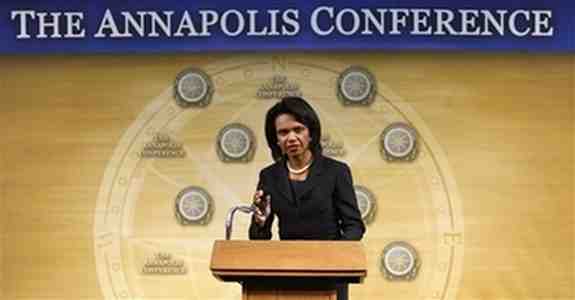
For an event which right up to the last minute was scrambling in search of content (Glenn Kessler provides a useful decoding of the declaration), no effort was spared in putting together a solid stage presentation. The image behind Rice says it all: a compass.

Annapolis was all about pointing in a direction. And as if to underline the fact that there isn’t even a consensus on what that direction should be, the big compass had embedded within it lots of smaller compasses suggesting multiple bearings. All aboard, the peace train is on its way — somewhere.

More than a few commentators were ready to mainline this stuff. David Ignatius notes that “very words ‘peace process’ have a narcotic effect,” — here we have a precious opportunity to dull the pain. “In a Middle East that is already far too volatile, this tranquilizing aspect of the Annapolis process is useful — and shouldn’t be squandered.”

Touchy-feely Jonathan Freedland gets off on what he describes as a “remarkable passage” from Ehud Olmert. This is what Olmert said:

For dozens of years, many Palestinians have been living in camps, disconnected from the environment in which they grew, wallowing in poverty, neglect, alienation, bitterness and a deep, unrelenting sense of deprivation. I know that this pain and deprivation is one of the deepest foundations which fomented the ethos of hatred towards us.

But if Olmert really feels the Palestinians’ pain, how come he’s just about to cut off the electricity to Gaza? An Israeli leader who acknowledges Palestinian suffering and its roots even while he persists in inflicting more suffering is not expressing the empathy that Freedland wants to hear. This is honey-sweetened sadism.

Meanwhile, the mono-metaphor presidency stays perfectly on track. Oblivious to the ambiguity in using the imagery of warfare to describe a peace process, Bush insists that “the battle is underway for the future of the Middle East” and that “we must not cede victory to the extremists.” For observers happy to go along with this worn-out framing of this as a conflict between “moderates” and “extremists,” Hamas and Iran are characterized as the spoilers. It’s as though, absent the extremists, the conflict would have been resolved decades ago. Really?

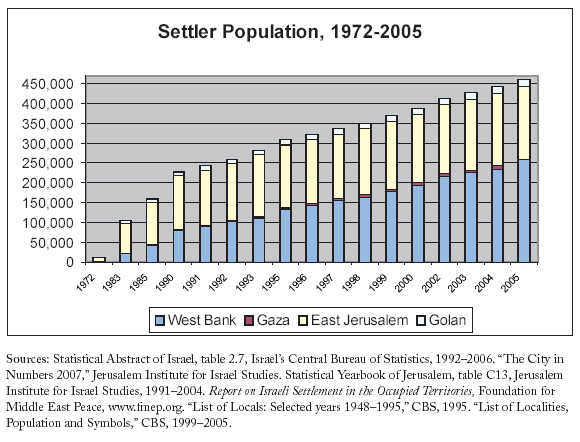
Who forced 450,000 Israelis to live outside Israel’s internationally recognized borders, largely on seized private Palestinian land? Those who refuse to acknowledge the unambiguous direction of the trendline (shown below), do so because they are unwilling to hear anyone utter its real name: colonization.

The Annapolis skeptics scoff at the connivance of the latest re-branding of the peace process, not because they hate peace but because they can see that the political substance of this enterprise is not aimed at a just and lasting resolution of the conflict. It aims at the perpetuation of a process intended to go on for as long as it takes to destroy the will of those who resist.
settler-growth.jpg
Are we to believe that an Israel that is willing to wall off its Palestinian problem, successfully placing it out of sight and out of mind for most Israelis, will, at some point in the future when no longer faced with any violent opposition, turn around and make magnanimous “concessions”? Or is it much more reasonable to assume that the peace that Israel seeks is merely acquiescence to the status quo?

Facebooktwittermail

OPINION: Peace through strangulation

Fire and water in Gaza

On Sept. 19, the Israeli government declared the Gaza Strip “hostile territory” and authorized steps to punish its civilian population. It decided that every Qassam rocket fired into Israel would carry a price tag: cutting the supply of electricity and fuel that Israel sells to Gaza. This assumes that disrupting civilian life in Gaza will have positive political results for Israel.

Gaza’s 1.5 million residents have been living with collective punishment for some time. We have endured years of border closures, aerial attacks and military operations — measures Israel has always explained as militarily necessary. But now, Israeli politicians claim it is legitimate to deprive all of Gaza’s civilians of basic needs.

Israel controls Gaza’s borders and the movement of all people and goods. Since Hamas came to power in June, Israel has tightened its siege. It has banned raw materials for manufacturing and construction; only basic foodstuffs are permitted into Gaza, and exports have been halted. Gaza’s economy is suffocating: Since June, 85 percent of its factories and 95 percent of its construction projects have been paralyzed. More than 70,000 people have lost their jobs. A million and a half people are locked in a pressure cooker in one of the world’s most densely populated areas. Stripped of the ability to travel, receive goods or engage in productive work, Gaza’s residents have become dependent on Western and Islamic aid organizations.

Disrupting the supply of electricity and fuel will first and foremost affect medical devices, refrigerators, operating-room lighting and other essential systems.

Cutting fuel and electricity threatens to create a water and sewage crisis in the Gaza Strip and surrounding areas. Power is needed to run treatment plants, pump water to homes and pump sewage away from populated areas. Since Israel began restricting fuel supplies on Oct. 28, I have had difficulty purchasing the full amount of fuel needed to power Gaza’s water system. Early this month, I stopped operating seven wells that provided drinking water to 35,000 people. Last week, I stopped operating three other wells and two sewage pumping stations, serving 50,000 people. Already, more than 15 percent of Gaza’s residents do not receive an adequate supply of water to their homes. [complete article]

Facebooktwittermail

NEWS, ANALYSIS & OPINION: Annapolis in context

In Annapolis, conflict by other means

Both Abbas and Hamas are betting, in opposite directions, on the Annapolis meeting and the process it may spawn. Abbas hopes to show that bilateral negotiations can achieve what resistance cannot, both in terms of diplomatic process and improvements in daily life. Hamas is wagering that precisely the opposite will occur, and that, once chastened, Fatah will have no choice but to revive its partnership with the Islamists, on the latter’s terms. Yet even should the international custodians of this process provide Abbas with sufficient goods to dissuade Fatah from resuming dialogue with Hamas, the Islamist movement assumes that the fruits of the process will ultimately redound to its benefit, as did those of the Oslo process when Hamas in 2006 won control of the legislature. And should the process further threaten Hamas’ position, it need not stand idly by. Abbas is in no position to conclude a historic compromise without the safety net of a national consensus including Hamas — much less implement one in the teeth of active and perhaps armed Islamist opposition.

Compelling Hamas to fight for its very survival rather than what it perceives as its rightful role in the Palestinian political system is only compounding these challenges. The Gaza Strip is under unprecedented pressure. Border crossings remain closed to most exports and all but the most vital imports, precipitating an economic freefall from which an eventual recovery will be prolonged and difficult. The economy is being hollowed out, as the private sector — the most productive — is progressively destroyed. Given the continued rocket fire on southern Israel, the Olmert government has declared Gaza a “hostile entity,” setting the stage for further measures including embargoes on electricity and fuel. These sanctions may be a prelude to an eventual Israeli military offensive in the Gaza Strip akin to that in the West Bank in 2002, though many consider this scenario unlikely — except in the event of significant Israeli causalities — because it will create as many Israeli dilemmas as it resolves. Once Israel conquers the coastal strip, it will either need to remain and occupy or withdraw and, inevitably, face further attacks. That Hamas will be unseated from within seems even less likely; despite growing popular disenchantment and sporadic clashes, the Islamists have the wherewithal to remain in power and a proven determination to use it. [complete article]

See also, Hamas: Abbas has no right to give up one inch of Palestine (Haaretz) and 4 main issues that divide Israel, Palestinians (McClatchy).

Iran: The uninvited guest a peace summit

According to a Tehran University political science professor, the reason Tehran is highly skeptical about the results of the Annapolis conference is that “all the principal participants are weak. You have a lame-duck president in the White House who completely forgot the Palestinian issue for seven years, a weak Israeli prime minister [Ehud Olmert] and an even weaker Palestinian leader [President Mahmoud Abbas], who does not lead more than a minority of Palestinians. How is a durable breakthrough possible under these conditions when the principal participants are not powerful enough to make the necessary concessions? Can Olmert stop the illegal settlements or order their removal from the Palestinian lands? The answer is no.”

Such sentiments can be found aplenty in Iran, prompting President Mahmud Ahmadinejad to echo the sentiment of Hamas leaders, who are highly critical of those Arab leaders participating at Annapolis, by stating: “Attending the conference shows a lack of political intelligence. The name of those who give concessions to the Zionist occupiers by attending will not be remembered for goodness.”

Iran’s Foreign Minister Manouchehr Mottaki, on the other hand, has stated, “The end result of all these conferences leads to a further erosion of Palestinian rights.” Mottaki has been touring the Gulf Cooperation Council states and has been delighted that Sultan Qabus of Oman in particular has praised the latest International Atomic Energy Agency (IAEA) report on Iran’s nuclear program as “successful” and has supported Iran’s nuclear rights. [complete article]

Did Livni mean what she said?

One morning recently, I went to a grocery store in the north Jerusalem neighborhood of Beit Hanina, where I bought a few items, which I paid for with a Jordanian coin. When I glanced at the change I received, in Israeli currency, I saw I had been shortchanged by three shekels. I looked at the grocer, who, without my saying a word, seemed to understand, as he shouted angrily: We still remember you as tramps. Now you all drive around in Mercedes, but you still squabble with us over a few pennies.

That was the opinion of a simple Palestinian about his Palestinian brothers who live inside Israel – if you will, the “Israeli Arabs” or “the Arabs of ’48.” Of course this was just one man’s opinion, but there is little doubt that it is representative of a widespread feeling among our Palestinian brethren, who expresses an objective reality.

I recalled the episode when I heard Foreign Minister Tzipi Livni declare last week that the Palestinian state would provide a national solution for all the Palestinians, including those who live inside Israel. The minister in effect was offering her understanding of the real significance of Israel’s insistence on conditioning its participation in the Annapolis conference on Palestinian recognition of Israel as the state of the Jewish people. The connection Livni made between the Palestinian refugees and the Palestinian citizens of the State of Israel – by saying that both of them could find their solution in a future Palestinian state – did not leave much to the imagination, for this time the remarks were made by the foreign minister and in the name of the Israeli government, and herein lies the danger.

Since the state’s establishment, its leaders have refused to internalize the fact that an Arab Palestinian minority remained here. Their decision to stay and live on their lands constituted a painful reminder to the leaders of the Zionist movement about the way in which reality failed to conform to Israel Zangwill’s well-known slogan that saw this as “a land without a people for a people without a land.” [complete article]

An arrest on the border

Ghazi-Walid Falah was not worried when Israeli security agents stopped his car on a narrow mountain road near the Lebanese border, just before sundown on July 8, 2006.

When they discover who I am, he assured himself, they will immediately release me.

Mr. Falah is a prominent political geographer who studies borders. He is a tenured professor at the University of Akron. And he is a dual citizen of Israel and Canada. He thought he had nothing to fear.

But his self-assurance — and his freedom — were short-lived.

That night agents of the Israel Security Agency, also known as the Shin Bet, or Shabak, arrested Mr. Falah and took him to a police station in Nahariya. There they told him they had found something in his camera: a photograph of a “sensitive” military antenna near the coast.

Then they used the word meragel: Spy.

In the middle of the night, a three-car convoy carried Mr. Falah, bound hand and foot, to his brother’s home, near Nazareth, so the Shin Bet could search his luggage there. In that blur of a visit, Mr. Falah spoke just a few words to his brother. “Contact my lawyer,” he said. “I’m clean.”

That was the last Mr. Falah’s family, friends, or colleagues would hear from him for the next 18 days. A gag order from an Israeli court forbade Mr. Falah to speak with his lawyer, his lawyer to speak with the press, and the Israeli press to cover his arrest.

Four days into Mr. Falah’s detention, war broke out between Israel and Hezbollah in Lebanon, further burying his disappearance in the public consciousness. When he was released, on July 30, with the war still raging, he had been imprisoned and interrogated for 23 days. No charges were ever filed against him.

In the history of the region’s conflicts, the story of one detained geography professor is a minor episode at best.

But at a time when scholars of the Middle East agonize over visa denials and public tenure battles, Mr. Falah’s experience gives even starker definition to the risks involved in studying the region. [complete article]

Facebooktwittermail

ANALYSIS & OPINION: A theatrical peace process

Demands of a thief

The public discourse in Israel has momentarily awoken from its slumber. “To give or not to give,” that is the Shakespearean question – “to make concessions” or “not to make concessions.” It is good that initial signs of life in the Israeli public have emerged. It was worth going to Annapolis if only for this reason – but this discourse is baseless and distorted. Israel is not being asked “to give” anything to the Palestinians; it is only being asked to return – to return their stolen land and restore their trampled self-respect, along with their fundamental human rights and humanity. This is the primary core issue, the only one worthy of the title, and no one talks about it anymore.

No one is talking about morality anymore. Justice is also an archaic concept, a taboo that has deliberately been erased from all negotiations. Two and a half million people – farmers, merchants, lawyers, drivers, daydreaming teenage girls, love-smitten men, old people, women, children and combatants using violent means for a just cause – have all been living under a brutal boot for 40 years. Meanwhile, in our cafes and living rooms the conversation is over giving or not giving.

Lawyers, philosophers, writers, lecturers, intellectuals and rabbis, who are looked upon for basic knowledge about moral precepts, participate in this distorted discourse. What will they tell their children – after the occupation finally becomes a nightmare of the past – about the period in which they wielded influence? What will they say about their role in this? Israeli students stand at checkpoints as part of their army reserve duty, brutally deciding the fate of people, and then some rush off to lectures on ethics at university, forgetting what they did the previous day and what is being done in their names every single day. Intellectuals publish petitions, “to make concessions” or “not to make concessions,” diverting attention from the core issue. There are stormy debates about corruption – whether Prime Minister Ehud Olmert is corrupt and how the Supreme Court is being undermined. But there is no discussion of the ultimate question: Isn’t the occupation the greatest and most terrible corruption to have taken root here, overshadowing everything else? [complete article]

The Grinch who stole Annapolis

When the Western powers suggested, at Yalta, that the Pope be brought into discussions over the shape of post-war Europe, Stalin famously retorted, “how many divisions does he command?” The same is essentially true for Abbas. The Israelis and Americans are going into talks now with a Palestinian leadership unable to deliver. And they know it. This is talking for the sake of talking, and showing that talks could potentially lead somewhere under very different circumstances.

All of those regimes, including Abbas’s, who have thrown in their lot with the floundering Pax Americana in the Middle East have no alternative but to show up at Annapolis, and hope — against hope — that the Bush Administration is ready to do more than it has ever done to press the Israelis into withdrawing from the territories conquered in 1967. What they’ll get, though, at best, is a process that promises to reach that point at some unspecified date in the future. Still, where else are Abbas and the Arab regimes going to spend next Tuesday? [complete article]

See also, Syria is to attend talks in Annapolis (WP), Skeptical Arab leaders agree to attend Mideast peace conference (McClatchy), and Hamas warns of violence after talks (The Observer).

Facebooktwittermail

NEWS, ANALYSIS & EDITOR’S COMMENT: The Annapolis peace ambiance

U.S. push on Palestinians has Iran motive

The United States hopes one byproduct of its Israeli-Palestinian peacemaking will be a moderate Arab alliance to counter Iran’s influence in the region, but analysts are skeptical the strategy will work.

U.S. Secretary of State Condoleezza Rice has argued that a strong Palestinian state could act as a bulwark against a rise in extremism, mainly from Iran, which Washington accuses of backing groups such as Hezbollah in Lebanon and Hamas in the Palestinian territories. [complete article]

Editor’s Comment — Reuters reports that:

Rice was asked this week if ending the Israeli-Palestinian conflict had more to do with Iran than anything else.

“It’s a strange argument,” she told reporters but she reiterated her view that growing extremism in the Middle East was a key factor driving the main players in the region to end the Israeli-Palestinian conflict.

Even if Rice says this is a strange argument, it should also be a familiar argument since it was essentially the argument being made by her then-counselor, Philip Zelikow in a keynote address to the Washington Institute for Near East Policy just over a year ago. Zelikow envisioned a coalition of the “United States, key European allies, the state of Israel and the Arab moderates” that would be needed to confront Iran. He said that what would “bind that coalition and help keep them together is a sense that the Arab-Israeli issues are being addressed.” The Annapolis meeting is taking place to foster that “sense”; to create an ambiance in which it feels like there is movement in the direction of a resolution of the Palestinian-Israeli conflict

Likudnik hawks work to undermine Annapolis

Despite near-universal skepticism about the prospects for launching a serious, new Middle East peace process at next week’s Israeli-Palestinian summit in Annapolis, a familiar clutch of neoconservative hawks close to the Likud Party leader, former Israeli Prime Minister Binyamin Netanyahu, isn’t taking any chances.

Hard-liners associated with the American Enterprise Institute and Freedom’s Watch, a bountifully funded campaign led by prominent backers of the Republican Jewish Coalition, among other like-minded groups, are mounting a concerted attack against next week’s meeting which they fear could result in pressure on Israel to make territorial concessions.

The attack, which comes amid steadily growing neoconservative fears that the administration of President George W. Bush is becoming increasingly “realist” in its last year in office, is being directed primarily against Secretary of State Condoleezza Rice, rather than the president himself. [complete article]

Syria reportedly to skip summit, as Haniyeh calls meet ‘stillborn’

Hamas’ Gaza leader Ismail Haniyeh said Thursday that next week’s U.S.-sponsored Middle East peace conference is stillborn and will achieve nothing for the Palestinians, as the London-based Arabic-language newspaper Al-Hayat reported that Syria has already decided not to attend the Annapolis, Maryland summit.

“We realize that this conference was stillborn and is not going to achieve for the Palestinian people any of its goals or any of the political and legal rights due to them,” Haniyeh said outside the Palestinian parliament building in Gaza City.

Haniyeh said Abbas did not have the mandate to make compromises in talks with Israel, especially over the demand of Palestinian refugees to return with their families to homes in Israel they lost during the 1948 War of Independence. [complete article]

Saudis to attend Middle East peace conference

Saudi Arabia’s foreign minister is to attend next week’s Middle East peace conference, he announced today, in a significant boost to the US-sponsored talks.

“I’m not hiding any secret about the Saudi position. We were reluctant until today,” Saud al-Faisal told a press conference at the ongoing Arab League meeting in Cairo.

“If not for the Arab consensus we felt today, we would not have decided to go,” he said. “But the kingdom would never stand against an Arab consensus, as long as the Arab position has agreed on attending, the kingdom will walk along with its brothers in one line.” [complete article]

Israel to start gradually reducing Gaza power supply December 2

Israel to begin gradually reducing the power supply to the Gaza Strip on December 2, in response to the ongoing Qassam rocket fire at Israeli communities along the Strip, Attorney General Menachem Mazuz told the High Court of Justice on Thursday.

According to the State Prosecution, the defense establishment has finalized preparations meant to ensure that the power reduction does not cause humanitarian harm Gaza.

The Palestinians will be given a one-week advance notice of the intention to begin reducing the power supply. [complete article]

Facebooktwittermail

NEWS: Who’s going to Annapolis?

Wanted: Participants for Mideast talks

The Bush administration finally acknowledged publicly on Tuesday that it had issued formal invitations to 40 countries and organizations that it hopes will attend a heavily anticipated Middle East peace conference scheduled for next week in Annapolis, Md. But the long, drawn-out route that State Department officials followed before making the acknowledgment reflected the high-stakes gamble that the administration is taking, as well as the unsettled nature of the outcome. Even late Tuesday afternoon, administration officials were still in negotiations with their Arab counterparts over whether Saudi Arabia and Syria would send their foreign ministers to the conference, or make do with lower-level envoys. [complete article]

Facebooktwittermail