Category Archives: Israel-Palestinian conflict

GUEST CONTRIBUTOR – John Robertson: The bullies converge

The bullies converge
By John Robertson, War in Context, March 3, 2008

uss-cole.jpg28 and 29 February: the US parks the USS Cole off the shore of Lebanon. Uh-oh.

1 March: Israeli forces launch a major operation into Gaza, killing as many as 60 Palestinians, many of them civilians and children.

Senators Clinton, McCain, and Obama daily wage verbal slugfests on national security, the US’s proper role in the Middle East, and which of them will be best prepared to defend “our strong ally” Israel. OK, business as usual in an election year?

Er, . . . wait a minute.

The timing here ought to be raising antennae here in the US. You can bet that the Arab and Iranian “street” will be taking due note.

The arrival of a US Navy vessel off the coast of Lebanon had to send chills up the spines of many Lebanese. As Roger Morris recently reminded us in his chronicle of the life of Hezbollah “engineer” Imad Mugnieh, the US Navy has pumped shells into Lebanese villages on several occasions (even rolling out a World War II era battleship, the USS New Jersey, on one occasion to use its huge shells to get maximum killing and intimidation effect on the unfortunate villagers on whom they rained down ). That was in the context of the Lebanese civil war of 1975-1990, which featured ongoing deadly scrums involving the IDF, the PLO, and various Lebanese militias – Christian and Muslim, including the newly established Hezbollah. In the summer of 2006, Israel and Hezbollah got into it again, with horrific toll in life and infrastructure (especially on the Lebanese side) while US Secretary of State Condoleeza Rice, as a rather ghoulish birthing coach, urged on the IDF during what she then called the “birth pangs of a new Middle East.” Now, in March 2008, the Lebanese government is mired in a parliamentary impasse, unable to elect a new president. Not yet a full-fledged civil war in Lebanon, but the US Navy lies offshore again, this time, we’re told, to signal to Hezbollah (which is now a legitimately constituted, democratically elected political party in Lebanon’s political structure) that the US will tolerate no stronger interference from them (or from Syria or Hezbollah’s ally and patron, Iran) as Lebanon’s struggles continue.

Yet the very next day, the IDF launched its deadly raid into Gaza, knowing that Hamas forces would resist with whatever means they could muster but would be ultimately powerless to change the outcome. Might they assume (dare we say, hope?) that Hezbollah and Iran might find this an unacceptable provocation and wish to retaliate against Israel? Except that – gosh, wouldn’t you know it? – the US Navy is parked right offshore. And wouldn’t you know it? It’s the USS Cole, the same USS Cole in whose side an al-Qaeda suicide boat blew a hole in those distant days before 9-11. The irony is palpable – indeed, dare we say, intended? Certainly, from the US perspective, delicious.

So, with the US looming in the wings, Israel can do what it wants to in Gaza. And if Hezbollah (and, by implication, Iran) decide not to respond to Israel’s wanton holocaust of innocent Palestinians in Gaza (whose lives had already been made miserable by Israel’s US-approved blockade), they run the risk of accusations of cowardice in the face of the Zionist bullies. If they were to rise to the bait and retaliate, they run the risk of the bullies turning against them and trying to flatten them. Israeli prime minister Olmert will jump at the chance to atone for the disaster of the summer 2006 war, and George Bush may get the military confrontation with Iran that he well may have been hoping for all along.

And all the while, our senator-candidates must intone their often rehearsed mantra, “Israel has the right to defend itself against the terrorists.” The US Navy offshore, the US presidential candidates cowed by political realities in an election season — how much better cover could the bully have?

John Robertson is a professor of Middle East history at Central Michigan University and has his own blog, Chippshots.

Editor’s Comment — It’s worth recalling that less than two weeks before the beginning of the 2006 Lebanon War, Israel was in the middle of pounding Gaza in what Mahmoud Abbas described as an “unacceptable and barbaric collective punishment of civilians, including women, children and old people.”


Facebooktwittermail

REVIEW: Jabotinsky, Weizmann, and the roots of the most contentious communal struggle on earth today

Zion story

In her last, powerful little book, The Question of Zion (reviewed in the TLS, April 21, 2006), Jacqueline Rose perceptively observed that, “while Israel barely leaves the front page of the daily papers, Zionism itself is hardly ever talked about”. That’s quite true, though not quite unique. Think of the column inches and radio and television time that have been devoted to the small island of Ireland and its smaller province of Ulster, and of the vehement polemic they have inspired, and then ask how often the origins or meaning of Irish Republicanism or of Ulster Unionism are ever talked about, or how many of those commentators could write so much as a paragraph each on Arthur Griffith, Colonel Saunderson or General O’Duffy.

But the conflict in the Holy Land is still more dissonant in this regard. It is the single most bitterly contentious communal struggle on earth today (something which itself casts an ironical light on the aspiration of the first Zionists to “answer the Jewish question” by “normalizing” the Jews and removing them from the pages of history); it must receive more media coverage than India, which has a population a hundred times greater; it inflames acute passions. And yet it sometimes seems that the more strongly people feel, the less they actually know about the story of Zionism. Maybe it should be a requirement for anyone who wishes to hold forth on the subject to write first a few lines each on Ahad Ha’am, Max Nordau, George Antonius – or Vladimir Jabotinsky.

If not many Europeans or Americans know who “Jabo” was, Israelis certainly do. He remains the most charismatic, fascinating and controversial figure in the history of Zionism, and in the state to whose creation he devoted his life, but which he never saw. Born in 1880 in Odessa, he was converted to the Zionist cause as a young man by tsarist persecution, became a tireless publicist and organizer, and helped to create the Jewish Legion which fought with the British against Turkey during the First World War. In the 1920s he broke away to found the uniformed youth group Betar, and then the militantly nationalistic right-wing brand of Zionism he called Revisionism, in opposition to Chaim Weizmann and the general Zionists, and to David Ben Gurion and the Labour Zionists of the Yishuv, the Jewish settlement in Palestine.

From Betar would grow the Irgun Zvei Leumi, which waged an armed campaign against the British and the Arabs – in British and Arab eyes, a terrorist campaign – in the ten years before Israel was born. When Jabotinsky died in American exile in 1940, he had not seen the murderous horror that engulfed the European Jews, the creation of the Jewish state, or the legacy of his own movement. The Irgun evolved into the right-wing Herut party, which was not merely excluded from office but veritably anathematized in Israel for the first quarter-century the state existed after 1948, but which, now in the guise of Likud, took power at last in 1977 under the old Irgun leader Menachem Begin – and which descends to the present administration.

Almost unremarked in the West, Israel today has the purest Jabotinskian government yet seen. Ehud Olmert, the Prime Minister, has been called “one of Likud’s princes from a prominent Revisionist family”, which makes his rather fetching Foreign Minister, Tzipi Livni, a princess. Both their fathers were militants in the Irgun; the governing party is now called Kadima or “eastward”, the telling motto that Jabotinsky chose for the Jewish Legion; a picture of Jabotinsky hangs at party meetings; and Livni likes to quote him regularly, as Olmert did in his first speech to the Knesset as Prime Minister. Jabotinsky has never cast a longer shadow. [complete article]

Facebooktwittermail

NEWS: Israel threatens to commit genocide in Gaza

Israel threatens to unleash ‘holocaust’ in Gaza

An Israeli minister gave warning today that the Gaza faces a “holocaust” if Islamist militants there do not end their daily barrages of home-made Qassam rockets, and their increasing use of Iranian-built Grad missiles.

“The more Qassam fire intensifies and the rockets reach a longer range, they will bring upon themselves a bigger holocaust because we will use all our might to defend ourselves,” Matan Vilnai, the Deputy Defence Minister said.

The use of the term “holocaust” is usually restricted to descriptions of the Nazi genocide of the Jews in Europe in the Second World War, and many Israelis resent its use in any other context. Mr Vilnai’s deployment of the word appeared to show Israel’s growing frustration that Hamas and other militant groups in Gaza refuse to curb their attacks, despite heavy tolls inflicted in Israeli air strikes and tank raids. [complete article]

Facebooktwittermail

NEWS & OPINION: After the siege of Gaza

Hamas doesn’t want a separate Gaza

Many Western observers, politicians and journalists considered the recent breach of the Rafah crossing between Gaza and Egypt a victory for the Hamas movement. Some viewed it as the beginning of the end of the siege imposed on the Palestinian people. The statement by Luisa Morgantini, the vice president of the European Parliament, was an example of this. The breach in the wall and the thousands of Palestinians crossing the border, she said, “are all true acts of resistance and an affirmation of the freedom of that people.”

The purpose of crossing the frontier was not to embarrass Egypt, challenge its sovereignty or threaten its security. It was a message to the forces of the Israeli occupation and the international community that the pressure to bring down the government of Premier Ismail Haniyya by starving the people of Gaza to death will not succeed and will not break the steadfastness and determination of the Palestinian people or end their legitimate resistance. [complete article]

Officials: Gaza op will bring int’l troops

Israel is considering a large-scale incursion into the Gaza Strip during which it would present an ultimatum to the international community for the deployment of a multinational force as the only condition under which it would withdraw, defense officials have told The Jerusalem Post.
[…]
“We are talking about the Second Lebanon War model,” a defense official said. “To go to war and tell the world that if they want a cease-fire and for us to leave then they will need to send a force to replace us.” [complete article]

Facebooktwittermail

NEWS & ANALYSIS: Trusting Hamas

All power to Hamas …

During the years 2000-2006, Hamas obtained all the war medals it needed by steering what has become called the al-Aqsa Intifada. There was no higher reward for the leaders of Hamas than an esteemed reputation in the Islamic world, the ability to inflict pain on Israel, discredit Yasser Arafat, and achieve martyrdom; the ultimate goal of jihadis worldwide. By 2006, it was clear that something was still missing for Hamas. It was the opportunity to rule; the chance to dictate policy and be recognized not only by Arabs and Muslims but by the international community as well.

That, of course, in addition to their conviction that they could run a state, combat corruption and find jobs for the Palestinians. They sincerely believed – and still do – that they can deliver if given the chance. This is actually why they were voted into office in 2006. Palestinians did not vote for them because they promised to annihilate the state of Israel. They actually did not use that during their parliamentary race but rather, campaigned on a social agenda, banking on the bankruptcy of Fatah and the numerous shortcomings that surfaced after the death of Arafat in November 2004. It was a pragmatic victory rather than an ideological one. The Palestinians voted for Hamas because they promised better schools, more security, less bureaucracy and no corruption. Voters included seculars and Christians.

Giving them the full burden of government would have sidelined them from the resistance – the way it did to Fatah after 1993. They would have been too busy cleaning up house in the civil service, inspecting schools, and building roads, to lead a proper resistance. They made several important gestures towards Israel and the Americans, however, crying “Uncle” without actually saying it, because they wanted recognition as statesmen rather than guerilla warriors. Decision-makers in Washington, however, refused to listen, seeing Hamas as no different from al-Qaeda, because of its Islamic program. Instead of taking advantage of the situation, Israel brought Hamas back to the fold of the resistance (what they know how to do best). [complete article]

Egypt: Hamas, Fatah should control Gaza border together

Cairo wants Hamas and Fatah to jointly operate the border crossing between Gaza and Egypt, a spokesman for Egyptian President Hosni Mubarak said yesterday.

Meanwhile, the border was closed yesterday by mutual agreement of Egypt and Hamas, 12 days after the Islamic organization blew up the wall that sealed it.

Speaking after a meeting between Mubarak and European Union foreign policy chief Javier Solana, presidential spokesman Suleiman Awad said that Egypt would not allow the border to reopen. “Egypt is a respectable country,” he said. “You can’t break open its borders and throw stones at its soldiers.”

What Egypt would prefer, he said, is for the Rafah crossing to reopen under the same arrangements that were in place before Hamas took over Gaza last June – namely, under Palestinian control alongside EU monitors. The monitors left after the Hamas takeover, causing the crossing to be shut. Now, said Awad, “the ball is in the Europeans’ court.” [complete article]

Facebooktwittermail

OPINION & INTERVIEW: Hamas takes the lead

Finally, a popular uprising

The fall of the Rafah wall was a fitting combination of planning and the precise reading of the social and political map by the Hamas government, mixed with a mass response to the dictates of the overlord, Israel.

Quite a few people in Rafah knew that “anonymous figures” had secretly been destablizing the foundations of the wall for several months, so that it would be possible to knock it down easily when the time came – but the secret didn’t leak. The hundreds of people who began leaving Palestinian Rafah right after the wall was breached did so despite the risk, and the precedent of the Egyptians shooting at those who infiltrate through the border.

The leadership and public of Gaza, as two elements of the occupied people, were partners in the courageous and necessary step of breaking the Israeli rules of the game. The breach of the wall is a clear manifestation of the conception and temperament of a popular resistance among the Palestinian people, which for various reasons, were dormant in recent years. [complete article]

The world according to Hamas

Foreign Policy: What is your opinion of the Annapolis peace process?

Khaled Meshaal: We were hoping there would be American seriousness in achieving peace in the region. But I regret to say that the behavior of the American administration does not reflect that there is seriousness. Even right after Annapolis, [Israeli Prime Minister Ehud] Olmert expanded the settlements in the occupied West Bank and East Jerusalem. The American reaction to that was very weak. Olmert is taking the same path that [former Prime Minister Ariel] Sharon took previously, which was defined by the “Four Nos”: no to Jerusalem; no to the right of return; no to the borders of 1967; and no to dismantling the settlements. This path will lead to neither peace nor security in the region, nor to a Palestinian state. [complete article]

Facebooktwittermail

NEWS, ANALYSIS & OPINION: After the siege

Whose monopoly now?

First there was delight. Senior officials in Israel said that Egypt had taken on this trouble called Gaza. You could almost hear the chadenfreude in their voices. After not wanting to hear about Gaza or its refugees for a generation, Egypt received both, explosively. Now, at last, there will be a responsible country, and not Israel, to deal with the refugees.

Egypt will also have to safeguard the blasted gate, which looks like a modern sculpture, prevent the passage of explosives and terrorists and supervise the behavior of Hamas, because otherwise it will bear the consequences. The feeling is that Egypt has become a true enemy state at last, Syria-style. Just as Damascus is perceived as responsible for the actions of Hezbollah, so Cairo will be the custodian of Hamas. And what could be better for Israel than to have an address to turn to that is not an organization but a state, which at any given moment can have the screws applied to it in the form of sanctions that will affect not 1.5 million Palestinians but 75 million Egyptians?

Hey, Hamas really showed Egypt what’s what this time. But this approach ignores two facts. First, it was not Egypt that breached the barrier. Egypt did what any humane country would be expected to do in this situation, albeit quite belatedly. It allowed hundreds of thousands of crushed people to enter its territory to stock up on what they have been unable to buy in Gaza for months, nearly two years, in fact. Egypt’s government capitulated to public pressure, as every government is expected to do. President Hosni Mubarak understood that even his great loathing for Hamas could no longer justify his being dragged in the wake of an inhumane Israeli policy, the more so with masses of Egyptians demanding that he take action to save Palestinians, no matter how Israel defines them. [complete article]

Israeli ‘economic warfare’ to include electricity cuts in Gaza

Saying they were waging “economic warfare” against the Gaza Strip’s Hamas leaders, Israeli officials told the Supreme Court on Sunday that the military intends to start cutting electricity to the Palestinian territory and continue restricting fuel.

The statements by Israel’s state attorney, outlining Defense Ministry plans, came in response to a lawsuit filed by Israeli and Palestinian rights groups.

The organizations are asking the Supreme Court to make Israel end fuel restrictions that caused power blackouts in the Gaza Strip this month. The activists argue that the restrictions constitute collective punishment of Gaza’s 1.5 million people and violate international law. [complete article]

No way to avoid Hamas now

On Jan. 16, I interviewed Hamas leader Khaled Meshaal in his well-guarded office here in Damascus. He told me Hamas is interested in reaching a cease-fire with Israel, though he said Israel still rejects this idea completely. He said that Hamas – which has a long and close relationship with Egypt’s main political opposition movement, the Muslim Brotherhood – considers its support within the Arab countries an important asset. While we talked, Yemen’s president, Ali Abdullah Saleh, called. During their five-minute conversation, Mr. Meshaal asked President Saleh to work hard to help lift the siege on Gaza.

Meshaal said Hamas seeks a better relationship with the US. “We are not against the American people, but against this administration. We are not against American interests. Every state has the right to have its own interests – but not at the expense of other peoples.”

The State Department’s designation of Hamas as a foreign terrorist organization had caused big problems for the organization, he admitted. But “American policy is also affected badly,” he argued, “because it finds itself fighting the wrong wars.” [complete article]

See also, Abbas wins int’l backing for PA control at Egypt-Gaza border (Haaretz).

Facebooktwittermail

NEWS ROUNDUP: January 27

Bush order expands network monitoring
President Bush signed a directive this month that expands the intelligence community’s role in monitoring Internet traffic to protect against a rising number of attacks on federal agencies’ computer systems.

Bush urged to renounce torture, restore ‘moral authority’
Delivering what they called a “prebuttal” to President Bush’s final State of the Union speech, congressional Democratic leaders called on Bush to chart a new direction for the U.S. economy and restore America’s “moral authority” abroad, notably by publicly renouncing torture and closing the Guantanamo Bay detention facility.

Israel to restore supply of industrial-use fuel to Gaza Strip
The state told the High Court of Justice on Sunday that Israel would restore the supply of industrial-use diesel to the Gaza Strip to target levels set prior to the blockade imposed on Gaza earlier this month.

American aid worker seized in Afghanistan
Gunmen kidnapped an American aid worker and her driver in southern Afghanistan’s largest city early Saturday, seizing the woman from a residential neighborhood as she was on her way to work.

Maliki sending troops to Mosul
Iraqi Prime Minister Nouri al-Maliki said Friday that Iraqi reinforcements have begun moving toward the northern city of Mosul for a “decisive” battle with the Sunni insurgent group al-Qaeda in Iraq.

FBI agent: Hussein didn’t expect invasion
Before the Iraq war, Saddam Hussein misjudged the U.S. military strategy and thought the United States would launch only several days of airstrikes and not a full-scale ground invasion, according to a television interview with the FBI agent who interrogated the former Iraqi leader for seven months.

Facebooktwittermail

ANALYSIS & EDITOR’S COMMENT: “Hamas chalked up a real coup”

Gaza border breach shows Israel that Hamas is in charge

A few Israel Defense Forces Engineering Corps officers surely shed a tear yesterday while viewing the television reports from Rafah: The barrier built by the IDF with blood and sweat along the Philadelphi Route, on the Gaza Strip border with Egypt, was coming down.

It was, apparently, the final remnant of Israel’s years of occupying the Strip. But Israel has better reasons to be worried by what happened yesterday. In destroying the wall separating the Palestinian and Egyptian sides of Rafah, Hamas chalked up a real coup. Not only did the organization demonstrate once again that it is a disciplined, determined entity, and an opponent that is exponentially more sophisticated than the Palestine Liberation Organization. It also took the sting out of the economic blockade plan devised by Israel’s military establishment, an idea whose effectiveness was doubtful from the beginning but whose potential for international damage was not.

Israel, Egypt and the Palestinian Authority are now forced to find a new joint border control arrangement, one that will probably depend on the good graces of Hamas. If the PA is indeed interested in taking responsibility for the border crossings, as Prime Minister Salam Fayyad has declared, it will have to negotiate with Hamas even though President Mahmoud Abbas is trying to avoid that at any cost. The other option – to leave the border untended – is even worse. [complete article]

See also, Sick Gazans rush Egypt’s chemists (AFP), Hole in the wall provides relief from misery of Israeli blockade (The Independent), and Churches decry Israel’s treatment of Gaza (Christian Post).

Editor’s Comment — In the cable TV/Israeli/neocon/Bush administration narrative, Hamas is a terrorist organization. So is al Qaeda. But here’s the difference — and this is one of the many reasons why the label “terrorist” explains so little and obscures so much. What Hamas did, al Qaeda would have found technically challenging and conceptually impossible.

Facebooktwittermail

OPINION: Escaping the Israeli siege

Hamas blows a hole in Bush’s plans

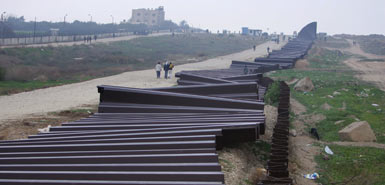
The hole blown by Hamas in the Gaza-Egypt border fence has finally punctured the bubble of delusion surrounding the U.S.-Israeli Middle East policy. In a moment reminiscent of the collapse of the Berlin Wall, gazawall.jpgthrough the breach surged some 350,000 Palestinians — fully one fifth of Gaza’s total population, as my friend and colleague Tim McGirk observed at the scene. And what did they do on the other side? They went shopping for the essentials of daily life, denied them by an Israeli siege imposed with the Wehrmacht logic of collective punishment. And the Egyptian security forces didn’t stop them, despite Washington and Israel urging them to, because U.S.-backed strongman Hosni Mubarak would provoke a mutiny among his citizenry and even his own security forces if they were to be ordered to stop hungry Palestinians from eating because Israel has decided that they should starve until they change their attitude. [complete article]

See also, Hamas exposes Israeli weakness in Gaza (Reuters) and Hamas ‘spent months cutting through Gaza wall in secret operation’ (The Times).

Facebooktwittermail

OPINION: Punishing Gaza

Where does it end?

Much of Gaza is once again in darkness, as Israel cut off the fuel to its only power plant. Hospital patients have reportedly died, communications are out, and movement and commerce in an already beleaguered economy have come to a near halt.

Michele Mercier, spokesperson for the the International Committee of the Red Cross, said Gaza hospitals still had medications “but it won’t last for more than two or three days.” Now, Gazans must also contend with the possibility of already scarce food supplies being cut off. Christopher Gunness of UNRWA, the UN relief agency, said the agency could be forced to suspend food distribution to 860,000 people because of the shortage of fuel and plastic bags.

The New York Times, always to be counted on to provide the right euphemisms, reported that “Israel’s defense minister, Ehud Barak, ordered a temporary halt on all imports into the Hamas-run Gaza Strip late last week. The measure, along with stepped-up military operations in Gaza, was meant to persuade Palestinian militants there to stop firing rockets at Israel.” (Isabel Kershner, “Fuel Shortage Shuts Gaza Power Plant, Leaving City Dark,” 21 January 2008.)

Terms like “measures” and “persuasion” sound so gentle. But they cover up a brutal reality that Israeli leaders are keen to boast about: they are acting with premeditation to inflict suffering on the Palestinian civilian population, and they display an extraordinary degree of callousness for their victims. [complete article]

Facebooktwittermail

NEWS & OPINION: Collective punishment of Gaza

Strong in numbers

Here we have the yardstick for security success: the number of Palestinians killed. As in the most primeval wars, the heads of the defense establishment are boasting about the number of people Israel has killed. Their job is to ensure protection for the residents of the state. And, as we know, the residents of the “Gaza perimeter” are not receiving this protection. So the death toll has become the measure of their success.

Shin Bet head Yuval Diskin briefed the cabinet last week about the “achievements” of his organization: 810 Palestinians killed during the past two years. His predecessor, Avi Dichter, once appeared before the editorial board of Haaretz and proudly presented a sophisticated slideshow from his laptop computer: a pie chart of Palestinian casualties, in several colors. Last week, the brigade commander in Gaza, Colonel Ron Ashrov, defined the operation in the Zeitun neighborhood as “very successful.” Why? Because his troops killed 19 Palestinians in a single day and further inflamed the conflagration in the South. How depressing, morally and in practical terms, to think that this is the measure of success. [complete article]

Olmert: No fuel? Gazans can walk

“We won’t allow a situation in which people in Sderot walk around in fear day and night, while Gazans lead a completely normal life,” olmert told his faction members. “We won’t allow for a humanitarian crisis, but have no intention of making their lives easier. And the harder their lives, excluding humanitarian damage, we will not allow them to lead a pleasant life.

“As far as I am concerned, all of Gaza’s resident can walk and have no fuel for their cars, as they live under a murderous regime.” [complete article]

The poor and the sick suffer as Israel cuts power to Gaza

Mansour Rahal lay unconscious in the intensive care unit of Gaza City’s Shifa hospital, linked to an electrically powered ventilator, the coloured monitor above his head showing his heart, respiration and oxygen saturation rate.

On Thursday last week, he was driving his donkey cart through Beit Lahiya when it was destroyed by a missile which targeted militants in a nearby car – it also killed his mother and older brother. His hopes of survival yesterday depended on there being enough diesel to keep in operation the four generators which were Shifa’s only source of power.

His doctor, Kamal al-Geathny, said: “If the fuel runs out for the generators and we have no power, he and six other patients in this unit will die.”

This was the scene at the hospital before Israel authorised limited supplies of fuel and medicine to Gaza last night after a wave of international condemnation for its act of “collective punishment” in imposing a four-day total embargo, which had left much of the Strip without electricity. [complete article]

Defusing the Gaza time bomb

The Gaza Strip suffers from sky-rocketing unemployment and poverty, and lacks medicine, fuel, electricity, food, and other essential commodities. It is virtually cut off. It also is the most likely trigger for the next Arab-Israeli war.

In the past few weeks, Palestinian militant groups have fired rockets and mortars into Israel. Israeli incursions and aerial attacks have resulted in Palestinian casualties, including one that killed the son of one of Hamas’s senior leaders. The situation is untenable, and both sides know it. Israel is unlikely to stand idly by as Hamas’s arsenal grows and attacks continue. Hamas undoubtedly will retaliate for the deaths. Neither can afford to back down. [complete article]

Facebooktwittermail

NEWS, ANALYSIS & OPINION: A deadbeat’s peace process

Gaza City plunged into darkness

The only power plant in the Hamas-run Gaza Strip has shut down because of a lack of fuel, Palestinian officials say, blaming Israeli restrictions.

Gaza City was plunged into darkness after the plant’s turbines stopped.

Israel’s closure of border crossings amid continued rocket fire from Gaza has brought the delivery of almost all supplies, including fuel, to a halt. [complete article]

Senior Saudi prince offers Israel peace vision

A senior Saudi royal has offered Israel a vision of broad cooperation with the Arab world and people-to-people contacts if it signs a peace treaty and withdraws from all occupied Arab territories.

In an interview with Reuters, Prince Turki al-Faisal, a former ambassador to the United States and Britain and adviser to King Abdullah, said Israel and the Arabs could cooperate in many areas including water, agriculture, science and education.

Asked what message he wanted to send to the Israeli public, he said:

“The Arab world, by the Arab peace initiative, has crossed the Rubicon from hostility towards Israel to peace with Israel and has extended the hand of peace to Israel, and we await the Israelis picking up our hand and joining us in what inevitably will be beneficial for Israel and for the Arab world.” [complete article]

The march of cynics

The prize for the most sharply cynical remark goes to President George W. Bush, who said in Ramallah of the Israel Defense Forces crossing points: “You’ll be happy to hear that my motorcade of a mere 45 cars was able to make it through without being stopped.” No doubt, he was speaking ironically, but even if he added that he wasn’t “so exactly sure that’s what happens to the average person,” he should be reminded of the saying that one doesn’t mention rope in a hanged man’s home. Okay, so there’s a lack of political and human understanding here, but isn’t there even a drop of sensitivity and empathy?

This cynical remark made only the slightest impression on those who heard it. After all, the people who met with Bush are not the ones who are exposed to the humiliations that thousands go through at the barriers every day, and they even receive VIP treatment. Why should they express dissatisfaction with a spontaneous bit of nonsense when they feel no need to react to a stupid thing that someone in Bush’s retinue formulated for the president? “Swiss cheese isn’t going to work when it comes to the outline of a state. And I mean that,” declared Bush. Right after that he said the drawing up of the future border will reflect the current reality. But it is the reality of the settlement blocs that has created the “Swiss cheese.” [complete article]

Middle East triangle

Nervous about being left out, all three parties are laboring mightily to avert an understanding between the other two. Hamas threatens the nascent Israeli-Palestinian political process, challenging its legitimacy and intimating that it could resort to more violence. Israel warns that renewed Palestinian unity will bring that process to an abrupt halt. Abbas actively discourages any third-party contact with Hamas. The end result is collective checkmate, a political standstill that hurts all and serves none.

The truth is, none of these two-way deals is likely to succeed. In tandem, no two parties are capable enough to deliver; any one party is potent enough to be a spoiler. There can be neither Israeli-Palestinian stability nor a peace accord without Hamas’s acquiescence. Intra-Palestinian reconciliation will not last without Israel’s unspoken assent and willingness to lift its siege. Any agreement between Hamas and Israel over Abbas’s strong objection is hard to imagine.

For any of these dances to go forward, all will have to go forward. Synchronicity is key. Fatah and Hamas will need to reach a new political arrangement, this time not one vigorously opposed by Israel. Hamas and Israel will need to achieve a cease-fire and prisoner exchange, albeit mediated by Abbas. And Israeli Prime Minister Ehud Olmert will need to negotiate a political deal with Abbas, who will have to receive a mandate to do so from Hamas. The current mind-set, in which each side considers dealmaking by the other two to be a mortal threat, could be replaced by one in which all three couplings are viewed as mutually reinforcing. For that, the parties’ allies ought to cast aside their dysfunctional, destructive, ideologically driven policies. Instead, they should encourage a choreography that minimizes violence and promotes a serious diplomatic process. Otherwise, no matter how many times President Bush travels to the region, there is no reason to believe that 2008 will offer anything other than the macabre pattern of years past. [complete article]

Not on the itinerary

Take a president who rarely travels overseas and certainly not for extended periods of time. Add the region of the world most associated with this administration and most in turmoil. Throw in the president’s first visit to Israel and the Palestinian territories after seven years in office. What do you get? Remarkably little, as it turns out.

President Bush’s eight-day tour of the Middle East registered barely an above-the-fold headline in the major American and international newspapers. Perhaps the subject of greatest speculation was how a president, famous for maintaining a schoolboy’s bedtime curfew, would cope with the late Arabian nights. But Bush’s Middle East trip was of some importance – as much for what didn’t happen, as for what did. Paradoxically, an administration guided by a transformational vision of the application of American power was now displaying the limitations of its role – limitations partially created by its own failures. [complete article]

Facebooktwittermail

NEWS ROUNDUP: Saudi Arabia, Iraq, Israel, Gaza, Syria

Bush prods Saudi Arabia on high oil prices

President Bush urged the Organization of the Petroleum Exporting Countries on Tuesday to take into account the toll that high oil prices are having on the American economy, gingerly touching on an issue that has begun to color the last year of his presidency and dominate the presidential election campaign. [complete article]

U.S. offers Saudis ‘smart’ arms technology

The most controversial element of the sales is the offer to the Saudis of Joint Direct Attack Munitions, technology that allows standard weapons to be converted into precision-guided bombs. The deal envisions the transfer to Saudi forces of 900 upgrade kits worth about $120 million. [complete article]

Minister sees need for U.S. help in Iraq until 2018

The Iraqi defense minister said Monday that his nation would not be able to take full responsibility for its internal security until 2012, nor be able on its own to defend Iraq’s borders from external threat until at least 2018. [complete article]

U.S. shifts Sunni strategy in Iraq

More than 70,000 members of mostly Sunni Arab groups now work for American forces in neighborhood security programs. Transferring them to the control of the Shiite Muslim-dominated government, as policemen and members of public works crews, has taken on a new urgency as American troops begin to withdraw, officials indicated in recent interviews, meetings and briefings. [complete article]

Ex-Baathists get a break. Or do they?

A day after the Iraqi Parliament passed legislation billed as the first significant political step forward in Iraq after months of deadlock, there were troubling questions — and troubling silences — about the measure’s actual effects. [complete article]

Bush trip revives Israeli push for pardon of spy

A balding, bearded visage loomed over President Bush’s visit here last week, peering down from banners and from posters on buses barreling along quiet streets. The face was that of Jonathan Pollard, an American who pleaded guilty in 1986 to passing top-secret information to Israel. [complete article]

Israeli pianist Daniel Barenboim takes Palestinian citizenship

Daniel Barenboim, the world renowned Israeli pianist and conductor, has taken Palestinian citizenship and said he believed his rare new status could serve a model for peace between the two peoples. [complete article]

Olmert faces right-wing rebellion

With Avigdor Lieberman, leader of the most right-wing party in Mr Olmert’s government already threatening to walk out, Benjamin Netanyahu, leader of the opposition Likud, urged both him and the religious party Shas to do so “to stop this process”. [complete article]

Haaretz probe: Shin Bet count of Gaza civilian deaths is too low

Israeli security forces killed 810 Palestinians in the Gaza Strip in 2006 and 2007, Shin Bet security service chief Yuval Diskin reported Sunday at the weekly cabinet briefing in Jerusalem. He estimated that some 200 of those killed were not clearly linked to terrorist organizations. [complete article]

Syria rebuilds on site destroyed by Israeli bombs

The puzzling site in Syria that Israeli jets bombed in September grew more curious on Friday with the release of a satellite photograph showing new construction there that [vaguely] resembles the site’s former main building. [complete article]

Facebooktwittermail

OPINION: It’s not about Iran

It’s not about Iran

As President Bush travels through the Middle East, the prevailing assumption is that Arab states are primarily focused on the rising Iranian threat and that their attendance at the Annapolis conference with Israel in November was motivated by this threat. This assumption, reflected in the president’s speech in the United Arab Emirates yesterday, could be a costly mistake.

Israel and the Bush administration place great emphasis on confronting Iran’s nuclear potential and are prepared to engage in a peace process partly to build an anti-Iran coalition. Arabs see it differently. They use the Iran issue to lure Israel and the United States into serious Palestinian-Israeli peacemaking, having concluded that the perceived Iranian threats sell better in Washington and Tel Aviv than the pursuit of peace itself.

Many Arab governments are of course concerned about Iran and its role in Iraq, but not for the same reasons as Israel and the United States. Israel sees Iran’s nuclear potential as a direct threat to its security, and its support for Hezbollah and Hamas as a military challenge.

Arab governments are less worried about the military power of Hamas and Hezbollah than they are about support for them among their publics. They are less worried about a military confrontation with Iran than about Iran’s growing influence in the Arab world. In other words, what Arab governments truly fear is militancy and the public support for it that undermines their own popularity and stability.

In all this, they see Iran as a detrimental force but not as the primary cause of militant sentiment. Most Arab governments believe instead that the militancy is driven primarily by the absence of Arab-Israeli peace.

This argument has been a loser in Washington, rejected by many and not taken seriously by others. The issue of Iran gets more traction inside the Beltway. [complete article]

Facebooktwittermail

NEWS & EDITOR’S COMMENT: Bush — tough as Bambi in challenging Israel

Differing opinions fail to dent Israel’s love affair with Bush

The Israeli Prime Minister, Ehud Olmert, declared last night that Israel reserved the right to expand existing Jewish settlements in Arab East Jerusalem and in parts of the West Bank that it hopes to retain in any final peace deal.

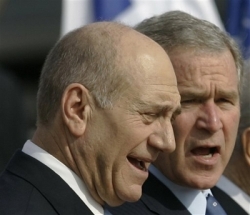
bush-olmert.jpgIn terms which appeared to defy earlier sharp criticism by the US Secretary of State, Condoleezza Rice, Mr Olmert made it clear in front of President George Bush that he regarded such expansion as outside the “moratorium” he has promised on new settlement building. His declaration came as the US President, on his first visit in office to Israel, used some of his strongest language yet in demanding the dismantling of separate settlement outposts which are illegal even under Israeli law. Mr Bush said at a joint news conference last night: “We have been talking about it for four years – illegal outposts. They ought to go.”

Mr Olmert did not demur from that and repeatedly emphasised that Israel was very serious about advancing a negotiating process over the coming year. Mr Bush said the resumption of formal negotiations between Mr Olmert and the Palestinian President, Mahmoud Abbas, presented a historic moment, a historic opportunity. [complete article]

Gaffe overshadows Bush visit

“You’ll be happy to know, my whole motorcade of a mere 45 cars was able to make it through without being stopped,” Bush said after being asked about the 30-minute journey from Jerusalem and Ramallah.

“I’m not so exactly sure that’s what happens to the average person.”

Bush was forced to travel by car to meet Mahmoud Abbas, the Palestinian president, in the West Bank after his helicopter was grounded by bad weather.

The journey took him through an Israeli security checkpoint and within sight of the separation barrier.

Bush said that he could understand why Palestinians were “frustrated” by the checkpoints, but they were necessary to “create a sense of security for Israel”. [complete article]

Editor’s Comment — If Americans had to live under the same kind of stranglehold as do Palestinians in the West Bank, there would be more than 800,000 roadblocks across this country. To speak of “frustration” wouldn’t even hint at the level of anger ordinary people would feel at this extraordinary curtailment of freedom.

For Bush to joke about not getting stopped at an Israeli checkpoint shows a staggering degree of insensitivity — though it will hardly surprise or shock the average Palestinian.

Ramallah demo brands Bush ‘war criminal’

Angry demonstrators in the West Bank town of Ramallah branded US President George W. Bush a “war criminal” on Thursday as locals said he would do nothing for the plight of the Palestinians.

Security forces, out in force to ensure the security of the American leader on his first trip to the occupied Palestinian territory, used batons and tear gas as they charged around 200 demonstrators who were chanting “Bush, war criminal!” and “Bush out!”.

While their leader Mahmud Abbas gave Bush a red carpet welcome on the second day of his Middle East tour, ordinary Palestinians were dismisssive. [complete article]

Bush predicts Mideast peace treaty before he leaves White House

President Bush today predicted that a Mideast peace treaty would be completed by the time he leaves office, but undercut that optimism with harsh criticism of Hamas militants who control part of the land that could form an eventual independent Palestine.

Bush said he’s convinced that both Israeli and Palestinian leaders understand “the importance of democratic states living side by side” in peace, and noted that he has a one-year deadline for progress on his watch. He named Lt. Gen. William Fraser III, assistant to the Chairman of the Joint Chiefs of Staff, to monitor steps that both sides are making on the peace process, a U.S. official told The Associated Press. [complete article]

See also, From Palestinians, harsh view of Bush (NYT).

Facebooktwittermail

NEWS, ANALYSIS, OPINION & EDITOR’S COMMENT: Bush’s trip notes

Bush’s last throw against Iran

The leitmotif of Bush’s high-profile tour of the Middle East is unmistakably Iran. But Washington’s Iran policy lies in tatters and it has no choice but to ratchet up anti-Iran rhetoric, though it realizes there are no takers in the Middle East for such rhetoric of fire and brimstone. The danger now is that Tehran may choose to hunker down and prefer to deal with the next US administration.

Tehran once heeded back-channel pleas from Ronald Reagan’s campaign managers not to negotiate the hostage crisis with the Carter administration in its final months in the White House so that Reagan could claim the credit for the denouement. Bush is certainly better placed than Carter insofar as presidential hopefuls such as Barack Obama and Mike Huckabee would never do such a Reaganite thing on him.

Actually, the danger to the Bush legacy comes from faraway places. Continued delay in constructively engaging Iran will only open the gateway wider for the international community to encroach into a region that until four years ago used to be the exclusive strategic preserve of the US. China is already wading deep into the region, and Russia too. The S-300 missiles from Russia are a sign that US dominance of the Middle East is in serious jeopardy. [complete article]

See also, Bush calls Iran ‘threat to world peace’ (CNN).

Israeli leaders greet Bush with warning for Iran

President Bush began an eight-day Middle East peace mission Wednesday as Israeli leaders warned him and the world not to forget about the regional threat that Iran poses.

Standing on the airport tarmac with Bush looking on shortly after his arrival, Israeli President Shimon Peres relegated peace talks with the Palestinians to secondary status and issued a warning to Iran.

“We take your advice not to underestimate the Iranian threat,” Peres said.

“Iran should not underestimate our resolve for self-defense.” [complete article]

Talking to Iran?

Shortly before Christmas, over dinner in his palace, one of the ruling sheiks of the United Arab Emirates told this reporter he had not been at all surprised by the release of the National Intelligence Estimate that said Iran had suspended its nuclear weapons program back in 2003.

“We were warned by Rafsanjani to expect a very big, very surprising announcement out of Washington,” the sheik said. “He knew it was coming.”

Akbar Hashemi Rafsanjani, former president of Iran and chairman of the country’s Assembly of Experts, also chairs the special council that mediates between the ayatollahs and the Parliament whenever there is a dispute. Derisively nicknamed “Akbar Shah” by his enemies, he is also the head of what is widely reckoned to be Iran’s richest family. Born into a prosperous family of pistachio farmers, he is the link between the ayatollahs, politics and the business community.

Seen as something of a moderate by Iranian standards, Rafsanjani is believed in the Gulf states to have long maintained his own back channels to Washington — hence his supposed advance knowledge of the NIE. [complete article]

Editor’s Comment — As an indication of the importance of President Bush’s trip to the Middle East, his press secretary, Dana Perino, is blogging the trip — though being too diffident to use the actual term “blog”, the White House is modestly calling her record, Trip Notes. Since she’s only two days into this bold new communications venture, I should perhaps refrain from passing judgment, but I was hoping to be able to find at least one — just one — memorable line. The best I could find was this: “As we descended into Tel Aviv, many of us looked out the window to see a country that some of us have only seen in pictures.” Perino was one of the many, but was she also one of the some? I guess divulging whether she’s been to Israel before or how many of her trip mates are on a return trip would be way too personal.

In light of the focus of the current trip, Perino might want embellish her “notes” a bit and see if she can make them at least as interesting as Mahmoud Ahmadinejad’s blog. Here’s a recent entry of his:

To read or to write, that is the question!‎ 2007/11/18
In the Name of Almighty God-the All-Knowing, the Most Lovingly ‎Compassionate

Since my last post on the blog, a few months have passed. But this doesn’t ‎mean that I have not been keeping my promise of spending fifteen minutes per week ‎on it. As a matter of fact, I have spent more than the allocated time on the blog. The ‎magnitude of the reception and acclamation from the viewers was beyond ‎expectations. So I had to decide how to spend the limited time that I have allocated ‎for the blog; should I write new notes or respect those viewers who kindly and ‎generously have shared their thoughts and opinions with me and sent messages and read ‎their numerous received messages. ‎

‎***‎

As you know, the purpose of running this blog is to have a direct and mutual ‎contact and communication with the viewers and even though I have received many ‎messages from the viewers to update the blog and write new notes, I preferred to write ‎less and spend more time on reading the viewers’ messages – and not let this ‎communication tool become just a one-way medium.‎

‎***‎

I personally have read those messages that are considered to be short. I even ‎have read those messages that have started with a sentence like “I know that the ‎president is not going to read this message, but….” ‎

Also some of my trusted students have shortened the long messages for me ‎and have prepared a statistical report regarding all of the messages which I have read ‎and studied those too. God willing, a portion of the overall analysis of the messages ‎and its interesting results will be posted on the blog in the future.‎

‎***‎

I am apologetic to those who have been waiting for my new posts, but ‎fortunately overall, the analysis of the messages has got to a point that I can start ‎writing here again. ‎

I would like to use this opportunity and ask those of you who intend to send ‎me messages through blog, to make it as brief as you can. Thank you.
Written by Mahmoud Ahmadinejad at 23:24

Now if the White House really wants to push the envelope and follow Ahmadinejad’s lead, the Trip Notes from the Middle East should include at least one entry from the president and also be open to comments. On Ahmadinejad’s blog, comments are not as strictly moderated as one might expect, such as the comment from one “John Jacobs” from the United States: “I hate you. you are retarted. that simple mentally retarted.” The remarks of an irate pastry chef?

Facebooktwittermail

NEWS, ANALYSIS & OPINION: Bush heads to Middle East

Remember him? Bush begins Middle East tour

Voters in the United States may have switched their attention to the contest to find his successor, but George Bush will embark on an ambitious nine-day tour of the Middle East tomorrow in a last desperate effort to salvage a legacy from two terms in office overshadowed by a catastrophic foreign policy that has earned him the distinction of being one of the worst presidents in the country’s history.

The Bush legacy will not be peace in the Middle East nor an end to conflict in Iraq, but it could be a political earthquake among voters so dismayed by the mess he has made of America’s foreign policy and fearful of economic recession that they are deserting his party in droves.

As he prepares to board a plane for Israel and wrap himself in the tattered flag of victory in Iraq, Mr Bush’s real legacy to the American people is evident in the disillusionment on display in New Hampshire. [complete article]

See also, Army of 8,000 to protect George Bush visit (Telegraph).

Israel’s false friends

Once again, as the presidential campaign season gets underway, the leading candidates are going to enormous lengths to demonstrate their devotion to the state of Israel and their steadfast commitment to its “special relationship” with the United States.

Each of the main contenders emphatically favors giving Israel extraordinary material and diplomatic support — continuing the more than $3 billion in foreign aid each year to a country whose per capita income is now 29th in the world. They also believe that this aid should be given unconditionally. None of them criticizes Israel’s conduct, even when its actions threaten U.S. interests, are at odds with American values or even when they are harmful to Israel itself. In short, the candidates believe that the U.S. should support Israel no matter what it does. [complete article]

A hostile president

George Bush is coming to Israel this week. He will take pleasure in his visit. One can assume that there are few prime ministers with a giant photo of themselves with the U.S. president hanging on the wall in their home, as our Ehud Olmert boasted last week that he does, to his exalted guest, the comic Eli Yatzpan. There are also few other countries where the lame duck from Washington would not be greeted with mass demonstrations; instead, Israel is making great efforts to welcome him graciously. The man who has wreaked such ruin upon the world, upon his country, and upon us is such a welcome guest only in Israel. [complete article]

Israel warns of Iranian missile peril for Europe

Iran is developing nuclear missiles capable of reaching beyond its enemies in the Middle East to Europe, President George Bush will be warned when he visits Israel and the Palestinian territories for the first time since entering the White House. [complete article]

Israel to brief George Bush on options for Iran strike

Israeli intelligence is understood to agree that the [nuclear weapon] project was halted around the time of America’s invasion of Iraq, but has “rock solid” information that it has since started up again.

While security officials are reluctant to reveal all their intelligence, fearing that leaks could jeopardise the element of surprise in any future attack, they are expected to present the president with fresh details of Iran’s enrichment of uranium – which could be used for civil or military purposes – and the development of missiles that could carry nuclear warheads. [complete article]

Israel not honoring pledge, Olmert says

Israel has failed to keep its pledge to stop enlarging Jewish settlements in the West Bank, Prime Minister Ehud Olmert acknowledged in an interview published Friday, addressing a criticism he expects to hear next week from President Bush.

“Every year all the settlements in all the territories [of the West Bank] continue to grow,” Olmert told the Jerusalem Post. “There is a certain contradiction in this between what we’re actually seeing and what we ourselves promised. . . . We have obligations related to settlements and we will honor them.” [complete article]

Nudged by Bush, Israel talks of removing illegal outposts

Pressed by President Bush to keep promises to destroy illegal settler outposts, Israeli leaders said Friday that they hoped to take action after his visit to the region next week.

The awkward exchange through the news media exemplified the importance of Israel’s relationship to the United States and the way in which Washington can sometimes push it to take controversial steps that benefit the Palestinians, who have little diplomatic weight of their own. [complete article]

Hamas confirms: Swiss probed possibility of talks with Israel

The “Swiss Document”, as it was dubbed Tuesday by Former Palestinian Foreign Minister and top Hamas official, Mahmoud al-Zahar, in fact exists. This refers to a deceleration of intent, drafted by Swiss officials, paving the way for negotiations between Israel and Hamas.

Palestinian President Mahmoud Abbas (Abu Mazen) confirmed the existence of the “Swiss Document” Monday, and stated that the Swiss had mediated direct negotiations between Israel and Hamas. In his comments Tuesday, however, al-Zahar noted that there were no direct talks between Israel and Hamas. [complete article]

Just going to work, Palestinians and Israelis travel different roads

Before they set out for work each morning, neighbors Naim Darwish, a Palestinian Muslim, and Jacob Steinmetz, an Israeli Jew, begin their days in quiet meditation.

In the pre-dawn chill, Darwish sets his Muslim prayer rug on the floor facing Mecca. In the soft morning light, Steinmetz throws on his prayer shawl and turns toward Jerusalem. Then the lives of these West Bank neighbors diverge.

It takes Steinmetz about half an hour to drive and hitchhike the 20 miles to the West Bank office where he works as an Israeli government attorney. If he’s lucky, it takes Darwish two-and-a-half hours to travel the 30 miles to his computer engineering job at a Palestinian high-tech company in Ramallah. [complete article]

Facebooktwittermail