Category Archives: Two-State Solution

Two-State Solution: The Broadway Musical

Two-State Solution: The Broadway Musical

Remember a mere five months ago when Hillary Clinton, with all the toughness she had displayed during her primary campaign, said bluntly: “[Obama] wants to see a stop to settlements — not some settlements, not outposts, not ‘natural growth’ exceptions”?

The whole administration — presumably with expert coaching by Rahm Emanuel — was sending a strong message to Israel: We know your games and we’re not going to take any crap.

Freezing settlements — this was the litmus test for Benjamin Netanyahu to demonstrate his ability to engage in the so-called peace process.

Within a few weeks the administration’s Iran policy was in disarray — in the aftermath of the disputed presidential election — and terrified of the charge that he was being tough on Israel while soft on Iran, Obama’s resolve withered. Netanyahu bounced back and he has been riding high ever since.

Back in June, Netanyahu was admonished for not doing his homework. Now he’s thrown it in the trash and gets praise for offering “restraint on the policy of settlements” — even as Israel demolishes Palestinian homes in East Jerusalem and Palestinian citizens of Israel protest against the ethnic cleansing of Jerusalem.

Meanwhile, as Netanyahu mocks the idea that Washington has the capacity or will to apply pressure on an Israeli government, J Street, “the political arm of the pro-Israel, pro-peace movement,” after launching itself onto the stage of mainstream American politics through its first national conference last week, must somehow strive to keep the two-state-solution dream alive.

The two-state solution is indeed the stuff of dreams — at least the dreams of Zionists who find the idea of equality between Jews and non-Jews abhorrent, or as J Street’s Jeremy Ben-Ami puts it, “a nightmare for the Jewish people.”

Perhaps Washington is not the best place for dream believers. Maybe it’s time for a glitzy Two-State Solution on Broadway.

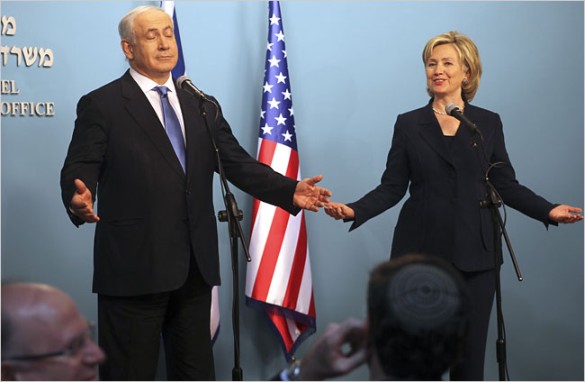
Oh look!

Bibi and Hillary are already auditioning.

J Street: Do we really need another Jewish-only road?

If you’re Palestinian, you know about checkpoints. There are over 600 checkpoints in the West Bank alone. They block, obstruct, frustrate and kill. Women die in childbirth at checkpoints, students are kept from attending school, parents from visiting their children, laborers from going to work. No one can swim in the sea. Israeli Jews are waved through checkpoints. They can swim in the sea. No problem. Jews travel freely on a complex system of Jewish-only roads and live on the Jewish side of the Separation Barriers along hundreds of miles of walls and fortified fences that keep Palestinians out. Palestinians live in an open air prison. Sometimes there is a moment of spring and the guards open the gates. But spring never lasts long. Blockades, nightly incursions, full-scale invasions, imprisonment, collective punishment, land theft, water theft, denial of education, health care, an economic future, frequent beatings and no freedom of movement is the daily bread of Palestinians. You can’t travel more than three miles without encountering a check point. Talk about stress.

J Street was a place where Jews talked to Jews about the Israeli-Palestinian conflict. Few Palestinians were present. Apparently they didn’t make it through the checkpoint. The narrative of J Street, like most Jewish narratives about the Israeli-Palestinian conflict, reflects the nature of the conflict as seen through a Jewish lens: Palestinians are physically absent. A Jew who seeks to express her activism in solidarity with Palestinians is in danger of loosing her ‘I love Israel’ card at a mainstream Jewish checkpoint. There were checkpoints at J Street. Some people were allowed in but not officially asked to participate, some were dis-invited, and some were not considered to be part of the conversation in the first place. [continued…]

Editor’s Comment — As Ahmed Moor eloquently puts it:

A purely Jewish focus on a more-than-Jewish problem causes many leftist Jews to take a paternalistic view of Palestinians. Rather than equals whose inalienable rights form the crux of the case against Zionism, the Palestinians are the clay of Jewish humanism, waiting to be fully actualized by thoughtful and reflective Jewish hands.

Facebooktwittermail

Palestinian equal rights joins the progressive agenda on ‘The Daily Show’

Palestinian equal rights joins the progressive agenda on ‘The Daily Show’

The Daily Show With Jon Stewart Mon – Thurs 11p / 10c
Exclusive – Anna Baltzer & Mustafa Barghouti Extended Interview Pt. 1
www.thedailyshow.com
Daily Show
Full Episodes
Political Humor Health Care Crisis
The Daily Show With Jon Stewart Mon – Thurs 11p / 10c
Exclusive – Anna Baltzer & Mustafa Barghouti Extended Interview Pt. 2
www.thedailyshow.com
Daily Show
Full Episodes
Political Humor Health Care Crisis

Throughout the day I had been hearing on the grapevine that The Daily Show was having second thoughts about doing the show as they had been getting pressure to cancel it. [continued…]

Editor’s Comment — During a week in which J Street — an organization that is attempting to break AIPAC’s stranglehold on the issue of US-Israeli relations — held its first national conference in Washington DC, it’s interesting that Jon Stewart took the opportunity to turn to the issue of the Israeli-Palestinian conflict not by inviting J Street’s Jeremy Ben-Ami onto the show but instead, as Adam Horowitz notes, “a Palestinian leader demanding equal rights and an anti-Zionist Jew calling for boycott, divestment and sanctions to pressure Israel towards peace.”

One of the disappointing features of the way the interview got edited for broadcast was that by cutting out much of the applause, the editors took out one of the most significant messages: the Palestinian issue, framed as one of freedom and human rights, resonated well with Jon Stewart’s audience.

While Stewart himself tended to stick to the well-worn tracks that this is a seemingly intractable conflict, that the Palestinians need to stop anti-Semitic incitement, that the Arabs need to do their bit, Barghouti’s constant refrain was that the core issue here is freedom.

That’s a message the J Street and its mainstream two-state-solution supporters really don’t want to see placed at the center of the conversation. They seem to view the conflict not in terms primarily of human rights but in terms of the need to preserve the Jewish state — a state in relation to which Palestinians pose a “demographic threat”. The urgency of implementing a two-state solution is that unless it can be done fast, Palestinians will demand equal rights in a single state — a state in which (thanks to the Greater Israel project that has been in motion for the last 42 years) Jews will be in a minority. That possibility is in the eyes of some, “horrific“.

Squaring the circle and erasing the margins

The mission to move US policy through reforming the Jewish community’s debate over Israel/Palestine has clear political implications. Ben-Ami ended the opening evening by saying the movement J Street is a part of is a “movement rooted in love of Israel,” and while all are welcomed to join J Street in its work, “the heart of this movement has to be in the Jewish community.” From this perspective, it was telling that Gaza was not mentioned once the entire evening (except by Rabbi Andy Bachman who said it was no longer occupied). There was only one panel during the entire conference dedicated to “Palestinian perspectives,” and even the closing panel called “Why Two States? Why Now?” only included speakers to explain Israeli interests and American interests in promoting two states. Two of the most moving parts of the conference for me was hearing Laila El-Haddad, from the Gaza Mom blog, describe life in still occupied Gaza on the unofficial blogger’s panel. She told a story about how her family was almost unable to leave Gaza to visit her in the US and she is totally unable to enter her homeland. Later, Bassim Khoury, the ex-Minister of National Economy for the Palestinian Authority who recently quit in protest to their reaction to the Goldstone report, demonstrated “Israeli apartheid” in Jerusalem through a power point presentation outlining the gross discrepancies in municipal funding between Jews and Palestinians in the city. Both presentation injected an intense dose of reality into a proceeding that seems to be chugging along more on vision and hope.

J Street represents a very important rupture and opportunity in the supposed American Jewish consensus over Israel/Palestine which should be celebrated. Pushing this wedge into the heart of the community could only be a good thing. But, the tenor and message of the J Street conference would seem to indicate that the struggle to end the Israeli-Palestinian conflict can only be lead by Jews, after we conquer our own internal issues to reform our community, and on our agenda. Meanwhile, Palestinians will have to continue to catch the brunt of the Israel everyone loves so much. [continued…]

Elie Wiesel’s shocking stage appearance with mad preacher and anti-Semite John Hagee

On October 25, while an overflow crowd of 1,500 poured into the first convention of the progressive-leaning Israel-oriented lobbying organization J Street, Elie Wiesel addressed a crowd of 6,000 Christian Zionists at Pastor John Hagee’s “Night To Honor Israel.” According to the San Antonio Express News, while Wiesel sat by his side, Hagee trashed President Barack Obama, baselessly accusing him of “being tougher on Israel than on Russia, Iran, China and North Korea.”

Meanwhile, Israeli Ambassador Michael Oren, who appeared at Hagee’s Christians United for Israel summit earlier this year, rejected J Street’s request to speak at their convention, instead dispatching a low-level embassy official to “observe” the event. Oren then accused J Street of “impair[ing] Israel’s interests.”

In blessing Hagee while damning J Street, Wiesel and Oren chose an anti-Semitic group led by a far-right End Times theology preacher over a fledgling progressive organization that bills itself as “pro-Israel, pro-peace.” And both Wiesel and Oren seem to be embroiled in yet another controversy over involvement with the extremist preacher. [continued…]

Facebooktwittermail

Obama pushes timetable for Mideast talks

Obama pushes timetable for Mideast talks

Mr. Obama and his aides have stressed the settlement-freeze issue as the key to developing support among the Arab states. Mr. Netanyahu hasn’t agreed to a complete freeze on building settlements, though he did agree earlier this year to a partial freeze.

The president and other senior U.S. officials focused Tuesday on the urgency of resuming talks. Mr. Obama met the Israeli and the Palestinian leaders on the sidelines of the annual U.N. General Assembly. “Simply put, it is past time to talk about starting negotiations,” Mr. Obama said before a trilateral meeting with Mr. Netanyahu and Palestinian Authority President Mahmoud Abbas at the Waldorf Astoria in New York. “Permanent status negotiations must begin and begin soon.”

Arab diplomats said Washington’s apparent softening on the settlement issue ran the risk of looking like a concession to Mr. Netanyahu. “This could seriously blow back against Abbas if there isn’t quick progress on talks,” said an Arab official closely involved in the peace process. [continued…]

Editor’s Comment — When Obama picked Rahm Emanuel as his chief of staff, there was some reason to hope that Emanuel was going to function as Obama’s enforcer. The president could remain Mr Congeniality while, when the situation required it, Emanuel would be sent out to break knee-caps.

There were hints of this when earlier this summer it was reported that Netanyahu had been told he couldn’t meet Mitchell until he’d finished his “homework” on freezing settlements.

In the end, it turned out that “pressure” from the Obama administration amounts to strong words with no visible force behind them. It comes in the form of sternness — no doubt quite effective when Obama insists to Malia and Natasha that it’s bedtime, but not very impressive when it’s directed at the likes of Benjamin Netanyahu.

Enough with the pressure — it’s time for some threats and then follow through. Obama needs to demonstrate through actions that he means what he says.

And while the Israelis would like to see linkage between the administration’s approach to the Middle East conflict and its engagement with Iran, here’s the contrast: pressure applied on a friend can often be more effective than pressure applied on an adversary. Israel has a lot to lose. It should not be allowed to take its close ties with the United States for granted.

Visit msnbc.com for Breaking News, World News, and News about the Economy

Editor’s Comment — As refreshing as Gavin Polone’s appeal is that the US stop treating Israel as an exception among all states, equally refreshing is Dylan Ratigan’s directness in posing his questions. (Hat tip to Mondoweiss.)

Facebooktwittermail

Israel’s never-ending war

Israel’s never-ending war

As Israel’s Prime Minister, Benjamin Netanyahu, and Palestinian Authority President Mahmoud Abbas, meet at the United Nations today, “both sides have made clear that they’ll essentially be humoring Obama, showing up because the President of the United States expects it of them and not to relaunch long-stalled ‘final status’ peace negotiations, as the administration had hoped,” writes Tony Karon at Time magazine.

The conventional wisdom among most seasoned observers of the conflict is that the status quo is untenable — that at some point both sides will have to arrive at a mutually acceptable way of implementing a two-state solution.

The process that might lead to that point is as murky as ever.

The possibility that receives less consideration is that Israelis, living in a country forged through war — a country that has never really known peace — having become resigned to the apparent necessity of remaining on a perpetual war footing, have now reached a point where war is more than tolerable: it is acceptable.

War is what created Israel, has allowed it to exist and will guarantee its perpetuation. Many Israelis may pay lip-service to the notion that peace is desirable, yet it is their willingness to engage in war that makes them feel safe.

For Ariel Siegelman, an Israeli soldier who fought in Gaza in a special forces unit of the IDF, the key lesson from the 2006 war in Lebanon was this: “We learned that we had been living in an imaginary world and that the most dangerous type of war is the one that you call peace. We learned that we are not in fact in a ‘peace process’ at all. We are at war.”

In the Washington Post just this week, Jackson Diehl pointed out that even as the UN’s damning report on the war on Gaza brought renewed critical attention to the most recent conflict, “Operation Cast Lead, as the three-week operation is known in Israel, is generally regarded by the country’s military and political elite as a success.” (Diehl, with apparent satisfaction, predicted: “As for the Goldstone report [PDF], the heat it briefly produced last week will quickly dissipate”.)

Claiming that the wars in Lebanon and Gaza had for Israel both been qualified successes, Diehl suggested that Israel is far less fearful than are most of its allies about picking a fight with Iran.

… as with Gaza, even a partial and short-term reversal of the Iranian nuclear program may look to Israelis like a reasonable benefit — and the potential blowback overblown.

Americans who do not share Diehl’s neoconservative perspective, don’t need to ask themselves whether they share Israel’s view of itself; they simply need to decide whether the United States has a responsibility (or any legitimate excuse) for sustaining Israel’s war machine.

Without American arms, the Jewish state will not be starved of materiel — there are plenty of non-US arms manufacturers who would happily pick up the new demand.

The only issue is whether we should regard Israel’s wars as ours.

* * *

Israel’s military might and its fighting forces have been celebrated by Israelis and Israel’s supporters through numerous songs and videos. Here are a few:

Facebooktwittermail

The point of no return

The point of no return

Let’s just ask ourselves what would have happened in Israel itself without what is known as the “settlement enterprise.” Where would another half a million women, children, and men live within the 1967 borders? How many new towns, neighborhoods, and communities would have to be built? What kind of infrastructure would have to be built? How many additional roads would we need to pave, instead of the ones paved in the West Bank, some of them for Israelis only? And what would have happened to the population density in central Israel and in western Jerusalem?

The evacuation of 8,000 Jewish settlers from the Gaza Strip and their absorption in Israel cost taxpayers NIS 10 billion. Those interested in turning back time and evacuating Israelis from the areas beyond the 1967 borders would have to invest NIS 600 billion [$160 billion] for that end. An unreal figure.

Without the Palestinians grasping the process, and without most of Israeli citizens giving it some thought, the areas beyond the 1967 borders have become the main absorption area for new Israeli citizens: New immigrants from the former Soviet Union, young Jerusalemites, haredim facing economic distress, etc. The “territories” served as Israel’s territorial backbone, and played this role with great success.

Israel’s Leftist camp believes that it has the upper hand, referring as ultimate proof to Likud Prime Minister Benjamin Netanyau’s declaration in favor of a Palestinian state, albeit with some conditions. Yet the Left is wrong: While it was engaged in the futile “diplomatic process,” the active Rightist camp, with the backing and assistance of all of Israel’s governments with the exception of one, engaged in developing Jewish settlements in the territories.

Half a million Jews beyond the Green Line constitute the point of no return. The talk about a “construction freeze” or “construction suspicion” at certain settlements are a joke and an insurance policy for the leaders – in Israel, in Palestine, and in the world – who know deep in their hearts that the decision had been made.

What we have here is two peoples that cannot be divided: A mixture of Jews and Palestinians that cannot be separated. It’s too late. [continued…]

Editor’s Comment — When Benjamin Netanyahu uttered the phrase, “Palestinian state”, it should have been taken as a signal that the two-state solution was well and truly dead.

Shimon Peres now says Salam Fayyad is a “Palestinian Ben-Gurion”. A Ben-Gurion or a Pétain?

The state Fayyad envisions may indeed provide the means for the effective pacification of the majority of Palestinians. And as a Haaretz commenter put it, the Palestinians may end up being able “to elect their own dog catchers, … issue Palestinian stamps and sing their own anthem and even have an Olympic ping-pong team.” What they will not gain is sovereignty.

As a Jewish 36-year-old mother of five told The National recently when asked whether her Palestinian neighbors had any right to their shared water supply:

“We should take care of the foreigners here, and give them running water and help them survive and live the proper way,” she says firmly, like a schoolmarm. “But we should do this only after they understand we are the rulers of this country. Until they deserve it, they can’t have the best conditions.”

Cap in hand, the Palestinians must ask their masters if they can be given a state — a little patchwork one without any real power.

Maybe they’d be better off simply asking for a vote.

EU sources: Terms set for renewal of Israel-PA talks

Negotiations between Israel and the Palestinians will resume next month on the basis of an understanding that the establishment of a Palestinian state will be officially announced in two years.

Palestinian and European Union sources told Haaretz that talks will initially focus on determining the permanent border between Israel and the West Bank.

Due to the Palestinians’ reservations over establishing a state with temporary borders, as was proposed during the second stage of the road map, this step will probably be defined as “early recognition” of Palestine. [continued…]

Borders first?

The most immediate issue raised by ‘borders first’ is whether it will deal with the Greater Jerusalem border. The issue here is not the Old City, the central focus of so much emotion and identity. It is the large central area of the West Bank, an area far beyond the old municipal boundaries of the city which extends deep into the central West Bank. Israel has developed huge settlements and a massive infrastructure which now almost surrounds East Jerusalem and which all but prevents any meaningful connection between the north and the south, and between the West Bank and East Jerusalem.

Will the negotiated border between the West Bank and Israel deal with the Jerusalem area? If the negotiated borders ratify the Israeli settlements and infrastructure as currently configured and proposed (including the controversial E-1 area), then the supposed Palestinian state would be essentially non-viable. It’s hard to imagine a government led by Netanyahu agreeing to remove existing settlements around the Greater Jerusalem area. But no Palestinian leader is likely to be able to sell a deal which ignores or ratifies the Greater Jerusalem settlement areas to his people, even if pressured to accept. If the negotiated borders ignore or defer the Jerusalem area – an idea I’ve heard in circulation – then the outcome would be meaningless and counter-productive. [continued…]

Dividing war spoils: Israel’s robbery of Palestinian property

While the news headlines were occupied with the freeze or suspension of Jewish settlements in the Occupied Palestinian Territories or with the competition for positions in the sixth Fateh conference in Bethlehem, Israel is putting into effect the most devastating operation since the ethnic cleansing of Palestine in al Nakba of 1948. This new operation aims to eliminate irrevocably Palestinian rights and historical roots in Palestine.

Ironically, Arab and Palestinian leaderships remain oblivious to these cataclysmic developments. In particular, the Palestinian leadership, whose main duty is to defend Palestinian rights, is bogged down with the assignment of internal political posts and fighting what it sees as its primary enemy, Hamas.

The Zionist leadership in Israel felt bold enough to transform the ideological slogan of ‘Jewish Israel’ into a reality on the ground. The Knesset, the Israel Parliament, passed a law on August 3rd, 2009, after its second and third readings, which allowed the sale of “Absentees” Palestinian refugees’ land to Jewish individuals and Jewish institutions exclusively anywhere in the world. Thus, the legal right of the original Palestinian owner to his land would be severed through creating a barrier between the owner and his property. The passing of the new law represents an audacious initiative by the current Israeli government that no previous Israeli government dared contemplate or venture into. [continued…]

Wobbly stools

There no question anymore that the only recipe for healing the Israeli-Palestinian wound is the termination of the occupation and the establishment of peace between the State of Israel and the new State of Palestine beside it. This demands meaningful and intense negotiations, within a fixed time span. That is impossible if at the same time settlements continue to expand. As the Palestinian lawyer Michael Tarasi aptly put it: ‘We are negotiating about the division of a pizza and in the meantime Israel is eating the pizza.’

That’s why Obama has presented the Israeli government with an unequivocal demand: an immediate stop to all building in the settlements, including East Jerusalem. A clear and logical demand. But while pressuring Netanyahu, he himself is exposed to heavy pressure at home over the health insurance system and the Afghan war…

The Americans recognise, of course, that our government is trying to deceive them. If they allow the building of just another 500 houses in the settlement blocks, and the completion of just another 2500 houses whose construction has already begun, and just a few more in East Jerusalem, in practice the building will go on unchecked.

The settlers know perfectly well that their whole enterprise has been based on deceit and trickery, house after house and neighbourhood after neighbourhood, and they are happy to allow Netanyahu to continue with this method. For the time being, they do not cry out, they are not worried, the more so as no large Israeli public movement has yet arisen in support of Obama’s peace efforts. [continued…]

Facebooktwittermail

Dismantling the matrix of control

Dismantling the matrix of control

Many Palestinian, Israeli and international proponents of a just peace took heart in Obama’s early gestures. Beginning with the appointment of former Sen. George Mitchell as special envoy and continuing through the president’s June 4 speech in Cairo, these proponents allowed themselves, after years of disappointment and struggle, a cautious hopefulness. Some of the speech’s formulations, like the nods to the “pain of dislocation” felt by Palestinians and the “daily humiliations” of occupation, had been heard before. But one sentence had not been: Obama said that a two-state solution “is in Israel’s interest, Palestine’s interest, America’s interest and the world’s interest.” Obama seemed to “get it,” that is, he seemed to understand that the US is isolated politically by its unquestioning backing of Israel, which is seen as obstructing a solution to the conflict. And, for the first time, a US president actually said that resolving the Israeli-Palestinian conflict is in the vital national interest, not just a nice thing to do. These words significantly raise the bar. Framing the conflict in this way makes it easier for the administration to win Congressional support for tougher demands upon Israel while undermining the ability of the American Israel Public Affairs Committee (AIPAC) to mount an effective resistance, given American Jewish sensibilities about suspicions of dual loyalty.

Since the Cairo speech, however, fundamental doubts about US efforts have resurfaced. The only demand made by Obama upon Israel has been for a settlement “freeze,” a welcome symbolic gesture, to be sure, yet irrelevant to any peace process. Israel has enough settlement-cities in strategic “blocs” that it could in fact freeze all construction without compromising its control over the West Bank and “greater” Jerusalem, the Arab areas to the north, south and east of the city where Israel has planted its flag. Focusing on this one issue — which, months later, is still being haggled over — has provided Israel with a smokescreen behind which it can actively and freely pursue more significant and urgent construction that, when completed, will truly render the occupation irreversible. It is rushing to complete the separation barrier, which is already being presented as the new border, replacing the “Green Line,” the pre-June 1967 boundary to which Israel is supposed to withdraw, by the terms of UN Security Council resolutions, but on which even the most ardent two-staters have long since given up. Israel is demolishing homes, expelling Palestinian residents and permitting Jewish settlement throughout East Jerusalem, measurably advancing the “judaization” of the city. It is confiscating vast tracts of land in the West Bank and “greater” Jerusalem and pouring bypass road asphalt at a feverish pace so as to permanently redraw the map. It is laying track on Palestinian land for a light-rail line connecting the West Bank settlement-city of Pisgat Ze’ev to Israel. It is drying up the main agricultural areas of the West Bank, forcing thousands of people off their lands, while instituting visa restrictions that either keep visiting Palestinians and internationals out of the country altogether, or limit their movement to the truncated Palestinian enclaves of the West Bank.

“Quiet,” behind-the-scenes diplomacy is surely taking place, but the few details that have emerged are far from reassuring. The State Department has mocked as “fiction” a ten-point document given to the Arab press by Fatah figure Hasan Khreisheh that promises an “international presence” in parts of the West Bank and US backing for a Palestinian state by 2011. The component of this alleged plan that seems more likely is that the US wants a partial freeze on settlement activity from Israel in exchange for a pledge from Washington to push for more stringent sanctions upon Iran for its nuclear research. On August 25, the Guardian quoted “an official close to the negotiations” saying: “The message is: Iran is an existential threat to Israel; settlements are not.” By all indications, if the Obama administration does present a regional peace plan, which it is expected by many to do around the time of the UN General Assembly meeting on September 20, it will be nothing more than a “rough draft.” It is no exaggeration to say a two-state solution will rise or fall on the outlines of this draft — and may perhaps fall forever if no concrete plan is presented at all, which is also possible. Although the two-state solution has been eulogized many times in the past, Obama represents a best-case scenario. If he presents, in the end, a disappointing peace plan that offers no genuine breakthrough, then the shift to a one-state solution on the part of the Palestinian people and their international supporters will be inescapable. [continued…]

Facebooktwittermail

Israeli settlement expansion may bring one-state solution closer

Israeli settlement expansion may bring one-state solution closer

As Israel announced plans to expand settlements in the West Bank in anticipation of a settlement “freeze”, the former US president, Jimmy Carter, who recently returned from a trip to the Holy Land, suggested that the implementation of a two-state solution is becoming increasingly unlikely.

“A more likely alternative to the present debacle is one state, which is obviously the goal of Israeli leaders who insist on colonising the West Bank and East Jerusalem. A majority of the Palestinian leaders with whom we met are seriously considering acceptance of one state, between the Jordan River and the Mediterranean Sea. By renouncing the dream of an independent Palestine, they would become fellow citizens with their Jewish neighbours and then demand equal rights within a democracy. In this nonviolent civil rights struggle, their examples would be Mahatma Gandhi, Martin Luther King Jr and Nelson Mandela.”

Mr Carter belongs to a group of veteran world leaders, known as the Elders, who recently visited Israel and the West Bank. Another member of the group, former Irish president and UN Human Rights Commissioner Mary Robinson told The Jerusalem Post last month that if Israel does not freeze settlement construction, a two-state solution may no longer be possible. [continued…]

Facebooktwittermail

Israel ‘ups settlement activity in east Jerusalem’

Israel ‘ups settlement activity in east Jerusalem’

Israeli settlement activity in annexed east Jerusalem accelerated in the first half of 2009 despite US calls for a freeze, an anti-settlement activist group said on Sunday in a report.

“Recent months have seen the acceleration of the process of Israeli settlement in Palestinian communities in east Jerusalem,” the Israeli Ir Amim group said.

“These settlements… implant (a) Jewish population… precisely in the areas of the most intense dispute in the Palestinian-Israeli conflict,” it said. [continued…]

Facebooktwittermail

Barack Obama on brink of deal for Middle East peace talks – updated

Barack Obama on brink of deal for Middle East peace talks

Barack Obama is close to brokering an Israeli-Palestinian deal that will allow him to announce a resumption of the long-stalled Middle East peace talks before the end of next month, according to US, Israeli, Palestinian and European officials.

Key to bringing Israel on board is a promise by the US to adopt a much tougher line with Iran over its alleged nuclear weapons programme. The US, along with Britain and France, is planning to push the United Nations security council to expand sanctions to include Iran’s oil and gas industry, a move that could cripple its economy.

In return, the Israeli government will be expected to agree to a partial freeze on the construction of settlements in the Middle East. In the words of one official close to the negotiations: “The message is: Iran is an existential threat to Israel; settlements are not.” [continued…]

Editor’s Comment — A US-brokered Israeli-Palestinian deal – in other words, how Obama got shafted by Netanyahu and the Palestinians and Iran’s reformist movement got thrown under the bus, all for what? A little Clinton-era nostalgia in the form of a Rose Garden handshake between Netanyahu and Abbas while Rahm Emanuel gets to re-live the good old nineties?

Updated: Perhaps a hasty judgment on my part.

Laura Rozen writes: “In meetings with news editors in London Monday, Netanyahu seemed to describe Israeli and U.S. positions moving closer together on a settlements deal, policy towards Iran, and other issues, according to sources familiar with the discussion.”

I thus infer that The Guardian, having been honored to be able to sit at Bibi’s feet, thought that they should thereafter try and perform like his parrot.

Why Israel will thwart Obama on settlements

The idea that the Obama administration can advance the Middle East peace process by having Israel freeze its construction of Jewish settlements in the West Bank stretches credulity.

Does any serious observer of the region believe that Israel’s appetite for land – owned and occupied for generations by Palestinians – is going to abate?

The Israeli land grab has continued for four decades, in defiance of international law and most US presidents. US Middle East envoy George Mitchell has been trying to secure a halt, but his efforts follow a well-worn path that typically ends in charade. [continued…]

Palestinians seek state by 2011

Palestinian Prime Minister Salam Fayyad released a government plan Tuesday calling for the establishment of a de facto Palestinian state by the end of 2011 regardless of the outcome of negotiations with Israel.

The plan faces significant practical hurdles and raised worries that Mr. Fayyad was advocating the sort of unilateral actions toward statehood long opposed by the U.S. and Israel. Implementing it would mean overcoming likely Israeli opposition to key elements and Mr. Fayyad’s own weak domestic political standing, and would also require hefty financial-aid commitments from foreign donors, such as the U.S., European Union, and Arab states.

But the plan also reflected an unprecedented Palestinian emphasis on the nuts and bolts of self-rule. It lays out the broad outlines of a state on Palestinian lands occupied by Israel in 1967 with East Jerusalem as its capital, and details each government ministry and its functions. [continued…]

Facebooktwittermail

Israeli officials: New West Bank projects frozen (briefly)

Israeli officials: New West Bank projects frozen

Israel has quietly stopped approving new building projects in the West Bank while publicly still refusing U.S. demands for a formal settlement freeze, officials, peace activists and settlers said Tuesday.

Prime Minister Benjamin Netanyahu’s office denied there was any agreement among senior ministers to freeze new construction. But settlement watchdog Peace Now said no new building had been approved since Netanyahu took office in March.

President Barack Obama’s administration has been prodding Israel to shelve all settlement construction on land Palestinians want for a future state, a demand Israel has said it cannot accept. The issue has grown into a rare public disagreement between the two close allies.

However, several government officials said Tuesday that Israel has decided to temporarily stop green-lighting new projects because of the international pressure.

The move falls short of the U.S. demand because it doesn’t amount to a full freeze — projects approved in the past are still being built, and groups tracking settlements say the pace of construction in the settlements has not slowed. [continued…]

Israel agrees to freeze settlement construction as gesture to US

Despite pressure from right-wing ministers, the housing minister has yet to issue one building tender in the settlements, including in the large settlement blocs, since Netanyahu has taken office. This has been confirmed by Prime Minister Netanyahu’s office. The ministry also did not issue new tenders in the final days of Olmert’s administration. The right-wing and the haredi sector have expressed their disappointment over this quiet policy.

Right-wing ministers claim that this policy has been forced upon Israel and undermines the country’s sovereignty in areas over which there should not be any dispute.

Habayit Hayehudi Chairman Daniel Hershkowitz attacked the settlement freeze policy: “The State of Israel is not a satellite of the US. We have a strategic alliance and close friendly relations with the Americans, but it is a two-way alliance. They need us, too, and we must stand our ground, even more so since the Palestinians show their true face anew each and every time proving that theirs is not a face of peace. As long as this remains the situation in the Middle East, the Americans must halt their pressure on the settlement and not prevent natural growth just as we do not get involved in building in Arizona. The natural growth in Judea and Samaria and the building in the settlement blocs and Jerusalem are a red line that must not be crossed.” [continued…]

U.S. group invests tax-free millions in East Jerusalem land

American Friends of Ateret Cohanim, a nonprofit organization that sends millions of shekels worth of donations to Israel every year for clearly political purposes, such as buying Arab properties in East Jerusalem, is registered in the United States as an organization that funds educational institutes in Israel.

The U.S. tax code enables nonprofits to receive tax-exempt status if they engage in educational, charitable, religious or scientific activity. However, such organizations are forbidden to engage in any political activity. The latter is broadly defined as any action, even the promotion of certain ideas, that could have a political impact.

Financing land purchases in East Jerusalem would, therefore, seem to violate the organization’s tax-exempt status. Continue reading

Facebooktwittermail

If they won’t make peace we may have to make it for them

If they won’t make peace we may have to make it for them

Until now the Obama administration has clung to the basic assumptions of the Oslo process: incremental steps on both sides build the confidence necessary to negotiate a bilateral agreement on final-status issues such as borders, Jerusalem and refugees. Plainly that approach has failed so far, and it’s hard to see it succeeding simply because there is a new cast of actors in the lead roles. The problem may be in the script rather than the casting.

There is no domestic political pressure on Netanyahu to make the territorial compromises necessary for a deal. On the contrary, his once precarious domestic political position has been strengthened by his resistance to the settlement freeze demands, and Israelis are unlikely to accept the conflict that would erupt if their government tried to evict thousands of West Bank settlers under a peace agreement. Nor are the Palestinians inclined to make compromises that the refugees would consider surrender of their rights.

In the absence of domestic pressure on either side to force a compromise, restarting talks would be either a repeat of the Annapolis failure or a demonstration that the gap between the two sides cannot be bridged by mutual consent. Either way, the parameters of a two-state solution will have to be prescribed by the international community, just as they were in 1947 – except this time with enough international clout and domestic support to prevent a repeat of the tragedy that followed the last UN partition of Palestine. [continued…]

Facebooktwittermail