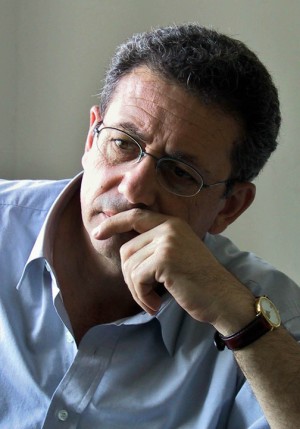
Phil Weiss, who’s in Israel right now, sat down to talk with Jeff Halper, the Minnesota-born founder of the Israeli Committee Against House Demolitions, to hear his thoughts on the conflict.
Halper would be happy living in a democracy with Palestinians. I asked him why so many Israelis don’t feel that way.
“There is a principle inculcated in Israelis and Jews from before 1948, by all politicians, newscasters, teachers, journalists, any official, and that is that the Arabs are our permanent enemies. And that’s it! And if you take that as an unchanging premise, then it doesn’t matter what is being done to Palestinians.They brought it on themselves.
“You can’t trust the Arabs. That makes everything else a non-issue… Yitzhak Shamir said, ‘The Jews are still the Jews, the Arabs are still the Arabs, and the sea is still the sea.’ Which means, it’s just the way it is, it’s nature. Arabs are what they are, and we are what we are, and nothing’s going to change that….”
But are Israelis even aware of the tapestry of suffering that is the occupation, and what this does to Palestinian lives?
“Israelis don’t care. Because they’re living the good life. Polls show that peace is the 8th issue in priority for Israelis. It’s like that cover ot Time magazine, Israel doesn’t want peace. I’ve been saying that for years…. And the Israeli government thinks it’s sustainable, they think they can keep this going for another 40 years. They have no idea that we’re living on borrowed time.
“And Israel is not going to cooperate and is not going to negotiate in good faith. Because of the Congress. The only way to go to some kind of peace is by exerting pressure on Israel, which the U.S. could do easily, but the president can’t do. And Israel feels completely protected. The U.S. can’t do anything to Israel, and it won’t let anyone else do anything to Israel. We start building settlements, and it’s, ‘So what?’”
I said that the status quo will bring on violence. Halper said he doubts it.
“It’s too sewn up. Israel is too much in control. Israeli soldiers are every ten feet in the West Bank… Israel is knocking off Palestinian leaders all the time.” And the natural source of Palestinian leadership is all in Israeli jails, 12,000 Palestinians– “I use the term warehousing”– and Palestinian society is rife with collaborators, from the Palestinian Authority on down.
Where’s the hope?
“I don’t use the word hope, I use the word struggle. There’s a struggle going on…”
The good news is that now it’s globalized: the United States is becoming more and more isolated on this issue.
“I don’t think Americans appreciate how isolated they are internationally. This is now a global conflict, and so you have the irresistible force meeting the immovable object. The irresistible force is– the EU can make things hard on Israel economically, and the whole Muslim world can be up in arms, and you have BDS, Turkey, isolating Israel, and the international community saying that this is too costly to accept forever. But then the immovable object is the U.S. Congress.”
One-state solution? Two-state solution? Isn’t it time for a democratic state solution?
In response to an article in Haaretz on proposals for a one-state solution coming from the Israeli right, Uri Avnery warns that the “attractive leftist vision of the one-state solution may grow up into a rightist monster.”
The regime described here is not an apartheid state, but something much worse: a Jewish state in which the Jewish majority will decide if at all, and when, to confer citizenship on some of the Arabs. The words that come up again and again – “perhaps within a generation” – are by nature very imprecise, and not by accident.
But most important: there is a thunderous silence about the mother of all questions: what will happen when the Palestinians become the majority in the One State? That is not a question of “if”, but of “when”: there is not the slightest doubt that this will happen, not “within a generation”, but long before.
This thunderous silence speaks for itself. People who do not know Israel may believe that the rightists are ready to accept such a situation. Only a very naive person can expect a repetition of what happened in South Africa, when the whites (a small minority) handed power over to the blacks (the large majority) without bloodshed.
We said above that it is impossible to “turn the triangle into a circle”. But the truth is that there is one way: ethnic cleansing. The Jewish state can fill all the space between the sea and the Jordan and still be democratic – if there are no Palestinians there.
Ethnic cleansing can be carried out dramatically (as in this country in 1948 and in Kosovo in 1998) or in a quiet and systematic way, by dozens of sophisticated methods, as is happening now in East Jerusalem. But there cannot be the slightest doubt that this is the final stage of the one-state vision of the rightists.
Let’s grant Avnery all his assumptions about the real intentions of these one-state rightists, and let’s on that basis say that their disingenuous vision underlines the necessity for a swiftly implemented two-state solution.
And let’s go one step further and anticipate that a contiguous, viable, sovereign Palestinian state is created and operates peacefully alongside the neighboring Jewish state of Israel.
Israel still has a problem. It has a sizable and growing Palestinian minority. Unless Avnery and other two-state proponents imagine that the vast majority of Palestinian Israelis would decide to move to a newly-created Palestinian state, Israel will still have to address the problem of reconciling its Jewish and democratic identities.
If Israel fails to address that issue, then neither one state nor two states presents a solution. The issue in either context remains: is a Jewish population willing to place a higher value on democracy than it does on Jewish rule?
Who are the enemies of peace in the Middle East? No list can be comprehensive, but a shortlist should include a few individuals who present themselves as messengers of peace: Barack Obama, George Mitchell, J Street’s Jeremy Ben-Ami, Tony Blair…
In a word, the proponents of the two-state solution have become the enemies of peace.
A young Israeli leader says:
The assumption of the left is that once it hides behind the international border, everything will be permitted. But it’s clear already now that not everything is permitted and that the principle of proportionality is shackling Israel in Gaza — so what will happen in Judea and Samaria [the West Bank]? In fact, it goes even deeper. There is a moral failure here. After all, the left has long since stopped talking about peace and is resorting to a terminology of separation and segregation. They are also convinced that the confrontation will continue even afterward. The result is a solution that perpetuates the conflict and turns us from occupiers into perpetrators of massacres, to put it bluntly. It’s the left that made us a crueler nation and also put our security at risk.
This is Tzipi Hotovely from Likud, the youngest member of the Knesset and a proponent of some radical rethinking on the Israeli-Palestinian conflict. “The taboo that forbids talk about any option other than the two-state solution is almost anti-democratic. It’s like brain-gagging,” says Hotovely.
The one-state solution generally associated with the Israeli right and the settler movement does not usually go by that name. Eretz Yisrael, or Greater Israel, comes in various sizes but to its proponents it is seen as land on which Jews belong and to which Palestinians can be allowed to make no claim. But as Noam Sheizaf describes in this week’s Haaretz magazine cover story, a new trend is emerging on the right presenting a one-state solution that would offer Palestinians equal rights and full citizenship in an expanded Israeli state that includes the whole of the West Bank.
A number of figures on the right are presenting their own versions of this vision and so far they have not formed a political camp, yet many of their observations are based on a political realism that cannot be found among liberal Zionists. Indeed, they expose the fact that the advocates of a two-state solution are not merely victims of wishful thinking; they now bear the primary responsibility for the perpetuation of the conflict.
A one-state solution promoted by diehard Zionists might sound too toxic an idea for any Palestinian to entertain seriously, yet who can currently question the assertion that the prospects for the creation of a sovereign Palestinian state have never looked so bleak?
Perhaps more to the point, it needs to be remembered that the creation of a Palestinian state is and always has been a false promise if regarded as an ultimate goal and not simply a means to an end.
The goal of every legitimate political struggle is the creation of a fair society. Each struggle focuses on the most glaring forms of injustice — discrimination based on class, ethnicity, gender, sexual orientation, nationality, or faith. But as these struggles coalesce around the specific forms of inequality they seek to redress, they often lose sight of their overarching purpose by allowing political means to be turned into political goals. Rather than diluting the power of political elites, one elite ends up making way for another. The fact that a new elite might have closer ties to a wider population will allow it to operate in a more sympathetic context, but sooner or later the core political problem will reemerge: that any majority cannot indefinitely tolerate being governed by a minority whose primary loyalty is to its own narrow interests.
The one-state rightwing Zionists — at least as they are presented in this Haaretz article — are unequivocal in asserting that they refuse to abandon the requirement that Israel remains a Jewish state. What they fail to explain is how in practice Jews and non-Jews would have equal rights if, for instance, Jews retained the privilege enshrined in the Law of Return.
Moshe Arens says: “first of all, we need to take care of the Israeli Arabs who are citizens. That is also essential if we are thinking of giving citizenship to Palestinians from Judea and Samaria [the West Bank]. Only if they see that the Arabs have it good in Israel will they think it might be good for them, too.”
OK. But this begs the question: why is it that 62 years after its creation, Israel has not bridged the gap between its nature as a Jewish state and its claim to be a democratic state? Does its failure to take care of its non-Jewish citizens not expose the inherent contradiction in trying to merge the state’s Jewish and democratic identities?
A single state as envisioned by figures on the Israeli right may be more viable than the two-state solution, but eventually it will have to shed the shackles to which Zionism has always been bound: the idea that there can ever be any legitimacy to any form of ethnic or religious supremacy.
As liberal Zionists and their allies repeatedly — if unpersuasively — proclaim that the implementation of a two-state solution is now a matter of urgency, the explicit urgency is that this is the only way of ensuring that Israel will thwart the “demographic threat” of Jews becoming a minority in the country they insist they must run. At the same time, the creation of a Palestinian state is presented as the means to fulfill the national aspirations of the Palestinian people.
What never gets stated in this narrative is that the two-state solution would be the ultimate concession for Palestinians as it cements the loss of a land which was once their own.
Against the background of Barack Obama’s attempt to defend the idea of “two states for two peoples” in Israel/Palestine, consider a recent talk given by the Palestinian Sufian Abu-Zayda. Abu-Zayda is fifty years old. He was born in the Jabalya refugee camp in northern Gaza, the largest of the Palestinian camps, and he is considered the Palestinian spokesman most fluent in Hebrew, which he learned during the fourteen years that he spent in an Israeli prison on charges of participating in terrorist activities. After his release in 1993, he was one of the senior Fatah leaders in Gaza and was appointed to various positions in the Palestinian government. Among other activities he has been active in the Israeli-Palestinian Geneva Initiative, in which moderates from both sides argue that it is possible to find a just two-state solution.
It was quite surprising, therefore, that Abu-Zayda, in his talk to an Israeli audience, announced that he had changed his mind. Like other Palestinians who spoke to the Israeli media over the last months, he was responding to Prime Minister Benjamin Netanyahu’s speech at Bar Ilan University—itself a response of sorts to President Obama’s June 2009 speech at the University of Cairo. With some drama, Netanyahu had agreed that a Palestinian state should be established in territory of the Land of Israel to the west of the Jordan River. This was a significant change for Netanyahu, whose roots are in the nationalist movement that has given up its earlier slogan—“There are two banks to the Jordan, this one is ours, and so is that one”—but that still demands Israeli rule in the “Greater” Land of Israel west of the Jordan. Commentators talked of a “fissure” on the Israeli Right; it was widely believed that as long as Ben Zion Netanyahu is still alive, his son wouldn’t dare rebel against the nationalist traditions of the family.
But what might have seemed unbelievable a short time ago has become a reality. Netanyahu, at the head of the nationalist, right-wing government with members like Benny Begin (son of Menachem Begin) who have consistently rejected all concessions, has accepted the idea of a Palestinian state.
In his talk at Tel Aviv University, Abu-Zayda responded to what the prime minister had said: “Many thanks to Benjamin Netanyahu. After twenty years of the peace process [since the Madrid Conference in 1991], and after the mutual recognition of Israel and the PLO [in the Oslo Accords], he finally agrees to a Palestinian state.” There was irony in his voice as he continued, “Do you think you are doing us a favor when you agree to two states? No favor at all. From my side, from the Palestinians’ side—let there be one state, not two…. I was introduced to you as Sufian Abu-Zayda from the Jabalya camp, but I’m not from Jabalya. I might have been born there, but my family had been exiled in 1948 from a village named “Breer,” where Kibbutz Bror Hayill now stands, near the Gaza border. If there will be one state, I’ll be happy to rent or buy a house near the kibbutz and live there.” And then Abu-Zayda said in a loud voice, “You are doing yourselves a favor by establishing two states, not us.”
In a bloggingheads.tv interview, Robert Wright speaks to Bassam Nasser, who works for the Catholic Relief Services in Gaza. Though Wright’s questions tend to be somewhat uninformed and predictable, Nasser’s responses provide a much richer and more nuanced view of life under siege and Israeli occupation than can be gleaned for standard news reports.
As anyone who has spent time in the Occupied Territories knows, it is already an incipient apartheid state with separate laws, separate roads, and separate housing for Israelis and Palestinians, who are essentially confined to impoverished enclaves that they can leave and enter only with great difficulty.
Israelis and their American supporters invariably bristle at the comparison to white rule in South Africa, but that is their future if they create a Greater Israel while denying full political rights to an Arab population that will soon outnumber the Jewish population in the entirety of the land. Indeed, two former Israeli prime ministers have made this very point. Ehud Olmert, who was Netanyahu’s predecessor, said in late November 2007 that if “the two-state solution collapses,” Israel will “face a South-African-style struggle.” He went so far as to argue that, “as soon as that happens, the state of Israel is finished.” Former Prime Minister Ehud Barak, who is now Israel’s defense minister, said in early February of this year that, “As long as in this territory west of the Jordan River there is only one political entity called Israel it is going to be either non-Jewish, or non-democratic. If this bloc of millions of Palestinians cannot vote, that will be an apartheid state.”
Other Israelis, as well as Jimmy Carter and Bishop Desmond Tutu, have warned that if Israel does not pull out of the Occupied Territories it will become an apartheid state like white-ruled South Africa. But if I am right, the occupation is not going to end and there will not be a two-state solution. That means Israel will complete its transformation into a full-blown apartheid state over the next decade.
In the long run, however, Israel will not be able to maintain itself as an apartheid state. Like racist South Africa, it will eventually evolve into a democratic bi-national state whose politics will be dominated by the more numerous Palestinians. Of course, this means that Israel faces a bleak future as a Jewish state. Let me explain why.
For starters, the discrimination and repression that is the essence of apartheid will be increasingly visible to people all around the world. Israel and its supporters have been able to do a good job of keeping the mainstream media in the United States from telling the truth about what Israel is doing to the Palestinians in the Occupied Territories. But the Internet is a game changer. It not only makes it easy for the opponents of apartheid to get the real story out to the world, but it also allows Americans to learn the story that the New York Times and the Washington Post have been hiding from them. Over time, this situation may even force these two media institutions to cover the story more accurately themselves.
The growing visibility of this issue is not just a function of the Internet. It is also due to the fact that the plight of the Palestinians matters greatly to people all across the Arab and Islamic world, and they constantly raise the issue with Westerners. It also matters very much to the influential human rights community, which is naturally going to be critical of Israel’s harsh treatment of the Palestinians. It is not surprising that hardline Israelis and their American supporters are now waging a vicious smear campaign against those human rights organizations that criticize Israel.
The main problem that Israel’s defenders face, however, is that it is impossible to defend apartheid, because it is antithetical to core Western values. How does one make a moral case for apartheid, especially in the United States, where democracy is venerated and segregation and racism are routinely condemned? It is hard to imagine the United States having a special relationship with an apartheid state. Indeed, it is hard to imagine the United States having much sympathy for one.
Palestinian Authority Prime Minister Salam Fayyad has staked his political credibility on securing a Palestinian state by 2011 in the entire West Bank, Gaza and East Jerusalem, a program enthusiastically embraced by the international community. Ambitious PA plans include roads and other infrastructure across the West Bank, with funds provided by the United States, Europe and other donors.
Fayyad has argued that development will make the reality of a Palestinian state impossible to ignore. However, many of the new roads facilitate Israeli settlement expansion and pave the way for the seizure of main West Bank highways for exclusive Israeli use.
For decades Israel has carried out its own infrastructure projects in the occupied West Bank and East Jerusalem. These include a segregated road network that, together with the separation wall Israel began building in 2002, divides Palestinian areas from each other while bringing the settlements–all of which are illegal under international law–closer to Israel.
Now, armed with information from United Nations sources and their own research, Palestinian nongovernmental organizations are raising the alarm. Their evidence spotlights the extent to which PA road-building is facilitating the Israeli goal of annexing vast areas of the West Bank–making a viable Palestinian state impossible.
Yousef Munayyer says it’s time for the Palestinians to give the Israelis an ultimatum: the Palestinian Authority should set a date for the Israeli occupation to end and settlements be dismantled. “If this deadline is not met, the PA should dissolve the authority and convert the disjointed national movement into a broad civil rights movement seeking equal rights in a bi-national state.”
Munayyer writes:
Among those involved in the Middle East peace process industry there is much talk about “time running out” for a two-state solution.
Recently, the same sentiments were echoed by the US state department, reflecting a shift in the way the Obama administration is publicly talking about the conflict.
On more than one occasion, the state department and other Obama administration figures have said that “the status quo is unsustainable”. Notice again the element of time.
Time has been running out for a two-state solution since the beginning of Israel’s colonial enterprise in occupied Palestinian territory in 1967. Yet despite this reality, analyses of the situation continue to repeat this now-meaningless cliche year after year, decade after decade. It seems that, to many, time in the Middle East can be magically be suspended. Gravity, in this war-torn region, ceases to affect the inverted hourglass.
The idea that time is running out presupposes some actual threshold beyond which time will actually have run out – a midnight hour when the Cinderella-style fantasy of a two-state solution wakes up to the embarrassing reality of facts on the ground.
However, we never hear analysts specify where the threshold lies – at what point Israeli actions of settlement construction and expansion are considered to have finally tipped it over the edge. Without this, the two-state solution becomes the consummate zombie, very much alive in the policy discussion despite being long dead in reality.
A growing number of Palestinians support the establishment of a single state for Jews and Arabs including Israel and the occupied territories, according to a poll released on Wednesday.
The survey by the Jerusalem Media and Communication Centre (JMCC) found that support for a bi-national state in which Israelis and Palestinians would have equal rights had grown to 33.8 percent from 20.6 percent in June 2009.
During the same period, support for a negotiated two-state solution dropped from 55.2 percent to 43.9 percent, while 32.1 percent of respondents said the “peace process is dead” in response to a separate question.
Most Palestinians, 43.7 percent, support peaceful negotiations, while 29.8 percent support armed struggle and 21.9 percent support peaceful resistance as the best strategy for ending the Israeli occupation, the poll found.
Dmitry Reider reviews sociologist Yehouda Shenhav’s book The Time of the Green Line.
That the notion of a one-state solution may be gaining some traction among diverse Israeli groups will be disturbing news for two-state solution dead-enders like J Street, though in this particular instance, Shenhav’s own vision may itself not garner wide appeal: a single state that looks like… Lebanon?
Still, as Reider notes, Shenhav’s book is “a conversation starter; it asks many more questions than it gives answers.” This is indeed a conversation worth engaging.
Rather than pinning his hopes for an equitable solution on the Israeli left, Shenhav actually looks to a coalition of Palestinians, non-Zionist leftists, and, most surprisingly, a few dissident settlers for a solution to the dispute. Unlike the Israeli left — bogged down in nostalgia for a mythically pure pre-1967 Israel — he argues that an increasing number of settlers are more in sync with the Palestinian timeline of 1948 and are opting to share sovereignty rather than give up their homes. Moreover, some appear to be more aware than “mainland” Israelis of the realities of occupation; Shenhav quotes a settler journal slamming the checkpoints and curfews, as well as a prominent settler educator saying that the military regime’s ongoing wrongs are “like Sabra and Shatila multiplied by a million,” in reference to the infamous 1982 massacre of Palestinians in the Lebanese refugee camps, perpetrated by a Christian militia allied with Israel. Shenhav also quotes poet Eliaz Cohen, resident of Gush Etzion, as saying: “Just as I have a right of return to Kfar Etzion, there’s no reason that Palestinians from Nablus shouldn’t have a right of return to Jaffa.”
Shenhav claims that the transition to one-state thinking will redraw the Israeli political map, currently defined by the right’s and the left’s positions toward Israel’s future role in the Palestinian territories. Although it’s far too early to speak of a movement, both left and right have begun realigning themselves: Leftists are beginning to use the racist jargon of demographics, while a new settler group calls for a one-state solution — with the right of return to boot. Quite apart from them, firebrand Likud Knesset member Tzipi Hotovely calls for the phased admission of West Bank Palestinians as Israeli citizens.
Curiously for a decidedly left-wing manifesto, Shenhav rejects out of hand the “one man, one vote,” “state of all its citizens” model as an alternative to a two-state solution.
This model, he says, “presumes the existence of a homogenous population motivated by individual interests and ignores the fact that most people in the contested space are religious nationalists with tremendous differences within both the Israeli and Palestinian communities.” He opts instead for a consociational democracy: a system in which religious, cultural, national, and economic considerations will be balanced by mutual agreement, within a power-sharing government.
When Israel defines itself as a “Jewish State,” it not only sees itself as the state of Jews worldwide. It also sees Arab identity in this homeland as a threat to that definition. That’s why the state sees discrimination against Arabs as part of its “job description.” — Hassan Jabareen, Founder and General Director of Adalah, The Legal Center for Arab Minority Rights in Israel.
One of the most insidious deceptions embedded in the concept of a two-state solution is the implication that once a peaceful Palestinian state comes into existence alongside a secure Israel, then the Jewish state will finally have established its international legitimacy. Israel will no longer be a state that disregards the political rights and aspirations of the Palestinian population. It will be vindicated in its claim to be a Jewish democracy.
The deception in that picture is that it glosses over the fact that even if against all expectations a Palestinian state was established in two years, those Palestinians who are also Israeli citizens and who make up a quarter of Israel’s population would remain as they are today: second class citizens. Indeed, in the event that a Palestinian state is created, it seems quite likely that the Palestinian citizens of Israel would come under pressure to leave Israel for the Jews and to move to “their own state”. In such an event, the two-state solution far from being the panacea that it is portrayed to be could well be the forerunner of another catastrophe.
If Israeli Jews cannot embrace the idea that non-Jews deserve equal rights, then there is no formula — two-state or otherwise — that will lead to a just resolution of the Middle East conflict.
A drive east of the Green Line suggests the two-state solution is moot. Jewish-only roads slice through the hills. The separation barrier winds through the West Bank, choking Palestinian villages. Settlements are lodged in the land’s throat.
Dr. Neve Gordon, author of the book Israel’s Occupation comments, “The one-state solution is already on the ground, in the sense that close to half a million Israeli Jews currently live in the area occupied by the [Israeli] army. They’re enmeshed within the Palestinian population.”
While the body of one state is here, the spirit isn’t. The current system, according to Dr. Gordon, is a democracy for Jews and an apartheid regime for Palestinians–different from that of South Africa, but functioning in a similar way.
“The question is whether there can be a separation,” Dr. Gordon says, pointing to the argument made by former Deputy Mayor of Jerusalem, Meron Benvenisti, who called the West Bank an egg that can’t be unscrambled.
And even if Israel could undo some of the mess, the proverbial finger Netanyahu recently gave the Americans suggests that the government has another agenda.
“I think what’s clear is that there is no intention on the part of the Israeli government to support a two-state solution,” Dr. Gordon says. “The borders, the airspace, all remain under Israeli control. What Netanyahu means when he says two states is not a state–it’s a municipality [for Palestinians] to collect their own garbage… What Netanyahu is supporting is a deepening of [settlements and the occupation] while talking about two states.”
To continue to advocate for a two-state solution, Dr. Gordon explains, is to support Netanyahu and his map for an unacknowledged, de facto single state that oppresses Palestinian residents.
Palestinian support for a two-state solution to the conflict with Israel is declining, a joint Palestinian-Israeli study has found.
The latest public opinion survey conducted by the Palestinian Center for Policy and Survey Research and the Harry S. Truman Research Institute for the Advancement of Peace at the Hebrew University of Jerusalem found that the while the majority of Palestinians and Israelis support a two-state solution to the conflict, Palestinian support for such a resolution has declined in recent months.
“The results show a decline in the Palestinians support for the two-state solution,” Waleed Ladadweh, a researcher with the Palestinian Center for Policy and Survey Research told The Media Line. “From 64 percent in December 2009 to 57 percent in this poll.”
Dr Nabil Kukali, Director of the Palestinian Center for Public Opinion, agreed that Palestinian public opinion is trending towards a bi-national state.
“On the whole Palestinians support the peace process, but there are some changes in attitudes towards the two-state solution,” he told The Media Line. “The Palestinians feel hopeless and they don’t think the Israelis will give the Palestinians one meter of their land.”
Isn’t it time that the “two-state solution” be regarded as an object of the imagination no more real than the Tibetan kingdom of Shambala?
At the heart of this Middle Eastern fable is another Shangri-La: Jerusalem, capital of the Jewish state and a Palestinian state.
In reality, Jews in an unremitting march of expansion are taking over the whole city, making sure that East Jerusalem will never become a Palestinian capital.
Some 50,000 new housing units in Jerusalem neighborhoods beyond the Green Line are in various stages of planning and approval, planning officials told Haaretz. They said Jerusalem’s construction plans for the next few years, even decades, are expected to focus on East Jerusalem.
Most of the housing units will be built in predominantly Jewish neighborhoods beyond the Green Line, while a smaller number of them will be built in Arab neighborhoods. The plans for some 20,000 of the apartments are already in advanced stages of approval and implementation, while plans for the remainder have yet to be submitted to the planning committees.
When the Netanyahu government resisted pressure from the Obama administration to impose a settlement freeze, it also made it clear that it regards Jerusalem as indivisible and outside the scope of any agreement on settlements.
Three and a half months in, the settlement freeze is turning out to be more of a slowing down. With all the exceptions being made, its effect is limited and it appears to be mainly a demonstration of Israel’s willingness to offer concessions to expedite the renewal of negotiations. The total disappearance of the settlers’ protests against the freeze, which they originally described as a disaster, testifies to the actual state of things.
Meanwhile, Jewish extremists occupying Palestinian homes in Sheikh Jarrah in East Jerusalem have gained attention most recently as they sing the praise of the settler and mass murderer Baruch Goldstein:
.
Andrew Sullivan sees “massive Israeli demonstrations” as a sign that the Goldstein supporters are a small minority. Their behavior certainly makes them an easy target for criticism but in a way they seem to serve more as a distraction than to highlight the problem.
The plans to expand the Jewish population in East Jerusalem are unlikely to mean that the putative Palestinian capital will be populated with Goldstein supporters. On the contrary, most of these Israelis are likely to move into East Jerusalem for economic rather than ideological reasons, confident that the neighborhoods in which they live will remain under the authority of the Israeli government.
Even if the majority of Israelis actually thought that the creation of a Palestinian state would be a positive development, all the evidence suggests that most Israelis simply don’t believe that such a state is ever going to exist. Israel has invested too deeply in its claim to Palestinian territory to ever let go. Indeed, the perpetuation of the two-state myth has actually served to make a two-state solution impossible.
The impasse in the peace process is not a failure to implement a two-state solution; it is a failure to confront the realities which must be grappled with once such a proposition is abandoned.
Palestinian Legislative Council speaker Aziz Dweik on Thursday denied reports by Israeli news outlets that he said on Wednesday Israel has a right to exist.
“The media reports in question were inaccurate,” he said in a statement, adding that since his release from an Israeli prison last year, Israeli news outlets have repeatedly misrepresented his views.
The Jerusalem Post, an English-language Israeli newspaper, quoted Dweik as saying on Wednesday that the Islamic movement has accepted Israel’s right to exist and would be prepared to nullify its charter, which calls for dismantling the state.
The remarks were said to have been made during a meeting in Hebron with British millionaire David Martin Abrahams, who reportedly maintains close ties with senior Israeli and British government officials.
Dweik told Ma’an, however, that he offered no such recognition of Israel’s “right to exist on Palestinian land,” as was reported, and moreover, that he told Abrahams the PLO had made a mistake by nullifying its charter.
“The PLO canceled its charter, and Palestinians achieved nothing,” he said. “This is Hamas’ stance and the opinion of any Hamas leader regarding the nullification of [its] charter.”
Dweik said the talks was held at Abrahams’ request, and came within a series of meetings with the PLC’s leadership with international officials, delegations and other news outlets. There was nothing unusual about Abrahams’ visit, he said. [continued…]
Hamas has accepted Israel’s right to exist and would be prepared to nullify its charter, which calls for the destruction of Israel, Aziz Dwaik, Hamas’s most senior representative in the West Bank, said on Wednesday.
Dwaik’s remarks are seen in the context of Hamas’s attempts to win recognition from the international community.
Dwaik is the elected speaker of the Palestinian Legislative Council. He was released a few months ago after spending nearly three years in an Israeli prison.
Dwaik was among dozens of Hamas officials and members who were rounded up by Israel following the abduction of IDF soldier St.-Sgt. Gilad Schalit near the Gaza Strip in June 2006.
His latest remarks were made during a meeting he held in Hebron with British millionaire David Martin Abrahams, who maintains close ties with senior Israeli and British government officials.
Abrahams is scheduled to brief British Foreign Secretary David Milliband this weekend on the outcome of his meeting with Dwaik and other top Hamas officials in the West Bank.
Abrahams, a major donor to Britain’s Labor Party, told The Jerusalem Post he would urge Milliband to “consider the implications of Hamas’s positive overtures.” [continued…]
Speaking to reporters last night Israel’s Prime Minister Benjamin Netanyahu hammered away on one of his favorite points: the Palestinian precondition, no peace talks without a comprehensive freeze on West Bank settlement construction. “Let’s stop piling preconditions.” Said the Prime Minister, “Let’s get on with it. Let’s get on with peace negotiations.”
During the same speech, Netanyahu also insisted that East Jerusalem, which Palestinians want for a Capitol of their future state, is not up for negotiation and will remain part of Israel at the end of a peace deal. He demanded that Israel maintain a presence “on the Eastern side of a Palestinian state” to keep militants from using the territory to launch rockets at Israel ’s heartland. The Prime Minister was not clear if that simply meant a military presence on the Jordanian border or if Israel would keep the Jordan valley. Either way, it would leave the future Palestinian state as an Island with no control of its border. [continued…]
The Palestinians on Thursday rejected the idea of an Israeli presence on the eastern border of their future state, which was mooted by Israel’s hawkish prime minister.
“The Palestinian leadership will not accept the presence of a single Israeli soldier in the Palestinian territories after the end of the occupation,” Nabil Abu Rudeina, a spokesman for president Mahmud Abbas, told AFP. [continued…]
The underground tunnels between Egypt and Gaza are a lifeline for those trapped inside the blockaded Strip, but along with the clothes, furniture and food that make their way through the tunnels, a dangerous drug – Tramadol – is also entering the territory. Tramal, as it is known in Gaza, is a dangerously addictive painkiller which is illegal without a prescription, but an increasing number of Gazans are becoming hooked on it. Uncomfortably Numb talks to some of those addicts, those who are trying to help them and the authorities seeking to crack down on drug abuse.
Turkey and Israel are at loggerheads again, and this should come as no surprise.
Israeli Deputy Foreign Minister Danny Ayalon recently staged a rebuke of the Turkish ambassador in Tel Aviv over the contents of a Turkish television show. Israel subsequently apologized, but this will go down as yet another milestone in the ongoing tension between Turkey and Israel.
Despite some Israeli and American efforts to paint Turkey’s objections to Israeli policies as “anti-Semitic,” people in the business of statecraft understand very well where Turkey is coming from.
They recognize that disagreements between Turkey and Israel are likely to continue provided there is no recognizable change in issues such as improving the humanitarian situation in Gaza. They also recognize the complete and immediate freezing of settlements and the overall posture of Israel toward the peace process – if one can still talk about such a process. [continued…]
The American editor of a Palestinian news agency was removed from Israel on Wednesday after being questioned by authorities about his “anti-Israeli” views…
“They judged me to have anti-Israeli politics,” Malsin, 24, said from a cellphone as he boarded the El Al plane. “It’s outrageous that would even appear in a legal argument, that a person’s politics would be a relevant issue.”
An official with the Israeli Interior Ministry said Malsin had refused to answer questions about his presence in Israel and had “exploited” the fact that he is Jewish to say he wanted to explore immigrating to Israel.
“He was asked, why would he want to make aliya and become an Israeli citizen, as his opinions are clearly anti-Israeli,” Interior Ministry official Mietal Rochman wrote in an account of Malsin’s interrogation at the airport, which included a check of numbers stored in his cellphone and a review of his writings on the Internet. “The passenger chose to remain silent.” Malsin’s attorney provided a copy of Rochman’s report. [continued…]
For the pacifist Palestinian Sari Nusseibeh, Israel will soon have no choice but to integrate its Arab population. Sari Nusseibeh, Dean of al-Quds University in Jerusalem and committed Palestinian intellectual, was the author in 2002 of a peace plan co-written with Ami Ayalon, former head of Shin Bet, the Israeli security service.
LE FIGARO – Doesn’t the issue of Jerusalem, which resurfaced in 2009, complicate the resumption of negotiations between Israelis and Palestinians?
SARI NUSSEIBEH – Everyone kept putting off the issue of Jerusalem. Suddenly they rediscovered that it is undoubtedly the main problem. And also that the parameters of this problem are no longer the same. While the negotiators were working in their bubble towards a peaceful solution, the city was fundamentally changing: the 1967 state of affairs no longer exists today, and sharing it has become much more difficult.
What are these changes?
Geographically, the area of Jerusalem and its suburbs has grown from 20 sq km to 50 sq km: in the eastern part of this Greater Jerusalem, the Israelis have built 13 new neighborhoods, where 250 000 Jews now live, linked together by freeways. They encircle the Arab areas of East Jerusalem and separate them from one another. The Israelis have also invented the concept of the “holy basin”, which includes the Muslim Quarter of the Old City and the surrounding areas, which form the core of Arab Jerusalem. They are carrying out an active policy of expulsions, destruction and expropriation, making an eventual partition of Jerusalem much more difficult.
And yet the two-state solution is supported by the whole world?
In 1967, one of the first advocates of the two-state solution was Uri Avnery (historic figure on the Israeli pacifist left). He had no support at that time. Four decades later, his ideas have been immensely successful, as they are shared today by the entire world, even Bush. But in the meantime, the possibility of creating two states has faded away. Even if I do not rule out the possibility of a miracle, I do not personally believe anymore that the prospect is achievable. [continued…]
(H/t to Mondoweiss)
Israel’s relentless drive to establish “facts on the ground” in the occupied West Bank, a drive that continues in violation of even the limited settlement freeze to which Prime Minister Benjamin Netanyahu committed himself, seems finally to have succeeded in locking in the irreversibility of its colonial project. As a result of that “achievement,” one that successive Israeli governments have long sought in order to preclude the possibility of a two-state solution, Israel has crossed the threshold from “the only democracy in the Middle East” to the only apartheid regime in the Western world. [continued…]
The last decade has seen all the right’s leaders — from Ariel Sharon and Ehud Olmert to, finally, Netanyahu — accept the left’s idea of a Palestinian state. They did so not because they suddenly abandoned the desire to hold on to the entirety of the Greater Land of Israel, nor because they realized how unjust the occupation is. The only reason leaders from the right are today willing to consider withdrawal from Hebron and even from East Jerusalem is that one argument made by the Zionist left did strike a chord with them: that a Palestinian state is the only way to keep a clear Jewish majority in Israel.
By raising the flag of “the demographic battle,” the Jewish left was able to win the debate over the West Bank and Gaza. But it did so in a way that betrayed the same values the left has always claimed to represent — humanism, equal rights and brotherhood. That’s also where the left’s political fate was sealed. When the left abandoned the hope for true partnership with the Palestinians — on both sides of the Green Line — and became almost solely defined by its focus on demography and ethnic separation, it opened the door for Lieberman and his vision of an exclusionary Jewish state.
In fact, all Lieberman did was to propose taking the left’s platform one step further: If we are to separate from the Palestinians in the name of demography, why not redraw the borders so that Israel’s Arab citizens are placed in the Palestinian state as well? Livni and Netanyahu haven’t gone this far yet, but basically they offer the public the same deal: In return for the withdrawal from the West Bank, they pledge to preserve a clear Jewish majority within the state’s borders, the implicit message being that this is an opportunity to make Israel more Jewish.
This conception naturally comes at the expense of the state’s non-Jewish minorities; it makes it clear that Israel is not their country. This has helped set the stage for the current surge of anti-Arab legislation and government measures — from the effort to ban commemorations of the Palestinian Nakba to the order to replace Arab place names on road signs. (In this xenophobic political atmosphere, it is not surprising that even providing refuge to the survivors of the genocide in Darfur became a controversial issue.)
To all this, the left could have responded by opening its ranks to Arabs and creating new coalitions with the non-Zionist parties and grassroots organizations such as those that marched in Tel Aviv. No other political coalition has the power to preserve Israel as a home not just for Jews, but for all the people living in the country. Instead, the left’s leaders and thinkers chose to engage in a contest of ethnic patriotism with the right — one that they have no hope of winning. [continued…]
I have lived my entire adult life under occupation, with Israelis holding ultimate control over my movement and daily life.
When young Israeli police officers force me to sit on the cold ground and soldiers beat me during a peaceful protest, I smolder. No human being should be compelled to sit on the ground while exercising rights taken for granted throughout the West.
It is with deepening concern that I recognize the Obama administration is not yet capable of standing up to Israel and the pro-Israel lobby. Our dream of freedom is being crushed under the weight of immovable and constantly expanding Israeli settlements.
Days ago, the State Department spokesman, Ian Kelly, managed only to term such illegal building “dismaying.” The Israeli foreign minister, Avigdor Lieberman, stands up and walks out on the U.S. envoy, George Mitchell, every time the American envoy mentions East Jerusalem.
And Javier Solana, just prior to completing his stint as European Union foreign policy chief, claimed Palestinian moves toward statehood “have to be done with time, with calm, in an appropriate moment.” He adds: “I don’t think today is the moment to talk about that.”
When, precisely, is a good time for Palestinian freedom? I call on Mr. Solana’s replacement, Catherine Ashton, to take concrete actions to press for Palestinian freedom rather than postpone it.
If Israel insists on hewing to antiquated notions of determining the date of another people’s freedom then it is incumbent on Palestinians to organize ourselves and highlight the moral repugnance of such an outlook.
Through decades of occupation and dispossession, 90 percent of the Palestinian struggle has been nonviolent, with the vast majority of Palestinians supporting this method of struggle. Today, growing numbers of Palestinians are participating in organized nonviolent resistance.
In the face of European and American inaction, it is crucial that we continue to revive our culture of collective activism by vigorously and nonviolently resisting Israel’s domination over us. [continued…]
Opposition MK Shaul Mofaz is planning to meet with senior Hamas officials, the Channel 10 website reported late Monday.
On Sunday, Mofaz presented his peace plan, which calls for the establishment within a year of a Palestinian state with provisional boundaries on 60 percent of the West Bank. He urged dialogue with Hamas as a means of achieving peace with the Palestinians.
Mofaz portrayed his proposal as a challenge not only to Prime Minister Benjamin Netanyahu but also to his own party’s leader, Tzipi Livni.
The plan sparked severe criticism, both from the Palestinians as well as within Israel. In response, Mofaz said Monday that “I will talk to the devil himself if that’s what will bring peace,” Israel Radio reported.
In recent years, Mofaz has vehemently rejected any contact with the Islamist Hamas, who violently seized control over the Gaza Strip in a bloody coup in 2007. In a complete turnaround, Mofaz told Israel Radio Monday that if Hamas is voted to power in the upcoming elections – scheduled for January – he is willing to negotiate with them. [continued…]
Something is stirring within the Hamas body politic, a moderating trend that, if nourished and engaged, could transform Palestinian politics and the Arab-Israeli peace process. There are unmistakable signs that the religiously based radical movement has subtly changed its uncompromising posture on Israel.
For example, in the last few months top Hamas officials have publicly stressed that they want to be part of the solution of the Palestinian-Israeli conflict, not part of the problem. What is happening inside Hamas’ mosques and social base shows a concerted effort on the part of its leadership to re-educate its rank and file about co-existence with the Jewish state and in so doing mentally prepare them for a permanent settlement in the future.
In Gazan mosques, pro-Hamas clerics have begun to cite the example of Salah al-Din al-Ayubi, a famed Muslim military commander and statesman, who, after liberating Jerusalem from the Western Crusaders, allowed them to retain a coastal state of their own. The moral lesson of the story is that if the famed leader could tolerate the warring, bloodthirsty Crusaders, then today’s Palestinians should be willing to live peacefully with a Jewish state in their midst. [continued…]
The possible collapse of the Palestinian Authority, Israel’s negotiating partner, loomed Monday, as several aides to its president, Mahmoud Abbas, said that he intended to resign and forecast that others would follow.
“I think he is realizing that he came all this way with the peace process in order to create a Palestinian state, but he sees no state coming,” Saeb Erekat, the chief Palestinian peace negotiator, said in an interview. “So he really doesn’t think there is a need to be president or to have an Authority. This is not about who is going to replace him. This is about our leaving our posts. You think anybody will stay after he leaves?”
Mr. Abbas warned last week that he would not participate in Palestinian elections he called for, to take place in January. But he has threatened several times before to resign, and many viewed this latest step as a ploy by a Hamlet-like leader upset over Israeli and American policy. Many also noted that the vote might not actually be held, given the Palestinian political fracture and the unwillingness of Hamas, which controls Gaza, to participate.
In the days since, however, his colleagues have come to believe that he is not bluffing. If that is the case, they say, the Palestinian Authority could be endangered. [continued…]
More than 40 years of Israeli military occupation have had a devastating impact on Palestinians in Gaza. Air strikes, artillery shelling, ground invasions, jet flybys and other acts of violence have all led to an epidemic of suffering among Gaza’s most vulnerable inhabitants. The most recent studies indicate that the vast majority of Gaza’s children exhibit symptoms of post-traumatic stress disorder (PTSD).
Soon after the Israeli winter assault, a group of scholars at the University of Washington discussed different aspects of the situation in Gaza and the Occupied Palestinian Territories (OPT). Dr. Evan Kanter, a UW School of Medicine professor and the current president of Physicians for Social Responsibility, delivered a somber talk describing the mental health situation among Gaza’s population. The numbers he cited described a staggering level of psychological trauma.
Dr. Kanter described studies that revealed 62 percent of Gaza’s inhabitants reported having a family member injured or killed, 67 percent saw injured or dead strangers and 83 percent had witnessed shootings. [continued…]
In the 20th anniversary of the fall of the Berlin Wall, Western leaders are full of self-congratulation. But their paeans to universal freedom ring hollow, when they bear large responsibility for another wall constricting human freedom: the apartheid wall dividing the Palestinian West Bank.
Israeli authorities refer to it as a “separation barrier,” but that’s misleading. The wall doesn’t separate pre-1967 Israel from the West Bank. If that’s all it did, it would be an entirely different political object. Instead, the wall cuts deep into the Palestinian West Bank, separating Palestinians from each other and from their land, and signaling to the Palestinians that Israel intends to annex territory that Palestinians want for an independent Palestinian state. The fact that Western countries that support the Israeli government – above all the United States – say nothing about the West Bank wall signals to Palestinians that Western support for Palestinian statehood is merely rhetorical.
Today, AFP reports, Palestinians tore down a chunk of the wall near Ramallah. [continued…]
The announcement by Palestinian President Mahmoud Abbas that he will not run for reelection is the exclamation point on the utter collapse of the Obama adminstration’s Middle East policy. Launched to great expectations — the appointment of George Mitchell, Obama’s Cairo declaration that the plight of the Palestinians is intolerable — it is now in complete disarray. It is, without doubt, the first major defeat for Obama’s hope-and-change foreign policy.
Here’s how it unraveled. First, Obama began a test of strength with Israel over that country’s policy of illegal settlements, an expansion of its occupation of the West Bank driven by extremist, right-wing settlers who are fanatical, Bible-believing cultists who think that Israel has some God-given right to that territory. The settler-kooks — indeed, one of their past leaders was named Rabbi Kook — are supported by ultra-hardliners in Israel’s security establishment, who see the West Bank as strategic depth in Israel’s defense posture. What happened after Obama told Israel it had to stop settlements? Nothing. Score: Netanyahu 1, Obama 0. [continued…]
Editor’s Comment — In his somewhat hagiographic report on Clinton’s tour of the region, Joe Klein suggests that the Secretary of State’s “recklessness” in Jerusalem might coincide with her emergence as a single strong voice on foreign policy as the administration’s diplomatic efforts are increasingly in disarray.
“In the course of the trip, there were the first stray wisps of a hint that Clinton wanted to begin asserting her independence, as the Administration, facing roadblocks across the world, struggled for a firmer foreign policy tone after an opening nine months that might be called the Rodney King — ‘Can’t we all just get along?’ — phase,” Klein wrote.
Another way of putting this might be to say that in an administration that lacks leadership, there are likely to be an increasing number of freelancers as a power vacuum creates openings for political opportunists. The current trend is heading from bad to worse.
“It’s time for you to find another donkey.” With those words, according to Palestinian sources, Palestinian Authority (PA) President Mahmoud Abbas told the Palestine Liberation Organziation (PLO) executive committee that he would not seek re-election in January. The 74-year-old leader, on whom U.S. peace efforts in the Middle East are heavily dependent, reiterated that message later on Thursday in a televised address from his home in Ramallah. “This decision does not at all amount to bargaining or political maneuvering. While I appreciate the views expressed by brothers [in the PLO, who rejected his move], I hope they will understand my wish.”
The prime audience for Abbas’ statement, of course, was not the PLO leadership but the Obama Administration. According to Palestinian sources who attended the meeting, Abbas told his PLO comrades that the U.S. had “cheated” him by retreating from its insistence that Israel end settlement construction in the West Bank and East Jerusalem. “We welcomed it, and were optimistic when President Obama announced the need for a complete halt to settlements, including natural growth,” Abbas said. “We were surprised by his support for the Israeli position.” [continued…]
This website or its third-party tools use cookies, which are necessary to its functioning. By closing this banner, you agree to the use of cookies.

Halper would be happy living in a democracy with Palestinians. I asked him why so many Israelis don’t feel that way.




 This is Tzipi Hotovely from Likud, the youngest member of the Knesset and a proponent of some radical rethinking on the Israeli-Palestinian conflict. “The taboo that forbids talk about any option other than the two-state solution is almost anti-democratic. It’s like brain-gagging,” says Hotovely.


 have lived my entire adult life under occupation, with Israelis holding ultimate control over my movement and daily life.
 pposition MK Shaul Mofaz is planning to meet with senior Hamas officials, the Channel 10 website reported late Monday.