Category Archives: Issues

In northern Syria, outside powers have exploited Arab-Kurdish tensions to consolidate counter-revolutionary interests

Michael Karadjis writes: A week after the United States rushed to defend its Kurdish allies, the People’s Protection Units (YPG), against the Assad regime in Hassakeh, Washington supported the intervention of the Kurds’ Turkish nemesis to expel IS from the border town of Jarabulus.

These events suggest the outlines of a regional understanding over a reactionary solution in northern Syria.

It follows the recent diplomatic back-flips by Turkey’s Erdogan government – including Ankara’s reconciliation with Russia and Israel (who themselves have formed a very close alliance over the past year), the further strengthening of relations with Iran (which have remained strong despite Tehran’s backing of Assad), and the declaration by Prime Minister Yildirim that Turkey was no longer opposed to a role for Assad in a “transitional” government consisting of elements drawn from both the regime and opposition.

The YPG – connected to the Democratic Union Party (PYD) – has had a long-term, pragmatic non-aggression pact with Assad, sometimes leading to minor conflict, while at other times collaborating more closely – including during the recent siege of rebel-held Aleppo.

However, Hassakeh was the first time Assad launched his airforce against the YPG, possibly in response to Turkey’s feelers. An official from Turkey’s ruling Justice and Development Party (AKP) recently noted that Assad “does not support Kurdish autonomy… we’re backing the same policy”. Despite YPG pragmatism, Assad has forcefully rejected Kurdish autonomy, while the rise in the Kurdish struggle in Iran suggests recent Turkish-Iranian meetings are likely anti-Kurdish in content.

Both Russia and the US have been key backers of the YPG. Russian airstrikes helped the Afrin YPG in February seize Arab-majority towns from the rebels in northern Aleppo, including Tal Rifaat. But Putin’s reconciliation with Erdogan suggests that Russia has dropped the YPG. [Continue reading…]


Facebooktwittermail

U.S. decision to lift an arms embargo has empowered Bahrain to intensify its political repressions

Nabeel Rajab writes: I write this from a Bahraini jail cell where I have been detained, largely in isolation, since the beginning of summer. This is not new to me: I have been here before, from 2012 to 2014, in 2015, and now again, all because of my work as a human rights defender.

Nor am I alone: There are some 4,000 political prisoners in Bahrain, which has the highest prison population per capita in the Middle East. This is a country that has subjected its people to imprisonment, torture and even death for daring to desire democracy. My close colleague Abdulhadi al-Khawaja was tortured and sentenced to life in prison in 2011 for his human rights work.

No one has been properly held to account for systematic abuses that have affected thousands. In 2015, I was arrested on new charges of “insulting a statutory body” and “spreading rumors during a time of war” for posts on Twitter. The police held me from April to July last year. I was released only after the king of Bahrain issued a pardon in an earlier case, also related to views I had expressed.

Despite the pardon, the 2015 charges and a travel ban remained in place, and I was threatened with further action. The head of the cybercrimes unit at the Criminal Investigation Directorate in Bahrain summoned me and my family to a meeting, where — in front of my children — he warned me that if I didn’t stop my advocacy work, I would face up to 15 years in prison. [Continue reading…]

Facebooktwittermail

German anti-immigrant party beats Merkel in her home district

The New York Times reports: Voters in Chancellor Angela Merkel’s political home state delivered her a stinging rebuke on Sunday, propelling a far-right party to second place in the state legislature, ahead of her center-right bloc.

It is the first time in an election in modern Germany that a far-right party has overtaken Ms. Merkel’s bloc of Christian Democrats and their Bavarian sister party, the Christian Social Union.

Official results released early Monday showed that Ms. Merkel’s Christian Democrats had received 19 percent of the vote, against 21 percent for the far-right Alternative for Germany. The center-left Social Democrats, with whom Ms. Merkel governs nationally, got 31 percent in the state, Mecklenburg-Vorpommern, and are likely to continue their coalition there with Ms. Merkel’s bloc.

The vote took place a year to the day after Ms. Merkel agreed with Austria that the two countries would admit thousands of mostly Syrian refugees then trapped in Hungary, with several hundred desperately marching on foot toward the West.

Although Mecklenburg-Vorpommern has only 1.3 million eligible voters in a country of 81 million people, Sunday’s elections were seen as an indicator of Ms. Merkel’s political strength and as the real start of the campaign for national elections, due by fall of next year. [Continue reading…]

Facebooktwittermail

Muslim gathering laments a ‘normalization of bigotry’

The New York Times reports: An imam of a mosque in New York City and his associate shot dead while strolling following afternoon prayers. A presidential candidate calling for Muslims to be barred from entering the United States. Muslim women harassed and physically attacked in Chicago while walking to their car.

During the Islamic Society of North America convention that started here on Friday, official speakers said these actions had become all too commonplace in the United States.

“In this political climate, we’ve seen a normalization of bigotry,” said Altaf Husain, an associate professor at Howard University and a vice president of the society, whose convention here is the largest Muslim gathering in the United States and Canada.

But Mr. Husain, expressing what he said was the sentiment of many other American Muslims, said the Obama administration had made it a priority to bolster engagement with Muslims across the country. The latest example of the administration’s engagement came Saturday night when Jeh Johnson, the secretary of Homeland Security, became the first sitting cabinet member to address the Islamic Society’s convention.

Mr. Johnson said his speech was part of a sustained outreach effort that has taken him from the suburbs of Washington to Minneapolis to Los Angeles, where he has met with community leaders and visited mosques, while fielding questions about racial profiling and anti-Muslim speech on the presidential campaign trail.

In his address, Mr. Johnson told the audience that their lives were “the quintessential American story.” [Continue reading…]

Facebooktwittermail

Young blacks voice skepticism on Hillary Clinton, worrying Democrats

The New York Times reports: When a handful of liberal advocacy organizations convened a series of focus groups with young black voters last month, the assessments of Donald J. Trump were predictably unsparing.

But when the participants were asked about Hillary Clinton, their appraisals were just as blunt and nearly as biting.

“What am I supposed to do if I don’t like him and I don’t trust her?” a millennial black woman in Ohio asked. “Choose between being stabbed and being shot? No way!”

“She was part of the whole problem that started sending blacks to jail,” a young black man, also from Ohio, observed about Mrs. Clinton.

“He’s a racist, and she is a liar, so really what’s the difference in choosing both or choosing neither?” another young black woman from Ohio said.

Young African-Americans, like all voters their age, are typically far harder to drive to the polls than middle-aged and older Americans. Yet with just over two months until Election Day, many Democrats are expressing alarm at the lack of enthusiasm, and in some cases outright resistance, some black millennials feel toward Mrs. Clinton. [Continue reading…]

Facebooktwittermail

Where did Donald Trump get his racialized rhetoric? From libertarians

Matthew Sheffield writes: Trump’s style and positions — endorsing and consorting with 9/11 truthers, promoting online racists, using fake statistics — draw on a now-obscure political strategy called “paleolibertarianism,” which was once quite popular among some Republicans, especially former presidential candidate Ron Paul.

Formally, Sen. Rand Paul (R-Ky.) may be his father’s political heir. But there’s no question that the paranoid and semi-racialist mien frequently favored by Trump originates in the fevered swamps that the elder Paul dwelled in for decades. Most people who back Trump don’t do so for racist reasons, but it’s incredible how many of the same white nationalists and conspiracy theorists to whom Ron Paul once catered are now ardent Trump supporters. It’s because Trump and Paul speak the same language.

Mainstream libertarians have been agonizing over this legacy among themselves for some time, hoping that either the elder or younger Paul would definitively denounce the movement’s racialist past, but no such speech has ever come. Instead, the paleolibertarian strategy concocted decades ago as a way to push for minimal government threatens to replace right-wing libertarianism with white nationalism.

The figure whose ideas unify Pauline libertarians and today’s Trumpists is the late Murray Rothbard, an economist who co-founded the Cato Institute and is widely regarded as the creator of libertarianism.

Nowadays, many libertarians like to portray their ideology as one that somehow transcends the left-right divide, but to Rothbard, this was nonsense. Libertarianism, he argued, was nothing more than a restatement of the beliefs of the “Old Right,” which resolutely opposed the New Deal and any sort of foreign intervention in the early 20th century. Many of its adherents, such as essayist H.L. Mencken, espoused racist viewpoints, as well.

As moderate Republicans such as Dwight Eisenhower and “New Right” Christian conservatives such as William F. Buckley became more influential within the Republican Party in the 1950s and ’60s, the future creators of libertarianism gravitated instead toward the work of secular anti-communist thinkers such as economist Ludwig von Mises and novelist Ayn Rand. [Continue reading…]

Facebooktwittermail

Trump’s political police at the gates of America

Timothy Egan writes: Give me your extreme-vetted, your ideologically certified, your elite. Send only the smartest, the best-connected, the richest to our shores. No losers, no freethinkers, and no ugly people, please.

In the hate speech that Donald Trump gave on immigration in Phoenix on Wednesday night, he all but deported the Statue of Liberty, laying out one of the darkest visions of the American experience that any major-party nominee has ever given. Despite the media misread by some who presented the speech as a pivot, it got rave reviews from neo-Nazi and Ku Klux Klan supporters, and prompted some of Trump’s few Latino advisers to resign in protest. “Excellent speech,” said David Duke, the former Klan leader.

In Trump’s America, those working in the shadows are not the lawn cutters, Sheetrock hangers, fruit pickers or nannies we see in every community, but the criminal dregs. Under his rules, this country would have closed its doors long ago to those who made the United States the great experiment, unique to the world. He would have shut off the flow of people whose best and perhaps only asset at the time was desire for a better life. [Continue reading…]

Facebooktwittermail

U.S. and China ratify Paris Agreement, upping pressure on other nations

Inside Climate News reports: China and the United States, the two biggest emitters of the carbon pollution that has brought global warming to a crisis point, formally ratified the Paris climate agreement on Saturday. Their move propels the ambitious global pact toward its entry into force by the end of this year.

The leaders acted the day before a meeting in Hangzhou of the G20 group of international economic powerhouses. Those nations account for almost all current emissions, and must all act swiftly to strengthen their commitments if the Paris accord is to meet its objectives.

Appearing together, President Barack Obama and President Xi Jinping pledged to extend their countries’ Paris commitments to encompass “mid-century, long-term low greenhouse gas emission development strategies.” The treaty’s ultimate objective is to bring the whole world to zero net emissions of greenhouse gases as quickly as possible.

For the Paris agreement to take force early, 55 countries representing 55 percent of global CO2 emissions must ratify it. Together, China and the U.S. account for about 38 percent of emissions. According to the World Resources Institute, 24 other parties have already ratified, but together those parties only account for another 1 percent of emissions. The fastest way to hit the 55/55 goal would be for the European Union and a smattering of additional countries to sign on. [Continue reading…]

The Guardian reports: With China, the US and a host of smaller countries signed up, the biggest emitter left outstanding is the EU, which negotiated the agreement as a bloc. The EU is unlikely to be able to ratify the accord any time soon, because of the mechanics of getting legal surety from its 28 member states.

There is a way around this. Nicholas Stern, chairman of the Grantham Institute on Climate Change and author of the landmark 2006 report on the economics of climate change, called on EU member states and the UK to ratify the agreement individually, through their national parliaments, to speed up the process. EU members are legally parties to the accord at a national as well as a bloc level, so if enough major countries – including the UK and Germany – were to enact the necessary processes then the accord could pass the final hurdle.

“This is a tremendous opportunity,” Stern told the Guardian. “It’s very important for the credibility of the process [of gaining global agreement on climate action through the UN] to get the treaty ratified this year. EU countries can and should ratify as soon as possible. It’s not sensible to hold back, when they could make a big difference.” [Continue reading…]

Facebooktwittermail

Angela Merkel and Marine Le Pen: One of them will shape Europe’s future

Natalie Nougayrède writes: Two very different women hold Europe’s future in their hands – and neither of them is Theresa May. The battle for Europe’s soul is being waged between Angela Merkel and Marine Le Pen. This is a clash of personalities and visions: Germany’s chancellor v the leader of France’s Front National, the largest far-right party in Europe. As Britain prepares to leave the EU, the Franco-German dimension of the continent’s destiny has arguably never been so important since the end of the cold war. What is at stake is momentous: whether Europe can survive as a project, and whether fundamental principles such as the rule of law, democracy and tolerance can be salvaged. The battle will play out nationally in 2017, in key elections in France and Germany, but it concerns all Europeans.

It may seem strange to reduce Europe’s existential crises to just one personal confrontation. Merkel has been in power since 2005 and is trying to remain there, while Le Pen may dream of being in office but has never approached it (last year her party failed to take control of a single French region in local elections). Some may ask: why would a French opposition figure count more than the man currently sitting in the Elysée Palace? But François Hollande has become so weak – even more so with this week’s resignation of his economics minister, Emmanuel Macron – and terrorism has transformed French politics to such a degree that Le Pen’s prospects now stand out as a key defining factor of where France, and Europe for that matter, may be heading.

It is only partly reassuring to say that Le Pen has little chance of becoming president next year (the French electoral system makes that difficult). The trouble is, in recent months, her brand of anti-Muslim, xenophobic and nationalistic politics has spread across the French mainstream right like wildfire. Le Pen is fast capitalising on this summer’s burkini episode and on the national trauma left by jihadi terrorism. It’s hard to see which French politician or movement can find the authority and strength to push back against her ideas, or counter their appeal among the French suburban middle classes as well as in rural areas. Nicolas Sarkozy hopes to win primaries in November, but his whole strategy hinges on imitating rather than disputing Le Pen’s line of thinking. [Continue reading…]

Facebooktwittermail

While Twitter chases ISIS accounts away, it allows homegrown extremists to thrive

Quartz reports: Twitter has earned a reputation for being a recruiting ground for the Islamic State, but the terror group only represents a fraction of the site’s extremist landscape.

White nationalists and self-identified Nazi supporters — who’ve been around much longer than ISIL — have grown their follower count more than six-fold over the last four years, according to a new study published by George Washington University’s Program on Extremism. With ISIL’s social media tactics gaining traction in 2014, other groups have mimicked its propaganda techniques to further their reach. Currently, the white extremist accounts post tweets more often than their ISIL counterparts.

The researchers first identified the most prominent white nationalist organizations and leaders, who had a strong offline presence too. Then, they downloaded accounts following these influencers — over 25,000 of them — and scraped the 200 most recent tweets from them. In 2012, the same technique had yielded only 3,500 accounts. [Continue reading…]

Facebooktwittermail

How spy tech firms let governments see everything on a smartphone

The New York Times reports: Want to invisibly spy on 10 iPhone owners without their knowledge? Gather their every keystroke, sound, message and location? That will cost you $650,000, plus a $500,000 setup fee with an Israeli outfit called the NSO Group. You can spy on more people if you would like — just check out the company’s price list.

The NSO Group is one of a number of companies that sell surveillance tools that can capture all the activity on a smartphone, like a user’s location and personal contacts. These tools can even turn the phone into a secret recording device.

Since its founding six years ago, the NSO Group has kept a low profile. But last month, security researchers caught its spyware trying to gain access to the iPhone of a human rights activist in the United Arab Emirates. They also discovered a second target, a Mexican journalist who wrote about corruption in the Mexican government.

Now, internal NSO Group emails, contracts and commercial proposals obtained by The New York Times offer insight into how companies in this secretive digital surveillance industry operate. The emails and documents were provided by two people who have had dealings with the NSO Group but would not be named for fear of reprisals.

The company is one of dozens of digital spying outfits that track everything a target does on a smartphone. They aggressively market their services to governments and law enforcement agencies around the world. The industry argues that this spying is necessary to track terrorists, kidnappers and drug lords. The NSO Group’s corporate mission statement is “Make the world a safe place.”

Ten people familiar with the company’s sales, who refused to be identified, said that the NSO Group has a strict internal vetting process to determine who it will sell to. An ethics committee made up of employees and external counsel vets potential customers based on human rights rankings set by the World Bank and other global bodies. And to date, these people all said, NSO has yet to be denied an export license.

But critics note that the company’s spyware has also been used to track journalists and human rights activists.

“There’s no check on this,” said Bill Marczak, a senior fellow at the Citizen Lab at the University of Toronto’s Munk School of Global Affairs. “Once NSO’s systems are sold, governments can essentially use them however they want. NSO can say they’re trying to make the world a safer place, but they are also making the world a more surveilled place.” [Continue reading…]

Facebooktwittermail

Oklahoma earthquake felt in several U.S. states, as oil wells draw scrutiny

The Wall Street Journal reports: A 5.6-magnitude earthquake rattled Oklahoma on Saturday, damaging buildings and tying for the strongest temblor ever recorded in the state, which has experienced a rash of earthquake activity in the past decade that U.S. seismologists have tied to the underground disposal of wastewater from oil and gas drilling.

Oklahoma Gov. Mary Fallin said via Twitter on Saturday afternoon that state regulators were contacting operators of 37 disposal wells in a 500-square-mile area and asking them to shut down following the quake.

The shutdown order is the latest action the commission has taken against the oil and gas industry since 2013, when it asked some wastewater-well owners to reduce disposal volumes, he said. Since then, the commission has taken action against around 700 Arbuckle wells. There are about 4,000 wastewater wells across the state, he said.

Oklahoma has a history of seismic activity, and earthquakes in the state aren’t unheard of. But it has stepped up regulation of the wastewater injection wells after seeing a dramatic increase in seismic activity over the past decade. In 2015 the USGS recorded 2,500 quakes with a magnitude of 2.5 or higher in the state, up from just three in 2005. [Continue reading…]

Facebooktwittermail

How Fox News women took down the most powerful, and predatory, man in media

Gabriel Sherman reports: It took 15 days to end the mighty 20-year reign of Roger Ailes at Fox News, one of the most storied runs in media and political history. Ailes built not just a conservative cable news channel but something like a fourth branch of government; a propaganda arm for the GOP; an organization that determined Republican presidential candidates, sold wars, and decided the issues of the day for 2 million viewers. That the place turned out to be rife with grotesque abuses of power has left even its liberal critics stunned. More than two dozen women have come forward to accuse Ailes of sexual harassment, and what they have exposed is both a culture of misogyny and one of corruption and surveillance, smear campaigns and hush money, with implications reaching far wider than one disturbed man at the top.

It began, of course, with a lawsuit. Of all the people who might have brought down Ailes, the former Fox & Friends anchor Gretchen Carlson was among the least likely. A 50-year-old former Miss America, she was the archetypal Fox anchor: blonde, right-wing, proudly anti-intellectual. A memorable Daily Show clip showed Carlson saying she needed to Google the words czar and ignoramus. But television is a deceptive medium. Off-camera, Carlson is a Stanford- and Oxford-educated feminist who chafed at the culture of Fox News. When Ailes made harassing comments to her about her legs and suggested she wear tight-fitting outfits after she joined the network in 2005, she tried to ignore him. But eventually he pushed her too far. When Carlson complained to her supervisor in 2009 about her co-host Steve Doocy, who she said condescended to her on and off the air, Ailes responded that she was “a man hater” and a “killer” who “needed to get along with the boys.” After this conversation, Carlson says, her role on the show diminished. In September 2013, Ailes demoted her from the morning show Fox & Friends to the lower-rated 2 p.m. time slot.

Carlson knew her situation was far from unique: It was common knowledge at Fox that Ailes frequently made inappropriate comments to women in private meetings and asked them to twirl around so he could examine their figures; and there were persistent rumors that Ailes propositioned female employees for sexual favors. The culture of fear at Fox was such that no one would dare come forward. Ailes was notoriously paranoid and secretive — he built a multiroom security bunker under his home and kept a gun in his Fox office, according to Vanity Fair — and he demanded absolute loyalty from those who worked for him. He was known for monitoring employee emails and phone conversations and hiring private investigators. “Watch out for the enemy within,” he told Fox’s staff during one companywide meeting. [Continue reading…]

Facebooktwittermail

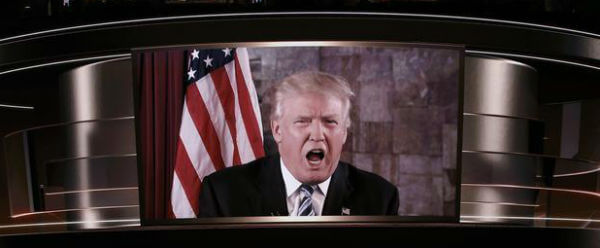
Donald Trump and the politics of fear

trump-purge

Molly Ball writes: “People are scared,” Donald Trump said recently, and he was not wrong.

Fear is in the air, and fear is surging. Americans are more afraid today than they have been in a long time: Polls show majorities of Americans worried about being victims of terrorism and crime, numbers that have surged over the past year to highs not seen for more than a decade. Every week seems to bring a new large- or small-scale terrorist attack, at home or abroad. Mass shootings form a constant drumbeat. Protests have shut down large cities repeatedly, and some have turned violent. Overall crime rates may be down, but a sense of disorder is constant.

Fear pervades Americans’ lives — and American politics. Trump is a master of fear, invoking it in concrete and abstract ways, summoning and validating it. More than most politicians, he grasps and channels the fear coursing through the electorate. And if Trump still stands a chance to win in November, fear could be the key.

Fear and anger are often cited in tandem as the sources of Trump’s particular political appeal, so frequently paired that they become a refrain: fear-and-anger, anger-and-fear. But fear is not the same as anger; it is a unique political force. Its ebbs and flows through American political history have pulled on elections, reordering and destabilizing the electoral landscape.

This week, Trump delivered a speech on immigration that depicted outsiders as a frightening threat. “Countless innocent American lives have been stolen because our politicians have failed in their duty to secure our borders,” he said. His acceptance speech at the Republican National Convention similarly made clear the extent to which his message revolves around fear. “The attacks on our police, and the terrorism in our cities, threaten our very way of life,” Trump thundered. “Any politician who does not grasp this danger is not fit to lead our country. Americans watching this address tonight have seen the recent images of violence in our streets and the chaos in our communities. Many have witnessed this violence personally; some have even been its victims.”

Notes of uplift were few and far between in the convention speech, and commentators were duly shocked by its dark tone. (The conservative writer Reed Galen called Trump’s convention “a fear-fueled acid trip.”) Trump summons fear in the conventional way, by describing in concrete terms the threats Americans face. But he also, in a more unusual maneuver, summons fear in the abstract: There’s something going on, folks. [Continue reading…]

Facebooktwittermail

Putin says DNC hack was a public service, Russia didn’t do it

Bloomberg reports: “There’s no need to distract the public’s attention from the essence of the problem by raising some minor issues connected with the search for who did it,” Putin said of the DNC breach. “But I want to tell you again, I don’t know anything about it, and on a state level Russia has never done this.”

The Federal Bureau of Investigation has high confidence that the government in Moscow was behind the theft at the DNC and other Democratic Party organizations seeking to propel Clinton to victory over Republican Donald Trump in November, a person familiar with the findings has said. Trump has praised Putin as a great leader and the billionaire’s former campaign chairman spent years working for the Kremlin ally who was ousted from Ukraine’s presidency in 2014.

In a two-hour conversation near Russia’s eastern fringe, Putin touched on subjects ranging from the war in Syria to oil prices and trade with China. It came just two days before Putin, Barack Obama and other world leaders gather at a Group of 20 meeting in Hangzhou.

An internal DNC probe by CrowdStrike Inc., a cybersecurity company, traced the DNC break-in to two groups it says are linked to Russian intelligence services. One, Cozy Bear, it says is affiliated with the Federal Security Service, the main successor to the KGB, while the other, Fancy Bear, it says is tied to the Main Intelligence Directorate, a branch of the Defense Ministry.
James Lewis, a cybersecurity expert at the Center for Strategic and International Studies in Washington, said Russia’s “track record” of state hacking goes back at least a decade, so Putin’s denials aren’t credible.

“Nice try, but no goal,” Lewis said.

The digital net cast by the hackers has widened almost weekly — security experts say it now includes congressional staffers, NATO generals, Washington think tanks and the Democratic Congressional Campaign Committee — adding another unpredictable element to a highly unusual election. The subsequent leaks have included the mobile number of House Minority Leader Nancy Pelosi, who said she was barraged with “obscene” calls within hours.

Putin also took a dig at the U.S. campaign and what he saw as an obvious party bias in favor of Clinton, saying he “couldn’t imagine” that the information leaked from the DNC would be newsworthy for “American society — specifically that the campaign headquarters worked in the interest of one of the candidates, in this case Mrs. Clinton, rather than equally for all of the Democratic party candidates. ”

Alexander Gostev, the chief expert at Kaspersky Lab, a Moscow-based software security firm, said of all the Russian-speaking hacking groups targeting governments, Fancy Bear “is the most notable.”

Malware linked to Fancy Bear was widely detected in Ukrainian government computers during the elections that were held after the country’s Kremlin-backed leader, Viktor Yanukovych, was deposed, Gostev said, adding that “six or seven” groups may be tied to the Russian government.

At the same time, Russia has come under attack by viruses linked to U.S. and U.K. intelligence services, Gostev said, adding that hacking efforts from China against Russian defense and nuclear agencies have intensified in the past year. [Continue reading…]

Facebooktwittermail

Why did Peña Nieto invite Trump to Mexico?

Ioan Grillo writes: Mexico’s president, Enrique Peña Nieto, had already had a terrible summer. July was the most murderous month in Mexico since he took office in 2012. Second-quarter results showed negative economic growth for the first time in three years. A survey found his approval rating slipping to 23 percent. And a news report even alleged that he plagiarized nearly a third of his law degree thesis. How could he make it any worse? Only by inviting Donald J. Trump, one of the most hated men in Mexico — so hated that piñatas with his visage are brisk sellers across the country — to his presidential palace.

The curious thing about Mr. Peña Nieto’s latest debacle is how, unlike his other woes, it was totally self-inflicted. There is little tradition of sitting Mexican leaders meeting with American presidential hopefuls, so he was under no pressure to arrange the get-together. And it couldn’t have come at a worse time: the very day of Mr. Trump’s hard-hitting immigration speech, and the day before Mr. Peña Nieto’s state of the union address. Mr. Peña Nieto had even compared Mr. Trump to Hitler.

But in a stupefying decision, last week he sent invitations out to the Democratic hopeful Hillary Clinton and Mr. Trump to come to Mexico, and then conceded, reportedly under pressure from the Trump team, to meet its candidate first, on the fateful Aug. 31.

Mr. Peña Nieto insists that his nation won something from the encounter. “I was very clear — in public and private — in emphasizing that in Mexico we feel wounded and hurt by his announcements about Mexicans,” he wrote in an opinion piece in El Universal newspaper on Thursday. “I expressed that Mexicans deserve respect.”

But most politicians and pundits — and the public — read the scene differently. To them, Mr. Peña Nieto looked weak and submissive in front of a bully who is humiliating their nation. [Continue reading…]

Politico reports: Several major Latino surrogates for Donald Trump are reconsidering their support for him following the Republican nominee’s hardline speech on immigration Wednesday night.

Jacob Monty, a member of Trump’s National Hispanic Advisory Council, has resigned, and Alfonso Aguilar, the president of the Latino Partnership for Conservative Principles, said in an interview that he is “inclined” to pull his support.

“I was a strong supporter of Donald Trump when I believed he was going to address the immigration problem realistically and compassionately,” said Monty, a Houston attorney who has aggressively made the Latino case for Trump. “What I heard today was not realistic and not compassionate.” [Continue reading…]

Facebooktwittermail