Ivan Krastev writes: Russian elites have the right to be corrupt, but only if they have proved their loyalty. Paradoxically, the West’s sanctions against business figures closest to the Russian president helped whitewash some of the most notoriously corrupt Russian oligarchs and allow Russian propaganda to present them as selfless defenders of the motherland.
Ultimately, the most important reason for Mr. Putin’s reluctance to declare a war on corruption is that any anti-corruption campaign will inspire the public to demand change. It plays not only on the public’s anger, but also on its aspirations. And it is precisely this demand for change that the Kremlin fears most. Unlike in China, leaders in Russia avoid promising that life will be better tomorrow; what they promise is that things will not get worse. And unlike in China, they can afford to do so because the Russian economy is driven not by the entrepreneurial energy of the masses, but by natural resources.
This is why the Russian government is ready to acknowledge corruption’s ubiquity — the slickest propaganda couldn’t convince people otherwise. But the government also advances the idea that corruption is a way of life and is thus a natural phenomenon. In a way, corruption is like vodka: You know it hurts, but Russia is unimaginable without it. [Continue reading…]
Category Archives: Issues
Afghanistan’s ‘ghost soldiers’: Thousands enlisted to fight Taliban don’t exist
The Guardian reports: From about 8.30pm until well after midnight, the dark blue sky above Babaji lit up, as rockets and flares crisscrossed above this cluster of villages close to Helmand’s provincial capital, Lashkar Gah.
At a mud fortress beyond a river bridge painted in the tricolours of the Afghan flag, 24 members of the Afghan border police dug in. They were not supposed to be there.
“We were not trained to fight on the front line,” said Cpt Ghulam Wali Afghan, the commander, when the Guardian visited the post.
As their name suggests, Wali Afghan’s men are meant to protect Afghanistan’s porous border, where smugglers cross with copious drugs, weapons and people.
But seven months ago, the captain and 122 other ABP men were relocated to Babaji, some 300km from the frontier with Pakistan in an effort to bolster the defence against the Taliban, who continue to capture territory the international coalition spent years getting little more than a slippery grip on.
On their first day on the front line, three border police were killed, said Raz Mohammad, a soldier stationed in Babaji. “For two months, we had trouble getting to know the area,” he said.
The police eventually repelled the Taliban assault. But with the calm of the poppy harvest over, and the fighting season just beginning, it is unlikely that the ABP officers will return to the border anytime soon.
With an estimated 25,000 troops officially based in Helmand, the government should have enough muscle to confront the Taliban.
The problem is many of those troops don’t exist.
Across Afghanistan, lists of troops and police officers are filled with fake names, or the names of men killed in the fighting, but not officially declared dead. Captain Wali and his men are in Babaji to fill the void of these “ghost soldiers”.
A recent investigation by Helmand’s provincial council found that approximately 40% of enlisted troops did not exist. The authors of an analysis commissioned by the Afghan government – and obtained by the Guardian – said the share might be even higher. [Continue reading…]
French plan to hold Israel-Palestine conference postponed indefinitely
Middle East Eye reports: A conference on the peace process between Israelis and Palestinians, due to be held on 30 May in Paris, has been postponed, French President Francois Hollande said on Tuesday.
“[US Secretary of State] John Kerry cannot come on May 30 so it has been delayed. It will take place in the summer,” he told French radio.
Hollande said it was vital for France to take “a strong initiative” in the dispute.
“If not… what will happen? Settlement building, attacks,” he said.
The original date for the conference falls on the US Memorial Day holiday honouring members of the armed forces who died in combat.
“We’re in discussions right now with the French about any possible alternative date that might better work for the secretary,” State Department spokesman John Kirby said Monday, though he added that Kerry’s agenda is currently “jammed”.[Continue reading…]
In fight against Western decadence, Iranian prosecutor attacks ‘actions that run counter to the values of the establishment’
The New York Times reports: Iran’s judiciary unleashed one of its periodic crackdowns on social media permissiveness on Sunday, announcing the arrest of eight people involved in online modeling without a mandatory head scarf and questioning another woman, a former model, live on state television on Sunday.
A blogger, Mehdi Abutorabi, 53, who managed a publishing tool called Persian Blog, was also detained, the semiofficial student news agency ISNA reported Monday.
The former model, Elham Arab, 26, had been something of an Instagram star, posting pictures of herself in bridal gowns with eye-catching, dyed-blond hair. But on Sunday, months after her Instagram account had been shut down, she wore a pious black scarf and matching gloves as she was questioned by two prosecutors during a live television program.
In sharp contrast to the happy and glamorous images of herself posted online, Ms. Arab spoke of her “bitter experiences” in Iran’s technically illegal modeling industry and warned young women to think twice before posting pictures of themselves online. “You can be certain that no man would want to marry a model whose fame has come by losing her honor,” she said.
The head scarf issue often features prominently in the constant tug of war between powerful hard-liners and Iran’s increasingly urbanized and worldly society. Iran’s laws require that all women, even visiting foreigners, cover their hair out of a traditional respect for culture and morality. Many hard-liners view the obligatory veil as a last-ditch defense against what they say is an onslaught of Western cultural decadence.
But the main culprit was not Ms. Arab, Tehran’s public prosecutor, Abbas Jafar-Dolatabadi, concluded on the television program. No, the main offender was “the enemy,” Iran’s household label for the West and its unwanted influences.
“The enemy is investing in order to create a generation without any willpower,” the prosecutor said of social media. “We must refrain from any actions that run counter to the values of the establishment.” [Continue reading…]
IranWire reports: In March, Iran’s online authorities shut down the Instagram pages of several well-known models, as well as those of hair salons and photography workshops. In their place, online visitors found a large blue frame with the caption “These pages are blocked by the authority of Operation Spider 2 to open security cases by order of the judiciary.” They did not provide any details about the operation, which became known as “the spider attacks.”
Now, Dolatabadi has explained what the so-called “spider attacks” were all about. “In the past two years, a lot of good things have been done in the fight against hair salons and fashion workshops related to modeling,” he said. “In operations Spider 1 and Spider 2, around 50 hair salons, 50 fashion workshops, and 50 photography workshops were prosecuted. Individuals were arrested and pages were shut down by the supervisor of the Prosecution Office for Media Crimes.”
At the same time, the website Gerdab, which promotes news about Revolutionary Guards’ online activities, reported on what it called the successes of Operation Spider 2 over the past two years.
Gerdab’s report accused the “secret supporters and operators of Instagram” of attempting to subvert the “Islamic Iranian lifestyle.” It championed what it called an important achievement in combating “modeling and vulgarity.”
“The first phase resulted in the creation of an accurate database of more than 300 Instagram pages,” the report said, quoting the Organized Cyberspace Crimes Unit of the Revolutionary Guards. “The database is an intelligent collection of specifics about these pages such as postings, followers, those who are followed, the ‘likes,’ the comment writers, addresses of [account users on sites] such as Facebook, Line, and Telegram, and emails, phone numbers, addresses and bank account numbers.” [Continue reading…]
An aristocrat’s view of Beirut

Michael Specter writes: The Sursocks are among the oldest and richest of the Christian families in Lebanon. And at the age of 94, Lady Cochrane, a Sursock by birth, may be the last great dame of the Levant. Lucid and acerbic, she seems like a cross between the Dowager Countess of Grantham and one of the less savory Mitford sisters. We had tea late one afternoon in her library, which, because it is the “coziest” place in the house, also serves as her sitting room. (This particular cozy room has 33-foot ceilings and mahogany walls and enormous 17th-century paintings. A collection of Flemish tapestries lines the entrance vestibule and dining room.)
Lady Cochrane, dressed crisply in a brown blouse, silk salmon foulard and houndstooth skirt, met me in the middle of the great hall, which features a double flight of marble stairs at its center. I asked the most obvious question first: Were you here during the civil war?
“Always,” she replied, as if my question was slightly insulting. “It’s where I live.”
Even today it is hard to walk three blocks in Beirut without seeing a building pockmarked with machine gun fire or mortar rounds, and yet the Sursock Palace was pristine. I wondered how that was possible.
“ I believe we were somehow respected,” she said matter-of-factly. “Because one day I was in the middle of the hall where you came in.” A crowd of what she referred to as “young ruffians” walked into the house. “I knew that these people would go from house to house, burgle and ruin them,” she said. (I wondered whether the words “ruffian,” and “burgle” had ever before been used to describe the vengeful packs of murderers that held sway in Beirut during the war.)
“I was alone,” she said, “and I thought, this is terrible. There must have been 50 of them. With big guns. I thought, they are just going to murder me. They saw me at a distance, and then they all went upstairs,” she said. “I tried to stay calm as best I could. After a time, they came down and I thought they must have just destroyed everything or stolen things.” She said this all with a kind of effortless serenity.
“But they did not pinch one single thing,” she continued, shaking her head in amazement 30 years later. “Except for an old poniard that had been hanging on the wall. There were two of them with exquisite Chinese handles. Very rare. They stole one and left the other where it was. I have always felt quite certain they didn’t care about the handle. Probably threw it away. They only wanted the dagger itself.”
Lady Cochrane explained that her staff had buried most of the valuables at the start of the hostilities. And there were a lot of them to bury. (“After it was over my own butler had trouble finding everything,” she said. “He hid it all so well.”)
She is horrified by the city she now inhabits. “When I was a child, Beirut was the most beautiful city. Full of gardens. Then bad government got a hold of the place. Now, after years of war and neglect it is nothing but a generalized slum.”
It was perhaps not the most nuanced analysis, but I had to ask one more question: What had happened?
“Democracy, young man,” she said. “Democracy. We never had a proper leader, and eventually the place began to fall apart.” [Continue reading…]
Countering American anti-intellectualism involves more than challenging ignorance
The Washington Post reports on President Obama’s commencement address at Rutgers University on Sunday: The president throughout his speech decried a strain of anti-intellectualism in American politics that he said rejects science, reason and debate. “These are things you want in people making policy,” Obama said to laughter. “That might seem obvious.”
At one point, clearly referring to Trump and congressional Republicans who have decried efforts to combat global warming, Obama warned that “in politics and in life, ignorance is not a virtue.”
“It’s not cool to not know what you are talking about,” he said. “That’s not keeping it real or telling it like it is. That’s not challenging political correctness. That’s just not knowing what you are talking about.”
Throughout the year, Obama has turned again and again in speeches to the obligations that come with citizenship and the need for a more reasoned and respectful political debate at a moment when the country’s politics have never seemed more vulgar and poisonous. [Continue reading…]
Given Obama’s youthful audience, it’s hardly surprising that he would appeal to their desire to be cool, but that itself strikes me as being part of the problem.
Intellectual development hinges less on knowing what you are talking about, than it requires the cultivation of curiosity.
It’s got more to do with asking the right questions, than knowing the right answers.
To be cool, on the other hand, suggests never being caught by surprise — as though to be surprised (which means to encounter the unexpected) must be a bad thing.
But no one can become so seasoned in life that they actually never encounter anything new. On the contrary, where the sense of surprise has been lost, nothing more is being learned. The process of digesting new information and new perceptions that modify ones understanding of the world, has atrophied. Thought, once malleable, has become fixed.
Those who claim they’ve seen it all before, have more likely just stopped looking.
The rancor in political debate which Obama criticizes, is itself not simply representative of a fractious political environment. It isn’t just that discourse is lacking in civility; it’s a reflection of the fears that inhibit creative political thinking.
When politics is strictly factionalized, orthodoxies rule. No one wants to challenge the conventional wisdom inside the camp to which they are aligned. Politics is then simply a power struggle between competing camps.
The intransigence we project onto our opponents is mirrored by the inflexibility on our side.
GOP leaders: ‘People don’t care’ about Trump’s woman problem
The Guardian reports: After a week of make-up meetings with Donald Trump, Republican party leaders have arrived at a new strategy to accommodate their presumptive presidential nominee: ignore his problematic attitude to women, his tax issues and his fluctuating positions on trade, immigration, foreign relations and a host of other topics, and instead embrace the will of Republican voters.
The switch was illuminated on Sunday, a day after the New York Times published a lengthy investigation into Trump’s alleged mistreatment and objectification of women in his personal life.
Reince Priebus, chair of the Republican National Committee, told Fox News Sunday that if voters have shown they are prepared to ride over issues surrounding the nominee’s behavior, so should the party.
“We’ve been working on this primary for over a year,” he said. “People don’t care. The question is, who is going to bring an earthquake to Washington DC?”
Trump, Priebus added, “represents something much different from the analysis of traditional candidates. Donald Trump is going to have to answer the question, but we’re in a year where nothing applies.
“It’s down to the bigger question: Who is going to blow up the system? That’s what this election is coming down to.” [Continue reading…]
Israel tells France it’s not interested in multilateral peace talks
The Washington Post reports: French officials said Sunday that they will continue to press ahead with plans to host a multilateral Middle East peace conference later this year, despite hearing, in blunt language, that Israel doesn’t really like the idea.
French Foreign Minister Jean-Marc Ayrault met with Prime Minister Benjamin Netanyahu on Sunday to promote what diplomats are calling the “French Initiative,” a still evolving and admittedly vague diplomatic project that seeks to bring global attention to the Israeli-Palestinian conflict and find consensus among the international community on how to move forward with a two-state solution.
The French are planning to host about 30 foreign ministers — from Europe and the Middle East as well as Russia, China and India — at a preparatory meeting at the end of this month, which could lead to a peace conference later this year.
Neither Israel nor the Palestinians, who support the French Initiative, will attend the May meeting in Paris.
U.S. Secretary of State John F. Kerry has not said whether he would be there.
Israeli officials have been pressing Washington to pour cold water on the French effort, which seeks to fill the vacuum left behind by the Obama administration, which declared that it would not be making any major move to bring Israel and the Palestinians back to the negotiating table. [Continue reading…]
Kurdish militants reportedly shoot down Turkish security forces helicopter
The Washington Post reports: They were used to stalk Russian helicopters in Afghanistan, and the United States has worked hard to keep them out of chaotic Syria. But now Kurdish guerrillas battling Turkey’s security forces may now have shoulder-fired missiles — an acquisition analysts say will seriously challenge Turkish air power and potentially intensify fighting in the region.
On Saturday, media affiliated with the Kurdistan Workers’ Party (PKK), a leftist militant group battling the Turkish state, posted a video purporting to show a fighter downing a Cobra attack helicopter with a man-portable air-defense system — or MANPADS — in the mountains of southeastern Turkey on Friday morning. Arms observers said this is the first time they have seen PKK fighters successfully using MANPADS in their four-decade fight against the Turks.
About four minutes into the video, the fighter, clad in camouflage fatigues, crouches on a verdant hillside with the weapons system on his shoulder. When the launcher locks on its target — a helicopter whirring noisily on the horizon — the fighter stands to fire. The heat-seeking missile swoops through the air and strikes the Cobra’s tail, sending the aircraft spinning and eventually crashing into the mountainside. [Continue reading…]
America’s climate-change exodus

Jeremy Miller writes: In a rumpled suit jacket and faded jeans, Giles Slade stands atop an earthen levee and looks out over a vast expanse of water. It’s mid-November, and the Fraser River runs gray and glasslike into the Salish Sea. Overhead, airplanes flash through low clouds, descending into Vancouver International Airport. To our backs is the city of Richmond, British Columbia, splayed out on the table-flat delta, the majority of its homes and buildings set just a few feet above sea level. “You can begin to see the scale of our problems from right here,” he says, waving a hand across the gray swath of water and sky.
Slade, 62, resembles a svelter John Goodman. He wears hip glasses, and his sentences are delivered in a calm, professorial baritone. But his mellow demeanor belies a deep anxiety, rooted in the threats posed by climate change to the Pacific Northwest, and to his flood-prone town of 190,000. He’s channeled that angst into a gripping work of non-fiction titled American Exodus (the title is an homage to An American Exodus, a book about the Dust Bowl published in 1939 by economist Paul Taylor, with photographs by Dorothea Lange). Slade’s book offers a disaster-movie account of the days ahead for North America — a future defined by epic drought, megafires, colossal hurricanes, rising seas, and the massive human migrations that such events are likely to spawn.
The idea for the book dates back to the late 2000s, when Slade began to note numerous climate-driven migrations happening in the developing world. “There was a lot of material on climate migrations in Somalia and some other parts of the world,” he recalls. But at the time he could find no resources exploring how climate change might affect human populations in North America. Could things here reach a sort of climatic tipping point, Slade wondered, forcing people to move suddenly and in large numbers? “I was surprised to find that there were things that were already happening,” he says, mentioning Mexico and Central America, where prolonged drought, combined with violence and economic and political instability, has triggered the movement of tens of thousands of people northward over recent decades.
As he pored over the climate data, he became obsessed with one particular scenario. With drought intensifying in California, Slade envisioned a new Dust Bowl situation, in which tens of thousands of people evacuate the drought-ravaged southwestern United States and stream into the Pacific Northwest. Would the Oregon state line become like the U.S.-Mexico border? “That scenario,” Slade says, “seems closer and closer every day.”
For years, publishers weren’t interested in his ideas. “I was told by several U.S. publishers that climate change wasn’t happening,” he says. “Others viewed it as a boring disaster book with an unlikely prediction.” Things changed in October of 2012, when Superstorm Sandy blasted New York, forcing thousands of evacuations from the U.S.’s most populous and high-profile city. “I got a call and an offer the same week.”
One might be inclined to dismiss his predictions as the products of an overactive imagination (Slade spent his early years writing military novels for Harlequin Books) — that is, if the book weren’t so meticulously researched and reported. And then there’s the fact that Slade is no longer the only one talking in such stark terms about climate-driven migrations.
“What we’re seeing in Europe now with mass migrations, that will happen in California,” declared California Governor Jerry Brown last fall at a press conference. “Central America and Mexico, as they warm, people are going to get on the move.” In a recent talk to U.S. ambassadors, Secretary of State John Kerry painted a similar scene: “There’ll be climate refugees that all of you will be coping with at some point — if not now, in the not-too-distant future.”
Recent data underscores these predictions. A study from the Centre for Research on the Epidemiology of Disasters estimated that, between 1994 and 2014, as many as 3.5 billion people worldwide were affected by flooding and drought. More recently, a study in the journal Science Advances estimated that four billion people — roughly two-thirds of the entire human population — experience severe water shortages for at least one month out of every year.
And yet, here in the U.S., we tend to think of severe climate disruption as something that is happening elsewhere. According to recent Gallup polls, 60 percent of Americans accept that climate change is happening, and 57 percent believe that it is caused by human activities — but only 36 percent believe it poses a threat to their way of life. [Continue reading…]
Untangling the complicated legacies of colonialism and failed Arab regimes overshadowing today’s conflicts in the Middle East
Rami G Khouri writes: Why have most Middle Eastern lands that Great Britain, Italy, and France managed as mandates or colonies become violent wrecks and sources of large-scale conflict and human despair? It is just as dishonest to blame mainly Western colonialism for our national wreckages and rampant instability as it is to blame only Arab people and culture for those failings. We need a more complete and integrated analysis of the multiple phenomena that shaped our last erratic century.
Initially, we must absolutely acknowledge that Arab states’ inability to achieve sustainable economic growth and pluralistic democracies is the core reason for our problems today. The main reason for this reason, however, is to be found in a more complex set of interlocking relationships among powerful political actors inside our countries and capitals far and near.
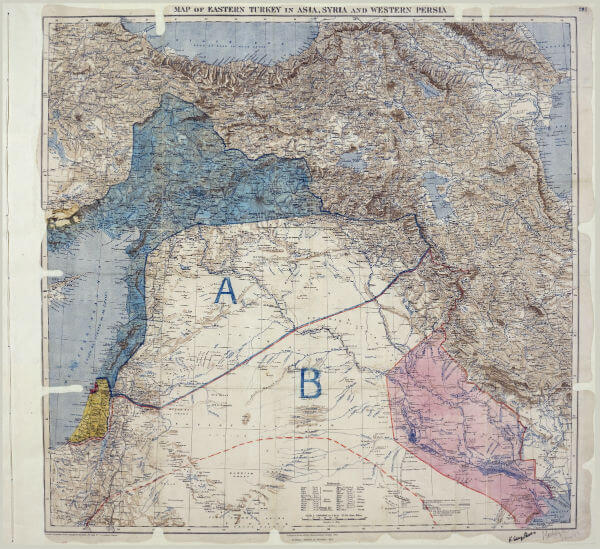
This requires going back before 1916, maybe a century or two, to recall how European powers conquered much of the world as colonies or sites of unchecked imperial plunder. The main problem with Sykes-Picot is not only what happened in and after 1916; it is also heavily a consequence of the European colonial mindset that matured in the century before 1916, and continued to exercise its colonial prerogatives for decades to follow — perhaps even in today’s continued use of European, Russian, and American military power across our region.
At the same time, three critical issues after 1916 made it virtually impossible for many Arab countries to transition from Euro-manufactured instant states born on after-dinner napkins in the hands of Cognac-mellowed British and French colonial officers, to stable, democratic, prosperous sovereign states.
These three issues were, in their historical order:
1) British support for Zionism and a Jewish state in Palestine in November 1917, which plunged Palestine into endless Zionism-Arabism warfare since then, and sucked in other Arab states, Iran, and others yet;
2) the discovery of large amounts of oil in the Middle East in the 1930s especially, which the West needed to maintain access to for its own industrial expansion; and,
3) the post-1947 Cold War between the U.S.-led West and the Russian-led Soviet Communist states that was translated into perpetual proxy wars across the Middle East for forty-four years, and maybe is resurfacing today in new guises. [Continue reading…]
Don’t blame Sykes-Picot for the Middle East’s mess

Steven A. Cook and Amr T. Leheta write: Sometime in the 100 years since the Sykes-Picot agreement was signed, invoking its “end” became a thing among commentators, journalists, and analysts of the Middle East. Responsibility for the cliché might belong to the Independent’s Patrick Cockburn, who in June 2013 wrote an essay in the London Review of Books arguing that the agreement, which was one of the first attempts to reorder the Middle East after the Ottoman Empire’s demise, was itself in the process of dying. Since then, the meme has spread far and wide: A quick Google search reveals more than 8,600 mentions of the phrase “the end of Sykes-Picot” over the last three years.
The failure of the Sykes-Picot agreement is now part of the received wisdom about the contemporary Middle East. And it is not hard to understand why. Four states in the Middle East are failing — Syria, Iraq, Yemen, and Libya. If there is a historic shift in the region, the logic goes, then clearly the diplomatic settlements that produced the boundaries of the Levant must be crumbling. History seems to have taken its revenge on Mark Sykes and his French counterpart, François Georges-Picot, who hammered out the agreement that bears their name.
The “end of Sykes-Picot” argument is almost always followed with an exposition of the artificial nature of the countries in the region. Their borders do not make sense, according to this argument, because there are people of different religions, sects, and ethnicities within them. The current fragmentation of the Middle East is thus the result of hatreds and conflicts — struggles that “date back millennia,” as U.S. President Barack Obama said — that Sykes and Picot unwittingly released by creating these unnatural states. The answer is new borders, which will resolve all the unnecessary damage the two diplomats wrought over the previous century.
Yet this focus on Sykes-Picot is a combination of bad history and shoddy social science. And it is setting up the United States, once again, for failure in the Middle East.
For starters, it is not possible to pronounce that the maelstrom of the present Middle East killed the Sykes-Picot agreement, because the deal itself was stillborn. Sykes and Picot never negotiated state borders per se, but rather zones of influence. And while the idea of these zones lived on in the postwar agreements, the framework the two diplomats hammered out never came into existence.
Unlike the French, British Prime Minister David Lloyd George’s government actively began to undermine the accord as soon as Sykes signed it — in pencil. The details are complicated, but as Margaret Macmillan makes clear in her illuminating book Paris 1919, the alliance between Britain and France in the fight against the Central Powers did little to temper their colonial competition. Once the Russians dropped out of the war after the Bolshevik Revolution in 1917, the British prime minister came to believe that the French zone that Sykes and Picot had outlined — comprising southeastern Turkey, the western part of Syria, Lebanon, and Mosul — was no longer a necessary bulwark between British positions in the region and the Russians.
Nor are the Middle East’s modern borders completely without precedent. Yes, they are the work of European diplomats and colonial officers — but these boundaries were not whimsical lines drawn on a blank map. They were based, for the most part, on pre-existing political, social, and economic realities of the region, including Ottoman administrative divisions and practices. The actual source of the boundaries of the present Middle East can be traced to the San Remo conference, which produced the Treaty of Sèvres in August 1920. Although Turkish nationalists defeated this agreement, the conference set in motion a process in which the League of Nations established British mandates over Palestine and Iraq, in 1920, and a French mandate for Syria, in 1923. The borders of the region were finalized in 1926, when the vilayet of Mosul — which Arabs and Ottomans had long associated with al-Iraq al-Arabi (Arab Iraq), made up of the provinces of Baghdad and Basra — was attached to what was then called the Hashemite Kingdom of Iraq.
On a deeper level, critics of the Middle East’s present borders mistakenly assume that national borders have to be delineated naturally, along rivers and mountains, or around various identities in order to endure. It is a supposition that willfully ignores that most, if not all, of the world’s settled borders are contrived political arrangements, more often than not a result of negotiations between various powers and interests. Moreover, the populations inside these borders are not usually homogenous.
The same holds true for the Middle East, where borders were determined by balancing colonial interests against local resistance. These borders have become institutionalized in the last hundred years. In some cases — such as Egypt, Iran, or even Iraq — they have come to define lands that have long been home to largely coherent cultural identities in a way that makes sense for the modern age. Other, newer entities — Saudi Arabia and Jordan, for instance — have come into their own in the last century. While no one would have talked of a Jordanian identity centuries ago, a nation now exists, and its territorial integrity means a great deal to the Jordanian people.
The conflicts unfolding in the Middle East today, then, are not really about the legitimacy of borders or the validity of places called Syria, Iraq, or Libya. Instead, the origin of the struggles within these countries is over who has the right to rule them. The Syrian conflict, regardless of what it has evolved into today, began as an uprising by all manner of Syrians — men and women, young and old, Sunni, Shiite, Kurdish, and even Alawite — against an unfair and corrupt autocrat, just as Libyans, Egyptians, Tunisians, Yemenis, and Bahrainis did in 2010 and 2011.
The weaknesses and contradictions of authoritarian regimes are at the heart of the Middle East’s ongoing tribulations. Even the rampant ethnic and religious sectarianism is a result of this authoritarianism, which has come to define the Middle East’s state system far more than the Sykes-Picot agreement ever did. [Continue reading…]

Sadiq Khan and the future of Europe

Mehdi Hasan writes: As the votes in London’s mayoral election were being counted on May 5, almost every British Muslim I know seemed to have only one thought: Would Sadiq Khan pull it off?
He did. Mr. Khan, the son of Pakistani immigrants, was elected as the first Muslim mayor of a Western capital city, with more than 1.3 million votes, in what is being called the biggest mandate in the history of British politics. And the Labour candidate managed his landslide even after his opponent, the Conservative politician Zac Goldsmith, smeared him as a “radical” and shamelessly accused him of giving “oxygen” to extremists.
Islamophobes are tearing their hair out as they decry the Islamization of Britain. But for all the Muslim baiting, London’s new mayor is part of an encouraging trend. He’s just the latest in a series of observant Muslims who have captured the hearts and minds of the British public. Last October, 14.5 million Britons tuned in to watch the smiling, hijab-clad Nadiya Hussain, the daughter of a waiter from Bangladesh, as she was crowned champion of “The Great British Bake Off,” a TV show. In April, Riyad Mahrez, who was born in Paris to an Algerian father and a Moroccan mother, was awarded the Professional Footballers’ Association Player of the Year trophy after scoring 17 goals for Leicester City, which went on to a surprise victory in the Premier League championship.
In a perfect world, the faith of a TV cooking show star, an athlete or even a major politician would be irrelevant. But in our deeply imperfect — and, yes, Islamophobic — world, it isn’t. British newspapers are filled with alarmist headlines about “Muslim sex grooming” and “the rise in Muslim birthrate.” Earlier this year, Trevor Philips, the former chairman of Britain’s Equality and Human Rights Commission, accused Britain’s Muslims of “becoming a nation within a nation.”
It’s harder to say that now. The tide is turning in the toxic debate on Islam, integration and multiculturalism. [Continue reading…]
How ISIS uses the internet: Talking on Telegram and sending viruses to their enemies
BuzzFeed reports: Abu Majad figured that when ISIS came for him, it would be with a knife on a dark street, or a bomb planted on his car. The 34-year-old had been living in southern Turkey since fleeing Syria nearly three years ago and knew that his outspoken stance against ISIS — online and in his hometown in northern Syria — had put him in the terrorist group’s crosshairs. What he wasn’t expecting was to wake up on the morning of March 29 to a virus planted by ISIS within a seemingly innocuous email attachment.
“Everything about this looked like a real email, sent from the admin of my own website. It looked safe, but it was not. They were trying to get my login information, my passwords. They were trying to get things that could have put real lives in danger,” said Abu Majad, who asked that his nickname be used instead of his real name to protect himself and his remaining family in Syria from reprisal attacks by ISIS. “It was very clever. When I saw it I thought to myself, Shit, now they are professional hackers?”
Cybersecurity experts and intelligence agencies who monitor ISIS say the malware is just one more sign that ISIS is growing more sophisticated in its use of the internet.
“I don’t think it is far-fetched to say that the internet is a major reason why ISIS is so successful, and so worrying, as far as global terror movements go,” said one U.S. intelligence officer, who spoke to BuzzFeed News in Washington, D.C., and asked not to be named as he wasn’t authorized to speak to the press. “They have always been ‘good’ at the internet, at the strategy of how they use it. Now they are smarter at the internet too.” [Continue reading…]
Kurdish tensions undermine the war against ISIS
Hassan Hassan writes: Amnesty International has in seven months issued two major reports highlighting allegations of war crimes by rebel and Kurdish forces in northern Syria. The two reports are related to a secondary conflict brewing between Arabs and Kurds from Hasakah to Qamashli to Aleppo, which could easily spin out of control and add to the many conflicts that already plague the country.
The United States has an unintentional hand in this new conflict, and de-escalation hinges largely on whether Washington is willing to review its strategy in northern Syria, which sometimes privileges the appearance of success in the battle against ISIL over sustainable policies.
On Friday, Amnesty published a damning new report accusing rebel factions in Aleppo, organised under the Army of Conquest, of committing acts that may amount to war crimes. The rights group said it gathered strong evidence of indiscriminate attacks that killed at least 83 civilians, including 30 children, in the Kurdish-dominated Sheikh Maqsoud between February and April.
On October 13 last year, Amnesty issued a report, Forced Displacement and Demolitions in Northern Syria, accusing the Kurdish political party PYD, the Democratic Union Party, of carrying out a wave of forced displacement and home demolitions that it also said may amount to war crimes. The shelling of civilians by rebel forces cannot be justified, and perpetrators must be punished and restrained by their regional backers. The attacks on Sheikh Maqsoud were encouraged by some supporters of the opposition living abroad, after the PYD’s military wing, the YPG, attacked the rebels in February. Worse, such calls continue to be heard and more indiscriminate attacks can be expected. [Continue reading…]
What happened to billions in U.S. military aid to Egypt?
Julian Pecquet writes: The Egyptian government is hindering Washington’s ability to track billions of dollars worth of anti-aircraft missiles and other US weapons, the US government watchdog said in a blistering report just as Congress gets ready to renew the annual $1.3 billion request.
The United States provided $6.5 billion in military assistance to Cairo between 2011 and 2015 with the understanding that it would be closely monitored and it would serve American interests. Instead, the Government Accountability Office (GAO) asserts that the Obama administration has often failed to meet those requirements due to resistance from their Egyptian counterparts, lack of guidance from Washington and insufficient staffing at the US Embassy in Cairo.
The State Department and the Defense Department (DOD) have established programs “to provide reasonable assurance that military equipment transferred or exported to foreign governments is used for its legitimate intended purposes and does not come into the possession of individuals or groups who pose a threat to the United States or its allies,” the GAO said in its May 12 report. “However, gaps in the implementation of these end-use monitoring programs — in part due to limited cooperation from the Egyptian government — hampers DOD’s and State’s ability to provide such assurances.” [Continue reading…]
Bill Clinton recalls killing himself for the Palestinians
Politico reports: Bill Clinton went on the defensive over his record on the Israeli-Palestinian conflict, as well as his wife’s, after a spectator at a Friday afternoon campaign event repeatedly pressed the former president on the issue.
Clinton was explaining his wife’s policy positions in Ewing Township, New Jersey, when a spectator yelled, “What about Gaza?”
“She and the Muslim Brotherhood president of Egypt stopped the shooting war between Israel and Hamas in Gaza,” Clinton responded.
“She said neutrality is not an option,” the spectator said, prompting boos from the audience, but Clinton told them to stop.
“Depends on whether you care what happens to the Palestinians as opposed to the Hamas government and the people with guided missiles,” the former president answered.
“They were human beings in Gaza,” the audience member said.
“Yes, they were,” Clinton said. “And Hamas is really smart. When they decide to rocket Israel, they insinuate themselves in the hospitals, in the schools, in the highly populous areas, and they are smart.”
The line prompted applause, and he continued: “They said they try to put the Israelis in a position of either not defending themselves or killing innocents. They’re good at it. They’re smart. They’ve been doing this a long time.”
“I killed myself to give the Palestinians a state. I had a deal they turned down that would have given them all of Gaza,” Clinton said. [Continue reading…]
When Bill Clinton supposedly “killed himself” in his efforts at Camp David, one of his principle aides was Robert Malley, Special Assistant to President Clinton for Arab-Israeli Affairs. After Clinton and others blamed Yasser Arafat for refusing to accept a “generous” offer from Israel’s prime minister, Ehud Barak, Malley set the record straight in the New York Review of Books in 2001:
Robert Malley and Hussein Agha wrote: In accounts of what happened at the July 2000 Camp David summit and the following months of Israeli-Palestinian negotiations, we often hear about Ehud Barak’s unprecedented offer and Yasser Arafat’s uncompromising no. Israel is said to have made a historic, generous proposal, which the Palestinians, once again seizing the opportunity to miss an opportunity, turned down. In short, the failure to reach a final agreement is attributed, without notable dissent, to Yasser Arafat.
As orthodoxies go, this is a dangerous one. For it has larger ripple effects. Broader conclusions take hold. That there is no peace partner is one. That there is no possible end to the conflict with Arafat is another.
For a process of such complexity, the diagnosis is remarkably shallow. It ignores history, the dynamics of the negotiations, and the relationships among the three parties. In so doing, it fails to capture why what so many viewed as a generous Israeli offer, the Palestinians viewed as neither generous, nor Israeli, nor, indeed, as an offer. Worse, it acts as a harmful constraint on American policy by offering up a single, convenient culprit—Arafat—rather than a more nuanced and realistic analysis. [Continue reading…]
Israel must recognize its responsibility for the Nakba, the Palestinian tragedy
Saeb Erekat writes: For the Palestinian people, the Nakba is a collective tragedy whose wounds have yet to heal 68 years later. What we call the ‘Catastrophe’ is not just the destruction of at least 436 villages or the forced displacement of 70 percent of our people, but of our ethnic cleansing at the hands of a colonialist strategy. For reconciliation between Israelis and Palestinians, Israel must recognize what it has done to the Palestinian people.
It is time for Israelis to confront reality: when the Zionists came to Palestine, there were another people living here. Over 100 years ago, a Zionist mission was sent to Palestine and their report acknowledged this fact: “The bride is beautiful but she is married to another man.” And this: soon plans to displace Palestine’s population were unveiled. Millions of Palestinians still pay for the colonialist British promise referred to as the Balfour Declaration. No people on earth would have accepted such a clandestine deal, sealing their fate to a foreign power intent on wiping its presence and identity from the land they came from, tilled, and souls returned to.
Unfortunately, Nakba deniers throughout Israeli society continue to use neocolonialist nationalism to rejects the existence of the Palestinian people while redefining traditional constructs of colonialism to justify the systematic Israeli theft of Palestinian land and deprivation of Palestinian human rights.
Palestinians are Arabs who immigrated to Israel. We Jews fended off the attacks by seven Arab armies in self-defense. These declarations deny the very existence of the Palestinian people, continue to justify the atrocities committed against us, and deny Palestinian refugees’ legitimate right of return. However, if Israel aspires to live in peace in the region, it must face its own archival evidence attesting to the past that ties our two peoples together. Even 68 years after the Nakba, Jews are still the minority in historic Palestine while Palestinian Christians aren’t even recognized by Israel as Palestinian. Israel cannot continue to deny what it has done to the Palestinian people, and it’s time it understood that coexistence means acknowledgment. [Continue reading…]