IBT reports: Residents have returned to Cizre to find their homes destroyed by shelling. Authorities partially lifted a 24-hour curfew that had been imposed to facilitate security operations against Kurdish militants. A first wave of arrivals reached the town at the break of dawn, their vehicles loaded with personal belongings and, in many cases, children. In the battle-scarred Sur neighbourhood, homes have enormous holes blasted into their walls, ceilings have collapsed, windows are shattered and doors are hanging on their hinges.
The level of damage in some neighbourhoods evoked the early days of military conflict in neighbouring Syria with buildings gutted by shelling and shrapnel. “Those who did this are not humans,” said Cizre resident Serif Ozem. “What took place here is a second Kobani in a country that is supposed to be a democracy.” Kobani is a predominantly Kurdish town in northern Syria that suffered a brutal siege at the hands of the Islamic State (Isis) group. [Continue reading…]
Category Archives: Issues
If the Kurds go broke, it’s lights out for Obama’s war on ISIS
John Hannah writes: Here’s a worrying bit of news: America’s best ally in the war against the Islamic State, Iraq’s Kurdistan Regional Government (KRG), is nearly broke. That’s a major problem, especially as the U.S.-led coalition gears up for its most difficult battle yet: the effort to liberate Mosul, the heart of the Islamic State’s power in Iraq. With the Kurds slated to play an essential role in that potentially decisive military campaign, now is the time for their capabilities to be reaching their zenith. Instead, they’re under growing threat of catastrophic collapse.
A near-perfect storm of crises has been draining KRG finances. First, there’s the burden of the war. For over 18 months, Kurdish forces have been pushing IS back across a 600-mile front. There’s also the KRG’s chronic dispute with the central government in Baghdad that has denied the region its share of Iraq’s national budget for the better part of two years. That’s billions upon billions of dollars in foregone revenue.
Further exacerbating the situation has been a massive influx of refugees and displaced persons, an estimated 1.8 million men, women, and children, fleeing the Islamic State’s hordes for the relative safety of Kurdistan. That tidal wave of humanity has increased the region’s population by an astounding 30 percent, straining its infrastructure and social services to the breaking point (just think about that: in the United States, that’s the equivalent of trying to take in over 90 million people overnight). Finally, like oil producers everywhere, what earnings the KRG receives from its own energy exports have been decimated by the collapse in world prices.
This can’t end well. The warning signs are everywhere. Up to 70 percent of Kurdistan’s workforce is on the KRG’s payroll. Most have not been paid for months. When back wages finally come through, it’s often at a fraction of what’s owed. Going forward, officials have dangled the threat of draconian salary cuts. Labor strikes are breaking out, involving teachers, medical workers, and even elements of the police. Political tensions are escalating. The broader economy is grinding to a halt. Construction of schools, hospitals, roads, and other critical infrastructure, is stalled. Tourism has dried up. Property values have plummeted. Consumer spending is collapsing.
Even more worrisome is the impact on Kurdistan’s oil sector, overwhelmingly the KRG’s primary source of revenue. The small international firms responsible for most of the region’s exports have received only sporadic payments. Absent these funds, the companies largely lack the necessary cash flow to invest in further developing existing fields. And without sufficient capital expenditures, production at these fields could actually begin to decline. New exploration, meanwhile, is at a virtual standstill, with the region’s rig count down by more than 90 percent, reaching levels not seen since the first production contracts were signed more than a decade ago. [Continue reading…]
Foreign Policy reports: Iraqi Kurds’ dreams of energy-financed political independence are taking a beating — and not just because of low oil prices.
Since the middle of February, Iraqi Kurdistan’s tenuous export link to the outside world has been totally shut down. As recently as January, the Kurds were exporting 600,000 barrels a day in exchange for desperately needed revenue. But the mysterious closure of the pipeline that connects Kurdish refineries to the Turkish coast has brought that number to essentially zero.
Kurdish officials say they don’t know for sure why the pipeline has been shut down; theories range from a terrorist bombing to simple sabotage to a precautionary shutdown by Turkish authorities carrying out big military operations in the area.
What’s crystal clear is that a region dependent on oil export revenues — one that was already struggling mightily to make ends meet during its costly war against the Islamic State — now has its back to the wall. The Kurdish region earned about $630 million a month from direct oil sales in 2015, which still fell short of the $850 million or so it needed every month to pay its soldiers and civil servants, as well as foreign oil companies for the crude they’ve pumped. The two-week pipeline closure has now cost Erbil an additional $200 million — and the Kurdish losses will continue to grow until it comes back online. [Continue reading…]
‘I never heard from them again’: An Afghan family’s doomed journey
The Observer reports: n the early morning on 8 February, before setting off from the Turkish coast with his family, Firooz Mozafari was on the phone to his brother Farid in Kabul. They had spoken every day since Firooz left Afghanistan 48 days earlier, and Farid asked him to keep his phone on during this last stretch of the journey to Europe.
“I can’t, I’m running out of battery,” Firooz said, hung up, and climbed aboard a small speedboat with 11 relatives, including his wife and two children.
After two hours without word from his brother, Farid began to worry. The trip across the Aegean should take 40 minutes. A friend reassured him nothing was wrong. “It takes a couple of hours to get through immigration,” Farid remembered him saying. So he waited.
But later he received the terrible news: Firooz’s boat had sunk 15 minutes after leaving Izmir, with 24 people on board.
As a journalist Firooz had known the hazards of the journey but, weighing his options, he thought it worth spending his savings on plane tickets to Iran and smuggler fees to escape the never-ending war in his homeland.
Afghans make up a large proportion of the migrants and refugees who are arriving in Europe. Last year more than 210,000 Afghans arrived, 21% of the total, according to the UN. It is a staggering number, fully 15 years after the Taliban were driven out of Kabul. During that time, Afghanistan has received aid greater in value than the Marshall Plan, which rebuilt Europe after the second world war. [Continue reading…]
Syrian and Russian forces have deliberately targeted hospitals near Aleppo
Amnesty: Russian and Syrian government forces appear to have deliberately and systematically targeted hospitals and other medical facilities over the last three months to pave the way for ground forces to advance on northern Aleppo, an examination of airstrikes by Amnesty International has found.
Even as Syria’s current fragile ceasefire deal was being hammered out, Syrian government forces and their allies intensified their attacks on medical facilities.
Amnesty has gathered compelling evidence of at least six deliberate attacks on hospitals, medical centres and clinics in the northern part of the Aleppo Countryside governorate in the past 12 weeks. The attacks, which killed at least three civilians including a medical worker, and injured 44 more, continue a pattern of targeting health facilities in various parts of Syria which amounts to war crimes. [Continue reading…]
Russian atheist faces year in jail for denying existence of God during webchat
AFP reports: A man in southern Russia faces a potential jail sentence after he was charged with insulting the feelings of religious believers over an internet exchange in which he wrote that “there is no God”.
Viktor Krasnov, 38, who appeared in court Wednesday, is being prosecuted under a controversial 2013 law that was introduced after punk art group Pussy Riots was jailed for a performance in Moscow’s main cathedral, his lawyer Andrei Sabinin told AFP.
The charges – which carry a maximum one-year jail sentence – centre on an internet exchange that Krasnov was involved in in 2014 on a humorous local website in his hometown of Stavropol.
“If I say that the collection of Jewish fairytales entitled the Bible is complete bullshit, that is that. At least for me,” Krasnov wrote, adding later “there is no God!”
One of the young people involved in the dispute with Krasnov then lodged a complaint against him accusing him of “offending the sentiments of Orthodox believers”. [Continue reading…]
U.S. defense secretary takes position against a data ‘back door’
The New York Times reports: Defense Secretary Ashton B. Carter assured an audience of computer security experts Wednesday that he was not in favor of a “back door” that would give the government access to data that is protected by encryption.
Speaking at the annual RSA Conference, Secretary Carter sought common ground with companies worried by Apple’s fight with the Federal Bureau of Investigation over access to an iPhone.
“Just to cut to the chase, I’m not a believer in back doors or a single technical approach,” Secretary Carter said to loud applause during a panel discussion at the conference. “I don’t think it’s realistic. I don’t think that’s technically accurate.” [Continue reading…]
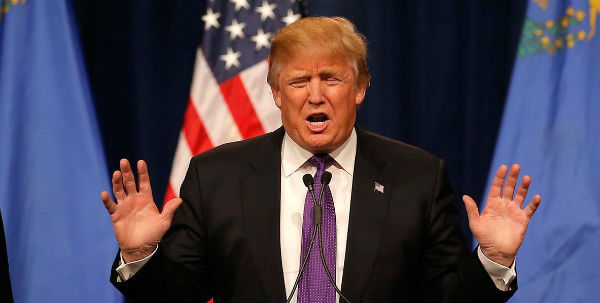
Donald Trump embodies how great republics meet their end

Martin Wolf writes: In creating the American republic, the founding fathers were aware of the example of Rome. Alexander Hamilton argued in the Federalist Papers that the new republic would need an “energetic executive”. He noted that Rome itself, with its careful duplication of magistracies, depended in its hours of need on the grant of absolute, albeit temporary, power to one man, called a “dictator”.
The US would have no such office. Instead, it would have a unitary executive: the president as elected monarch. The president has limited, but great, authority. For Hamilton, the danger of overweening power would be contained by “first, a due dependence on the people, secondly, a due responsibility”.
During the first century BC, the wealth of empire destabilised the Roman republic. In the end, Augustus, heir of the popular party, terminated the republic and installed himself as emperor. He did so by preserving all the forms of the republic, while he dispensed with their meaning.
It is rash to assume constitutional constraints would survive the presidency of someone elected because he neither understands nor believes in them. Rounding up and deporting 11m people is an immense coercive enterprise. Would a president elected to achieve this be prevented and, if so, by whom? What are we to make of Mr Trump’s enthusiasm for the barbarities of torture? Would he find people willing to carry out his desires or not?
It is not difficult for a determined leader to do the previously unthinkable by appealing to conditions of emergency. Both Abraham Lincoln and Franklin Delano Roosevelt did some extraordinary things in wartime. But these men knew limits. Would Mr Trump also know limits? Hamilton’s “energetic” executive is dangerous. [Continue reading…]
The white supremacists fully emboldened and energized by Trump
The full story of the white supremacists who assaulted this Black student at a Trump rally.https://t.co/WPywX72tVOhttps://t.co/vpJrCxH1bP
— Shaun King (@ShaunKing) March 2, 2016
Shaun King reports: On Monday, 30 black students attending a Donald Trump rally at Valdosta State University in rural Georgia were forcefully ejected — simply for being black.
On Tuesday, in Louisville, Kentucky, what happened to young black protestors at another Trump rally wasn’t just racist — it appears to be outright criminal.
While we have already widely reported that white supremacists are openly proclaiming that they are fully emboldened and energized by Trump, the natural progression of their romance with Trump is now on full display.
A man wearing a make America great again hat — thought to be Matthew Heimbach, a leader of the Traditionalist Worker Party — can be seen next to a protestor at the Trump rally in Louisville.
While Trump was giving his typical campaign speech about making America great again, several different predominantly black groups of protestors, who were simply there to hold up signs, began having those signs snatched and getting cursed by the white Trump supporters surrounding them.We now know that those Trump supporters are open bigots, Neo-Nazi’s, and white supremacists belonging to many different groups including the Traditionalist Worker Party — a well-documented hate group. Their social media profiles are full of Nazi photos, KKK and white supremacist references, and some of the most insulting, despicable hate speech you’ll ever see. [Continue reading…]
NATO accuses Russia of ‘weaponising’ immigrants
Financial Times reports: Nato’s top commander accused Russia and the Syrian regime on Tuesday of “weaponising” immigration by using bombs aimed at civilians to deliberately cause large flows of refugees and challenge European political resolve.
General Philip Breedlove, Nato’s supreme allied commander, said that the types of bombs being used in Syria — especially the Assad regime’s barrel bombs — were designed to force civilians from their homes.
Asked at a Senate hearing whether Russia was aggravating the Syrian refugee crisis in order to divide countries in the EU, he replied: “I can’t find any other reason for them [air strikes against civilians] other than to cause refugees to be on the move and make them someone else’s problem.” He added: “I use the term weaponisation of immigration.” [Continue reading…]
Most of the refugees stuck in Greece are now women and children
The Washington Post reports: In a cold drizzle, Aziza Hussein, a 30-year-old Syrian widow traveling with her four children, stood amid a surge of migrants trapped at the northern Greek border. Her way forward blocked by armed Macedonian troops, police dogs and a razor-wire fence, she stood in the middle of the chaotic scrum of refugees, clutching her 5-year-old son.
“What are we going to do?” she said, shielding her eyes with a trembling hand as she cried.
In recent days, European nations have moved more aggressively than ever to shut down the route used by more than a million migrants fleeing war and poverty in the Middle East and beyond. Yet even as they do, the region is confronting a new kind of migrant flow — waves of women and children.
Last year, most of the asylum seekers fleeing to Europe were men, many of them young and single. But in the past several weeks, the balance has shifted, with women and their children, as well as unaccompanied minors, now accounting for roughly 57 percent of asylum seekers. [Continue reading…]
From astronaut to refugee: How the Syrian spaceman fell to Earth
The Guardian reports: The Neil Armstrong of the Arab world has an office in a ramshackle building in Istanbul’s Fatih or “Little Syria”. Muhammed Faris is a refugee, just like the people milling outside, facing up to the hardest challenge in his life; one that has already seen the roles of fighter pilot, spaceman, military advisor to the Assad regime; protester, rebel and defector.
In Syria, Faris is a national hero, with a school, airport and roads named after him. Medals on the wall of his office honour his achievements as an astronaut (or, strictly speaking, a cosmonaut). Here, hundreds of miles from his birthplace, Aleppo, he campaigns for democratic change in Syria, “through words, not weapons”.
In 1985, he was one of four young Syrian men vying to join the Interkosmos training programme, for allies of the Soviet Union, at Star City just outside Moscow. There had been one Arab in space before, Sultan Bin Salman Al Saud, a member of the Saudi royal family, but never a professional Arab spaceman. Despite the thawing of the cold war, US relations with Iran and its ally Syria were deteriorating. Syrian ties to the Soviet Union were strong: Russia supported Bashar’s father, Hafez Assad, in his rise to power in a coup in 1970. In return, the Soviets were allowed to open a naval base in Tartus, which remains in Russian hands today. [Continue reading…]
As Europe falls apart, America clowns around
Fred Hiatt writes from Adasevci, Serbia: It is hard to watch the desperate, dignified families huddling around the phone-charging stations in the government shelter in this Balkan village as the clownish spectacle of a presidential campaign unfolds at home.
Foot soldiers of misery, they tumble out of buses and their first request is not for water, food or diapers. They have been on the move for weeks, in some cases months, and they need to connect — with relatives they’ve left behind and may never see again, with comrades who can relay rumors on the dangers of the road ahead.
They are escaping the wreckage of entire countries. A million have washed into Europe in the past year, and another million are on the threshold. The continent’s leaders see the mass migration as their starkest test since World War II. Far-right xenophobic parties are on the rise. Longtime commitments to free speech, tolerance and open borders are eroding. Many of the leaders despair at the absence of U.S. leadership and the rise of Russian meddling.
Whatever your politics, you cannot fail to grasp that the problems are deadly serious, and any remedies complex and elusive. Meanwhile, the Republican presidential debates unfold like some grotesque game of playground taunting, with real problems, to the extent they are discussed at all, presented as amenable to easy solution. [Continue reading…]
Bernie Sanders might be discouraging his own supporters from voting
Jake Flanagin writes: Voters go to the polls for the issues they care about most — right?
For Bernie Sanders, things may not be so simple. The Vermont senator’s campaign to highlight income inequality and the pervasive influence of Big Money in politics may be inadvertently suppressing the very votes he needs to defeat Hillary Clinton in the Democratic presidential primary.
Adam Seth Levine, an assistant professor of government at Cornell University and author of American Insecurity: Why Our Economic Fears Lead to Political Inaction (Princeton University Press, 2015), thinks that Sanders’s twin themes might actually be discouraging Americans in “the broad middle class” from participating in politics altogether. [Continue reading…]
Donald Trump’s strongman strategy

To the mild frustration of reporters and commentators, Donald Trump has thus far run a presidential campaign that is virtually content-free when it comes to policy substance.
The main thing he promises to deliver if he becomes president is Donald Trump. He isn’t asking voters to support what he stands for; he wants Americans to support him.
And as for why anyone should support him, his reason is plain: I’m the man. I’m stronger than anyone who tries to challenge me. I can make America great because I am great.
Each time Trump casually generates outrage, he demonstrates his growing power. He parades his ability to act without constraint and baits the media which promptly and obediently declares, “this time Trump’s gone too far.”
Yet as both he and they know, on the contrary, he’s just shown that none of his rivals or critics have the power to rein him in. Like a boxing champion, he continues waiving his fist in the air to the delight of his admirers.
When Trump refused to disavow the Ku Klux Klan this weekend, did this have anything to do with his views about the KKK? I very much doubt it. Instead, it much more likely revealed what he thinks of Jake Tapper and CNN. Trump wasn’t about to jump through a disavowal hoop on the command of a journalist.
Trump has made it abundantly clear how he views the media, not only through his countless verbal expressions of contempt, but also through demeaning the press at campaign rallies by forcing them into pens, like farmyard animals — a humiliation that news organizations accept because of their own greed.
Since Trump is running as a strongman for America, all he has to do is pick fights and win them. It doesn’t matter what the fight is about — just that he’s the one who comes out on top.
When the pope seemed to be picking a fight with him, Trump backed down — that was a fight that offered no reward.
When Trump runs as the Republican candidate in the general election, he won’t need to be the most popular candidate in order to win — he’ll just need to get the most votes. In other words, it probably won’t matter who he is running against if he is successful in generating a higher turnout from his supporters than that of his opponent.
In this regard, Trump’s trump card is the fact that he mostly appeals to Americans who are loyal to strong leaders and obedient to their commands.
Last month, Max Ehrenfreund wrote:
One of the reasons that Donald Trump has flummoxed pollsters and political analysts is that his supporters seem to have nothing in common. He appeals to evangelical and secular voters, conservative and moderate Republicans, independents and even some Democrats. Many of his supporters are white and don’t have a college degree, but he also does well with some highly educated voters, too.
What’s bringing all these different people together, new research shows, is a shared type of personality — a personality that in many ways has nothing to do with politics. Indeed, it turns out that your views on raising children better predict whether you support Trump than just about anything else about you.
Matthew MacWilliams, a doctoral candidate at the University of Massachusetts, Amherst, conducted a poll in which Republicans were asked four questions about child-rearing. With each question, respondents were asked which of two traits were more important in children:
- independence or respect for their elders;
- curiosity or good manners;
- self-reliance or obedience;
- being considerate or being well-behaved.
Psychologists use these questions to identify people who are disposed to favor hierarchy, loyalty and strong leadership — those who picked the second trait in each set — what experts call “authoritarianism.” That many of Trump’s supporters share this trait helps explain the success of his unconventional candidacy and suggests that his rivals will have a hard time winning over his adherents.
When it comes to politics, authoritarians tend to prefer clarity and unity to ambiguity and difference. They’re amenable to restricting the rights of foreigners, members of a political party in the minority and anyone whose culture or lifestyle deviates from their own community’s.
“For authoritarians, things are black and white,” MacWilliams said. “Authoritarians obey.”
When Donald Trump calls out his troops on November 8, they will obey.

Andrew Bacevich: Donald Trump and the remaking of America
As a child of the 1980s, certain touchstones, figures, and moments are seared into my brain: Pac-Man and Michael Jackson, the personal computer, Yuppies, crack hysteria, AIDs, the Challenger disaster, and in the waning days of the decade, the fall of the Berlin Wall. Two newsmakers also stand out in my mind. From my local area, there was Mafioso John Gotti, the “Teflon Don,” who always seemed to be mugging for the camera and beating the rap. On the national front, there was Ronald Reagan, the “Teflon president,” who slipped and slid (and maybe slept) through one scandal after another: the Iran-Contra Affair, influence-peddling at the Department of Housing and Urban Development , the Ill Wind Pentagon fraud scandal, Sewergate at the Environmental Protection Agency, the Inslaw Affair, and so on.
Something else stands out from those years, a commercial that always seemed to be playing on TV, perhaps even between stories about the two Teflon newsmakers. It began with a team of horses charging through the night pulling a carriage. As the coach comes to a stop, a clone of Henry VIII steps forth, his eyes wide, his mouth open, awed by the utter 1980s opulence arrayed before him. “You’re the king, you’re the king of the castle,” sings a woman with a cruise-ship-quality voice. “Trump Castle, hotel and casino, and baby, baby, do we know how to treat a king!” What follows is a barrage of a montage: a tux-clad maître d’, Vegas-style showgirls, a cork popping from a bottle of champagne. And then Henry’s back. “Now this is a castle!” he booms, his arms lifted to the sky as the camera pans to take in the gaudy “elegance” of Donald Trump’s Atlantic City pleasure palace.
For decades, that commercial, or at least the horrible jingle sung by Trump’s sequin-clad chanteuse, never quite left my brain. Still, who could have imagined that the man who sired that ad would emerge as a “serious” presidential candidate of the party of the Teflon president and prove to be, at least to this moment, more resilient, more Teflonesque, no matter what he says or does, than Dutch Reagan and John Gotti combined? What started as a joke has become a disaster-in-the-making and the wink offered by a tiara-wearing cocktail waitress at that ad’s end has taken on a new resonance for me.
Trump’s Castle was rebranded out of existence in the 1990s and The Donald’s Atlantic City empire — the Trump Taj Mahal (now owned by activist investor Carl Icahn), Trump Plaza, and the Trump Marina (the old Castle) — crumbled. But Trump himself has somehow emerged stronger than ever. The man who sought to lure all aspiring monarchs to A.C. (“welcome to a kingdom where everybody’s treated like a king”) has whipped up a heady mix of xenophobia, political bromides, and so-light-it-floats policy proposals into a movement. Call it Trumpism, or maybe even Trumpismo. And should he ride this populist wave of fear and loathing to the Republican nomination for president, the American political system will never be the same — so says TomDispatch regular Andrew Bacevich whose monumental new book, America’s War for the Greater Middle East, is due out this April. If the Teflon doesn’t wear thin soon, you might want to start preparing yourself for this once-improbable candidate to become, as Bacevich suggests, America’s very own Juan Perón, though he might prefer to be called the king of the castle. Nick Turse
Don’t cry for me, America
What Trumpism means for democracy
By Andrew J. BacevichWhether or not Donald Trump ultimately succeeds in winning the White House, historians are likely to rank him as the most consequential presidential candidate of at least the past half-century. He has already transformed the tone and temper of American political life. If he becomes the Republican nominee, he will demolish its structural underpinnings as well. Should he prevail in November, his election will alter its very fabric in ways likely to prove irreversible. Whether Trump ever delivers on his promise to “Make America Great Again,” he is already transforming American democratic practice.
Trump takes obvious delight in thumbing his nose at the political establishment and flouting its norms. Yet to classify him as an anti-establishment figure is to miss his true significance. He is to American politics what Martin Shkreli is to Big Pharma. Each represents in exaggerated form the distilled essence of a much larger and more disturbing reality. Each embodies the smirking cynicism that has become one of the defining characteristics of our age. Each in his own way is a sign of the times.
The megacities most endangered by climate change are doing the least about it
Lucien Georgeson and Mark Maslin write: Cities across the world are increasingly at risk from climate change. People living in extreme poverty are especially vulnerable, both because global warming will tend to hit developing countries the hardest, and because they have less money to throw at the problem.
We used newly-available data to investigate how cities are responding to climate change and whether resources are being allocated efficiently or fairly. We expected there to be differences in spending between rich and poor. But we did not expect them to be so vast, with New York for instance spending more than £190 (US$260) per person to protect its people and infrastructure from the impact of climate change, while Ethiopia’s capital Addis Ababa spends less than £5 ($7).
It seems the amount spent on climate adaptation is driven more by the amount of wealth at risk rather than the number of vulnerable people. [Continue reading…]
Barack Obama’s broken nuclear promise
Jared Keller writes: In the early days of his presidency, during a visit to Prague’s Hradčany Square, Barack Obama launched what observers saw as a centerpiece of his foreign policy: a doctrine for a nuclear free world. “The Cold War has disappeared but thousands of those weapons have not,” President Obama announced, pointing out the paradoxical twist of the modern nuclear dilemma — as the threat of global nuclear war has subsided, the risk of a singular nuclear attack has only intensified.
“More nations have acquired these weapons. Testing has continued. Black market trade in nuclear secrets and nuclear materials abound. The technology to build a bomb has spread. Terrorists are determined to buy, build, or steal one,” Obama continued. “Our efforts to contain these dangers are centered on a global non-proliferation regime, but as more people and nations break the rules, we could reach the point where the center cannot hold.”
Taken in the context of his other campaign promises — the closure of Guantanamo, (which has only truly blossomed in the twilight hours of his presidency) and the end of the two costly wars he inherited — Obama’s nuclear promise seemed both heroic and unimpeachable, especially given its tacit support by past foreign policy luminaries. Mere months after his Prague address, Obama was awarded the 2009 Nobel Peace Prize — a symbolic endorsement of his nascent doctrine — with the Nobel Committee specifically citing the “special importance to Obama’s vision of and work for a world without nuclear weapons.” Obama used the moment to make the case for “just war” in the modern geopolitical stage: “We will not eradicate violent conflict in our lifetimes. There will be times when nations — acting individually or in concert — will find the use of force not only necessary but morally justified.” [Continue reading…]
Apple wins ruling in New York iPhone hacking order
The New York Times reports: A federal magistrate judge on Monday denied the United States government’s request that Apple extract data from an iPhone in a drug case in New York, giving the company’s pro-privacy stance a boost as it battles law enforcement officials over opening up the device in other cases.
The ruling, from Judge James Orenstein in New York’s Eastern District, is the first time that the government’s legal argument for opening up devices like the iPhone has been put to the test. The denial could influence other cases where law enforcement officials are trying to compel Apple to help unlock iPhones, including the standoff between Apple and the F.B.I. over the iPhone used by one of the attackers in a mass shooting in San Bernardino, Calif., last year.
Judge Orenstein, in his 50-page ruling on Monday, took particular aim at a 1789 statute called the All Writs Act that underlies many government requests for extracting data from tech companies. The All Writs Act broadly says that courts can require actions to comply with their orders when not covered by existing law. Judge Orenstein said the government was inflating its authority by using the All Writs Act to force Apple to extract data from an iPhone seized in connection with a drug case.
The government’s view of the All Writs Act is so expansive as to cast doubt on its constitutionality if adopted, Judge Orenstein wrote. [Continue reading…]

