Category Archives: Issues

Apple and FBI look to Congress to settle battle over iPhone encryption

The Guardian reports: The war of words between Apple and US law enforcement escalated again on Monday as their fight over personal versus national security prepared to move beyond the courthouse and into the halls of Congress.

In testimony released ahead of a hotly anticipated congressional hearing, Apple’s chief attorney argued that helping unlock an iPhone used by a terrorist in San Bernardino will ultimately create more crime. New York’s chief prosecutor said the company’s devices were beyond the law and urged Congress to pass new legislation keeping encryption keys to user data in the hands of the tech giants.

Both sides have called on Congress to settle the dispute, although lawmakers and the Obama administration have thus far balked at either setting encryption standards by legislation or permanently ceding the territory to mathematicians. Technologists and privacy advocates spent much of 2015 in a highly visible public push to prevent Congress from mandating so-called backdoors into company-held data. [Continue reading…]


Facebooktwittermail

Italian student killed in Egypt was tortured for days

Reuters reports: An Egyptian forensics official has told the public prosecutor’s office the autopsy he conducted on an Italian student showed he was interrogated for up to seven days before he was killed, two prosecution sources said.

The findings are the strongest indication yet that Giulio Regeni was killed by Egyptian security services because they point to interrogation methods such as burning with cigarettes in intervals over several days, which human rights groups say are the hallmark of the security services.

In the past, the Interior Ministry has rejected accusations about human rights abuses. [Continue reading…]

Facebooktwittermail

Half of the Earth’s surface and seas must be preserved for nature, or humanity will have no future

lichen8

Edward O. Wilson writes: Unstanched haemorrhaging has only one end in all biological systems: death for an organism, extinction for a species. Researchers who study the trajectory of biodiversity loss are alarmed that, within the century, an exponentially rising extinction rate might easily wipe out most of the species still surviving at the present time.

The crucial factor in the life and death of species is the amount of suitable habitat left to them. When, for example, 90 per cent of the area is removed, the number that can persist sustainably will descend to about a half. Such is the actual condition of many of the most species-rich localities around the world, including Madagascar, the Mediterranean perimeter, parts of continental southwestern Asia, Polynesia, and many of the islands of the Philippines and the West Indies. If 10 per cent of the remaining natural habitat were then also removed – a team of lumbermen might do it in a month – most or all of the surviving resident species would disappear.

Today, every sovereign nation in the world has a protected-area system of some kind. All together the reserves number about 161,000 on land and 6,500 over marine waters. According to the World Database on Protected Areas, a joint project of the United Nations Environmental Program and the International Union for Conservation of Nature, they occupied by 2015 a little less than 15 per cent of Earth’s land area and 2.8 per cent of Earth’s ocean area. The coverage is increasing gradually. This trend is encouraging. To have reached the existing level is a tribute to those who have led and participated in the global conservation effort.

But is the level enough to halt the acceleration of species extinction? Unfortunately, it is in fact nowhere close to enough. The declining world of biodiversity cannot be saved by the piecemeal operations in current use alone. The extinction rate our behaviour is now imposing on the rest of life, and seems destined to continue, is more correctly viewed as the equivalent of a Chicxulub-sized asteroid strike played out over several human generations.

The only hope for the species still living is a human effort commensurate with the magnitude of the problem. The ongoing mass extinction of species, and with it the extinction of genes and ecosystems, ranks with pandemics, world war, and climate change as among the deadliest threats that humanity has imposed on itself. To those who feel content to let the Anthropocene evolve toward whatever destiny it mindlessly drifts, I say please take time to reconsider. To those who are steering the growth of reserves worldwide, let me make an earnest request: don’t stop, just aim a lot higher. [Continue reading…]

Facebooktwittermail

‘We know what the U.S. can do with bombs,’ a Libyan student said. ‘What else can you do?’

In a 12,000-word two-part report for the New York Times on the U.S. intervention in Libya and Hillary Clinton’s role in it, Jo Becker and Scott Shane write: President Obama has called failing to do more in Libya his biggest foreign policy lesson. And Gérard Araud, the French ambassador to the United Nations during the revolution, is deeply troubled by the aftermath of the 2011 intervention: the Islamic State only “300 miles from Europe,” a refugee crisis that “is a human tragedy as well as a political one” and the destabilization of much of West Africa.

“You have to make a moral choice: a blood bath in Benghazi and keeping Qaddafi in power, or what is happening now,” Mr. Araud said. “It is a tough question, because now Western national interests are very much impacted by what is happening in Libya.”

It was late afternoon on March 15, 2011, and Mr. Araud had just left the office when his phone rang. It was his American counterpart, Susan E. Rice, with a pointed message.

France and Britain were pushing hard for a Security Council vote on a resolution supporting a no-fly zone in Libya to prevent Colonel Qaddafi from slaughtering his opponents. Ms. Rice was calling to push back, in characteristically salty language. Continue reading

Facebooktwittermail

If you want a revolution, you have to vote for it

Derek Thompson writes: Because Generation Y is the largest generation in American history, it’s a big deal if it remains one of the most liberal generations ever. But there’s a huge, inescapable problem with the viability of Millennial politics today: Young people just don’t vote. Between 1964 and 2012, youth voter turnout in presidential elections has fallen below 50 percent, and Baby Boomers now outvote their children’s generation by a stunning 30 percentage points. Millennials might make a lot of noise between presidential elections, but in November, politicians remember what young people are: All throat and no vote.

The liberal revolution would require more than quadrennial thrills. It would require a sustained focus on filling congressional and Senate seats with liberals so that a left-leaning president can sign bills approved by left-leaning majorities. Instead, this generation hasn’t shown that it can sustain interest in politics through non-presidential elections. Voting among people under 30 in non-presidential elections is hovering around its lowest rate in the last half-century.

A lasting revolution would require even more than that. At a time when the federal government is dragging its feet on every issue, the most significant policy decisions often come at the local and state level. But Republicans control more than half of state legislatures and governor’s mansions, in part because Millennials simply don’t show up to vote. One study found that the median age of voters in mayoral elections is 60.You cannot create a national movement around critical local policies, like higher minimum wages, if city hall is elected exclusively by voters born before Dwight Eisenhower’s reelection. [Continue reading…]

Facebooktwittermail

The politics of greed: Disney blocks Leonardo DiCaprio’s message on climate change

disney

Truth Dig reports: Upon being named winner of the 2016 Oscar for best actor for his leading role in the Alejandro Innaritu-directed film “The Revenant,” Leonardo DiCaprio, a committed environmental activist with a long record of backing campaigns, led the political charge at the awards show and pleaded with listeners to “work collectively together and stop procrastinating” and take action to stop climate change.

“Making The Revenant was about man’s relationship to the natural world, a world that we collectively felt in 2015 as the hottest year in recorded history,” DiCaprio said. “Our production needed to move to the southern tip of this planet just to be able to find snow. Climate change is real, it is happening right now. It is the most urgent threat facing our entire species, and we need to work collectively together and stop procrastinating.”

DiCaprio even urged support for political candidates who do not rely on corporations and their interest groups to finance their campaigns. That appears to be an endorsement of candidates like Sen. Bernie Sanders and Jill Stein, as opposed to Hillary Clinton and most of the Republicans.

“We need to support leaders around the world who do not speak for the big polluters or the big corporations, but who speak for all of humanity, for the indigenous people of the world, for the billions and billions of underprivileged people who will be most affected by this. For our children’s children, and for those people out there whose voices have been drowned out by the politics of greed … Let us not take this planet for granted. I do not take tonight for granted.” [Continue reading…]

The YouTube clip of DiCaprio’s acceptance speech used by Truth Dig has been blocked by Disney Enterprises Inc — apparently they are more concerned about copyright infringement than they are about climate change. But this isn’t the first time the actor has spoken on this issue. To hear him speak at slightly greater length, watch his 2014 address to the UN in New York:

The Guardian adds: Over the last few years, DiCaprio has steadily donated his celebrity – and at least $30m in funding according to his foundation – to help advance the United Nations climate negotiations, protect coral reefs and tigers, and spread public awareness about the dangers of climate change.

The actor has become a fixture at events focused on global challenges since 2014, dropping in at the Davos economic forum to pick up an award last January, and holding a private chat on the sidelines with Ban Ki-Moon, the United Nations secretary general, on the sidelines of the Paris climate negotiations last December. [Continue reading…]

Facebooktwittermail

Living under business surveillance in America

One of the ironies of Libertarianism in America is its soft-spot for Capitalism — as though anything that brands itself free, like free-enterprise, actually promotes freedom. Libertarians never tire of warning about the threats posed by the NSA and other intrusive government agencies, while the coercive and covert power of commerce generates far less fury.

Yet anyone who is genuinely concerned about infringements on civil liberties through electronic systems of surveillance, probably needs to be more wary of business than they are of government.

Most of the data the government collects gets poured into digital black holes — the data being collected for business applications, however, is constantly being mined to extract all its value.

Government might be watching you, but business is telling you where to go.

The New York Times reports: Pass a billboard while driving in the next few months, and there is a good chance the company that owns it will know you were there and what you did afterward.

Clear Channel Outdoor Americas, which has tens of thousands of billboards across the United States, will announce on Monday that it has partnered with several companies, including AT&T, to track people’s travel patterns and behaviors through their mobile phones.

By aggregating the trove of data from these companies, Clear Channel Outdoor hopes to provide advertisers with detailed information about the people who pass its billboards to help them plan more effective, targeted campaigns. With the data and analytics, Clear Channel Outdoor could determine the average age and gender of the people who are seeing a particular billboard in, say, Boston at a certain time and whether they subsequently visit a store. [Continue reading…]

Facebooktwittermail

Berlin’s museum tours in Arabic forge a bridge to refugees

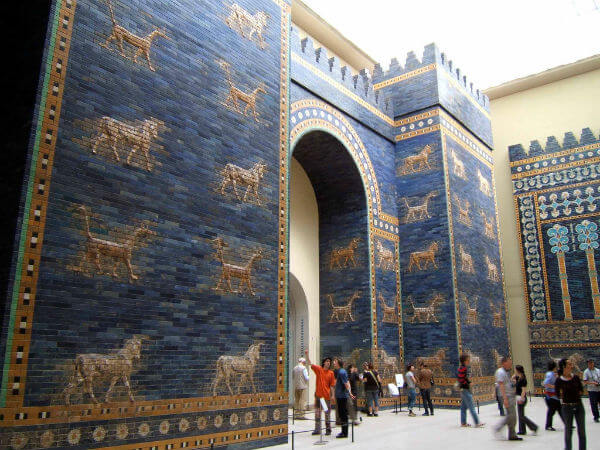
Ishtar_Gate_at_Berlin_Museum

The New York Times reports: The Pergamon Museum is home to the famous Ishtar Gate, a monument of blue and white tile decorated with golden lions and daisies that was once the entrance to ancient Babylon. When Kamal Alramadhani, a 25-year-old Iraqi economics student, saw it for the first time this month, “I got goose bumps,” he said, pointing to his arm.

“It’s from Iraq,” he added quietly, through an Arabic translator. “My country.” A native of Mosul, Mr. Alramadhani studied economics at the University of Baghdad and came to Germany in October, part of a wave of asylum seekers that is stirring opposition here but also leading the government to look for ways to help the migrants adjust.

That afternoon, Mr. Alramadhani and about 30 others — some of them teenagers who had walked much of the way from Syria — were visiting the museum for the first time, on a free Arabic-language tour. It is part of a new and growing state-financed program to introduce the refugees to Germany’s cultural heritage — even, of course, when some of that heritage comes from the Middle East.

The visits can be fraught. “Sometimes people say: ‘The Germans have all our heritage! They stole it!’” said Zoya Masoud, 27, who led the Arabic-language tour that afternoon at the Museum of Islamic Art, which is part of the Pergamon Museum and filled with treasures from empires past. Often, the visitors say the art is probably better off in Berlin because so much in Syria has been destroyed by the war and the Islamic State, Ms. Masoud said.

Other times, the tours bring up raw memories for visitors who have arrived in the last three months. At a painted marble wall niche from a house in Damascus that dates to the 15th and 16th century and was inhabited by Samaritans, a Christian minority, “some people want to cry,” Ms. Masoud said. “When they see the colors and the shapes, they get chills.”

Ms. Masoud is not a refugee — she grew up in Damascus, a child of Syrian and Lebanese parents, and moved to Europe to study in 2010, before Syria fell into civil war. She is one of 19 guides — 18 from Syria and one from Iraq — who are part of a program, called Multaka, or “meeting point” in Arabic, which began in December and is aimed at training refugees to become museum guides. [Continue reading…]

Facebooktwittermail

Report spells out dangers of killer robots

The New York Times reports: A new report written by a former Pentagon official who helped establish United States policy on autonomous weapons argues that such weapons could be uncontrollable in real-world environments where they are subject to design failure as well as hacking, spoofing and manipulation by adversaries.

In recent years, low-cost sensors and new artificial intelligence technologies have made it increasingly practical to design weapons systems that make killing decisions without human intervention. The specter of so-called killer robots has touched off an international protest movement and a debate within the United Nations about limiting the development and deployment of such systems.

The new report was written by Paul Scharre, who directs a program on the future of warfare at the Center for a New American Security, a policy research group in Washington, D.C. From 2008 to 2013, Mr. Scharre worked in the office of the Secretary of Defense, where he helped establish United States policy on unmanned and autonomous weapons. He was one of the authors of a 2012 Defense Department directive that set military policy on the use of such systems. [Continue reading…]

Facebooktwittermail

Tech companies are eating journalists’ lunch. Shouldn’t they at least pay for it?

Richard Jones, University of Huddersfield

Journalism is in an existential crisis: revenue to news organisations has fallen off a cliff over the past two decades and no clear business model is emerging to sustain news in the digital era.

In the latest in our series on business models for the news media, Richard Jones asks whether tech companies that benefit from journalism should pay a levy to help sustain it.

Twitter was once described as the most significant innovation in journalism since the telephone. More than three quarters of journalists in the UK use it to gather stories, promote their own work and keep up with what’s going on.

But Twitter is in trouble. User growth slows every quarter, and is flat in the US. Squished between Facebook, Google and Apple, and under pressure to do more to tackle abuse, Twitter has lost some of its sparkle, not least to Facebook-owned Instagram and WhatsApp.

Now back at the helm of the company he co-founded, Jack Dorsey recently signalled that Twitter’s most famous feature – the 140-character limit – might soon be lifted.

Continue reading

Facebooktwittermail

The Arab world and the West: A shared destiny

Jean-Pierre Filiu discusses his book, Les Arabes, leur destin et le nôtre, which aims to shed light on struggles in the Arab World today by exploring the entwined histories of the Arab World and the West, starting with Bonaparte’s expedition to Egypt in 1798, through military expeditions and brutal colonial regimes, broken promises and diplomatic maneuvers, support for dictatorial regimes, and the discovery of oil riches. He also discusses the “Arab Enlightenment” of the 19th Century and the history of democratic struggles and social revolts in the Arab world, often repressed.

Filiu is also the author of From Deep State to Islamic State: The Arab Counter-Revolution and its Jihadi Legacy, “an invaluable contribution to understanding the murky world of the Arab security regimes.”

Facebooktwittermail

Brexit has the potential to destroy the EU

Wolfgang Münchau writes: There is now a real possibility that the EU system for border and immigration controls will break down in about 10 days. On March 7, EU leaders will hold a summit in Brussels with Ahmet Davutoglu, the Turkish prime minister.

The idea is to persuade Ankara to do what Greece failed to do: protect the EU’s south-eastern border and halt the flow of immigrants. There is a lot of behind-the-scenes diplomacy going on between Germany and Turkey. The mood in Berlin, however, is not good.

The action taken by Austria, Hungary and other countries to protect their national borders has shut the western Balkan route along which migrants had made their way to Germany.

Refugees now find themselves trapped in Greece. Some may leave for Italy by boat. When those who survive the journey arrive there, I would expect Slovenia, Switzerland and France to close their borders. At that point, we should no longer assume that the European Council of heads of government is a functioning political body.

A refugee crisis that spins out of control could tilt the vote in the British referendum. There is no way the EU will be able to deal with two simultaneous shocks of such size. Coming at a time like this, Brexit has the potential to destroy the EU.

I do not expect such a doomsday scenario, but it is not implausible either. The EU is about to face one of the most difficult moments in its history. Member states have lost the will to find joint solutions for problems that they could solve at the level of the EU but not on their own. The EU’s population of more than 500m can easily absorb 1m refugees a year. No member state can do this alone, even Germany. [Continue reading…]

Facebooktwittermail

World economy stands on the cusp of another crash, warns former Bank of England governor

The Telegraph reports: Former Bank of England Governor Lord Mervyn King has warned that the world is on the cusp of another crash because regulators’ have failed in their attempts to reform the financial system in the wake of the last crisis.

“Another crisis is certain, and the failure…to tackle the disequilibrium in the world economy makes it likely that it will come sooner rather than later,” Lord King says in his new book, the exclusive serialisation of which starts in The Telegraph this weekend.

Since the last crisis, “governments and regulators have been hyperactive at the national and international level” but “bankers and regulators have colluded in a self-defeating spiral of complexity”, he claims. [Continue reading…]

Facebooktwittermail

After elections, Iranian women’s demands are forgotten

Massoumeh Torfeh writes: Iran’s parliamentary elections this year included the highest number ever of women candidates from the combined reformist-moderate camp. Supporters of President Hassan Rouhani joined forces with the reformists presenting a combined list of 30 candidates for Tehran, eight – less than one-third – of which are women.

More or less, the same pattern was seen across the country. Photos of women candidates were branded around on campaign posters and the reformist media hailed this as a major success.

Despite persistent attempts by women to find a voice in the politics of the Islamic Republic, their presence has been minimal and, for the most part, cosmetic. It is now almost the norm that at important historical junctures, the male-dominated conservative establishment calls upon women to perform their “Islamic duty” and participate in elections. Once the elections are over, however, women’s demands are forgotten.

The encouragement to participate in this year’s elections came first from the spiritual leader Ayatollah Ali Khamenei. [Continue reading…]

Facebooktwittermail

Iran executed all adult men in one village for drug offences, official reveals

The Guardian reports: The entire adult male population of a village in southern Iran has been executed for drug offences, according to Iran’s vice-president for women and family affairs.

The matter came to light earlier this week after Shahindokht Molaverdi revealed it during an interview with the semi-official Mehr news agency in rare comments from a senior government official highlighting the country’s high rate of executions of drug traffickers.

“We have a village in Sistan and Baluchestan province where every single man has been executed,” she said, without naming the place or clarifying whether the executions took place at the same time or over a longer period. “Their children are potential drug traffickers as they would want to seek revenge and provide money for their families. There is no support for these people.” [Continue reading…]

Facebooktwittermail