Category Archives: Issues

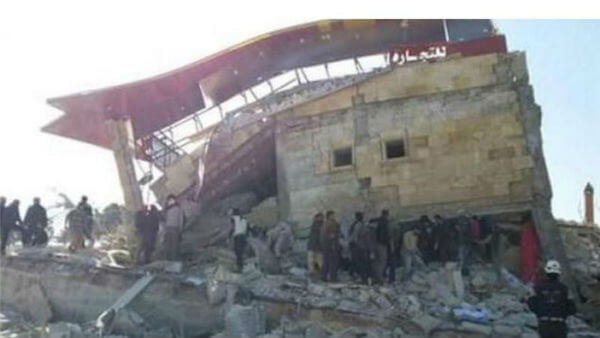
Syria’s UN envoy claims MSF hospital was front for French intelligence and got bombed by the U.S.

AFP reports: Syria’s U.N. envoy on Tuesday accused the medical aid charity MSF of being a front for French intelligence in Syria and dismissed allegations that Russian air strikes had destroyed one of its hospitals.

“The so-called hospital was installed without any prior consultation with the Syrian government by the so-called French network called MSF which is a branch of the French intelligence operating in Syria,” said Ambassador Bashar Jaafari.

Doctors Without Borders (MSF) said at least 11 people were killed after the hospital in Idlib province was destroyed on Monday morning, but it did not assign blame for the attack.

“They assume the full consequences of the act because they did not consult with the Syrian government,” Jaafari told reporters.

“They did not operate with the Syrian government permission.”

He repeated Syrian claims that the U.S.-led coalition had carried out the air strikes that hit the MSF-backed hospital. [Continue reading…]

Facebooktwittermail

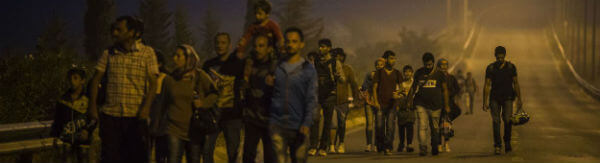
Spring could bring a fresh surge of refugees — but Europe isn’t ready for them

refugees1

The Washington Post reports: After an unparalleled tide of asylum seekers washed onto European shores last summer and fall, the continent’s leaders vowed to use the relative calm of winter to bring order to a process marked by chaos.

But with only weeks to go before more favorable spring currents are expected to trigger a fresh surge of arrivals, the continent is no better prepared. And in critical respects, the situation is even worse.

Ideas that were touted as answers to the crisis last year have failed or remain stuck in limbo. Continental unity lies in tatters, with countries striking out to forge their own solutions — often involving a razor-wire fence. And even the nations that have been the most welcoming toward refugees say they are desperately close to their breaking point or already well past it.

The result, analysts say, is a continent fundamentally unequipped to handle the predictable resurgence of a crisis that is greater than any Europe has faced in its post-Cold War history. [Continue reading…]

Facebooktwittermail

Assad preparing to handover Syria’s energy sector to Russia

The New Arab reports: The regime of Bashar al-Assad is reportedly seeking to rehabilitate and operate oil fields and power plants in areas controlled currently by the rebels and the Islamic State group respectively — areas that the regime forces began recapturing in northern and Western Syria backed by Russian airstrikes.

Measures are already in place by the Syrian regime to hand over the Syrian energy sector to Russian companies, led by a law on partnership between the private sector and foreign companies issued in early 2016.

Last month as well, Russian press reports said Bashar al-Assad, during a recent visit to Moscow, signed an agreement consisting of ten clauses purportedly giving Russia the right to freely operate in Syria, which cannot be revoked except by written agreement.

In the same vein, a recent report published by Russia’s RIA agency said Syria’s ambassador to Moscow, Riad Haddad, had met with the chairman of Russian gas company Gazprom Alexei Miller, and discussed giving Russian energy firms oil and gas concessions in Syria and other forms of cooperation. [Continue reading…]

Facebooktwittermail

Why ISIS hates the Sufis and blows up their shrines

Nile Green writes:

The soul that denies true love as its motto
Were better unborn; its existence is dishonour.
So be drunk with love, for love is all there is.
Unless you deal with love, the way to God is closed.

These words were among the hundreds of poems written by Rumi, the 13th-century Sufi apostle of love. Such was Rumi’s status in previous centuries that his epic Masnavi was called ‘the Quran in Persian’. For those who have read his verse, it’s hard to understand how anyone could despise the beauty of Sufi Islam. Considering that the Sufis always presented themselves as the loyal heirs of the Prophet Mohammad, it’s even harder to understand why Muslims should despise them. And yet over the past century, wave after wave of Muslim reform and renewal movements have rejected almost every aspect of Sufi Islam. The Islamic State of Iraq and Syria (ISIS) – whose franchises have sentenced Sufis to death in Syria and bulldozed their shrines in Libya – is only the latest of these anti-Sufis.

Why?

Here are a few reasons. [Continue reading…]

Facebooktwittermail

Apple encryption case risks influencing Russia and China, privacy experts say

The Guardian reports: Authoritarian governments including Russia and China will demand greater access to mobile data should Apple lose a watershed encryption case brought by the FBI, leading technology analysts, privacy experts and legislators have warned.

Apple’s decision to resist a court order to unlock a password-protected iPhone belonging to one of the San Bernardino killers has created a worldwide privacy shockwave, with campaigners around the world expecting the struggle to carry major implications for the future of mobile and internet security. They warned that Barack Obama’s criticism of a similar Chinese measure last year now risked ringing hollow.

Senator Ron Wyden of Oregon, a leading legislator on privacy and tech issues, warned the FBI to step back from the brink or risk setting a precedent for authoritarian countries.

“This move by the FBI could snowball around the world. Why in the world would our government want to give repressive regimes in Russia and China a blueprint for forcing American companies to create a backdoor?” Wyden told the Guardian.

“Companies should comply with warrants to the extent they are able to do so, but no company should be forced to deliberately weaken its products. In the long run, the real losers will be Americans’ online safety and security.” [Continue reading…]

Facebooktwittermail

The more Donald Trump defies his party, the more his supporters cheer

The New York Times reports: Mark Jebens, a veteran of 22 years in the Marine Corps, found no fault with Donald J. Trump’s scathing criticism that President George W. Bush “lied” about weapons of mass destruction while leading the United States into war in Iraq.

“At the end of the day, a lot of good Marines and sailors and airmen died over something that wasn’t there,” said Mr. Jebens, who served three combat tours in Iraq. “So you’ve got to ask tough critical questions. In the military we called it a debrief or a hot wash.”

Mr. Trump’s hot wash of Mr. Bush in a debate on Saturday, including a suggestion that he did not heed intelligence warnings before the Sept. 11, 2001, terrorist attacks, convinced many Republicans that Mr. Trump had finally gone too far, tarring a former president who is popular in military-friendly South Carolina, and uttering charges that Rush Limbaugh, for one, called “liberal Democrat lingo.”

But numerous military veterans interviewed at Trump rallies in South Carolina this week, including Mr. Jebens, said they had no problem with Mr. Trump’s comments, even if they did not entirely agree with him. [Continue reading…]

Facebooktwittermail

The world’s failure to stop the massacre in Syria is based on a string of lies

Amir Tibon writes: In my conversations with the refugees [at a camp in Serbia] last month, I asked them about some of these lies as if they were well-established truths. Not because I believe them — but rather, because so many people, all over the world, hear and read these lies every day that it’s impossible to ignore them.

It felt dumb, for instance, to ask a family — father, mother, three children aged 12 to 3 — who had just escaped from the burning city of Aleppo, what they thought about “Russia’s bombing campaign against ISIS.” Of course, there is no such thing. Russia isn’t focusing its effort on bombing ISIS, but rather on trying to kill the people I was talking to, who are Syrian civilians. Yet conducting the interview without treating this big lie as if it is simply an alternate explanation of events would be considered “biased reporting.” So, I ask the question and get looks of disbelief, and worse.

Nadia, the mother of this family, told me that “the Russians are the worst thing that happened to us. We survived everything before them, but when they came in to help Bashar, we said — enough. They bomb schools, hospitals, refugee camps, buses carrying people to the border.” What specifically did their involvement mean, I asked her. Her reply: “I would ask myself every morning — how are the Russians going to try to kill my children today?”

Her husband, Yasser, a merchant who owned two stores in the city, disagrees with this analysis — he thinks Shiite militias supported by Iran are an even greater danger than Putin’s air force. “We ran away from the city because we know that after the Russians will finish it, the Iranians will come in. The Iranians are sending people to kill us for Assad.”

These militias, which are entering Syria from neighboring Iraq, have quite a reputation when it comes to killing. “They are just like ISIS, only difference is they are Shi’a and they talk Farsi,” says Yasser. “Tell me — why isn’t anyone bombing them? Why is the entire world only talking about ISIS? The Iranians in Syria burn people alive, burn children and women. Where is the world?” The couple then apologized, explaining they had much more to say, but their youngest daughter started crying, and anyway, they had to leave for the bus. They have six more days on the road ahead of them before reaching Germany.

The biggest lie of them all is that Bashar al-Assad, even more than Vladimir Putin, wants to defeat ISIS. The civil war in Syria, we are told more and more as of late, is actually a choice between Assad and ISIS. Framing the conflict in such terms makes it legitimate and acceptable to cooperate with Assad, a man who is responsible for the deaths of over a quarter of a million people. I tried to ask each and every Syrian I talked to one simple and “neutral” question that has to do with this falsehood. The question was — “Who are you running away from?” The vast majority of people didn’t choose Assad or ISIS — they said they are running away from both.

“The world needs to understand that Assad and ISIS are not enemies — they are partners in destroying our lives,” explained Muhammad, 24, from Aleppo, who stayed in the bombarded city for the last five years because he wanted to complete his university studies before getting out. “It’s like a coin that has two bad sides to it. Doesn’t matter which way you flip it, you’ll end up dead. As long as there is Assad, there will be ISIS. His violence against the Sunni people in Syria is what created ISIS in the first place.”

One man in his 50s, who presented himself in perfect English as a university professor from Aleppo, added: “I’m running away from Da’esh (the Arabic name for ISIS), but there are many different kinds of Da’esh operating in Syria today. There is Da’esh-Da’esh, the people who cut off heads and burn prisoners in cages. There is also Da’esh-Assad, which is actually much worse, and Da’esh-Iran, the Iranian militias who rape and murder women in front of their children’s eyes. They have much more money and capabilities, and they don’t film themselves while doing their atrocities. They are smart enough to hide it from the world. In addition to all these, there is also Da’esh-Putin. I’m coming from Aleppo; I’ve seen the results of his bombings. It’s a massacre. People are killed like cockroaches under a shoe. And then there is Da’esh-the West, which I think is the worst! I mean the civilized world, doing nothing to stop all of this.” [Continue reading…]

Facebooktwittermail

Will Merkel pay for doing the right thing?

Merkel

Roger Cohen writes: A former German chancellor, Gerhard Schröder, recently called Angela Merkel’s decision to open the door to an unlimited number of refugees a “mistake” and offered this verdict: Merkel had a “heart, but no plan.”

This view of the German leader, who is beloved but now begrudged, is gaining ground as refugees from a ravaged Syria and elsewhere pour in. Local authorities are strained to the limit. Billions of euros have been spent with no end in sight. Many people came in whose identities are unknown; they have to register if they want handouts, but some have not and there are security concerns. Cologne has become a byword for concern over how a large influx of Muslim men will affect the place and security of women in German society.

Three important state elections loom next month. It seems inevitable the far-right Alternative for Germany Party will surge. Merkel will be blamed. Her support has already tumbled. One poll this month showed 46 percent of Germans support her, compared with 75 percent in April last year — and that’s with a strong economy. She could be vulnerable if her Christian Democratic Party turns on her. Europe without Merkel will sink.

So why did this customarily prudent chancellor do it? Because she is a German, and to be German is to carry a special responsibility for those terrorized in their homeland and forced into flight. Because she once lived in a country, East Germany, that shot people who tried to cross its border. Because a united Europe ushered Germany from its darkest hour to prosperity, and she is not about to let the European Union pitch into mayhem on her watch — as it would with more than a million ragged refugees adrift. And, yes, because she has a heart.

Merkel did the right thing. The question now is how she handles the consequences. [Continue reading…]

Facebooktwittermail

To be a refugee is much harder for a woman than for a man

Renate van der Zee reports from the transit camp of Vinojug on the Macedonian-Greek border: In the camp’s supposedly “child-friendly” space, 25-year-old Nameen, from Homs, is nursing her tiny baby daughter. She went into labour as she was travelling through Turkey. “Fortunately they could get me to the hospital in time. The delivery went well,” she says with a faint trace of a smile.

Nameen stayed in the hospital for two days, rested for another 10 days in Turkey, and then crossed the Mediterranean in a dinghy with her baby in her arms.

“All I could think of was my girl, I was so scared she would drown or get ill. It was so cold. I am still worried for her safety, day and night.”

The other women in Vinojug agree: to be a refugee is much harder for a woman than for a man.

Amnesty International and the UN refugee agency, UNHCR, recently presented reports on the vulnerable position of women refugees and the dangers they face.

Europe is failing to provide basic protection for them, the Amnesty report stated.

This problem is now all the more critical because the percentage of women among the refugees who travel through Europe has risen dramatically. Exact data is not available, but according to UNHCR, last summer, a quarter of the refugees were women and children – now it is 55 percent. [Continue reading…]

Facebooktwittermail

Russian airstrikes targeted hospitals: ‘The planes returned several times,’ says eyewitness

msf-hospital

Syria Direct reports: Reported Russian airstrikes knocked three hospitals in northern Syria out of service on Monday, depriving more than 5,000 patients a month of care ahead of the deadline for a “cessation of hostilities” deal worked out between major powers at last week’s annual Munich Security.

The ceasefire, notably, excludes the Islamic State in addition to Jabhat a-Nusra, one of the lead factions in the Victory Army that controls nearly all of Idlib province.

Two hospitals, one belonging to Doctors Without Borders (MSF), were bombed in Idlib province on Monday. A third, a women and children’s hospital in the city of Azaz near the Turkish border, was also hit.

The National Hospital, also in Maarat al-Nuaman, was bombed shortly after the strikes on the MSF facility, Amjed al-Idlibi, a first responder with the Civil Defense who worked to extract the dead and wounded, told Syria Direct Tuesday.

“Both hospitals were hit directly…the planes returned several times to conduct air raids, with roughly 10 minutes between each raid,” said al-Idlibi. He said that the planes were Russian. [Continue reading…]

Meanwhile, Russia’s TASS reports: The Kremlin has dismissed as unacceptable the allegations the Russian air group in Syria has destroyed a hospital in Syria.

“We are strongly against such claims, the more so, since each time those who come up with such charges prove unable to somehow confirm their groundless accusations,” Russian presidential spokesman Dmitry Peskov has said.

Asked for a comment regarding reports a hospital in Syria’s Idlib province had been bombed, as well as claims the Russian air group was responsible, Peskov invited everybody to rely “on the root source first and foremost.” “In this particular case the representatives of Syrian authorities are the root source,” he said.

Peskov recalled that Syria’s ambassador to Russia, Riyadh Haddad, said on Tuesday the hospital in Idlib province was destroyed by the Americans, and not the Russian air group. [Continue reading…]

Note the reasoning of the propagandists: The allegations that the airstrikes on hospitals were carried out by Russia are firstly dismissed as “groundless accusations” and secondly dismissed by repeating a groundless accusation made by Syria’s ambassador to Russia — that these were U.S. airstrikes.

Unfortunately, there exists an uncritical audience all too willing to swallow this kind of shameless lying and tortured reasoning.

Facebooktwittermail

Kurds carve out new reality in northern Syria

The Guardian reports: Amid the chaos in northern Syria in recent months, several themes have emerged.

The first is that Islamic State has been spared from intensified Russian airstrikes and advances by pro-regime forces. The second, and potentially more important development, is that one of the war’s least visible players – the Kurds – have done more than anyone else to carve out a new reality.

As Lebanese Hezbollah, militias from Iraq, and Syrian troops – all led by Iran – have inched their way around the top of Aleppo, the Kurdish YPG, supported by Russian air cover, has been making strident moves towards areas they have avoided throughout the conflict.

Over the weekend, the YPG moved towards two Syrian towns between the Turkish border and the almost besieged Aleppo, after earlier seizing an airbase that had been held by the opposition. Throughout the war, the YPG had been viewed warily by the opposition, and given a wide berth by the regime.

Now, though, its moves have sharply expanded a footprint in the north, alarming rebels who have been distracted by other foes, and Turkey, which had vowed never to let the Kurds dominate its border with Syria.

The Kurds are ascendant, and the Turks are enraged. Ankara sees YPG militants, who are affiliated with the Kurdistan Workers’ party (PKK), as vying to own areas they have never before controlled, to establish a foothold from Irfin in Syria’s north-west to the Iraqi border, a frontier dominated for decades by Arabs.

Helping the YPG do that are the same Russian jets that are steadily destroying Turkish-supported rebel groups, whose three-year push to oust Bashar al-Assad increasingly looks lost. [Continue reading…]

Facebooktwittermail

How Scalia’s death might help our planet

Eric Holthaus writes: Supreme Court Justice Antonin Scalia’s death at a remote Texas ranch has triggered a political earthquake and instantly changes the outlook for a host of high-profile issues the court is currently considering. But perhaps none of these are as consequential as the fate of the planet itself. As Climate Central’s John Upton wrote, “in dying, Scalia may have done more to support global climate action than most people will do in their lifetimes.”

Scalia’s death comes just days after the Supreme Court issued an unprecedented stay that temporarily blocked the implementation of the Clean Power Plan, Obama’s centerpiece climate legislation. The Clean Power Plan isn’t perfect, but it was on pace to double the already accelerating rate of coal-fired power plant retirements by 2040. Last week’s surprising action by the Supreme Court — dubbed a “nightmare scenario” by the Hill — raised substantial fears among environmentalists that the court’s conservatives might eventually block the Clean Power Plan completely. At the very least, the stay buys some time for Republican hopefuls in this year’s presidential election; if one were to win, he could just cancel the executive order that launched the plan in the first place.

The stay is still in place, but the climate law experts I talked to say Scalia’s death greatly boosts the eventual survival chances of the Clean Power Plan. A 4-4 court would guarantee that the lower court ruling would stand—and the D.C. Circuit Court is expected to approve the plan. [Continue reading…]

Facebooktwittermail

Peter Van Buren: Minimum wage, minimum chance

To say that we live on a 1% planet isn’t just a turn of phrase. In fact, it would undoubtedly be more accurate to speak of a .1% or a .01% planet.  In recent years, wealth and income inequalities have grown in a notorious fashion in the United States — and, as it turns out, globally as well. In January, Oxfam released a report on the widening gap between global wealth and poverty. It found that, between 2010 and today, the wealth of the poorest half of the planet’s population fell by a trillion dollars, a drop of 41%, while that of the richest 62 people (53 men and nine women) increased by half a trillion dollars.  Put another way, those 62 billionaires were wealthier than the bottom 50% of the world’s people, while the richest 1% owned more than the other 99% combined.  The direction in which we’re heading is obvious.  Just consider that, in 2010, it took 388 of the super-rich to equal the holdings of the bottom 50%; now, that number is 326 people smaller.

Keep that trend line in mind as you read about TomDispatch regular Peter Van Buren’s latest adventures in the minimum-wage economy. Back in 2014, he described for this site how, having lost his State Department job for being a whistleblower on the Iraq War, he fell for a time into the low-wage world. As he wrote, “And soon enough, I did indeed find myself working in exactly that economy and, worse yet, trying to live on the money I made. But it wasn’t just the money. There’s this American thing in which jobs define us, and those definitions tell us what our individual futures and the future of our society is likely to be. And believe me, rock bottom is a miserable base for any future.” His experiences in a big-box retail store inspired him to write his novel, Ghosts of Tom Joad: A Story of the #99Percent. As last year ended, he returned to the minimum-wage world, now — thanks in particular to Bernie Sanders — part of the national conversation. And here’s what he found. Tom Engelhardt

Nickel and dimed in 2016
You can’t earn a living on the minimum wage
By Peter Van Buren

When presidential candidate Bernie Sanders talks about income inequality, and when other candidates speak about the minimum wage and food stamps, what are they really talking about?

Whether they know it or not, it’s something like this.

My Working Life Then

A few years ago, I wrote about my experience enmeshed in the minimum-wage economy, chronicling the collapse of good people who could not earn enough money, often working 60-plus hours a week at multiple jobs, to feed their families. I saw that, in this country, people trying to make ends meet in such a fashion still had to resort to food benefit programs and charity. I saw an employee fired for stealing lunches from the break room refrigerator to feed himself. I watched as a co-worker secretly brought her two kids into the store and left them to wander alone for hours because she couldn’t afford childcare. (As it happens, 29% of low-wage employees are single parents.)

At that point, having worked at the State Department for 24 years, I had been booted out for being a whistleblower. I wasn’t sure what would happen to me next and so took a series of minimum wage jobs. Finding myself plunged into the low-wage economy was a sobering, even frightening, experience that made me realize just how ignorant I had been about the lives of the people who rang me up at stores or served me food in restaurants. Though millions of adults work for minimum wage, until I did it myself I knew nothing about what that involved, which meant I knew next to nothing about twenty-first-century America.

Continue reading

Facebooktwittermail

The BuzzFeed business model: data, learning, dollars

Fast Company reports: Across all the platforms where it now publishes content, the company generates 5 billion monthly views—half from video, a business that effectively did not exist two years ago. Traffic to the website has remained steady — 80 million people in the U.S. every month, putting it ahead of The New York Times — even though as much as 75% of BuzzFeed’s content is now published somewhere else.

BuzzFeed has become the envy of the media world for its seemingly magical ability to engineer stories and ads that are shared widely — whether it’s a dress that looks to be either white and gold or blue and black, an investigation into taxpayer-funded “ghost schools” in Afghanistan, or an older cat imparting wisdom to a kitten on behalf of Purina. Rivals in the insular media world carp that BuzzFeed is gaming Facebook’s algorithm, or buying ads to pump up its content, and both are unsustainable; viral smashes like the dress are mere luck; even traditional brands such as The Washington Post can beat BuzzFeed with their own traffic-oriented gambits.

What’s lost here is a true understanding of what Peretti, one of the world’s most astute observers of Internet behavior, has built. The company’s success is rooted in a dynamic, learning-driven culture; BuzzFeed is a continuous feedback loop where all of its articles and videos are the input for its sophisticated data operation, which then informs how BuzzFeed creates and distributes the advertising it produces. In a diagram showing how the system works, Peretti synthesized it down to “data, learning, dollars.” [Continue reading…]

Facebooktwittermail

Airstrikes hit hospitals in northern Syria; MSF views Russia or Assad’s forces as responsible

msf-hospital

The Guardian reports: Airstrikes have hit hospitals in two locations in northern Syria – marking the latest in a series of attacks on medical facilities and workers in the five-year civil war.

Médecins Sans Frontières said seven people were killed when a facility it supports in Maaret al-Numan, Idlib province, was hit four times in two separate raids. Mego Terzian, MSF’s France president, told Reuters he thought that either Russia or Syrian government forces were responsible. Both have been engaged in an unrelenting aerial bombardment in Idlib.

The hospital, which has 54 staff and 30 beds, is financed by the medical charity, which also supplies medicine and equipment.

“The destruction of the hospital leaves the local population of about 40,000 people without access to medical services in an active zone of conflict,” said Massimiliano Rebaudengo, MSF’s head of mission in Syria.

In separate incident, Syrian opposition activists said a missile struck a children’s hospital in the rebel-held town of Azaz, near the Turkish border, killing 10 and wounding more than 30. The Turkish prime minister, Ahmet Davutoğlu, said a Russian ballistic missile had hit the town. [Continue reading…]

Reuters adds: Residents in both towns blamed Russian strikes, saying the planes deployed were more numerous and the munitions more powerful than the Syrian military typically used. [Continue reading…]

Facebooktwittermail

Merkel isolated as EU partners slam door on refugees

AFP reports: Abandoned by France, defied by eastern Europe, German Chancellor Angela Merkel cuts a lonely figure in her struggle for EU “solidarity” on the refugee crisis ahead of a Brussels summit.

Merkel is battling for a deal that will see refugees more evenly spread around the European Union after Germany welcomed 1.1 million asylum seekers last year.

But instead, eastern European countries are planning new razor wire fences, and even Paris — traditionally Berlin’s closest EU ally — has shown little enthusiasm for Merkel’s welcome policy.

French Prime Minister Manuel Valls said Saturday that the mood in France was “not favourable” to Merkel’s call for a permanent quota system.

“Europe cannot take in all the migrants from Syria, Iraq or Africa,” Valls told German media. “It has to regain control over its borders, over its migration or asylum policies.”

US Secretary of State John Kerry praised Merkel for showing “great courage in helping so many who need so much” amid “the gravest humanitarian crisis in Europe since World War II”.

But he also told the Munich Security Conference that the mass influx spells a “near existential… threat to the politics and fabric of life in Europe”. [Continue reading…]

Facebooktwittermail

A political movement is rising from the mud in Calais

By Raphael Schlembach, University of Brighton

Since the official refugee reception centre in the French town of Calais closed in 2002, undocumented migrants hoping to cross the Channel to Britain have found shelter in a number of squatted migrant camps, locally known as “the jungles”.

Consisting largely of tents and self-built shacks, the two largest in Calais and Dunkirk now have some 8,000 residents between them. Many are refugees fleeing conflict in Syria, Afghanistan, Iraq and Sudan and surviving in extremely poor living conditions.

For the most part, this is a humanitarian disaster. But the jungles of Northern France are also giving rise to a new political movement, which draws in new supporters every day.

Continue reading

Facebooktwittermail

‘These countries [in Europe] prefer that we drown than live on their lands’

The New York Times reports: As NATO dispatches warships to the Aegean Sea in a new effort to contain the flow of refugees coming through Turkey and on to Europe, the deaths keep piling up: at least 400 so far this year, according to the International Organization for Migration. Already in 2016, more than 76,000 people — nearly 3,000 a day — have arrived in Greece from Turkey.

Increased patrols by the Turkish coast guard, plummeting temperatures and stormy seas — all factors that officials believed would lead to fewer crossings — have seemed to have little effect on the numbers.

If anything, there has been a surge in departures in recent weeks, as desperate refugees have taken advantage of the lower prices that smugglers typically charge during winter, when the journey is riskier than it is in summer. Those numbers could rise further, with a new wave of what Turkish officials say is now at least 100,000 refugees fleeing heavy Russian bombing raids and a Syrian government offensive near Aleppo this week.

“We have no choice but to leave now,” said Mahdi, 36, a Syrian refugee and former teacher who prepared to make the journey with his wife and two children, ages 11 months and 3. “It’s already hard to get to Europe, and it’s going to get harder because these countries prefer that we drown than live on their lands.” [Continue reading…]

Facebooktwittermail