Category Archives: Issues

The pragmatic case for Bernie Sanders

Christopher D Cook writes: As Bernie Sanders defies expectations with a resounding New Hampshire victory and a virtual tie in Iowa, Democratic Party leaders still insist Hillary Clinton is the pragmatic choice to beat Republicans and bring effective leadership and change — if incremental — to Washington. Clinton and her supporters frame the race, and her appeal, as a matter of “ready on day one” leadership and “get things done” practicality. But what does the record show, and what do leadership and pragmatism really mean?

On the pragmatics of electability, nearly every major national poll consistently shows Sanders equaling or bettering Clinton against all Republicans. Polls show Sanders nearly tied with Clinton nationally and rising. On electability, if anything, Sanders has the edge right now. There is nothing empirical to suggest Clinton’s superior electability — quite the contrary given her loss to Barack Obama in 2008 and her flagging campaign this year. While Clinton might gain more moderate Independents (particularly against a polarizing Republican nominee), Sanders can inspire massive Democratic and liberal Independent turnout and likely win over many white working-class swing voters.

Clinton’s most persistent attack—parroted by mainstream media — claims that Sanders’s agenda is perhaps laudable but unrealistic. Moderation is more effective, she claims. However, this is a misreading of American politics and factual comparisons of the candidates’ track records. [Continue reading…]

Facebooktwittermail

For Bernie Sanders, foreign policy is an afterthought

David Ignatius writes: Sanders’s statements on Syria suggest that he would take a position embraced by many self-described realists. His first priority, he has said, would be a “broad coalition, including Russia,” to defeat the Islamic State. “Our second priority must be getting rid of [President Bashar al-Assad], through some political settlement, working with Iran, working with Russia.”

Some critics would argue that it’s immoral to make replacing a leader who used chemical weapons a secondary concern. But Sanders’s defenders could argue that foreign policy is about making clear choices, especially when they aren’t easy.

Foreign policy just hasn’t been on Sanders’s radar: His campaign website lists 22 important issues. “Income and wealth inequality” is at the top, and 19 are about domestic policy. Just three involve foreign concerns, and one of these is climate change, which Sanders has described as the biggest threat to national security.

Unease about Sanders partly reflects the fact that he seems to have no real foreign policy mentors. The Sanders campaign made comical missteps in the past few weeks when it tried to name his key foreign policy advisers. Several of them said they had briefed the candidate just once or twice; one was a full-time White House staffer. [Continue reading…]

In place of foreign policy advisers, Sanders is most likely relying on foreign policy advice: the less said, the better.

Politically, that might be sound advice during an election campaign, but it has a corrosive effect because it does nothing to challenge the affliction that always distorts the way America deals with the world: the prevailing sense that the rest of the world doesn’t matter.

Isolationists can’t effectively tackle global issues — including climate change.

Facebooktwittermail

Donald Trump’s history as a reckless gambler

trump-house

Michael Crowley writes: In January 1992, a Japanese one-time billionaire named Akio Kashiwagi was found dead in his palatial home near Mt. Fuji. The scene was gruesome. The house’s white paper screens were spattered with blood. The 54-year-old had been stabbed as many as 150 times. By some reports the weapon of choice was a samurai-style sword.

The crime was never solved, though it bore the hallmarks of a killing by Japan’s criminal yakuza. Ostensibly a real estate investor, Kashiwagi was a mysterious figure reputed to have underworld connections. He was also one of the world’s top five gamblers, a “whale” in casino parlance, willing to wager $10 million in a single gaming bender.

And that is how he crossed paths with Donald J. Trump, then a budding Atlantic City casino mogul. In 1990 the two men had an epic and remarkably personal showdown in which millions of dollars changed hands in a matter of days, before it all ended in a flurry of recriminations. One of the Japanese mogul’s last statements to the U.S. media, through an aide, involved his plans to burn a copy of Trump’s book, The Art of the Deal.

After his murder, the New York Times reported that he owed at least $9 million to casinos in Atlantic City and Las Vegas. One unnamed casino Atlantic City executive told the paper that Kashiwagi had owed the Trump Plaza Hotel and Casino $4 million.

Trump is obsessed with winning, a topic he usually brings up in the context of his merciless deal-making style. But a crucial question about any would-be president who may be confronted with questions of war and peace is his attitude toward risk. Some presidents — Barack Obama comes to mind — are highly averse to it. Others roll the dice, as George W. Bush did when he invaded Iraq.

The story of Akio Kashiwagi, drawn from Trump’s memoirs and news accounts from the day, offers a revealing window into Trump’s instincts. It shows that Trump isn’t just a one-time casino owner — he’s also a gambler, prone to impulsive, even reckless action. In The Art of the Comeback, published in 1997, Trump explains that until he met Kashiwagi, he saw himself as an investor who dealt only in facts and reason. But his duel with the great whale in action made him realize “that I had become a gambler, something I never thought I was.”

Perhaps just as important, when gambling failed him, Trump didn’t quit: He doubled down. But he did it shrewdly, summoning a RAND Corporation mathematician to devise a plan that would maximize his chance of fleecing his Japanese guest.

And it worked. Kind of. In Trump’s recollection, which he shared for this story, his showdown with Kashiwagi was another one of his many great wins. Just don’t look too hard at the ledger. [Continue reading…]

Facebooktwittermail

Boycotting Israeli goods to become criminal offence for public bodies and student unions in UK

The Independent reports: Local councils, public bodies and even some university student unions are to be banned by law from boycotting “unethical” companies, as part of a controversial crackdown being announced by the Government.

Under the plan all publicly funded institutions will lose the freedom to refuse to buy goods and services from companies involved in the arms trade, fossil fuels, tobacco products or Israeli settlements in the occupied West Bank.

Any public bodies that continue to pursue boycotts will face “severe penalties”, ministers said. [Continue reading…]

Facebooktwittermail

How ex-Communists shaped American conservatism

Sam Tanenhaus writes: A paradox of 20th-century American politics is that its most sustained ideological movement, modern conservatism, was the brainchild of ex-Communists who had been disillusioned by the crimes of the Soviet revolution or caught on the wrong side of factional disputes. Estranged and unhappy, they went in search of a new god and helped create it—in the mirror image, it has often seemed, of the one that failed them the first time. Together they were “Stalin’s gift to the American Right,” John Patrick Diggins wrote in Up From Communism (1975), his account of four writers who exiled themselves from the left and then wandered like restless spirits before finding refuge in the pages of William F. Buckley Jr.’s National Review in the 1950s and early 1960s.

In Exit Right: The People Who Left the Left and Reshaped the American Century, Daniel Oppenheimer, a writer and a director of communications at the University of Texas at Austin who was born the year after Diggins’s book came out, reprises and updates the history of political defectors. To Oppenheimer’s credit, his own politics, which seem somewhere on the left, don’t intrude on the absorbing stories he tells. He begins with the ex-Communists Whittaker Chambers and James Burnham, then discusses two renouncers of liberalism, Ronald Reagan and Norman Podhoretz, and closes the circle with two casualties of the ’60s–’70s radical left, David Horowitz and Christopher Hitchens. “The ex-believers—the heretics, the apostates—are the problem children of any politics, in any time,” Oppenheimer writes. But the problem, he suggests, isn’t theirs. It’s ours. So quick to denounce or praise, and to demand to be told which side everyone is on, we forget that politics also offers parables of second thoughts and transformation. Ideological changelings, if we catch them mid-flight, remind us that “belief is complicated, contingent, multi-determined.” They can show us, too, “how hard it is to be a person in the world, period, and how much more confusing that task can become when you take on responsibility for repairing or redeeming it.” [Continue reading…]

Facebooktwittermail

The Syrian government, with Russia’s help, is driving its own people into exile

refugees4

Roy Gutman reports:  The airstrikes began just after midnight one week ago, as four or more warplanes criss-crossed the skies and unleashed missiles into the small town just northwest of Aleppo. The targets were private residences and apartments on the outskirts of Haritan, and then the town center.

The windows in Salah Hawa’s four-room house had already been shattered by an airstrike nearby last month. The latest blasts blew out the nylon sheets used to cover the gaps.

After two days and nights of attacks — possibly 300 missiles or more — Hawa, a 40-year-old English teacher, and his wife and four children, aged 5 to 16, fled to the nearby countryside in a neighbor’s pickup truck.

During one airstrike, his wife, Hasna, 39, lay down, and for an hour, “she couldn’t stand up out of fear,” Hawa recounted in a Skype conversation from northern Syria. “My children clung to me, crying, and said we are going to die.”

Hawa’s family, multiplied by 10,000, are the face of the latest mass displacement in Syria. They are now living in a village about 30 miles to the west, in Idlib province in a house shared with four other families. Tens of thousands of others displaced by the fighting headed to the closed border with Turkey, where accommodation was even more scarce.

It is the latest evidence of a dramatic shift in the war that began with the Russia air intervention last September 30. Russia claims to be bombing only “terrorists” and has told the Obama administration it is committed to a political settlement. But the real aim of the latest onslaught — which forced the United Nations to suspend peace talks before they even began — could be a lot more menacing.

The airstrikes cleared the way for Lebanon’s Hezbollah militia, Iraqi militias, and Afghan Hazara forces, which are officered by Iran’s Revolutionary Guard Corps and Syrian security forces, to make critical advances on the ground. Now Syrian President Bashar al-Assad is poised to surround Aleppo and besiege some 250,000 civilians living in the rebel-defended eastern sector.

If the military advances continue, Assad soon will also be able to block all military and humanitarian aid now flowing across the border from Turkey. But Assad is also in a position to drive millions of Syrians out of their country into Turkey, which will be hard pressed to stop them from continuing on to Europe. Mass displacement increasingly appears to be the aim of the military operation, and not just a side effect, humanitarian aid officials say.

“The Syrian government is driving its people into exile and the Russians are playing a major part, forcing civilians to Turkey which, caught between this violent exodus and pressure from Europe, risks being destabilized,” said Rae McGrath, head of the Mercy Corps program in Turkey and north Syria. “How can we talk about protecting civilians in the midst of this cynical disregard for the most basic humanitarian principles?” [Continue reading…]

Zachary Laub spoke to Noah Bonsey, senior Syria analyst for the International Crisis Group:
Do these sieges reflect the strategy of the Assad regime?

The regime’s military strategy, supported and increasingly embraced by its backers, is based heavily on collective punishment, [which is] especially important given the regime’s manpower disadvantage. This is one of the reasons we see such heavy use of bombing that is not indiscriminate so much as it is discriminately targeting civilian areas and civilian infrastructure. This is also why we see the siege tactics, which in some cases bring rebel[-held] areas to the point of starvation.

As civilians leave areas, regime advances can become easier. These tactics are also applied as a means of raising the price of resistance to the communities as a whole, so that communities pressure the fighters in their area to accept what the regime offers as cease-fire terms, but also, effectively, to surrender.

The Feb. 11 meeting of the International Syria Support Group [ISSG] came as fledgling peace talks in Vienna appeared to be at an impasse. Where do these efforts on a political transition stand?

The political process is based on the premise of U.S.-Russian sponsorship in which the U.S. is the point man rallying the opposition and its backers to a serious negotiating process, and Russia is to do that for the regime side. The reason this current round of the political process is surrounded by such skepticism is that while the U.S. appears enthusiastic—almost desperate—to get some sort of political process moving, Russia appears far less interested in making the process viable at this stage. Russia’s decision to escalate dramatically its aerial attacks on Aleppo—areas with heavy civilian populations—the very day the opposition delegation arrived in Geneva for talks was the latest in a series of indications that Russia is happy to see this political process stall or, potentially, even derail. [Continue reading…]

Facebooktwittermail

Over half the world’s population suffers from ‘severe’ water scarcity, scientists say

shadow16

The Washington Post reports: Alarming new research has found that 4 billion people around the globe — including close to 2 billion in India and China — live in conditions of extreme water scarcity at least one month during the year. Half a billion, meanwhile, experience it throughout the entire year.

The new study, by Mesfin Mekonnen and Arjen Hoekstra of the University of Twente in the Netherlands, uses a high resolution global model to examine the availability of “blue water” — both surface and underground freshwater — in comparison with the demand for it from agriculture, industry and human household needs. The model — which zoomed in on areas as small as 60 kilometers by 60 kilometers in size at the equator — also took into account climatic factors, ecological ones (how much water is needed to sustain a river ecosystem or lake) and other causes of depletion such simple evaporation.

“We find that 4 billion people live in areas that experience severe water scarcity at least part of the year, which is more than previously thought, based on those earlier studies done on an annual basis,” says Hoekstra, who published the work in Science Advances Friday. “You have to look really month by month, in order to get the scarcity.” [Continue reading…]

Facebooktwittermail

As Europe faces worst crises since World War II, few expect help from Washington

Josh Rogin writes: Europe is facing a convergence of the worst crises since World War II, and the overwhelming consensus among officials and experts here is that the U.S. no longer has the will or the ability to play an influential role in solving them.

At the Munich Security Conference, the prime topics are the refugee crisis, the Syrian conflict, Russian aggression and the potential dissolution of the European Union’s very structure. Top European leaders repeatedly lamented that 2015 saw all of Europe’s problems deepen, and unanimously predicted that in 2016 they would get even worse.

“The question of war and peace has returned to the continent,” German Foreign Minister Frank-Walter Steinmeier told the audience, indirectly referring to Russian military interventions. “We had thought that peace had returned to Europe for good.”

What was missing from the conference speeches and even the many private discussions in the hallways, compared to previous years, was the discussion of what Europe wanted or even expected the U.S. to do. [Continue reading…]

Facebooktwittermail

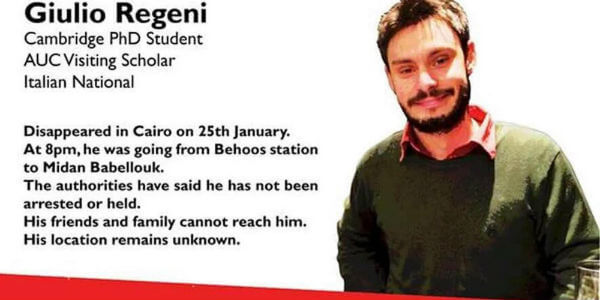
Italian student murdered in Cairo showed signs of electrocution and other forms of torture

GIULIO-REGENI

Reuters reports: Egypt’s forensics authority handed over to the prosecutor general’s office on Saturday its final autopsy report on the Italian student who was tortured and found dead in Cairo last week.

Giulio Regeni, 28, had been researching independent trade unions in Egypt and had written articles critical of President Abdel Fattah al-Sisi’s government – prompting speculation that he was killed at the hands of Egypt’s security forces.

Egypt’s interior and foreign ministers both dismissed the notion of security forces being behind Regeni’s murder.

The prosecutor general’s office said it would not publicly disclose the contents of the report as the investigation was ongoing. Reuters was not able to obtain a copy to verify the contents.

However, a senior source at the forensics authority told Reuters Regeni, a graduate student at Britain’s Cambridge University, had seven broken ribs, signs of electrocution on his penis, traumatic injuries all over his body, and a brain haemorrhage.

His body also bore signs of cuts from a sharp instrument suspected to be a razor, abrasions, and bruises. He was likely assaulted using a stick as well as being punched and kicked, the source added. [Continue reading…]

Facebooktwittermail

Civilian casualties in Afghanistan hit record high

Reuters reports: Civilian casualties of the war in Afghanistan rose to record levels for the seventh year in row in 2015, as violence spread across the country in the wake of the withdrawal of most international troops, the United Nations reported on Sunday.

At least 3,545 noncombatants died and another 7,457 were injured by fighting last year in a 4-percent increase over 2014, the international organization said in its annual report on civilian casualties.

“The harm done to civilians is totally unacceptable,” Nicholas Haysom, the head of the U.N. Assistance Mission in Afghanistan, said in a statement. [Continue reading…]

Facebooktwittermail

The Clintons earned over $3.5 million in paid addresses to pro-Israel organizations

Sarah Lazare and Max Blumenthal report: Bill and Hillary Clinton are under increasing scrutiny from the mainstream press over paid speeches they have given to big banks in exchange for millions of dollars. According to CNN, the couple has earned a total of $153 million in lecture fees from companies and organizations affiliated with the financial industry.

But the media has been conspicuously silent about the large sums the Clintons have raked in from paid addresses to pro-Israel organizations, including the Jewish National Fund (JNF), which directly participates in the ethnic cleansing of Palestinians and Bedouin citizens of Israel. An evaluation of Hillary Clinton’s public disclosures from 2001 to 2015 shows that she and Bill, and their daughter, Chelsea, have earned roughly $4 million in speaking fees from pro-Israel organizations, including JNF and organizations allied with the right-wing government of Israeli Prime Minister Benjamin Netanyahu. The vast majority of these documented payments — $3,599,999 — have gone toward the Clintons’ personal income, and up to $450,000 has been funneled into the Clinton Foundation. [Continue reading…]

Facebooktwittermail

The conservative playbook for keeping ‘dark money’ dark

By Robert Faturechi, ProPublica

How do you stop states and cities from forcing more disclosure of so-called dark money in politics? Get the debate to focus on an “average Joe,” not a wealthy person. Find examples of “inconsequential donation amounts.” Point out that naming donors would be a threat to “innocents,” including their children, families and co-workers.

And never call it dark money. “Private giving” sounds better.

These and other suggestions appear in internal documents from conservative groups that are coaching activists to fight state legislation that would impose more transparency on the secretive nonprofit groups reshaping U.S. campaign finance.

The documents obtained by ProPublica were prepared by the State Policy Network, which helps conservative think tanks in 50 states supply legislators with research friendly to their causes, and the Conservative Action Project (CAP), a Washington policy group founded by Edwin Meese, a Reagan-era attorney general.

Dark money is the term for funds that flow into politics from nonprofit groups, which can accept donations of any size but, unlike political action committees, are not required by federal law to reveal the identities of their donors. The anonymity has been upheld by courts that cite as precedent a 1958 Supreme Court ruling that the state of Alabama could not demand that the NAACP turn over a list of its members.

Continue reading

Facebooktwittermail

As species migrate to escape climate change, plants get left behind

mt-tam

Climate Central reports: Willis Linn Jepson encountered a squat shrub while he was collecting botanical specimens on California’s Mount Tamalpais in the fall of 1936. He trimmed off a few branches and jotted down the location along the ridge trail where the manzanita grew, 2,255 feet above sea level.

The desiccated specimen is now part of an herbarium here that’s named for the famed botanist. It was among hundreds of thousands of specimens of thousands of different species that were used recently to track the movement of plant species up the state’s many hills.

The results of the analysis warn that native plants are struggling to keep up with changes around them as pollution from fuel burning and deforestation continues to warm the planet. Earlier research into the movement of Californian animals shows they’re shifting more quickly than the native plants.

“The big takeaway is that species are on the move, and they’re moving at different rates,” said Jon Christensen, a scientist and historian at the University of California, Los Angeles. “Which raises the concern that the ecosystems of California could be unraveling.” [Continue reading…]

Facebooktwittermail

Why the time is again ripe for American socialism

By Michael Espinoza, UCL

Vermont Senator Bernie Sanders has handily beaten Hillary Clinton to win the New Hampshire primary – and after being dismissed as more or less an ideological sideshow when it first began, his campaign has become an unlikely but remarkable movement.

With the Republican Party in a seemingly unstoppable rightward spiral, as the likes of Ted Cruz and Donald Trump dominate its race, the seemingly unexpected rise of as such a proud left-wing candidate as Sanders might seem inconsistent with every trend in recent American politics. At the beginning of the race, he was unknown to many voters outside his home state of Vermont. He is also the Senate’s only self-proclaimed socialist, a label that many once thought would make him utterly unelectable.

But Sanders’s support for “democratic socialism” hasn’t just been surprisingly popular: it’s rapidly changing the way America perceives socialism and all it stands for.

A major strength of Sanders’s campaign is an economic argument against income inequality. This message is at the heart of Sanders’s self-described democratic socialism, but the “revolution” he’s advocating isn’t a Marxist seizure of the means of production; it’s a democratic political uprising.

But this in itself is hardly anything new by the standards of American politics, even at the presidential level.

Continue reading

Facebooktwittermail

Bernie Sanders’ universalism

Haaretz reports: One of [Richard Sugarman’s] duties seems to be explaining Sanders’ Jewish identity – or lack thereof – to the media. [Sugarman is an Orthodox Jewish academic and longtime friend of Sanders.] In October, Sugarman told the Jewish Telegraphic Agency that his friend is not “embarrassed or ashamed” of being Jewish, but he is a “universalist” and “doesn’t focus on those issues.” In November, Sugarman made a similar point to NPR – that Sanders is “not into identity politics, and I don’t think … this campaign is going to change him.”

His prediction has held true. Sanders has never referred to his Judaism except in jest – as in his Saturday Night Live appearance – or when asked directly about it by a reporter. In the latter circumstance, he usually refers to his family’s history with the Holocaust and his commitment to social justice and economic equality, but avoids talk of theology or observance.

When, last fall, Sanders was asked on-camera whether he believed in God – by, of all people, late-night host Jimmy Kimmel, he avoided directly answering the question, and invoked none other than the Pope in his answer: “I am who I am, and what I believe in and what my spirituality is about is that we’re all in this together. I think it is not a good thing to believe as human beings we can turn our backs on the suffering of other people, And this is not Judaism. This is what Pope Francis is talking about, that we cannot worship just billionaires and the making of more and more money.”

More recently, Sanders shook off the whispers that he may well be an atheist simply afraid to say the word, by telling the Washington Post that “I think everyone believes in God in their own ways,” he said. “To me, it means that all of us are connected, all of life is connected, and that we are all tied together.” [Continue reading…]

Facebooktwittermail