Category Archives: Issues

After Bernie Sanders landslide in New Hampshire, team Hillary plans fightback on Israel

The Forward reports: Tuesday night will go down in history as the first time a Jew won a presidential primary.

A jubilant Sanders, who describes himself as a democratic socialist, repeated his call for eradicating income inequality, breaking up the big banks and providing free college tuition.

“Together we have sent the message that will echo from Wall Street to Washington, from Maine to California, and that is that the government of our great country belongs to all of the people and not just a handful of wealthy campaign contributors,” Sanders said in his victory speech.

For the Clinton campaign it was a night that made clear that it is time to increase pressure on the Vermont socialist — including a harsher message to Jewish American voters.

“Hillary Clinton has been a very strong friend of Israel and that is something that should not be lost on the American Jewish community,” said Paul Hodes, a former New Hampshire congressman who came to rally for Clinton at her post-primary event. Hodes, who is Jewish and from New Hampshire, told the Forward: “Senator Sanders hasn’t showed himself to be the kind of friend of Israel that Secretary Clinton is.”

Clinton, the former U.S. secretary of state and former U.S. senator, now looks wounded, trailing Sanders by 60 to 39% based on 86% of the returns. [Continue reading…]

Who can suck up to Israel, is a game that only works when everyone plays and the shamelessness is mutual as the Goyim compete as Zionists.

In that respect, the fact that Sanders is Jewish and the fact that he isn’t fishing for large donations, both serve to his advantage. When questioned about his loyalty to Israel, he can reasonably wave off such challenges by pointing out that he’s running in an American presidential election.


Facebooktwittermail

Bernie Sanders has raised $5.2 million since the polls closed in New Hampshire

BuzzFeed reports: The Money Bomb is a short, online-driven fundraising drive tied to a specific event or date. It’s a mainstay of modern, internet-driven politics.

Bernie Sanders has unleashed a new kind of fundraising weapon the world has never seen.

In the hours since polls closed in New Hampshire Tuesday at 7 p.m. ET, the Sanders campaign raised $5.2 million, aides told reporters Wednesday. The average contribution was just $34. [Continue reading…]

Facebooktwittermail

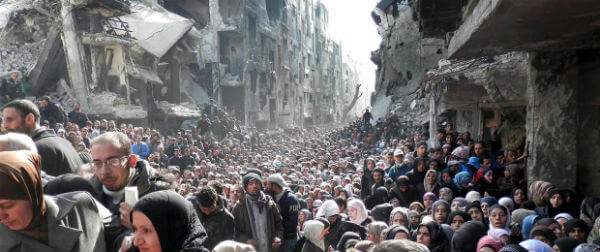
The cheap, brutally effective medieval tactic shaping the Syrian civil war

yarmouk-palestinians

Annia Ciezadlo writes: On Feb. 3, the United Nations suspended talks between the regime of Syrian President Bashar al-Assad and representatives of the Syrian opposition. The Geneva talks, which were aimed at ending the five-year-old civil war, had bogged down in distrust and regional politics before they even got underway.

The UN mediator, Staffan de Mistura, hinted that the initial round of discussions collapsed because the Syrian regime refused to lift the sieges that are slowly starving hundreds of thousands of people across the country. Assad’s regime has been using starvation as a weapon — technically a war crime, when used against civilians — for the past four years.

As the war has progressed, various rebel factions, like Islamic State and Nusra Front, have also adopted the strategy. But the vast majority of the people under siege in Syria are being starved by their own government. Today, up to a million people are being slowly and deliberately starved to death in the heart of the Fertile Crescent, many of them a stone’s throw away from grain silos full of wheat. [Continue reading…]

Facebooktwittermail

The Supreme Court halted Obama’s climate change plan. This doesn’t bode well

coal-power

Scott Lemieux writes: Hours before New Hampshire’s primary voters made Donald Trump the favorite for the Republican presidential nomination Tuesday night – I can’t really believe this even as I type it – the US supreme court reminded us of why the upcoming presidential election is so important. On a party-line vote, the court temporarily stopped Barack Obama’s clean power plan from going into effect. This decision could well portend a future one that will have devastating consequences – not only for the climate but for the state of our lawmaking process.

The decision also underscores the urgency of the November elections in two ways: it will be a choice between a candidate who supports taking action against climate change and one who believes it should be ignored, and it will present a choice between a president who believes that the federal government has the authority to effectively regulate and one who believes that the supreme court should arbitrarily throw monkey wrenches into the political process. [Continue reading…]

Facebooktwittermail

UN fears for hundreds of thousands if Syria troops encircle Aleppo

Reuters reports: Hundreds of thousands of civilians could be cut off from food if Syrian government forces encircle rebel-held parts of Aleppo, the United Nations said on Tuesday, warning of a massive new flight of refugees from a Russian-backed assault.

Syrian government forces, backed by Russian air strikes and Iranian and Lebanese Hezbollah fighters, have launched a major offensive in the countryside around Aleppo, which has been divided between government and rebel control for years.

The assault to surround Aleppo, once Syria’s biggest city with 2 million people, amounts to one of the most important shifts of momentum in the five year civil war that has killed 250,000 people and already driven 11 million from their homes. [Continue reading…]

Facebooktwittermail

Anger mounts in Italy over torture and murder of student, seen as victim of Egypt’s ‘death squads’

The Local reports: Italy on Monday warned Egypt it would not allow the fate of Giulio Regeni to be brushed under the carpet as anger mounted over the Cambridge University student’s torture and killing in Cairo.

With the media publishing gruesome details of Regeni’s treatment and pointing the finger at Egyptian security services, Prime Minister Matteo Renzi was under pressure to authorize a state funeral for the slain 28-year-old.

Regeni disappeared on January 25th and was found dead on February 3rd. An Italian autopsy carried out following his corpse’s repatriation at the weekend concluded that he was killed by a violent blow to the base of his skull having already suffered multiple fractures all over his body.

Foreign Minister Paolo Gentiloni said that Egypt appeared to be collaborating with a team of Italian detective and forensic investigators dispatched to Cairo.

But he warned: “We will not settle for alleged truths.”

Gentiloni, in an interview with daily La Repubblica, added: “We want those really responsible identified and punished on the basis of law.”

La Repubblica reported that, as well as being systematically beaten, Regeni had his finger and toe nails pulled out in a pattern of torture which the daily said suggested that his “death squad” killers believed him to be a spy. [Continue reading…]

Facebooktwittermail

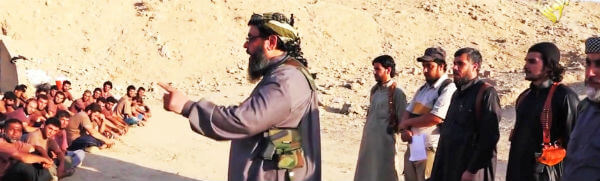
The offline allure of ISIS

ISIS-instructor

TSG IntelBrief: Two recent announcements highlight the difference between the so-called Islamic State’s reach on social media and its real-world appeal. On February 5, 2016, Twitter announced it had suspended more than 125,000 accounts for supporting terrorism since mid-2015. On the same day, UN Secretary-General Ban Ki-moon announced that 34 militant groups worldwide had pledged allegiance to the Islamic State as of last December, with more likely in 2016. The Islamic State’s social media efforts have always received disproportionate attention. Less attention has been paid to the offline power of the group in terms of radicalization and recruitment. Social networks matter more than social media when it comes to proliferating the ideology of bin-Ladinism espoused by both the Islamic State and al-Qaeda.

From pamphlets to audio cassette tapes—and now videos and mobile messaging apps—terrorists have always sought to broadcast their ideology to motivate and rally people to their cause. But the real propagation of terrorism requires salesmen and saleswomen—people who understand that the principles of persuasion begin with a deep understanding of the prospective customer. Graphic tweets may produce headlines, but persuasive individuals produce recruits, often in clusters.

The eight young men who left the Lisleby district of Fredrikstad, Norway, to join the Islamic State in Syria did not join because of social media, even if it did help spread the group’s message. All were reportedly motivated to join the Islamic State by the example of Abdullah Chaib, a charismatic local soccer player who traveled to Syria in 2012. The small group of friends created a feedback loop of motivation and encouragement that did not depend on Twitter or Facebook. Likewise, the terror recruit cluster in Molenbeek, Belgium thrived on networks built around friendship and familial ties, not Telegram or Kik. This same dynamic of peer-to-peer recruitment and consistent face-to-face interaction produced the cluster in the Minneapolis-Saint Paul region of Minnesota. Long-time foreign fighter hotbeds such as Derna, Libya, and Bizerte and Ben Gardane in Tunisia rely on decidedly offline networks to export extremism. [Continue reading…]

Facebooktwittermail

Anywhere but home: An Afghan child labourer in Iran dreams of life in Sweden

The Guardian reports: Mohammad, 14, is an Afghan immigrant who recently joined the flow of refugees arriving in the holding centre for unaccompanied minors on the Greek island of Lesvos.

Leaving his parents behind in Iran, he crossed the Aegean Sea on an overcrowded rubber dinghy with 38 other passengers. Mohammad describes the nighttime crossing as the scariest moment in his life. But he would not allow himself to cry. Unlike the other children on the boat, his parents were not there to comfort him. He “needed to be brave” and “be a man,” he says. His family’s decision to send their eldest son on an uncertain journey to Europe was a difficult one – but it was the most promising option compared to returning to his homeland or staying in Iran.

Afghans account for the largest proportion of unaccompanied minors arriving in Lesvos. Over one-third of the 2,248 minors that passed through Lesvos last year hail from Afghanistan, according the Greek NGO Metadrasi.

Most Afghans fleeing war and economic strife in their homeland have spent time in Iran, which has hosted the second-largest population of Afghan refugees for over 30 years. But worsening living conditions in Iran are forcing young migrants like Mohammad to leave even their temporary homeland in search of yet another one.

An estimated 2.3-3 million Afghans now live inside Iran, of whom 800,000 are children. The first wave of Afghan refugees arrived in Iran following the 1979 Soviet invasion of Afghanistan and subsequent civil war. They had access to public education and opportunities to work. Some 97% of Afghans lived outside refugee camps, and were integrated into urban communities.

Since the 2001 US invasion of Afghanistan and the fall of the Taliban, Iran began instituting increasingly restrictive laws on Afghans, including bureaucratic hurdles, limitations on movement, deportation of minors and separation of families, and reduced access to education. [Continue reading…]

Facebooktwittermail

Turkey’s Erdogan reported to have threatened to flood Europe with migrants

Reuters reports: Turkish President Tayyip Erdogan threatened in November to flood Europe with migrants if European Union leaders did not offer him a better deal to help manage the Middle East refugee crisis, a Greek news website said on Monday.

Publishing what it said were minutes of a tense meeting last November, the euro2day.gr financial news website revealed deep mutual irritation and distrust in talks between Erdogan and the EU’s two top officials, Jean-Claude Juncker and Donald Tusk.

The EU officials were trying to enlist Ankara’s help in stemming an influx of Syrian refugees and migrants into Europe. Over a million arrived last year, most crossing the narrow sea gap between Turkey and islands belonging to EU member Greece.

Tusk’s European Council and Juncker’s European Commission declined to confirm or deny the authenticity of the document, and Erdogan’s office in Ankara had no immediate comment.

The account of the meeting, in English, was produced in facsimile on the website. It does not state when or where the meeting took place, but it appears to have been on Nov. 16 in Antalya, Turkey, where the three met after a G20 summit there. [Continue reading…]

Facebooktwittermail

U.S. suffering from shortage of immigrants

Financial Times reports: US builders do not suffer from too many Mexican workers, but too few; they stand to gain from immigration reform, not lose. The joke in Texas is that if Mr Trump really wants to put up a wall between the US and Mexico, he will have to open the border first to find enough workers to finish the job.

Across the US, the construction sector — which contributes 4 per cent to US gross domestic product — is suffering from chronic shortages of workers that are pushing up wages and slowing down activity. Of the 1,358 companies surveyed last year by the Associated General Contractors of America, 86 per cent had trouble filling positions, up three percentage points from 2014. More than seven out of 10 contractors reported difficulty finding carpenters, 60 per cent for electricians and 56 per cent for roofers. In 2014, a builder called Camden Property Trust installed security guards at sites in Denver, Colorado, and Austin, Texas, to prevent competitors from poaching workers.

“I could be twice the size in terms of revenue if we had the flow of labour that we could be training,” says Chad Collins, owner of Bone Dry Roofing in Athens, Georgia. “We are handcuffed by the lack of a willing and skilled work force.”

The impact is particularly dramatic in Dallas. Even as US recession fears grow, the city and its suburbs are thriving as companies such as Toyota, Facebook and JPMorgan Chase build facilities. “There is a workforce issue,” says Keith Post, KPost chief executive. “People are stealing and overpaying [workers].” Steve Little, the company’s president, says labour costs have risen 15 per cent in the past two years.

Homebuilder Bruno Pasquinelli, president and founder of CB JENI Homes in Dallas, says delays are mounting. “It’s very difficult to predict when a house is going to get finished,” he says. “Houses that we used to build in 22 weeks are now taking upwards of 30 and bad ones could be 40.”

The labour shortages are counterintuitive. US construction employment fell from 7.7m to 5.4m during the downturn, and it was assumed there would be plenty of workers once business recovered. But some industry veterans retired. Others headed to the oilfields as the shale boom gathered pace. And many went home to Mexico — creating a problem, given the sector’s dependence on immigrants. [Continue reading…]

Facebooktwittermail

New report shows oil getting dirtier, alternatives cleaner

oil-industry

Union of Concerned Scientists: American motorists are driving more efficient cars than ever, but when they fill up their tanks, the gas they pump into their cars and trucks is 30 percent dirtier to extract and refine than it was just ten years ago, according to an analysis released today by the Union of Concerned Scientists (UCS).

“Even as increased vehicle efficiency has cut global warming tailpipe emissions per mile, the search for tougher-to-extract sources of oil has increased the emissions that come from producing a gallon of gasoline by nearly a third over the past decade,” said Jeremy Martin, senior scientist for the UCS Clean Vehicles Program and lead author of the report.

The UCS report, “Fueling a Clean Transportation Future: Smart Fuel Choices for a Warming World,” is a comprehensive look at the global warming impact of how we fuel our cars and trucks. The report compares oil, biofuels and electricity, and finds a significant and growing gap between oil and other ways to fuel transportation. With more oil coming from depleted wells, tight oil and tar sands the climate impact of oil is rising—emissions from extracting and refining different sources of oil range by a factor of more than five. Electricity and biofuels, in contrast, are already cleaner than oil and have the potential to get even cleaner in years to come. [Continue reading…]

Facebooktwittermail

Trump to Syrian refugee children: ‘You can’t come here’

The Hill reports: Donald Trump said he’d be able to look into the eyes of Syrian refugee children to tell them they cannot come to schools in America in light of concerns about safely vetting refugees.

“We don’t know where their parents come from, they have no documentation whatsoever,” Trump said Monday during a town hall in New Hampshire.

“I’ve talked to the greatest legal people, spoken to the greatest security people. There’s absolutely no way of saying where these people come from. They may be from Syria, they may be ISIS, they may be ISIS related.”

During the event, a man who said he was from Connecticut told Trump about plans to relocate Syrian families into the community and let their children come to schools. When asked whether he’d be able to “look at these children” to tell them they couldn’t go to school, Trump said: “I can look in their faces and say, ‘You can’t come here.’”

The crowd applauded his answer. [Continue reading…]

Facebooktwittermail

Under Sanders, income and jobs would soar, economist says

CNN reports: Median income would soar by more than $22,000. Nearly 26 million jobs would be created. The unemployment rate would fall to 3.8%.

Those are just a few of the things that would happen if Bernie Sanders became president and his ambitious economic program were put into effect, according to an analysis given exclusively to CNNMoney. The first comprehensive look at the impact of all of Sanders’ spending and tax proposals on the economy was done by Gerald Friedman, a University of Massachusetts Amherst economics professor.

Friedman found that if Sanders became president — and was able to push his plan through Congress — median household income would be $82,200 by 2026, far higher than the $59,300 projected by the Congressional Budget Office.

In addition, poverty would plummet to a record low 6%, as opposed to the CBO’s forecast of 13.9%. The U.S. economy would grow by 5.3% per year, instead of 2.1%, and the nation’s $1.3 trillion deficit would turn into a large surplus by Sanders’ second term [Continue reading…]

Facebooktwittermail

Invasion of the body snatchers

Jacob Weisberg writes: “As smoking gives us something to do with our hands when we aren’t using them, Time gives us something to do with our minds when we aren’t thinking,” Dwight Macdonald wrote in 1957. With smartphones, the issue never arises. Hands and mind are continuously occupied texting, e-mailing, liking, tweeting, watching YouTube videos, and playing Candy Crush.

Americans spend an average of five and a half hours a day with digital media, more than half of that time on mobile devices, according to the research firm eMarketer. Among some groups, the numbers range much higher. In one recent survey, female students at Baylor University reported using their cell phones an average of ten hours a day. Three quarters of eighteen-to-twenty-four-year-olds say that they reach for their phones immediately upon waking up in the morning. Once out of bed, we check our phones 221 times a day — an average of every 4.3 minutes — according to a UK study. This number actually may be too low, since people tend to underestimate their own mobile usage. In a 2015 Gallup survey, 61 percent of people said they checked their phones less frequently than others they knew.

Our transformation into device people has happened with unprecedented suddenness. The first touchscreen-operated iPhones went on sale in June 2007, followed by the first Android-powered phones the following year. Smartphones went from 10 percent to 40 percent market penetration faster than any other consumer technology in history. In the United States, adoption hit 50 percent only three years ago. Yet today, not carrying a smartphone indicates eccentricity, social marginalization, or old age.

What does it mean to shift overnight from a society in which people walk down the street looking around to one in which people walk down the street looking at machines? [Continue reading…]

As one of those eccentric, socially marginalized but not quite old aged people without a smartphone, it means I now live in a world where it seems the mass of humanity has become myopic.

A driver remains stationary in front of a green light.

A couple sit next to each other in an airport, wrapped in silence with attention directed elsewhere down their mutually exclusive wormholes.

A jogger in the woods, hears no birdsong because his ears are stuffed with plastic buds delivering private tunes.

Amidst all this divided attention, one thing seems abundantly clearly: devices tap into and amplify the desire to be some place else.

To be confined to the present place and the present time is to be trapped in a prison cell from which the smartphone offers escape — though of course it doesn’t.

What it does is produce an itch in time; a restless sense that we don’t have enough — that an elusive missing something might soon appear on that mesmerizing little touchscreen.

The effect of this refusal to be where we are is to impoverish life as our effort to make it larger ends up doing the reverse.

Facebooktwittermail

World’s largest concentrated solar plant switches on in the Sahara

CNN reports: Morocco has switched on what will be the world’s largest concentrated solar power plant.

The new site near the city of Ouarzazate — famous as a filming location for Hollywood blockbusters like “Lawrence of Arabia” and “Gladiator” — could produce enough energy to power over one million homes by 2018 and reduce carbon emissions by an estimated 760,000 tons per year, according to the Climate Investment Funds (CIF) finance group.

As His Majesty Mohammed VI of Morocco pressed a button on 4 February 2016, the first phase of the three-part project was set in motion. [Continue reading…]

Facebooktwittermail

How popular are Britain First and its Islamophobic ‘Christian patrols’?

britain-first-golding

The Washington Post reports: It’s a video that depicts just the sort of civilizational clash that extremists everywhere crave: Christians walking down a central shopping street in Britain. Muslim storekeepers and passerby hurling verbal abuse. A push. More abuse from both sides. And finally, police intervening to keep the warring clans apart.

The video, a slick propaganda job by the virulently anti-Muslim group Britain First, became a viral hit when the organization posted it to its Facebook page, racking up millions of views.

But there was more to the story than what the video showed.

The video was filmed on Jan. 23 in the multicultural British town of Luton, 30 miles north of London. The town, a former industrial powerhouse that is today known for its budget-flight-focused airport, has become a magnet for both Islamist and Islamophobic extremists. It’s often the canvas upon which hate groups unfurl their provocative displays.

And so it was when Britain First came to town for the fourth time in two years for what it termed a “Christian Patrol.”

The group — a far-right rival of the homegrown English Defense League — specializes in anti-Muslim street theater, while dressing itself in the garb of a devoutly Christian organization. Members wear dark green paramilitary-style uniforms, and march with oversized crosses through Muslim-majority areas, or even through mosques. [Continue reading…]

The garb of a devoutly Christian organization whose members wear dark green paramilitary-style uniforms?

Would the Washington Post refer to the Ku Klux Klan as bearing the symbols of a devoutly Christian organization because — like Britain First — its members like to march carrying large crosses?

There’s no question that these knuckleheads and self-described defenders of British culture have as little right to speak in the name of Christianity as Anjem Choudary has to present himself as the voice of Islam. But easy as Paul Golding and his rowdy followers might be to dismiss, do they actually stand at the vanguard of a much wider but less visible movement stretching across Britain?

The Washington Post picked up this story because Britain First’s recent Luton video went viral, but how much political significance derives from social media popularity?

Britain’s Labour Party, now under the leadership of Jeremy Corbyn who enjoys more grass root support than he does in parliament, has a Facebook page with 422,000 likes.

Britain First’s Facebook page has 1,289,000 likes!

But what do all these “likes” actually mean?

Paul Golding probably thinks they mean a lot and this might explain why he felt confident enough to run in the upcoming election to become Mayor of London. Moreover, he probably thinks it’s imperative that he, or someone like him, be able to govern the British capital city given that his leading opponent, Sadiq Khan, is a Muslim.

The election will take place on May 5, and the most recent YouGov poll gives Khan a clear lead (45%) over his closest rival, Zac Goldsmith (35%).

Further down the field comes George Galloway (Respect Party), who is just one point ahead of British National Party candidate, David Furness, who is himself, one point ahead of Golding.

That is to say, 1% of London voters say they support the BNP while 0% support Britain First.

Maybe the antics of Golding and his motley crew deserve less attention than does the promise of what would surely be a victory for multiculturalism: the increasingly likely election of London’s first Muslim mayor.

Facebooktwittermail

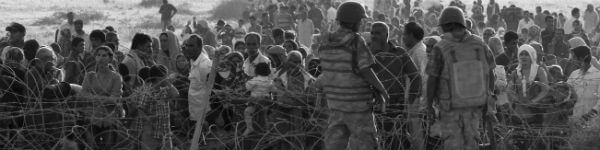
As Syrians flee anew, neighbors’ altruism hardens into resentment

refugee5

The New York Times reports: When the Syrian refugees first started streaming into this bedraggled border town, Gassim al-Moghrebi was their tireless benefactor, distributing donations of food, money and clothes and sheltering as many as possible in two apartments he owned.

“All of Ramtha was just like me,” Mr. Moghrebi said, describing a good will rooted in family ties that spanned the border, and sympathy for the victims of a pitiless war. “One man had 10 apartments. He gave them to the Syrians for free.”

But now, as Syria witnesses a new escalation of violence, including waves of Russian airstrikes, and as Syrians flee for safety again by the tens of thousands, neighboring countries are increasingly overwhelmed and reluctant to let them in. In many places, that early altruism has hardened into resentment — an ominous turn for those fleeing war.

Desperate Syrians are backed up at the borders of Jordan and Turkey, barred from entering or else just allowed to trickle in. Increasingly, they find escape routes closing. [Continue reading…]

Facebooktwittermail