Category Archives: Issues

Obama’s lofty plans on gun violence amount to little action

The New York Times reports: The centerpiece of a plan for stemming gun violence that President Obama announced to great fanfare last month largely amounts to this: an updated web page and 10,000 pamphlets that federal agents plan to give out at gun shows.

In a tearful display of anger and sadness in the East Room of the White House, Mr. Obama ordered a series of steps intended to limit gun violence and vowed to clamp down on what he called widespread evasion of a federal law requiring gun dealers to obtain licenses.

But few concrete actions have been put in motion by law enforcement agencies to aggressively carry out the gun dealer initiative, despite the lofty expectations that Mr. Obama and top aides set.

Obama administration officials said they have no specific plans to boost investigations, arrests or prosecutions of gun sellers who do not comply with the law. No task forces have been assembled. No agents or prosecutors have been specifically reassigned to such cases. And no funding has been reallocated to accelerate gun sale- investigations in Washington or at the offices of the 93 United States attorneys. [Continue reading…]

Facebooktwittermail

Attackers torch refugee center in Prague

The Associated Press reports: Czech police say unknown attackers have set a refugee center on fire in the Czech capital of Prague, injuring one person.

Spokeswoman Iveta Martinkova says about 20 people attacked the Klinika center in Prague’s No. 3 district with Molotov cocktails Saturday about 7:30 p.m. She says it’s not clear who was behind the attack and police are investigating.

The attack took place just hours after thousands of people rallied in Prague against Muslims and immigration. [Continue reading…]

Facebooktwittermail

Outrage grows as Italy investigates research student’s murder in Egypt

The New York Times reports: The furor surrounding the death of an Italian student whose body was discovered Wednesday on an Egyptian roadside grew Friday as Italian investigators flew to Cairo to help find his killers, and it emerged that the young man had secretly written from Egypt for a left-wing Italian newspaper.

The newspaper, Il Manifesto, published an article on Friday that the Italian student, Giulio Regeni, 28, had written under a pseudonym weeks before he was found dead that was sharply critical of the Egyptian president, Abdel Fattah el-Sisi, while describing faltering attempts by Egyptian unions to organize.

There was no indication that Mr. Regeni’s writing led to his death, but the article contributed to the broader Italian outrage over Mr. Regeni’s injuries as news outlets pointed an accusatory finger at the Egyptian security forces. Egyptian officials said on Thursday that Mr. Regeni had been tortured extensively and probably died from a brain hemorrhage.

“Giulio, Egyptian police under accusation,” read the headline of La Stampa, a Turin-based daily newspaper.

Hoping to defuse a potentially damaging crisis with a relatively close European ally, Egyptian officials promised cooperation and vowed to find Mr. Regeni’s killers. The Italian prime minister, Matteo Renzi, spoke with Mr. Sisi by telephone and both agreed to cooperate to “unravel the mystery,” Mr. Sisi’s office said in a statement. [Continue reading…]

Facebooktwittermail

Revealed: Honeybees are being killed off by a manmade pandemic

By Stephen John Martin, University of Salford

We live in a world where large numbers of people are connected by just a few degrees of separation. But while having friends of friends all over the globe can be great for holidays, trade and networking, travel also allows viruses to move like never before.

Zika is the latest “explosive pandemic” to be declared a global emergency by the World Health Organisation. But viruses don’t just target humans – they can infect all forms of life from bacteria to bananas, horses to honeybees.

A lethal combination of the Varroa mite and the deformed wing virus has resulted in the death of billions of bees over the past half century. In a study published in the journal Science, colleagues from the Universities of Exeter, Sheffield and I report how the virus has spread across the globe.

Continue reading

Facebooktwittermail

Syrian refugees in Jordan: ‘If they cut the coupons, we will probably die’

The Guardian reports: Just look at how we’re living,” says Umm Majd, a Syrian who fled to Jordan. She stands in a tiny single-room apartment in Amman, the capital. It lies deep underground, next to a subterranean car park, and measures just two metres by two and a half. It is here that she, her husband and their two sons live out their exile.

“Just look,” says Umm Majd, gesturing at the room. “That’s enough to understand what’s happening to Syrians here in Jordan.”

There are between 630,000 and 1.27 million Syrian refugees in the country, depending on whose estimate you believe. Like most of them, Umm Majd’s husband does not have the right to work – so he works illegally as a carwasher for 100 Jordanian dinars a month (about £100, half the minimum wage). The family collectively receives 40 dinars in food coupons from the UN – down from 80 a year ago. Their rent is 50 dinars, leaving them just 90 each month for any other living expenses.

“Right now we’re not thinking of going to Europe,” says Umm Majd’s husband. “But if they cut our funding again then we’ll have to. If they cut the coupons we’d probably die.” [Continue reading…]

Facebooktwittermail

Turkey’s academics pay heavy price for resisting Erdoğan’s militarised politics

By Celal Cahit Agar, University of Exeter and Steffen Böhm, University of Exeter

While the EU and the US have turned a blind eye to the Turkish government’s brutal clampdown in Kurdish regions, Turkish academics who have spoken out about the regime’s increasingly dictatorial policies have faced punishment and even imprisonment.

A petition published in early January by the Academicians for Peace initiative, criticising the Turkish state’s political and military attacks against the Kurdish people, raised a red flag with its signatories stating: “We will not be a party to this crime.” They wrote:

The Turkish state has effectively condemned its citizens in Sur, Silvan, Nusaybin, Cizre, Silopi, and many other towns and neighborhoods in the Kurdish provinces to hunger through its use of curfews that have been ongoing for weeks. It has attacked these settlements with heavy weapons and equipment that would only be mobilized in wartime. As a result, the right to life, liberty, and security, and in particular the prohibition of torture and ill-treatment protected by the constitution and international conventions have been violated.

In response, Turkish president Recep Tayyip Erdoğan immediately demanded that all institutions in Turkey take action: “Everyone who benefits from this state but is now an enemy of the state must be punished without further delay.”

Continue reading

Facebooktwittermail

The world’s most cutting-edge renewable tech is powering rural Africa

Quartz reports: Distributed power — where electricity is generated locally, instead of delivered via complex grid infrastructure — makes lots of sense for Africa. About 600 million Africans don’t have electricity. But sunlight is a widely available resource across most of the continent, making distributed solar power one of the more sensible options for electrification.

Plenty of companies see the potential. This has made parts of Africa a testing ground for cutting-edge solar power. Some countries are developing a whole new type of infrastructure not seen elsewhere in the world: mobile-phone-led, flexible, and controlled by the user rather than big utilities and government.

“We are now seeing the first innovation where the leading technologies are actually being deployed in Africa, not being deployed in the mainstream West,” said Simon Bransfield-Garth, CEO of Azuri Technologies. Azuri is based in Cambridge, UK, and installs rent-to-buy solar systems for homes in Tanzania and several other sub-Saharan states. Power from the panels are paid for by mobile phone or scratchcard. The payments also serve as installments towards owning the system outright. After about 18 months the homeowner has typically paid off the cost of the panels, or can buy them for a very small sum (say, $5). [Continue reading…]

Facebooktwittermail

How politics has poisoned Islam

Mustafa Akyol writes: We Muslims like to believe that ours is “a religion of peace,” but today Islam looks more like a religion of conflict and bloodshed. From the civil wars in Syria, Iraq and Yemen to internal tensions in Lebanon and Bahrain, to the dangerous rivalry between Iran and Saudi Arabia, the Middle East is plagued by intra-Muslim strife that seems to go back to the ancient Sunni-Shiite rivalry.

Religion is not actually at the heart of these conflicts — invariably, politics is to blame. But the misuse of Islam and its history makes these political conflicts much worse as parties, governments and militias claim that they are fighting not over power or territory but on behalf of God. And when enemies are viewed as heretics rather than just opponents, peace becomes much harder to achieve.

This conflation of religion and politics poisons Islam itself, too, by overshadowing all the religion’s theological and moral teachings. The Quran’s emphasis on humility and compassion is sidelined by the arrogance and aggressiveness of conflicting groups. [Continue reading…]

Facebooktwittermail

The West must stop giving Turkey a free pass

Behlul Ozkan writes: Last month, more than 1,200 Turkish and foreign academics signed a petition calling attention to the continuing humanitarian crisis in many Kurdish-majority towns in southeastern Turkey, which are the site of fighting between the Turkish Army and the Kurdistan Workers’ Party, or P.K.K. The petition decried the Army’s shelling of urban areas and the imposition of weekslong, 24-hour curfews, which have left many civilians unable to bury their dead or even obtain food. President Recep Tayyip Erdogan publicly denounced the signers as “so-called intellectuals” and “traitors.” Within days, antiterror police had detained and harassed dozens of the signatories.

Mr. Erdogan’s actions shouldn’t have been surprising. The president has a history of jailing journalists and cracking down on media companies critical of his policies. And yet this time the response from his supporters was exceptionally chilling: A pro-Erdogan organized crime boss proclaimed, “We will take a shower in your blood,” while the office doors of some of the academics were ominously marked with red crosses.

Prime Minister Ahmet Davutoglu, who as a former academic might have been expected to come to his colleagues’ defense, announced that he “did not regard the petition as falling under the rubric of free speech.” He then set out on a trip to several European countries in order to encourage foreign investment in Turkey’s foundering economy. In Britain and Germany, Mr. Davutoglu received a warm welcome from Prime Minister David Cameron and Chancellor Angela Merkel. The European Union’s response to the latest crackdown on dissent in Turkey amounted to little more than a statement calling the persecution of the academics “extremely worrying.”

Many prominent Western academics and non-governmental organizations have been vocal in censuring the persecution suffered by their Turkish counterparts. The European Union’s lack of action on Turkey’s crackdown on academic freedom and human rights would therefore be inexplicable but for one crucial detail: As the European Union faces its largest refugee crisis since World War II, the 2.5 million Syrians currently in Turkey are a huge bargaining chip for Ankara. Europe’s leaders are well aware of this. [Continue reading…]

Facebooktwittermail

President Obama’s remarks at the Islamic Society of Baltimore on February 3

President Obama said: This is a moment when, as Americans, we have to truly listen to each other and learn from each other. And I believe it has to begin with a common understanding of some basic facts. And I express these facts, although they’d be obvious to many of the people in this place, because, unfortunately, it’s not facts that are communicated on a regular basis through our media.

So let’s start with this fact: For more than a thousand years, people have been drawn to Islam’s message of peace. And the very word itself, Islam, comes from salam — peace. The standard greeting is as-salamu alaykum — peace be upon you. And like so many faiths, Islam is rooted in a commitment to compassion and mercy and justice and charity. Whoever wants to enter paradise, the Prophet Muhammad taught, “let him treat people the way he would love to be treated.” (Applause.) For Christians like myself, I’m assuming that sounds familiar. (Laughter.)

The world’s 1.6 billion Muslims are as diverse as humanity itself. They are Arabs and Africans. They’re from Latin America to Southeast Asia; Brazilians, Nigerians, Bangladeshis, Indonesians. They are white and brown and black. There’s a large African American Muslim community. That diversity is represented here today. A 14-year-old boy in Texas who’s Muslim spoke for many when he wrote to me and said, “We just want to live in peace.”

Here’s another fact: Islam has always been part of America. Starting in colonial times, many of the slaves brought here from Africa were Muslim. And even in their bondage, some kept their faith alive. A few even won their freedom and became known to many Americans. And when enshrining the freedom of religion in our Constitution and our Bill of Rights, our Founders meant what they said when they said it applied to all religions.

Back then, Muslims were often called Mahometans. And Thomas Jefferson explained that the Virginia Statute for Religious Freedom he wrote was designed to protect all faiths — and I’m quoting Thomas Jefferson now — “the Jew and the Gentile, the Christian and the Mahometan.” (Applause.)

Jefferson and John Adams had their own copies of the Koran. Benjamin Franklin wrote that “even if the Mufti of Constantinople were to send a missionary to preach to us, he would find a pulpit at his service.” (Applause.) So this is not a new thing. [Continue reading…]

The New York Times reports: For Mr. Obama, the remarks were also an admission of how little progress has been made since the speech in Cairo [in 2009], where he called for “a sustained effort to listen to each other, to learn from each other, to respect one another, and to seek common ground.” In his speech on Wednesday, he suggested that his hopes for a reconciliation had been dashed, but he called on all Americans to stick by the country’s founding ideals.

Muslims in the audience hailed the address.

“I think it was one of the best speeches he’s ever given,” said Representative André Carson, an Indiana Democrat. Representative Keith Ellison, a Minnesota Democrat, said the speech “hit me in the heart” and was a vital antidote to growing intolerance.

“I have a 19-year-old daughter who is a Muslim and wants to contribute to her nation, and it bugs me that someone who says he wants to be president would want to exclude her,” Mr. Ellison said.

But Morton Klein, president of the Zionist Organization of America, one of the country’s oldest and largest pro-Israel organizations, denounced Mr. Obama for visiting a mosque whose leaders, Mr. Klein said, have among other issues criticized Israeli military actions. “Going to such a mosque only encourages radical Muslims to harm Americans,” Mr. Klein said. [Continue reading…]

Facebooktwittermail

Aviva Chomsky: A newspaper’s crisis reveals unreported worlds

Is there a category of human beings who, in election 2016, have been the focus of more negative attention, fear-mongering, or worse press than immigrants, especially undocumented ones coming from or through Mexico (those infamous “rapists”)?  I doubt it.  Thought of in another way, such immigrants seem to be the only “lobbying group” capable of convincing Republican politicians that our crumbling infrastructure needs to be shored up — hence those monster walls to come along the Mexican border.  Immigrants, it’s now well known, are a shiftless bunch of criminals, or as Donald Trump put it, “If you look at the statistics of people coming, you look at the statistics on rape, on crime, on everything coming in illegally into this country it’s mind-boggling!” And don’t forget the terrorist types supposedly worming their way in among refugees — another category of immigrants — fleeing the chaos the U.S. had such a hand in creating in Syria and Iraq.  Those lost souls looking for asylum here have been a particular target of Republican candidates and office holders eager to ban them from coming anywhere near this country or at least their states.  Put it all together and you have a witch’s brew when it comes to the land of the free and home of the… well, whatever.

So imagine the national shock (had anyone been paying attention) that “The Criminalization of Immigration in the United States,” a study by researchers Walter A. Ewing, Daniel E. Martínez, and Rubén G. Rumbaut released last July through the American Immigration Council, should have caused here.  The three scholars offered truly shocking news.  They crunched the latest numbers and confirmed decades of other studies showing that immigration does anything but increase U.S. crime rates.  Immigrants, legal and otherwise, are charged with far fewer “serious crimes” and are jailed far less often than the native born.  To be specific, their study found that “1.6% of immigrant males age 18-39 are incarcerated, compared to 3.3% of the native-born. This disparity in incarceration rates has existed for decades, as evidenced by data from the 1980, 1990, and 2000 decennial censuses. In each of those years, the incarceration rates of the native-born were anywhere from two to five times higher than that of immigrants.”  The same, by the way, holds true for incarceration rates “among the young, less-educated Mexican, Salvadoran, and Guatemalan men who make up the bulk of the unauthorized population.”

How in the world do such definitive hard numbers fit with the overwrought sense of fear and alarm, the myth-making about immigrants alive in the country today?  In her second TomDispatch post, Aviva Chomsky offers an interesting answer: it’s not that hard to create a nightmare vision of immigrants when they are almost never seen by the Americans you are scaring the hell out of.  Their invisibility in our world ensures that just about any picture can be painted of them without fear of contradiction because there’s nothing in most of our lives to which to compare it.  So consider today just one recent case in which, however briefly, that cloak of invisibility began to be lifted from the remarkably lawful, remarkably hardworking immigrants who are the target of so much calumny this election season. Tom Engelhardt

All the news that’s fit to print
How the media hide undocumented workers
By Aviva Chomsky

In our post-modern (or post-post-modern?) age, we are supposedly transcending the material certainties of the past. The virtual world of the Internet is replacing the “real,” material world, as theory asks us to question the very notion of reality.  Yet that virtual world turns out to rely heavily on some distinctly old systems and realities, including the physical labor of those who produce, care for, and provide the goods and services for the post-industrial information economy. 

As it happens, this increasingly invisible, underground economy of muscles and sweat, blood and effort intersects in the most intimate ways with those who enjoy the benefits of the virtual world. Of course, our connection to that virtual world comes through physical devices, and each of them follows a commodity chain that begins with the mining of rare earth elements and ends at a toxic disposal or recycling site, usually somewhere in the Third World.

Closer to home, too, the incontrovertible realities of our physical lives depend on labor — often that of undocumented immigrants — invisible but far from virtual, that makes apparently endless mundane daily routines possible.

Continue reading

Facebooktwittermail

Russia’s manipulation of Germany’s refugee problems

Judy Dempsey writes: Russia’s propaganda machine—which went full blast against members of the Ukrainian government during the Ukraine crisis, labeling them fascists and anti-Semites—is in full swing again. This time, the target is Germany, once considered Russia’s closest ally in Europe.

Ever since Chancellor Angela Merkel declared her intention to allow refugees from Syria to enter Germany, the Russian media have been reporting every twist and turn of the opposition that is building up in her conservative bloc and among sections of the German public to her open-door refugee policy.

But in recent days, the Russian state media, joined by none other than Sergey Lavrov, the Russian foreign minister, have taken a different turn. They are tapping into Germany’s community of 1.2 million ethnic Russians to criticize Merkel’s policies and boost those who are unequivocally against Germany taking in refugees. The community is known for its conservative if not xenophobic views, as witnessed during demonstrations by Germany’s anti-Islam Pegida movement, in which ethnic Russians participate.

Now, Russia may be using Germany’s Russian-speaking community to create further opposition to Merkel, similar to the way it tries to instrumentalize the ethnic Russian communities in the Baltic states. Merkel is an easy target, certainly for many Russians living in Germany and for Russians back home. To the surprise and annoyance of the Kremlin, Merkel has managed to keep the EU united over maintaining sanctions on Russia after it annexed Crimea in March 2014 and subsequently invaded eastern Ukraine. [Continue reading…]

Facebooktwittermail

Pankaj Mishra on Arundhati Roy: Hindu nationalists ​have many ways to silence writers

Pankaj Mishra writes: he governments of Egypt and Turkey are brazenly leading a multi-pronged assault on writers, artists and intellectuals. Turkish president Recep Tayyip Erdoğan last month denounced his critics among Turkish academics as treasonous fifth columnists of foreign powers; many of them have been subsequently dismissed and suspended. Both Turkey and Egypt have imprisoned journalists, provoking international protests. But the suppression of intellectual and creative freedoms is assuming much cannier forms in India, a country with formal and apparently free democratic institutions.

Controlled by upper-caste Hindu nationalists, Indian universities have been purging “anti-nationals” from both syllabuses and campuses for some months now. In a shocking turn of events last month, Rohith Vemula, a PhD student in Hyderabad, killed himself. Accused of “anti-national” political opinions, the impoverished research scholar, who belonged to one of India’s traditionally and cruelly disadvantaged castes, was suspended, and, after his fellowship was cancelled, expelled from student housing. Letters from Modi’s government in Delhi to university authorities revealed that the latter were under relentless pressure to move against “extremist and anti-national politics” on campus. Vemula’s heartbreaking suicide note attests to the near-total isolation and despair of a gifted writer and thinker.

The extended family of upper-caste nationalists plainly aim at total domination of the public sphere. But they don’t only use the bullying power of the leviathan state – one quickly identified by local and foreign critics – to grind down their apparent enemies. They pursue them through police cases and legal petitions by private individuals – a number of criminal complaints have been filed against writers and artists in India. They create a climate of impunity, in which emboldened mobs ransack newspapers offices, art galleries and cinemas. [Continue reading…]

Facebooktwittermail

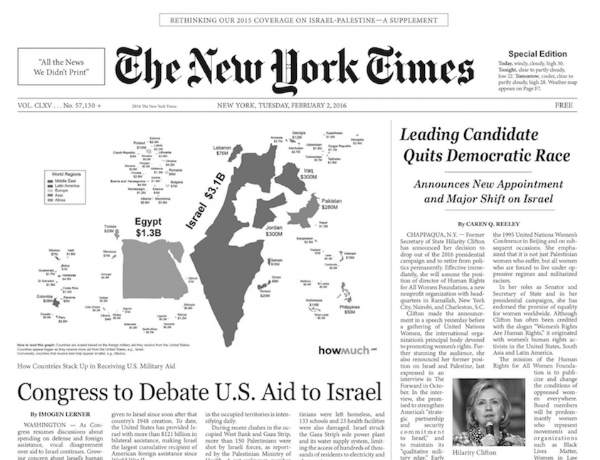
‘All the News We Didn’t Print’: Anonymous group distributes parody New York Times — updated

Update from Salon: Jewish Voice for Peace — New York and Jews Say No! informed Salon that they had organized the protest. The former is the local chapter of Jewish Voice for Peace, or JVP, an American human rights and social justice organization that challenges the Israeli government’s continued violence against and oppression of the indigenous Palestinian people. Jews Say No! is a New York City-based peace group that, like JVP, protests Israel’s illegal 48-year occupation of the Palestinian territories and periodic heavy bombing of Gaza.

nyt-parody

Haaretz reports: An unidentified group claiming that the New York Times is guilty of bias against the Palestinians and in favor of Israel distributed a fake version of the daily newspaper with parodied content more to the group’s liking in Manhattan on Tuesday.

The mock newspaper, which is also available online and has its own Twitter account, is represented as an effort at reconsidering the Times’ coverage of Israel and the Palestinians over the past year. Presented in a design strikingly similar to the Times itself, the online version of the “supplement” is labeled “Rethinking Our 2015 Coverage on Israel-Palestine.” [Continue reading…]

To call this a “fake” edition is to imply it was intended to deceive readers into thinking it was the real thing. I doubt that was the intention of the producers; neither is it likely that many recipients of a free copy of the print edition failed to notice that stories such as Hillary Clinton’s departure from the presidential race were fictitious — especially since they actually referred to her as “Hilarity Clifton.”

If this is a piece of activism, why the anonymity? And why spend this amount of money on a stunt that will garner public attention for less than 48 hours?

Since The Yes Men did something very similar in 2008, some observers suggest they might be behind the current undertaking. Just as likely, they merely provided a model for imitation.

If triggering editorial reform in the newspaper was actually the goal, I would have thought a steady stream of genuine letters to the paper’s public editor, Margaret Sullivan, might actually be more productive — even if they never yielded a news event.

Moreover, to characterize this stunt as “pro-Palestinian” sounds dubious. Among the range of issues confronting Palestinians, biased reporting in the New York Times probably doesn’t rank among their most pressing concerns.

Facebooktwittermail

Google thinks it can combat terrorism with advertising

The Telegraph reports: Jihadi sympathisers who type extremism-related words into Google will be shown anti-radicalisation links instead, under a pilot scheme announced by the internet giant.

The new technology means people at risk of radicalisation will be presented with internet links which are the exact opposite of what they were searching for.

Dr Anthony House, a senior Google executive, revealed the pilot scheme in evidence to MPs scrutinising the role of internet companies in combating extremism.

“We are working on counter-narratives around the world. This year one of the things we’re looking at is we are running two pilot programmes,” said Dr House.

“One is to make sure these types of views are more discoverable.

“The other is to make sure when people put potentially damaging search terms into our search engine they also find these counter narratives.”

A Google spokeswoman said the pilot project referred to by Dr House would bring up counter-narrative messages in “AdWords” – the sponsored links which are returned at the top of a Google search – and not the search results themselves.

Dr House said later: “We offer Google AdWords Grants to NGOs so that meaningful counter-speech ads can be surfaced in response to search queries like ‘join Isis’.” [Continue reading…]

Let’s disregard the fact that would-be jihadists are just as likely as anyone else to use ad-blocking software. What are we to imagine the click-through rate will be for, let’s say, a Human Rights Watch ad that appears on a search page delivered on a query about the ISIS magazine, Dabiq?

Is Dr House serious? This sounds, more than anything, like a PR exercise for Google — a way of saying: we’re playing out part in combating terrorism.

Clearly, Google, like every other internet company, wants to be seen as being opposed to terrorism; not as a facilitator of terrorism through the creation of communications platforms — even though in reality these have become a vital tools in 21st century terrorism.

Terrorists are often credited with being able to stay one step ahead of their adversaries — as though this is an indication of their cunning. Unfortunately, more often it seems to be an indication that counter-terrorism is another name for easy money.

Anything can get funded on the smallest prospect it might be effective. Those who carry the burden that they must be seen to be doing something, can duly claim they are meeting their responsibilities as they approve almost anything.

Aside from the question of efficacy when it comes to Google’s strategy for presenting counter-narratives, just as importantly, we need to question the search engine’s ability to decipher the motives of its users, i.e it’s ability to accurately identify “dangerous searches.” After all, a query that indicates the malevolent intentions of one user, might from another user be an indication that they are a journalist or an academic. Search terms indicate what is sought but not necessarily why it is being sought.

Beyond that is the broader issue of the political and social manipulation that internet companies are engaged in when the services they provide are designed to modify the behavior of their users.

As Henry David Thoreau wrote, “Men have become the tools of their tools,” but it’s hard to grasp the degree to which, during the intervening 150 years, this has become so much more true.

Google might not have high expectations about its ability to limit the growth of ISIS through the use of adwords, yet it certainly has a huge interest in every branch of research through which it can refine the effectiveness of its primary revenue source by shaping our interests and desires.

Facebooktwittermail

Google: Big bets on future tech are sign of an empire bidding for immortality

By Robert MacIntosh, Heriot Watt University

We have got used to Google as a massive global success story. But sometimes the detail is more interesting than the top line. On February 1 an announcement by the firm’s holding company Alphabet gave investors their first real insight into the relative performances of its different parts. And it revealed a lot about a section of the operation of which we previously knew very little – the large number of investments into technologies that are some distance from the core businesses.

We now know that these “moonshots”, as they have come to be known, produced an operating loss of $3.6bn (£2.5bn) in 2015. They lost $1.9bn in 2014 and $527m in 2013. You may have heard about the wearable technology or the driverless cars, but it goes much further than that. There is fibre-optic broadband, Indian railway wifi, thermostats, IP video cameras and solar-powered drones. Then there is Google’s X-lab. Initially shrouded in secrecy, it is now known to be working on everything from contact lenses for diabetics that can monitor glucose levels in tears, to nano-particles that will be able to predict disease.

The revelation about the losses didn’t stop Alphabet from replacing Apple as the most valuable company on the planet the day after the announcement. So what can we infer from its seemingly voracious appetite for newness?

Continue reading

Facebooktwittermail

From Iraq, general rebukes Ted Cruz’s plan to ‘carpet-bomb’ ISIS

The Washington Post reports: The top U.S. general in Iraq on Monday addressed recent political rhetoric in the presidential campaign that the United States should “carpet-bomb” the Islamic State, saying that the Pentagon is bound by the laws of armed conflict and does nt indiscriminately bomb civilian areas.

“We’re the United States of America, and we have a set of guiding principles and those affect the way we as professional soldiers, airmen, sailors, Marines, conduct ourselves on the battlefield,” MacFarland said. “So indiscriminate bombing, where we don’t care if we’re killing innocents or combatants, is just inconsistent with our values. And it’s what the Russians have been accused of doing in parts of northwest Syria. Right now we have the moral high ground, and I think that’s where we need to stay.”

The comments came in response to a question from CNN’s Barbara Starr during a Pentagon news conference. The general was asked why the military isn’t engaged in “so-called carpet-bombing,” a phrase that has been used often by presidential candidate Sen. Ted Cruz (R.-Tex.). [Continue reading…]

Facebooktwittermail

Fight ISIS with democracy

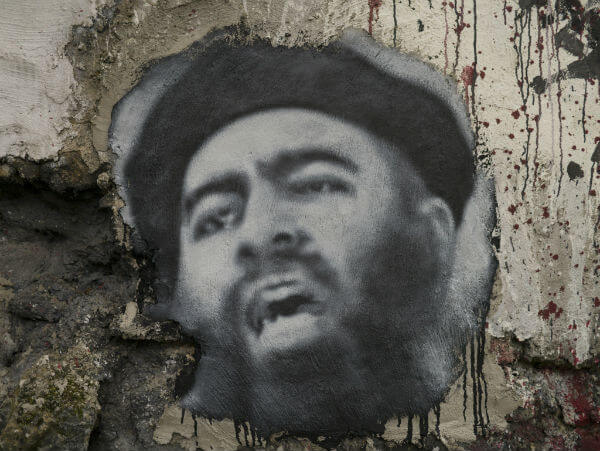
Baghdadi

Rached Ghannouchi, co-founder and president of Tunisia’s Muslim democrats party, Ennahdha, writes: As more countries confront the question of how to counter terrorist groups like ISIS, it is clear that a short-term, reductionist approach focused largely on military force has proven ineffective. Efforts to dislodge the so-called Islamic State through bombing, and to keep it at bay by strengthening and equipping security forces in the places it operates, have so far had limited success despite their enormous financial costs.

This is because, although such efforts are critical, they are not sufficient. The rise of ISIS, and its ability to recruit from a region that just five years ago was swept by democratic hopes and aspirations, requires a global response that is informed by where the group came from. For such a response to work, I believe it must reflect five principles. These are based on Tunisia’s experience as the most successful democratic transition to emerge from the Arab uprisings, as well as my personal intellectual and political work in Tunisia and the Arab world over five decades.

First, there is no universal approach to tackling ISIS. Rather, the group can only be defeated through a variety of locally designed and targeted responses. Extremist groups like ISIS use technology and social networks to cross boundaries and attract recruits globally—but their discourse is linked to local grievances wherever they operate. [Continue reading…]

Facebooktwittermail