Category Archives: Issues

Ai Weiwei shuts Danish show in protest at asylum-seeker law

The Guardian reports: The Chinese dissident artist Ai Weiwei has closed down his exhibition in Copenhagen in protest at a new law that allows Danish authorities to seize valuables from asylum seekers.

The 58-year-old, who is currently on the Greek island of Lesbos undertaking research on Europe’s refugee crisis, told the Guardian: “My moments with refugees in the past months have been intense. I see thousands come daily, children, babies, pregnant women, old ladies, a young boy with one arm.

“They come with nothing, barefoot, in such cold, they have to walk across the rocky beach. Then you have this news; it made me feel very angry.

“The way I can protest is that I can withdraw my works from that country. It is very simple, very symbolic – I cannot co-exist, I cannot stand in front of these people, and see these policies. It is a personal act, very simple; an artist trying not just to watch events but to act, and I made this decision spontaneously.”

An earlier post on his official Instagram and Facebook accounts read: “Ai Weiwei has decided to close his exhibition, Ruptures, at Faurschou Foundation Copenhagen, Denmark. This decision follows the Danish parliament’s approval of the law proposal that allows seizing valuables and delaying family reunions for asylum seekers.” The exhibition opened in March 2015 and had been due to close in mid-April.

Denmark’s parliament adopted reforms on Tuesday aimed at dissuading migrants from seeking asylum by delaying families being reunited and allowing authorities to confiscate migrants’ valuables.

The law has provoked international outrage, with many human rights activists criticising the delay for family reunifications as a breach of international conventions. [Continue reading…]


Facebooktwittermail

Why Hillary Clinton’s friend, Robert Reich, is backing Bernie Sanders

Robert Reich writes: Not a day passes that I don’t get a call from the media asking me to compare Bernie Sanders’s and Hillary Clinton’s tax plans, or bank plans, or health-care plans.

I don’t mind. I’ve been teaching public policy for much of the last thirty-five years. I’m a policy wonk.

But detailed policy proposals are as relevant to the election of 2016 as is that gaseous planet beyond Pluto. They don’t have a chance of making it, as things are now.

The other day Bill Clinton attacked Bernie Sanders’s proposal for a single-payer health plan as unfeasible and a “recipe for gridlock.”

Yet these days, nothing of any significance is feasible and every bold idea is a recipe for gridlock.

This election is about changing the parameters of what’s feasible and ending the choke hold of big money on our political system.

I’ve known Hillary Clinton since she was 19 years old, and have nothing but respect for her. In my view, she’s the most qualified candidate for president of the political system we now have.

But Bernie Sanders is the most qualified candidate to create the political system we should have, because he’s leading a political movement for change. [Continue reading…]

Facebooktwittermail

‘Politics of fear’ threatens human rights around the globe

Human Rights Watch: The politics of fear led governments around the globe to roll back human rights during 2015.

In the 659-page World Report 2016, its 26th edition, Human Rights Watch reviews human rights practices in more than 90 countries. In his introductory essay, Executive Director Kenneth Roth writes that the spread of terrorist attacks beyond the Middle East and the huge flows of refugees spawned by repression and conflict led many governments to curtail rights in misguided efforts to protect their security. At the same time, authoritarian governments throughout the world, fearful of peaceful dissent that is often magnified by social media, embarked on the most intense crackdown on independent groups in recent times.

“Fear of terrorist attacks and mass refugee flows are driving many Western governments to roll back human rights protections,” Roth said. “These backward steps threaten the rights of all without any demonstrated effectiveness in protecting ordinary people.”

Significant refugee flows to Europe, spurred largely by the Syrian conflict, coupled with broadening attacks on civilians in the name of the extremist group Islamic State (also known as ISIS), have led to growing fear-mongering and Islamophobia, Human Rights Watch said. But as European governments close borders, they are reviving old patterns of shirking responsibility for refugees by passing the problem to countries on Europe’s periphery that are less equipped to house or protect refugees. The emphasis on the potential threat posed by refugees is also distracting European governments from addressing their homegrown terrorist threats and the steps needed to avoid social marginalization of disaffected populations.

Policymakers in the United States have used the terrorism threat to try to reverse recent modest restrictions on intelligence agencies’ ability to engage in mass surveillance, while the United Kingdom and France have sought to expand monitoring powers. That would significantly undermine privacy rights without any demonstrated increase in the ability to curb terrorism. Indeed, in a number of recent attacks in Europe, the perpetrators were known to law enforcement authorities, but the police were too overwhelmed to follow up, suggesting that what’s needed is not more mass data but more capacity to pursue targeted leads, Human Rights Watch said.

“The tarring of entire immigrant or minority communities, wrong in itself, is also dangerous,” Roth said. “Vilifying whole communities for the actions of a few generates precisely the kind of division and animosity that terrorist recruiters love to exploit.” [Continue reading...]

Facebooktwittermail

For Sanders — unlike Clinton — there is no such thing as a noble cold war

Peter Beinart writes: In the final days before she and Bernie Sanders face the voters of Iowa, Hillary Clinton is leveling the same attack she leveled against Barack Obama. She’s saying that on foreign policy, she’s the only adult in the race.

In their January 17 debate, Sanders declared that, “What we’ve got to do is move as aggressively as we can to normalize relations with Iran. … Can I tell you that we should open an embassy in Tehran tomorrow? No, I don’t think we should. But I think the goal has got to be, as we’ve done with Cuba, to move in warm relations with a very powerful and important country in this world.”

When the debate ended, Team Hillary pounced. Ignoring the second half of Sanders’s statement, the campaign released a video of foreign-policy advisor Jake Sullivan asking, “Normal relations with Iran right now? President Obama doesn’t support that idea. Secretary Clinton doesn’t support that idea, and it’s not at all clear why it is that Senator Sanders is suggesting it. … It’s pretty clear that he just hasn’t thought it through.” Hillary herself added that Sanders’s comments reflect a “fundamental misunderstanding of what it takes to do the patient diplomacy that I have experience in.”

The language echoes Clinton’s attack on Obama after he pledged in a July 2007 debate to meet leaders of Iran, Syria, Venezuela, Cuba, and North Korea without preconditions — a pledge she called “irresponsible and frankly naive.” That attack, like this one, was contrived: Obama wasn’t planning to rush out to meet Iran’s supreme leader any more than Sanders would rush to build an embassy in Tehran. [Continue reading…]

Facebooktwittermail

Israel feels the heat of U.S., EU and U.N. criticism

Reuters reports: The United States, European Union and the United Nations have issued unusually stern criticism of Israel, provoking a sharp response from Prime Minister Benjamin Netanyahu and raising Palestinians’ hopes of steps against their neighbor.

U.N. Secretary-General Ban Ki-moon on Tuesday described Israel’s settlements as “provocative acts” that raised questions about its commitment to a two-state solution, nearly 50 years after occupying lands the Palestinians seek for a state.

Ban also laid some of the blame for four months of stabbings and car rammings by Palestinians at Israel’s door, saying “as oppressed peoples have demonstrated throughout the ages, it is human nature to react to occupation, which often serves as a potent incubator of hate and extremism”.

Netanyahu’s response was quick and furious. Ban’s remarks “give a tailwind to terrorism”, he said, and ignore the fact “Palestinian murderers do not want to build a state”. [Continue reading…]

Facebooktwittermail

King Salman’s first year in power in Saudi Arabia has been a dark year for human rights

Amnesty International: Despite limited improvements in the field of women’s rights, the Saudi Arabian authorities have pursued a persistent and ruthless crackdown on all forms of dissent by, among other measures, detaining critics after grossly unfair trials before the Specialized Criminal Court, often on spurious terrorism charges, increased their use of the death penalty and maintained practices that discriminate against the country’s Shi’a Muslim minority. The Kingdom’s military has also repeatedly violated the laws of war in its military campaign in Yemen.

Dozens of human rights defenders, peaceful activists and dissidents remained behind bars after being imprisoned in previous years. Among them were blogger Raif Badawi and his lawyer Waleed Abu al-Khair, the first human rights defender to be sentenced after an unfair trial under Saudi Arabia’s counter-terror law, in force since February 2014. Dozens more were jailed under the law in 2015, including human rights defenders Dr Abdulkareem al-Khoder and Dr Abdulrahman al-Hamid, both founding members of the now disbanded independent Saudi Civil and Political Rights Association (ACPRA), also after unfair trials. Most of the organization’s other founding members remained in prison.

Prominent writer Dr Zuhair Kutbi was sentenced in December 2015 to four years in prison by the Specialized Criminal Court, followed by a five-year ban on overseas travel, a fine of 100,000 Saudi Arabian riyals (about US$26,600) and a 15-year ban on writing and giving interviews to the media. The court also ordered him to erase his social media accounts. It suspended two years of his four-year sentence because of his poor health, but indicated they would be re-imposed if he “offended” again. [Continue reading…]

Facebooktwittermail

Amnesty: Iran still a leading executioner of children

The New York Times reports: Iran is one of the leading executioners of juvenile offenders, despite its improved legal protections for children and a pledge more than two decades ago to end the death penalty for convicts younger than 18, Amnesty International said Monday.

In a new report, Amnesty International said that it had documented the execution of at least 73 juveniles in Iran from 2005 to 2015 and that 160 juvenile offenders are languishing on the country’s death row.

The report casts doubt on laws meant to improve children’s rights in Iran in the past few years, including new discretion by judges to impose alternative punishments on juveniles convicted of capital crimes. In reality, the report said, these changes are attempts by the authorities to “whitewash their continuing violations of children’s rights and deflect criticism of their appalling record as one of the world’s last executioners of juvenile offenders.”

Amnesty International, a leading global advocate for abolition of the death penalty, had also recorded the execution of juveniles in Pakistan, Saudi Arabia and Yemen, and there are juveniles on death row in the Maldives and Nigeria.

There is little doubt among rights groups that Iran has executed more people convicted of capital crimes committed as minors than any other country. [Continue reading…]

Facebooktwittermail

Failures in handling unaccompanied migrant minors have led to trafficking

The Washington Post reports: On the phone, the boy was frantic. After traveling hundreds of miles from a village in Guatemala, he had made it across the U.S. border and into a government-funded shelter for unaccompanied minors.

But then something went terribly wrong.

Instead of sending him to his uncle, Carlos Enrique Pascual, a landscape worker in Florida, authorities said the shelter released the teenager to traffickers who took him to central Ohio, held him captive in a roach-infested trailer and threatened to kill him if he tried to leave.

“Please, how can I get out of this?” Pascual’s nephew begged him during a stolen moment with a telephone. “I’m hungry, and my heart is bursting with fear.”

Pascual called police and, in December 2014, authorities found his nephew, then 17, and seven other boys living in cramped, dirty trailers about an hour outside of Columbus. Authorities said they were working at Trillium Farms, one of the country’s largest egg producers, debeaking hens and cleaning cages nearly 12 hours a day, six days a week, for as little as $2 a day.

The boys were part of a surge of children flowing across the U.S.-Mexico border over the past four years, overwhelming federal officials responsible for their safekeeping, child advocates say. Since 2011, more than 125,000 unaccompanied minors from Central America have been stopped at the border, many placed in shelters funded by the federal Office of Refugee Resettlement. [Continue reading…]

Facebooktwittermail

Pursuing critics, China reaches across borders. And nobody is stopping it.

The Washington Post reports: China’s campaign against dissent is going global.

Amid extraordinary moves to rein in criticism at home, Chinese security personnel are reaching confidently across borders, targeting Chinese and foreign citizens who dare to challenge the Communist Party line, in what one Western diplomat has called the “worst crackdown since Tiananmen Square.”

A string of incidents, including abductions from Thailand and Hong Kong, forced repatriations and the televised “confessions” of two Swedish citizens, has crossed a new red line, according to diplomats in Beijing. Yet many foreign governments seem unwilling or unable to intervene, their public response limited to mild protests.

The European Union is divided and appears uncertain about what to do. Hong Kong is in an uproar, with free speech under attack, activists looking over their shoulders and many people saying they feel betrayed by a lack of support from Britain. [Continue reading…]

Facebooktwittermail

Europe wades into debate over Poland’s constitutional crisis

By Simona Guerra, University of Leicester and Fernando Casal Bértoa, University of Nottingham

Poland’s prime minister Beata Szydło recently found herself summoned to the European Parliament in Strasbourg to defend her government over accusations that its commitment to democratic values is on the slide.

This was an unprecedented meeting. The parliament had called a debate under the auspices of a law introduced in March 2014, giving it the right to question a national government if it thinks a systemic threat to democracy is about to take place in a European country.

In Poland’s case, concerns were raised over government plans to limit the power of the national constitutional court, and change the way the media is governed and civil servants hired.

The aim of a meeting is to have a constructive conversation about concerns but if that fails, Brussels can move to suspend a country from taking part in EU decision making (although this is an unlikely scenario).

Among the post-communist states that joined the EU in 2004, Poland has generally been seen as a success story. While Hungary and Romania, and candidate countries such as Macedonia and Bosnia and Herzegovina seem to be dragging their feet over democratic reform, Poland has blazed the trail.

But in October 2015, the new social national conservative government, led by Szydło (Law and Justice party, PiS) won an outright majority in parliamentary elections and quickly set about making significant changes.

Continue reading

Facebooktwittermail

The inequality problem

Ed Miliband writes: ‘What do I see in our future today you ask? I see pitchforks, as in angry mobs with pitchforks, because while … plutocrats are living beyond the dreams of avarice, the other 99 per cent of our fellow citizens are falling farther and farther behind.’ Who said this? Jeremy Corbyn? Thomas Piketty? In fact it was Nick Hanauer, an American entrepreneur and multibillionaire, who in a TED talk in 2014 confessed to living a life that the rest of us ‘can’t even imagine’. Hanauer doesn’t believe he’s particularly talented or unusually hardworking; he doesn’t believe he has a great technical mind. His success, he says, is a ‘consequence of spectacular luck, of birth, of circumstance and of timing’. Just as his own extraordinary wealth can’t be explained by his unique talents, neither, he says, can rising inequality in the United States be justified on the grounds that it is a side effect of a broader economic success from which everyone benefits. As Henry Ford recognised, if you don’t pay ordinary workers decent wages, the economy will lack the demand to sustain economic growth.

Hanauer is in the vanguard of the ‘Fight for 15’, the campaign for a $15 minimum wage. Like Bill Gates and Warren Buffett, who have also issued loud warnings about inequality, he is heir to a long tradition of social concern among the wealthy in the US. They have reason to be worried. The last time inequality reached comparable levels was shortly before the Wall Street Crash. As Anthony Atkinson shows in Inequality: What Can Be Done?, inequality in the US fell for decades after the crash, before beginning to rise again in the 1970s.​ Since then the gap between the wealthy and the rest has grown steadily wider. The top 1 per cent now has nearly 20 per cent of total US personal income. In the 1980s, inequality in the UK went up even more sharply than in the US. Since then, overall UK inequality has been relatively stable but the income share of the top 1 per cent has increased significantly and now accounts for about 12 per cent of UK personal income. The important factors are rising inequality in wages, a decline in the share of the national income that wages represent as more money goes to corporate profits and dividends, and a reversal of redistribution from the rich to the poor.

The rise in inequality should not, Atkinson insists, be brushed aside as an inevitable effect of irresistible forces such as globalisation or developments in technology. It is driven by political choices. [Continue reading…]

Facebooktwittermail

By 2030, renewables will be the world’s primary power source

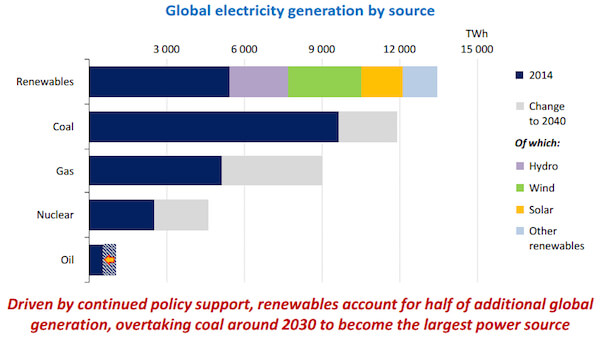
Climate Progress reports: In November, the International Energy Agency quietly dropped this bombshell projection: “Driven by continued policy support, renewables account for half of additional global generation, overtaking coal around 2030 to become the largest power source.”

In this post, I’ll dive deeper into this rapidly-approaching role reversal for coal and renewables. In Part Two, I’ll explain why the so-called “intermittency” problem for some renewables is basically solved and thus not a barrier to this reversal.

In releasing its World Energy Outlook 2015 last fall, the IEA published this chart of projected electricity generation in 2040: [Continue reading…]

renewables2030

Facebooktwittermail

‘Half the confusion in the world comes from not knowing how little we need’

lichen7

Pico Iyer writes: The idea of going nowhere is as universal as the law of gravity; that’s why wise souls from every tradition have spoken of it. “All the unhappiness of men,” the seventeenth-century French mathematician and philosopher Blaise Pascal famously noted, “arises from one simple fact: that they cannot sit quietly in their chamber.” After Admiral Richard E. Byrd spent nearly five months alone in a shack in the Antarctic, in temperatures that sank to 70 degrees below zero, he emerged convinced that “Half the confusion in the world comes from not knowing how little we need.” Or, as they sometimes say around Kyoto, “Don’t just do something. Sit there.”

Yet the days of Pascal and even Admiral Byrd seem positively tranquil by today’s standards. The amount of data humanity will collect while you’re reading The Art of Stillness is five times greater than the amount that exists in the entire Library of Congress. Anyone reading it will take in as much information today as Shakespeare took in over a lifetime. Researchers in the new field of interruption science have found that it takes an average of twenty-five minutes to recover from a phone call. Yet such interruptions come every eleven minutes — which means we’re never caught up with our lives.

And the more facts come streaming in on us, the less time we have to process any one of them. The one thing technology doesn’t provide us with is a sense of how to make the best use of technology. Put another way, the ability to gather information, which used to be so crucial, is now far less important than the ability to sift through it. [Continue reading…]

Facebooktwittermail

Wall Street declares war on Bernie Sanders

Bill Black writes: Wall Street billionaires are freaking out about the chance that Bernie Sanders could be elected President. Stephen Schwarzman, one of the wealthiest and most odious people in the world, told the Wall Street Journal that one of the three principal causes of the recent global financial trauma was “the market’s” fear that Sanders may be elected President. Schwarzman is infamous for ranting that President Obama’s proposals to end the “carried interest” tax scam that allows private equity billionaires like Schwarzman to pay lower income tax rates than their secretaries was “like when Hitler invaded Poland.”

Schwarzman and Pete Peterson co-founded the private equity firm Blackstone. Peterson leads the effort to destroy the safety net in America. His greatest dream is to privatize Social Security so that Wall Street could increase its revenues by tens of billions of dollars. Blackstone is a major owner of Sea World, and it was in this sphere that Schwarzman went beyond his delusional rants about Hitler and became vile. When an Orca killed its trainer, Schwarzman lied and blamed the death on the trainer, claiming that Sea World “had one safety lapse — interestingly, with a situation where the person involved violated all the safety rules that we had.”

Schwarzman’s claim that the global financial markets are tanking because of Bernie’s increasing support is delusional, but it is revealing that he used the most recent market nightmare as an excuse to attack Bernie. The Wall Street plutocrats, with good reason, fear Bernie – not Hillary. Indeed, it is remarkable how vigorous and open Wall Street has been in signaling through the financial media that it has no problem with Hillary’s Wall Street plan. CNN, CNBC, and the Fiscal Times, under titles such as: “Here’s Why Wall Street Has Little to Fear from Hillary Clinton,” pushed this meme. [Continue reading…]

Facebooktwittermail

In the face of mounting opposition, Angela Merkel holds to her principles on accepting refugees

Angela_Merkel

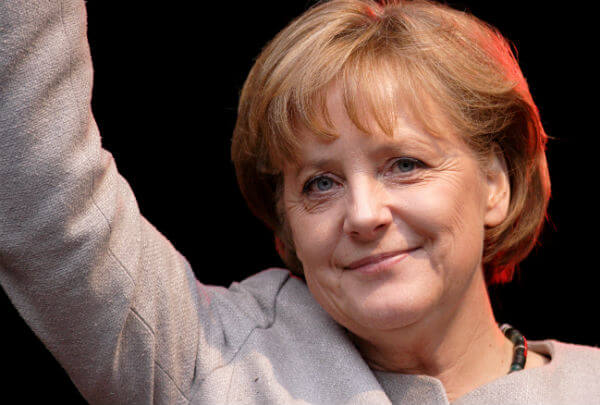
Der Spiegel reports: On a Sunday evening in early January, Angela Merkel went to a piano concert by Antonio Acunto in the Konzerthaus on Berlin’s beautiful Gendarmenmarkt. The program included works from Chopin, Rachmaninoff and Schumann, but the chancellor didn’t just come for the music. It was also for a good cause and to show support. The concert was a benefit for the refugees. Her refugees.

Shortly before the concert began, Merkel saw an old acquaintance: Reverend Rainer Eppelmann. In 1990, Eppelmann was head of the Democratic Awakening, a party formed in East Germany soon after the fall of the Berlin Wall, and Merkel was its spokesperson. The party was ultimately folded into the Christian Democratic Union, of which Merkel is now the head.

At the concert, Eppelmann told Merkel how courageous and wonderful he thought her refugee policies were. Given the situation in which Merkel is now in, Eppelmann said, he finds himself thinking often about his favorite quote from the former Czech president and writer Vaclav Havel. “Hope is not the conviction that something will turn out well, but the certainty that something makes sense, regardless of how it turns out.”

The concert began and Merkel listened to a melancholic Chopin ballad in G-minor. When the intermission arrived, she jumped up from her chair and walked directly over to Eppelmann. She asked: “How did that quote about hope go again?”

It is completely unclear how the experiment will end that the German chancellor has forced upon the European Continent, upon her fellow citizens and, not least, upon her party. Her decision late last summer to open the German border to refugees transformed Merkel into a historic figure. It was the most consequential decision of her entire decade in office. [Continue reading…]

Facebooktwittermail

Danish parliament approves plan to seize assets from refugees

The Guardian reports: Denmark has become the latest European state to force refugees to hand over their valuables, with the continent increasingly using scare tactics and physical deterrents to deal with the biggest migration crisis since the second world war.

Following similar moves in Switzerland and southern Germany, Denmark’s parliament voted on Tuesday to allow police to search asylum seekers on arrival in the country and confiscate any non-essential items worth more than 10,000 Danish kroner (about £1,000) that have no sentimental value to their owner.

The bill presented by the centre-right minority government of the prime minister, Lars Løkke Rasmussen, was approved after almost four hours of debate by 81 of the 109 lawmakers present, as members of the opposition Social Democrats and two small rightwing parties backed the measures. [Continue reading…]

Facebooktwittermail

Growing concern about EU’s commitment to open borders

The New York Times reports: European Union interior ministers clashed on Monday over how to check the flow of migrants across their countries’ borders amid growing concern that the Continent’s commitment to the free movement of people within the bloc is at risk of collapse.

Some of the wealthy northern nations that are the preferred destinations of many migrants suggested that much of the solution should rest with their neighbors to the south, especially Greece, the main entry point into the European Union for refugees arriving from Syria, Iraq and Afghanistan via Turkey. At a meeting here, Germany told Greece to do its “homework” to stop the flow at its borders, and Austria suggested that Greece could be excluded from the Schengen area, which allows border-free travel across much of the European Union.

Ioannis Mouzalas, a Greek minister for immigration policy, criticized the focus on his country, saying that the bloc had not made good on its pledges of more assistance in managing the flow of people — nearly 1.1 million arrived last year in the European Union — and that some European politicians were spreading “lies” about the crisis and the role of the government in Athens.

There is a “blame game against Greece,” Mr. Mouzalas said. [Continue reading…]

Facebooktwittermail

Hardliners disqualify Khomeini’s grandson in Iran power struggle

Hassan-Khomeini

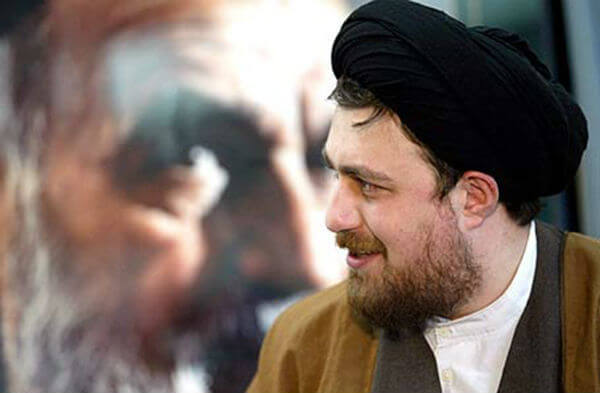
Financial Times reports: Hassan Khomeini may be the grandson of the founder of Iran’s 1979 Islamic Revolution, but his religious and political credentials were deemed insufficient to qualify him for membership in the Assembly of Experts, the body that will determine Iran’s next supreme leader.

The Guardian Council, a constitutional watchdog that vets candidates standing for the council, disqualified Mr Khomeini despite “testimony by all those senior clerics” that he had reached a sufficiently high level of religious learning to interpret Islamic law or Ijtihad, Mr Khomeini’s son, Ahmad, said on his Instagram page on Tuesday.

“The reason for the disqualification is clear to all,” he added, implying that Mr Khomeini, whose candidacy outraged hardliners, was disqualified because of his alliance with reformists.

Mr Khomeini’s disqualification is a blow to centrist president Hassan Rouhani and comes amid a tense power struggle between moderate forces and hardliners. The implementation of the landmark nuclear agreement last week was seen as a big victory for pro-reform forces. But their conservative opponents are determined to maintain their hold on key institutions and say they will resist “infiltration” by western governments bent on “undermining the regime” through pro-reform forces. [Continue reading…]

IranWire reports: Reformists and moderates enthusiastically embraced Khomeini when he announced his candidacy, an excitement that Khomeini tried to quell in order to comply with electoral guidelines and to satisfy the Guardian Council — half of which are appointed by the Supreme Leader. Aware of the importance of pleasing the regime, Hassan Khomeini’s brother Ali spoke about his brother’s candidacy in a way that would meet the approval of Iran’s hardliners, particularly those on the Council.

Despite these overtures, the Council rejected Khomeini’s bid to join the Assembly of Experts.

Under Iranian law, disqualified Assembly candidates have the right to appeal the Council’s decision. The deadline for this is January 30. Khomeini has not stated whether he will launch an appeal.

Former president Akbar Hashemi Rafsanjani, currently the president of the Expediency Council, and Intelligence Minister Mahmoud Alavi, as well as President Hassan Rouhani, were all successful in their bids to run as candidates for the Assembly. [Continue reading…]

Facebooktwittermail