Category Archives: Issues

American donors funding West Bank settlements

Mitchell Plitnick writes: A great deal of support for Israeli settlements comes from the United States in the form of tax-deductible contributions from private donors. The Obama administration, like all administrations before it, opposes Israeli settlement in the West Bank and considers it an obstacle to peace. Yet, at the same time, the United States government effectively incentivizes support for the settlements by allowing American charities to disburse millions of tax-deductible dollars in support for them.

This problem has not gone unnoticed, even though it continues unimpeded at this point. The Israeli daily, Ha’aretz, is publishing a series of reports and data uncovered by journalist Uri Blau detailing the extent of private American support for the settlements.

This investigation by Blau pushes forward efforts that a number of US-based groups have made in the past. Most recently, T’Ruah: The Rabbinic Call for Human Rights brought attention to this issue by filing a complaint against one such group, Honenu, in New York. Earlier in 2015, the group Avaaz petitioned the IRS to revoke the tax-exempt status of The Hebron Fund, which directly supports the flashpoint Israeli settlement in that Palestinian city. [Continue reading…]

Facebooktwittermail

What most people don’t understand about climate change

The Atlantic reports: The world’s highest-ranking diplomats are meeting in Paris this week to complete the final version of a new UN agreement on climate change.

They are working on a 48-page draft resolution, prepared during the first week of the talks by lower-ranking climate ministers. One of the questions they’ll take up during the week to come: Should the world’s nations attempt to limit climatic warming to 1.5 degrees Celsius, instead of the previously agreed-upon 2 degrees?

1.5 degrees has become one of the most surprising stories of Paris. Many observers expected the international community to drop the two-degree target at the Paris talks due to its scientific impracticability. Instead, thanks to climate activists and sustained diplomacy from the countries most vulnerable to sea-level rise, it might settle on an even more ambitious target. The United States and China have both signaled tentative support for 1.5, despite Saudi Arabian and Indian opposition.

Yet actually achieving 1.5 degrees will be extraordinarily difficult. Speaking to The Atlantic Monday morning from Paris, President Obama’s top science advisor said that it will be an near impossible target to meet. [Continue reading…]

Facebooktwittermail

If Donald Trump wants to figure out ‘what is going on’ he should listen to Marvin Gaye

Official statement from the Trump campaign: “Donald J. Trump is calling for a total and complete shutdown of Muslims entering the United States until our country’s representatives can figure out what is going on.”

Here’s Marvin Gaye’s answer: “What’s Going On”

Mother, mother
There’s too many of you crying
Brother, brother, brother
There’s far too many of you dying
You know we’ve got to find a way
To bring some lovin’ here today, eheh

Father, father
We don’t need to escalate
You see, war is not the answer
For only love can conquer hate
You know we’ve got to find a way
To bring some lovin’ here today, oh oh oh

Picket lines and picket signs
Don’t punish me with brutality
Talk to me, so you can see
Oh, what’s going on
What’s going on
Yeah, what’s going on
Ah, what’s going on

Facebooktwittermail

Russian bombs halt relief work in northern Syria, as hundreds of thousands of civilians flee and ISIS advances

McClatchy reports: In the days since Turkey downed a Russian warplane that flew into its airspace, Russian President Vladimir Putin has ordered a bombing campaign that’s destroyed bakeries and relief convoys in northern Syria, cutting the flow of food to more than half a million civilians.

The result has been a complete halt in relief operations by major humanitarian aid groups, all of which operate out of Turkey. It’s also brought the region to the brink of further catastrophe as hundreds of thousands of residents are caught in the crossfire and are unable to flee their homes.

Since Russia began bombing Sept. 30, “there’s been a huge wave of internally displaced,” said Karl Schembri, regional coordinator for the Norwegian Refugee Council. The situation has grown worse since the shoot-down Nov. 24. “People cannot move at all, and there is nowhere for them to flee to,” he told McClatchy.

All of Syria’s neighbors, including Turkey, have now shut their borders to fleeing refugees, and informal camps for displaced persons just inside the Syrian border are reported to be packed.

The stepped-up Russian bombing campaign has had another effect, rebels and aid workers say, allowing the Islamic State to move into areas that it previously had not controlled close to the Turkish border. [Continue reading…]

Facebooktwittermail

Government attacks on Syria’s health care system

In the New England Journal of Medicine, Michele Heisler, M.D., M.P.A., Elise Baker, B.A., and Donna McKay, M.S., write: In July 2015, a 26-year-old pediatrician described to our team of Physicians for Human Rights (PHR) investigators his experiences in Aleppo, Syria’s most populous city. When he was a medical student in 2012, government forces detained and severely beat him. He now works as an emergency medicine physician and surgery resident in a hospital that has twice been bombed by the Syrian government. He lives in fear of being killed by bombs on his way to work or while there. His family wants him to leave Syria as they did, but he explained, “It’s our country, and if we leave, it will fall apart. At times, I think maybe I will leave and specialize and come back with better skills, but then I see how much the people need me. Maybe that’s the biggest thing that’s keeping me inside.”

Media coverage of Syria has focused on the exodus of refugees fleeing the sectarian warfare and the atrocities committed by the Islamic State. Less attention is paid to the Syrian government’s destruction of hundreds of hospitals and clinics in opposition-controlled areas and deaths of doctors, nurses, and other medical personnel. Since the conflict began in 2011, PHR has documented the killings of 679 medical personnel, 95% of them perpetrated by government forces. Some personnel were killed in bombings of their hospitals or clinics; some were shot dead; at least 157 were executed or tortured to death.

In July, a PHR team investigated the state of the health care system in eastern Aleppo.3 Though Aleppo does not reflect the worst of the destruction in Syria today, conditions there illustrate the consequences of these repeated attacks: the city’s medical facilities have been attacked nearly 50 times since opposition groups gained control of eastern Aleppo in 2012. The government has rained rockets, missiles, and since 2013, “barrel bombs” (100-to- 1000-kg barrels filled with explosives, shrapnel, nails, and oil that are dropped from helicopters and break into thousands of fragments on impact) on homes and civilian infrastructure, including hospitals. The number of barrel-bomb attacks reached an all-time high between April and July 2015. These bombs, which obliterate everything they hit and inflict head-to-toe injuries on anyone in their large blast radius, have had a devastating impact on life in eastern Aleppo. Only a quarter of the city’s 1.2 million residents remain, more than two thirds of the hospitals have stopped functioning, and roughly 95% of doctors have been killed or have fled. [Continue reading…]

Facebooktwittermail

This is what happens when modernity fails all of us

Muqtedar Khan writes: Muslims were told that if they embraced modernity they would become free and prosperous. But modernity has failed many Muslims in the Muslim World. It brought imperialism, occupation, wars, division and soul stifling oppression by home states and foreign powers. Today the most important element of modernity, the modern state, is crumbling across the Arab World, precipitating chaos and forcing Muslims to seek refuge abroad.

For Muslims in the West, unjust foreign policies of their new homes, persistent and virulent Islamophobia, state surveillance, discrimination and demonization can be at best alienating and at worst radicalizing. Perhaps it is those whom modernity has failed at home and abroad who are tempted by the fatal attraction of extremism.

But why Muslims only you might ask? My answer: Open your eyes and look, modernity is failing non-Muslims too. Egregious income inequalities, police brutality, rampant institutionalized racism, mass-killings, drugs, gang violence, sexual predatory behaviors, militarization of police, diminishing civil rights as the state becomes more intrusive and rising rhetoric of intolerance from mainstream politicians — they are symptoms of institutional failures, extremism and even domestic terrorism.

We can combat extremism only by recognizing and resisting it everywhere. But we must make the promise of modernity a reality for all in order to render the appeal of radical utopias less attractive. [Continue reading…]

Facebooktwittermail

#YouAintNoMuslimBruv said it better than Cameron ever could

I can’t decide if this is Vine at its best or worst:

“Whereof one cannot speak, thereof one must be silent,” wrote Ludwig Wittgenstein.

I think that applies to the phrase “bruv” coming out of David Cameron’s mouth.

Still, he meant well:

As Muhbeer Hussain, founder of British Muslim Youth, says, the man who defiantly challenged the Leytonstone attacker, is “a hero for the British Muslim community for speaking out against this.”

Facebooktwittermail

Yes, it’s fair to compare the plight of the Syrians to the plight of the Jews. Here’s why

Josh Zeitz writes: Peter Shulman, an associate professor of American history at Case Western Reserve University, [recently] caused a political stir when he tweeted results from a Fortune Magazine poll dated July 1938. “What’s your attitude towards allowing German, Austrian & other political refugees to come into the US?” Fortune asked its survey audience. Over two-thirds of respondents answered in the negative.

Shulman’s tweet went viral, igniting a spirited debate about whether opposition to welcoming Syrian refugees is morally or situationally equivalent to American indifference in the 1930s toward Jewish victims of the Nazi state. In what can only be described as a sharp reversal of prevailing norms, many conservatives, who these days seem inclined to liken every government overreach to Nazism, are incensed by the analogy, while many liberals, who have grown accustomed to rolling their eyes each time that Bill Kristol invokes the Munich Agreement, are sticking by it.

So is the analogy a good one? In short, yes. Contrary to what conservatives are saying these days, language commonly invoked in opposition to admitting Syrian refugees bears striking similarity to arguments against providing safe harbor to Jewish refugees in the late 1930s. Then as now, skepticism of religious and ethnic minorities and concerns that refugees might pose a threat to national security deeply influenced the debate over American immigration policy. For conservatives, this likeness is an inconvenient truth.

But the analogy doesn’t stop there. There may be no historic precedent for the rise of the Islamic State, but many current-day conditions in the Middle East are reminiscent of the broader context in which the Holocaust occurred. Europe in the 1930s and 1940s witnessed a systemic breakdown of national borders and civil society; brutal ethnic cleansing and population transfers; and a refugee crisis that strained the world’s creativity and resources. These human-made disasters do not just befall majority-Muslim countries.

For liberals, this raises its own inconvenient truth. Even had the United States admitted a large number of Jewish refugees in 1938, the underlying forces tearing Europe apart would not have abated. Winning this particular argument is important, but it does not resolve the larger challenge facing Syria or Iraq. [Continue reading…]

Facebooktwittermail

Israel’s identity crisis is at the heart of its conflicts

Joseph Dana writes: In remarks delivered at the Saban Forum in Washington last week, US secretary of state John Kerry warned that the Israeli-Palestinian conflict is heading towards a one-state reality. For close observers of the conflict, Israel and Palestine have long been mired in a one-state situation. It is one in which Israel administers rights and privileges based solely on ethnicity and religion.

The pressing question now is not how the international community can avoid such a situation – it won’t – but how the conflict reached this stage and what can be done to reverse the current regime of inequality.

To address these issues requires an honest evaluation of Israel’s identity politics and the various manifestations of exclusionary policy that define Israeli governance. Since its founding in 1948, the country has been struggling to create a coherent identity for itself. How can a state remain democratic when it favours the rights of one ethnic or religious group over others? [Continue reading…]

Facebooktwittermail

Trump County, USA

Politico reports: The most accurate pundits in the history of American presidential politics reside far from the Beltway, on a 403-square mile patch of land along the western border of Indiana. At the intersections of U.S. Highways 40 and 41, and off Interstate 70, you find yourself in Vigo County, with its 108,000 residents and its ho-hum county seat, Terre Haute, situated along the Wabash River. Terre Haute is the land of Clabber Girl Baking Powder—and its citizens call it the “Crossroads of America.” It’s the place where both Democratic Sen. Evan Bayh and labor leader and Social Democratic Party founder Eugene Debs were born, and home to the U.S. penitentiary where the Oklahoma City bomber Timothy McVeigh died.

And, in nearly every presidential election since 1888, voters here in this blue-collar county have selected the winning candidate, missing only twice: Once, in 1908, when they opted for Williams Jennings Bryan instead of William Howard Taft, and again in 1952, when they chose Adlai Stevenson rather than Dwight D. Eisenhower.

“It’s obviously because of our extraordinary intelligence and good sense,” said Bayh, whose father built the family’s political dynasty here. “It’s classic middle America. Small businesses. Family farms. Community schools. We care more about common sense results than we do about party labels and ideology. … You don’t get the excesses of New York or California. We keep it between the 40-yard-lines.”

So, when it comes to 2016, you might expect these “between-the 40-yard-lines” voters to be soberly weighing the merits of Jeb Bush, Hillary Clinton and Marco Rubio, with maybe an occasional flirtation with Bernie Sanders or Mike Huckabee. And yet, when I spent two days traveling around its gathering places and watering holes, I discovered that, while the county’s Democrats have, for their part, coalesced around Clinton, its Republicans mostly wanted to talk about just one candidate: Donald Trump. [Continue reading…]

Facebooktwittermail

Global emissions to fall for first time during a period of economic growth

The Guardian reports: Worldwide greenhouse gas emissions will fall in 2015, researchers have said, in what would mark the first time they have declined while the economy has grown substantially.

Emissions have fallen in previous years but only because of financial crashes, such as the global slump in 2007.

But a decline in coal consumption by China, the world’s carbon juggernaut responsible for more than a quarter of emissions, means global levels are projected to fall 0.6% this year. China’s own emissions are expected to drop 3.9% in 2015, after a decade of rising by nearly 6.7% a year.

The figures, published in the journal Nature Climate Change, will provide a fillip to negotiators from 195 countries entering a second week of climate talks in Paris on Monday.

But the paper’s authors warned the fall may only be temporary and that a switch away from fossil fuels to clean sources of energy needs to be accelerated if dangerous warming is to be avoided. [Continue reading…]

Facebooktwittermail

#YouAintNoMuslimBruv — Muslims and non-Muslims stand in solidarity

As a formal exercise, denunciations and condemnations nearly always ring hollow.

“We strongly condemn the recent attacks…”

Blah blah blah… Ya don’t say?

That’s not to suggest these statements are insincere; it’s just that they are generally so predictable they have become a somewhat pointless ritual.

What’s radically different is when the denunciation comes from someone in the moment who in that moment spontaneously uses words to upend the meaning of an act of violence. This is when language grasps its real power.

This is what happened last night at the Leytonstone Underground station in London after a 29-year-old man stabbed a 56-year-old man, while shouting, “this is for Syria.”

I’m going to make some wild guesses and see if I can deconstruct what happened here:

1. The man with the knife was a Muslim (and probably British).
2. He had no idea who he was stabbing other than that he assumed his victim was British and not a Muslim and thus could be held responsible for the actions of the British government following its recent decision to start bombing Syria.
3. The attacker felt like he was standing up for Muslims.

A bystander, a Muslim Londoner, having witnessed what happened, videos the arrest and as a Muslim policemen handcuffs the attacker, the bystander calls out: “You ain’t no Muslim bruv [brother].”

Again, another assumption: he was directing this statement at the attacker, not the policeman.

For good reason, the bystander has received widespread praise.


Echoing the gunmen in the Paris attacks, the attacker in London chose the phrase “this is for Syria,” but in spite of ISIS’s large presence on Twitter, the hashtag that’s trending now is #YouAintNoMuslimBruv — it isn’t #ThisIsForSyria.

Some Muslims aren’t happy about this.


I understand why Muslims feel like they shouldn’t be expected to denounce the actions of extremists — such condemnations inevitably sound like an expression of collective guilt. But this isn’t what happened in London.

At a moment when a guy has posed a threat to everyone around him and he’s claiming to be acting in the name of Muslims, another Muslim deftly cuts down that claim in an expression of solidarity that unites Muslims and non-Muslims, Londoners (who come from all quarters of the globe) and everyone else.

ISIS wants Muslims and non-Muslims to spill each other’s blood in an apocalyptic war, but instead we have to stand together.

#YouAintNoMuslimBruv shows how it can be done.

Facebooktwittermail

#YouAintNoChristianBruv — Jerry Falwell Jr. says if more good people had concealed guns, ‘we could end those Muslims’

The Washington Post reports: The president of Liberty University, a popular pilgrimage site for presidential candidates, urged students during the school’s convocation Friday to get their permits to carry concealed weapons.

In his remarks, President Jerry Falwell Jr., son of the late religious right leader Jerry Falwell Sr., pressed students at the Christian school in Lynchburg, Va., to carry weapons on campus following Wednesday’s mass shooting in San Bernardino, Calif.

“It just blows my mind that the president of the United States [says] that the answer to circumstances like that is more gun control,” he said to applause.

“If some of those people in that community center had what I have in my back pocket right now …,” he said while being interrupted by louder cheers and clapping. “Is it illegal to pull it out? I don’t know,” he said, chuckling.

“I’ve always thought that if more good people had concealed-carry permits, then we could end those Muslims before they walked in,” he says, the rest of his sentence drowned out by loud applause while he said, “and killed them.” [Continue reading…]

Facebooktwittermail

Two men armed with knives — one gets arrested, the other gets killed

A shirtless man, armed with a straight razor from a barbershop and suspected of having just attempted to rob a bank, stands surrounded by at least five Miami Beach Police officers. After failing to comply with their commands, the suspect is shot and killed.

Meanwhile, in London a suspected terrorist who is not only armed with a knife but has already stabbed and seriously injured a 56-year-old man, gets surrounded by British police officers. The suspect doesn’t just fail to comply with demands from the police — he continues threatening anyone nearby with his knife. Nevertheless, the police are able use a taser to bring him down, handcuff and arrest him.

Are the British police more courageous than their American counterparts?

I don’t know.

The immediate difference derives from police tactics. But the wider difference is that Britain isn’t burdened by a popular gun fetish or a cartoon culture in which adults talk about “good guys” and “bad guys.”

A commenter on YouTube sarcastically asks: “In America, do you have more chance of being killed by ISIS or the cops?”

Facebooktwittermail

Donald Trump’s demagogy leavened with a smile and joke

The New York Times reports: “Something bad is happening,” Donald J. Trump warned New Hampshire voters Tuesday night, casting suspicions on Muslims and mosques. “Something really dangerous is going on.”

On Thursday evening, his message was equally ominous, as he suggested a link between the shootings in San Bernardino, Calif., and President Obama’s failure to say “radical Islamic terrorism.”

“There is something going on with him that we don’t know about,” Mr. Trump said of the president, drawing applause from the crowd in Washington.

The dark power of words has become the defining feature of Mr. Trump’s bid for the White House to a degree rarely seen in modern politics, as he forgoes the usual campaign trappings — policy, endorsements, commercials, donations — and instead relies on potent language to connect with, and often stoke, the fears and grievances of Americans.

The New York Times analyzed every public utterance by Mr. Trump over the past week from rallies, speeches, interviews and news conferences to explore the leading candidate’s hold on the Republican electorate for the past five months. The transcriptions yielded 95,000 words and several powerful patterns, demonstrating how Mr. Trump has built one of the most surprising political movements in decades and, historians say, echoing the appeals of some demagogues of the past century. [Continue reading…]

Facebooktwittermail

What passing a key CO2 mark means to climate scientists

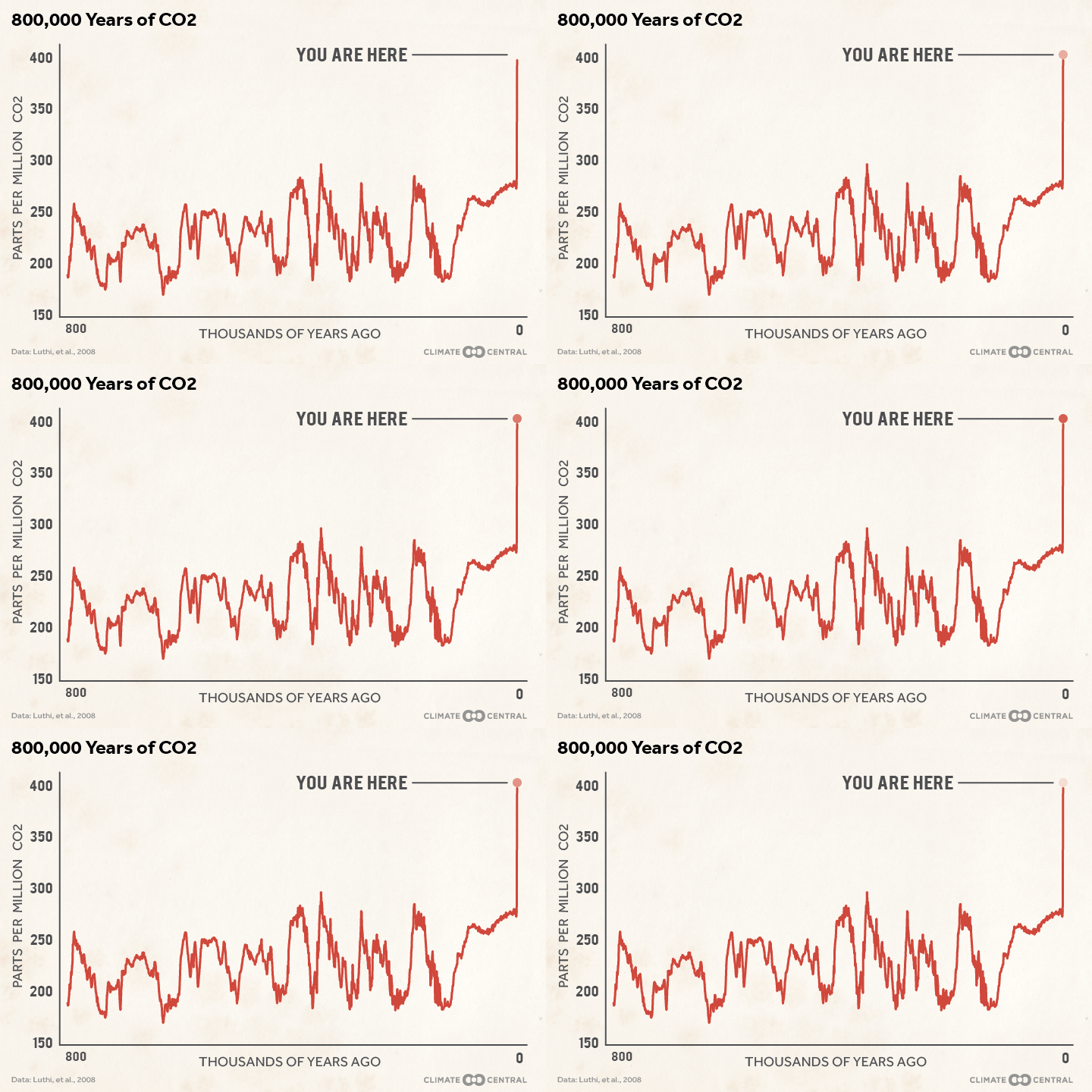
Climate Central reported in November: This week is a big one for our world. Atmospheric carbon dioxide (CO2) levels climbed above the 400 parts per million (ppm) at the Mauna Loa Observatory and it’s distinctly possible they won’t be back below that level again in our lifetimes.

Humans have burned enough fossil fuels to drive atmospheric CO2 to levels that world hasn’t seen in at least 400,000 years. That’s driven up temperatures, melted ice and caused oceans to acidify. Some extreme weather events around the world have become more likely and stronger because of it, and some will likely only get worse as the planet continues to warm.

Because CO2 sits in the atmosphere long after it’s burned, that means we’ve likely lived our last week in a sub-400 ppm world. It also means that the reshaping of our planet will continue for decades and centuries to come, even if climate talks in Paris in two weeks are successful. [Continue reading…]

Facebooktwittermail

As America’s fear of terrorism grows, a ‘wacky gun enthusiast’ supposedly threatens no one

“Right now it looks like he’s a wacky gun enthusiast and a police buff, yet he was going around pretending to be a federal agent – that’s troubling,” a source told the New York Daily News.

Mark Vicars

He had a fake federal air marshal ID in one pocket, a Ruger .380-caliber pistol in the other and was driving around Long Island with ballistic body armor and a loaded AR-15 assault rifle. He also had an arsenal of weapons at his gated home.

But don’t worry folks, Mark Vicars wasn’t a threat to anyone, Nassau County officials insisted Friday.

The amount of firepower is comparable to what terror couple Syed Farook and Tashfeen Malik had during the massacre they committed Wednesday in San Bernardino, Calif.

So why did the Nassau County Police Department spokesman Det. Lt. Richard LeBrun tell reporters, “At this time we don’t see any immediate threat to the public”?

[C]ops don’t believe that Vicars was up to anything nefarious — except for masquerading as a federal agent.

“We don’t see any nexus to any terrorism at this time,” LeBrun said, adding that no anti-American literature or links to terrorism were found at his home.

How about links to organizations such as Stop Islamization of America? Or indications of support for any of the current xenophobic, anti-immigrant GOP presidential candidates?

(Note also that in the current climate, “anti-American literature” is apparently a red flag raising suspicions of terrorism. It sounds like the police were less alarmed by the weapons Vicars owned, than they would have been had they found in his possessions a few books by Noam Chomsky.)

Even if it turns out that there’s no evidence to suspect Vicars might be ideologically motivated to engage in an act of terrorism, why should a heavily armed individual like this be any less a cause for public concern?

Along with his arsenal of weapons (“seven illegal firearms, three high-capacity magazines and 8,300 rounds of ammunition”) he was found (without prescription) to be in possession of steroids used for muscle growth — drugs known to cause aggression and violence.

For America’s gun lovers, pieces of steel are symbols of personal freedom, even though for many such individuals, this bond of affection thinly masks underlying fears of the rest of society.

This is the paradox of gun-bound right-wing patriotism: the country in whose name so much red-blooded passion gets vented, is one upon whose streets it is supposedly only safe to walk while carrying a weapon.

If Mark Vicars needed body armor, muscle armor, an arsenal, and a fake identity in order to feel strong, there must be a very weak and vulnerable man on the inside.

Unfortunately, fear is contagious and nowadays grips some sections of American society.

Unfortunately, the fearful are liable to lash out — to shoot first and ask questions later.

At a time such as this, a country needs leaders who through their own example can demonstrate that courage is stronger than fear. Instead, we are left to choose between the strident and the timid — an environment in which the loudest voices easily drown out all others.

A society built on fear will ultimately be no society at all, since fear leads to isolation.

As much as ISIS and other terrorist groups do indeed pose a real threat to America, a much greater threat is posed by fear itself because of the corrosive effect this has on social bonds.

Far from making America stronger, the easy availability of weapons simply makes this country more dangerous.

Rather than looking for ways to individually and collectively become more defended, reinforcing and amplifying our fears, what we need are more expressions of human solidarity and mutual support.

Unity built around antipathy is just another way of validating fear. Our real strength, however, can only be found on common ground — an understanding of and commitment towards a shared destiny.

Facebooktwittermail

Guns don’t kill people; bullets do

The carnage unleashed by Syed Rizwan Farook and his wife Tashfeen Malik in San Bernardino, is yet another reminder of how easy it is for anyone to go on the warpath inside a country that remains awash with guns.

Once again the need for more effective gun control has been highlighted. And once again, I guarantee that gun owners are rushing to dealers to expand their home arsenals in anticipation of new laws.

Indeed, the only predictable consequence of another spectacular display of gun violence in America, is that it always boosts gun sales.

As the gun lobby likes to say, guns don’t kill people, and as Daniel Patrick Moynihan more accurately stated: bullets do.

And yet it’s easier to legally buy bullets and stockpile them by the thousand, than it is to legally get a prescription for OxyContin.

The U.S. government deems an array of drugs so dangerous that they are regulated as “controlled substances” — even though none are manufactured in pills containing a lethal dose.

Bullets, on the other hand, while always designed to contain a lethal dose of kinetic force, are as easy to buy as candy.

Guns are indeed relatively harmless — no more dangerous than any other heavy object — absent the fuel supply of violence: ammunition.

While taxation might have some effect, it seems to me that the levers of control would need more precision. Why not set absolute limits on how many bullets an individual can purchase and retain. And why not have those wishing to replenish their stocks be required to return their spent cartridges?

Control the supply and then maybe there’s some chance of stemming the violence.

Four years ago, the New York Times reported: In 1993, a United States senator with one of the great political brains of 20th-century America, Daniel Patrick Moynihan, said that we ought to forget gun control as a way to stanch criminal violence. It was hopeless, Senator Moynihan pointed out: even if the sale of new guns was totally forbidden, there were already enough guns in homes and private hands to last the country for 200 years.

“These mostly simple machines last forever,” Mr. Moynihan said.

But he wasn’t through.

“On the other hand, we have only a three-year supply of ammunition.”

His solution: Increase the tax on bullets. He wouldn’t raise the tax on ammunition typically used for target shooting or hunting. But he proposed exorbitant taxes on hollow-tipped bullets designed to penetrate armor and cause devastating damage.

“Ten thousand percent,” Mr. Moynihan said.

That would have made the tax on a 20-cartridge pack of those bullets $1,500. “Guns don’t kill people; bullets do,” said Senator Moynihan, a Democrat who died in 2003.

Another sharp political mind, the comedian Chris Rock, argued that the price of bullets ought to be even higher than what the senator had suggested.

“If a bullet costs $5,000, there’d be no more innocent bystanders,” he said during a routine in the film “Bowling for Columbine.”

In June, the City of New York sold 28,000 pounds of spent shell casings to a an ammunition dealer in Georgia, where they were to be reloaded with bullets. Anyone with $15 can buy a bag of 50, no questions asked, under Georgia law. As The New York Times reported, the city has previously sold shell casings — which are collected at the police target shooting range — to scrap metal dealers, but in this case the highest bidder was the ammunition store.

It was perfectly legal. And jarring, considering that the mayor, Michael R. Bloomberg, has made aggressive gun regulation one of his prime causes, at no small risk to any national political ambitions he might harbor. He has arranged sting buys and filed lawsuits against firearms dealers in other states who, in his view, flouted even the easygoing regulatory regimen of recent years.

But surely, it couldn’t make any sense for the city itself to put more bullets into the weapons economy by recycling casing? After all, the city destroys perfectly usable — and sellable — guns that it recovers from criminals. The sale of the casings must have been the product of someone in an unnoticed cubicle in city government, simply following the bidding rules by rote.

You might think that when learning about the sale, the mayor would have said, “Thanks for the tip.”

Instead, City Hall rose in chorus to sing of the constitutional freedom to own guns and the bullets that go in them. Indeed, the city would gladly sell the next batch of shell casings to a high-bidding ammunition dealer, said John Feinblatt, the criminal justice coordinator. (The dealers of super-size soft drinks, now facing mayoral regulation, must be wondering why the founding fathers couldn’t have added “and drink soda” after the right to “bear arms.”)

Asked about the sale on Monday, the mayor said that people could legally own guns and bullets.

Then one of the most experienced and professional of New York television reporters, Mary Murphy of WPIX, asked Mr. Bloomberg if the city was going to change its policy and not sell shell casings to ammunition dealers. Mr. Bloomberg set forth into a minisermon about how it was an act of integrity.

“This is the public’s money that we are stewards of, and deliberately deciding to sell things at lower prices than the marketplace commands makes no sense at all, and if you think about it, would create chaos and corruption like you’ve never seen,” he said.

Ms. Murphy pressed on: “Does it send the wrong message though?”

The mayor scolded her as if she were an errant schoolgirl.

“Miss, Miss,” Mr. Bloomberg said. “Either you want to ask a question and I give you an answer, or please come to the next press conference and stand in the back.”

Oh, dear.

Bill Cunningham, a former aide to Senator Moynihan and Mr. Bloomberg, said that the senator would have been delighted to discover that he was aligned on the issue with Chris Rock.

“Pat would have liked that,” Mr. Cunningham said, “although we’d have to answer his query, ‘Who is Mr. Rock?’ ”

Facebooktwittermail