Jonathan Turley writes: We previously discussed how the American Studies Association joined a growing boycott of Israeli institutions, which is part of an even broader boycott of Israeli goods in many stores. There are good points to be made on both sides, including the absence of such boycotts for Chinese institutions and those of other abusive nations. However, we should all be able to agree that the response of New York legislator Dov Hikind is excessive and absurd. Hikind is showing his support for Israel by pushing legislation to cut off money to colleges involved in American Studies Association. He ignores the fact that the ASA resolution is non-binding and an expression of opposition to Israel’s policies as opposed to an enforceable ban. However, he wants to cut off whole institutions for even a loose association with a group that has condemned Israel. It is precisely the type of unhinged reaction that has distorted the debate over Middle East policies. He is being joined by Jeffrey Klein (right), another Democrat.
Hikind is planning to formally introduce the legislation early next year that would cut off state aid to schools that retain membership in the ASA. Under their plan, all money would be cut off from both private and public schools if they remain in the ASA. It is hard not to see the analogy with McCarthyism. Are you or have you been a member of the ASA? [Continue reading…]
Category Archives: Issues
Study predicts ‘catastrophic’ rise in global temperatures
The Guardian reports: Temperature rises resulting from unchecked climate change will be at the severe end of those projected, according to a new scientific study.
The scientist leading the research said that unless emissions of greenhouse gases were cut, the planet would heat up by a minimum of 4C by 2100, twice the level the world’s governments deem dangerous.
The research indicates that fewer clouds form as the planet warms, meaning less sunlight is reflected back into space, driving temperatures up further still. The way clouds affect global warming has been the biggest mystery surrounding future climate change.
Professor Steven Sherwood, at the University of New South Wales, in Australia, who led the new work, said: “This study breaks new ground twice: first by identifying what is controlling the cloud changes and second by strongly discounting the lowest estimates of future global warming in favour of the higher and more damaging estimates.”
“4C would likely be catastrophic rather than simply dangerous,” Sherwood told the Guardian. “For example, it would make life difficult, if not impossible, in much of the tropics, and would guarantee the eventual melting of the Greenland ice sheet and some of the Antarctic ice sheet”, with sea levels rising by many metres as a result.
The research is a “big advance” that halves the uncertainty about how much warming is caused by rises in carbon emissions, according to scientists commenting on the study, published in the journal Nature. [Continue reading…]
Soil pollution is poisoning China’s food supply

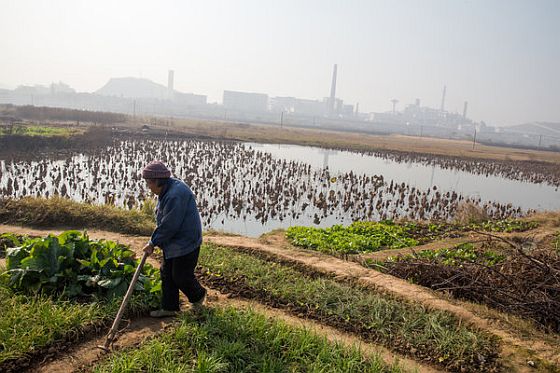
The New York Times reports: The farm-to-table process in China starts in villages like this one in the agricultural heartland. Food from the fields of Ge Songqing and her neighbors ends up in their kitchens or in the local market, and from there goes to other provinces. The foods are Chinese staples: rice, cabbage, carrots, turnips and sweet potatoes.
But the fields are ringed by factories and irrigated with water tainted by industrial waste. Levels of toxic heavy metals in the wastewater here are among the highest in China, and residents fear the soil is similarly contaminated. Though they have no scientific proof, they suspect that a spate of cancer deaths is linked to the pollution, and worry about lead levels in the children’s blood.
“Of course I’m afraid,” said Ms. Ge, in her 60s, pointing to the smokestacks looming over her fields and the stagnant, algae-filled irrigation canals surrounding a home she shares with a granddaughter and her husband, a former soldier. “But we don’t do physical checkups. If we find out we have cancer, it’s only a burden on the children.”
With awareness of China’s severe environmental degradation rising, there has been a surge of anxiety in the last year among ordinary Chinese and some officials over soil pollution in the country’s agricultural centers and the potential effects on the food chain. In recent years, the government has conducted widespread testing of soil across China, but it has not released the results, adding to the fear and making it more difficult for most Chinese to judge what they eat and pinpoint the offending factories.
An alarming glimpse of official findings came on Monday, when a vice minister of land and resources, Wang Shiyuan, said at a news conference in Beijing that eight million acres of China’s farmland, equal to the size of Maryland, had become so polluted that planting crops on it “should not be allowed.”
A signal moment came in May, when officials in Guangdong Province, in the far south, said they had discovered excessive levels of cadmium in 155 batches of rice collected from markets, restaurants and storehouses. Of those, 89 were from Hunan Province, where Ms. Ge farms.
The report set off a nationwide scare. In June, China Daily, an official English-language newspaper, published an editorial saying that “soil contaminated with heavy metals is eroding the foundation of the country’s food safety and becoming a looming public health hazard.”
One-sixth of China’s arable land — nearly 50 million acres — suffers from soil pollution, according to a book published this year by the Ministry of Environmental Protection. The book, “Soil Pollution and Physical Health,” said that more than 13 million tons of crops harvested each year were contaminated with heavy metals, and that 22 million acres of farmland were affected by pesticides.
But the government has refused to divulge details of the pollution, leaving farmers and consumers in the dark about the levels of contaminants in the food chain. The soil survey, completed in 2010, has been locked away as a “state secret.” [Continue reading…]
Alberta tar sands operations encircled by expanding area of mercury pollution
ThinkProgress: Just one week after Al Jazeera discovered that regulatory responsibility for Alberta, Canada’s controversial tar sands would be handed over to a fossil-fuel funded corporation, federal scientists have found that the area’s viscous petroleum deposits are surrounded by a nearly 7,500-square-mile ring of mercury.
Canadian government scientists have found that levels of mercury — a potent neurotoxin which has been found to cause severe birth defects and brain damage — around the region’s vast tar sand operations are up to 16 times higher than regular levels for the region. The findings, presented by Environment Canada researcher Jane Kirk at an international toxicology conference, showed that the 7,500 miles contaminated are “currently impacted by airborne Hg (mercury) emissions originating from oilsands developments.”
The Canadian government touts Alberta’s oil sands as the third-largest proven crude oil reserve in the world, next to Saudi Arabia and Venezuela. The region’s heavy crude oil is mixed with clay, bitumen, and a good deal of sand — hence the name “oil sands.” This makes for a unique and energy-intensive extraction process that some scientists say produces three times the greenhouse gas emissions of conventionally produced oil. Environment Canada has said it expects production emissions from tar sands to hit 104 million tonnes of CO2 by 2020 under current expansion plans. [Continue reading…]
Israeli military intelligence sees genuine political change in Iran
Summarizing the assessment of Israeli military intelligence, Haaretz reports: Syria is continuing to fall apart, with forces that oppose the regime now in control of nearly half the country, in the north and the east. But the Assad regime continues to cling to the cities that are important to its survival and maintains a fairly wide corridor that includes the Alawite cities in the northwest of the country, as well as Aleppo, Homs, Damascus and the southern city of Daraa. Last March, Assad seemed to be on the verge of collapse, but was able to recover thanks to massive aid from Russia, Iran and Hezbollah. Since the victory organized for Assad in June by Hezbollah forces in the town of Qusair, on the Lebanese border, the fighting has become static, with no thrust of momentum or victory by either side. Presently, the opposition looks too weak and divided to topple the regime in the near future.
All the signs are that the upheaval in the Arab world will continue into 2014. The worsening economic situation – which the violence has only aggravated – will likely push more young people into the arms of the jihadist organizations, which will increasingly also clash with Israel on the margins of their main activity.
As for Iran, intelligence discerns a genuine struggle over the future image of the country between the spiritual leader Ali Khamenei and his conservative allies, and a more moderate group headed by the new president, Hassan Rohani. Expert analysis does not view Rohani’s election as a deception by Khamenei intended solely to mislead the West, but rather as an authentic leader who is creating an independent power center. The internal struggle between the blocs in Iran has yet to be resolved, but Rohani enjoys broad public support, despite the clout of the Revolutionary Guards and the senior army officers who are loyal to the spiritual leader.
Haaretz reported in September that on the eve of Netanyahu’s departure for the United Nations General Assembly in New York, the head of MI, Maj. Gen. Aviv Kochavi, provided him with an assessment holding that a deep strategic change was being played out in Iran, expressed in Rohani’s election victory in June.
Kochavi appears to be sticking to this opinion. Earlier this month, he presided over a ceremony at which prizes for creative thinking were awarded to intelligence officers. According to a report on Israel Radio, a group of officers from the research division who “identified the change in Iran” received a special certificate of appreciation from Kochavi. Officially, senior Israeli figures such as Netanyahu, Ya’alon and Foreign Minister Avigdor Lieberman are scoffing at the change in Tehran and saying that Rohani’s “charm offensive” is simply a mask assumed by the regime solely in order to get relief from the international sanctions. It turns out that MI, without for a moment detracting from the dangers of Iran’s nuclear project and its support for terrorism, thinks otherwise.
Video: Glenn Greenwald keynote at Chaos Communications Congress (30C3), Hamburg
Chomsky: Mainstream media remains an ‘invaluable resource’
Salon: This year’s revelations about the scope of surveillance-state activity are certainly not the first major leaks you’ve seen draw scrutiny on government spying. Is there something particular or unique, in your view, about the NSA revelations?
In principle it’s not an innovation; things like this have been going on for a long time. The scale and the incredibly ambitious character of the surveillance and control is something new. But it’s the kind of thing one should expect. The history goes back a long way. So, for example, if you go back a century ago, right after the U.S. invasion of the Philippines — a brutal invasion that killed a couple hundred thousand people — there was a problem for the U.S. of pacification afterwards. What do you do to control the population to prevent another nationalist uprising? There’s a very good study of this by Alfred McCoy, a Philippines scholar at University of Wisconsin, and what he shows is that the U.S. used the most sophisticated technology of the day to develop a massive system of survelliance, control, disruption to undermine any potential opposition and to impose very tight controls on the population which lasted for a long time and in many ways the Philippines is still suffering from this. But he also points out the technology was immediately transferred home. Woodrow Wilson’s administration used it in their “Red Scare” a couple years later. The British used it, too.
Q: Do you think revelations about sprawling surveillance have prompted much significant self-reflection from the American public about the workings of our state apparatus and our use of technology?
Governments are power systems. They are trying to sustain their power and domination over their populations and they will use what means are available to do this. By now the means are very sophisticated and extensive and we can expect them to increase. So for instance, if you read technology journals you learn that in robotics labs for some years there have been efforts to develop small drones, what they call “fly-sized drones,” which can intrude into a person’s home and be almost invisible and carry out constant surveillance. You can be sure that the military is very much interested in this, and the intelligence systems as well, and will soon be using it.
We’re developing technologies that will be used by our own governments and by commercial corporations and are already being used to maximize information for themselves for control and domination. That’s the way power systems work. Of course, they’ve always played the security card. But I think one should be very cautious about such claims. Every government pleads security for almost anything it’s doing, so since the plea is predictable it essentially carries no information. If after the event the power system claims security, that doesn’t mean it’s actually a functioning principle. And if you look at the record, you discover that security is generally a pretext and security is not a high priority of governments. If by that I mean the security of the population — security of the power system itself and the domestic interests it represents, yes, that’s a concern. But security of the population is not.
Q: You’ve often highlighted flaws in mainstream media’s insidious institutional fealty during your career — notably in your book “Manufacturing Consent” [1988]. What do you think of the current state of the U.S. media? Do you have much hope for new ventures like Glenn Greenwald’s, which has already promised to aggressively take on government and corporate wrongdoing?
The availability of the Internet has offered a much easier access than before to a wide variety of information and opinion and so on. But I don’t think that is a qualitative shift. It is easier to go to the Internet than to go to the library, undoubtedly. But the shift from no libraries to the existence of libraries was a much greater shift than what we’ve seen with the Internet’s development. [The Internet] gives more access — that part is good — but on the other hand, it is combined with a process of undermining independent inquiry and reporting within the media themselves. There’s plenty to criticize about the mass media but they are the source of regular information about a wide range of topics. You can’t duplicate that on blogs. And that’s declining. Local newspapers, I need not inform you, are becoming very much narrower in their global outreach, even their national outreach. And that’s the real meat of inquiry, of information gathering. We can criticize its character and the biases that enter into it, and the institutional constraints on it, but nevertheless it’s of inestimable importance. I’ve never questioned that. And that’s diminishing at the same time as accesses to a wider range of materials is increasing. The Greenwald initiative is a very promising one. He himself has had an impressive career of independent thinking, inquiry, analysis and reporting. I think there is good reason to have a good deal of trust in his judgement. Where it will go, we don’t know; it hasn’t started yet so it is just speculation.
I think that, for example, the New York Times will remain what’s called the “newspaper of record” for the foreseeable future. I don’t see any competitor arising which has the range of resources, of overseas bureaus and so on. Again, I think there is plenty to criticize about it, but it is nevertheless an invaluable resource. There are many other independent developments which are quite significant of themselves, so it’s valuable to have, say, Amy Goodman’s Democracy Now or Salon or any other independent voice. But I don’t see any indication that there is going to be some radically new form of gathering, reporting and analyzing information. [Continue reading…]
The danger of new Iran sanctions
Colin H. Kahl writes: The Geneva “interim” agreement reached in November between Iran and the so-called P5+1 (the United States, Britain, China, France, Germany, and Russia) freezes Tehran’s nuclear program in exchange for modest sanctions relief, with the goal of enabling further talks to comprehensively resolve one of the world’s thorniest challenges. Yet despite the landmark accord, more than two dozen Senators introduced legislation on December 19 to impose new oil and financial sanctions on Iran. The Senate could vote on the measure soon after it returns from recess in January. Powerful lobby organizations are mobilized in support of the bill, and it could certainly pass.
The legislation defies a request by the Obama administration and ten Senate committee chairs to stand down on sanctions while negotiations continue. It also flies in the face of an unclassified intelligence assessment that new sanctions “would undermine the prospects for a successful comprehensive nuclear agreement with Iran.” Proponents of the bill note that the proposed sanctions would only come into force if Iran violates the Geneva agreement or fails to move toward a final deal, and would not kick in for months. But the White House warns that enshrining new economic threats in law now runs counter to the spirit of the Geneva pledge of no new sanctions during negotiations, and risks empowering Iranian forces hoping to scuttle nuclear talks. The legislation also defines congressionally acceptable parameters for a final deal that Iran experts almost universally believe are unachievable, namely the requirement that Iran completely dismantle its uranium enrichment program. For these reasons, the administration believes the bill represents a poison pill that could kill diplomacy, making a nuclear-armed Iran or war more likely.
Sanctions hawks disagree, arguing that the legislation will enable, not thwart, diplomatic progress. “Current sanctions brought Iran to the negotiating table,” Senator Robert Menendez, the bill’s leading champion, contends, “and a credible threat of future sanctions will require Iran to cooperate and act in good faith at the negotiating table.”
But this logic badly misreads the historical effect of sanctions on Iranian behavior and under-appreciates the role played by Iran’s fractious domestic politics. A careful look at Iranian actions over the past decade suggests that economic pressure has sometimes been effective, but only when it aligns with particular Iranian political dynamics and policy preferences. And once domestic Iranian politics are factored in, the lesson for today’s sanctions debate is clear: the threat of additional sanctions, at this critical juncture, could derail negotiations toward a peaceful solution. [Continue reading…]
Would NSA surveillance have stopped 9/11 plot?
Peter Bergen writes: The Obama administration has framed its defense of the controversial bulk collection of all American phone records as necessary to prevent a future 9/11.
During a House Intelligence Committee hearing on June 18, NSA director Gen. Keith Alexander said, “Let me start by saying that I would much rather be here today debating this point than trying to explain how we failed to prevent another 9/11.”
This closely mirrors talking points by the National Security Agency about how to defend the program.
In the talking points, NSA officials are encouraged to use “sound bites that resonate,” specifically, “I much prefer to be here today explain these programs, than explaining another 9/11 event that we were not able to prevent.”
On Friday in New York, Judge William H. Pauley III ruled that NSA’s bulk collection of American telephone records is lawful. He cited Alexander’s testimony and quoted him saying, “We couldn’t connect the dots because we didn’t have the dots.”
But is it really the case that the U.S. intelligence community didn’t have the dots in the lead up to 9/11? Hardly.
In fact, the intelligence community provided repeated strategic warning in the summer of 9/11 that al Qaeda was planning a large-scale attacks on American interests.
Here is a representative sampling of the CIA threat reporting that was distributed to Bush administration officials during the spring and summer of 2001:
— CIA, “Bin Ladin Planning Multiple Operations,” April 20
— CIA, “Bin Ladin Attacks May Be Imminent,” June 23
— CIA, “Planning for Bin Ladin Attacks Continues, Despite Delays,” July 2
— CIA, “Threat of Impending al Qaeda Attack to Continue Indefinitely,” August 3The failure to respond adequately to these warnings was a policy failure by the Bush administration, not an intelligence failure by the U.S. intelligence community. [Continue reading…]
Inside the NSA’s catalog of surveillance magic
Sean Gallagher writes: The National Security Agency’s sophisticated hacking operations go way beyond using software vulnerabilities to gain access to targeted systems. The agency has a catalog of tools available that would make James Bond’s Q jealous, providing NSA analysts access to just about every potential source of data about a target.
In some cases, the NSA has modified the firmware of computers and network hardware—including systems shipped by Cisco, Dell, Hewlett-Packard, Huawei, and Juniper Networks—to give its operators both eyes and ears inside the offices the agency has targeted. In others, the NSA has crafted custom BIOS exploits that can survive even the reinstallation of operating systems. And in still others, the NSA has built and deployed its own USB cables at target locations—complete with spy hardware and radio transceiver packed inside.
Documents provided by former NSA contractor Edward Snowden to Der Spiegel reveal a fantastical collection of surveillance tools dating back to 2007 and 2008 that gave the NSA the power to collect all sorts of data over long periods of time without detection. The tools, ranging from back doors installed in computer network firmware and software to passively powered bugs installed within equipment, give the NSA a persistent ability to monitor some targets with little risk of detection. While the systems targeted by some of the “products” listed in the documents are over five years old and are likely to have been replaced in some cases, the methods and technologies used by all the exploit products could easily still be in use in some form in ongoing NSA surveillance operations. [Continue reading…]
Jacob Applebaum, co-author of the Der Spiegel report, spoke yesterday at the 30th annual Chaos Communication Congress where he presented new details including the NSA’s ability to hack a Wi-Fi network from up to eight miles away.
It won’t be long before the victims of climate change make the West pay
Chris Huhne writes: Would you enjoy the cosiness and warmth of Christmas with your children or grandchildren just that little bit less if you knew that other people’s children were dying because of it? More than four million children under five years old are now at risk of acute malnutrition in the Sahel, an area of the world that is one of the clearest victims of the rich world’s addiction to fossil fuels.
About 18 million people in the Sahel – the vulnerable pan-African strip of land that runs from Senegal to Sudan along the southern edge of the Sahara – faced famine last year. Life has never been easy there. Its land is poor. Its people are often semi-nomadic, moving their animals between the grasslands. But science is increasingly pointing a hard finger at those to blame for the persistence of Sahelian drought – and it is us.
This is an ineluctable consequence of improving the computer models of climate change. Of course, there are still large uncertainties. But what has long persuaded me of the strength of the scientific case for human-induced climate change is that climate-sceptic scientists have not managed to build a model that explains global warming without human-induced effects. The human hand is indispensable in understanding what has happened.
There are legitimate doubts about the scale of the impact, and about other offsetting factors that may reduce human-induced global warming. But what should be a wake-up call is science’s growing ability to highlight the blame for particular extreme events, and not just in the Sahel. [Continue reading…]
Iran, Turkey’s new ally?
Vali R. Nasr writes: In sharp contrast to Israel and the Persian Gulf monarchies, which have been alarmed by the interim deal on Iran’s nuclear program, Turkey sees benefit in serving as a bridge between Iran and the West and in providing the gateway to the world that Tehran needs as it emerges from isolation.
The Iranian turn has come at an opportune time for Turkish foreign policy in other ways, too. Iran has influence with Iraq’s Shiite-led government and Syria’s Alawite elite. In Iraq, where a crucial oil deal hangs in the balance, Turkey needs Iranian cooperation. It also needs Iran’s help on Syria.
Turkey initially tied its policy to America’s demand that President Bashar al-Assad quit. It was disappointed when the Obama administration signed on to a Russian-brokered deal with Mr. Assad on chemical weapons. With violence menacing across the border, Turkey wants to see an end to Syria’s civil war. The new moderate government in Tehran is Turkey’s best hope for leveraging a settlement.
Economic ties between Turkey and Iran have been strengthening, with trade now estimated to be worth $20 billion. The real number may be still higher, since the recent corruption charges allege that Turkish officials and the state-owned Halkbank have been helping Iranian businesses dodge international sanctions. In any case, Iranian exports still reach Turkey, and the proceeds fund the purchase of gold and silver that flow back to Iran. In turn, Turkey’s economy depends on Iran’s oil and gas, its investments dollars and large export market.
If Iran does conclude a long-term nuclear deal with the West, it still cannot expect a warm welcome from the Sunni Arab world. With the region divided by a widening sectarian rift, the Persian Gulf monarchies will become only more fretful about Iran’s regional ambitions. That makes Turkey potentially a key strategic partner for Iran, especially if its economy starts to grow as sanctions are relaxed. [Continue reading…]
The ghosts of Benghazi
David Kirkpatrick reports: Months of investigation by The New York Times, centered on extensive interviews with Libyans in Benghazi who had direct knowledge of the attack there [on September 11, 2012] and its context, turned up no evidence that Al Qaeda or other international terrorist groups had any role in the assault. The attack was led, instead, by fighters who had benefited directly from NATO’s extensive air power and logistics support during the uprising against Colonel Qaddafi. And contrary to claims by some members of Congress, it was fueled in large part by anger at an American-made video denigrating Islam.
A fuller accounting of the attacks suggests lessons for the United States that go well beyond Libya. It shows the risks of expecting American aid in a time of desperation to buy durable loyalty, and the difficulty of discerning friends from allies of convenience in a culture shaped by decades of anti-Western sentiment. Both are challenges now hanging over the American involvement in Syria’s civil conflict.
The attack also suggests that, as the threats from local militants around the region have multiplied, an intensive focus on combating Al Qaeda may distract from safeguarding American interests.
In this case, a central figure in the attack was an eccentric, malcontent militia leader, Ahmed Abu Khattala, according to numerous Libyans present at the time. American officials briefed on the American criminal investigation into the killings call him a prime suspect. Mr. Abu Khattala declared openly and often that he placed the United States not far behind Colonel Qaddafi on his list of infidel enemies. But he had no known affiliations with terrorist groups, and he had escaped scrutiny from the 20-person C.I.A. station in Benghazi that was set up to monitor the local situation.
Mr. Abu Khattala, who denies participating in the attack, was firmly embedded in the network of Benghazi militias before and afterward. Many other Islamist leaders consider him an erratic extremist. But he was never more than a step removed from the most influential commanders who dominated Benghazi and who befriended the Americans. They were his neighbors, his fellow inmates and his comrades on the front lines in the fight against Colonel Qaddafi.
To this day, some militia leaders offer alibis for Mr. Abu Khattala. All resist quiet American pressure to turn him over to face prosecution. Last spring, one of Libya’s most influential militia leaders sought to make him a kind of local judge.
Fifteen months after Mr. Stevens’s death, the question of responsibility remains a searing issue in Washington, framed by two contradictory story lines.
One has it that the video [Innocence of Muslims], which was posted on YouTube, inspired spontaneous street protests that got out of hand. This version, based on early intelligence reports, was initially offered publicly by Susan E. Rice, who is now Mr. Obama’s national security adviser.
The other, favored by Republicans, holds that Mr. Stevens died in a carefully planned assault by Al Qaeda to mark the anniversary of its strike on the United States 11 years before. Republicans have accused the Obama administration of covering up evidence of Al Qaeda’s role to avoid undermining the president’s claim that the group has been decimated, in part because of the raid that killed Osama bin Laden.
The investigation by The Times shows that the reality in Benghazi was different, and murkier, than either of those story lines suggests. Benghazi was not infiltrated by Al Qaeda, but nonetheless contained grave local threats to American interests. The attack does not appear to have been meticulously planned, but neither was it spontaneous or without warning signs. [Continue reading…]
Irrespective of whatever actually happened in Benghazi, the ability of most Americans of all political stripes to view such an event without a distorted perspective is severely constrained by the degree to which terrorism has become a pillar of the American worldview.
The neoconservatives were resoundingly successful in promoting the idea of a global terrorist network — not one which has a formal, verifiable structure; but one that exists more like a mycelium of evil.
Its tentacles are subterranean, vast, and yet ethereal. It is everywhere and nowhere, elusive and yet all-powerful; at some moments about to expire and yet paradoxically always an inextinguishable force.
We are meant to fear it just as resolutely as we cling to any object of faith. Indeed, to fail to view terrorism with sufficient gravity is to fail to uphold ones responsibilities as a patriotic American.
Even though it’s more than a decade since 9/11, terrorism remains America’s cultural straightjacket — that’s why even now in popular culture we have yet to see the war on terrorism being satirized.
At the height of the Cold War, when thousands of young Americans were getting killed in Vietnam in the name of standing up against Communism, it was somehow possible for Mel Brooks to create Get Smart and poke fun at spies and the paranoiac neuroses of the era.
The world has since pulled back from the threat of Mutually Assured Destruction and yet by some spectacular defiance of logic or any sense of proportion, terrorism has been conjured as an even greater threat.
At this time, 83% of Americans believe that protecting this nation from terrorist attacks should be the U.S. government’s top foreign policy priority whereas only 37% would prioritize dealing with global climate change.
That, to my mind, is a definition of collective insanity.

Don’t let Israel declare war for America
Sheldon Richman writes: The American people should know that pending right now in Congress is a bipartisan bill that would virtually commit the United States to go to war against Iran if Israel attacks the Islamic Republic. “The bill outsources any decision about resort to military action to the government of Israel,” Columbia University Iran expert Gary Sick wrote to Sen. Chuck Schumer (D-NY) in protest, one of the bill’s principal sponsors.
The mind boggles at the thought that Congress would let a foreign government decide when America goes to war, so here is the language (PDF):
If the government of Israel is compelled to take military action in legitimate self-defense against Iran’s nuclear weapon program, the United States Government should stand with Israel and provide, in accordance with the law of the United States and the constitutional responsibility of Congress to authorize the use of military force, diplomatic, military and economic support to the Government of Israel in its defense of its territory, people and existence.
This section is legally nonbinding, but given the clout of the bill’s chief supporter outside of Congress — the American-Israel Public Affairs Committee (AIPAC [PDF]), leader of the pro-Israel lobby — that is a mere formality. [Continue reading…]
I worked on the U.S. drone program. The public should know what really goes on
Heather Linebaugh writes: Whenever I read comments by politicians defending the Unmanned Aerial Vehicle Predator and Reaper program – aka drones – I wish I could ask them some questions. I’d start with: “How many women and children have you seen incinerated by a Hellfire missile?” And: “How many men have you seen crawl across a field, trying to make it to the nearest compound for help while bleeding out from severed legs?” Or even more pointedly: “How many soldiers have you seen die on the side of a road in Afghanistan because our ever-so-accurate UAVs [unmanned aerial vehicle] were unable to detect an IED [improvised explosive device] that awaited their convoy?”
Few of these politicians who so brazenly proclaim the benefits of drones have a real clue of what actually goes on. I, on the other hand, have seen these awful sights first hand.
I knew the names of some of the young soldiers I saw bleed to death on the side of a road. I watched dozens of military-aged males die in Afghanistan, in empty fields, along riversides, and some right outside the compound where their family was waiting for them to return home from mosque.
The US and British militaries insist that this is such an expert program, but it’s curious that they feel the need to deliver faulty information, few or no statistics about civilian deaths and twisted technology reports on the capabilities of our UAVs. These specific incidents are not isolated, and the civilian casualty rate has not changed, despite what our defense representatives might like to tell us.
What the public needs to understand is that the video provided by a drone is a far cry from clear enough to detect someone carrying a weapon, even on a crystal-clear day with limited clouds and perfect light. This makes it incredibly difficult for the best analysts to identify if someone has weapons for sure. One example comes to mind: “The feed is so pixelated, what if it’s a shovel, and not a weapon?” I felt this confusion constantly, as did my fellow UAV analysts. We always wonder if we killed the right people, if we endangered the wrong people, if we destroyed an innocent civilian’s life all because of a bad image or angle. [Continue reading…]
How data thieves have captured our lives on the internet
John Naughton writes: [T]he biggest misjudgment of all – the one that legitimised most of the excesses that Snowden has unveiled – was … a political one. It was the decision of the George W Bush administration to declare a “war on terror” in the aftermath of the 9/11 attacks – and the eager adoption by the UK and other allies of the same stance.
As Professor Eben Moglen of Columbia University puts it, the intelligence agencies “presented with a mission by an extraordinarily imprudent national government in the United States, which having failed to prevent a very serious attack on American civilians at home, largely by ignoring warnings, decreed that they were never again to be put in a position where they should have known. This resulted in a military response, which is to get as close to everything as possible. Because if you don’t get as close to everything as possible, how can you say that you knew everything that you should have known?” In a real war, one in which the very survival of a state is threatened by a foreign adversary, almost anything is permissible, including the suspension of civil liberties, the right to privacy and all the other things we liberals hold dear. Between 1939 and 1945, Britain was governed by what was effectively a dictatorship wielding unimaginable powers, including comprehensive censorship, the power to requisition private property on demand, and so on. Citizens might not have liked this regime, but they consented to because they understood the need for it.
The “war” on terror is not a war in this sense. It is a rhetorical device aimed at engineering consent for a particular political strategy. But it was enough to provide legislative cover for the acquisition by the US intelligence-gathering agencies of warlike powers, which included the means of surveilling every citizen on earth who had an internet connection, and every owner of a mobile phone in most countries of the world. The war on terror may have succeeded in turbocharging the surveillance capabilities of the US and its allies, but it has also inflicted significant collateral damage on the foreign policy of the US, threatened its dominance of cloud computing and other markets, undermined its major technology companies, infuriated some of its most important allies and superimposed a huge question-mark on the future of the internet as a global system. The war on terror may have made tactical sense in the traumatic months post-9/11. But as a political decision it has had a catastrophic long-term impact. [Continue reading…]
Why won’t the West call out Saudi Arabia for persecution of democratic activists?
Andy Fitzgerald writes: At the memorial for Nelson Mandela, President Barack Obama eulogized the fallen leader:
Like Gandhi, he would lead a resistance movement – a movement that at its start held little prospect of success. Like [Martin Luther] King, he would give potent voice to the claims of the oppressed.
Listening in the crowd sat Prince Muqrin bin Abdulaziz al-Saud, the Kingdom of Saudi Arabia’s second deputy prime minister. Apparently the words were lost on the government His Royal Highness was representing (though it’s questionable he even relayed the message), because within the next week, a Saudi judge sentenced democratic activist Omar al-Saeed to 4 years in prison and 300 lashes. His crime: calling for a constitutional monarchy (a government that would likely outlaw such cruel and unusual punishment).
Saeed is a member of the Saudi Civil and Political Rights Association (Acpra), an organization documenting human rights abuses and calling for democratic reform. He is its fourth member to be sentenced to prison this year. In March, co-founders Mohammad Fahad al-Qahtani (who I have met in the past, and previously wrote about) and Abdullah al-Hamid were sentenced to prison terms of 10 and 5 years on charges such as “breaking allegiance with the ruler” and running an unlicensed political organization – despite repeated attempts to obtain a license.
Not surprisingly, there has been no strong public statement from the Obama administration regarding Saeed’s sentencing. [Continue reading…]
Noam Chomsky: We’re no longer a functioning democracy, we’re really a plutocracy
Raw Story: The world faces two potentially existential threats, according to the linguist and political philosopher Noam Chomsky.
“There are two major dark shadows that hover over everything, and they’re getting more and more serious,” Chomsky said. “The one is the continuing threat of nuclear war that has not ended. It’s very serious, and another is the crisis of ecological, environmental catastrophe, which is getting more and more serious.”
Chomsky appeared Friday on the last episode of NPR’s “Smiley and West” program to discuss his education, his views on current affairs and how he manages to spread his message without much help from the mainstream media.
He told the hosts that the world was racing toward an environmental disaster with potentially lethal consequence, which the world’s most developed nations were doing nothing to prevent – and in fact were speeding up the process.
“If there ever is future historians, they’re going to look back at this period of history with some astonishment,” Chomsky said. “The danger, the threat, is evident to anyone who has eyes open and pays attention at all to the scientific literature, and there are attempts to retard it, there are also at the other end attempts to accelerate the disaster, and if you look who’s involved it’s pretty shocking.”
Chomsky noted efforts to halt environmental damage by indigenous people in countries all over the world – from Canada’s First Nations to tribal people in Latin America and India to aboriginal people in Australia—but the nation’s richest, most advanced and most powerful countries, such as the United States, were doing nothing to forestall disaster.