Category Archives: Issues

No doubt about effectiveness of mass metadata collection, claims federal judge — ignoring evidence to the contrary

Adam Serwer writes: When Judge William H. Pauley ruled that the National Security Agency’s metadata program was lawful on Friday, he argued that there was no significant dispute about “the effectiveness of bulk telephony metadata collection.”

Pauley — who issued his ruling from a courthouse less than two miles from where the twin towers once stood — then offered a series of examples cited by the NSA to bolster their claims that the program is effective, all of which have been “seriously disputed.”

Only four plots among the fifty-four the NSA claims to have helped foil have been made public. Pauley cited three of those four plots in arguing that the metadata program was effective, but journalists and legislators have picked already picked those examples apart. ProPublica published a piece in October by Justin Elliott and Theodoric Meyer noting that in each of the three cases Pauley mentions, there were serious doubts as to whether or not the NSA was exaggerating either the plot itself or the impact of the program.

Pauley cites the case of Najibullah Zazi, who was convicted of a plot to bomb the New York subway in 2009. An Associated Press examination concluded that the NSA had the authority to monitor the email account that lead to Zazi’s capture even without the authority to gather communications records in bulk.

Pauley also cited an effort by a man named Khalid Ouazzani to attack the New York Stock Exchange. But Ouazzani was convicted of funding al Qaeda, and as ProPublica notes neither he nor anyone else was ever actually charged or convicted of a plot to bomb the NYSE.

Pauley also cites the case of David Headley, who was involved in the 2008 terrorist attack in Mumbai and was involved in a plot to attack on a Danish newspaper which had published cartoons depicting the Islamic prophet Mohammed. But according to ProPublica, it was British intelligence, not the NSA’s datagathering, that first brought Headly to U.S. authorities’ attention.

All of this information would have been available to Pauley, because the ProPublica piece disputing the NSA’s claims was cited as a footnote in the prior ruling by Judge Richard Leon that found the NSA’s data gathering program unconstitutional. Pauley refers to Leon’s ruling multiple times in his own, indicating that he read it. [Continue reading…]

Facebooktwittermail

The Snowden saga heralds a radical shift in capitalism

Evgeny Morozov writes: Following his revelations this year about Washington’s spying excesses, Edward Snowden now faces a growing wave of surveillance fatigue among the public – and the reason is that the National Security Agency contractor turned whistleblower has revealed too many uncomfortable truths about how today’s world works.

Technical infrastructure and geopolitical power; rampant consumerism and ubiquitous surveillance; the lofty rhetoric of “internet freedom” and the sober reality of the ever-increasing internet control – all these are interconnected in ways most of us would rather not acknowledge or think about. Instead, we have focused on just one element in this long chain – state spying – but have mostly ignored all others.

But the spying debate has quickly turned narrow and unbearably technical; issues such as the soundness of US foreign policy, the ambivalent future of digital capitalism, the relocation of power from Washington and Brussels to Silicon Valley have not received due attention. But it is not just the NSA that is broken: the way we do – and pay for – our communicating today is broken as well. And it is broken for political and economic reasons, not just legal and technological ones: too many governments, strapped for cash and low on infrastructural imagination, have surrendered their communications networks to technology companies a tad too soon.

Mr Snowden created an opening for a much-needed global debate that could have highlighted many of these issues. Alas, it has never arrived. The revelations of the US’s surveillance addiction were met with a rather lacklustre, one-dimensional response. Much of this overheated rhetoric – tinged with anti-Americanism and channelled into unproductive forms of reform – has been useless. Many foreign leaders still cling to the fantasy that, if only the US would promise them a no-spy agreement, or at least stop monitoring their gadgets, the perversions revealed by Mr Snowden would disappear. [Continue reading…]

Facebooktwittermail

UK anti-Muslim hate crime soars, police figures show

The Press Association reports: Hate crimes against Muslims have soared in the UK this year, figures show.

Hundreds of anti-Muslim offences were carried out across the country in 2013, with Britain’s biggest force, the Metropolitan police, recording 500 Islamophobic crimes.

Many forces reported a surge in the number of anti-Muslim hate crimes after the murder of soldier Lee Rigby by two Islamic extremists in Woolwich, south-east London, in May.

But the figures could be much higher as nearly half of the 43 forces in England and Wales did not reveal how many hate crimes had targeted Muslims. Some forces admitted they did not always record the faith of a religious hate-crime victim.

Freedom of Information requests were sent by the Press Association to every police force in England and Wales. Of the 43 forces, 24 provided figures on the number of anti-Muslim crimes and incidents recorded.

Tell Mama, a group which monitors anti-Muslim incidents, said it had dealt with 840 cases since April, with the number expected to rise to more than 1,000 by the end of March. This compared with 582 anti-Muslim cases it dealt with from March 2012 to March 2013. [Continue reading…]

Facebooktwittermail

There’s an alarming number of deaths in U.S. jails

Cara Tabachnick writes: Kyam Livingston begged for help. After seven hours of lying on the floor of a jail cell, the 38-year-old mother of two died, her calls unheeded by the correction officers providing security for the approximately 15 female inmates at Brooklyn “central booking” jail this past summer, according to witnesses and court documents.

Witnesses told the family that she had died in the cell among fetid conditions before she was taken to Brooklyn Hospital Health Center on 21 July 2013 where Livingston was pronounced dead at 6:58am, according to police reports. A witness, registered nurse Aleah Holland, told The Daily News, that police at Central Booking ignored her complaints of stomach pains and diarrhea. She said that when she and other inmates banged on the bars calling for help, officers told them Livingston was an alcoholic.

No one knows what happened, and no one wants to say. The NYPD told the family that she died of a seizure, but her family says she never suffered from seizures. This October the family sued the city, the NYPD, and the Department of Corrections in an effort to force systemic change and “responsibility” for her death.

Livingston was one of the few hundred jail deaths that happen across the country. In 2011, (the latest available numbers) 885 inmates died (pdf) in the custody of local jails, the Justice Department’s Bureau of Justice Statistics reported. Notice I said jails. These are different from prisons. Prisons are for people who have been convicted of a crime and sentenced. There are roughly 3,000 jails nationwide and each facility is set up to process people that have been arrested before they are arraigned or go to trial. Some will serve a misdemeanor sentence (of under a year). The majority will be let go because the charges against them won’t stick as they move through the legal system. Others will remain in jails while waiting to go to trial too poor to make bail – yet to be convicted of anything. Regardless, they will be treated as criminals. [Continue reading…]

Facebooktwittermail

Why non-believers need rituals too

Suzanne Moore writes: The last time I put my own atheism through the spin cycle rather than simply wiping it clean was when I wanted to make a ceremony after the birth of my third child. Would it be a blessing? From who? What does the common notion of a new baby as a gift mean? How would we make it meaningful to the people we invited who were from different faiths? And, importantly, what would it look like?

One of the problems I have with the New Atheism is that it fixates on ethics, ignoring aesthetics at its peril. It tends also towards atomisation, relying on abstracts such as “civic law” to conjure a collective experience. But I love ritual, because it is through ritual that we remake and strengthen our social bonds. As I write, down the road there is a memorial being held for Lou Reed, hosted by the local Unitarian church. Most people there will have no belief in God but will feel glad to be part of a shared appreciation of a man whose god was rock’n’roll.

When it came to making a ceremony, I really did not want the austerity of some humanist events I have attended, where I feel the sensual world is rejected. This is what I mean about aesthetics. Do we cede them to the religious and just look like a bunch of Calvinists? I found myself turning to flowers, flames and incense. Is there anything more beautiful than the offerings made all over the world, of tiny flames and blossom on leaves floating on water?

Already, I am revealing a kind of neo-paganism that hardcore rationalist will find unacceptable. But they find most human things unacceptable. For me, not believing in God does not mean one has to forgo poetry, magic, the chaos of ritual, the remaking of shared bonds. I fear ultra-orthodox atheism has come to resemble a rigid and patriarchal faith itself. [Continue reading…]

Facebooktwittermail

UN’s Navi Pillay compares uproar over mass surveillance to fight against apartheid

The Guardian reports: The UN human rights chief, Navi Pillay, has compared the uproar in the international community caused by revelations of mass surveillance with the collective response that helped bring down the apartheid regime in South Africa.

Pillay, the first non-white woman to serve as a high-court judge in South Africa, made the comments in an interview with Sir Tim Berners-Lee on a special edition of BBC Radio 4’s Today programme, which the inventor of the world wide web was guest editing.

Pillay has been asked by the UN to prepare a report on protection of the right to privacy, in the wake of the former National Security Agency analyst Edward Snowden leaking classified documents about UK and US spying and the collection of personal data.

The former international criminal court judge said her encounters with serious human rights abuses, which included serving on the Rwanda tribunal, did not make her take online privacy less seriously. “I don’t grade human rights,” she said. “I feel I have to look after and promote the rights of all persons. I’m not put off by the lifetime experience of violations I have seen.”

She said apartheid ended in South Africa principally because the international community co-operated to denounce it, adding: “Combined and collective action by everybody can end serious violations of human rights … That experience inspires me to go on and address the issue of internet [privacy], which right now is extremely troubling because the revelations of surveillance have implications for human rights … People are really afraid that all their personal details are being used in violation of traditional national protections.” [Continue reading…]

Facebooktwittermail

Outsourcing mass surveillance

The Washington Post reports: A measure that President Obama is considering as a way to curb the National Security Agency’s mass storage of phone data is already facing resistance — not only from the intelligence community but also from privacy advocates, the phone industry and some lawmakers.

Obama last week suggested that he was open to the idea of requiring phone companies to store the records and allowing the government to search them under strict guidelines. Currently, the agency stores those records itself, part of a sprawling collection program that came to light through documents shared by former NSA contractor Edward Snowden.

But now, industry officials, privacy advocates and congressional officials are expressing resistance to any alternatives that involve mandating phone companies to hold the data for longer periods. And other possible scenarios, including having a private third party store the records, also raise concerns, they say.

Civil libertarians consider mandated phone-company or third-party storage an unacceptable “proxy” for the NSA’s holding of the database. Last Thursday, a group of privacy advocates met with White House officials and urged them not to seek legislation to mandate data retention, among other things. [Continue reading…]

Facebooktwittermail

The War on Terror’s Jedi mind trick

Julian Sanchez writes: A Republican-appointed judge and President Obama’s own handpicked Surveillance Review Group both came to the same conclusion last week: The National Security Agency’s controversial phone-records program has been of little real value to American security. Yet its defenders continue to insist that it is necessary, clinging desperately to long-debunked claims about foiled terror plots. Their stubbornness fits a decade-long pattern of fear trumping evidence whenever the word “terrorism” is uttered — a pattern it is time to finally break.

Since the disclosure of the NSA’s massive domestic phone-records database, authorized under a tortured reading of the Patriot Act’s Section 215 authority to obtain business records, intelligence officials and their allies in Congress have claimed it plays a vital role in protecting Americans from “dozens” of terror attacks. But as the expert panel Obama appointed to review the classified facts concluded, in a report released Wednesday, that just isn’t true.

“Our review suggests that the information contributed to terrorist investigations by the use of section 215 telephony meta-data was not essential to preventing attacks,” the report found, “and could readily have been obtained in a timely manner using conventional section 215 orders.”

In other words, instead of vacuuming up sensitive information about the call patterns of millions of innocent people, the government could have followed the traditional approach of getting orders for specific suspicious numbers. As for those “dozens” of attacks, the review groups found that the NSA program “generated relevant information in only a small number of cases, and there has been no instance in which NSA could say with confidence that the outcome would have been different without the section 215 telephony meta-data program.” [Continue reading…]

Facebooktwittermail

The funders behind climate-change denial

Drexel University: A new study conducted by Drexel University environmental sociologist Robert J. Brulle, PhD, exposes the organizational underpinnings and funding behind the powerful climate change countermovement. This study marks the first peer-reviewed, comprehensive analysis ever conducted of the sources of funding that maintain the denial effort.

Through an analysis of the financial structure of the organizations that constitute the core of the countermovement and their sources of monetary support, Brulle found that, while the largest and most consistent funders behind the countermovement are a number of well-known conservative foundations, the majority of donations are “dark money,” or concealed funding.

The data also indicates that Koch Industries and ExxonMobil, two of the largest supporters of climate science denial, have recently pulled back from publicly funding countermovement organizations. Coinciding with the decline in traceable funding, the amount of funding given to countermovement organizations through third party pass-through foundations like Donors Trust and Donors Capital, whose funders cannot be traced, has risen dramatically.

Brulle, a professor of sociology and environmental science in Drexel’s College of Arts and Sciences, conducted the study during a year-long fellowship at Stanford University’s Center for Advanced Study in the Behavioral Sciences. The study was published today in Climatic Change, one of the top 10 climate science journals in the world.

The climate change countermovement is a well-funded and organized effort to undermine public faith in climate science and block action by the U.S. government to regulate emissions. This countermovement involves a large number of organizations, including conservative think tanks, advocacy groups, trade associations and conservative foundations, with strong links to sympathetic media outlets and conservative politicians.

“The climate change countermovement has had a real political and ecological impact on the failure of the world to act on the issue of global warming,” said Brulle. “Like a play on Broadway, the countermovement has stars in the spotlight – often prominent contrarian scientists or conservative politicians – but behind the stars is an organizational structure of directors, script writers and producers, in the form of conservative foundations. If you want to understand what’s driving this movement, you have to look at what’s going on behind the scenes.”

To uncover how the countermovement was built and maintained, Brulle developed a listing of 118 important climate denial organizations in the U.S. He then coded data on philanthropic funding for each organization, combining information from the Foundation Center with financial data submitted by organizations to the Internal Revenue Service.

The final sample for analysis consisted of 140 foundations making 5,299 grants totaling $558 million to 91 organizations from 2003 to 2010. The data shows that these 91 organizations have an annual income of just over $900 million, with an annual average of $64 million in identifiable foundation support. Since the majority of the organizations are multiple focus organizations, not all of this income was devoted to climate change activities, Brulle notes.

Key findings include:

  • Conservative foundations have bank-rolled denial. The largest and most consistent funders of organizations orchestrating climate change denial are a number of well-known conservative foundations, such as the Searle Freedom Trust, the John William Pope Foundation, the Howard Charitable Foundation and the Sarah Scaife Foundation. These foundations promote ultra-free-market ideas in many realms.
  • Koch and ExxonMobil have recently pulled back from publicly visible funding. From 2003 to 2007, the Koch Affiliated Foundations and the ExxonMobil Foundation were heavily involved in funding climate-change denial organizations. But since 2008, they are no longer making publicly traceable contributions.
  • Funding has shifted to pass through untraceable sources. Coinciding with the decline in traceable funding, the amount of funding given to denial organizations by the Donors Trust has risen dramatically. Donors Trust is a donor-directed foundation whose funders cannot be traced. This one foundation now provides about 25% of all traceable foundation funding used by organizations engaged in promoting systematic denial of climate change.
  • Most funding for denial efforts is untraceable. Despite extensive data compilation and analyses, only a fraction of the hundreds of millions in contributions to climate change denying organizations can be specifically accounted for from public records. Approximately 75% of the income of these organizations comes from unidentifiable sources.
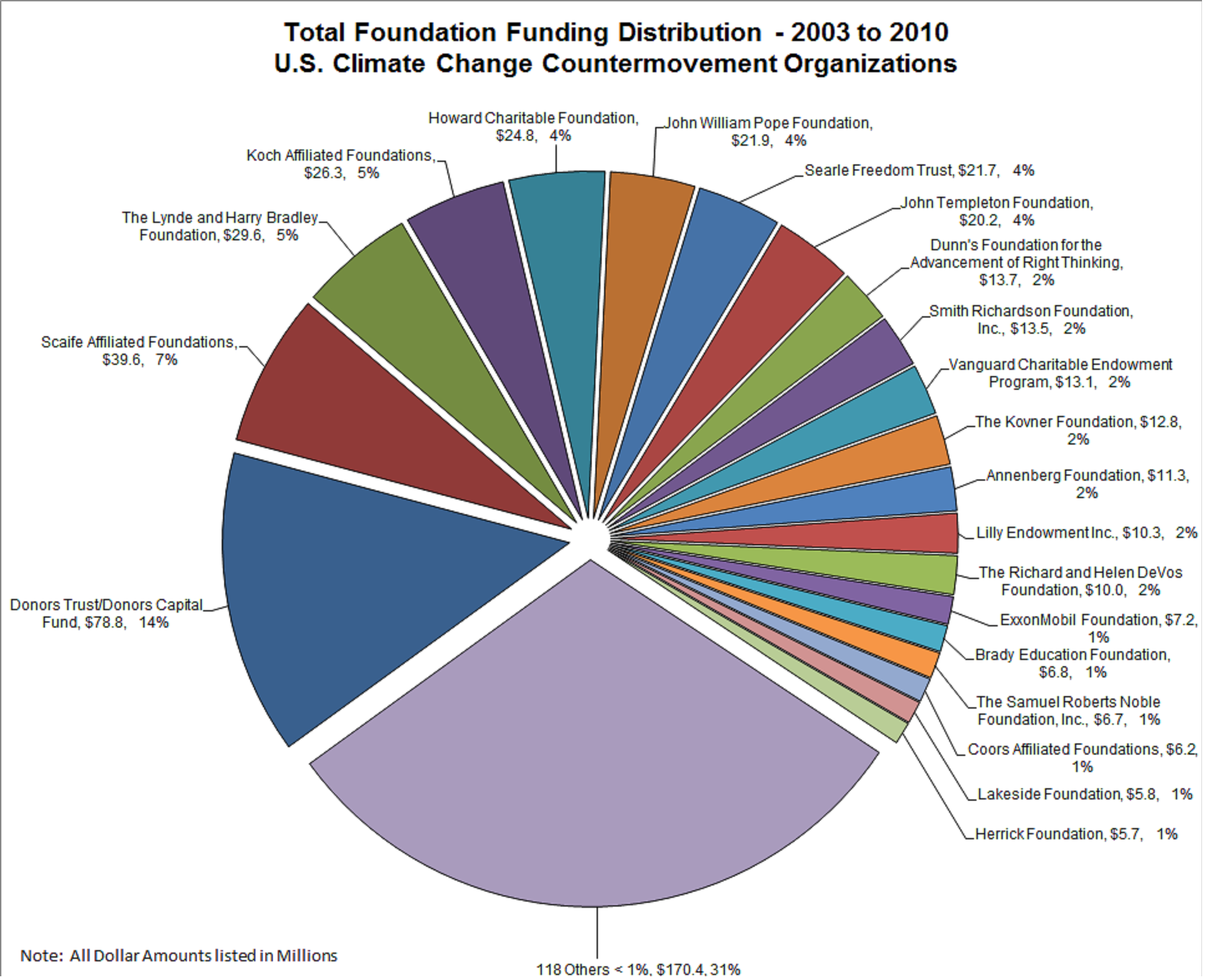
 This chart shows the overall amount and percentage distribution of foundation funding of countermovement organizations

“The real issue here is one of democracy. Without a free flow of accurate information, democratic politics and government accountability become impossible,” said Brulle. “Money amplifies certain voices above others and, in effect, gives them a megaphone in the public square. Powerful funders are supporting the campaign to deny scientific findings about global warming and raise public doubts about the roots and remedies of this massive global threat. At the very least, American voters deserve to know who is behind these efforts.”

This study is part one of a three-part project by Brulle to examine the climate movement in the U.S. at the national level. The next step in the project is to examine the environmental movement or the climate change movement. Brulle will then compare the whole funding flow to the entire range of organizations on both sides of the debate.

Brulle has authored numerous articles and book chapters on environmental science, and is a frequent media commentator on climate change. He co-edited Power, Justice and the Environment: A Critical Appraisal of the Environmental Justice Movement (2005) with David Pellow, and is the author of Agency, Democracy, and Nature: U.S. Environmental Movements from a Critical Theory Perspective (2000).

Brulle previously served as a commissioned officer in the United States Coast Guard for two decades. He received a doctorate in sociology from George Washington University, a master of science degree in natural resources from the University of Michigan, a master of arts degree in sociology from the New School for Social Research and a bachelor of science degree in marine engineering from the United States Coast Guard Academy.

The full paper is available here.

Facebooktwittermail

2013: Climate change and energy in charts

Think Progress charts the data:

  • Global Temperatures Keep Going Up
  • Carbon Dioxide Levels Hit 400ppm For The First Time In Recorded History
  • Most Congressional Republicans Denied Climate Change
  • The First Bulk Freighter Passed Through The Arctic, Carrying Coal
  • Arctic Sea Ice Volume Still In Jeopardy
  • The Price Of Solar Dropped Dramatically
  • 99 Percent of New Electric Capacity In October Came From Renewables
  • Turns Out More Shale Gas Will Not Bring A Major Climate Benefit
Facebooktwittermail

Snowden’s mission ‘already accomplished’

In the first in-person interview Edward Snowden has conducted since his arrival in Moscow in June, Barton Gellman reports:

“For me, in terms of personal satisfaction, the mission’s already accomplished,” he said. “I already won. As soon as the journalists were able to work, everything that I had been trying to do was validated. Because, remember, I didn’t want to change society. I wanted to give society a chance to determine if it should change itself.”

“All I wanted was for the public to be able to have a say in how they are governed,” he said. “That is a milestone we left a long time ago. Right now, all we are looking at are stretch goals.”

Snowden is an orderly thinker, with an engineer’s approach to problem-solving. He had come to believe that a dangerous machine of mass surveillance was growing unchecked. Closed-door oversight by Congress and the Foreign Intelligence Surveillance Court was a “graveyard of judgment,” he said, manipulated by the agency it was supposed to keep in check. Classification rules erected walls to prevent public debate.

Toppling those walls would be a spectacular act of transgression against the norms that prevailed inside them. Someone would have to bypass security, extract the secrets, make undetected contact with journalists and provide them with enough proof to tell the stories.

The NSA’s business is “information dominance,” the use of other people’s secrets to shape events. At 29, Snowden upended the agency on its own turf.

“You recognize that you’re going in blind, that there’s no model,” Snowden said, acknowledging that he had no way to know whether the public would share his views.

“But when you weigh that against the alternative, which is not to act,” he said, “you realize that some analysis is better than no analysis. Because even if your analysis proves to be wrong, the marketplace of ideas will bear that out. If you look at it from an engineering perspective, an iterative perspective, it’s clear that you have to try something rather than do nothing.”

By his own terms, Snowden succeeded beyond plausible ambition. The NSA, accustomed to watching without being watched, faces scrutiny it has not endured since the 1970s, or perhaps ever.

Facebooktwittermail

How the NSA became an advanced persistent threat to global cybersecurity

In the first in-person interview Edward Snowden has conducted since his arrival in Moscow in June, Barton Gellman reports:

The documents leaked by Snowden compelled attention because they revealed to Americans a history they did not know they had.

Internal briefing documents reveled in the “Golden Age of Electronic Surveillance.” Brawny cover names such as MUSCULAR, TUMULT and TURMOIL boasted of the agency’s prowess.

With assistance from private communications firms, the NSA had learned to capture enormous flows of data at the speed of light from fiber-optic cables that carried Internet and telephone traffic over continents and under seas. According to one document in Snowden’s cache, the agency’s Special Source Operations group, which as early as 2006 was said to be ingesting “one Library of Congress every 14.4 seconds,” had an official seal that might have been parody: an eagle with all the world’s cables in its grasp.

Each year, NSA systems collected hundreds of millions of e-mail address books, hundreds of billions of cellphone location records and trillions of domestic call logs.

Most of that data, by definition and intent, belonged to ordinary people suspected of nothing. But vast new storage capacity and processing tools enabled the NSA to use the information to map human relationships on a planetary scale. Only this way, its leadership believed, could the NSA reach beyond its universe of known intelligence targets.

In the view of the NSA, signals intelligence, or electronic eavesdropping, was a matter of life and death, “without which America would cease to exist as we know it,” according to an internal presentation in the first week of October 2001 as the agency ramped up its response to the al-Qaeda attacks on the World Trade Center and the Pentagon.

With stakes such as those, there was no capability the NSA believed it should leave on the table. The agency followed orders from President George W. Bush to begin domestic collection without authority from Congress and the courts. When the NSA won those authorities later, some of them under secret interpretations of laws passed by Congress between 2007 and 2012, the Obama administration went further still.

Using PRISM, the cover name for collection of user data from Google, Yahoo, Microsoft, Apple and five other U.S.-based companies, the NSA could obtain all communications to or from any specified target. The companies had no choice but to comply with the government’s request for data.

But the NSA could not use PRISM, which was overseen once a year by the surveillance court, for the collection of virtually all data handled by those companies. To widen its access, it teamed up with its British counterpart, Government Communications Headquarters, or GCHQ, to break into the private fiber-optic links that connected Google and Yahoo data centers around the world.

That operation, which used the cover name MUSCULAR, tapped into U.S. company data from outside U.S. territory. The NSA, therefore, believed it did not need permission from Congress or judicial oversight. Data from hundreds of millions of U.S. accounts flowed over those Google and Yahoo links, but classified rules allowed the NSA to presume that data ingested overseas belonged to foreigners.

Disclosure of the MUSCULAR project enraged and galvanized U.S. technology executives. They believed the NSA had lawful access to their front doors — and had broken down the back doors anyway.

Microsoft general counsel Brad Smith took to his company’s blog and called the NSA an “advanced persistent threat” — the worst of all fighting words in U.S. cybersecurity circles, generally reserved for Chinese state-sponsored hackers and sophisticated criminal enterprises.

Facebooktwittermail

The NSA has assumed the expansive powers of colonial Britain against which Americans fought

In the first in-person interview Edward Snowden has conducted since his arrival in Moscow in June, Barton Gellman reports:

Snowden likened the NSA’s powers to those used by British authorities in Colonial America, when “general warrants” allowed for anyone to be searched. The FISA court, Snowden said, “is authorizing general warrants for the entire country’s metadata.”

“The last time that happened, we fought a war over it,” he said.

Technology, of course, has enabled a great deal of consumer surveillance by private companies, as well. The difference with the NSA’s possession of the data, Snowden said, is that government has the power to take away life or freedom.

At the NSA, he said, “there are people in the office who joke about, ‘We put warheads on foreheads.’ Twitter doesn’t put warheads on foreheads.”

Privacy, as Snowden sees it, is a universal right, applicable to American and foreign surveillance alike.

“I don’t care whether you’re the pope or Osama bin Laden,” he said. “As long as there’s an individualized, articulable, probable cause for targeting these people as legitimate foreign intelligence, that’s fine. I don’t think it’s imposing a ridiculous burden by asking for probable cause. Because, you have to understand, when you have access to the tools the NSA does, probable cause falls out of trees.”

Facebooktwittermail

Snowden took on a responsibility that others refused to exercise

In the first in-person interview Edward Snowden has conducted since his arrival in Moscow in June, Barton Gellman reports:

It is commonly said of Snowden that he broke an oath of secrecy, a turn of phrase that captures a sense of betrayal. NSA Director Keith B. Alexander and Director of National Intelligence James R. Clapper Jr., among many others, have used that formula.

In his interview with The Post, Snowden noted matter-of-factly that Standard Form 312, the ­classified-information nondisclosure agreement, is a civil contract. He signed it, but he pledged his fealty elsewhere.

“The oath of allegiance is not an oath of secrecy,” he said. “That is an oath to the Constitution. That is the oath that I kept that Keith Alexander and James Clapper did not.”

People who accuse him of disloyalty, he said, mistake his purpose.

“I am not trying to bring down the NSA, I am working to improve the NSA,” he said. “I am still working for the NSA right now. They are the only ones who don’t realize it.”

What entitled Snowden, now 30, to take on that responsibility?

“That whole question — who elected you? — inverts the model,” he said. “They elected me. The overseers.”

He named the chairmen of the Senate and House intelligence committees.

“Dianne Feinstein elected me when she asked softball questions” in committee hearings, he said. “Mike Rogers elected me when he kept these programs hidden. . . . The FISA court elected me when they decided to legislate from the bench on things that were far beyond the mandate of what that court was ever intended to do. The system failed comprehensively, and each level of oversight, each level of responsibility that should have addressed this, abdicated their responsibility.”

“It wasn’t that they put it on me as an individual — that I’m uniquely qualified, an angel descending from the heavens — as that they put it on someone, somewhere,” he said. “You have the capability, and you realize every other [person] sitting around the table has the same capability but they don’t do it. So somebody has to be the first.”

Facebooktwittermail

The Democratic senators willing to risk a war with Iran

The Huffington Post reports: As the United States finally puts a decade of war behind it, a group of senators, including 15 Democrats, is defying the White House and threatening to push the country into a fresh war with Iran.

Sen. Bob Menendez (D-N.J.) is leading the charge to pass legislation in January that would impose tougher sanctions on Iran, despite dire warnings from the White House, Iranian leaders, 10 Democratic committee chairs and a host of liberal groups that such an effort could sink a delicate nuclear agreement already in place. Under that Nov. 24 deal, Tehran would curb its nuclear program in exchange for some relief from economic sanctions for a period of six months.

The Senate bill, which has 19 Republican cosponsors, takes a hard line, levying new sanctions on Iran unless the country’s leaders agree to abandon all uranium enrichment — what some have called an “absurd” stance. In the past, both John Kerry, then a U.S. senator, and Mohamed ElBaradei, former head of the International Atomic Energy Agency, have said that Iran has the right to enrich uranium for peaceful purposes.

Iranian Foreign Minister Javad Zarif said earlier this month that if the Senate moved forward with its bill, the current nuclear deal would be dead. A senior Obama administration official went further, telling The Huffington Post that Senate action makes it “far more likely that we’ll be left only with a military option” regarding Iran. [Continue reading…]

Facebooktwittermail

When ‘60 Minutes’ checks its journalistic skepticism at the door

David Carr writes: Last week, a study commissioned by the president concluded that the National Security Agency had reached too far into the private lives of Americans. The study, which came after a series of journalistic revelations exposing the agency’s surveillance practices, recommended numerous reforms that would curb the N.S.A.’s prerogatives. President Obama said he was “open to many” of the suggestions.

It was exactly the kind of news-making moment that “60 Minutes” — America’s leading purveyor of serious television news — has often been responsible for creating. For more than four decades, the program has exposed C.I.A. abuses, rogue military contractors and hundreds of corporate villains.

But where was “60 Minutes” on the N.S.A. story? The Sunday before the damning study, the program produced a segment that scanned as a friendly infomercial for the agency. Reported by John Miller, a CBS News reporter, the piece included extensive interviews with Gen. Keith Alexander, the director of the N.S.A.

In a scene that served as something of a metaphor for the whole segment, the producers negotiated access to the Black Chamber, a supersecret area where the nation’s top code breakers work. The door is briefly opened, we see a deserted office hall that looks like any other and then the door is closed. We get a look in, but we learn nothing.

Coming as it does on the heels of the now-discredited Benghazi report — in which “60 Minutes” said it was fooled by an eyewitness who was apparently nothing of the kind — the N.S.A. segment raises the question of whether the program has not just temporarily lost its mojo, but its skepticism as well. It didn’t help that the day after the piece aired, a federal judge ruled that the agency’s program of collecting phone records was most likely unconstitutional. [Continue reading…]

Facebooktwittermail
