Category Archives: Issues

Iran’s elite military warns of dangers of dealing with U.S.

Reuters reports: Iran’s elite Revolutionary Guard has warned of the dangers of dealing with U.S. officials, ahead of expected diplomatic contacts, underlining the internal challenges President Hassan Rouhani could face to improve ties with the West.

Rouhani is expected to pursue a charm offensive in the coming week while in New York for the U.N. General Assembly in order to set the right tone for further nuclear talks with world powers which he hopes will bring relief from sanctions, according to diplomats and analysts.

Hours before leaving for New York on Sunday, the new Iranian president said that Tehran was ready for negotiations with Western powers provided they set no pre-conditions. He also said the world needed to accept Iran’s right to enrich uranium.

The Islamic Revolutionary Guard Corps (IRGC) military force was established to safeguard Iran’s revolution in 1979 and has since influenced political, social and economic affairs.

“Historical experiences make it necessary for the diplomatic apparatus of our country to carefully and sceptically monitor the behaviour of White House officials so that the righteous demands of our nation are recognised and respected by those who favour interaction,” an IRGC statement said.

It added the IRGC would support initiatives that were in line with national interests and strategies set forth by Iran’s theocratic leader and highest authority, Ayatollah Ali Khamenei.

The United States and its allies have imposed tough economic sanctions on Iran over suspicions Tehran intends to develop a nuclear capability. Iran says the programme is purely peaceful.

The IRGC statement, published by Iran’s Tasnim news agency on Saturday and marking the 33rd anniversary of the start of the Iran-Iraq war, came days after Khamenei and Rouhani told the security hardliners to stay out of politics, in effect instructing them not to scupper the new centrist government’s attempt to resolve the nuclear dispute.

Facebooktwittermail

How France’s burqa ban is promoting deadly intolerance

Nabila Ramdani writes: Join me in a criminal court in suburban Paris on almost any weekday and I’ll show you exactly where national debates about female face coverings end up.

Ever since France introduced its “burqa ban” in 2011, there has been a constant stream of wretched cases involving the handful of Muslims who choose to wear such garments. Not only are perfectly upstanding women being fined for their choice of dress, principally the full-body niqab, which leaves a slit for the eyes, but an increasing number of defendants are being tried for attacking them.

One case involves two self-styled “patriotic vigilantes” who targeted a pregnant 21-year-old in the commuter town of Argenteuil, north-west of Paris, in June. The new law persuaded the men to shout racist insults before putting the woman in hospital, where she lost her baby. Another three reported cases on the same council estate over the course of just one month this summer saw full-veil wearers assaulted as their attackers shouted: “Dirty Arab, dirty Muslim.”

Those calling for a veil ban in Britain have clearly ignored such depressingly routine cases. They do not realise how the legislation introduced by President Nicolas Sarkozy’s government has not only stigmatised Muslim women, but somehow legitimised physical attacks on them. The ban in France is a hateful assault on basic freedoms, one that has been seized on by an unlikely alliance of rightwing politicians and feminists. [Continue reading…]

Facebooktwittermail

Mint Press, Dale Gavlak, and alternative narratives around the August 21 chemical weapons attacks

For some people, antipathy for and suspicion of the U.S. government is so visceral that their immediate inclination is to believe the opposite of anything a U.S. official might claim.

Since the U.S. was quick to assert that the Assad regime must have been responsible for the August 21 chemical attacks, a knee-jerk reaction was to counter that the attack must have been carried out by rebels in an effort to trigger Western intervention.

This theory still has life even as it becomes increasingly evident that by happenstance or design, Bashar al Assad has been the preeminent beneficiary of the latest turn of events in Syria.

From the outset, this was a theory desperately in need of supporting facts and thus an August 29 report published by Mint Press News was quickly seized upon, among other reasons because included in the byline was the name Dale Gavlak, who has freelanced for the Associated Press.

A few days after the report appeared, the following note was added at the top of the report:

Dale Gavlak assisted in the research and writing process of this article, but was not on the ground in Syria. Reporter Yahya Ababneh, with whom the report was written in collaboration, was the correspondent on the ground in Ghouta who spoke directly with the rebels, their family members, victims of the chemical weapons attacks and local residents.

Gavlak is a MintPress News Middle East correspondent who has been freelancing for the AP as a Amman, Jordan correspondent for nearly a decade. This report is not an Associated Press article; rather it is exclusive to MintPress News.

She has now made it known that on August 29 when she filed the report she also wrote an email which said: “Pls find the Syria story I mentioned uploaded on Google Docs. This should go under Yahya Ababneh’s byline. I helped him write up his story but he should get all the credit for this.”

She didn’t want the byline but she did believe the report deserved credit.

She has now issued the following statement which appears at Brown Moses Blog:

Mint Press News incorrectly used my byline for an article it published on August 29, 2013 alleging chemical weapons usage by Syrian rebels. Despite my repeated requests, made directly and through legal counsel, they have not been willing to issue a retraction stating that I was not the author. Yahya Ababneh is the sole reporter and author of the Mint Press News piece. To date, Mint Press News has refused to act professionally or honestly in regards to disclosing the actual authorship and sources for this story.

I did not travel to Syria, have any discussions with Syrian rebels, or do any other reporting on which the article is based. The article is not based on my personal observations and should not be given credence based on my journalistic reputation. Also, it is false and misleading to attribute comments made in the story as if they were my own statements.

In a word, Gavlak wants to have nothing to do with the story.

It’s not hard to figure out why she now finds this an embarrassment. What’s harder to explain is why she filed the story in the first place.

Facebooktwittermail

Obama would be crazy not to seize this chance to engage with Iran

Fred Kaplan writes: President Obama would be crazy not to dive deep into diplomacy with Iran, right now. Forget the standard throat-clearing bromides and water-testing toe-dips that mark the resumption of relations with suspect characters. When the world’s leaders meet at the U.N. General Assembly next week, Obama should not only shake hands with Iranian President Hassan Rouhani but also meet with him privately, hand him a list of a dozen issues to discuss (uranium enrichment, sanctions, regional stability, etc.), and even be prepared to announce, if possible, a time and place for negotiations to begin and a roster of the delegates to be invited.

If Rouhani is who he claims to be—an Iranian moderate who has the authority to strike a bargain on nuclear programs and economic sanctions (at least until hardliners lose patience with him)—then this is an opportunity no Western leader can pass up.

If it’s all a ruse, or if the mullahs overrule whatever deal emerges, there’s no harm in trying. In fact, if things go bad and Western leaders feel compelled to respond with tighter sanctions or military action, they could do so with greater legitimacy after having given the high road a chance.

In any case, it does little good to sit around and debate the potential truth of Rouhani’s proclamations or the nature of Iranian politics, about which any outsider’s knowledge is limited. Rouhani has put his statements on the table. No Iranian president, in the entire revolutionary period, has said anything remotely this appealing. He has appointed, in Mohammad Javad Zarif, a foreign minister whose known views are consistent with these statements. Iran’s economy is in such a tailspin that the regime — including the mullahs who are ultimately in charge — may be willing to trade some things of value for an end to the U.S.-imposed sanctions. [Continue reading…]

Facebooktwittermail

Why Iran seeks constructive engagement

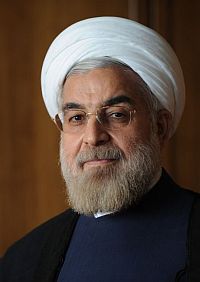
Hassan-RouhaniHassan Rouhani, the president of Iran, writes in the Washington Post: Three months ago, my platform of “prudence and hope” gained a broad, popular mandate. Iranians embraced my approach to domestic and international affairs because they saw it as long overdue. I’m committed to fulfilling my promises to my people, including my pledge to engage in constructive interaction with the world.

The world has changed. International politics is no longer a zero-sum game but a multi-dimensional arena where cooperation and competition often occur simultaneously. Gone is the age of blood feuds. World leaders are expected to lead in turning threats into opportunities.

The international community faces many challenges in this new world — terrorism, extremism, foreign military interference, drug trafficking, cybercrime and cultural encroachment — all within a framework that has emphasized hard power and the use of brute force.

We must pay attention to the complexities of the issues at hand to solve them. Enter my definition of constructive engagement. In a world where global politics is no longer a zero-sum game, it is — or should be — counterintuitive to pursue one’s interests without considering the interests of others. A constructive approach to diplomacy doesn’t mean relinquishing one’s rights. It means engaging with one’s counterparts, on the basis of equal footing and mutual respect, to address shared concerns and achieve shared objectives. In other words, win-win outcomes are not just favorable but also achievable. A zero-sum, Cold War mentality leads to everyone’s loss.

Sadly, unilateralism often continues to overshadow constructive approaches. Security is pursued at the expense of the insecurity of others, with disastrous consequences. More than a decade and two wars after 9/11, al-Qaeda and other militant extremists continue to wreak havoc. Syria, a jewel of civilization, has become the scene of heartbreaking violence, including chemical weapons attacks, which we strongly condemn. In Iraq, 10 years after the American-led invasion, dozens still lose their lives to violence every day. Afghanistan endures similar, endemic bloodshed.

The unilateral approach, which glorifies brute force and breeds violence, is clearly incapable of solving issues we all face, such as terrorism and extremism. I say all because nobody is immune to extremist-fueled violence, even though it might rage thousands of miles away. Americans woke up to this reality 12 years ago.

My approach to foreign policy seeks to resolve these issues by addressing their underlying causes. We must work together to end the unhealthy rivalries and interferences that fuel violence and drive us apart. We must also pay attention to the issue of identity as a key driver of tension in, and beyond, the Middle East.

At their core, the vicious battles in Iraq, Afghanistan and Syria are over the nature of those countries’ identities and their consequent roles in our region and the world. The centrality of identity extends to the case of our peaceful nuclear energy program. To us, mastering the atomic fuel cycle and generating nuclear power is as much about diversifying our energy resources as it is about who Iranians are as a nation, our demand for dignity and respect and our consequent place in the world. Without comprehending the role of identity, many issues we all face will remain unresolved.

I am committed to confronting our common challenges via a two-pronged approach.

First, we must join hands to constructively work toward national dialogue, whether in Syria or Bahrain. We must create an atmosphere where peoples of the region can decide their own fates. As part of this, I announce my government’s readiness to help facilitate dialogue between the Syrian government and the opposition.

Second, we must address the broader, overarching injustices and rivalries that fuel violence and tensions. A key aspect of my commitment to constructive interaction entails a sincere effort to engage with neighbors and other nations to identify and secure win-win solutions.

We and our international counterparts have spent a lot of time — perhaps too much time — discussing what we don’t want rather than what we do want. This is not unique to Iran’s international relations. In a climate where much of foreign policy is a direct function of domestic politics, focusing on what one doesn’t want is an easy way out of difficult conundrums for many world leaders. Expressing what one does want requires more courage.

After 10 years of back-and-forth, what all sides don’t want in relation to our nuclear file is clear. The same dynamic is evident in the rival approaches to Syria.

This approach can be useful for efforts to prevent cold conflicts from turning hot. But to move beyond impasses, whether in relation to Syria, my country’s nuclear program or its relations with the United States, we need to aim higher. Rather than focusing on how to prevent things from getting worse, we need to think — and talk — about how to make things better. To do that, we all need to muster the courage to start conveying what we want — clearly, concisely and sincerely — and to back it up with the political will to take necessary action. This is the essence of my approach to constructive interaction.

As I depart for New York for the opening of the U.N. General Assembly, I urge my counterparts to seize the opportunity presented by Iran’s recent election. I urge them to make the most of the mandate for prudent engagement that my people have given me and to respond genuinely to my government’s efforts to engage in constructive dialogue. Most of all, I urge them to look beyond the pines and be brave enough to tell me what they see — if not for their national interests, then for the sake of their legacies, and our children and future generations.

[Note: I am typically fastidious about including links that appear in the original publication of any article since the choice of links is just as much a matter of authorship as is the choice of words. In this case, however, I have left out the links which all point to other articles in the Washington Post. It’s possible that Rouhani particularly likes the Post’s coverage of the issues, or that he recognizes the need of the struggling paper to capitalize on the traffic his op-ed will be bringing in today. More likely, though, is that the inclusion of these links can be attributed to a bit of opportunistic “initiative” on the part of an online editor.]

Facebooktwittermail

Israel’s efforts to obstruct U.S.-Iranian diplomacy

Reuters reports: Iran is on course to develop a nuclear bomb within six months and time has run out for further negotiations, a senior Israeli minister said.

Strategic Affairs Minister Yuval Steinitz said Iran still believed it had room for maneuver in dealing with world powers, and that unless it faced a credible threat of U.S. military action, it would not stop its nuclear activities.

“There is no more time to hold negotiations,” Steinitz, who is close to Prime Minister Benjamin Netanyahu, said in an interview with the Israel Hayom daily published on Friday. [Continue reading…]

The Jerusalem Post reports: Jerusalem urged the world on Thursday not to be fooled by Iranian President Hassan Rouhani’s smiles and to intensify sanctions against the regime until he takes concrete steps toward dismantling Tehran’s nuclear program.

“One should not be taken in by Rouhani’s deceptive words,” the Prime Minister’s Office said in a statement. “The same Rouhani boasted in the past how he deceived the international community with nuclear talks, even as Iran was continuing with its nuclear program.”

The Prime Minister’s Office comments followed the Iranian president’s two-part interview with NBC on Wednesday and Thursday that aired just before he is to fly to the US and address the UN General Assembly.

Rouhani said Iran was not seeking war, and slammed Israel for bringing “instability” to the Middle East and for questioning his government’s intentions toward nuclear arms.

He called Israel “an occupier, a usurper government that does injustice to the people of the region,” and said it “has brought instability to the region with its war-mongering policies.” [Continue reading…]

Facebooktwittermail

Iran’s leaders signal effort at new thaw

The New York Times reports: A series of good-will gestures and hints of new diplomatic flexibility from Iran’s ruling establishment was capped on Wednesday by the highest-level statement yet that the country’s new leaders are pushing for a compromise in negotiations over their disputed nuclear program.

In a near staccato burst of pronouncements, statements and speeches by the new president, Hassan Rouhani; his foreign minister, Mohammad Javad Zarif; and even the supreme leader, Ayatollah Ali Khamenei, the leadership has sent Rosh Hashana greetings to Jews worldwide via Twitter, released political prisoners, exchanged letters with President Obama, praised “flexibility” in negotiations and transferred responsibility for nuclear negotiations from the conservatives in the military to the Foreign Ministry.

“They’re putting stuff out faster than the naysayers can keep up,” said Gary Sick, an Iran expert with Columbia University. “They dominate the airwaves.”

Mr. Rouhani, preparing for a trip to New York next week for the annual gathering of the United Nations, kept up the dizzying pace on Wednesday in an interview with NBC News in which he declared that Iran would never “seek weapons of mass destruction, including nuclear weapons” and that he had “full power and complete authority” to make a nuclear deal with the West.

There is plenty of skepticism in the West over the new tone emanating from Tehran, and Iran veterans have seen previous thaws in the diplomatic climate disappear seemingly overnight. Mr. Obama has spoken of testing Mr. Rouhani’s seriousness.

But Iran experts, citing the apparent end to Iran’s ideological taboo against direct talks with the United States as well as the apparent concurrence of the supreme leader, say that this new moderation seems different. [Continue reading…]

Facebooktwittermail

The American psyche can be easily manipulated

The “American psyche can be easily manipulated” Sheherazad Jaafari – a press attache at Syria’s mission to the UN – advised an aide to the Syrian president prior to Barbara Walters’ interview with Bashar al-Assad in late 2011. That observation remains just as true now as it was then.

If America’s war on terrorism has turned out to be an abysmal failure in terms of eradicating terrorism, it has nevertheless been extraordinarily successful as an exercise in brainwashing a whole nation. Americans believe in terrorism with close to the same conviction that they believe in God.

“Terrorism” and “terrorist” are absolute terms. There might be small-time crooks but there are no small-time terrorists. The terrorist has become the archetype of evil whose power is treated as almost metaphysical — a threat to whole nations and to a way of life.

Whatever PR advice Assad received early on, it was sound, he took it to heart, and he has remained “on message” even while his international political opponents have become increasingly incoherent.

Assad’s fight is the good fight; the fight that virtually no American dare question: the fight against terrorism.

In Assad’s interview with Fox News which aired last night he said that “80 to 90% of the rebels or terrorists on the ground are Al Qaeda and their offshoots.”

A statement from Michael Clemente, executive vice president of news at Fox News, said that the interview “was conducted with no restrictions on the questions that could be asked,” yet neither Fox contributor Dennis Kucinich nor Senior Foreign Affairs Correspondent Greg Palkot, made any serious attempt to question Assad’s assertion.

They could for instance have pointed out that in a conflict that now involves an estimated 1,000 armed groups, the expressions “rebels,” “terrorists,” and “al Qaeda and their offshoots” grossly over-simplify a complex environment. Moreover, within that array of 100,000 fighters only 10% are believed to be linked to al Qaeada.

Islamic State in Iraq and Syria (ISIS), with its historical ties to the infamous Abu Musab al-Zarqawi, and Jabhat al-Nusra have both been branded terrorist organizations and al Qaeda affiliates yet in Syria are operating as rivals. Furthermore, the complexity of that rivalry is open to differing interpretations even by close observers.

Mohammed Al Attar writes:

Some tend to the view that there is no great difference between the two, with both functioning as two extremist arms of a main body that is Al Qaeda. Others believe that open confrontation between the two is on its way, driven by a dispute over approach and vision and, moreover, over legitimacy of representation. People tell the story of an Al Raqqa-born Front commander called Abu Saad who joined ISIS in the wake of the dispute between the two groups, after Al Nusra leader Abu Mohammed Al Jolani refused to swear an oath of loyalty to Abu Bakr Al Baghdadi. Within months, Abu Saad and a group of mujahideen split from ISIS and re-joined the Al Nusra Front in Al Tabaqa. We heard a number of similar stories in the countryside around Idlib and Aleppo of this reverse migration of fighters from ISIS to the Al Nusra Front. Some attribute this to the predominantly Syrian make-up of Al Nusra as opposed to ISIS, while others talk of the revulsion felt by certain mujahideen towards the excessively extreme and uncompromising practices of ISIS. None of this equips us to make a precise measurement of the numbers and strength of the two groups, but it points to a constant movement between them.

Is there any chance that this kind of analysis might be incorporated into an interview with Assad on Fox News? No way!

Assad knows without doubt that with American journalists and in front of an American audience, the terrorism narrative works. Use the label terrorist and supposedly few other details are necessary.

The terrorism narrative also works in the sense that it has effectively shut down intelligent political discourse on the issue inside the United States.

I don’t think that Dennis Kucinich is stupid or utterly naive and he is surely in no doubt that Assad uses the term terrorist as a label of political convenience to vilify his opponents, yet would the former Congressman be bold enough to challenge Assad by referring to “so-called” terrorists? Not likely. Why? Because if anyone on the left talks about “so-called” terrorists, they will swiftly get jumped on for being soft on terrorism. At the same time, someone like Charles Krauthammer, a bona fide neoconservative and general-purpose supporter of American wars, can freely scoff at Assad’s assertions and refer to “so-called” terrorists confident that he is not going to be accused of being soft on terrorism. The American right, having taken full ownership of the terrorism discourse can speak freely, while the left needs to perpetually monitor itself and polish its national security credibility.

Meanwhile, as Assad takes advantage of easy access to a U.S. media short on analysis, witness the contrast between the deferential treatment being offered to a president who has sanctioned mass killing, versus the zealous denouncing of a 26-year old Syria analyst who is guilty of having padded out her résumé and been less than forthright about some of her affiliations.

I refer to Elizabeth O’Bagy, the analyst cited by Secretary of State John Kerry when he asserted in Congress that the majority of Syria’s rebels are “moderates” — an analyst who it turns out does not possess a doctorate. Alongside working for Washington’s Institute for the Study of War, she also worked for the Syrian Emergency Task Force, “which both lobbies in Washington for the moderate Syrian opposition and does humanitarian work inside Syria,” reports Time.

Those vilifying O’Bagy see her as an easy target because the actions she has been faulted for cannot be easily defended, yet these attacks also, and not incidentally, sidestep the issue of the credibility of her analysis of the Syrian opposition.

It’s as though her lack of a PhD reveals much more about her knowledge of Syria than her six trips to rebel-controlled territory taught her. The fact that she can speak Arabic apparently matters much less than that she was hired by the Syrian Emergency Task Force. And to cap it all, she’s 26 — as though we can overlook the fact that plenty of similarly youthful reporters do not have their journalism dismissed on the basis of their age.

O’Bagy’s critics expose their superficiality and hypocrisy by glossing over the precise basis of her expertise which derived from neither academic credentials nor institutional affiliations but the very thing that hardly anyone in Washington possesses when it comes to Syria: on-the-ground experience.

Facebooktwittermail

Iran frees political prisoners ahead of new president’s UN visit

The Guardian reports: Iran’s most prominent human rights activist was released from jail on Wednesday along with several other political prisoners in what appears to be the most tangible sign of change yet under the new Iranian president, Hassan Rouhani.

Ahead of Rouhani’s eagerly awaited visit to the UN general assembly in New York next week, Nasrin Sotoudeh, who has been likened to Aung San Suu Kyi, was driven from Evin prison in Tehran to her house in another part of the Iranian capital and told she did not need to return to jail.

“They were quite certain this time that I’m freed and I don’t need to go back,” the 50-year-old women’s rights activist told the Guardian by phone from her home.

Opposition website Kaleme reported on Wednesday that seven other women political prisoners had also been released in the previous 24 hours, including the dissident journalist Mahsa Amrabadi, and at least four men, including reformist politicians Feizollah Arabsorkhi, Mirtaher Mousavi and former deputy foreign minister Mohsen Aminzadeh.

“In the past, when I was granted prison leave they used to give me a document, this time they gave me nothing,” said Sotoudeh, who last October was awarded the European parliament’s most prestigious human rights award, the Sakharov prize for freedom of thought, which has previously been won by Suu Kyi and Nelson Mandela.

“My goals and mentality are the same as before, I haven’t changed,” Sotoudeh insisted, adding that like other lawyers she would still work “to restore justice and defend the rights of protesters”.

The prisoner releases have come amid increasing signs of a political opening-up in the Islamic republic following Rouhani’s inauguration last month and as he prepares for his UN visit, which many have suggested may be the scene for a historic meeting between the Iranian president and Barack Obama. [Continue reading…]

The question is, can Obama muster the heroic flexibility to defy the Israel lobby and talk to Rouhani? They are going to be in the same building at the same time. Can the U.S. really afford to squander such an opportunity? If nothing else, a friendly greeting to a noteworthy visitor really should be a matter of common courtesy. A handshake should be a bare minimum and since — as the media now credits Rouhani as a bona fide “moderate” because he’s had a Western education and speaks fluent English — can’t they at least have a conversation?

Facebooktwittermail

What does Khamenei mean by ‘heroic flexibility’?

Reza HaghighatNejad writes: Iran’s Supreme Leader Ali Khamenei has created a stir this week by declaring that he supports “heroic flexibility” in diplomacy, during a speech to commanders of the Revolutionary Guards. The term has been the buzz of Iranian media since Khamenei uttered it, raising questions as to what precisely the supreme leader meant with his elusive phrasing.

This isn’t the first time Khamenei refers to “heroic flexibility.” On September 5, during a meeting with members of Assembly of Experts he said, “artistic and heroic leniency and flexibility in all political arena is desirable and acceptable,” though he cautioned that this “maneuvering must not mean passing redlines, regressing from fundamental strategies, and disregarding the ideals.”

Even so, emphasizing these words in the presence of Guards’ commanders, the powerful military and political figures most loyal to him, suggests that Khamenei is not playing with shades of meaning but signaling a new approach.

If “heroic flexibility” suggests a new approach, how can this nascent policy be interpreted? In the same speech, Khamenei outlined the main condition for this type of diplomatic flexibility to be exercised: “A technical wrestler may also show some flexibility on technical grounds occasionally, but does not forget who his opponent is and what his main goal is.”

What Khamenei is likely stressing here is that the Rouhani government’s diplomatic innovations must be limited to the technical area of Iran’s nuclear program. Khamenei has said recently that though he is not optimistic about negotiations with the United States, he has issued permission for certain case-by-case negotiations. Talking about case-by-case negotiations is, in fact, a manifestation of the reason for diplomatic leniency. Hossein Mousavian, a former Iranian nuclear negotiator, has recently said that the supreme leader has permitted President Hassan Rouhani to hold direct talks with the United States.

Khamenei also emphasized, however, that he expects the new cabinet to project an image of strength, as it is representing the regime politically alongside whatever new diplomacy it takes forward. He spoked repeatedly in his speech about the rightfulness of the Islamic Republic, the defeat of the West, and the importance of presenting a new model to the world. He stressed that Iran’s relationship within the West and the handling of the nuclear crisis must be evaluated in the context of the West’s dealings with Islam and the Iranian state.

One of the most significant aspects of the speech was Khamenei’s efforts to prepare hardliners, especially the most radical, for the potential innovations, read concessions, of the Rouhani government. [Continue reading…]

Facebooktwittermail

Iran moves to mend ties with West

The New York Times reports: Iran’s supreme leader seemed to put his authority behind Iran’s moderate new president on Tuesday, calling for “heroic leniency” in navigating the country’s diplomatic dispute with the West.

The president, Hassan Rouhani, was elected in June on a moderate platform of ending the nuclear standoff with the West and increasing personal freedoms. In a speech to the Revolutionary Guards, considered stalwarts of the conservative wing of the government, the supreme leader, Ayatollah Ali Khamenei, said he was “not opposed to proper moves in diplomacy.”

Enlarging on that theme, he said, “I agree with what I called ‘heroic leniency’ years ago, because such an approach is very good and necessary in certain situations, as long as we stick to our main principles.”

In what may be a further signal that Mr. Rouhani’s victory in the June election has created a chance for intensified diplomacy, the country’s Foreign Ministry confirmed on Tuesday that he had exchanged letters with President Obama.

But asked about the tone of Mr. Obama’s letter — something the Iranians are extremely sensitive about — Marzieh Afkham, the ministry spokeswoman, said Iran expected improvement in the way Washington talked to Iran.

“Unfortunately, the U.S. administration is still adopting the language of threat while dealing with Iran,” Ms. Afkham said at a weekly news conference. “We have announced that this needs to change into the language of respect.” [Continue reading…]

Facebooktwittermail

For Americans, al Qaeda is less deadly than cantaloupe

Michael Meurer writes: One of the most important revelations from the international drama over Edward Snowden’s NSA leaks in May is the exposure of a nearly lunatic disproportion in threat assessment and spending by the US government. This disproportion has been spawned by a fear-based politics of terror that mandates unlimited money and media attention for even the most tendentious terrorism threats, while lethal domestic risks such as contaminated food from our industrialized agribusiness system are all but ignored. A comparison of federal spending on food safety intelligence versus antiterrorism intelligence brings the irrationality of the threat assessment process into stark relief.

In 2011, the year of Osama bin Laden’s death, the State Department reported that 17 Americans were killed in all terrorist incidents worldwide. The same year, a single outbreak of listeriosis from tainted cantaloupe killed 33 people in the United States. Foodborne pathogens also sickened 48.7 million, hospitalized 127,839 and caused a total of 3,037 deaths. This is a typical year, not an aberration.

We have more to fear from contaminated cantaloupe than from al-Qaeda, yet the United States spends $75 billion per year spread across 15 intelligence agencies in a scattershot attempt to prevent terrorism, illegally spying on its own citizens in the process. By comparison, the Food and Drug Administration (FDA) is struggling to secure $1.1 billion in the 2014 federal budget for its food inspection program, while tougher food processing and inspection regulations passed in 2011 are held up by agribusiness lobbying in Congress. The situation is so dire that Jensen Farms, the company that produced the toxic cantaloupe that killed 33 people in 2011, had never been inspected by the FDA. [Continue reading…]

To note that Americans face more threats related to food safety than terrorism may be a useful way of highlighting the miniscule threat posed by terrorism, but it doesn’t mean we should start getting more afraid of food.

Fear is a bigger problem than food safety.

The more we learn about the ecology of the human body, the more apparent it becomes that a significant number of modern health problems are a result of excessive cleanliness. In our effort to produce pathogen-free environments we are destroying the bacteria upon which good health depends.

Facebooktwittermail

The world’s vanishing ice

Union of Concerned Scientists: In the next few days the Arctic sea ice will reach its minimum extent for 2013. At the end of this year’s summer melt season, the areal extent covered by sea ice was more than a million square kilometers below the 30-year average. That’s a lot of ice missing compared to an average year. An area of frozen ocean—ten times the size of Indiana, or four times the size of Colorado, or a third bigger than Texas—is just not there this summer.

While this is shocking and part of a several-decade decline in Arctic sea ice, what’s also alarming is the lack of substantive media coverage. The decline in Arctic sea ice should concern all of us in the same way that a collapse of the economic system does. It deserves front page billing. A recent Nature commentary stated that “the costs of a melting Arctic will be huge, because the region is pivotal to the functioning of Earth systems such as oceans and the climate.” They don’t mince their words.

Here are five reasons why the decline of the Arctic sea ice matters:

1. Sea ice reflects sunlight, keeping earth cool

When bright, reflective sea ice melts, it gives way to a darker ocean. More heat is absorbed by a darker surface, leading to more warming. This is known as the ice-albedo feedback effect. Largely due to the recent dramatic loss of sea ice and this feedback, the Arctic is now warming at twice the global rate. [Continue reading…]

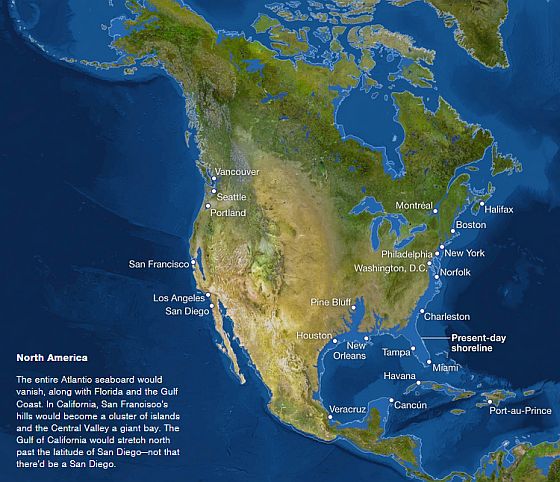
National Geographic depicts the world without ice: All the ice on land has melted and drained into the sea, raising it 216 feet and creating new shorelines for our continents and inland seas.

There are more than five million cubic miles of ice on Earth, and some scientists say it would take more than 5,000 years to melt it all. If we continue adding carbon to the atmosphere, we’ll very likely create an ice-free planet, with an average temperature of perhaps 80 degrees Fahrenheit instead of the current 58.

ice-melted

Facebooktwittermail

White House says Obama won’t meet with new Iranian leader

The Hill reports: The White House is denying that President Obama has any intention of meeting with Iran’s new president in what would be the first such encounter since the 1979 Islamic revolution.

British and Israeli media reported over the weekend that such a meeting could happen on the margins of the United Nations General Assembly in New York next week. President Hassan Rouhani, a relative moderate, is expected to address the world body on Sept. 24.

“There are currently no plans for the president and President Rouhani to meet at UNGA,” National Security Council spokeswoman Bernadette Meehan told The Hill in an email.

Facebooktwittermail

Two-state illusion

Ian S. Lustick writes: Conceived as early as the 1930s, the idea of two states between the Jordan River and the Mediterranean Sea all but disappeared from public consciousness between 1948 and 1967. Between 1967 and 1973 it re-emerged, advanced by a minority of “moderates” in each community. By the 1990s it was embraced by majorities on both sides as not only possible but, during the height of the Oslo peace process, probable. But failures of leadership in the face of tremendous pressures brought Oslo crashing down. These days no one suggests that a negotiated two-state “solution” is probable. The most optimistic insist that, for some brief period, it may still be conceivable.

But many Israelis see the demise of the country as not just possible, but probable. The State of Israel has been established, not its permanence. The most common phrase in Israeli political discourse is some variation of “If X happens (or doesn’t), the state will not survive!” Those who assume that Israel will always exist as a Zionist project should consider how quickly the Soviet, Pahlavi Iranian, apartheid South African, Baathist Iraqi and Yugoslavian states unraveled, and how little warning even sharp-eyed observers had that such transformations were imminent.

In all these cases, presumptions about what was “impossible” helped protect brittle institutions by limiting political imagination. And when objective realities began to diverge dramatically from official common sense, immense pressures accumulated.

JUST as a balloon filled gradually with air bursts when the limit of its tensile strength is passed, there are thresholds of radical, disruptive change in politics. When those thresholds are crossed, the impossible suddenly becomes probable, with revolutionary implications for governments and nations. As we see vividly across the Middle East, when forces for change and new ideas are stifled as completely and for as long as they have been in the Israel-Palestinian conflict, sudden and jagged change becomes increasingly likely.

History offers many such lessons. Britain ruled Ireland for centuries, annexing it in 1801. By the mid-19th century the entire British political class treated Ireland’s permanent incorporation as a fact of life. But bottled-up Irish fury produced repeated revolts. By the 1880s, the Irish question was the greatest issue facing the country; it led to mutiny in the army and near civil war before World War I. Once the war ended, it took only a few years until the establishment of an independent Ireland. What was inconceivable became a fact.

France ruled Algeria for 130 years and never questioned the future of Algeria as an integral part of France. But enormous pressures accumulated, exploding into a revolution that left hundreds of thousands dead. Despite France’s military victory over the rebels in 1959, Algeria soon became independent, and Europeans were evacuated from the country.

And when Mikhail S. Gorbachev sought to save Soviet Communism by reforming it with the policies of glasnost and perestroika, he relied on the people’s continuing belief in the permanence of the Soviet structure. But the forces for change that had already accumulated were overwhelming. Unable to separate freedom of expression and market reforms from the rest of the Soviet state project, Mr. Gorbachev’s policies pushed the system beyond its breaking point. Within a few years, both the Soviet Union and the Communist regime were gone.

Obsessive focus on preserving the theoretical possibility of a two-state solution is as irrational as rearranging deck chairs on the Titanic rather than steering clear of icebergs. But neither ships in the night nor the State of Israel can avoid icebergs unless they are seen. [Continue reading…]

Facebooktwittermail

Iran’s Rouhani may meet Obama at UN after American president reaches out

The Guardian reports: An exchange of letters between Barack Obama and the Iranian president, Hassan Rouhani, has set the stage for a possible meeting between the two men at the UN next week in what would be the first face-to-face encounter between a US and Iranian leader since Iran’s 1979 revolution.

Britain’s foreign secretary, William Hague, is also due to meet his Iranian counterpart, Mohammad Javad Zarif, at the UN general assembly meeting in New York, adding to guarded optimism that the June election of Rouhani, a Glasgow-educated moderate, and his appointment of a largely pragmatic cabinet, has opened the door to a diplomatic solution to the 11-year international standoff over Iran’s nuclear programme.

Tehran took the Foreign Office by surprise, tweeting on Rouhani’s English-language feed that the president would also be prepared to meet Hague, something the UK had not even requested.

“Tehran has responded positively to UK’s request. President Rouhani’s meeting w/WilliamJHague on the sidelines of UNGA has been confirmed,” the tweet said.

“We would be happy to meet,” a Foreign Office spokeswoman said, “but we have had nothing formal from Tehran about it.”

Diplomats said that the tweet reflected the new Iranian government’s eagerness to make diplomatic headway on the nuclear issue, which has been at an impasse for several years. A Hague meeting with either Rouhani or Zarif could clear the way to restoring full diplomatic ties, which have not existed since the British embassy in Tehran was ransacked by a mob in November 2011. [Continue reading…]

Facebooktwittermail

Israel has removed any chance of a two-state solution

Joseph Dana writes: Twenty years after the Oslo Accords were signed on a sun-drenched White House lawn, the two-state solution has become the butt of jokes, in both Israel and Palestine.

Among Palestinians, the phrase “Oslo Accords” has become a concise way to refer to land theft, economic domination and the failure of the international community to pressure Israel into moving towards a two-state solution.

Meanwhile Israel, despite a superior army, a tendency for violence and the backing of the United States, finds itself stymied by internal indecision and infighting about a sustainable solution.

Israeli settlers and their supporters in the government have taken advantage of society’s uncertainty. And the more deeply the occupation entrenches itself, the more valuable control over the West Bank becomes for Israel.

To put it simply, Israel is in the throes of creating its own worst nightmare: a binational state.

Walk around any West Bank city these days and you will find people who are quick to say that Israel wants a “South African” solution to the conflict. That is, they want to control the land and administer it through an unequal system of governance which affords privileges and rights on the basis of religion.

Many Palestinians have come to understand that Israel could not disengage from them, even if it wanted to. They see that the land of the West Bank is simply too valuable, that holding the Palestinian economy captive is too lucrative and that the appeasement of radical Jewish settlers is too convenient; for these reasons Israel is unwilling to end its control and really begin to move towards a two state solution.

All but the most starry-eyed and emotional supporters of the two- state solution can now clearly see the reality of the current situation: Israel has built its system of domination into the very fabric of life for all between the Jordan River and the Mediterranean, but at the same time had been timidly reticent to take responsibility for the results of its actions. [Continue reading…]

Facebooktwittermail