Category Archives: Issues

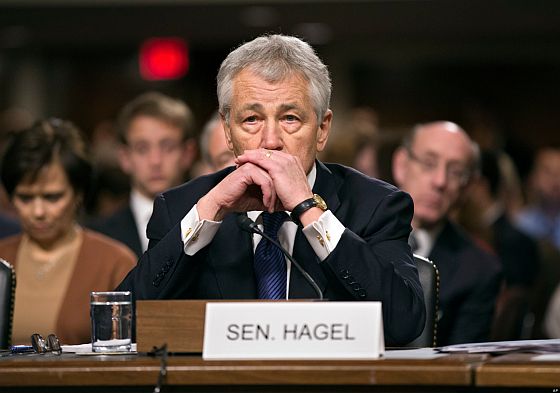
Over $1 million spent on anti-Hagel advertising

Eli Clifton reports: While the Sunlight Foundation estimates the ad blitz by anti-Hagel astroturf at over $100,000, research by Lobe Log suggests that the actual total probably exceeds $1 million.

Sunlight based its conclusions on FCC-required disclosures on ad buys by two groups who hide their donors’ identities: Americans for a Strong Defense and Use Your Mandate. But that barely scratches the surface of the anonymously funded media campaign aimed against Hagel’s nomination as the next secretary of defense.

Anti-Hagel advertising — including tv and newspaper ads, website banner ads, and direct mailing — paid for by the American Future Fund (AFF), the Emergency Committee for Israel (ECI), Log Cabin Republicans, and Use Your Mandate brings the estimated total to over $1 million, according to Lobe Log’s research. [Continue reading…]

Facebooktwittermail

U.S.-Israeli exceptionalism: above the law

Rami G Khouri writes: For anyone who wonders why so many people around the world criticize American and Israeli foreign policy and militarism, this has been a valuable learning week. I refer to the U.S. Senate Foreign Relations Committee hearings on Chuck Hagel’s nomination to be the next U.S. defense secretary, and the twin Israeli attacks against military targets in Syria.

The juxtaposition of these two events clarifies again two core trends in American and Israeli foreign policy: their insistence that they are above international law and can use their military anytime, anywhere in the world, if they feel this serves their security interests, regardless of the credibility of the evidence to justify their attacks; and, the unwritten rule that American policies in the Middle East should conform above all else to the dictates of Israel, before considering the interests of the U.S. itself or the nearly 600 million other people who live in the Middle East.

My gut reaction to watching some of the Hagel confirmation hearings is to thank the American Founding Fathers for implementing the doctrine of the separation of powers and checks-and-balances among the different branches of government. For if some of the ideological zealots, intellectual wrecks, and pro-Israel songbirds who sit on the Senate foreign relations committee were ever to assume executive power, the world would be a much more violent and dangerous place. [Continue reading…]

Facebooktwittermail

How the Israel lobby’s toadies savaged Hagel

Michael Cohen writes: [W]hat made Hagel such an interesting secretary of defense candidate was that he was willing to make provocative statements about national security and the actual limits on US power. This week, we saw the neutered version of that candidate and it wasn’t pretty.

In defense of Hagel, though, it’s hard to imagine a sadder display of senatorial prerogatives than what the country witnessed in Thursday’s hearing. There were basically three categories of questions asked of Hagel:

• “Is Israel a great country, or is it the greatest? And if it’s the former, can you explain your lack of support for America’s most important ally?”

• “Why don’t you think Iran is crazy, unbalanced and a military competitor of the United States, as I do?”

• “Let me tell you more about the vital national security rule played by the weapons system or military base located in my home state.”

I’m not really exaggerating when I say these three themes accounted for practically 80% of the questions asked of Hagel, particularly by Republicans. In fact, according to a tweet from Washington Post reporter Rajiv Chandrasekaran that made the rounds yesterday evening, Israel was mentioned 136 times in the hearing and Iran 135 times:

Even though the defense secretary nominee said repeatedly that he supports Israel, that he considers Iran a state sponsor of terrorism and that he wouldn’t take military force off the table in dealing with its potential nuclear program, Republicans mined practically every statement ever made by Hagel (and often taken out of context) in an effort to assert that he doesn’t hold as uncompromising a position on these issues as they do.

The day reached its point of high comedy when Senator Lindsey Graham began interrogating Hagel on whether he believes – as he allegedly said several years ago – that the so-called “Jewish lobby” causes US senators to occasionally do dumb things that harm US foreign policy. Hagel hemmed and hawed on the question when, in an ideal world, he should have said, “Yes, and this hearing is example A.”

Senator Lindsey Graham: Name one person in your opinion who’s intimidated by the Israeli lobby in the United States Senate?
Chuck Hagel (if he felt at liberty to speak the truth): With all due respect, Senator Graham, I think you are? Why else would you be asking me this question?

Facebooktwittermail

Milan appeals court convicts 3 Americans in CIA kidnap case, throwing out earlier acquittals

The Associated Press reports: A Milan appeals court on Friday vacated acquittals for a former CIA station chief and two other Americans, and instead convicted them in the 2003 abduction of an Egyptian terror suspect from a Milan street as part of the CIA’s extraordinary rendition program.

The appeals court sentenced former CIA Rome station chief Jeffrey Castelli to seven years, and handed sentences of six years each to Americans Betnie Medero and Ralph Russomando. All three were tried in absentia at both levels. A lower court that convicted 23 other Americans in 2009 had previously acquitted the three citing diplomatic immunity.

The November 2009 convictions, which were held up on two levels of appeal, were the first anywhere in the world against CIA actors involved in a practice alleged to have led to torture.

None of the Americans tried in Italy have ever been in Italian custody, but they risk arrest if they travel to Europe and lawyers have in the past suggested that final verdicts would open the way for the Italian government to seek their extradition. No such action has yet been taken.

Facebooktwittermail

Israel must withdraw all settlers or face International Criminal Court, says UN report

The Guardian reports: Israel must withdraw all settlers from the West Bank or potentially face a case at the international criminal court (ICC) for serious violations of international law, says a report by a United Nations agency that was immediately dismissed in Jerusalem as “counterproductive and unfortunate”.

All settlement activity in occupied territory must cease “without preconditions” and Israel “must immediately initiate a process of withdrawal of all settlers”, said the UN Human Rights Council (UNHRC). Israel, it said, was in violation of article 49 of the fourth Geneva convention, which forbids the transfer of civilian populations to occupied territory.

The settlements were “leading to a creeping annexation that prevents the establishment of a contiguous and viable Palestinian state and undermines the right of the Palestinian people to self-determination,” it said.

The UNHRC report broadly restated international consensus on the illegality of Israeli settlements. But its conclusions are likely to bolster the Palestinians following their admission last November to the UN as a non-member state, which potentially gives them recourse to the ICC. [Continue reading…]

Facebooktwittermail

2013 World Press Freedom Index — dashed hopes after Arab Spring

Reporters Without Borders: Last year’s index was marked by the Arab spring’s major news developments and the heavy price paid by those covering the protest movements. A range of scenarios has been seen in 2012, including countries such as Tunisia, Egypt and Libya, where regime change has taken place, countries such as Syria and Bahrain where uprisings and the resulting repression are still ongoing, and countries such as Morocco, Algeria, Oman, Jordan and Saudi Arabia, where the authorities have used promises and compromise to defuse calls for political and/or social and economic change.

Some of the new governments spawned by these protests movements have turned on the journalists and netizens who covered these movements’ demands and aspirations for more freedom. With legal voids, arbitrary appointments of state media chiefs, physical attacks, trials and a lack of transparency, Tunisia (138th, -4) and Egypt (158th, +8) have remained at a deplorable level in the index and have highlighted the stumbling blocks that Libya (131st, +23) should avoid in order to maintain its transition to a free press.

The deadliest country for journalists in 2012 was Syria (176th, 0), where journalists and netizens are the victims of an information war waged by both the Assad regime, which stops at nothing in order to crack down and impose a news blackout, and by opposition factions that are increasingly intolerant of dissent. In Bahrain (165th, +8) the repression let up slightly, while in Yemen (169th, +2) the prospects continue to be disturbing despite a change of government. Oman (141st, -24) fell sharply because of a wave of arrests of netizens.

Facebooktwittermail

How the New York Times covers the Israel lobby: by pretending it doesn’t exist

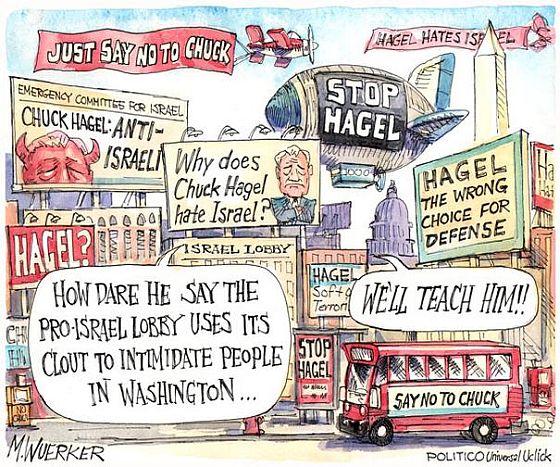
Cartoon by Matt Wuerker appearing in Politico, January 23, 2013.

The cartoon above, which appeared in Politico a few days ago, is pretty straightforward in identifying who is behind the campaign against Chuck Hagel’s nomination as defense secretary: the Israel lobby. (It’s worth noting, Politico is a fairly lobby-friendly publication, so the willingness of its editors to name names in this case has more to do with stating what is blindingly obvious rather than springing from some desire to ‘out’ the lobby.)

How does the New York Times cover the same story? Assign it to a reporter who apparently doesn’t believe the Israel lobby exists.

In Jim Rutenberg’s mind, the campaign against Chuck Hagel is a story about the effects of the Supreme Court decision, Citizen’s United. You have to go all the way down to paragraph nineteen in his report before Rutenberg mentions the Emergency Committee for Israel (creators of the anti-Hagel ChuckHagel.com website which doesn’t even get mentioned in the article).

Even though Rutenberg refers to Sheldon Adelson as a prominent backer of the anti-Hagel campaign, he only comes up after mentioning major conservative groups like Americans for Prosperity and Crossroads GPS who are not involved in the fight against Hagel.

Facebooktwittermail

How the pharmaceutical industry deceives doctors and patients

Fake pharma ad for "Havidol"

Ben Goldacre writes: In 2010, three researchers from Harvard and Toronto found all the trials looking at five major classes of drug — antidepressants, ulcer drugs and so on — and then measured two key features: were they positive, and were they funded by industry? They found over 500 trials in total: 85 percent of the industry-funded studies were positive, but only 50 percent of the government-funded trials were. That’s a very significant difference.

In 2007, researchers looked at every published trial that set out to explore the benefit of a statin. These are cholesterol-lowering drugs which reduce your risk of having a heart attack, and they are prescribed in very large quantities. This study found 192 trials in total, either comparing one statin against another, or comparing a statin against a different kind of treatment. Once the researchers controlled for other factors (we’ll delve into what this means later), they found that industry-funded trials were 20 times more likely to give results favoring the test drug. Again, that’s a very big difference.

We’ll do one more. In 2006, researchers looked into every trial of psychiatric drugs in four academic journals over a 10-year period, finding 542 trial outcomes in total. Industry sponsors got favorable outcomes for their own drug 78 percent of the time, while independently funded trials only gave a positive result in 48 percent of cases. If you were a competing drug put up against the sponsor’s drug in a trial, you were in for a pretty rough ride: You would only win a measly 28 percent of the time.

These are dismal, frightening results, but they come from individual studies. When there has been lots of research in a field, it’s always possible that someone — like me, for example — could cherry-pick the results and give a partial view. I could, in essence, be doing exactly what I accuse the pharmaceutical industry of doing by only telling you about the studies that support my case while hiding the rest from you.

To guard against this risk, researchers invented the systematic review. In essence a systematic review is simple: Instead of just mooching through the research literature, consciously or unconsciously picking out papers here and there that support your pre-existing beliefs, you take a scientific, systematic approach to the very process of looking for scientific evidence, ensuring that your evidence is as complete and representative as possible of all the research that has ever been done.

Systematic reviews are very, very onerous. In 2003, by coincidence, two were published, both looking specifically at the question we’re interested in. They took all the studies ever published about whether industry funding is associated with pro-industry results. Each took a slightly different approach to finding research papers, and both found that industry-funded trials were, overall, about four times more likely to report positive results. A further review in 2007 looked at the new studies that had been published in the four years after these two earlier reviews: It found 20 more pieces of work, and all but two showed that industry-sponsored trials were more likely to report flattering results.

I am setting out this evidence at length because I want to be absolutely clear that there is no doubt on the issue. Industry-sponsored trials give favorable results, and that is not just my opinion or a hunch from the occasional passing study. This is a very well-documented problem, and it has been researched extensively without anybody stepping out to take effective action, as we shall see. [Continue reading…]

Facebooktwittermail

Selling a new generation on guns

The New York Times reports: Threatened by long-term declining participation in shooting sports, the firearms industry has poured millions of dollars into a broad campaign to ensure its future by getting guns into the hands of more, and younger, children.

The industry’s strategies include giving firearms, ammunition and cash to youth groups; weakening state restrictions on hunting by young children; marketing an affordable military-style rifle for “junior shooters” and sponsoring semiautomatic-handgun competitions for youths; and developing a target-shooting video game that promotes brand-name weapons, with links to the Web sites of their makers.

The pages of Junior Shooters, an industry-supported magazine that seeks to get children involved in the recreational use of firearms, once featured a smiling 15-year-old girl clutching a semiautomatic rifle. At the end of an accompanying article that extolled target shooting with a Bushmaster AR-15 — an advertisement elsewhere in the magazine directed readers to a coupon for buying one — the author encouraged youngsters to share the article with a parent.

“Who knows?” it said. “Maybe you’ll find a Bushmaster AR-15 under your tree some frosty Christmas morning!” [Continue reading…]

Facebooktwittermail

Ann Jones: The Afghan end game?

The euphemisms will come fast and furious.  Our soldiers will be greeted as “heroes” who, as in Iraq, left with their “heads held high,” and if in 2014 or 2015 or even 2019, the last of them, as also in Iraq, slip away in the dark of night after lying to their Afghan “allies” about their plans, few here will notice.

This will be the nature of the great Afghan drawdown. The words “retreat,” “loss,” “defeat,” “disaster,” and their siblings and cousins won’t be allowed on the premises.  But make no mistake, the country that, only years ago, liked to call itself the globe’s “sole superpower” or even “hyperpower,” whose leaders dreamed of a Pax Americana across the Greater Middle East, if not the rest of the globe is… not to put too fine a point on it, packing its bags, throwing in the towel, quietly admitting — in actions, if not in words — to mission unaccomplished, and heading if not exactly home, at least boot by boot off the Eurasian landmass.

Washington has, in a word, had enough. Too much, in fact.  It’s lost its appetite for invasions and occupations of Eurasia, though special operations raids, drone wars, and cyberwars still look deceptively cheap and easy as a means to control… well, whatever.  As a result, the Afghan drawdown of 2013-2014, that implicit acknowledgement of yet another lost war, should set the curtain falling on the American Century as we’ve known it.  It should be recognized as a landmark, the moment in history when the sun truly began to set on a great empire.  Here in the United States, though, one thing is just about guaranteed: not many are going to be paying the slightest attention.

No one even thinks to ask the question: In the mighty battle lost, who exactly beat us?  Where exactly is the triumphant enemy?  Perhaps we should be relieved that the question is not being raised, because it’s a hard one to answer.  Could it really have been the scattered jihadis of al-Qaeda and its wannabes?  Or the various modestly armed Sunni and Shiite minority insurgencies in Iraq, or their Pashtun equivalents in Afghanistan with their suicide bombers and low-tech roadside bombs?  Or was it something more basic, something having to do with a planet no longer amenable to imperial expeditions?  Did the local and global body politic simply and mysteriously spit us out as the distasteful thing we had become?  Or is it even possible, as Pogo once suggested, that in those distant, unwelcoming lands, we met the enemy and he was us?  Did we in some bizarre fashion fight ourselves and lose?  After all, last year, more American servicemen died from suicide than on the battlefield in Afghanistan; and a startling number of Americans were killed in “green on blue” or “insider” attacks by Afghan “allies” rather than by that fragmented movement we still call the Taliban. 

Whoever or whatever was responsible, our Afghan disaster was remarkably foreseeable.  In fact, anyone who, from 2006 on, read Ann Jones’s Afghan reports at TomDispatch wouldn’t have had a doubt about the outcome of the war. Her first piece, after all, was prophetically entitled “Why It’s Not Working in Afghanistan.” (“The answer is a threefold failure: no peace, no democracy, and no reconstruction.”)  From Western private-contractors-cum-looters making a figurative killing off the “reconstruction” of the country to an Afghan army that was largely a figment of the American imagination to up-armored U.S. soldiers on well-guarded bases whose high-tech equipment and comforts of home blinded them to the nature of the enemy, hers has long been a tale of impending failure.  Now, that war seems headed for its predictable end, not for the Afghans who, as Jones indicates in her latest sweeping report from Kabul, may face terrible years ahead, but for the U.S.  After more than 11 years, the war that is often labeled the longest in American history is slowly winding down and that’s no small thing.

So leave the mystery of who beat us to the historians, but mark the moment. It’s historic. Tom Engelhardt

Counting down to 2014 in Afghanistan
Three lousy options: pick one
By Ann Jones

Kabul, Afghanistan — Compromise, conflict, or collapse: ask an Afghan what to expect in 2014 and you’re likely to get a scenario that falls under one of those three headings. 2014, of course, is the year of the double whammy in Afghanistan: the next presidential election coupled with the departure of most American and other foreign forces. Many Afghans fear a turn for the worse, while others are no less afraid that everything will stay the same.  Some even think things will get better when the occupying forces leave.  Most predict a more conservative climate, but everyone is quick to say that it’s anybody’s guess.

Only one thing is certain in 2014: it will be a year of American military defeat.  For more than a decade, U.S. forces have fought many types of wars in Afghanistan, from a low-footprint invasion, to multiple surges, to a flirtation with Vietnam-style counterinsurgency, to a ramped-up, gloves-off air war.  And yet, despite all the experiments in styles of war-making, the American military and its coalition partners have ended up in the same place: stalemate, which in a battle with guerrillas means defeat.  For years, a modest-sized, generally unpopular, ragtag set of insurgents has fought the planet’s most heavily armed, technologically advanced military to a standstill, leaving the country shaken and its citizens anxiously imagining the outcome of unpalatable scenarios.

Continue reading

Facebooktwittermail

Watch 62 years of global warming in 13 seconds

NASA’s analysis of Earth’s surface temperature found that 2012 ranked as the ninth-warmest year since 1880. NASA scientists at the Goddard Institute for Space Studies (GISS) compare the average global temperature each year to the average from 1951 to 1980. This 30-year period provides a baseline from which to measure the warming Earth has experienced due to increasing atmospheric levels of heat-trapping greenhouse gases. While 2012 was the ninth-warmest year on record, all 10 of the warmest years in the GISS analysis have occurred since 1998, continuing a trend of temperatures well above the mid-20th century average. The record dates back to 1880 because that is when there were enough meteorological stations around the world to provide global temperature data.

Facebooktwittermail

The agricultural fulcrum: better food, better climate

Diana Donlon writes: This past year treated us to a climate change preview in spades: crazy heat waves, prolonged drought, and epic storms like Sandy. To help us stabilize the climate, before we reach the point of no return, we must tap the immense potential of our food system.

Since becoming an agrarian society, we’ve known that growing food successfully depends on climate stability. Not enough water, crops wither and die. Too much, they rot. Beyond this, we know that crops have specific climatic requirements. Wheat, for instance, grows best in a dry, mild climate. Stone fruits like cherries need a minimum number of “chill hours” in order to blossom and later fruit. Intense heat disrupts pollination and can even shut down photosynthesis. These are basic parameters. If we continue to disregard them, food will become more scarce over time and we will go hungry. Indeed, as the National Climate Assessment, the government’s 1,146-page report released earlier this week states: “The rising incidence of weather extremes will have increasingly negative impacts on crop and livestock productivity because critical thresholds are already being exceeded.”

Agriculture, positioned as it is at the intersection of food and climate, presents a unique fulcrum. Pushed in the direction of industrial agriculture, it contributes egregiously to our climate problem: As activist Bill McKibben has noted, industrial agriculture — predominant in the U.S. — “essentially insures that your food is marinated in crude oil before you eat it.” This is because at every step, from the production of fertilizers and pesticides to the harvesting, processing, packaging, and transporting of materials, the industrial food system depends on climate-changing fossil fuels. Indeed, in a new report on climate change and food systems, the agriculture research organization CGIAR concluded that our global food system is responsible for nearly a third of all greenhouse gas emissions.

But we can tip the scale in the other direction toward sustainable agriculture, working in concert with natural systems instead of depleting them. This side of the scale presents an elegant, under-recognized opportunity to stabilize the climate. Not only do agro-ecological, organic and other sustainable farming methods emit significantly less greenhouse gas (GHG) overall, they can also sequester or store excess carbon. Given our long list of existing environmental worries — erosion, polluted watersheds, dead zones in the Gulf of Mexico — strengthening our top soil is a lot smarter than loading it up with nitrogen and washing it down the Mississippi. [Continue reading…]

Facebooktwittermail

Will Kerry remember climate change when he decides Keystone’s fate?

Bloomberg reports: As a senator, John Kerry fought for sweeping climate change legislation, called human-induced warming among the top challenges facing the U.S., and pushed for an international accord to cut carbon dioxide emissions.

That track record has emboldened critics of TransCanada Corp’s Keystone XL pipeline who want him to scuttle the remaining $5.3 billion portion of the project if he’s confirmed as secretary of State. Appearing yesterday at a hearing on his nomination before the Senate committee he chairs, Kerry was non- committal on the Canada-U.S. pipeline, though called himself a “passionate advocate” for action on climate change.

“He’s made climate leadership a signature issue in his Senate career,” said Erich Pica, president of Friends of the Earth, an environmental group, in a phone interview yesterday. “At the State Department, Kerry has the ability to ensure the analysis that is done gives the president the full flavor of the global warming impacts from the pipeline.”

A rejection of the Keystone XL project would exacerbate a bottleneck of shipments from Alberta’s oil sands that has made Canadian heavy oil among the cheapest in the world. The shortage of pipeline capacity and rising output has widened the gap between heavy Canadian crude and a U.S. benchmark to $36 as of yesterday.

The decision ultimately rests with President Barack Obama, who in his inaugural address this week pledged to act on climate change. Kerry’s influence may come as the State Department updates an environmental assessment originally criticized by green groups as inadequately weighing how the pipeline, which would carry bitumen from tar sands in Canada, may affect climate change.

“There is a statutory process with regards to the review and that is currently ongoing,” Kerry told the Senate Foreign Relations Committee yesterday. “It will not be long before that comes across my desk, and I will make the appropriate judgments about it.”

Investors appear to be betting on Keystone approval, sending TransCanada shares to a record high this week. TransCanada, the country’s second-largest pipeline operator, has climbed 3.9 percent since Kerry was nominated Dec. 21 and has advanced 4.1 percent this year. [Continue reading…]

Facebooktwittermail

Obama puts fox in charge of hen house at SEC

Matt Taibbi writes: I was shocked when I heard that Mary Jo White, a former U.S. Attorney and a partner for the white-shoe Wall Street defense firm Debevoise and Plimpton, had been named the new head of the SEC.

I thought to myself: Couldn’t they have found someone who wasn’t a key figure in one of the most notorious scandals to hit the SEC in the past two decades? And couldn’t they have found someone who isn’t a perfect symbol of the revolving-door culture under which regulators go soft on suspected Wall Street criminals, knowing they have million-dollar jobs waiting for them at hotshot defense firms as long as they play nice with the banks while still in office?

I’ll leave it to others to chronicle the other highlights and lowlights of Mary Jo White’s career, and focus only on the one incident I know very well: her role in the squelching of then-SEC investigator Gary Aguirre’s investigation into an insider trading incident involving future Morgan Stanley CEO John Mack. While representing Morgan Stanley at Debevoise and Plimpton, White played a key role in this inexcusable episode.

As I explained a few years ago in my story, “Why Isn’t Wall Street in Jail?”: The attorney Aguirre joined the SEC in 2004, and two days into his job was asked to look into reports of suspicious trading activity involving a hedge fund called Pequot Capital, and specifically its megastar trader, Art Samberg. Samberg had made suspiciously prescient trades ahead of the acquisition of a firm called Heller Financial by General Electric, pocketing about $18 million in a period of weeks by buying up Heller shares before the merger, among other things.

“It was as if Art Samberg woke up one morning and a voice from the heavens told him to start buying Heller,” Aguirre recalled. “And he wasn’t just buying shares – there were some days when he was trying to buy three times as many shares as were being traded that day.”

Aguirre did some digging and found that Samberg had been in contact with his old friend John Mack before making those trades. Mack had just stepped down as president of Morgan Stanley and had just flown to Switzerland, where he’d interviewed for a top job at Credit Suisse First Boston, the company that happened to be the investment banker for . . . Heller Financial.

Now, Mack had been on Samberg’s case to cut him in on a deal involving a spinoff of Lucent. “Mack is busting my chops” to let him in on the Lucent deal, Samberg told a co-worker.

So when Mack returned from Switzerland, he called Samberg. Samberg, having done no other research on Heller Financial, suddenly decided to buy every Heller share in sight. Then he cut Mack into the Lucent deal, a favor that was worth $10 million to Mack.

Aguirre thought there was clear reason to investigate the matter further and pressed the SEC for permission to interview Mack. Not arrest the man, mind you, or hand him over to the CIA for rendition to Egypt, but merely to interview the guy. He was denied, his boss telling him that Mack had “powerful political connections” (Mack was a fundraising Ranger for President Bush).

But that wasn’t all. Morgan Stanley, which by then was thinking of bringing Mack back as CEO, started trying to backdoor Aguirre and scuttle his investigation by going over his head. Who was doing that exactly? Mary Jo White. [Continue reading…]

Facebooktwittermail

How academia betrayed and continues to betray Aaron Swartz

Michael Eisen writes: As news spread last week that digital rights activist Aaron Swartz had killed himself ahead of a federal trial on charges that he illegally downloaded a large database of scholarly articles with the intent to freely disseminate its contents, thousands of academics began posting free copies of their work online, coalescing around the Twitter hashtag #pdftribute.

This was a touching tribute: a collective effort to complete the task Swartz had tried – and many people felt died trying – to accomplish himself. But it is a tragic irony that the only reason Swartz had to break the law to fulfill his quest to liberate human knowledge was that the same academic community that rose up to support his cause after he died had routinely betrayed it while he was alive.

The most obvious culprit was MIT, whose computer system Swartz used for his downloads. Their decision to make sharing journal articles a criminal matter is inexcusable. But their real betrayal was allowing these articles to fall into private hands in the first place.

Although most academic research is funded by the public, universities all but force their scholars to publish their results in journals that take ownership of the work and place it behind expensive pay walls.

Centuries ago, when printing and mailing paper journals was the most efficient way to disseminate new knowledge, a symbiotic relationship developed between scholars, who had ideas they wanted to share, and publishers, who had printing presses and the means to convey printed works to a wide audience. Transferring copyright to publishers, which protected their ability to recover costs and profit from their investment, was a reasonable price for authors to pay to further their disseminating mission.

But with the birth of the internet, scholars no longer needed publishers to distribute their work. As NYU’s Clay Shirky has noted, publishing went from being an industry to being a button.

Had the leaders of major research universities reacted to this technological transformation with any kind vision, Swartz’s dream of universal free access to the scholarly literature would now be a reality. But they did not. Rather than seize this opportunity to greatly facilitate research and education, both within and outside the academy, they chose instead to reify the status quo. [Continue reading…]

Facebooktwittermail

Torture and Zero Dark Thirty

David Bromwich writes: Zero Dark Thirty is a spy thriller about the tracking and killing of Osama Bin Laden. Good police work did it, the film says, and it aims to show what (in the extraordinary circumstances) good police work amounts to. Action movies have been the director Kathryn Bigelow’s métier, and Zero Dark Thirty is tense and well-paced. It has the kind of proficiency one associates with, say, The Hunt for Red October. It does not mean to compete with a film like The Battle of Algiers. There is no question here of taking up a complex historical subject and exploring it with a semblance of human depth. Rather, the movie accepts the ready prejudices and fears of its American audience, and builds up pressure for two hours to prepare the thrill and relief at the raid on Bin Laden’s compound in Abbottabad. The first two hours skip forward selectively to cover the trajectory of ten years. The final twenty-five minutes of action are portrayed almost in real time.

Until Americans stop indulging our elected officials in their appetite for secrecy, we will not know exactly what orders the Navy Seals carried into Abbottabad. Pretty clearly, it was a kill mission and not “Capture or Kill.” Zero Dark Thirty makes killing the personal preference of its heroine, Maya, a CIA agent who begins the hunt in September 2001 and whose relentless pursuit is clinched by success. When she talks to the Navy Seals team, she says she wants them to “kill him for me.” The “me” element in the international hunt, and its reflexive connection to revenge, is emphasized more than once. This overtly simplifies an area of moral doubt which the film in other ways simplifies covertly. Maya’s stamina, force, and drive somehow place her beyond challenge. By the end, her superiors at CIA are intimidated, and we feel they ought to be. Maya has no friends, and no life outside the hunt, but her determination is itself a sort of passion. It is, in fact, the only passion that is represented in the film.

How was Bin Laden found? Zero Dark Thirty tells us that it was done by the torture of detainees; by the collection and deduction of evidence from dossiers, videos, recorded phone calls and intercepted emails; and by tailing couriers. All of these methods the movie dispassionately records, and it affirms the efficacy of all. The narrative lacks the patience and tightness to illustrate many convincing particulars of the detective work. That it leaves us in the dark, however, is also part of the point. We Americans, the film is saying, must put ourselves in the hands of the experts who have mastered the darkness. [Continue reading…]

Facebooktwittermail