The New York Times reports: Three decades after leaving the White House, former President Jimmy Carter still functions inside the trappings of power, cruising through fiercely contested areas of this city on Monday in a 12-car motorcade, with Secret Service agents stationed strategically as he surveyed the view from the Mount of Olives.
But at 88, Mr. Carter, trying to nudge his agenda without an official platform, no longer filters his words for politics or diplomacy. On Monday, he ramped up his years of criticism of Israeli policy by saying that Prime Minister Benjamin Netanyahu lacked the courage of his predecessors and that he had abandoned the two-state solution that has been the accepted framework for resolving the Israeli-Palestinian conflict for decades. And just two weeks before the American election, he was almost as critical of President Obama, saying his administration has shirked the historical role played by the United States in the region.
“I don’t think there’s any doubt that Netanyahu has decided the one-state option is the one he’s going to pursue,” Mr. Carter said, despite Mr. Netanyahu’s professed commitment to two states, notably in a 2009 speech at Bar Ilan University.
As for Mr. Obama, a fellow Democrat, the former president said, “The U.S. government policy the last two to three years has basically been a rapid withdrawal from any kind of controversy.”
He added: “Every president has been a very powerful factor here in advocating this two-state solution. That is now not apparent.” [Continue reading…]
Category Archives: Issues
Does Romney know the location of the Strait of Hormuz?
Saeed Kamali Dehghan writes: Mitt Romney is not particularly new to gaffes but when it comes to one about the relationship between Syria and Iran, he has shown extraordinary courage in repeating it at least six times just in the past year.
During last night’s foreign policy debate, Romney said: “Syria is Iran’s only ally in the Arab world. It’s their route to the sea.”
In fact, Iran, a close ally of Bashar al-Assad’s regime, has direct access to international waters through its large coastline on the Gulf and is not even a neighbour to Syria in order to rely on it as a route to the sea.
Instead, Syria gives Iran a physical access to Lebanon and its Hezbollah militia which is strategically important for Tehran leaders because of the group’s geographical position in respect to Israel.
It is not the first time that governor Romney has referred to Syria as a country that provides Iran with a route to the sea.
In March, Romney made the exact gaffe at AIPAC conference.
Modern American economic history in a few charts
Matt Stoller writes: The big economic strategy for the next term of whoever is Presidenti is essentially, “turn those machines back on”. It’s fracking to replace cheap oil and a new real estate bubble in housing. Essentially, the idea is to turn America into more and more of a resource extraction economy, or a petro-state. If American politics seems more and more oligarchical, that’s because the American political system is beginning to reflect the Middle Eastern oil states its economic investment implies it should. Here are a series of charts explaining what is going on.
First, this is data showing investment in various investment sectors.
American politics looks increasingly like a petro-state, and this chart shows why. In the 1990s, particularly the late 1990s, the Clinton economy showed parity between manufacturing of computers/electronic products and mining (mostly oil and gas extraction). The Bush economy, starting in 2003 when the invasion of Iraq went sour, saw enormous hockey stick like investment in fracking, tar sands, and other types of extractive mining. Technology investment showed a slight decline. Obama by and large has sustained these trends. [Continue reading…]
The war we aren’t debating
Michael Massing writes: It’s a social policy that, many experts agree, has failed miserably since it was introduced more than forty years ago, tearing apart families and communities across the United States, consuming tens of thousands of lives abroad, and squandering huge sums of money. Yet hardly any national politician is willing to challenge it, and it’s been completely ignored during the 2012 presidential campaign.
I’m speaking of the war on drugs. Since 1971, when Richard Nixon declared drug abuse “public enemy number one” and stated his intention of waging a “new, all-out offensive” against it, the government has spent an estimated trillion dollars on the war. Much of that money has gone to street-level drug arrests, undercover raids, intelligence taskforces, highway patrols, and—most costly of all—prison beds. Of the 2.3 million people in prison in the United States today, nearly half a million are there for drug offenses, many of them of the low-level, nonviolent variety. In 2010, 1.64 million people were arrested for drug violations—80 percent of them for possession.
In Latin America, the war on drugs has sown misery across a vast swath of territory stretching from the coca fields of Peru to Mexico’s border with the United States. Billions have been spent on crop eradication, commando units, military training, unmanned surveillance drones, and helicopters. The result has been endless bloodshed, widespread corruption, and political instability. In Mexico alone, an estimated 50,000 people have been killed in drug-related violence in the nearly six years since Mexican President Felipe Calderón (encouraged by Washington) declared war on his nation’s drug cartels. One result of the crackdown has been to push traffickers into Central America, where they now terrorize Guatemalans and Hondurans. All the while, drugs continue to flow unabated into the United States. In 1981, a pure gram of cocaine cost $669 (adjusted for inflation); today, it goes for $177.
As for consumption, cocaine use has decreased considerably since its peak in the mid-1980s, and methamphetamine use has also subsided after a destructive surge in the 2000s. But the abuse of prescription drugs, especially of opioid painkillers, has grown to what the Centers for Disease Control and Prevention calls “epidemic” levels, and the number of accidental overdose deaths from such substances has soared. This spurt underscores that the real source of our drug problem lies not in Mexico or Colombia but inside our own borders, and that arresting and locking up users is a singularly ineffective way of addressing it. [Continue reading…]
The death of the Israel-Palestine two-state solution brings fresh hope
Rachel Shabi writes: We could argue over who killed it, but what’s the point? It’s increasingly obvious that a continued insistence on zombie peace talks between Israelis and Palestinians is deluded, because the two-state principle framing them is dead. To précis: it’s now impossible to remove half a million Jewish settlers and infrastructure from the occupied West Bank and East Jerusalem; the international community is opposed to settlements on paper but does nothing in practice, and after 19 years of failed two-state talks, the fault plainly lies in the plan, not the leadership.
This view has grown more vocal on both sides, from unlikely quarters and for different reasons. In recent months, prominent Israeli commentators have declared the end of the two-state period, the latest to do so being the mainstream, veteran journalist Nahum Barnea, who in August wrote in the mass-circulation daily Yediot Aharonot that the Oslo two-state peace process is dead. His view – “Everybody knows how this will end. There will be a bi-national [state],” he clarified on Israeli TV – is shared by others once supportive of the Oslo framework but now calling time on it. “I do not give up on the two-state solution on ideological grounds,” wrote Haaretz columnist Carlo Strenger last month. “I give up on it because it will not happen.”
Alongside that, we’re starting to see the practical consequences of those Jewish settlers who, surprisingly, started talking about one-state approaches two years ago. Last week, a Palestinian village in an Israel-controlled area of the West Bank was given building permits – the first time that’s happened during a 45-year Israeli occupation – thanks to petitions from their Jewish settler neighbours. [Continue reading…]
From hope to fear: 2008 versus 2012
Richard Falk writes: In 2008, Barack Obama rekindled faith in the American electoral process for many, and revived the deeper promise of American democracy, bringing to the foreground of the national political experience a brilliant and compassionate African American candidate.
When Obama actually won the presidency, it was one of the most exciting political moments in my lifetime, and rather reassuring as a sequel to the dark years of George W Bush’s presidency.
Of course, many Americans didn’t share such positive feelings. An important embittered minority believed that the election of a liberal-minded black man was the lowest point ever reached in national politics, challenging this segment of society that now was deeply alienated from the prevailing political current to mobilise their forces so as to win back control of the country on behalf of white Christian Americans, and also a time to indulge such absurd scenarios as an imminent Muslim takeover of the society.
Such polarisation, gave rise to an Islamophobic surge that revived the mood of fear and paranoia that followed upon the 9/11 attacks and was reinforced by evangelical enthusiasm for Israel. In this regard, the Obama phenomenon was a mixed blessing as it contributed to a rising tide of rightest politics in the US that poses unprecedented dangers for the country and the world.
Nevertheless, as mentioned, Obama’s campaign and election was at the time a most welcome development, although not entirely free from doubts. From the outset, my hopes were tinged with concerns, although I did my best to suspend disbelief.
All along I found little evidence that Obama’s leadership would liberate the governing process from its threefold bondage to Wall Street, the Pentagon and Israel. Such a political will to mount such a challenge was never in evidence and never materialised. [Continue reading…]
Video: Matt Taibbi and Chrystia Freeland on the One Percent’s power and privileges
What Obama should say about Iran in the debate
Robert Wright writes: Sunday’s New York Times carried a story that will presumably come up in Monday’s foreign policy debate between President Obama and Mitt Romney: The U.S. and Iran have reportedly agreed “in principle” to have direct bilateral negotiations over Iran’s nuclear program, negotiations that could start after the election if Obama wins it.
If true, this is good news. Iran has long resisted direct talks with the U.S., and lots of people think this format would be more productive than the current cumbersome format known as “P5+1” (the permanent members of the UN Security Council plus Germany on one side of the table, Iran on the other). One reason Iran may have been reluctant to depart from the P5+1 format is that it includes Russia and China, which are relatively sympathetic to Tehran. Maybe, now that sanctions are starting to do serious damage to its economy, Iran figures it can’t afford to hold out for the optimal deal and needs to cut to the chase. In any event, the new Iranian position reported by the Times is auspicious.
So, if we lived in a rational world, the New York Times story would be hailed as validation of Obama’s foreign policy — there might even be suspicions that the Obama administration leaked the news to glorify itself!
But we don’t live in a rational world. We live in a world where (on much of the right, at least) negotiation is equated with capitulation. And that explains why there’s been much speculation that the Times story was leaked by people who oppose these negotiations and/or people who want to help Mitt Romney. The thinking goes like this: In Monday’s debate, Romney can depict this as Obama’s secret plan to implement Munich-style appeasement after re-election, cutting some shady deal that would be bad for the U.S. and for its ally Israel. [Continue reading…]
The undisclosed Mitt Romney
Thomas B. Edsall writes: Early in the general election campaign, Mitt Romney made it clear that he was not going to disclose the details of his plans before voters cast their ballots.
“One of the things I found in a short campaign against Ted Kennedy was that when I said, for instance, that I wanted to eliminate the Department of Education, that was used to suggest I don’t care about education,” Mitt Romney told the Weekly Standard in an interview published April 2:
So I think it’s important for me to point out that I anticipate that there will be departments and agencies that will either be eliminated or combined with other agencies. So for instance, I anticipate that housing vouchers will be turned over to the states rather than be administered at the federal level, and so at this point I think of the programs to be eliminated or to be returned to the states, and we’ll see what consolidation opportunities exist as a result of those program eliminations. So will there be some that get eliminated or combined? The answer is yes, but I’m not going to give you a list right now.
This was a dangerous assertion. It amounted to waving a red flag in front of reporters.
With the presidential election just two weeks away, Romney’s gamble may be paying off. He has failed to specify where he would wield the budget knife, and he has defied, with a striking degree of success, the relatively quiet group of people who have called for him to honor a host of traditional disclosure and campaign practices. [Continue reading…]
Former Israeli spymaster: We need to talk to Iran
Laura Rozen writes: Efraim Halevy served as chief of the Israeli intelligence service, Mossad, under three Israeli prime ministers and led the secret negotiations with Jordan’s King Hussein that made way for Israel’s historic 1994 peace treaty with that country. Other assignments in a four-decade government career include serving as Mossad station chief in Washington in the 1970s under then-Israeli ambassador to the United States Yitzhak Rabin, for whom, as prime minister, Halevy served as Mossad chief until Rabin’s 1995 assassination. Halevy also served as Israeli national security advisor and Israeli ambassador to the European Union in the late 1990s.
Born in Britain — Halevy moved to Israel in 1948 at the age of 14 — and wearing a trench coat with a newspaper tucked under his arm on a drizzly morning in Washington on Friday, Oct. 19, Halevy, 78, evoked George Smiley, the protagonist in the John Le Carre British spy novels, who is burdened by the knowledge of state secrets too sensitive and ugly to share. But it is Halevy’s fierce advocacy for dialogue with mortal enemies such as Iran and Hamas, combined with a biography laden with hard political experience, that makes him so iconoclastic, especially in the current Israeli political and national security landscape.
“I was 40 years in the business of dealing with adversaries — some of them very bitter ones, some we fought successive wars with,” Halevy said in an interview with Al-Monitor. “Over the years … I realized that, in order to be effective with one’s enemies, you have to have two essential capabilities: To overcome them by force if necessary … And do everything you can to get into their minds and try to understand how they see things … and where if at all there is room for common ground of one kind or another.”
“I think that what we have had over the years is an abundance of one side, and a dearth of the other,” Halevy said.
Halevy most especially emphasized the need for dialogue with Iran, and to try to understand the Iranians — a position rarely heard from top Israeli officials, even those who have expressed opposition to unilateral Israeli military action on Iran.
“The Iranians, in their heart of hearts, would like to get out of their conundrum,” Halevy told Al-Monitor. “The sanctions have been very effective. They are beginning to really hurt.” [Continue reading…]
U.S. and Iran deny plan for nuclear talks
The New York Times reports: The question of whether the United States should seek to engage Iran in one-on-one talks on its nuclear program joined the likely topics for Monday’s final presidential debate as supporters of President Obama and Mitt Romney jousted on Sunday over the issue.
The prospect of such talks was raised in an article published over the weekend by The New York Times that said Iran and the United States had agreed in principle to direct talks after the presidential election.
On Saturday, the White House denied that a final agreement on direct talks had been reached, while saying that it remained open to such contacts. On Sunday, the Iranian Foreign Ministry dismissed the report.
But if the report proved to be true, said a supporter of Mr. Romney, the Republican candidate, Iran’s motives should be seriously questioned.
“I hope we don’t take the bait,” Senator Lindsey Graham, Republican of South Carolina, said on “Fox News Sunday.” “I think this is a ploy by the Iranians” to buy time for their nuclear program and divide the international coalition, he said.
A supporter of Mr. Obama, Senator Richard J. Durbin, Democrat of Illinois, said on the same program that the tough international sanctions the president helped marshal against Iran might be bearing fruit exactly as hoped, forcing Iran to blink.
“This month of October, the currency in Iran has declined 40 percent in value,” said Mr. Durbin, a member of the Foreign Relations Committee. “There is unrest in the streets of Tehran, and the leaders in Iran are feeling it. That’s exactly what we wanted the sanctions program to do.”
The Times, citing unnamed senior Obama administration officials, reported over the weekend that after secret exchanges, American and Iranian officials had agreed in principle to hold one-on-one negotiations between the nations, which have not had official diplomatic relations since the 1979 Islamic Revolution in Iran.
Iran’s foreign minister, Ali Akbar Salehi, denied on Sunday that any direct talks had been scheduled. “We do not have anything such as talks with the United States,” he told the semiofficial Fars news agency. [Continue reading…]
The daily revolutions of Arab women

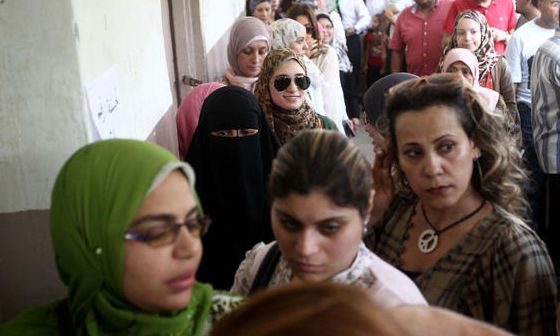
Millions of women voted in Egypt's first free presidential election but none were on the ballot.
At Aeon Magazine, Amal Ghandour writes: The face, a nod to her Egyptian mother, is pharaonic, curls freefalling all around it. The muscles packing her body betray countless hours of toil in the pool, on the bench press, on her feet — running. Her attire is as blunt in its skimpiness as Jordan, where she lives, is adamant in its conservatism. But while the look screams a fight easily won, her demeanor is tactful, her tenor even-keeled. This is a woman used to negotiating her way through life.
I will call her Hadaf, a common enough Arabic name, befitting a woman whose 34 years have been just that: hadaf, meaning singular purpose. At first glance, neither her impressive résumé nor her place in Jordanian society surprise. The milestones are all there: a BA in graphic design from Yarmouk University, up north in Irbid; a stint with a successful advertising agency, followed by a top executive job in a global company; and, just recently, an MBA from the London Business School. In Jordan, among the well-heeled, an education and a career with the tight skirts to match are not unusual.
Get to know Hadaf a little better, though, and you uncover a life that encapsulates the hard-going, incessant, yet finally successful struggles of Arab women to transform their unforgiving circumstances into a better set of odds.
Hadaf’s Palestinian father and Egyptian mother met in Egypt in the late 1960s. She was studying interior design, he agricultural engineering. Like thousands of Palestinians looking for a living, and indeed a home, he moved to Kuwait to teach. Hadaf’s mother soon followed, becoming a teacher herself so as to tiptoe neatly around her husband’s ego; interior design, they both knew, would have made them better money, but it would have made him feel less of a man.
When Saddam Hussein invaded Kuwait in 1990 and Yasser Arafat took his side, many Palestinians found themselves no longer welcome in the Gulf emirate, and so they moved to Jordan to try to reconstitute a decent life. Hadaf’s father was among them. Settling on the outskirts of the capital, he started up a spare-parts business, but it failed even before it had built up steam, plunging the entire family into near poverty.
There is no equivalent dramatic moment when Hadaf’s own battles began. No epiphanies that made her want to reach for something different. Her father’s tumble from middle-class status was not drastic. The neighbourhood was more ‘a social than an economic slum’ — very conservative and very comfortable with it. Her mother donned the veil when she hit 40, because that’s what women in her milieu do upon reaching the gateway to middle age. Her father stopped drinking alcohol but did not pray his way through the days. And there was love around — plenty of it. It’s just that Hadaf walked to the beat of a different drum.
‘Inch by inch. This is how I escaped marriage at 16 to a car mechanic; how I shortened the skirt and rolled up the sleeves a tiny bit; how I managed to go to Yarmouk; how I worked as a waitress there, and at the Hard Rock Café in Amman during the summers… I lobbied my mother, talked my father to death; had him visit the dorms, had him meet the owner of the restaurant up in Irbid, had him pick me up at 2am from the Hard Rock… But, you see, I was making a living. It was very difficult for them to argue with that.’
There were, of course, many fudges, omissions and fibs. ‘I did not tell my parents that I moved into my own apartment the second year of college [and] I escaped marriage to that mechanic by parading in a T-shirt in front of his shop. He was the one to break off the engagement. All I had to do then was persuade my father to let me finish high school.’
When Hadaf started to win the family’s bread, as it were, the parents went quiet. And they’ve been quiet ever since. Yet, even now, for their sake, Hadaf says, ‘I have two wardrobes at home: one for me, for my life; and one for them, when I go visiting.’
The Hadafs of the Arab world outnumber women like me, for whom life has been much gentler. But we don’t strain to reach out for each other across the divides. I did not have to go in search of her for insight. She lives everywhere around me. Hadaf populates the Middle East.
That said, hers is a distinctly upbeat story. Other women are fighting tooth and nail for much smaller breaks. They do win in the end — inch by inch — but the toll tends to draw age early on a young face, and the demands on grit and courage are almost always insufferably unkind.
A 22-year-old Palestinian – I’ll call her Suad – works with me on a region-wide community development initiative. She has just set aside her veil in conservative surroundings. She describes her own and her female friends’ lives in Beirut as an incessant search for opportunity amid a heap of constraints. ‘You worry about the consequences, and then you take a step, and then another one after that, and another one after that… You make use of every opening.’
This particular step, her unveiling, has proven to be especially charged. Suad took up the veil, a blend of shapes and colours in her case, at the age of 17, the last in her class to do so. Although most of her school friends were veiled, her parents’ leftist inclinations helped check the growing calls for Suad to amass herself into the fold. It was her teacher’s warning that finally tipped the scales. ‘She brought me before the entire class and told me that my mother would go to hell if I did not wear it. I succumbed.’
Suad took off her hijab two months ago, inspired by the rousing theme of nonconformity threading through her English literature courses. She felt she was being true to her identity.
Yet reactions to her move in a milieu that actively discourages feminine unorthodoxies are mixed. Suad’s father is happy to see her let her hair down and so, she thinks, would have been her mother, had she lived to witness this pointed return to visibility. So far, however, the neighbourhood has been worryingly quiet; and the backlash at work, especially among the men, upsetting. In the midst of widespread opprobrium, only one friend has said: ‘If that’s what you want, then do it.’ Suad shrugs. ‘Better this than hypocrisy.’
On their own, such triumphs as Suad’s and Hadaf’s stand as little more than heartening anecdotes on the margins of what is a crushingly discouraging situation for Arab women. One is tempted to ask: only this, after so many years of struggle? But pulled together and read differently, these small victories create a different norm of empowerment — one that, paradoxically, draws strength from the very subtlety and everyday nature of the ‘dissident’ acts themselves. [Continue reading…]

Tehran’s astute observers of American presidential politics
A correspondent for Tehran Bureau reports: If there were global statistics regarding which nations have been paying the most attention to the U.S. presidential campaign, Iran would probably be at the top. The crushing sanctions imposed over the past year aimed at forcing Iran to curb or abandon its nuclear program have created more pain than ever for average Iranians. They see President Barack Obama as prepared to effectively destroy their country’s economy even as he has shown that he is not eager to launch a military strike on the Islamic Republic.
On the other hand, they consider former Massachusetts Governor Mitt Romney as George W. Bush redux, and many believe that, if elected president, he will order a military attack on Iran.
“I believe it would be better if Romney was elected. We will suffer for a month, and then we will be all set,” says Ali Reza, 34, who peddles jeans around Rah Ahan Circle in south Tehran. What if armed conflict turns Iran into another Iraq? I ask. “That would be a catastrophe, by God!” he replies. “What can I say? They are both awful choices. Our luck here is that whichever way we turn, it’s a misfortune.”
Heading up to Vali Asr Square, I get into the front seat of a cab. The driver, Mahmoud, is playing a pop tune on his stereo. I ask him who he prefers, Obama or Romney. “This Islamic Republic that we see here needs a fist over its head. Obama has made a fool of himself for four years. Someone has to come and put these guys in their places.”
Across from the Tehran City Theater stand three young adults — two women and a man, students at the nearby Art College. I ask what they think of the American political system. Laleh, 21, says, “The two U.S. parties seem the same to me, except that the Democrats keep their cards over the table, while the Republicans keep them under the table. But the Democrats are quite slick.”
I ask for her election prediction. “If Romney wins, Obama’s long-term programs will be put aside. But it is clear that Obama will win.”
Houman, 24, says that he has enjoyed following the campaign. “It’s become complicated. It is very close.”
Who does he prefer? I ask.
“There’s no difference!”
“Not at all?”
“Their Iran policies match. Obama will have to get fervid too.”
I remind him that Romney has criticized Obama for interceding on behalf of the Green Movement after its rise in 2009. Houman says, “Ya, I was totally against interceding. It would have made things worse.”
I ask if he believes there would have been any difference if Romney had been in office? “Obama chose that position at the request of the Green Movement leaders and their own calculus. If Romney believes in the Green Movement, he should study some of Mir Hossein Mousvai’s communiqués.”
Mousavi, the former prime minister, issued a series of communiqués during and after his 2009 campaign as a reformist candidate for the Iranian presidency (the incumbent, Mahmoud Ahmadinejad, was declared the winner of the June vote amid widespread accusations of electoral fraud). In his seventh of these statements, Mousavi said that the regime’s crushing of domestic media outlets was opening the door to foreign intervention.
In his ninth communiqué, issued in July 2009 after the postelection protests and their violent suppression by the authorities, he added, “No matter how bitter this situation, it’s a feud between kindred, and we will regret it if we act immaturely and involve outsiders.”
Houman glances at his watch and sees that he has time to continue with the conversation. “The Republicans who attack Obama about the Green Movement didn’t speak up back then.”
And Romney?
He replies, “He is better than other Republican candidates, more moderate and more realistic.” He adds, “He seems to be a more intelligent person compared to George Bush’s team.”
With no security agents visible in the immediate vicinity, Golnoosh, who appears to be Houman’s girlfriend, is clasping his arm. “The issue of Iran has no effect on the U.S. voters,” she says. “Look, [former Secretary of State Henry] Kissinger in his recent interview said the same things about Iran as [Ambassador to the United Nations] Susan Rice and [Secretary of State] Hillary Clinton have said. American foreign policy has never been so homogeneous over the last decade.”
How so?
“Because they have gone through major crises, like the Iraq war and Bin Laden, and nobody relishes making up new crises.”
Houman agrees. “Obama himself knows that this is not the time to attack Iran.” [Continue reading…]
Video: Lawrence Wilkerson reports from the white West
Washington denies secret plan for direct talks with Iran
The Guardian reports: The Obama administration has moved quickly to water down a report that the US and Iran have agreed in principle to meet one-on-one for negotiations on Iran’s nuclear programme.
The New York Times said secret talks between officials that began early in Barack Obama’s term as president had delivered the provisional agreement. Iran had insisted the talks wait until after the November presidential election, the New York Times said, attributing the information to a senior official in the Obama administration.
However the National Security Council spokesman Tommy Vietor said in response that the United States would continue to work with fellow permanent members of the UN security council and Germany.
“It’s not true that the United States and Iran have agreed to one-on-one talks or any meeting after the American elections,” the statement said.
“We continue to work with the P5+1 [five permanent members of the UN security council plus Germany] on a diplomatic solution and have said from the outset that we would be prepared to meet bilaterally.”
Vietor said on Saturday that Obama had made clear that he would do whatever was necessary to prevent Iran from getting a nuclear weapon. Vietor said Iran must meet its obligations or it would “continue to face crippling sanctions and increased pressure”.
This sounds like a non-denial denial — and also suggests that the New York Times has been used (willingly) to tee-up a question that Obama wants the next debate to focus on: the candidates’ willingness to negotiate with Iran.
The assumption, reasonably, is presumably that Romney cannot persuasively argue that negotiation is a bad thing, nor that willingness to negotiate is in and of itself a sign of weakness. Yet, in expressing his reservations about negotiating he will also inevitably present himself as a handicapped negotiator and thus make Obama look like the more viable deal maker.
U.S. officials say Iran has agreed to nuclear talks
The New York Times reports: The United States and Iran have agreed for the first time to one-on-one negotiations over Iran’s nuclear program, according to Obama administration officials, setting the stage for what could be a last-ditch diplomatic effort to avert a military strike on Iran.
Iranian officials have insisted that the talks wait until after the presidential election, a senior administration official said, telling their American counterparts that they want to know with whom they would be negotiating.
News of the agreement — a result of intense, secret exchanges between American and Iranian officials that date almost to the beginning of President Obama’s term — comes at a critical moment in the presidential contest, just two weeks before Election Day and the weekend before the final debate, which is to focus on national security and foreign policy.
It has the potential to help Mr. Obama make the case that he is nearing a diplomatic breakthrough in the decade-long effort by the world’s major powers to curb Tehran’s nuclear ambitions, but it could pose a risk if Iran is seen as using the prospect of the direct talks to buy time.
It is also far from clear that Mr. Obama’s opponent, Mitt Romney, would go through with the negotiation should he win election. Mr. Romney has repeatedly criticized the president as showing weakness on Iran and failing to stand firmly with Israel against the Iranian nuclear threat. [Continue reading…]
This puts Romney in an interesting and awkward position.
He’ll find it hard to say that he refuses to enter into such negotiations. “I promise that I won’t talk to the Iranians,” just won’t sound like a vote winner from a guy who currently wants to paint himself as Mr Moderation.
But neither does he want to cast himself as an echo of Obama 2008 — willing to talk to America’s enemies.
So how’s he going to fashion some sort of credible middle ground?
To talk, or not to talk. That is the question.
Jewish groups have hissy fit after Christian leaders challenge U.S. military support for Israel
The New York Times reports: A letter signed by 15 leaders of Christian churches that calls for Congress to reconsider giving aid to Israel because of accusations of human rights violations has outraged Jewish leaders and threatened to derail longstanding efforts to build interfaith relations.
The Christian leaders say their intention was to put the Palestinian plight and the stalled peace negotiations back in the spotlight at a time when all of the attention to Middle East policy seems to be focused on Syria, the Arab Spring and the Iranian nuclear threat.
“We asked Congress to treat Israel like it would any other country,” said the Rev. Gradye Parsons, the top official of the Presbyterian Church (U.S.A.), “to make sure our military aid is going to a country espousing the values we would as Americans — that it’s not being used to continually violate the human rights of other people.”
The Jewish leaders responded to the action as a momentous betrayal and announced their withdrawal from a regularly scheduled Jewish-Christian dialogue meeting planned for Monday. In a statement, the Jewish leaders called the letter by the Christian groups “a step too far” and an indication of “the vicious anti-Zionism that has gone virtually unchecked in several of these denominations.”
“Something is deeply broken, badly broken,” said Ethan Felson, vice president and general counsel of the Jewish Council for Public Affairs, an umbrella group that helped to convene the meeting. “We’re certainly not getting anywhere now.”
The Jewish groups have called for the Christian churches to send their top officials to a “summit” meeting to discuss the situation, an invitation the Christian leaders say they are considering.
The Christian leaders involved are mostly from the historically mainline Protestant churches. Many of these same churches have taken up contentious resolutions to divest their stock holdings from companies that sell military and security equipment to Israel. Meanwhile, successive Israeli governments have found stalwart support in conservative evangelical American churches.
The breach is all the more bitter because it involves Jewish groups known for cultivating strong interfaith relationships, including the Reform and Conservative movements, the American Jewish Committee and B’nai B’rith International.
The controversy began on Oct. 5, when the Christian groups sent a letter urging Congress to hold hearings into whether Israel was violating the terms for foreign aid recipients. The Christian leaders wrote that they had “witnessed widespread Israeli human rights violations against the Palestinians, including killing of civilians, home demolitions and forced displacement, and restrictions on Palestinian movement.”
The letter said that Israel had continued expanding settlements in the West Bank and East Jerusalem despite American calls to stop “claiming territory that under international law and United States policy should belong to a future Palestinian state.”
The signers, besides the Presbyterians, included leaders of the Evangelical Lutheran Church in America, the United Methodist Church, the National Council of Churches, the United Church of Christ, the Christian Church (Disciples of Christ), the American Friends Service Committee (a Quaker agency) and the Mennonite Central Committee. Two Catholic leaders also signed, one with the Conference of Major Superiors of Men, an umbrella group of men’s religious orders.
Chomsky: Academic boycott ‘will strengthen support for Israel’
During a visit to the Gaza Strip, Noam Chomsky was interviewed by Electronic Intifada’s Rami Almeghari who asked whether he supports calls to boycott Israel academically and economically.
Noam Chomsky: If you call for an academic boycott of say Tel Aviv University you have to ask yourself, what the consequences are of that call for the Palestinians and there’s an indirect answer. When you carry out an act in the United States, you are trying to reach the American population and you’re trying to bring the American population to be more supportive of Palestinian rights and opposed to Israeli and US policies.
So you therefore ask yourself, will an academic boycott of Tel Aviv University have – you ask yourself what the effect would be on the American audience in the United States that you are trying to reach. Now, that depends on the amount of organization and education that has taken place in the United States.
Today, if you look at the people’s understandings and beliefs, a call for an academic boycott on Tel Aviv University will strengthen support for Israel and US policy because it’s not understood. There is no point of talking to people in Swahili if they don’t understand what you are saying. There could be circumstances in which a boycott of Tel Aviv would be helpful, but first you have to do the educational and organizational work.
Same with South Africa. The equivalent of BDS, the boycott and sanctions programs, they began really around 1980. There were a few before, but mainly around then. That was after twenty years of serious organizing and activism which had led to a situation in which there was almost universal opposition to apartheid. Corporations were pulling out following the Sullivan law, the [US] Congress was passing sanctions and the UN had already declared embargo. We’re nowhere near that in the case of Palestine. We are not even close.
Rami Almeghari: Do you agree or not agree, do you agree partially… ?
NC: You can’t agree or disagree, it’s meaningless. In the case of any tactic, you ask yourself, what are its consequences, ultimately for the victims, and indirectly for the audience you are trying to reach. So you ask, do the people I am trying to reach see this as a step towards undercutting US policy and freeing the Palestinians or do they see this tactic as a reason to strengthen their support for US policy and attacking the Palestinians. That’s the question you ask when you carry out any tactic, whether it is disobedience, breaking bank windows, demonstrations, whatever it is. Those are the questions you ask if you care about the victims, if you don’t care about the victims, you won’t bother with these questions and you just do what makes you feel good.