Patrick Seale writes: This past year has dealt a heavy blow — perhaps even a terminal one — to the project, long supported by the international community, of resolving the Israeli-Palestinian conflict on the basis of two states. When the United States itself proved unable to halt Israel’s relentless land grab, it seemed that nothing and nobody could rein in Israel’s iron-willed ambition to expand its borders towards a “Greater Israel.”
What will the immediate future bring? In the continued absence of firm international intervention, the likeliest scenario is that Israel will seek to consolidate its hold over 40 percent of the West Bank, including the Jordan Valley, either by settlement expansion or outright annexation. The main centres of Arab population, such as Nablus, Jericho and Ramallah, would be fenced off, although Israel might allow them corridors to Jordan. This first stage of the project would, of course, be portrayed by Israel as a painful concession.
If Israel managed to get away with it, the next stage could be a good deal more radical, and could possibly involve the expulsion of large numbers of Palestinians, probably under the cover of war as occurred in 1948 and 1967, so as to complete the creation of a Greater Israel between the sea and the river.
After the experience of the past two years, no one should have the slightest doubt that Prime Minister Benyamin Netanyahu’s right-wing coalition is utterly determined to prevent the creation of a Palestinian state on the West Bank. Bantustans, for a while perhaps, but a Palestinian state, never! Netanyahu is known to be profoundly influenced by his father, the historian Benzion Natanyahu, now 101 years old, who was once the secretary of Ze’ev Jabotinsky – “the father of Revisionist Zionism” — and who remains a life-long passionate believer in a Greater Israel. He petitioned against the UN Partition Plan for Palestine of 29 November 1947 because he, and others like him, wanted the whole of Palestine for the Jews. That remains his dream.
Category Archives: Issues
The phony war over which U.S. party loves Israel most
Josh Ruebner writes: “No Aid to Israel?” wonders a recent Facebook ad sponsored by US President Barack Obama’s re-election campaign. “Mitt Romney, Rick Perry, and Newt Gingrich say they would start foreign aid to Israel at zero. Reject their extreme plan now!” the ad implores, directing people to sign a petition to that effect on my.barackobama.com (“Stand against “zeroing out aid to Israel””).
After signing the petition, the caption underneath a beaming photo of the president declares that “Any plan to cut foreign aid to zero across the board is dangerous and ignorant. It’s up to us to get the word out about it. Donate now to help us spread the facts about the Romney-Perry-Gingrich plan to wipe out foreign aid to allies like Israel.”
As Salon writer Justin Elliott correctly notes, “the Obama ads are incredibly dishonest. First of all, the Republican candidates were talking about setting foreign aid at zero each year as a starting point in discussions about how much to give, not setting it at zero as a matter of policy” (“Obama’s dishonest Israel ads, Salon, 12 December 2011).
However, the Obama campaign is far from unique in employing a breathtakingly simplistic strategy of artifice and vituperation (both against opposing candidates and against Palestinians) to bolster their pro-Israel street cred in a transparent ploy to attract campaign donations and votes. US support for Israel, once a carefully nurtured bipartisan consensus, is fast degenerating in the context of the 2012 presidential election into a mud-slinging partisan contest as to which party, in the words of Mitt Romney, who leveled the accusation against Obama, is more guilty of having “thrown Israel under the bus” (“Mitt Romney accuses Obama of “throwing Israel under the bus”,” CBS News, 19 May 2011).
In Jerusalem, women barred from addressing gynecology conference
Patrick Martin reports: The controversial exclusion of women from various settings in Israel because of pressure from ultra-Orthodox Jewish leaders reached a new level this week with a major conference on gynecological advances that is permitting only males to address the audience.
The conference on “Innovations in Gynecology/Obstetrics and Halacha [Jewish law]” is being held by the Puah Institute this Wednesday in Jerusalem. It will include such topics as “ovary implants,” “how to choose a suitable contraceptive pill” and “intimacy during rocket attacks,” in which there are many qualified female professionals, but none will be permitted to speak, at least not from the podium.
Women are allowed in the audience, in a section separate from men.
Several Israeli human rights groups have protested the men-only nature of the conference. While it is considered a private rather than a public forum, and therefore not subject to Israeli policies against discrimination, Puah receives considerable funding from the Health Ministry, these complainants point out.
Such complaints are unlikely to make much of an impression, however. The Health Minister, to whom they are addressed, is actually the Prime Minister, Benjamin Netanyahu, owing to another sop to the Ultra-Orthodox.
Doomsday Clock ticks one minute closer to midnight
The Guardian reports: The world tiptoed closer to the apocalypse on Tuesday as scientists moved the Doomsday Clock one minute closer to the zero hour.
The symbolic clock now stands at five minutes to midnight, the scientists said, because of a collective failure to stop the spread of nuclear weapons, act on climate change, or find safe and sustainable sources of energy – as exemplified by the Fukushima nuclear disaster.
The rare bright points the scientists noted were the Arab spring and movement in Russia for greater democracy.
The clock, maintained by the Bulletin of Atomic Scientists, has been gauging our proximity to global disaster since 1947, using the potent image of a clock counting down the minutes to destruction. Until Tuesday afternoon, the clock had been set at six minutes to midnight.
“It is five minutes to midnight,” the scientists said. “Two years ago it appeared that world leaders might address the truly global threats we face. In many cases, that trend has not continued or been reversed.”
Videos: Patrick Seale and Nir Rosen on Syria
Video: Former chief prosecutor, ex-prisoner call on Obama to close Guantánamo
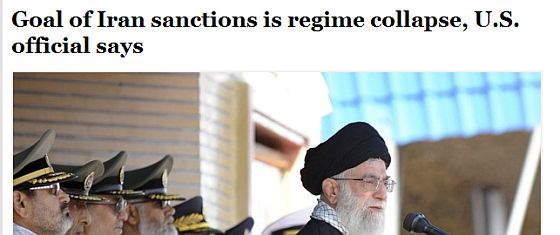
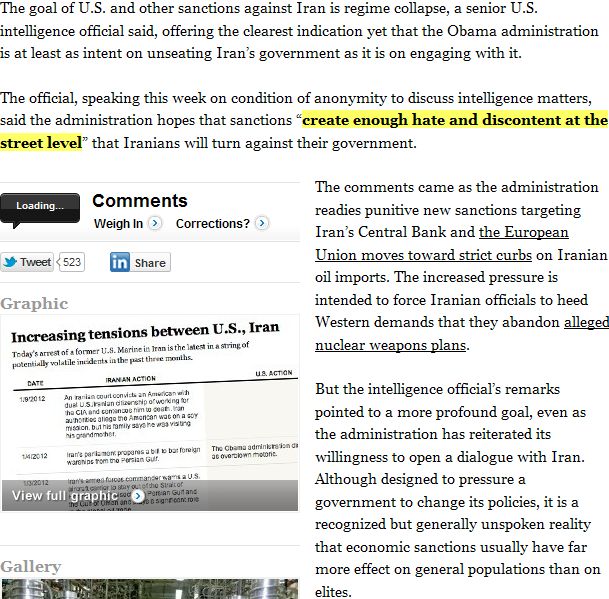
Obama administration’s mixed message on regime change in Iran
How does a senior U.S. intelligence official tell a Washington Post reporter that the administration’s goal in imposing sanctions on Iran is to bring about regime change, if that is not in fact the goal?

Washington Post -- By Karen DeYoung and Scott Wilson, Tuesday, January 10, 4:22 PM
The article (cached version) with this headline (which was later substantially re-written) begins:

The revised version of the article, under a revised headline, “Public ire one goal of Iran sanctions, U.S. official says”, begins:
The Obama administration sees economic sanctions against Iran as building public discontent that will help compel the government to abandon an alleged nuclear weapons program, according to a senior U.S. intelligence official.
In addition to influencing Iranian leaders directly, the official said, “another option here is that [sanctions] will create hate and discontent at the street level so that the Iranian leaders realize that they need to change their ways.”
The intelligence official’s remarks pointed to what has long been an unstated reality of sanctions: Although designed to pressure a government to change its policies, they often impose broad hardships on a population.
So who would this senior intelligence official be? CIA director David Petraeus? And was he misquoted? Or was he being too candid? Or is the Washington Post colluding with the administration in sending out a mixed message?
Attention to the unseen
Regular readers of War in Context might be perplexed about some of the items that have been popping up here lately — particularly those that appear under my generic and cryptic byline: Attention to the Unseen.
Here’s another one — but this isn’t just another seemingly “off-topic” post. It also illustrates one of the reasons I am picking out such items.
In Intelligent Life, Ian Leslie writes: One day in 1945, a man named Percy Spencer was touring one of the laboratories he managed at Raytheon in Waltham, Massachusetts, a supplier of radar technology to the Allied forces. He was standing by a magnetron, a vacuum tube which generates microwaves, to boost the sensitivity of radar, when he felt a strange sensation. Checking his pocket, he found his candy bar had melted. Surprised and intrigued, he sent for a bag of popcorn, and held it up to the magnetron. The popcorn popped. Within a year, Raytheon made a patent application for a microwave oven.
The history of scientific discovery is peppered with breakthroughs that came about by accident. The most momentous was Alexander Fleming’s discovery of penicillin in 1928, prompted when he noticed how a mould that floated into his Petri dish killed off the surrounding bacteria. Spencer and Fleming didn’t just get lucky. Spencer had the nous and the knowledge to turn his observation into innovation; only an expert on bacteria would have been ready to see the significance of Fleming’s stray spore. As Louis Pasteur wrote, “In the field of observation, chance favours only the prepared mind.”
The word that best describes this subtle blend of chance and agency is “serendipity”. It was coined by Horace Walpole, man of letters and aristocratic dilettante. Writing to a friend in 1754, Walpole explained an unexpected discovery he had just made by reference to a Persian fairy tale, “The Three Princes of Serendip”. The princes, he told his correspondent, were “always making discoveries, by accidents and sagacity, of things which they were not in quest of…now do you understand Serendipity?” These days, we tend to associate serendipity with luck, and we neglect the sagacity. But some conditions are more conducive to accidental discovery than others.
Today’s world wide web has developed to organise, and make sense of, the exponential increase in information made available to everyone by the digital revolution, and it is amazingly good at doing so. If you are searching for something, you can find it online, and quickly. But a side-effect of this awesome efficiency may be a shrinking, rather than an expansion, of our horizons, because we are less likely to come across things we are not in quest of.
To some extent, War in Context reflects this web-wide narrowing of attention in its focus on Middle East politics. But now, in my own attempt to buck this wider trend and also reflect the fact that my own interests are not limited to the enduring political reverberations of 9/11, I am using “attention to the unseen” as an amorphous theme where I will call attention to gleanings from the web covering topics as diverse as endangered cultures and neuroscience, or the social organization of bees and avant-garde accordion music.
Pathways to and from radicalisation
On the 10th anniversary of the first detainees to Guantánamo, Amnesty International charges detention facility is ‘leaving toxic legacy’
The failure of the U.S. government to close the detention facility at Guantánamo Bay is leaving a toxic legacy for human rights, Amnesty International said on the 10th anniversary of the first detainees being transferred to this notorious U.S. prison.
In a report published ahead of the anniversary, Guantánamo: A Decade of Damage to Human Rights, Amnesty International highlights the unlawful treatment of Guantánamo detainees and outlines the reasons why the detention center continues to represent an attack on human rights.
“Guantánamo has infected everything it has touched,” said Tom Parker, Amnesty International USA policy director for (counter) terrorism and human rights. “We mark this dismal anniversary knowing with a heavy heart that despite President Obama’s election promise to close the facility it will begin its tenth year of operation more deeply entrenched in U.S. life than ever.”
Despite the president’s pledge to close the Guantánamo detention facility by January 22, 2010, 171 men were being held there in mid-December 2011. At least 12 of those transferred to Guantánamo on January 11, 2002 were still held there. One of them is serving a life sentence after being convicted by a military commission in 2008. None of the other 11 has been charged.
The Obama administration – indeed large parts of all three branches of the federal government – has adopted the global “war” framework devised under the former George W. Bush administration. The administration asserted in January 2010 that four dozen of the Guantánamo detainees could neither be prosecuted nor released, but should remain in indefinite military detention without charge or criminal trial under the United States unilateral interpretation of the law of war.
“Until the United States addresses these detentions as a human rights issue, the legacy of Guantánamo will live on whether or not the detention facility there is closed down,” said Rob Freer, Amnesty International United States researcher.
The Guantánamo detention facility, which is located on the U.S. naval base in Cuba, became a symbol of torture and other ill-treatment after it was opened four months after the 9/11 attacks.
Among the detainees still held there today include individuals who were subjected by the United States to torture and enforced disappearance prior to being transferred to Guantánamo. There has been little or no accountability for these crimes under international law committed in a program of secret detention operated under presidential authority. The U.S. government has systematically blocked attempts by former detainees to seek redress for such violations.
In 10 years, only one of the 779 detainees held at the base has been transferred to the United States for prosecution in an ordinary federal court. Others have faced unfair trials by military commission. The administration is currently intending to seek the death penalty against six of the detainees at such trials.
The Obama administration has blamed its failure to close the Guantánamo detention facility on Congress, which has indeed failed to ensure U.S. government compliance with international human rights principles in this context.
To mark this historic anniversary, Amnesty International members and other activists will host events around the world, calling for the end of the detention facility. In Washington, DC, a broad coalition of activists will hold a rally at the White House and a demonstration representing detainees still held at the detention center; in Canada, activists will create a temporary art installation near the U.S. Consulate in Toronto and host a ten-hour musical event in Montreal; “happy birthday” cards will be delivered the U.S. embassy in the Netherlands and a giant detainee visual will be delivered to the U.S. embassy in Spain; activists will create a flashmob in France; and in Stockholm, Sweden, activists will enter a prison cell to sign a petition to President Obama as images are projected onto a nearby billboard.
Amnesty International is a Nobel Peace Prize-winning grassroots activist organization with more than 3 million supporters, activists and volunteers in more than 150 countries campaigning for human rights worldwide. The organization investigates and exposes abuses, educates and mobilizes the public, and works to protect people wherever justice, freedom, truth and dignity are denied.

The paralyzing effect of choice
Professor Renata Salecl explores the paralyzing anxiety and dissatisfaction surrounding limitless choice. Her unedited, unanimated talk can be viewed here.
Schools in the Texas police state
Chris McGreal reports: The charge on the police docket was “disrupting class”. But that’s not how 12-year-old Sarah Bustamantes saw her arrest for spraying two bursts of perfume on her neck in class because other children were bullying her with taunts of “you smell”.
“I’m weird. Other kids don’t like me,” said Sarah, who has been diagnosed with attention-deficit and bipolar disorders and who is conscious of being overweight. “They were saying a lot of rude things to me. Just picking on me. So I sprayed myself with perfume. Then they said: ‘Put that away, that’s the most terrible smell I’ve ever smelled.’ Then the teacher called the police.”
The policeman didn’t have far to come. He patrols the corridors of Sarah’s school, Fulmore Middle in Austin, Texas. Like hundreds of schools in the state, and across large parts of the rest of the US, Fulmore Middle has its own police force with officers in uniform who carry guns to keep order in the canteens, playgrounds and lessons. Sarah was taken from class, charged with a criminal misdemeanour and ordered to appear in court.
Each day, hundreds of schoolchildren appear before courts in Texas charged with offences such as swearing, misbehaving on the school bus or getting in to a punch-up in the playground. Children have been arrested for possessing cigarettes, wearing “inappropriate” clothes and being late for school.
In 2010, the police gave close to 300,000 “Class C misdemeanour” tickets to children as young as six in Texas for offences in and out of school, which result in fines, community service and even prison time. What was once handled with a telling-off by the teacher or a call to parents can now result in arrest and a record that may cost a young person a place in college or a job years later.
Assad’s combative speech: A method to the tyranny?
Time reports: It was a fiercely combative and confident Syrian President Bashar al-Assad who took to the podium of Damascus University on Tuesday to deliver his fourth speech since unrest erupted in his troubled land last March. His manner and his words made one thing clear: he’s not going anywhere.
In many ways, he has reason to exude confidence. The rickety Arab League monitoring mission, now in its third week of a month-long mission, has been widely criticized for perceived ineptitude and for providing the regime with a veneer of cooperation while Damascus continues to kill its way out of a crisis that has already claimed well over 5,000 lives. The Syrian opposition remains bitterly divided, and has struggled to present itself as a viable alternative to the current regime. Assad’s formidable military and security apparatus remains largely intact, despite low-level defections. Internationally, Russia and China continue to shield the regime from meaningful international censure.
The truth is, Assad’s almost two-hour long speech — full of conspiratorial claims of foreign intervention, a vast media plot against the country, a useless Arab League implementing a Western-Zionist agenda, and destruction caused by terrorists who want to unravel the country’s ethnic-religious harmony — will resonate with a significant portion of frightened, concerned Syrians.
The Syrian opposition, in all of its varied forms, has yet to win over those Syrians — and they were the primary target of Assad’s speech today. The region is rife with examples of what may befall Syria if Assad should fall: Tunisia, Egypt and Libya, newly freed of their own dictators, have demonstrated an ascendant Islamism (although it varies in intensity from country to country) that has worried minorities, particularly Christians. Syria has a sizable Christian minority, as Iraq once did. More than a million Iraqi refugees of various religious backgrounds, fled to Syria in the years following Saddam Hussein’s ouster. The sectarian wars in Iraq and Lebanon are a recent memory to Syrians who remember the floods of refugees and the instability lapping at their borders. Assad appealed not only to Syrians who fear the sectarian pandemonium some of their neighbors have recently experienced (Iraq, Lebanon), and the Islamist tilt shifting political orientations throughout the region, but also those who want a strong leader, whatever his faults, rather than a political vacuum and an untested opposition. “Who is the opposition?” Assad said at one point in his speech. “Anyone now can call themselves ‘opposition’ When I meet them I ask, who do you represent?” It’s a question Assad knows many Syrians are asking — and that is the constituency that he wants to keep on his side.
Israel prepares for fall of Assad, Syria refugees
Reuters reports: Israel is making preparations for the fall of Syrian President Bashar al-Assad and a flood of refugees from his minority Alawite sect into the Golan Heights, Israel’s military chief told a parliamentary committee on Tuesday.
“Assad cannot continue to hold onto power,” a committee spokesman quoted Lieutenant-General Benny Gantz as saying.
“On the day that the regime falls, it is expected to result in a blow to the Alawite sect. We are preparing to take in Alawite refugees on the Golan Heights.”
Israel should also prepare for the possibility that cornered authorities in Damascus could “as a lifesaver … act against us”, the general said.
Assad has faced 10 months of popular revolt in which more than 5,000 people have been killed, according to U.N. figures.
Israeli officials have said they do not expect his government to last more than a few months but Gantz’s remarks were the first indication that Israel is already making contingency plans for the end of the rule.
Israel breaking settlement records, says Peace Now
Reuters reports: Israel’s government broke all its settlement-building records in 2011, diminishing prospects for establishing a viable Palestinian state in the occupied West Bank, Israel’s anti-settlement activist group “Peace Now” said Tuesday.
The group’s annual report on building in Arab East Jerusalem and the West Bank – land the Palestinians want for a future state along with the Gaza Strip – showed that despite international calls to halt construction, thousands of new homes were being built.
“In 2011 (Israeli Prime Minister Benjamin) Netanyahu broke his government’s building records and turned it into a very fruitful year for the settlers and a very sad one for the citizens of Israel,” Peace Now director Yariv Oppenheimer said.
“At the current rate of building we will lose the chance for a two-state solution.
Israel prepares for nuclear-armed Iran
The Times reports: Israel has begun thinking the unthinkable: that it will have to deal with a nuclear-armed Iran within a year.
In documents seen by The Times, Israeli officials have begun preparing scenarios for the day after a nuclear weapons test.
The move is a tacit recognition that Israel is backing away from its long-held position that it would do everything in its power – including mounting a military strike – to stop Iran acquiring nuclear capabilities.
Details of the war game, which was enacted by former ambassadors, intelligence officials and ex-military chiefs, emerged as the United Nations’ nuclear watchdog confirmed yesterday that Iran has begun producing enriched uranium in an underground bunker designed to withstand airstrikes.
The International Atomic Energy Agency said that it was monitoring the work at the Fordow facility, which is concealed in a mountain near the holy city of Qom.
The simulation exercise was conducted in Tel Aviv last week by the Institute for National Security Studies (INSS), a think-tank. Its conclusions suggest that a nuclear test would radically shift the whole power balance of the Middle East.
Too many victims of the war on terror remain imprisoned across the world
Mary Fitzgerald writes: It didn’t take long before one of the incentives offered to coax the Taliban to the negotiating table came to light: last week the Guardian carried reports of American plans to release several high-ranking Taliban leaders from Guantánamo Bay. They include Mullah Khair Khowa, a former interior minister, Noorullah Noori, a former governor in northern Afghanistan and maybe, just maybe, the former army commander Mullah Fazl Akhund – if a third country, perhaps Qatar, will accept custody of him.
It’s an inevitable step in the right direction, reminiscent of the tentative early moves in the Northern Ireland peace process. It also offers a convenient, if partial, solution to the status of the 171 legal headaches still languishing in America’s brutal Caribbean prison.
But it forces into light other shaming questions about the conduct of the so-called war on terror; and in particular about those thousands of men, women and children, many innocent of any crime even by the US authorities’ own admission, who were “rendered” and remain trapped in prisons across the world.
Hamidullah Khan was just 13 when he disappeared from South Waziristan, in Pakistan. I met his father, Wakeel Khan, on a recent trip to Islamabad. He told me with pride that Hamidullah was a “very good-looking boy” and showed me pictures. He said his son could be quite absent-minded, but worked very hard at school: his dream was to become a doctor.
During the summer holidays in 2008, Wakeel sent Hamidullah to the family home in South Waziristan to collect some of their possessions, as Wakeel could not get the time off work to go himself. Hamidullah never returned.
Wakeel, an ex-solider, tried to retrace his son’s steps. He caught the bus up to the province, and asked everyone about his son: his relatives, his old army contacts, the local Taliban. No one knew anything. He thought of going to the police, but given that they charge a 300 rupee bribe to replace an ID card, he asked himself, “how much would they charge to find a person?”
After a year, the Red Cross finally tracked down Hamidullah and passed a letter to his family saying he was being held in Bagram prison in Afghanistan. Despite American assurances that the prisoners there are treated well, fresh allegations of abuse surfaced this weekend.
No explanation has ever been offered for why a boy so young was picked up and taken hundreds of miles away, why he has never been charged, and why he has still not been released.
Syria’s Bashar Assad says he won’t step aside
Atlantic Wire: Syrian President Bashar al-Assad delivered a defiant televised address on Tuesday saying that he will not step down and will not institute new democratic reforms, insisting that unrest in his country is the work of a foreign conspiracy. According to Al-Jazeera’s translations, Assad said that there are no real revolutionaries in his country, just terrorists carrying out a plan that was devised “tens of years ago” to divide Arab countries. Assad also claimed that he still had the support of Syrians and he will only leave office when it is “by the will of the people.”
During the rare 90 minute address, his first speech to the nation in more than six months, Assad also criticized other Arab League governments, which suspended Syria from the League and sent a team of monitors to attempt to oversee a peace plan. Assad says that Arab monarchies telling Syria how to institute democracy is “like a doctor who smokes and recommends to his patient to give up smoking while he, the doctor, has a cigarette in his mouth.”
Assad continued to insist that demonstrations taking place in Syria are merely the work of “terrorists” and “thieves” and that he will continue to hit them with “an iron fist.” However, he claims that “there are no orders for anyone to open fire on any citizen,” despite reports by the U.N. and opposition leaders that well over 5,000 Syrians have been killed by the military since the unrest began last March.