Category Archives: Issues

The end of Oslo

Judith Butler writes:

Among the many astonishing claims that Barack Obama made in his recent speech opposing the Palestinian bid for statehood was that ‘peace will not come through statements and resolutions.’ This is, at best, an odd thing to say for a president whose ascendancy to power itself depended on the compelling use of rhetoric. Indeed, his argument against the power of statements and resolutions at the United Nations to achieve peace was a rhetorical ploy that sought to minimise the power of rhetorical ploys. More important, it was an effort to make sure that the United States government remains the custodian and broker of any peace negotiation, so his speech was effectively a way of trying to reassert that position of custodial power in response to the greatest challenge it has received in decades. And most important, his speech was an effort to counter and drain the rhetorical force of the very public statements that are seeking to expose the sham of the peace negotiations, to break with the Oslo framework, and to internationalise the political process to facilitate Palestinian statehood.

There are reasons to question whether the Palestinian bid for statehood at this time and on these terms is the right thing to do, but they are not the ones that Netanyahu put forward in his blustery and arrogant remarks. Within the Palestinian debates, many have questioned whether the present bid for statehood effectively abandons the right of return for diasporic Palestinians, leaves unaddressed the structural discrimination against Palestinians within the current borders of Israel, potentially abandons Gaza, delegitimises the Palestinian Liberation Organisation by elevating the Palestinian Authority into a state structure, takes off the table the one-state solution, and mistakenly relies on the UN as an arbiter rather than insisting that Palestinian self-determination form the basis of any future state. Critics like Ali Abunimah, the editor of the Electronic Intifada, argue that the UN has proven itself time and again to be a venue for paralysis, given the veto rules that govern the Security Council and secure the hegemony of major powers, making it likely that the present bid for statehood will be defeated by a US veto.

And yet, one effect that is already felt as a consequence of these ‘resolutions and statements’ is that the 1993 Oslo Accords can no longer be presumed to be the framework for future negotiations – indeed, we may see that framework crumble definitively in the coming days. Oslo not only gave the US a privileged position as broker of all ‘peace’ negotiations, but effectively sponsored the massive growth of Israeli settlements on Palestinian land by refusing to recognise their illegal status according to international law. In fact, the Oslo years have seen the number of settlers grow from 241,500 in 1992 to 490,000 in 2010 (including East Jerusalem), and the indefinite deferral of all ‘permanent status issues’ – effectively establishing the occupation as a regime without foreseeable end. The Oslo Accords also implemented the principle that any change of status of Occupied Palestine would depend on the ‘consent’ of Israel. Thus, the power of Israel to decide the future of Palestine pre-empted the international right of Palestinians to self-determination.


Facebooktwittermail

Libya: the losers

Max Rodenbeck writes:

Compared to the office of his intelligence counterpart in Cairo, a luxury suite featuring plasma screens, crystal vases, and a jacuzzi, Tuhami Khaled’s was modest. For protection from aerial bombing, the head of Colonel Qaddafi’s internal security service did his business on the ground floor of its headquarters, an ungainly, antenna-studded tower on busy Sikka Street in central Tripoli. But like the chief of Egypt’s Mukhabarat, Khaled enjoyed a separate entrance and an attached bedroom where he was reputed to cavort with women seeking favors from the regime.

The bedroom’s occupants one day recently were two elderly men shuffling about in slippers and house robes, taking their meals seated on the tiled floor. Hadi Mbairish and Muhammad Abdu were being kept in custody here by revolutionary Libya’s new rulers. The captives were both generals, comrades of Qaddafi since before the 1969 coup that brought him to power. As members of a six-man operations control room for state security, they ranked among the top commanders of the fallen regime, responsible for seeing the Brother Leader’s orders executed on the ground.

Frail and ashen in complexion, General Mbairish chaired the group. During Libya’s revolution he is known to have issued handwritten instructions to “burn the vermin,” meaning the rebels. General Abdu, his ebony face chinless and spectrally gaunt like an African mask, headed Qaddafi’s military police. This was the force formally in charge of Tripoli’s Abu Salim prison, notorious for the 1996 massacre by machine gun of some 1,200 inmates, and more recently a holding pen for thousands of Tripoli’s ordinary citizens suspected of rebel sympathies. The massacre was covered up for years; members of the victims’ families traveled monthly to the prison from the far corners of the country in order to deposit gifts they assumed would reach the men inside. The arrest of the Benghazi lawyer who bravely championed these families proved the immediate spark for the revolution.

The generals insist that their captors have treated them kindly, and think they will be vindicated in court. “They will understand that we only followed orders,” says Mbairish hopefully. “This is just a summer cloud.” His colleague mumbles that whenever any prisoner in his charge was sick, it was he who made sure they went to the hospital. The generals give no sign of contrition or even awareness of the magnitude of the crimes for which they certainly bear some responsibility. They tried to resign, they say, but were refused. They could have slipped away abroad, as some others did to escape capture. But why should they, as Libyan patriots?

The generals complain that for the final months of fighting they never saw their families, since the operations room moved from one site to another to escape NATO bombs, ending on the twenty-sixth floor of Tripoli’s plush new Marriott Hotel.

As for Qaddafi himself, the generals say they rarely met with him in recent years. Their instructions were delivered by phone. Seif al-Islam, the second of Qaddafi’s seven sons and the most media-hungry, did make an appearance at the Marriott HQ in the last weeks before Tripoli’s fall on August 21. Overriding the generals’ warnings, he assured them that Libya’s masses would defend the Brother Leader to the end.

General Mbairish turns stone-faced when asked what Qaddafi’s intentions are today. “My opinion is that Qaddafi will never stop. He will accept that thousands die. He will fire rockets on cities if he gets any chance.” The general pauses and toys with his Rolex watch before adding softly, “He’s gotten used to killing.”

The contrast between the sallow, whispering prisoners and their ebullient captors could scarcely be more striking. Behind the desk in Tuhami Khaled’s former office, with a trim black beard and a pistol holstered over desert combat fatigues, sits thirty-six-year-old Khaled Garabulli. The fellow revolutionaries who saunter nonchalantly in and out, sporting motley bandanas, shades, and firearms, treat him with jovial deference. When the call to prayer sounds it is Garabulli who leads the fighters who choose to pray. No one seems to mind that some of them don’t.

Garabulli is one of Libya’s new heroes. He joined the revolution soon after it began on February 17, returning from Morocco, where he had moved to get away from Qaddafi, back to his family seat in a fishing village east of Tripoli. From there he and his brothers smuggled thousands of guns and rocket-propelled grenades to rebels in the capital, sending divers to locate where they had been dropped offshore by NATO planes, then lifting the crates by pumping air into flotation parachutes.

Just two weeks before Tripoli’s fall, only minutes after loading and dispatching a truck with a final consignment of two thousand FAL rifles, Garabulli himself was arrested by Qaddafi’s police. The three satellite phones and thirty SIM cards he was carrying made it clear what he was up to, and the purple crisscross of welts that still marks his back leaves no doubt what Qaddafi’s men thought of it. Garabulli was freed from Abu Salim prison on August 21 to find that his was one of a thousand names on a list of prisoners scheduled to be executed on the first of September, the anniversary of Qaddafi’s coup.

Facebooktwittermail

The Palestinians already knew about Obama’s hypocrisy

Robert Fisk writes:

So there I was, on the Via Dolorosa of course, chatting to a middle-aged guy in a red T-shirt and just a wisp of a beard with a prayer rug under his left arm.

And I asked him, of course, what he thought about Barack Obama’s speech. He grinned at me like he knew I had already guessed what he was going to say. “What did you expect?” he asked. Correct guess. After all, Haaretz had already referred this week to “President Barack Netanyahu” while the racist Israeli foreign minister said he would sign the speech with both hands. Maybe, I reflected in Jerusalem yesterday, Obama really is seeking election – to the Israeli Knesset.

But what was so striking about the streets of Jerusalem yesterday was the sense of resignation, of weary acceptance. The Israeli papers had warned of mass violence, but the crowds who turned up for morning prayers at Al-Aqsa simply laid out their prayer rugs on the highway outside the Damascus Gate or in the laneways behind the mosque and showed scarcely any interest in talking about Obama. Maybe America’s UN veto will rouse them to passion, but I have my doubts.

It’s a bit like the aftermath of the Abu Ghraib torture pictures, when the Americans restricted the number of photos to be released because they feared the pictures would enrage Iraqis. But I was in Baghdad that day and no one expressed any particular rage. What did I expect? After all, the Iraqis knew all about Abu Ghraib already – they were the ones who had been tortured there. So, too, Jerusalem yesterday. The Palestinians have watched America’s uncritical acceptance of Israeli occupation – the longest in the world – for 44 years. They knew all about it. It is only we Westerners who are horrified by torture pictures and by Obama’s hypocrisy.

Facebooktwittermail

Tony Blair faces calls for greater transparency over Middle East role

The Guardian reports:

Tony Blair is facing calls for greater transparency in his role as Middle East peace envoy after it emerged that he visited Muammar Gaddafi in 2009 while JP Morgan, the investment bank that employs Blair as a £2m-a-year adviser, sought to negotiate a multibillion-pound loan from Libya.

Blair also championed two large business deals in the West Bank and Gaza involving telecoms and gas extraction which stood to benefit corporate clients of JP Morgan, according to a Dispatches investigation to be broadcast on Monday night [on Channel 4 in the UK].

Blair, who represents the diplomatic Quartet on the Middle East – the US, European Union, Russia and the United Nations – flew to see the former Libyan leader in January 2009 as JP Morgan tried to finalise a deal for the Libyan Investment Authority (LIA) to loan a multibillion-pound sum to Rusal, the aluminium company run by Russian billionaire Oleg Deripaska.

LIA was set up by Gaddafi to manage the country’s wealth and was estimated to be worth $64bn (£41bn) last September.

Emails obtained by anti-corruption campaign group Global Witness and seen by the Guardian reveal JP Morgan’s vice chairman, Lord Renwick, invited the then vice chairman of LIA, Mustafa Zarti, to “finalise the terms of the mandate concerning Rusal before Mr Blair’s visit to Tripoli which is scheduled to take place on around 22 January”.

Facebooktwittermail

Saudi women without right to drive get right to vote in undemocratic elections

The New York Times reports:

King Abdullah of Saudi Arabia on Sunday granted women the right to vote and run in future municipal elections, the biggest change in a decade for women in a puritanical kingdom that practices strict separation of the sexes, including banning women from driving.

Saudi women, who are legally subject to male chaperones for almost any public activity, hailed the royal decree as an important, if limited, step toward making them equal to their male counterparts. They said the uprisings sweeping the Arab world for the past nine months — along with sustained domestic pressure for women’s rights and a more representative form of government — prompted the change.

“There is the element of the Arab Spring, there is the element of the strength of Saudi social media, and there is the element of Saudi women themselves, who are not silent,” said Hatoon al-Fassi, a history professor and one of the women who organized a campaign demanding the right to vote this spring. “Plus, the fact that the issue of women has turned Saudi Arabia into an international joke is another thing that brought the decision now.”

Although political activists celebrated the change, they also cautioned how deep it would go and how fast, given that the king referred to the next election cycle, which would not be until 2015. Some women wondered aloud how they would be able to campaign for office when they were not even allowed to drive. And there is a long history of royal decrees stalling, as weak enactment collides with the bulwark of traditions ordained by the Wahhabi sect of Islam and its fierce resistance to change.

In his announcement, the king said that women would also be appointed to the Majlis Al-Shura, a consultative council that advises the monarchy on matters of public policy. But it is a toothless body that avoids matters of royal prerogative, like where the nation’s oil revenue goes.

Facebooktwittermail

Gunman kills American at Kabul CIA office

The Wall Street Journal reports:

An Afghan gunman late Sunday killed one American citizen and wounded another at what is reported to be the Central Intelligence Agency’s offices in Kabul.

The two American citizens came under fire by a “lone Afghan employee” in an “annex of the U.S. Embassy” in Kabul, said Embassy spokesman Gavin Sundwall. Mr. Sundwall wouldn’t comment on whether the shootout involved CIA employees or occurred at the CIA’s Kabul offices.

A western security official in Kabul said the Afghan attacker “had the trust” of the CIA employees in the compound, and was possibly an informant, which is why he was allowed into the annex and had access to a gun. It wasn’t clear if he was searched before entering the building.

The western security official said the gunman late Sunday may have gotten on the roof of the CIA building, where he fired on the nearby U.S. Embassy.

Sunday night’s attack comes less than two weeks after Afghan insurgents occupied a building under construction and fired rocket-propelled grenades at the U.S. Embassy. About a half-dozen rockets penetrated the Embassy’s fortified walls and several more hit within the U.S.-led military coalition’s headquarters in Kabul. The attack lasted for about 20 hours.

Facebooktwittermail

Israel has rendered its closest ally impotent

Larry Derfner writes:

“Tafasta meruba, lo tafasta,” is a Hebrew saying that means, “If you get too greedy, you end up with nothing,” and it fits well to the arm-twisting job Israel just did on Obama at the UN. By leaning on him too single-handedly to block the Palestinian statehood bid, to pressure countries like Gabon and Bosnia-Herzegovina to go along, and to give a speech that Avigdor Lieberman said he would “sign with both hands,” Israel bent Obama too far, until he just broke. In the eyes of Palestinians, Muslims of the Middle East and probably everybody else in the world, the U.S. president has now assumed the identity of the ultimate Israel lobbyist, of Mr.Hasbara. “He’s not the president of the United States, he’s the president of Israel,” a man in Ramallah said to me the day after the speech, and that’s what Palestinians think today: They flat-out hate Obama. They may hate him more than any other U.S. president in history, including George W. Bush. They thought Obama was on their side, and in the moment of truth he sold them out to the LIkud, to the settlers, to the Republican wackos. Palestinians, and presumably all Muslims, feel toward Obama today how the settlers felt toward Ariel Sharon after he decided to withdraw from Gaza: betrayed.

With Obama’s America now having zero credibility in the Middle East, where does this leave Israel? Alone and vulnerable to an extent that’s unfamiliar to Israelis. Until now, the U.S. held sway with the Palestinians; it doesn’t anymore. It held sway with Egypt, Jordan and Turkey; I wonder how much it has left now. In highly dramatic fashion, the U.S. stood up for the occupation and against Palestinian independence, and the result of this disgrace is that outside of Israel and America, the occupation is more unpopular and Palestinian independence more popular than ever. It’s the Palestinians who have the wind at their back now, and Israel that’s pissing in the wind. And America can’t help us anymore because America has become a spent force around here.

Facebooktwittermail

This economic collapse is a ‘crisis of bigness’

Paul Kingsnorth writes:

Living through a collapse is a curious experience. Perhaps the most curious part is that nobody wants to admit it’s a collapse. The results of half a century of debt-fuelled “growth” are becoming impossible to convincingly deny, but even as economies and certainties crumble, our appointed leaders bravely hold the line. No one wants to be the first to say the dam is cracked beyond repair.

To listen to a political leader at this moment in history is like sitting through a sermon by a priest who has lost his faith but is desperately trying not to admit it, even to himself. Watch Nick Clegg, David Cameron or Ed Miliband mouthing tough-guy platitudes to the party faithful. Listen to Angela Merkel, Nicolas Sarkozy or George Papandreou pretending that all will be well in the eurozone. Study the expressions on the faces of Barack Obama or Ben Bernanke talking about “growth” as if it were a heathen god to be appeased by tipping another cauldron’s worth of fictional money into the mouth of a volcano.

In times like these, people look elsewhere for answers. A time of crisis is also a time of opening-up, when thinking that was consigned to the fringes moves to centre stage. When things fall apart, the appetite for new ways of seeing is palpable, and there are always plenty of people willing to feed it by coming forward with their pet big ideas.

But here’s a thought: what if big ideas are part of the problem? What if, in fact, the problem is bigness itself?

The crisis currently playing out on the world stage is a crisis of growth. Not, as we are regularly told, a crisis caused by too little growth, but by too much of it. Banks grew so big that their collapse would have brought down the entire global economy. To prevent this, they were bailed out with huge tranches of public money, which in turn is precipitating social crises on the streets of western nations. The European Union has grown so big, and so unaccountable, that it threatens to collapse in on itself. Corporations have grown so big that they are overwhelming democracies and building a global plutocracy to serve their own interests. The human economy as a whole has grown so big that it has been able to change the atmospheric composition of the planet and precipitate a mass extinction event.

One man who would not have been surprised by this crisis of bigness, had he lived to see it, was Leopold Kohr. Kohr has a good claim to be the most important political thinker that you have never heard of. Unlike Marx, he did not found a global movement or inspire revolutions. Unlike Hayek, he did not rewrite the economic rules of the modern world. Kohr was a modest, self-deprecating man, but this was not the reason his ideas have been ignored by movers and shakers in the half century since they were produced. They have been ignored because they do not flatter the egos of the power-hungry, be they revolutionaries or plutocrats. In fact, Kohr’s message is a direct challenge to them. “Wherever something is wrong,” he insisted, “something is too big.”

Facebooktwittermail

Haqqani network will outlast the U.S. in Afghanistan

The New York Times reports:

They are the Sopranos of the Afghanistan war, a ruthless crime family that built an empire out of kidnapping, extortion, smuggling, even trucking. They have trafficked in precious gems, stolen lumber and demanded protection money from businesses building roads and schools with American reconstruction funds.

They safeguard their mountainous turf by planting deadly roadside bombs and shelling remote American military bases. And they are accused by American officials of being guns for hire: a proxy force used by the Pakistani intelligence service to carry out grisly, high-profile attacks in Kabul and throughout the country.

Today, American intelligence and military officials call the crime clan known as the Haqqani network — led by a wizened militant named Jalaluddin Haqqani who has allied himself over the years with the C.I.A., Saudi Arabia’s spy service and Osama bin Laden — the most deadly insurgent group in Afghanistan. In the latest of a series of ever bolder strikes, the group staged a daylong assault on the United States Embassy in Kabul, an attack Adm. Mike Mullen, chairman of the Joint Chiefs of Staff, charged Thursday was aided by Pakistan’s military spy agency, the Directorate for Inter-Services Intelligence, or ISI. According to two American officials, cellphones used by the attackers made calls to suspected ISI operatives before the attack, although top Pakistani officials deny their government played any role.

But even as the Americans pledge revenge against the Haqqanis, and even amid a new debate in the Obama administration about how to blunt the group’s power, there is a growing belief that it could be too late. To many frustrated officials, they represent a missed opportunity with haunting consequences. Responsible for hundreds of American deaths, the Haqqanis probably will outlast the United States troops in Afghanistan and command large swaths of territory there once the shooting stops.

American military officers, who have spent years urging Washington to take action against the Haqqanis, express anger that the Obama administration has still not put the group on the State Department’s list of terrorist organizations out of concern that such a move would scuttle any chances that the group might make peace with Afghanistan’s government.

“Whoever is in power in Kabul will have to make a deal with the Haqqanis,” said Marc Sageman, a former C.I.A. officer who served in Pakistan during the Soviet-Afghan war. “It won’t be us. We’re going to leave, and those guys know it.”

The Los Angeles Times reports:

Pakistani officials warned Friday that they could jettison the United States as an ally if American officials continued to accuse Islamabad’s intelligence agency of assisting a leading Afghan Taliban group in recent attacks in Afghanistan.

Foreign Minister Hina Rabbani Khar cautioned the U.S. against airing allegations such as the blunt charge of collusion between Pakistan’s Inter-Services Intelligence agency, known as ISI, and the militant Haqqani network made Thursday by Adm. Michael G. Mullen, chairman of the Joint Chiefs of Staff, before the Senate Armed Services Committee.

“You cannot afford to alienate Pakistan; you cannot afford to alienate the Pakistani people,” Khar said in New York, speaking to a Pakistani television channel. She was in the U.S. for the U.N. General Assembly session.

Pakistani army chief Gen. Ashfaq Kayani in a statement called Mullen’s remarks “very unfortunate and not based on facts.”

Pakistani officials continued to tersely reject the allegations and challenged the U.S. to furnish evidence of ties between the country’s intelligence community and the Haqqani group.

Mullen called the Haqqani network “a veritable arm” of the ISI and said the intelligence agency helped Haqqani militants during attacks Sept. 13 on the U.S. Embassy in Kabul as well as a truck bomb blast in Wardak province three days earlier that injured 77 American troops.

Facebooktwittermail

French Jewish fighters move in to defend Israeli settlements in West Bank

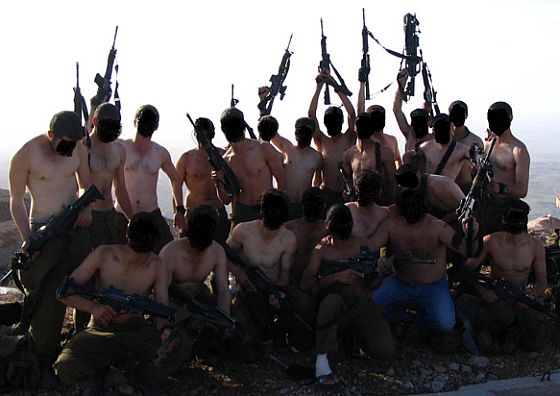
Armed French citizens in a West Bank settlement -- Photo: Jewish Defense League

While Israeli authorities are making it increasingly difficult for non-violent international activists to visit the West Bank, suspected Jewish terrorists — members of the Jewish Defense League (JDL) — coming from France in recent days apparently had no difficulty reaching the illegal settlements which they claim they want to defend.

The FBI has described the JDL as a “right-wing terrorist group“. One of its most infamous charter members was Baruch Goldstein who attack unarmed Palestinian Muslim worshipers at a mosque in Hebron in 1994, killing 29 and wounding 125 others. On its website, the JDL says “We do not consider his assault to qualify under the label of terrorism,” in reference to Goldstein’s Hebron attack — they also describe him as “a brilliant surgeon, a mild-mannered Yeshiva-educated man.”

Al Jazeera reports on an operation organized by the French chapter of the JDL.

Two weeks ago, an announcement appeared on a French website, calling for “militants with military experience” to participate in a solidarity trip to Israel between September 19 and 25. “The aim of this expedition is to lend a hand to our brothers facing aggression from the Palestinian occupiers, and to enhance the security of Jewish towns in Judea and Samaria,” it explained. The dates of the trip coincide with the Palestinian statehood bid at the United Nations.

As of yesterday, in response to this call, there were 55 French citizens, both men and women, with military experience, stationed inside the illegal Israeli settlements up and down the West Bank. Organised into five separate groups of 11, their mandate is to “defend the settlements against any attack from Palestinians”, and to “aid” in areas where they feel there is a lack of Israeli army personnel or police forces.

The website belongs to the French chapter of the Jewish Defence League (JDL), a far-right Jewish group founded by Rabbi Meir Kahane in the United States in 1968. The Federal Bureau of Investigation has refered to the JDL as a “violent extremist organisation”.

“In France, it is a movement made up of French citizens who defend the Jewish community when faced with aggression, and also defends Israel in a more general manner,” said Amnon Cohen, a spokesperson for the group. “In terms of ideology, we are Zionists, pro-Israeli, and we share similar ideologies to that of the Ichud Leumi [“National Union”] party in Israel.” The National Union advocates the settlement of Jewish people in the entirety of the occupied West Bank, which it calls by its biblical name of Judea and Samaria.

“People say we are extreme because we believe in Judea and Samaria, and that this belongs to the Israelis, the Jews, but I don’t consider this to be extreme,” he told Al Jazeera. [Continue reading…]

Facebooktwittermail

Syria: The revolution will be weaponised

Nir Rosen reports for Al Jazeera:

AJ Editor’s note: Al Jazeera special correspondent Nir Rosen spent seven weeks traveling throughout Syria with unique access to all sides. He visited Daraa, Damascus, Homs, Hama, Latakia and Aleppo to explore the uprising and growing internal conflict. In the first article of his series he meets with leaders of the armed opposition in Homs. Names of some of the individuals quoted have been changed to protect their identities.

Homs – On August 31, I met up with a trusted acquaintance called Abu Omar (not his real name). I had been waiting for this meeting with anticipation, as the people involved were extremely hard to reach. They were constantly evading the regime.

Abu Omar called the night before to let me know it was going to happen. The next morning I awoke excited. Adding to my nervous energy, the mobile network in town was shut off. Unable to call Abu Omar, I decided to go to the café near where we had last met, hoping he would find me.

Concurrently, he was sitting in the car near where he had last dropped me off, hoping I would find him. Two hours after the pre-arranged time, he pulled up to the café. He asked me what devices I had and instructed me to remove the batteries from my mobile phone.

We drove north to Rastan, a city with a strong opposition presence. The last time I was there, several weeks earlier, I had counted 50 tanks along the perimeter of the town. As we drove toward the town, the scene was wholly different, not a single tank in sight. Rastan felt liberated.

Abu Omar was a senior coordinator in the country’s six-month-old uprising and was involved in opposition activities since 2007. He lamented that to date, the revolution had only succeeded in costing the lives of three thousand people.

“After Libya, many people said it was a mistake to have a peaceful revolution and if they had done it like the Libyans they would be free by now,” he said.

As I spent more time in Syria, I could see a clear theme developing in the discourse of the opposition: A call for an organised armed response to the government crackdown, mainly from the opposition within Syria. Demonstrators had hoped the holy month of Ramadan would be the turning point in their revolution, but as it came to an end – six months into the Syrian uprising – many realised the regime was too powerful to be overthrown peacefully.

Previously, on August 25, I met with a senior opposition leader in Damascus’ large suburb of Harasta, an anti-regime stronghold. The government had cracked down harshly on demonstrations there, though the armed opposition had been able to kill many members of the security forces.

“In the end we cannot be free without weapons,” the leader said. “It’s necessary, but not by the people, by the army; we need defections.” [Continue reading…]

Facebooktwittermail

New evidence of Syria brutality emerges as woman’s mutilated body is found

Fresh evidence of the extreme brutality being meted out to Syrian protesters and their families has been revealed today by Amnesty International.

The mutilated body of 18-year-old Zainab al-Hosni of Homs, the first woman known to have died in custody during Syria’s recent unrest, was discovered by her family in horrific circumstances on 13 September.

The family was visiting a morgue to identify the body of Zainab’s activist brother Mohammad, who was also arrested and apparently tortured and killed in detention. Zainab had been decapitated, her arms cut off, and skin removed.

“If it is confirmed that Zainab was in custody when she died, this would be one of the most disturbing cases of a death in detention we have seen so far,” said Philip Luther, Amnesty International’s Deputy Director for the Middle East and North Africa.

“We have documented other cases of protesters whose bodies were returned to their families in a mutilated state during recent months, but this is particularly shocking.”

The killings of Zainab and Mohammad bring Amnesty International’s records of reported deaths in custody to 103 cases since mass protests in Syria began in March this year.

Facebooktwittermail

September 23, 2011: A historic day for Israel-Palestine?

Daniel Levy writes:

Cynicism and skepticism always have their place, but today might just go down as an historic day on the Israeli-Palestinian front. No, there is no direct or quick fix move from the Palestinian application for U.N. membership to the actual realization of a Palestinian state (and certainly not when one factors in the Israeli response) but the Palestinian U.N. move does represent the most definitive break yet with the failed and structurally flawed strategies for advancing peace of many a year. Many Palestinians and others are now suggesting that the PLO leadership progress from the symbolism of September 23rd to a concerted struggle for their freedom centered on nonviolent resistance, diplomacy, and international legality, believing that this would finally deliver a breakthrough.

In its theatrics, today was rather predictable — other than the Quartet statement of the afternoon, on which more in a moment. The speeches of Abbas and Netanyahu held few, if any, surprises. Abbas played to the Palestinian community at home and around the world, and to the rest of the international community.

Abbas spoke to the refugee experience, including his own, while leaving wiggle room for a future solution and embracing the Arab Peace Initiative on this score. He clarified that the PLO would continue to represent all Palestinians until all issues are definitively resolved, urged that this not become a religious struggle (pushing back on Netanyahu’s attempt to make this about a Jewish state), and linked the Palestinian struggle for rights to the so-called Arab Spring, albeit something that will have to be born out in reality beyond the made-for-TV pictures from Ramallah’s town square.

Abbas could also not have been more explicit on this being a Palestine alongside Israel, on the 67 lines, on only 22% of Mandatory Palestine — and thus calling the lie on Netanyahu’s claim that Abbas wants to have a state that would come at Israel’s expense, replacing Israel.

Netanyahu was playing to the Israeli public and to the American and Jewish right. His speech represented a doubling down of the porcupine strategy that guides his government’s policy. He told the world body that its Security Council was being presided over by terrorists and posed as the champion of the “Clash of Civilizations” narrative. In reminding his audience of the sacrifices entailed by Israel’s withdrawal from Gaza six years ago, he somehow overlooked the fact that this was a withdrawal that he himself vociferously opposed. In referring several times to Israel’s peace with Egypt, Netanyahu may have left some reminiscing that in that agreement Israel withdrew to the last centimeter of the 67 lines, removed every settler and IDF position, and entrusted security to an international force — the MFO.

In response to their respective speeches, Abbas received overwhelming applause from the delegates in the GA hall while Netanyahu’s support came only from his own delegation and from the peanut gallery — perhaps that was filled with a U.S. congressional delegation on a daytrip to the U.N.!

Facebooktwittermail

Palestinians vent anger at U.S. over statehood issue

McClatchy reports:

Palestinian protesters burned effigies of President Barack Obama and stomped on U.S. flags Thursday in one of the largest recent displays of anti-American sentiment here, sparked by the United States’ pledge to veto any request for U.N. membership for a Palestinian state.

Gathered outside the residence of Palestinian Authority President Mahmoud Abbas, who’s expected to address the U.N. General Assembly in New York on Friday, the protesters denounced Obama, whom they accused of siding with Israel in the lengthy impasse over peace negotiations.

“Obama betrayed the Palestinian people. He sided with Israel against us, and showed what kind of leader he is and what America truly thinks of Palestine,” said Mahmoud Abouta, 17, who carried a sign with Obama’s name crossed out.

Abbas is expected to appeal for U.N. membership during his speech Friday and has said he’ll submit a formal application to U.N. Secretary-General Ban Ki-moon that will propose a state that would comprise the West Bank, East Jerusalem and the Gaza Strip. Ban then would pass that application to the Security Council for consideration. As one of five permanent members, the United States has the power to veto anything that comes before the Security Council.

Israel has opposed the bid, and the United States has echoed its position, calling the proposed application a unilateral step that hurts peace negotiations between the countries. “Peace will not come through statements and resolutions at the U.N,,” Obama told the General Assembly on Wednesday, “If it were that easy, it would have been accomplished by now.”

But a U.S. veto of the Palestinians’ application for U.N. membership is certain to stoke anti-American ferment to new heights here, and also is likely to affect the United States’ diminishing status in the Middle East, where the Arab Spring toppled what had been a staunchly pro-American regime in Egypt.

“The U.S. has shown its true colors, as a puppet of Israel. If they use that veto, that is it. We will never forget,” Abouta said, expressing a sentiment heard here frequently Thursday.

Facebooktwittermail

PLO official: Rick Perry is a ‘racist’

Foreign Policy reports:

A top Palestine Liberation Organization official responded to Texas Gov. Rick Perry’s scathing criticisms of the PLO on Tuesday by telling The Cable that Perry’s comments were “discriminatory and racist.”

Perry hosted a pro-Israel rally in New York on Tuesday morning, during which he repeatedly accused President Barack Obama of “appeasement” of the Palestinians and of bungling three years of Middle East diplomacy. He also called for the closing of the PLO mission in Washington, and the cutting off of U.S. aid to the Palestinian leadership as punishment for their drive to seek member-state status at the United Nations.

But the part of Perry’s remarks that really angered the PLO’s Washington representative, Maen Rashid Areikat, was when Perry said, “The Obama policy of moral equivalency, which gives equal standing to the grievances of Israelis and Palestinians, including the orchestrators of terrorism, is a very dangerous insult.”

“I was appalled by what he said about ‘moral equivalence,’ that there shouldn’t be moral equivalence between Israelis and Palestinians. This amounts to taking a discriminatory and racist position,” Areikat said in a Tuesday interview with The Cable.

“I thought the fundamental principles of the United States were to support people who are seeking freedom and liberty and justice and the Palestinian people are doing exactly that,” Areikat continued.

Facebooktwittermail

Palestinians declare independence from the U.S.

“Israel and the US are one and the same: the US is Israel, and Israel is the US. Israel doesn’t want to give the Palestinians anything and Obama can’t do anything without Israel because Congress is pro-Israel.”

That’s how Marwan Jubeh, a shop owner in Ramallah, neatly sums up the situation.

If there was an honest element in President Obama’s speech at the UN General Assembly yesterday, it was implicit rather than directly spelled out: it was in effect a declaration of impotence.

And as Obama shifts into gear in his campaign for re-election, he will be grateful for the kosher seal of approval he just got from Israel’s political leaders which he can deploy as often as necessary over the next twelve months to signal that for both Democrats and Republicans, Israel and the US are one and indivisible — even when the president’s middle name is Hussein.

“I think it’s in our national interest, and Israel’s national interest, that we have a strong partnership and that the president is perceived as a friend and ally of Israel. While he does that, everybody should be happy.” So says Bob Turner who — even though he just rode to victory in New York’s 9th Congressional district through a campaign that presented Obama as no friend of Israel — now says that he does not see Israel as a wedge issue.

So now that Obama has once again burnished his credentials as a stalwart friend of Israel, he will be only too happy to set aside any expectation that the US, under his leadership, has a constructive role to play in ending the conflict.

Meanwhile, as Obama insists that the current Palestinian bid for statehood will make no difference, as Henry Siegman argues, it may actually completely change the power dynamics as the Palestinians begin to assert their right of self-determination.

The outpouring of commentary on the request that Palestinians intend to submit to the United Nations to affirm their right to statehood within the pre-1967 borders has fallen into two categories. The first supports the Israeli and American view that sees the Palestinian initiative as endangering the Oslo Accords and prospects for a two-state solution. As described by President Obama, it is a “distraction” from the serious business at hand. The second view supports the Palestinian right to apply for UN membership, or for non-member-state observer status, and rejects the notion that this would set back the peace process.

However, both approaches believe that UN action will not result in any practical changes on the ground and that Palestinians will have to return to the U.S.-orchestrated “peace process” to achieve a two-state solution. And both have in common a profound misreading of the significance of the Palestinian initiative, which is likely to be transformative, changing the rules of the game for Israeli-Palestinian peacemaking.

According to the prevailing rules, every aspect of the Palestinians’ existence depends on Israel. Whether Palestinians can travel from town to town within the areas to which they are restricted, open a new business venture, see their homes demolished by an Israeli bulldozer—indeed whether they will live or die—are Israeli decisions, often made by armed Israeli eighteen-year-olds just out of high school.

The Oslo Accords, requiring as they do that Israel withdraw its occupation in stages from the West Bank, were intended to change that reality. But Oslo was quickly undermined by Prime Minister Yitzhak Rabin, who declared—“unilaterally”—that the dates established in the accords for the withdrawals are not “holy” and can be ignored by Israel. Furthermore, as noted by Uri Savir, who headed Israel’s Foreign Ministry at the time, Rabin had no intention of returning the Jordan Valley or of sharing Jerusalem. (He might well have changed his views on these issues, as he did on some others, had he not been assassinated by a settler.)

Although the Oslo Accords did not mention a Palestinian state, statehood was the goal implicit in the agreement’s terms and the permanent-status issues slated for negotiations between the parties. But the peace process overseen by the United States was based on an unstated principle that fatally undermined the achievement of a Palestinian state: that any change in the Palestinians’ status as a people under Israel’s occupation depended entirely on Israel’s consent. This effectively excluded everyone other than the occupiers from a role in deciding the Palestinians’ fate. The UN, which was established to assure compliance with international law and to facilitate the self-determination of peoples living under colonial domination, was shunted aside. Above all, this principle excluded the Palestinian people themselves.

To be sure, President Obama recently proposed that negotiations begin at the 1967 lines, with territorial swaps. What he failed to say is that if the parties cannot reach agreement on the swaps, the lines will be drawn by the Security Council. Indeed, he said the opposite—that peace terms cannot be imposed on Israel. His proposal therefore changed nothing. Netanyahu can continue to make demands he knows no Palestinian leader can accept, and the occupation persists.

The real meaning of the Palestinians’ decision to defy the United States is that they will no longer accept their occupier’s role in their quest for statehood. They demand national self-determination as a right—indeed, as a “peremptory norm” that in international law takes precedence over all other considerations—and not as an act of charity by their occupiers.

The American insistence on aborting the Palestinians’ initiative and returning them to a peace process in which their fate remains dependent on Israel is shameful. It stains America’s honor. It will not succeed, for the Palestinian decision to defy the American demand is itself a declaration of independence; that genie cannot be returned to the bottle.

On the ground, little will be changed by a UN affirmation of Palestinian statehood. But nothing will be the same again in the Palestinians’ dealings with Israel and the United States. The notion that Israel will decide where negotiations begin and what parts of Palestine it will keep is history. It is sad that America, of all nations, has failed to understand this simple truth, even in the wake of the Arab Spring. Sadder still is Israel’s continuing blindness not only to the injustice but also to the impossibility of its colonial dream. That dream may now turn into a nightmare as the international community increasingly sees Israel as a rogue state and treats it accordingly.

Facebooktwittermail