Category Archives: Issues

Saleh is gone. What next for Yemen?

The Associated Press reports:

Protesters danced, sang and slaughtered cows in the central square of Yemen’s capital Sunday to celebrate the departure of the country’s authoritarian leader for medical treatment in Saudi Arabia after he was wounded in a rocket attack on his compound.

President Ali Abdullah Saleh was undergoing surgery to his chest at a military hospital in the Saudi capital, Riyadh, said a Yemeni diplomat, speaking on condition of anonymity under diplomatic rules. One of Saleh’s allies said the president, in his late 60s, was hit by jagged pieces of wood that splintered from the mosque pulpit when his compound was hit by a rocket on Friday.

There was no official announcement on who was acting as head of state. But under Yemen’s constitution, the vice president takes over for up to 60 days when the head of state is absent. Vice President Abed Rabbo Mansour Hadi met Sunday with U.S. Ambassador Gerald Michael Feierstein, a strong indication that he is in charge.

Brian Whitaker writes:

With the departure of President Ali Abdullah Saleh for medical treatment in Saudi Arabia, Yemenis now have a chance to resolve the political crisis that has bedevilled the country since February.

Contrary to the official story that he merely suffered scratches and/or a slight head wound in the explosion on Friday, latest reports say he has second-degree burns to his face and chest, plus a piece of shrapnel lodged near his heart which is affecting his breathing – though Saleh, who is 69, is said to have been able to walk from the plane when he landed in Riyadh.

A second plane followed him, reportedly carrying 24 members of his family. This is one indication that to all intents and purposes the Saleh era is finished. He is unlikely ever to return to Yemen as president – and the Saudis and Americans will be working behind the scenes to ensure that he doesn’t.

It’s also worth mentioning that others injured by the explosion include the prime minister, deputy prime minister, the heads of both houses of parliament and the governor of Sana’a, the capital. Some of them have also been flown to Saudi Arabia for treatment. One of Saleh’s nephews, the commander of the special forces, is said to have been killed. So, even discounting Saleh himself, what’s left of his regime is in serious disarray.


Facebooktwittermail

Why sanctions against Iran won’t work

Reza Marashi writes:

To the surprise of few, new Iran sanctions legislation was recently introduced in the House and Senate, shortly before this year’s AIPAC conference commenced. In what has become a game of domestic political one-upsmanship, some members of Congress are now supporting Iran-related legislation that would effectively seek to impose an oil embargo on the Islamic Republic — irrespective of the economic costs to the U.S. or the humanitarian costs to the Iranian people — and reduce President Obama’s waiver authority on sanctions that run counter to U.S. national interests (read: China).

Ostensibly, sanctions are devised as a multi-level (unilateral and multilateral) strategy to sharpen Iran’s choices, and build tough-minded international recognition of Iran’s failure to adhere to its international obligations. In practice, political constraints at home and abroad inhibit America’s ability to move beyond tactics centered on sanctions, and instead toward a strategy that deconstructs the U.S.-Iran institutionalized enmity through sustained diplomacy. Sanctions are a tool that American policymakers know — they know how to add them, change them, intensify them, push them through Congress, and negotiate them bilaterally and at the U.N. Lesser known is how Iran perceives this paradigm that seemingly traps U.S. policy. Indeed, the logic of some in Congress (and the Obama administration) regarding what sanctions can achieve is largely misguided.

For decision-makers in Tehran, the heart of the matter is how they perceive that the West will (and will not) react to its foreign policy posturing in general and the nuclear question in particular. The Iranian narrative can be summarized as follows: Former President Mohammad Khatami’s détente failed, so Iran must now deal with the West from a position of strength. To that end, when Mahmoud Ahmadinejad assumed the presidency in 2005, the Islamic Republic analyzed the finite scenarios surrounding the nuclear impasse, observed the inherent limitations of sanctions as panacea and perceived a reasonable degree of strategic flexibility over the short to medium term.

Daniel Luban writes:

Seymour Hersh’s new piece in the New Yorker has generated a fair amount of buzz, so much so that Iran hawks have quickly leaped into action to try to discredit it. Virtually none of the criticism of Hersh’s piece has actually addressed the substance of his article, however, and since the article is subscription-only, it’s possible that not many people have actually gotten a chance to read it. It may therefore be worthwhile simply to spell out what Hersh’s piece actually says.

By far the most significant revelation in the piece concerns the recently-completed 2011 National Intelligence Estimate (NIE). NIEs represent the consensus judgments of the 16 agencies that make up the U.S. intelligence community, and as such their findings frequently have major political ramifications. The 2007 NIE was particularly important (and contested), for it concluded that Iran had halted its nuclear weapons program in 2003 and found no evidence that the program had resumed.

Predictably, the 2007 NIE elicited howls of outrage from hawks who have been pushing military action against Tehran, and in the years since they have constantly attempted to discredit it. It’s worth making clear, however, just what the NIE did and didn’t say. It found no evidence of an active Iranian nuclear weapons program — that is, a nuclear program with elements that had no conceivable civilian uses (e.g., nuclear warhead design). The NIE never claimed that Iran had halted its nuclear program entirely, only that none of the nuclear program’s projects were unambiguously military in scope. Thus, to point to the fact that Iran continues to enrich uranium as evidence that the 2007 NIE has been discredited, as the Iran hawks have frequently tried to do, simply misses the point; the NIE did not suggest that Iran had stopped enriching uranium.

Facebooktwittermail

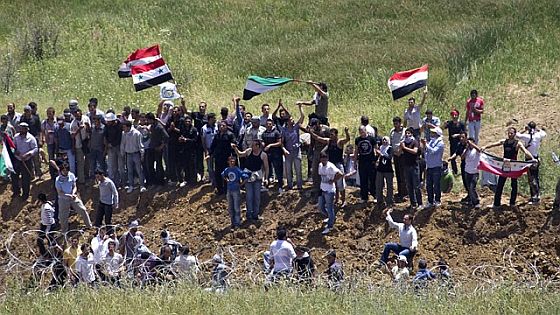
14 unarmed Palestinians killed while protesting near Israeli border

AFP reports:

Israeli troops opened fire as protesters from Syria stormed a ceasefire line in the Golan Heights, killing 14 of the demonstrators.

Hundreds of protesters rushed towards the ceasefire line, cutting through a line of barbed wire as they tried to head into the Golan Heights in a repeat of demonstrations last month that saw thousands mass along Israel’s north.

Similar protests were held in the West Bank, where hundreds demonstrated at Qalandia checkpoint near Ramallah, and in the Gaza Strip, where several hundred more gathered in the north of the coastal enclave.

In Majdal Shams, on the occupied Golan, Israeli troops opened fire as demonstrators sought to push through the mined ceasefire line, which had been reinforced with several rows of barbed wire blocking access to a fence.

“Despite numerous warnings, both verbal and later warning shots in the air, dozens of Syrians continue to approach the border and IDF (Israel Defence Forces) forces were left with no choice but to open fire towards the feet of protesters in efforts to deter further actions,” an army spokesman told AFP.

Updating an earlier toll, Syrian state media reported that 14 people were killed, including a woman and child, and more than 220 wounded. The Israeli military said it was aware of 12 casualties, but gave no more details.

Haaretz reports:

Uri Avneri, former MK and activist with Gush Shalom left-wing organization, said Sunday that the IDF used excessive force against the protesters in the Golan Heights. “The trigger-happy behavior stands out in particular when compared to the softness with which violent settlers are treated,” he said.

Avneri conceded that a country has a right to defend its borders and prevent illegal entrance to its territory, yet added that “in order to effectively protect its borders, the state should first know where its borders are and have them recognized by the international community – and this is a decision which Israel has been avoiding for years.”

“A state that trespasses its neighbors’ borders, steals their land and erects settlements on them will have a hard time justifying actions taken to protect its own borders,” Avneri said. “Contrary to what Prime Minister Netanyahu says, only a recognized and agreed upon international border – that is, a border based on the 1967 lines – is a defensible border.”

Facebooktwittermail

Can equality exist in the Jewish state?

Kieron Monks writes:

In 2005, following the arrest of several high profile Arab politicians and lobbyists living in Israel, the Shin Bet security agency made a statement justifying their actions: “The security service will thwart the activity of any group or individual seeking to harm the Jewish and democratic character of the State of Israel, even if such activity is sanctioned by the law.”

The statement highlighted a fundamental tension between democratic freedom in Israel, and the need to maintain its Jewish character. Thwarting harm to that character has been extrapolated to require controls on Israel’s Arab minority in many departments of society, from education to the right of dissent. The need to ensure Jewish demographic and institutional domination has prompted a raft of controversial policies and practises.

The confilct is most revealing at the level of political representation. Israel can point to the presence of 11 Arab Knesset members out of 120 as evidence of its civil rights credentials. Proportionally this is a reasonably fair reflection of a minority that accounts for 18 per cent of Israel’s population; given that the Arab community habitually votes in lower numbers.

In practise, the mandate to represent Arab concerns dictates that they work against – rather than with – the rest of parliament. Knesset Member Haneen Zouabi of the Balad party is open about her role being fundamentally oppositional. “I was elected to speak for those who voted for me, not to reinforce the Zionist consensus,” she says. “My role is to represent injustice and to make it more visible.” Zouabi has long argued against the legitimacy of a Jewish state for allowing “institutionalised discrimination”, instead favouring “a bi-national state not based on ethnicity”.

She has suffered for her beliefs. After participating in the 2010 Gaza flotilla, aimed at breaking the Israeli siege, a seven to one majority voted to strip her of parliamentary privileges. Likud Knesset Member Danny Danon called for her to be tried for treason, and there were attempts to disqualify her party from elections. The hostility was so great that Zouabi was forced to travel with an armed escort. A year later she remains a pariah in parliament, branded a traitor and a terrorist-sympathiser.

Facebooktwittermail

Syria forces kill 70 in anti-Assad protests

Reuters reports:

Syrian forces killed at least 70 protesters on Friday, activists said, in one of the bloodiest days since the start of an 11-week revolt against the authoritarian rule of President Bashar al-Assad.

Tens of thousands of protesters took to the streets on Friday in defiance of security forces determined to crush the uprising, and some activists said the death toll could hit 100.

Rami Abdulrahman, head of the Syrian Observatory for Human Rights, said at least 60 people were killed in Hama, where Assad’s father Hafez crushed an armed revolt 29 years ago by killing up to 30,000 people and razing parts of the city.

A political activist in Hama said tens of thousands of people were attending the funerals of dead protesters on Saturday, and that more protests were planned later in the day.

“Anger is very high in the city, people will never be silent or scared. The whole city is shut today and people are calling for a three day strike,” the activist, who gave his name as Omar, told Reuters by phone from the city.

Zénobie, a journalist in Damascus, writes:

“From now on, no more fear!” (Ma fi khawf baad al-yawm!) chanted the people of Deraa, in southern Syria, on 18 May. State repression intensified, but the protestors rejected the culture of fear, and in many towns declared they were ready to die: “Martyrs are going to heaven in their millions”; “There is only one God, and God loves martyrs”; “Resist Banias, freedom is worth giving your life for” (Banias is the name of a port). Martyrdom was a theme in every region, expressed in a slogan currently popular in the Middle East: “With our souls, with our blood, we sacrifice ourselves for you, oh martyr.” To express solidarity with a town where many people have died, they chant another version: “With our souls, with our blood, we sacrifice ourselves for you, oh Deraa” (Bi-ruh bi-damm, nafdîk ya shahîd).

Every protest since March has called for freedom by twisting a slogan of the regime; so “God, Syria, Bashar – that’s all!” has become “God, Syria, freedom – that’s all!” Syria was under a state of emergency from 1963 until this April, so freedom is associated with democracy: “We demand freedom and democratic elections.” This transcends sectarian divisions: “Freedom, freedom, Muslims and Christians!”; “We are the partisans of freedom and peace”.

The latest style, which is high-flown, is meant to mark the dignity of the individual citizen. And you can hear the growing rumble of anger in: “Don’t insult the Syrian people” (Al-shaab al-suri ma byandhal).

Matyrdom cleanses humiliation and restores an individual as a person and a believer (virtues traditionally reserved for nationalist heroes and saints): “Better to die than be debased” (Al-mawt wa lâ-l-madhalleh). At the beginning of the intifada it was common to hear opposition supporters, at gatherings of friends or family, greet someone from Deraa or its region with: “You have raised our heads high” (Rafa’tu-l-na ra’sna).

Ordinary people have tried to respond to accusations of division, violence and conspiracy. They proclaim their support for pacifism and unity, and reject sectarianism: “One, one, the Syrian people are one!”; “In peace, Muslims and Christians, in peace. No to sectarianism!”; “No to violence, no to vandalism!”

Facebooktwittermail

Iran and the bomb

In “Iran and the Bomb,” Seymour Hersh writes:

Is Iran actively trying to develop nu-clear weapons? Members of the Obama Administration often talk as if this were a foregone conclusion, as did their predecessors under George W. Bush. There is a large body of evidence, however, including some of America’s most highly classified intelligence assessments, suggesting that the United States could be in danger of repeating a mistake similar to the one made with Saddam Hussein’s Iraq eight years ago––allowing anxieties about the policies of a tyrannical regime to distort our estimations of the state’s military capacities and intentions. The two most recent National Intelligence Estimates (N.I.E.s) on Iranian nuclear progress, representing the best judgment of the senior officers from all the major American intelligence agencies, have stated that there is no conclusive evidence that Iran has made any effort to build the bomb since 2003.

Despite years of covert operations inside Iran, extensive satellite imagery, and the recruitment of many Iranian intelligence assets, the United States and its allies, including Israel, have been unable to find irrefutable evidence of an ongoing hidden nuclear-weapons program in Iran, according to intelligence and diplomatic officials here and abroad. One American defense consultant told me that as yet there is “no smoking calutron,” although, like many Western government officials, he is convinced that Iran is intent on becoming a nuclear state sometime in the future.

Further into the article, Hersh writes:

The political stress between Washington and Tehran has promoted some unconventional thinking. A group of English diplomats and public officials have suggested thinking in terms of containing an Iranian bomb, and not in terms of getting rid of it. “We just don’t think the Iranians will deal with us,” a former senior adviser to the British Foreign Office told me. “We want to talk about nuclear bombs, and they talk about regional issues.” The officials at 10 Downing Street were amused by the initial optimism of the Obama Administration. “The President thought an initiative to talk about the bomb with Iran would work, and then he found it would not. And the U.S. had no Plan B.”

One of the worries is that Netanyahu “might take a pot shot” at Iran, as the former adviser put it. “Everything in London is now about containment and the notion that if the Iranians get a bomb we’ll have to live with it. I believe that the Iranians do understand the logic of nuclear deterrence, but the Israelis do not. London believes we cannot allow containment to be seen as a policy of failure”—in terms of a fallback policy for dealing with Iran. “And so we’re trying to shift the public perception of deterrence so it is seen as a good. The Brits are really concerned about the Israelis, and what they might do unilaterally.”

Hersh discusses the article on Democracy Now!

Hersh on the Arab Spring, “disaster” U.S. wars in Afghanistan and Pakistan, and the looming crisis in Iraq:

Facebooktwittermail

Those who govern us are now governed by the banks

In Der Spiegel, Dirk Kurbjuweit writes:

We are doing well. In fact, we’re doing splendidly. The economy is booming, with 1.5 percent growth in the first quarter. We are as prosperous as we were before the crisis, which has finally been overcome. Congratulations are in order for everyone.

The banks, Deutsche Bank above all, deserve particular congratulations. In the first quarter, it earned €3.5 billion ($5.1 billion) in pretax profits in its core business, and by the end of the year the bank will likely report a record €10 billion in pretax profits, its best results ever. That number is expected to rise to €11 billion or even €12 billion in two or three years.

Less than three years after the peak of the crisis, it seems as if it never happened. That is true of the economy, but it also true of us as economic subjects. But is that all we are?

No, we are also citizens and participants in a democratic society. As such, we have no reason to be celebrating. Instead, we ought to be sad and outraged. Democracy, after all, is not doing splendidly, or even well. It is gradually becoming a casualty of the financial crisis.

Trouble is brewing all over Europe. Young people with little hope for the future are protesting in Spain. In France, 1.4 million copies were sold of a manifesto titled “Be Outraged.” Young Frenchmen and -women are devising utopias that extend well beyond civil society because they no longer expect anything from it. A deep depression has descended upon Greece, combined with a rage directed at politicians and the rest of Europe.

In Germany, this is what politicians are hearing from their citizens today: “You spent billions to rescue the banks, and now I’m supposed to be footing the bill? Forget it!” Hardly anyone is willing to put up with their politicians any more. And German leaders have lost support — and some of their own legitimacy.

They seem helpless, unable to come to grips with the euro crisis. They meet in Brussels, and they talk, argue and adopt resolutions, and yet nothing improves. Greece isn’t getting out of its hole, Ireland and Portugal are teetering on the brink, and Spain and Italy are heavily indebted to a dangerous degree. And no politician is providing leadership.

And then there were the lies. Jean-Claude Juncker, the prime minister of Luxembourg, had his spokesman deny that a meeting of European Union finance ministers on the Greek crisis was taking place, even though that meeting was in fact taking place. It wasn’t the kind of lie that frequently crops up in politics: the broken campaign promise. Rather, it was more crass type of untruth: the denial of a reality. Juncker no longer had the courage to speak the truth. He was guided by fear of the financial markets. His lie was a capitulation of politics.

This is what is so disturbing about the current situation: the fact that politicians seem so helpless and powerless. They have been given a new master, and it’s not us, the people, who tend to intervene in milder ways. Rather, it’s the ruthless financial markets. The markets drive politicians even further into anxiety, weakness, incapacity and lies. Those who govern us are now being governed by the banks.

Facebooktwittermail

The Israeli public is shielded from the realities of West Bank life

Gershom Gorenberg writes:

The settlement’s security man did not like us. He did not like the cameraman with his bulky gear, or the two documentary film producers who’d brought Dror Etkes and me to the outpost of Derekh Ha’avot south of Bethlehem, and he certainly didn’t like Etkes, an Israeli activist known for expertise on land ownership and for his legal challenges to West Bank settlement. The security coordinator wore civvies but bounced a bit on the balls of his feet in the spring-coiled posture of junior combat officers, or recently discharged officers.

“You can’t film in the neighborhood,” he told us. Neighborhood is a euphemism for an outpost, a mini-setttlement ostensibly established in defiance of the Israeli government but actually enjoying state support. Derekh Ha’avot — the name means “Forefathers’ Road” — is next to the veteran settlement of Elazar but outside its municipal boundaries. The security man worked for Elazar. Filming would be “a security risk. I don’t know a lot about security, but I know a little,” he sneered, meaning, I know a whole lot.

That security argument, I can say with very little risk, was a bluff. Derekh Ha’avot, home to three dozen families, stands on privately owned Palestinian land, as military authorities confirmed in an October 2007 letter to another activist, Hagit Ofran (in Hebrew). But last year, in a ploy to evade a Supreme Court order to demolish the outpost, the Defense Ministry announced it was reexamining the land’s status to see whether it was actually state property.

The man facing us at the outpost who wanted nothing filmed was making his small contribution to keeping the occupation’s realities out of the sight of the majority of the Israeli public. For that, he deserves thanks from Prime Minister Benjamin Netanyahu. Comfortable public ignorance of West Bank realities is essential to the Netanyahu’s domestic efforts to paint a fictional picture of the West Bank and of Israel’s deteriorating diplomatic situation.

Facebooktwittermail

AIPAC’s unrivaled influence

MJ Rosenberg writes:

Not surprisingly, my recent column on an ugly 1988 experience with AIPAC, the Israeli government, and late New York Times columnist William Safire elicited some controversy. I knew it would.

There aren’t that many first-person accounts of encounters with the lobby (for obvious reasons) so my recollections of how it went down on Capitol Hill fill a vacuum. Hopefully, there will be more such accounts as those of us who dealt with the lobby in the 1980s move into a position (career-wise or financially) where we feel free to talk and write about it without any fear of retribution.

If I were 35, there is no way that I would challenge an institution which has a long history of preventing its critics from advancing professionally. I am not that brave — although the terrain is finally changing for the better thanks to the internet.

Facebooktwittermail

In the Middle East, who cares what Obama says?

Robert Fisk writes:

This month, in the Middle East, has seen the unmaking of the President of the United States. More than that, it has witnessed the lowest prestige of America in the region since Roosevelt met King Abdul Aziz on the USS Quincy in the Great Bitter Lake in 1945.

While Barack Obama and Benjamin Netanyahu played out their farce in Washington – Obama grovelling as usual – the Arabs got on with the serious business of changing their world, demonstrating and fighting and dying for freedoms they have never possessed. Obama waffled on about change in the Middle East – and about America’s new role in the region. It was pathetic. “What is this ‘role’ thing?” an Egyptian friend asked me at the weekend. “Do they still believe we care about what they think?”

And it is true. Obama’s failure to support the Arab revolutions until they were all but over lost the US most of its surviving credit in the region. Obama was silent on the overthrow of Ben Ali, only joined in the chorus of contempt for Mubarak two days before his flight, condemned the Syrian regime – which has killed more of its people than any other dynasty in this Arab “spring”, save for the frightful Gaddafi – but makes it clear that he would be happy to see Assad survive, waves his puny fist at puny Bahrain’s cruelty and remains absolutely, stunningly silent over Saudi Arabia. And he goes on his knees before Israel. Is it any wonder, then, that Arabs are turning their backs on America, not out of fury or anger, nor with threats or violence, but with contempt? It is the Arabs and their fellow Muslims of the Middle East who are themselves now making the decisions.

Facebooktwittermail

Yemeni president ‘injured in attack’

Al Jazeera reports:

Ali Abdullah Saleh, the Yemeni president, has reportedly been injured in an attack on the presidential palace in the capital, Sanaa.

The country’s prime minister was also reportedly injured in the attack as street fighting between Saleh’s forces and a tribal federation widened on Friday in the capital, the Reuters news agency reported.

Four presidential guards and the speaker of parliament are reportedly in critical condition.

In an assurance to the Yemeni public, state television later said that the president was “well”.

The attack was blamed by the authoritites on dissident tribesmen loyal to Sheikh Sadiq al-Ahmar, who have been locked in fierce clashes with government forces in Sanaa since Tuesday.

“The prime minister, head of the parliament and several other officials who attended the Friday prayers in the mosque at the presidential palace were wounded in the attack,” Tareq al-Shami, spokesman for the ruling General People’s Congress, told AFP.

“The Ahmar (tribe) have crossed all red lines,” he added.

The attack came soon after Yemeni troops, who have deployed heavy weaponry in their battle against the tribesmen, sent a shell crashing into the home of Sheikh Hamid al-Ahmar, a leader of the biggest opposition party and brother of Sheikh Sadiq.

Facebooktwittermail

Rebels in western Libya seize mountain towns

The Associated Press reports:

A rebel leader says his forces have seized two western mountain towns from Moammar Gadhafi’s forces in a push toward the Libyan leader’s stronghold in the capital, Tripoli.

Col. Jumaa Ibrahim of the Nafusa mountain military council says Yefren and Shakshuk, the site of a strategic power station, were freed the day before. Ibrahim says the rebel forces are still battling with Gadhafi forces over a small town at the base of the mountain. He said Friday “our aim is the capital.”

The victories are a significant breakthrough for the rebels as they try to break Gadhafi’s hold on the western half of the coastal nation. The rebels so far have mainly been centered in the east, leaving the two sides locked in a stalemate.

Facebooktwittermail

IDF gearing for next wave of Palestinian protests

Ynet reports:

IDF Chief of Staff Lieutenant-General Benny Gantz has ordered the increased deployment of security forces across all Israel’s borders starting Friday and pending the conclusion of all “Naksa Day” events.

The Palestinians are planning a series of events to mark “Naksa Day” – the 44th anniversary of the Six Day War – starting Sunday.

Most disconcerting, as far as Israel is concerned, are calls by pro-Palestinian supporters – issued mostly on social media website – for Palestinians to march on and possibly storm all of Israel’s borders.

Facebooktwittermail

Locked up for reading a poem

Patrick Cockburn reports:

Bahrain’s security forces are increasingly targeting women in their campaign against pro-democracy protesters despite yesterday lifting martial law in the island kingdom.

Ayat al-Gormezi, 20, a poet and student arrested two months ago after reading out a poem at a pro-democracy rally, is due to go on trial today before a military tribunal, her mother said. Ayat was forced to turn herself in when masked policemen threatened to kill her brothers unless she did so.

She has not been seen since her arrest, though her mother did talk to her once by phone and Ayat said that she had been forced to sign a false confession. Her mother has since been told that her daughter has been in a military hospital after being tortured.

“We are the people who will kill humiliation and assassinate misery,” a film captures Ayat telling a cheering crowd of protesters in Pearl Square in February. “We are the people who will destroy the foundation of injustice.” She addresses King Hamad bin Isa al-Khalifa directly and says to him: “Don’t you hear their cries, don’t you hear their screams?” As she finishes, the crowd shouts: “Down with Hamad.”

Ayat’s call for change was no more radical than that heard in the streets of Tunis, Cairo and Benghazi at about the same time. But her reference to the king might explain the fury shown by the Bahraini security forces who, going by photographs of the scene, smashed up her bedroom when they raided her house and could not find her.

There are signs that Bahraini police, riot police and special security are detaining and mistreating more and more women. Many are held incommunicado, forced to sign confessions or threatened with rape, according to Bahraini human rights groups.

Facebooktwittermail