Category Archives: Issues

Dreaming spooks in search of digital metaphors

Michael Rosen writes:

News that a US government intelligence body is going to start analysing the metaphors used in various languages will have brought wry smiles to the faces of writers and critics. Presumably, “Metaphor Program” agents won’t restrict themselves to metaphors as that particular word is often used metonymically for the whole of figurative language – similes, symbols or indeed any use of language that appears to be standing in for something else or representing something else. That in itself is no simple matter, as we shall see, but let it stand for the moment.

“I wandered lonely as a cloud …” to which we are entitled to ask, “What’s lonely about a cloud?” It’s a pretty rare Lake District sky that gives us one cloud on its own. But who says a lonely cloud would have to be on its own to be lonely? Maybe clouds are just lonely things – full of a sense of their isolation in an alienated world. If we find ourselves grasping at straws here, Wordsworth gives us help: “… that floats on high o’er vales and hills”, which suggests that he’s talking about the cloud’s detachment from the earth. It’s the higher-than-hills-ness, floatiness of the cloud that is important.

This is the kind of speculation that metaphor-divining specialises in and it’s fun to think of US spooks chewing over such matters – though presumably they will hire patriotic literature graduates to do the job.

Such servants to the US cause will be able to take their masters on a trip through a forest of suggestion, resonance and ambiguity in their quest to find the hidden value-systems in speakers’ and writers’ use of metaphor. We now know that Wordsworth’s idea of a writer being detached from the world, wrapped up in thoughts about nature and the imagination, was indeed ideological – as he warned us:

“The world is too much with us; late and soon,
Getting and spending, we lay waste our powers.
Little we see in Nature that is ours.”

So, straight away, our US allies can label early Wordsworth an anti-bourgeois subversive – someone who will need to be watched.

But what of Shakespeare? He poses the problem that we can never know for certain that this is Shakespeare talking or one of his many characters through whom he speaks: “Whether ’tis nobler in the mind to suffer/The slings and arrows of outrageous fortune …” This is dense stuff: a cast of thought has to compress our interactions and outcome into one notion: “fortune”, which then has to be personified into a form that can “behave” or have appurtenances, as in this case “slings and arrows”. Aha, militaristic metaphor! Fortune is armed and aggressive. Clearly, Hamlet is a potential terrorist. And indeed he was. Or tried rather ineffectually to be. But the writer who conjured him up? Probably not.

Facebooktwittermail

Gaddafi snatch squads took hundreds of men and boys from Misrata

The Independent reports:

The lifting of the siege of the embattled Libyan city of Misrata has revealed the disappearance of hundreds of people with many of them suspected victims of snatch squads loyal to the Gaddafi regime, relatives and rights workers said yesterday.

A desperate search has begun for “the disappeared”, many of whom were reported to have been taken away to regime prisons or killed during some of the fiercest fighting of a three-month rebel uprising that has reduced parts of the city to rubble.

Witness accounts gathered by The Independent and rights groups indicate that there was a systematic attempt to kidnap men from parts of the city.

Facebooktwittermail

Hundreds of women report rapes by Gaddafi forces

The Associated Press reports:

At first, the responses to the questionnaire about the trauma of the war in Libya were predictable, if tragic: 10,000 people suffering post-traumatic stress, 4,000 children with psychological problems. Then came the unexpected: 259 women said they had been raped by militiamen loyal to Moammar Gadhafi.

Dr. Seham Sergewa had been working with children traumatized by the fighting in Libya but soon found herself being approached by troubled mothers who felt they could trust her with their dark secret.

The first victim came forward two months ago, followed by two more. All were mothers of children the London-trained child psychologist was treating, and all described how they were raped by militiamen fighting to keep Gadhafi in power.

Sergewa decided to add a question about rape to the survey she was distributing to Libyans living in refugee camps after being driven from their homes. The main purpose was to try to determine how children were faring in the war; she suspected many were suffering from PTSD.

To her surprise, 259 women came forward with accounts of rape. They all said the same thing.

“I was really surprised when I started visiting these areas, first by the number of people suffering from PTSD, including the large number of children among them, and then by the number of women who had been raped from both the east and west of the country,” Sergewa said in an interview with The Associated Press.

Facebooktwittermail

Remember Srebrenica? The west’s intervention in Libya is a no-brainer

Peter Preston at The Guardian writes:

It’s fashionable already to cluck apprehensively over Libya. Another botched adventure, another unwanted war. Look how much it’s costing – at this rate, more or less your standard Ministry of Defence project overrun before 2011’s out. Why isn’t it over long since? Why, for all his soaring rhetoric, has Barack Obama decided to rest on his oars? David Cameron broods over sending in four Apache helicopters while the BBC lugubriously reminds us that helicopters can get shot down. If you want to confect a stew of gloom, then any old ingredients will do.

But mix a pinch of foresight with your hindsight, and sprinkle lightly with added realism. Libya isn’t Afghanistan or Iraq. It isn’t even a proper war, more a series of skirmishes strung out along a long coastal strip. Oh! TV reporters talk excitedly as though this was some mighty contest between opposing armies, but they don’t even seem to look at their own pictures. In fact, it’s rag-tag stuff on both sides. There are casualties, of course; but the numbers involved seem relatively small. The colonel’s mercenary regiments are brutal, but militarily feeble. Take away air cover and they’re going nowhere. Will four British Apaches – count them again, yes just four! – make a big difference this week? Merely posing the question helps define this mini-conflict. Its costs and its risks aren’t worth so much rumbling angst.

Recent history tells us Muammar Gaddafi is a menace (especially if you’re in a jumbo jet over Scotland). When he vowed to take revenge on the insurgents, these were no idle threats. His first reaction when the citizens of his second city marched for change was to shoot them down. The chief prosecutor in The Hague already thinks that, just like Ratko Mladic, Gaddafi has a case to answer. On 18 March, as the allies finally prepared to move, his troops were driving into the outer suburbs of Benghazi. No hindsight necessary: it was five minutes to midnight. And no shucking off our own leaders’ responsibility, either.

After Tunisia, after Egypt, the word was the same from Obama to Nicolas Sarkozy to Cameron. The US Senate, the European parliament, the Arab League and the UN security council all knew what had to be done. So did Gaddafi’s man at the UN. There was massacre pending. All the usual recourses had been duly employed: sanctions, seizing overseas assets and the rest. But it wasn’t enough. Hundreds – probably thousands – of Libyan protesters we’d directly encouraged were about to get shot. Do nothing? Then or now, with or without hindsight, it’s a no-brainer.

Facebooktwittermail

How America screws its soldiers

Andrew J. Bacevich writes:

Riders on Boston subways and trolleys are accustomed to seeing placards that advertise research being conducted at the city’s many teaching hospitals. One that recently caught my eye, announcing an experimental “behavioral treatment,” posed this question to potential subjects: “Are you in the U.S. military or a veteran disturbed by terrible things you have experienced?”

Just below the question, someone had scrawled this riposte in blue ink: “Thank God for these Men and Women. USA all the way.”

Here on a 30 x 36 inch piece of cardboard was the distilled essence of the present-day relationship between the American people and their military. In the eyes of citizens, the American soldier has a dual identity: as hero but also as victim. As victims—Wounded Warriors —soldiers deserve the best care money can buy; hence, the emphasis being paid to issues like PTSD. As heroes, those who serve and sacrifice embody the virtues that underwrite American greatness. They therefore merit unstinting admiration.

Whatever practical meaning the slogan “support the troops” may possess, it lays here: in praise expressed for those choosing to wear the uniform, and in assistance made available to those who suffer as a consequence of that choice.

From the perspective of the American people, the principal attribute of this relationship is that it entails no real obligations or responsibilities. Face it: It costs us nothing yet enables us to feel good about ourselves. In an unmerited act of self-forgiveness, we thereby expunge the sin of the Vietnam era when opposition to an unpopular war found at least some Americans venting their unhappiness on the soldiers sent to fight it. The homeward-bound G.I. spat upon by spoiled and impudent student activists may be an urban legend, but the fiction persists and has long since trumped reality.

Facebooktwittermail

Israel braces for border clashes in coming days

The Associated Press reports:

The Israeli military is preparing for the possibility of violent protests along its borders in the coming days, aiming to avoid a repeat of deadly unrest that erupted earlier this month, a senior military official told The Associated Press on Sunday.

Facebook-organized activists have called for demonstrations next weekend in Lebanon, Syria, and Jordan to mark the anniversary of the 1967 Mideast war, in which Israel captured the West Bank, Gaza Strip east Jerusalem and Golan Heights.

The official said the army also is planning to counter possible unrest in the West Bank in September after an expected U.N. vote to recognize Palestinian independence.

The official said the army hopes to avoid civilian casualties but would set “red lines” for the demonstrations. That means Israel will not allow demonstrators to burst across the borders during the coming week’s protests — as they did on the Syria-Israel border on May 15 — or to enter Jewish settlements in the West Bank in September.

Facebooktwittermail

Police detain 7-year-old Palestinian boy and accost relatives, family members say

Haaretz reports:

Jerusalem policemen arrested a Palestinian seven-year-old child, relatives said on Sunday, claiming that the boy was battered by police officers during his arrest.

The boy’s parents, residents of the East Jerusalem village of Silwan, said they searched for their son for two hours at several police stations, without the police providing any information as to his whereabouts.

According to family members, the second grader was arrested during play. His father, who noticed policemen arresting his son, attempted to intervene, and in the ensuing scuffle was sprayed in his face with pepper spray and was evacuated to receive medical care.

Facebooktwittermail

Where Egypt is at

Issandr El Amrani writes:

The #May 27 “Second Revolution” came and went this weekend without the drama that many had expected. Turnout was pretty good — good enough to show that the ranks of those unsatisfied with the current state of affairs is plenty big, and big enough to show that the Muslim Brothers’ participation is not essential to getting a decent number of people protesting. Impressive also was that the protests took place across the country, as Zeinobia points out with her gallery of videos. Get more videos and an account at Jadaliyya. It may not be a second revolution but it’s enough to keep the SCAF [Supreme Council of the Armed Forces] on its toes and give media traction to multiple grievances: high-ranking corruption, insecurity, slow justice, heavy-handedness of the military, etc.

Although many of these grievances are indeed worthwhile, this opposition movement should start coalescing over one or two core demands with regards to the transition. It has already been a tragedy of Egypt’s revolution that the revolutionaries did not have a clear aim beyond the removal of Mubarak and that the post-Mubarak transition has been handled poorly, to say the least, by a SCAF that is guilty of bumbling incompetence perhaps more than malice. In particular, the transition process could have been more along the lines of Tunisia’s, with an elected constituent assembly rather than one appointed by parliament and independent commissions to investigate corruption as well as violence. The real drama, it seems to me, is that right now transitional justice consists of immediately going after certain persons (those close to Gamal Mubarak) yet only going after older apparatchiks (NDP apparatchiks, etc.) after popular pressure forced the SCAF to. And, most of all, a piecemeal approach to trying former officials: consider that Hosni Mubarak has just been fined for cutting off the internet, and may only be tried for the violence during the revolution, while not being held accountable for 30 years of autocracy.

To me, this should be the focus of the opposition: obtaining a real truth and reconciliation process that holds the regime, as a system, accountable and features the televised testimony of both its victims and participants. If Egyptians try to gloss over the Mubarak era as a question of a few bad apples and then quickly move on, they risk losing a more important understanding of what was the Mubarak regime (and institutions like State Security) and lose the chance of making a clean break. The other demand may be about postponement of elections, but then it has to make on sound grounds (as I discussed a few days ago) with concrete proposals on who will rule in the meantime — including explaining what would make a transitional presidential council more legitimate than the SCAF.

Facebooktwittermail

Libya: Britain prepares ‘bunker buster’ bombs for assaults

The Guardian reports:

Britain has ratcheted up the pressure on Colonel Muammar Gaddafi by preparing to load heavy “bunker buster” bombs on RAF jets ready to attack his compounds in and around Tripoli.

Paveway bombs, weighing 2,000lbs, the largest in the RAF’s arsenal, have been dispatched to Gioia del Colle in southern Italy where RAF Tornado and Typhoon jets are based. While the Apache’s cannon and Hellfire missiles are used against small or moving targets, the Paveway bombs are expected to be used against bunkers underneath the Gaddafi regime’s Bab al-Azizia compound in Tripoli and elsewhere.

The MoD said on Sunday the enhanced Paveway III bombs, are designed “to punch through the roof or wall of a hardened building”. The bombs join smaller laser or satellite-guided Paveway bombs, Brimstone missiles and Tomahawk submarine-launched cruise missiles, with which the army and navy have been attacking targets in Libya for more than two months.

Facebooktwittermail

In Benghazi, shouts of thanks to America and the West

Rod Nordland reports:

Frustrated by the gridlocked traffic, the young man in fatigues was leaning on the horn of his old Chevrolet Impala, the one with the front and rear windshields shot out. The shrillness of the pointless noise made a foreigner in the car next to him wince.

Then came one of those Free Libya moments.

“Sorry, sorry,” the horn-blower called apologetically, in English. The young man riding shotgun, also in fatigues and carrying a Kalashnikov, grinned sheepishly and apologized as well. Then he saluted, bringing his wounded right hand into view, a giant mitten of a bandage on it, blood soaking through in places.

“Thank you, thank you,” he said. “America No. 1.”

Americans and, for that matter, all Westerners are treated hereabouts with a warmth and gratitude rarely seen in any Muslim country — even those with 100,000 American troops — in probably half a century or more. People smile and go out of their way to say hello to them, and are almost shockingly courteous. It is that oddest of oddities, an Arab war zone where foreign joggers are regarded, not with hostility or even that sympathetic puzzlement reserved for the insane, but with a friendly wave or a toot on the horn.

Here, even taxi drivers do not rip off foreign visitors, and when a taxi cannot be found, some passing driver will soon volunteer a ride, and will be likely to refuse any offer of payment. A big problem for non-Arabic speaking journalists who visit is trying to find a translator who will accept payment for his or her services. The rebels’ press office has signed up all the English translators it could find, and ordered them to work for free.

In some restaurants, they seem almost reluctant to accept a foreigner’s money. It is a society chronically short of change, so a lot of the coffee bars will just say skip it, and serve up an espresso for whatever loose change is handy, if any. Espresso is one of the welcome surprises of Libya, and while no one would confuse it with Tre Scalini, it is pretty good for a region where the standard stuff is either instant Nescafe or Turkish coffee so thick that a toothpick is needed afterwards.

The pizza, too, is respectable, especially at Pisa Pizza in Benghazi, where the pies are about a yard in diameter. Proof that Italian colonialism accomplished something after all.

In other parts of the Mideast, one refrains from advertising American nationality, if only just in case. This is a part of the world where, other than outside American embassies, the Stars and Stripes are most often spotted ablaze and stomped upon.

Here, crowds of chanting youth fly it proudly, alongside their own new flag, a tricolor with red, black and green horizontal stripes and a crescent and star in the center. (It was widely and quickly adopted by the rebels to replace the Qaddafi government’s hated green flag, an unadorned panel so plain that it has been derided as a putting green.) What popular Arab street movement has ever flown the flags of not only the United States, but the European Union, NATO, Italy, France and Qatar, all at once?

Facebooktwittermail

Libyan tribal leaders call for united front

Al Jazeera reports:

More than 100 community and tribal leaders from Libya have met with members of the opposition National Transitional Council at a conference in Turkey, in a bid to show a united front against Muammar Gaddafi.

Most of the tribal leaders who gathered in Istanbul on Saturday and Sunday, were from the powerful Warfalla clan based in Baniwalid, a city in western Libya.

The delegates were calling for an end to the violence in Libya and the departure of Libyan leader Gaddafi and his sons.

An organiser of the conference told Al Jazeera that Gaddafi and his forces became aware of the conference yesterday and then moved in to seize control of Baniwalid.

“Fierce clashes broke out between Gaddafi’s forces and Warfalla members in Baniwalid, and at least 11 people died, including the brother of a conference delegate,” the source said.

Al Jazeera’s Anita McNaught, reporting from Istanbul, said that the delegates were mostly senior professionals from both inside Libya as well as those who have been in exile for the last few years.

“They all stood up together and presented their declaration and sang the old Libyan national anthem – I watched grown men break down in tears and sob all their way through this,” our correspondent said.

Facebooktwittermail

The psychology of dictatorship: Why Gaddafi clings to power

John Cloud writes:

Muammar Gaddafi continues to hold tightly to power even as NATO bombs rain down on Tripoli. Syrian autocrat Bashar al-Assad has killed more than 1,000 of his own people in an effort to quash protests. In Yemen, President Ali Abdullah Saleh has refused to step down despite months of unrest that has intensified into near civil war this week. The question is, why do all these guys fight so hard to keep power? Why not decamp to Saudi Arabia or Venezuela and live out their lives in luxury before being killed or held for trial like Hosni Mubarak?

Any attempt to diagnose a defining psychological feature of dictatorship would be facile. But in the public record available on many of them — Stalin and Mao, Saddam Hussein and Gaddafi himself — one can begin to see patterns that shape a dictatorial personality. At least since the Office of Strategic Services (now known as the Central Intelligence Agency) commissioned a secret profile called “A Psychological Analysis of Adolf Hitler,” which was issued in 1943, psychologists have sought an explanation for the authoritarian mind. New research has brought us closer than ever to understanding how leaders become despots.

There are at least three explanations for dictatorial behavior:

Facebooktwittermail

Why blindfolded people can’t walk straight and Gaddafi dresses funny

It is well-documented that when blindfolded, people find it impossible to walk (or drive) in a straight line.

Robert Krulwich explains:

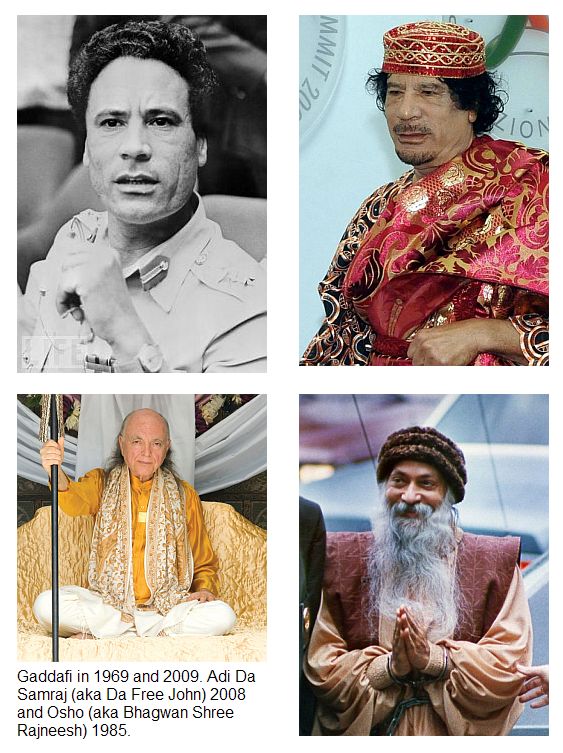
It is also well-documented that as cult leaders amass larger followings they often cultivate an increasingly bizarre and grandiose persona, evident in their own unique attire — a blend of the imperial, exotic or even extra-terrestrial.

So how did Gaddafi go from being a dapper young army officer to a would-be pan-African emperor?

By wearing a blindfold, so to speak.

The self-tied blindfold that sends cult leaders along a spiral path of deviation is adulation and uncritical attention from their followers. There are no countervailing forces which might temper the leader’s expanding grandiosity. There are no independent voices to warn the emperor that his sense of style has drifted towards wild eccentricity. The mutually reinforcing power of group-think places both leader and followers in a bubble sealed off from reality.

Now here’s the interesting thing: this human inclination to physically or figuratively deviate from a straight course when the individual is deprived of corrective input from external and independent sources is an adaptive tendency.

How so? Unlike aircraft that can safely employ an autopilot in the relatively predictable environment of high altitude, we operate in highly unpredictable, rapidly changing surroundings. We need autopilots that have a built-in need to be overridden. The more comfortable we become in a blindfold, the more certain we will run into trouble.

Facebooktwittermail

How the Israel lobby chills Middle East debate

The Israel lobby is like the Mafia. It’s commonly understood how it works, who its leaders are, how they wield their power through intimidation, and to what effect. But there’s a big difference between knowing the identity of a Mafia boss and being able to throw him in jail. Usually an informant needs to be wired so that incriminating words can get caught on tape.

The following story recounted by MJ Rosenberg, who was himself once an AIPAC official, goes beyond the broad brushstrokes that are usually employed to describe the impact of the lobby on American politics. It is more akin to evidence from a wire — evidence that those who get on the wrong side of the lobby risk having their lives destroyed.

This week, following that tumultuous reception for Prime Minister Netanyahu at the congressional joint meeting, I want to share a personal recollection of how the Middle East status quo is preserved on Capitol Hill.

It was in 1988 and I was a foreign policy aide to Sen. Carl Levin (D-MI). One February day, Levin called me into his office to say that he was disturbed at a quote he saw in that day’s New York Times. An article quoted Israeli Prime Minister Yitzhak Shamir saying that he rejected the idea of withdrawing from any of the land Israel captured in the 1967 war:

Mr. Shamir said in a radio interview, ”It is clear that this expression of territory for peace is not accepted by me.”

Levin instantly understood what Shamir was saying. He was repudiating U.N. Security Council Resolutions 242 and 338 (which Israel had helped draft) which provided for “withdrawal of Israeli armed forces from territories occupied in the recent [1967] conflict” in exchange for peace and security. Those resolutions represented official U.S. and international policy then, and they still do.

But, in 1988, Shamir tried to declare them null and void.

Levin asked me to draft a letter to Secretary of State George Shultz stating that it was the view of the Senate that the U.N. Resolutions remained the policy of the U.S. whether Shamir liked it or not. Of course, the letter wasn’t written in that kind of language. It was more than polite. Additionally, Levin wanted it addressed to Shultz, not to Shamir, to avoid ruffling too many feathers in Israel.

I wrote the draft. Levin edited and re-edited it. Then he called in the head of AIPAC, Thomas A. Dine, to run the language past him. Tom said it was “great.” Levin told Dine that he would not embarass him by revealing that he had approved the letter.

Levin then asked me to deliver it to the Secretary of State but said that first he would try to round up a few other senators to join him in signing it. In an hour he had 30. He probably could have gotten three times as many but it was Friday afternoon and most of the senators had decamped.

I delivered the letter. Because Levin wanted to avoid a brouhaha, the Levin office did no press about it. It was essentially a secret initiative.

But then one of the senators who had the letter gave it to the New York Times. And within minutes the phones started ringing off the hook. Reporters and AIPAC donors (who had no idea Dine had signed off on the letter) were going crazy. Levin was asked to appear on all three Sunday morning talk shows. He declined. In fact, he took off for Moscow, on a long-planned trip. [Continue reading…]

Facebooktwittermail

Russia agrees to try to talk Gaddafi into stepping down

The New York Times reports:

President Dmitri A. Medvedev on Friday offered to leverage Russia’s relationships in Libya to try to persuade Col. Muammar el-Qaddafi to leave power, an act of long-shot diplomacy that for the first time casts Russia as a central player in events unfolding in North Africa.

Mr. Medvedev’s announcement, which came a day after a 90-minute bilateral meeting with President Obama at the Group of 8 meeting in France, represents a pronounced shift in Russia’s tone on Libya. Russia’s criticism of NATO attacks had become increasingly tough over the last months, reviving a longstanding critique of American unilateralism that had quieted since Mr. Obama took office.

By signing on to the effort, Mr. Medvedev is taking a gamble. If Colonel Qaddafi could be persuaded to leave, Russia would win international plaudits but would also bear some responsibility for guaranteeing his safety. If he cannot, Mr. Medvedev might find it more difficult to keep his distance from the military campaign, which is not popular in Russia.

But all those risks may be mitigated by the prestige of being asked to defuse a violent standoff on behalf of world powers.

“Russia in the post-Soviet era has all these ideas about its influence and consequence in the world, and it is very sad for Russian politicians if it does not exist,” said Dmitri Oreshkin, an analyst with the Mercator Group, a Moscow-based advisory group. “In this case, it seems like it exists. This is a reason to feel strong and respected.”

Mikhail V. Margelov, Russia’s special envoy to the Middle East and Africa, said he had been ordered to fly to Benghazi, the rebel stronghold, to conduct negotiations with the Libyan opposition, with an eye to assessing their vision of a post-Qaddafi government. He has mentioned Qatar and Saudi Arabia as countries that might possibly offer Colonel Qaddafi asylum, and said Group of 8 allies have proposed a variety possibilities for his future, “from a quiet life as a simple Bedouin in the Libyan desert, to the fate of Milosevic in the Hague.”

Reuters reports:

NATO aircraft destroyed the guard towers at Muammar Gaddafi’s compound in Tripoli, a NATO official said on Saturday, then staged a rare daytime air strike on the Libyan capital, heightening pressure on him to quit.

“RAF Typhoons, along with other NATO aircraft, last night used precision-guided weapons to bring down guard towers along the walls of Colonel Gaddafi’s Bab al-Aziziyah complex in the center of Tripoli,” Major General John Lorimer, chief British military spokesman, said in a statement.

“Last night’s action sends a powerful message to the regime’s leadership and to those involved in delivering Colonel Gaddafi’s attacks on civilians that that they are no longer hidden away from the Libyan people behind high walls,” he said.

On Thursday, the New York Times reported:

President Obama has subtly shifted Washington’s public explanation of its goals in Libya, declaring now that he wants to assure the Libyan people are “finally free of 40 years of tyranny” at the hands of Col. Muammar el-Qaddafi, after first stating he wanted to protect civilians from massacres.

But if toppling Colonel Qaddafi is now the more explicit goal, Mr. Obama’s European trip this week has highlighted significant tensions over how much time the NATO allies have to finish a job that is now in its third month.

Mr. Obama has urged strategic patience, expressing confidence that over time the combination of bombing, sanctions and import cutoffs will force Colonel Qaddafi from power. “Time is working against Qaddafi,” Mr. Obama said on Wednesday at a news conference in London with Prime Minister David Cameron of Britain.

But in Europe and in Libya, patience is calculated differently. Many countries are struggling with the rapid pace of operations. Some, like Norway, have already said they will sharply reduce their forces beginning next month. According to NATO officials, Colonel Qaddafi has a calculation of his own: facing a possible indictment by the International Criminal Court, he may soon have few places to go and little to lose by waiting out NATO and betting that European public opinion will tire of the bombing campaign and its costs.

In interviews in Washington, at NATO headquarters in Brussels and in the alliance’s southern command center in Naples, Italy, officials have described a new strategy to intensify the pressure — and drive out Colonel Qaddafi, a goal that officials now privately acknowledge extends beyond the boundaries of the United Nations mandate to protect civilians.

The Associated Press reports:

The deputy leader of Libya’s rebel administration said it could take up to two years to organize elections, backtracking on promises of a six-month transition to democracy and adding to internal dissent already brewing within the movement seeking to topple Moammar Gadhafi.

Criticism of the rebel leadership’s National Transitional Council has been growing in its stronghold city of Benghazi, in the mostly rebel-held east of Libya. Deeper splits within the rebel movement could further hamper its faltering drive to remove Gadhafi, who has been in power for more than 40 years and is continuing to hold on despite NATO airstrikes in support of his opponents.

The announcement on Wednesday of a longer transition period has raised suspicions that some council members are intent on prolonging their power.

The council’s vice chairman, Abdel-Hafidh Ghoga, said a news conference that a one- to two-year transition period would be needed after the hoped-for ouster of Gadhafi. In that time, he said, the opposition would form a transitional legislative body tasked with writing a constitution, hold a referendum on the charter, form political parties and then hold elections.

Facebooktwittermail

Dubai’s skyscrapers, stained by the blood of migrant workers

Nesrine Malik writes:

Visiting Dubai on a work trip, I was wandering the resplendent hallways of my a hotel searching for an ATM when a commotion occurred. Some of the hotel staff were scurrying about, looking obviously distressed. I asked one of them if there was any trouble and he responded with a glossy smile. There was no trouble, madam, and was there anything he could help me with?

A few hours later, I discovered that there had indeed been trouble. A man – an Indian worker – had jumped from Burj Khalifa, the tallest building in the world, and a symbol of Dubai’s prowess. It is a needle-shaped skyscraper which impales the bleak Dubai sky.

Originally known as Burj Dubai, the building was planned during the city’s orgiastic construction phase, where the sky was the limit, but completed after the bubble had burst. It was then renamed in honour of Abu Dhabi’s ruler, Sheikh Khalifa bin Zayed, who rescued Dubai from its debt crisis.

Gossip about the suicide was horrifyingly callous. “It only took 10 months” [after the opening of the hotel], one person said. “He’s inaugurated the building,” another almost laughed. “Why did he jump?” I asked. People shrugged. He’s probably an expatriate worker, I was told – it’s usually them.

There is nothing remarkable about people being desensitised to suicides. London commuters on the underground can probably understand, but when the suicides are almost exclusively from one minority working in certain jobs, it is nothing short of inhumane. The dark underbelly of Dubai is never far away and sometimes we see the effect of this uglier side lying lifeless on a pavement.

The man, apparently an Indian cleaner who had been denied a holiday, was scraped off the floor on which he landed on and life went back to normal. Tourists and expats lapped up the luxury and sunshine, while workers from south Asia, little moving dots on the facades of the buildings under construction throughout the city, were ferried in buses to and from their living quarters. A couple of days later, another Indian man jumped from Jumeirah Lake Towers.

The Indian consulate in Dubai has since revealed that at least two Indian expats commit suicide each week. The consul-general stated that most are blue-collar workers who are either semi-skilled or skilled.

Facebooktwittermail