Category Archives: Issues

Mubarak to face trial for killing of protesters

The New York Times reports:

Former President Hosni Mubarak will be put on trial for conspiring to kill unarmed protesters, Egypt’s top prosecutor announced Tuesday, yielding to public demands for accountability and setting an example that could rattle autocrats around the region.

The charge could incur the death penalty. Mr. Mubarak was also accused of obtaining his seaside mansion in Sharm el Sheik as a kickback from a friend for a corrupt land deal, and prosecutors accused his two sons, Gamal and Alaa, of receiving a total of four other villas there as part of the same kickback. And in a third charge, prosecutors said the former president allowed the same friend to siphon $714 million in public money out of a deal to sell natural gas to Israel.

The charges — brought by prosecutors Mr. Mubarak had appointed — included hints that former subordinates might testify against him, as onetime allies and government insiders turn on one another.

A Cairo criminal court is expected to set a trial date within days, and the Egyptian people could soon see the leader whose iron fist ruled them for nearly three decades seated in the steel cage that serves as a docket in Egyptian courtrooms.

Facebooktwittermail

Saudi women are being driven to rebellion

Nesrine Malik writes:

While all eyes are on Libya, Syria and Yemen, a different kind of rebellion is taking place in Saudi Arabia. A group of Saudi women have set up Women2Drive, a right-to-drive campaign, with a launch date of 17 June.

Last week one of its members, Manal al-Sharif, took to the streets and drove a car for a couple of hours, filming her trip (her father assisted) and posting it on YouTube. On Sunday, she was arrested along with her brother, who reportedly has now been released.

This isn’t the first time that there has been a push to drive in the kingdom. In the early 1990s, members of a similar campaign were arrested and some were fired from their jobs.

Against the backdrop of the Arab uprisings, it might seem like a frivolous thing to ask, especially when we are told that Saudi women do not need to drive, as they are so covetously protected and provided with drivers to save them the trouble.

The irony is that although the entire system is constructed to prevent men and women finding khalwa, or privacy, together, it is permissible to be alone in a car with one’s non-Saudi driver – the perfect confluence of racism and patronage that exposes the absurdity and confusion behind arbitrary laws of public female deportment in Saudi Arabia.

Facebooktwittermail

Netanyahu’s Congress

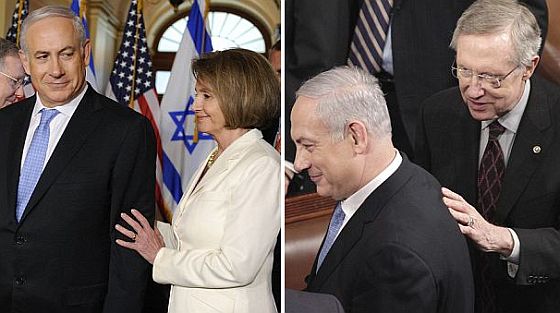
Benjamin Netanyahu being caressed in Congress this morning by Nancy Pelosi and Harry Reid

Josh Ruebner writes:

Gliding down the aisle of the House of Representatives like a popular president about to deliver the State of the Union address, escorted by a phalanx of dozens of ebullient Members of Congress, Israeli Prime Minister Benjamin Netanyahu entered a joint meeting of Congress today to a round of hearty handshakes and a thunderous standing ovation.

In a post-speech press conference, Senate Majority Leader Harry Reid gushed that Netanyahu delivered an “all-star” address, and Netanyahu proclaimed it a “great day” for Israel. And, in the self-contained world that is Capitol Hill, who could blame them for believing it to be so?

For in a world in which Israel finds itself as isolated as ever by a growing and successful Palestinian civil society-led international movement of boycott, divestment, and sanctions (BDS) against its apartheid policies; in which Palestinians are taking matters into their own hands diplomatically and pushing to have the United Nations admit the State of Palestine as a full member of the organization this fall; and in which even the President of the United States appears disgruntled by Israel’s intransigent ongoing colonization of Palestinian land, at least on Capitol Hill, Netanyahu can still play the ace up his sleeve to aplomb and then chum around like the king of the castle.

There on Capitol Hill, Netanyahu still has friends like Senator Chuck Schumer, who told a Jewish radio program that “One of my roles, very important in the United States Senate, is to be a shomer [guard]—to be a or the shomer Yisrael [guard of Israel]. And I will continue to be that with every bone in my body.” With friends like these wrapped around his little finger, no wonder Netanyahu’s forcible denunciations of international law were met with such rapturous approbation by Members of Congress who applauded his rejectionism dozens of times.

Justin Elliot lists the lines of Netanyahu’s speech that won 29 standing ovations.

Facebooktwittermail

The Zionist US Congress


(H/t Glenn Greenwald)

If anyone was in any doubt that Capitol Hill is Israeli occupied territory, the adulation Benjamin Netanyahu received from Republicans and Democrats in Congress today makes it obvious where the loyalties of most of our so-called representatives lie.

“In Judea and Samaria [the West Bank], the Jewish people are not foreign occupiers,” Netanyahu declared as members of Congress stood, clapped and cheered.

Well, if that’s what Washington really believes then it’s time to toss the two-state solution out of the window.

ABC News reports:

Prime Minister Benjamin Netanyahu’s speech before a joint meeting of Congress today had all trappings of a state of the union address by a U.S. president with sky-high approval ratings.

Speaking to a packed House chamber with Speaker of the House John Boehner and Vice President Joe Biden over his shoulders, Netanyahu was interrupted at least 53 times by applause, including at least 29 standing ovations.

To put those numbers in perspective, 29 standing ovations eclipse the total that President Obama received at the State of the Union this year. Obama, in a speech that lasted much longer than Netanyahu’s, garnered 79 applause interruptions, but his remarks were met by only 25 standing ovations.

One of Netanyahu’s biggest applause lines was aimed directly at President Obama.

“Israel will not return to the indefensible boundaries of 1967,” Netanyahu said, prompting a big standing ovation.

Later the prime minister added: “Israel under 1967 lines would be only nine miles wide. So much for strategic depth. So it’s therefore vital — absolutely vital — that a Palestinian state be fully demilitarized, and it’s vital — absolutely vital — that Israel maintain a long-term military presence along the Jordan River.”

As Netanyahu himself pointed out, the President has not called on Israel to return to the exact 1967 borders. The President has said that a peace agreement should be “based on 1967 lines with mutually agreed swaps.”

Nevertheless, Netanyahu speech – and the thunderous bi-partisan response – was a clear challenge to the idea of using the 1967 boundaries – with or without “swaps” — as a basis for a peace deal.

Netanyahu also got big ovations with hard-line statements on two other perennial sticking points to Israeli-Palestinian peace agreements: No right of return for Palestinian refugees, and “Jerusalem will never again be divided. Israel must remain the united Capital of Israel.”

Netanyahu arguably got a warmer reception than President Obama received during his last state of the union and certainly a warmer reception than he’d receive at the Knesset. When the speech was over, he lingered for a while at the podium as it seemed he didn’t want to leave.

Facebooktwittermail

Exposing Netanyahu

Paul Pillar writes:

Probably the most significant take-away from the past few days of U.S.-Israeli dialog is to shed light on the true intentions of Israeli Prime Minister Benjamin Netanyahu regarding peace with the Palestinians. Although Netanyahu finally allowed the phrase “Palestinian state” to pass his lips for the first time almost two years ago, this past week in Washington provided further confirmation of what had been apparent all along: that whatever conception Netanyahu may have of such a “state,” it is not a formula having any chance of becoming the basis for—to use Netanyahu’s own words from his joint appearance with President Obama on Friday—“a peace that will be genuine, that will hold, that will endure,” or probably even what most of the rest of the world would consider a state. Netanyahu is smart enough to realize this, which is to say he is content to let the status quo endure indefinitely. Israel will maintain that status quo through brute force—military force within the territories, and political force in Washington.

The drop-the-veil moment during this past week was the importunate lobbying by Netanyahu’s government before President Obama delivered his Middle East speech on Thursday at the State Department (and doesn’t that say something right there—where else would one see a foreign government get in the last lobbying licks on a president’s speech, even at the expense of delaying the speech?) to omit any mention of the 1967 borders as the basis for negotiating land swaps and an eventual territorial settlement. The president mentioned that anyway, and in the joint appearance on Friday Netanyahu said nothing about land swaps, instead denouncing the 1967 borders as not being a suitable basis for anything. As Mr. Obama correctly noted in his address to AIPAC on Sunday, there was nothing new in his mention of 1967-borders-with-swaps. It has long been recognized as the only formula that has any hope of being the basis for a successful negotiation. It has been the basis for several official proposals, including one by Israeli Prime Minister Ehud Olmert in 2008. It also has been at the center of several unofficial proposals, including ones from people whose concern for Israel cannot be doubted (such as a plan offered by David Makovsky of the Washington Institute for Near East Policy).

So for Netanyahu, not only is the land allotted to the Jewish state in the UN partition plan of the 1940s not enough, and not only is the larger territory that became the State of Israel with what we call the 1967 borders not enough. Even with land swaps that would extend Israel farther into the West Bank and include the large majority of the settlements Israel has constructed on land seized in the 1967 war, that would still not be enough for him. How much would be enough? One can speculate on what crumbs of land would be left to the Palestinians, but speculation is not required to have an idea based on Netanyahu’s own statements of what such a “state” would entail: Israeli control of the airspace, no military of its own, and, as the prime minister mentioned on Friday, a “long-term” Israeli military presence along the Jordan River. It sounds like a bantustan that would make Bophuthatswana look like a paragon of sovereignty. But trying to envision the details of such an entity is pointless because it is a non-starter very likely intended to be rejected.

Facebooktwittermail

Welcome Hamas’s conciliation with Fatah

Musa Abumarzuq, deputy head of Hamas’s political bureau in Damascus, writes:

The birth of the Cairo reconciliation agreement between Fatah and Hamas was slow and painful. But Palestinians welcomed its arrival. The tragic division which occurred in our national movement constituted a chapter we hope will never happen again. It never occurred to us that a time would come when we would turn against fellow Palestinians.

Today, the reconciliation exposes the Israeli occupation as the real spoiler of peace. The Israelis have reneged on every agreement signed with the Palestinian Authority. Now we have forged this historic agreement and buried the hatchet, they are threatening our people with dire consequences.

While we were ensconced in Cairo trying to finalise the agreement, Israel embarked on a diplomatic offensive to persuade European governments to withdraw economic assistance to the Palestinian Authority.

As western governments have, individually and collectively, welcomed the democratic changes taking place in the Middle East, they should support a similar transformation in Palestine. Any attempt to short change my people would have no legitimacy. The events marking the 63rd anniversary of the Nakba have shown that no amount of victimisation, wars and blockade will deter us from the path of freedom. The world must remember the core issue of our cause is the right of every refugee to return to their home – a right enshrined in international law. As others were allowed to exercise this right, we demand the same for our people.

Facebooktwittermail

US Congress controlled by AIPAC

Press TV reports:

A pro Israeli advocate knocked a camera out of the hands of Alison Weir, President of the Council for the National Interest Foundation. The group just finished their press conference on what they call unjustifiable US Aid to Israel.

The two sides met when the Press Club scheduled a pro Israeli news conference to follow held in the same room. The altercation illustrates heightened tensions on differing views regarding America’s relationship with Israel.

The Council for the National Interest Foundation wants Americans to know how much of their tax dollars are going to Israel.

Facebooktwittermail

NATO concern over Pakistan nuclear arsenal

Al Jazeera reports:

The head of NATO has admitted that the security of Pakistan’s nuclear weapons is a matter of concern, the day after the worst assault on a Pakistani military base in two years.

Anders Fogh Rasmussen was speaking in Afghanistan on Tuesday, where he met Hamid Karzai, the Afghan president, to discuss the transition of security from NATO-led troops to Afghan security forces, which is due to begin in July.

“Based on the information and intelligence we have, I feel confident that Pakistan’s nuclear arsenal is safe and well protected,” Rasmussen said. “But of course, it is a matter of concern and we follow the situation closely.”

Pakistani forces battled Taliban fighters for 17 hours before reclaiming control of a naval base in Karachi on Monday.

The attack, the worst on a base since the army headquarters was besieged in October 2009, piled further embarrassment on Pakistan three weeks after al-Qaeda leader Osama bin Laden was found living in the city of Abbottabad, close to the country’s military academy.

The Los Angeles Times reports:

The team of Islamist militants knew exactly where the naval base’s weak spot was.

Dressed in black and armed with AK-47 rifles, grenades and rocket launchers, they crept up to the back wall of Mehran Naval Station in Karachi, keeping clear of security cameras. Then, with just a pair of ladders, they clambered over the wall, cutting through barbed wire at the top, to launch a 17-hour siege that would renew disturbing questions about the Pakistani military’s ability to defend sensitive installations, including its nuclear arsenal.

The team, believed to consist of four to six militants, destroyed two U.S.-supplied maritime surveillance aircraft and engaged security forces in hours of pitched firefights. It was not until late Monday afternoon that Pakistani forces regained full control of the facility.

Interior Minister Rehman Malik said 10 Pakistani security personnel were killed and 15 were injured. Four militants died and two were believed to have escaped, he said.

The Pakistani Taliban, the country’s homegrown insurgency with ties to Al Qaeda, claimed responsibility for the attack, which it said was meant to avenge the May 2 killing of Osama bin Laden in the military city of Abbottabad.

Facebooktwittermail

Bin Laden’s gone. Can my son come home?

John Walker Lindh’s father calls for his son’s release.

In November 2000, John left Yemen for Pakistan, and the next April, he wrote to me and his mother to say he was going into the mountains of Pakistan for the summer. That was the last we heard from him. Throughout the summer, and especially after 9/11, our family became increasingly worried about John’s whereabouts and his welfare. In December 2001 we were shocked to learn from the news that John had been found among a group of Taliban prisoners who had survived an uprising and massacre at an old fortress near Mazar-i-Sharif.

Like Ernest Hemingway during the Spanish Civil War, John had volunteered for the army of a foreign government battling an insurgency. He thought he could help protect Afghan civilians against brutal attacks by the Northern Alliance warlords seeking to overthrow the Taliban government. His decision was rash and blindly idealistic, but not sinister or traitorous. He was 20 years old.

Before 9/11, the Bush administration was not hostile to the Taliban; barely four months before the attacks it gave $43 million in humanitarian aid to Afghanistan. There was nothing treasonous in John’s volunteering for the Afghan Army in the spring of 2001. He had no involvement with terrorism.

Facebooktwittermail

The 535 Americans who are blocking peace in the Middle East

Mehdi Hasan writes:

The Congress of the United States consists of 100 senators and 435 members of the House of Representatives; in effect, just 535 Americans are blocking efforts to bring peace to the Middle East. Why? Forget the pious guff about Israel being the region’s “only democracy” and a “valued friend and ally” of Washington. In the corrupt and dysfunctional US political system, where legislators are outnumbered by special interests, from the gun lobby to Big Pharma, the Israel lobby – specifically, the American Israel Public Affairs Committee (Aipac) that brags on its website about being “the most important organisation affecting America’s relationship with Israel” – has a financial stranglehold on both main parties. According to William Quandt, a former adviser on the Middle East to the Nixon and Carter administrations, “70 per cent to 80 per cent of all members of Congress will go along with whatever they think Aipac wants”.

It is Aipac that polices congressional votes on Israel, demands unconditional US support for the occupation of the West Bank and insists that Israel remain the largest single annual recipient of US foreign aid ($250 a year per Israeli, compared to $1 a year per African). Consider this: the upper and lower houses of Congress are more divided, polarised and partisan than in any other period in recent history. Democrats and Republicans agree on nothing. Except Israel.

Presidents who have tried to pressurise the Israelis – from Reagan to Obama – have found themselves attacked not just in the Knesset but in Congress. In the words of Paul Findley, a Republican from Illinois who served in the House of Representatives for 22 years before being
defeated by an Aipac-funded candidate in 1982: “Congress behaves as if it were a subcommittee of the Israeli parliament.” The irony is that there is far more heated debate about Israel’s actions on the floor of the Knesset than on Capitol Hill. “For 35 years, not a word has been expressed . . . in either chamber of Congress that deserves to be called debate on Middle East policy,” Findley wrote in 2002.

On 2 May 2002, after Ariel Sharon’s invasion of the West Bank and the destruction of the Jenin refugee camp, both houses of Congress overwhelmingly approved resolutions expressing “solidarity with Israel” – 352 to 21 in the House, 94 to two in the Senate.

On 20 July 2006, eight days after the start of Israel’s war against Lebanon, Congress passed a resolution endorsing Israeli military action by a vote of 410 to eight. On 9 January 2009, as the Palestinian death toll from the Israeli air assault on Gaza topped 700, the House of Representatives passed a resolution “reaffirming the United States’ strong support for Israel in its battle with Hamas”. The margin was 390 votes to five.

These comically one-sided resolutions illustrate the power and influence of the Israel lobby on Capitol Hill – and the way in which craven legislators in both main parties blindly throw their support behind any and every act of belligerence. As Uri Avnery, the Israeli author and peace activist, once remarked: if Aipac “were to table a resolution abolishing the Ten Commandments, 80 senators and 300 congressmen would sign it at once”.

Facebooktwittermail

Israel should prepare for life under siege

In today’s Hebrew Israeli daily Yediot, Yaron London writes:

Few believe in the possibility of making peace within our lifetime, though some imagine that an unwieldy hudna [truce] can be imposed. Our situation among the nations, many believe, is incurably deteriorating. The world is closing in on us, and even the US, our only ally, is losing its patience with us and redefining its map of interests. In a recent poll, one quarter of the Americans support stopping the aid to Israel, and another quarter wish to make the aid conditional upon “progress in the peace process.” Since we are not moving toward peace and since the American Jews are gradually losing their interest in us, it is difficult to hope that the support of our friend is assured.

We dare not think about the collapse of the state due to the pressures that burden it, but there is almost no doubt that the pressures will heighten and place it at great risk. If we do not wish to cling to foolish truisms (“we survived Pharaoh, we’ll survive this too”) or unsubstantiated beliefs (“God will not forsake his people”), it is our duty to think about how we will act if the worst scenario should materialize. The worst scenario means facing the situation of South Africa in the apartheid years: A pariah state, which is under economic boycott and political ostracism. There are already clear signs of this.

If we do not accept the advice of the advocates of compromise, decent right wing politicians should inform us of the price that we will be called upon to pay if we should insist on the positions that they hold. The price will be imposing the rules of conduct of a besieged community: Increasing the strength of the central government, which will be the only one capable of enforcing a strict regime, canceling the free economy and reducing human rights. It is not pleasant to live in such a country, but an unpleasant life is better than putting a stop to life. If we know what lies in store for us, perhaps it will be easier for us to adjust to the unbelievable.

The fear of siege lies in many people’s hearts, but preparation for the worst of all possible situations does not conform to the psychology of the masses, which contradicts the interests of the politicians. They aim their messages to assuage the concerns of the citizens, because concern and frustration are the bread and butter of the opposition. Concerned citizens should send a sharp and clear message to the government: Speak the truth to us.

Facebooktwittermail

Dennis Ross: Netanyahu’s man in the White House

The New York Times reports:

Mr. Ross is the most senior member of a coterie of American diplomats who have advised presidents stretching back to Ronald Reagan. Unlike many of his colleagues, Mr. Ross has thrived in Republican and Democratic administrations.

“Dennis is viewed as the éminence grise, a sort of Rasputin who casts a spell over secretaries of state and presidents,” said Aaron David Miller, a Middle East expert who has worked with him over several administrations and says he is an admirer. “But in the end, it’s the president who makes the ultimate decisions.”

Denis R. McDonough, the deputy national security adviser, said: “Dennis brings to the discussion a recognition of the vital importance of peace to the parties, but also to the United States. He’s in many ways dedicated much of his professional life to getting there.”

Mr. Ross initially began his tenure in the Obama administration as a senior Iran policy maker at the State Department. But in the summer of 2009, just a few months into his job at State, Mr. Ross moved to the White House, where he kept his Iran portfolio and eventually assumed a broader role that has allowed him to take part in developing Mr. Obama’s response to the upheavals in the Arab world.

His move came as the White House and Mr. Netanyahu were in a standoff over settlement construction. Over time, administration officials say, Mr. Ross took more of a role over Arab-Israeli policy. In September 2009, Mr. Obama abandoned his insistence on a settlement freeze in the face of Israeli recalcitrance.

“If Dennis Ross was in the inner circle in the early days, this administration would not have made that colossal settlements error,” Mr. Foxman said. “He would have said, ‘Don’t go there.’ ”

Once at the White House, Mr. Ross became invaluable, administration officials said, because of his close relationship not only with Mr. Netanyahu, but with the Israeli prime minister’s top peace negotiator, Yitzhak Molcho.

Mr. Ross demonstrated his growing influence last October, when the administration was pressing Mr. Netanyahu to agree to a three-month extension of his moratorium on settlement construction. Mr. Netanyahu balked.

So Mr. Ross devised a generous package of incentives for Israel that included 20 American fighter jets, other security guarantees, and an American pledge to oppose United Nations resolutions on Palestinian statehood. Many Middle East analysts expressed surprise that the administration would offer so much to Israel in return for a one-time, 90-day extension of a freeze.

Facebooktwittermail

Autocratic regimes fight Web-savvy opponents with their own tools

The Washington Post reports:

For weeks, Syrian democracy activists have used Facebook and Twitter to promote a wave of bold demonstrations. Now, the Syrian government and its supporters are striking back — not just with bullets, but with their own social-media offensive.

Mysterious intruders have scrawled pro-government messages on dissidents’ Facebook pages. Facebook pages have popped up offering cyber tools to attack the opposition. The Twitter #Syria hashtag — which had carried accounts of the protests — has been deluged with automated messages bearing scenes of nature and old sports scores.

“There is a war itself going on in cyberspace,” said Wissam Tarif, head of the Middle East human rights organization Insan, whose Web site has been attacked.

Syria offers just one example of the online backlash in countries ruled by authoritarian regimes. Although social media sites have been lionized for their role in the Arab Spring protests, governments are increasingly turning the technology against the activists.

“In the same way that, a few years ago, it became commonplace to talk about Web 2.0, we’re now seeing Repression 2.0,” said Daniel B. Baer, a deputy assistant secretary of state for democracy, human rights and labor.

Facebooktwittermail

Promise of Arab uprisings is threatened by divisions

Anthony Shadid and David D. Kirkpatrick report on the specter of sectarian division in a region that has long struggled to find unity in diversity.

The example of Iraq comes up often in conversations in Damascus, as does the civil war in Lebanon. The departure of Jews, who once formed a vibrant community in Syria, remains part of the collective memory, illustrating the tenuousness of diversity. Syria’s ostensibly secular government, having always relied on Alawite strength, denounces the prospect of sectarian differences while, its critics say, fanning the flames. The oft-voiced formula is, by now, familiar: after us, the deluge.

“My Alawite friends want me to support the regime, and they feel if it’s gone, our community will be finished,” said Mohsen, the young Alawite in Damascus, who asked that only his first name be used because he feared reprisal. “My Sunni friends want me to be against the regime, but I feel conflicted. We want freedom, but freedom with stability and security.”

That he used the mantra of years of Arab authoritarianism suggested that people still, in the words of one human rights activist, remain “hostage to the lack of possibilities” in states that, with few exceptions, have failed to come up with a sense of self that transcends the many divides.

“This started becoming a self-fulfilling myth,” said Mr. Azm, the Syrian intellectual.

“It was either our martial law or the martial law of the Islamists,” he added. “The third option was to divide the country into ethnicities, sects and so on.”

Despite a wave of repression, crackdown and civil war, hope and optimism still pervade the region, even in places like Syria, the setting of one of the most withering waves of violence. There, residents often speak of a wall of fear crumbling. Across the Arab world, there is a renewed sense of a collective destiny that echoes the headiest days of Arab nationalism in the 1950s and ’60s and perhaps even transcends it.

President Obama, in his speech on Thursday about the changes in the Arab world, spoke directly to that feeling. “Divisions of tribe, ethnicity and religious sect were manipulated as a means of holding on to power, or taking it away from somebody else. But the events of the past six months show us that strategies of repression and strategies of diversion will not work anymore.”

But no less pronounced are the old fears of zero-sum power, where one side wins and the other inevitably loses. From a Coptic Christian in Cairo to an Alawite farmer in Syria, discussions about the future are posed in terms of survival. Differences in Lebanon, a country that celebrates and laments the diversity of its 18 religious communities, are so pronounced that even soccer teams have a sectarian affiliation.

In Beirut, wrecked by a war over the country’s identity and so far sheltered from the gusts of change, activists have staged a small sit-in for two months to call for something different, in a plea that resonates across the Arab world.

The Square of Change, the protesters there have nicknamed it, and their demand is blunt: Citizenship that unites, not divides.

“We are not ‘we’ yet,” complained Tony Daoud, one of the activists. “What do we mean when we say ‘we’? ‘We’ as what? As a religion, as a sect, as human beings?”

Facebooktwittermail

The fight for Libya

The New York Times reports:

Near midnight, in the darkness of the deliberately unlit Misurata harbor, the tugboat’s crew loosened its lines from the pier and pulled them aboard.

The helmsman engaged Al Iradah 6’s dual engines and it spun into the basin, gathered speed and headed for the gap in the jetties. A few miles beyond, outside the range of Col. Muammar el-Qaddafi’s artillery, was the safety of the open sea.

There, the helmsman turned the round bow eastward, toward Benghazi, the Libyan rebel capital about 300 miles away. The latest leg for an unlikely smuggling vessel was complete. In a little more than 24 hours, Al Iradah 6 would reach rebel-controlled territory and line up for a fresh cargo of medicine, food and guns — fuel for a city besieged.

There have been many reasons for the rebels’ success in Misurata, where they recently drove the Qaddafi forces out of the city and seized the airport. One of them is this: a determined and surreptitious sealift by a small fleet of Libyan boats.

Combining the talents of those who procure a city’s wartime needs with those of merchant mariners and fishermen, rebels have organized about two dozen fishing vessels and former Qaddafi-controlled tugboats into an impromptu fleet that has provided Misurata with a lifeline of supplies. The fleet sails with NATO’s approval and support. (Rebels and organizers in both Benghazi and Misurata spoke openly of the smuggling effort, but asked that certain locations and shipping schedules not be disclosed.)

At a basic level, it has assumed missions of both mercy and war. The mixed cargo — baby formula and medicine beside crates of ammunition — has helped civilians survive and equipped Misurata for its fight.

The strategic significance of Misurata has not been lost on the crew of Al Iradah 6. For months, rebels trapped in the city, 130 miles from Tripoli, provided Libya’s opposition movement with a powerful argument against any discussion of the war’s end that called for national partition.

As long as Misurata’s armed men held on to their city, the nation’s third largest, the Qaddafi government could never credibly say that the war was a contest between east and west, and propose that the country, divided by history and tribal allegiances, be split.

Reuters reports:

The rebels said it would be easy: roll in, block the road, raise the flag — another village under their writ in Libya’s Western Mountains.

The villagers are with us, the rebels said of their fellow Berbers — an ethnic minority that rose up against Muammar Gaddafi at the very start of the rebellion in February.

“Only a few support Gaddafi, maybe five or six,” said Omar, commander of the rebel unit from the nearby town of Kabaw.

His call-sign was Rambo. But the operation, which began on Sunday afternoon with the rebels gathering over coffee at a roadside cafe, ended an hour later in angry confrontation, tense retreat and a lesson in the divided loyalties and half-truths of this particular theatre of Libya’s conflict.

“Only seven or eight people here don’t like Gaddafi,” Mohammed, a resident of Tamzin, quietly told a reporter.

The truth probably lay somewhere in the middle, like Tamzin itself and dozens of other towns and villages wedged between the rebels who hold most of the plateau and forces loyal to Gaddafi mainly in the desert plains.

Facebooktwittermail

Obama makes peace with AIPAC

If there’s one way of registering that President Obama could be saying something of significance while he’s addressing AIPAC, it’s during those passages when he gets no applause.

This morning he got plenty of applause when he assured the pro-Israel lobby that a negotiated border between Israel and a Palestinian state will not end up being the 1967 border.

But when he outlined the degree to which the regional and wider international environment has changed and implicitly acknowledged that Israel and the US are out of step with these changes, the audience was silent.

[A] new generation of Arabs is reshaping the region. A just and lasting peace can no longer be forged with one or two Arab leaders. Going forward, millions of Arab citizens have to see that peace is possible for that peace to be sustained.

And just as the context has changed in the Middle East, so too has it been changing in the international community over the last several years. There’s a reason why the Palestinians are pursuing their interests at the United Nations. They recognize that there is an impatience with the peace process, or the absence of one, not just in the Arab World — in Latin America, in Asia, and in Europe. And that impatience is growing, and it’s already manifesting itself in capitals around the world.

Before Obama arrived at the Washington DC convention center where AIPAC is assembled, AIPAC supporters gathered outside were heard yelling through a bullhorn: “Kill Obama.” I’ve seen no reports of anyone getting arrested for trying to incite the assassination of the president.

Ron Kampeas summed up the mood in this way: “When Obama is in the room, AIPAC is supportive. When he is out of the room, skeptical.”

Earlier, Reuters reported:

Some prominent Jewish Americans are rethinking their support for President Barack Obama’s 2012 re-election bid after he effectively called on Israel to give back territory it has occupied since 1967 to Palestinians.

The backlash after Obama’s keynote speech on the Middle East has Democratic Party operatives scrambling to mollify the Jewish community as the president prepares to seek a second term in the White House.

Obama on Thursday called for any new Palestinian state to respect the borders as they were in 1967, prompting Israeli Prime Minister Benjamin Netanyahu to tell him bluntly that his vision of how to achieve Middle East peace was unrealistic.

“He has in effect sought to reduce Israel’s negotiation power and I condemn him for that,” former New York Mayor Ed Koch told Reuters.

Koch said he might not campaign or vote for Obama if Republicans nominate a pro-Israel candidate who offers an alternative to recent austere budgetary measures backed by Republicans in Congress.

Koch donated $2,300 to Obama’s campaign in 2008, according to filings with the Federal Election Commission.

“I believed that then-Senator Obama would be as good as John McCain based on his statements at the time and based on his support of Israel. It turns out I was wrong,” he said.

Despite the stormy reaction to Obama’s remarks, some commentators noted talk of the 1967 borders was nothing new.

“This has been the basic idea for at least 12 years. This is what Bill Clinton, Ehud Barak and Yasser Arafat were talking about at Camp David, and later, at Taba,” Jeffrey Goldberg wrote on The Atlantic website.

“This is what George W. Bush was talking about with Ariel Sharon and Ehud Olmert. So what’s the huge deal here?”

Exit polls from the 2008 election showed 78 percent of Jewish voters chose Obama over his Republican rival Senator McCain.

“I have spoken to a lot of people in the last couple of days — former supporters — who are very upset and feel alienated,” billionaire real estate developer and publisher Mortimer Zuckerman said.

“He’ll get less political support, fewer activists for his campaign, and I am sure that will extend to financial support as well.”

Facebooktwittermail